




Abstract
The rapid construction of railways in China has posed tremendous challenges for managing railway construction projects, especially their progress. Frequently changed schedule, complicated contents, and error-prone data have practically hampered the efforts to automatically generate progress reports on railway construction projects within the country. In this paper, we set out to explore the linkages among current data from Chinese railway construction units on inspection lots, construction drawings, and construction schedules, which are used to establish an engineering quantity computation model and automatic project progress report model. An automatic progress report generation system for railway construction projects was developed to generate a wide range of standard progress reports. Practical applications showed that the proposed system offers an alternative to hardware-based methods of progress report generation and can significantly improve the accuracy of data and the quality of management regarding project progress.
1. Introduction
Progress reports are central to sound management of projects [1]. Much research has been conducted to develop more efficient ways of progress data acquisition and report generation [2]. In particular, automatic data acquisition and report generation have been a key area of international research [3, 4]. For example, Moselhi and El-Omari [5] used bar coding, radio frequency identification (RFID), three-dimensional (3D) laser scanning, photogrammetry, multimedia, and pen-based computers to automatically collect data from construction sites for purpose of progress measurement. Son et al. [6] proposed an efficient and automated method of 3D structural component recognition and modeling, in which color and 3D data acquired from a stereo vision system were applied to monitor construction progress. Cheng and Chen [7] developed ArcSched, an automated schedule monitoring system, to assist project managers in controlling precast building construction. In ArcSched, which was composed of a geographic information system, graphics and colors were used to represent construction progress. Zhang et al. [8] explored the potential of computer vision technology and developed an integrated building information system to specify construction progress from digital images captured on site and to partially automate the work progress measurement and interim payments. Turkan et al. [9] described a novel system that combined 3D object recognition technology with schedule information into a composite 4D object-oriented progress tracking system. The hardware components were presented in the research done by all researchers who aspired to develop means of automatic data acquisition and progress report.
In contrast, little research on automatic progress report generation for construction projects in general and for railway construction projects in particular has been conducted in China. For historical reasons, China's railway construction industry has long been a construction sector dominated by manual work. Currently, progress reports for railway construction projects are still filed manually. Thus, given the break-neck speed at which railway construction has been proceeding in recent years, automatic project progress report generation has become an urgent management issue that needs to be addressed [10].
In this paper, we establish an automatic progress report generation system for railway construction projects in China. By adopting a primarily “soft” approach to accommodate the current railway infrastructure situation in China, we set out to explore the inherent linkages among data on the inspection lots, construction drawings, and construction schedules that were expected to be dispersed across Chinese railway construction units. We established an engineering quantity computation model (EQCM) and an automatic project progress report model (PPRM) by using these data. We then developed an automatic progress report generation system (APRGS) to generate a wide range of standard progress reports for railway construction projects. Test results of the system in real world railway lines showed that the proposed system markedly improves the accuracy of data and management regarding the progress of projects.
2. Proposed System
2.1. Data Sources
The following primary data sources are collected by the APRGS.
(1) Inspection Lot Data. The Ministry of Construction promulgated the Unified Standard for Construction Quality of Building Engineering [11], which prescribes that construction quality inspection is conducted at the unit (subunit) project, subsection (tender subsection) project, item project, and inspection lot levels. Quality inspection is conducted for an inspection lot—a sample of projects for which the production condition or prescribed manner of inspection is identical. The construction quality should thus be approved after the approval of the inspection lot. In the process of inspection approval, forms must be filled as prescribed. The forms and attached table serve as the inspection lot data. Inspection lot approval records must be reported by construction units in the course of the quality control process.
(2) Construction Drawing Data. The Railway Survey and Design Construction Management Approach [12] prescribes that project implementation and approval are based on construction drawing files. These files, compiled on the basis of the verified preliminary design document that provides construction drawings, tables, design specifications, and confirmed project investments, are indispensable for construction and final approval. For each category of engineering project, we established standards for obtaining construction drawing data. Subsequently, we recorded the design parameters of construction drawings in the database.
(3) Construction Schedule Data. According to the requirements of The Code of Construction Project Management [13], headquarters and construction units are to create the project schedule, which is important for controlling the project duration, on the basis of contract documentation, project management documents, resource conditions, and constraints (internal and external). A progress plan is to be implemented by preparing annual, quarterly, monthly, ten-day, and weekly construction schedules. Various schedules must be reported in accord with the requirements of the national provisions.
2.2. Types of Progress Report Generated by Models
The models automatically generate various progress reports for the construction unit (e.g., daily, ten-day, monthly, quarterly, and annual reports). In addition, they automatically generate various comprehensive progress implementation reports for the headquarters as well as reports that compare actual and scheduled progress. These reports are also issued on a daily, ten-day, monthly, quarterly, and annual basis.
2.3. System Modules
The system includes the following modules: data acquisition and management, engineering quantity computation, progress report generation, reports printing, and history management.
3. Proposed Model
In this paper, we present two models in the APRGS design process—EQCM and PPRM.
(1) Engineering Quantity Computation Model (EQCM) Based on the Inspection Lot Data. Engineering quantity is the key information required for progress reports. Its calculation for an accomplished project is complicated. Because the calculation must be manually consulted a number of construction drawing files.
The EQCM, using the corresponding relationship between the approved parts of railway construction inspection lot and construction drawings, obtains the design parameters of the corresponding parts and establishes corresponding calculation rules by project category to calculate the engineering quantities. The quantities calculated by the model are entered in the quality approval records of the construction unit inspection lot approved by supervision units, which are the authoritative bodies that validate the engineering quantities.
(2) Project Progress Report Model (PPRM). Although progress reports differ in style and depend on the issuing body (headquarters, construction units, etc.), their basic content is similar. This may consist entirely of inspection lot data, engineering quantity data calculated from this data, and construction schedule data.
With the establishment of the progress report template library, PPRM can generate progress reports with combinations of inspection lot data, engineering quantity data, and construction schedule data, according to the requirements of the headquarters and construction units.
4. Contents Analysis of Progress Reports for China Railway Construction
The four levels of organizational structure for railway construction project management in China are as follows: Department of Construction of The Ministry of Railways, Railways Bureau, headquarters, and construction units [14]. The first two are involved in the macro-level control of progress, whereas the latter two are involved in progress control at a finer level. Here, the automatic generation of various reports for the headquarters and construction units is mainly discussed.
4.1. Contents of Progress Reports by Construction Units
Construction units are required to submit daily, weekly, ten-day, monthly, quarterly, and annual progress reports. The main contents of construction unit progress reports are shown in Table 1.
The main contents of construction unit progress reports.

4.2. Contents of Progress Reports for Headquarters
The headquarters are required to summarize the progress reports submitted by the construction units of the entire line. The headquarters are required to file daily, weekly, ten-day, monthly, quarterly, and annual progress reports. The main contents of these reports are shown in Table 2.
The main contents of headquarters progress reports.

Here, we describe an automatic progress report generation system with the inspection lot data as the main data sources. By establishing databases for inspection lots, construction drawings, and construction schedules, the system can assist the headquarters and construction units to generate more accurate reports automatically.
5. Contents Analysis of Inspection Lot
In accordance with the provisions of the State and Ministry of Railways, inspection lot data must be provided for quality approval. Through our research, we find that these data constitute a rich source of dynamic information on engineering progress.
5.1. National Standards of Quality Approval
The Unified Standard for Constructional Quality Approval of Building Engineering [11] and Code for Construction Project Document Filing and Arrangement [15] enacted by the Ministry of Construction set the relevant provisions of approval and management of inspection lots. Inspection lots are the smallest units of construction; their approval is required for subsequent approval of subproject items and single projects. The inspection records must be promptly reported by the construction units and preserved by the headquarters, construction units, and supervision units in the long term.
5.2. Contents of Inspection Lots for Railway Construction
Based on the requirements of national standards, A Handbook on Standard for Constructional Quality Approval of Railway Engineering [16] contains a total of 1352 inspection lot data sheet templates covering 10 types of engineering projects (e.g., tracks, subgrades, bridges, and culverts). In summary, inspection lot data, which is essential for management of construction projects, is legally binding and must be promptly reported and preserved in the long term by construction units.
However, the inspection lot approval records differ in style. The sheets reveal general characteristics of inspection lot data: all possess the spatial characteristics of mileage and location information; the temporal characteristics of creation and approval dates; and descriptions of the thematic characteristics of dominant and general items. The main contents of inspection lot data are shown in Table 3.
The main contents of inspection lot data.

The considerations above show that even inspection lot approval records are completed for quality inspection, compared with the progress reports in Section 4; it also contains rich and dynamic information on engineering progress.
5.3. Schedule Information in Inspection Lot Data
Inspection lot data contains information on the progress of time, mileage, and location and, compared with the progress reports in Section 4, provides more information on schedules and engineering quantity.
5.3.1. Time Information
Each record in the quality approval table for an inspection lot is accompanied by the corresponding time. In accordance with the requirements of national standards, the approval date must be filled in by the people in charge of the construction units and the supervision units as part of the approval process.
When the APRGS calculates the current output in various progress reports from the time information in the inspection lot database, a progress report of data within the required time period can be extracted. Progress reports with the names of the construction unit, single project, and subsection project and other information (e.g., safety, quality, construction workers, and supervisors) can be generated.
5.3.2. Mileage and Location Information
Mileage and location information, which is required for progress reports, can be extracted from the inspection lot data. However, these data do not contain information on engineering quantity. This information is obtained with the EQCM (Section 3), using the mileage and location information as well as the design parameters in the construction drawings data, in the form of current output, cumulative output, and percentage completed.
5.3.3. Producer Information
The header for each quality approval table contains information on the inspection lot of the construction unit and the people in charge. These must be included in the progress report, as described in Section 4.
6. Conceptual Framework of Automatic Progress Report Generation System
According to Sections 4 and 5, the inspection lot form for quality inspection reflects not only data on engineering quantity but also data on real progress.
(1) Engineering Quantity Is Calculated from Data on the Inspection Lots and Construction Drawings. On the basis of relationships between data on the inspection lot and construction drawings, the design parameters of the completed parts can be extracted through different engineering calculation rules. The engineering quantity assessments of certain parts are obtained and then summarized into the engineering qualities of the item project, subproject, and single project.
(2) Progress Report Content Can Be Generated from Three Kinds of Data. Inspection lot and progress schedule data include part of the content required in the progress report. The remaining information is obtained by establishing a construction drawings database. Thus, data on the inspection lots, the construction schedules, and the construction drawings can collectively generate the complete information required in the progress report.
(3) A Library of Progress Report Templates Is Established and the Progress Report Is Automatically Generated. Progress reports of the headquarters and construction units vary (Section 4). Because progress reports differ in style, a template library must be constructed and a model of the progress report must be established. The inspection lot, construction drawing, and construction schedule data are jointly used to generate the report. The system, in combination with a concrete progress report template, can automatically generate the progress report.
The conceptual framework of the automatic progress report generation system is shown in Figure 1.
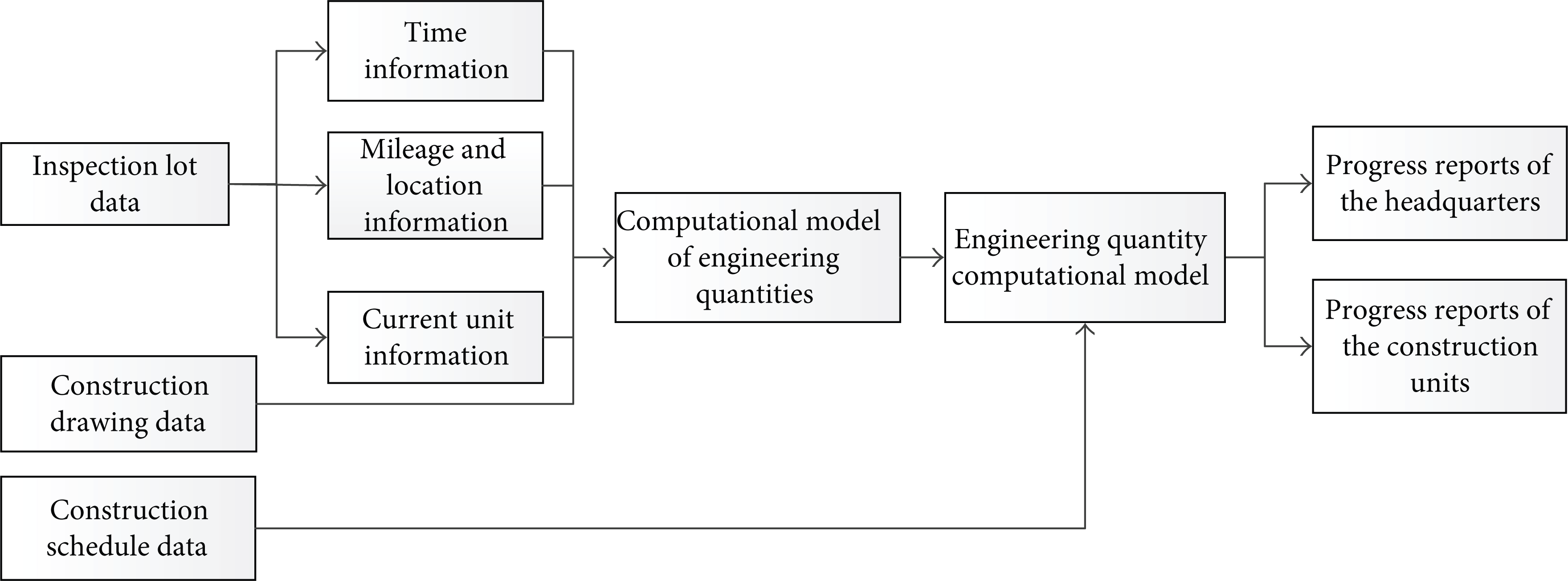
Diagram of APRGS framework.
7. EQCM Based on the Inspection Lot Data
The key to calculating engineering quantity is obtaining parameter data of the completed project from construction drawings. With the establishment of databases for inspection lot and construction drawing data, mileage and location information are extracted from the former. By examining the relationship between the approved parts and construction projects, the design parameters are extracted from the database of construction drawings. Finally, the specific calculation rules are set and quantities calculated according to the category and activity type. The EQCM is shown in Figure 2.

Diagram of EQCM.
The construction units complete the quality approval sheets for the inspection lots. After an audit, the information on the sheet is entered into the inspection lot database; the system then confirms that the corresponding parts of the sheet are completed. When the model generates a progress report, it extracts the mileage and location information from the inspection lot database and then extracts the design parameters of the corresponding parts from the construction drawing database. When the model generates the related progress reports, it calculates the parts based on the corresponding relations between the inspection lot and construction drawing data as well as associated calculation rules.
The following is an example of a calculation rule based on a formula determined by inspection lot data corresponding to the type of construction of parts in the construction drawings. For instance, consider the calculation for a bored pile of concrete in the bridge engineering. Figure 3 shows local construction drawings of the Hulustaiyi bridge (JINGYIHUO railways). The figure shows part of the elevations and sectional drawings of the bridge pile in accordance with the provisions of [16], with each pile as an inspection lot. For a cylindrical bored pile, the corresponding engineering quantity is calculated by the height times the base area. The measurement unit is cubic cm, and the specific calculation rule is

where V is the volume, H is the height, S is the base area, and R is the radius.
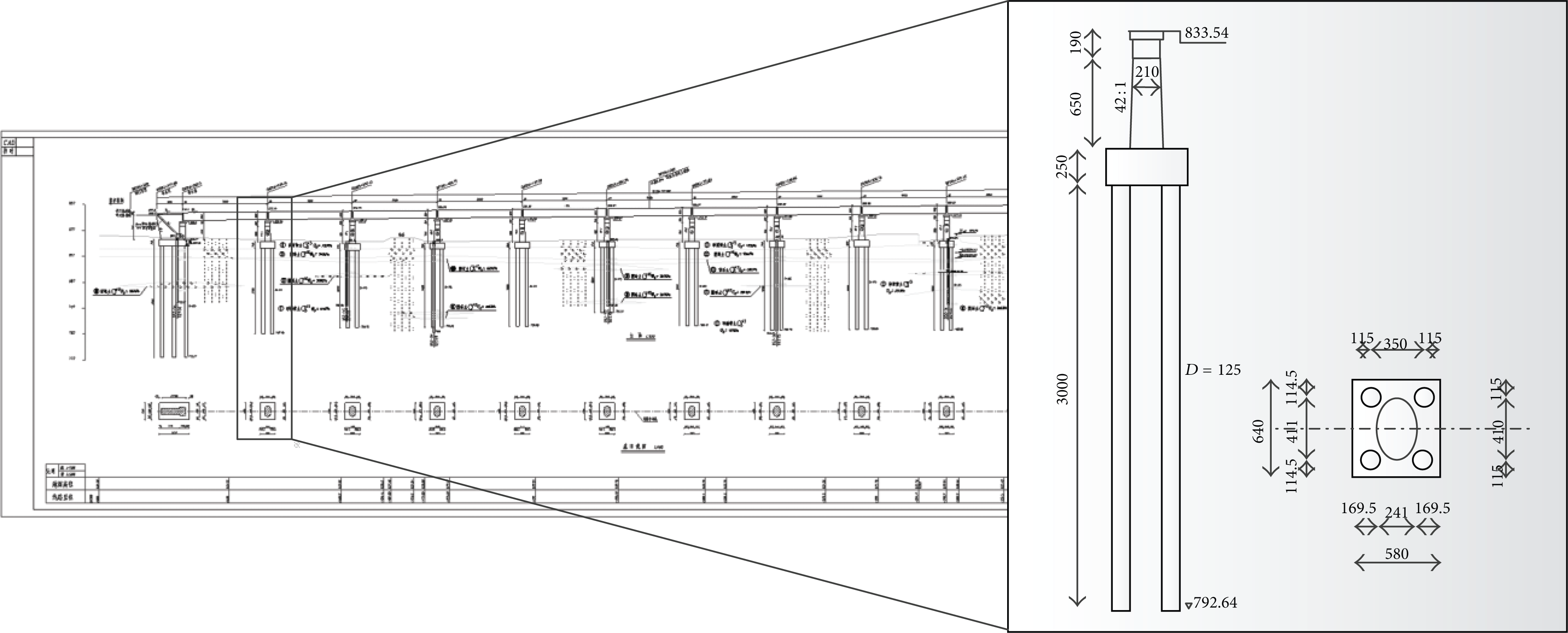
Local construction drawings of Hulustaiyi bridge (JINGYIHUO railways).
According to (1), the engineering quantity of a single bored pile in Figure 3 is calculated as follows (the numbers in the construction drawings are in cm):

8. Project Progress Report Model
When calculation of the engineering quantity is completed (Section 7), the system calculates the field data of the progress report (Section 4), such as the current output and cumulative output. The calculated engineering quantity, in combination with the inspection lot and construction schedule databases, can automatically generate all of the information required by a computer. The next task is to generate a wide variety of progress reports required by the headquarters and construction units (Section 4). A flowchart of the progress report generation model is shown in Figure 4. The model has the following features.
The model establishes a progress report template library of progress reports for the headquarters and construction units.
The model has optional settings for the headquarters and construction units, such as type of report, project, report unit, and time.
Depending on the conditions, the system automatically generates the required progress report content.
The system combines templates to generate the desired report, prints the report, and stores it in the archives.

Flowchart of progress report generation model.
9. Database and Interface of Proposed System
9.1. Design of Proposed System Database
9.1.1. Data Classification
The developed centralized database is at the core of the system for project tracking and control. The data involved in the proposed APRGS is broadly categorized into input data and output data. Input data are needed to produce deliverable data such as those on inspection lot, construction drawing, construction schedule, and system support (e.g., dictionary data). According to Sections 2 and 4, inspection lot, construction drawing, and construction schedule data are legally binding and must be promptly reported. By using a custom-designed Excel form, we will assist the construction unit in entering inspection lot data into the database. The data for construction drawings and construction schedules are already electronic; after processing, they can be entered into the database. The output data constitutes the progress reports of the construction units and headquarters.
9.1.2. Entities Included in the Database
The APRGS database model is of the relational type and consists of 5 entities or tables. The entity relationship diagram is shown in Figure 5. The database model is designed by using PowerDesigner software. The main entities of the database model are the “Project Details,” “Construction Drawing Parameter,” “Schedule,” “Inspection Lot Data,” and “Progress Report.” The following combination of entities share the common key “Project ID,” which realizes a one-to-many relationship: “Project Details” and “Schedule”; “Project Details” and “Construction Drawing Parameter”; “Project Details” and “Inspection Lot Data”; and “Project Details” and “Progress Report.” “Construction Drawings Parameters” and “Inspection Lot Data” share the common key “Inspection Lot Number,” which realizes a one-to-one relationship.

Database conception model of APRGS.
The entity “Project Details” mainly records the division of the project, construction units of each project section, and duration of the project. Its data source is the headquarters. The entity “Schedule” mainly records all types of schedule information for the headquarters and construction units, especially the engineering quantity completed in each time period. Its data sources are the headquarters and construction units. The entity “Construction Drawing Parameter” mainly records the design dimensions, materials, structures, and construction requirements of the project section. The design teams constitute its data source. The entity “Inspection Lot Data” mainly records quality approvals and related information of the inspection lot. It is filled out by the construction units and confirmed by the supervision units. The “Progress Report” data are automatically generated by the APRGS system.
9.2. System Interface Display
(1) System Programming Language and Database. On the basis of the ideas described earlier, the APRGS was designed with a Chinese interface and developed in the laboratory. The proposed system used the B/S structure based on the Visual Studio 2010 platform, with Visual Basic.net as the programming language and Oracle database technology. To verify the effectiveness of the system, the authors collected actual data from the JINGYIHUO railway construction projects. The total length of the JINGYIHUO railway system is 286 km (total investment, 6 billion Yuan); the project started in 2005 and was completed in 2008. It originates from Jinghe station in the western section of the Lanzhou-Xinjiang railway, crosses Mount Tianshan into the Ili River Valley, passes through Nilka County, Yining County, Yining City, and Huocheng County, and eventually reaches the port city of Horgos after stopping at a total of 17 stations. Data collected by the authors included those on design, schedule, inspection lot, and construction units.
(2) Operation of the System. The APRGS system provides the headquarters and construction units with two types of permission schemes. By entering a user name and password in the login screen, users can enter the system main page. With headquarters permission, a user can inquire and generate summarized whole-line progress reports. In contrast, with construction-unit permission, a user can only inquire and generate various types of progress report.
Users logging on with headquarters permission see the main page shown in Figure 6; the default display shows the 2008 progress report for the entire line and a histogram that compares the annually scheduled and actual progress. The menu bar on the left of the interface shows the four functional modules of engineering quantity generation, progress report generation, data maintenance, and history report query. The scheduled report generation function includes 6 options: annual, quarterly, monthly, ten-day, weekly, and daily progress reports for the entire line. The display area for the progress report is on the upper right, whereas that for the histogram that compares the annually scheduled and actual progress is on the lower right.

Main interface of APRGS.
By clicking on the name of a progress report under the progress report generation tab on the left side menu bar, one enters the progress report generation interface. For example, consider the button for the daily progress report of the entire line. The system default displays the progress report for the current date; users can also choose the year, month, and date to generate reports for other dates. By clicking the generate button, users can produce daily progress reports and contrast histograms that compare scheduled and actual progress under set conditions, as shown in Figure 7.

Generation interface of daily progress report for entire line.
The functional modules under construction unit permission are similar to those under headquarters permission. The menu bar on the left of the interface shows the four functional modules of progress report generation, engineering quantity generation, data maintenance, and history report query. The scheduled report generation function includes 6 options: annual, quarterly, monthly, ten-day, weekly, and daily progress.
10. Conclusions
In this paper, the problem of automatic progress report generation for railway construction projects in China was studied by using data on the inspection lots, construction drawings, and construction schedules to establish two models, EQCM and PPRM. Subsequently, APRGS, an automatic progress report generation system, was developed on the basis of these two models. Finally, the proposed system was tested and validated by actual data obtained for the JINGYIHUO railway construction projects. The system could automatically generate a series of progress reports required by the headquarters and construction units. It was also shown to improve the accuracy of progress report data and the efficiency of progress management.
Conflict of Interests
The authors declare that there is no conflict of interests regarding the publication of this paper.
Footnotes
Acknowledgment
This research was funded by China Railways Technology R&D Program under Grant 2013G009-I.