




Abstract
Due to the importance of increasing the firing precision of self-propelled artillery system corresponding to the projectile impact point, the launch dynamics of self-propelled artillery based on the transfer matrix method for multibody system (MSTMM) is studied in this paper. By using MSTMM to study launch dynamics of self-propelled artillery, there is no need of global dynamical equation of the system, the order of the system matrix is low, the computational speed is high, and it meets the requirements of dynamics of self-propelled artillery multibody system. The dynamical model of multibody system and its topological figure, the overall transfer equation, overall transfer matrix, characteristics equation and generalized coordinates equation, and launch dynamical equation of self-propelled artillery are developed. The vibration characteristics, initial disturbance of projectile, dynamical response, and firing dispersion for self-propelled artillery are simulated. The results of eigenfrequency and the time history of system dynamics got by simulations and experiments have good agreements. The study results can be used to improve the firing precision and design of self-propelled artillery.
1. Introduction
The research results of launch dynamics provided the theoretical basis and technical means for design and test of various weapon systems [1–6]. The movements of projectile and artillery are very complicated because of the complex mechanical structure of self-propelled artillery and the severe mechanical environments, such as high temperature, high pressure, high speed, instantaneous state, multibody, and mutation in launch process. Because of their great influence on firing precision of self-propelled artillery, the vibration characteristics and dynamical response of the system are paid great attention in the study of launch dynamics. To increase firing precision of self-propelled artillery, it is necessary to compute accurately the frequencies distribution and establish the quantitative relationship among the global structure parameters of the system and its vibration characteristics, dynamical response, and firing precision. By adjusting the structure parameters to design system vibration frequency distribution, it is then able to improve the firing precision for self-propelled artillery system.
At present, the methods to study vibration characteristics of mechanical system are mainly finite element method, modal analysis method, and the structural modal synthesis method. The multibody system dynamics methods, such as Wittenburg method, Schiehlen method, and Kane method have been widely accepted and applied by engineer of mechanical system dynamics [7–9]. Finite element method and multibody system dynamics method have been an important basis of weapon dynamics. However, when calculating natural vibration characteristics of weapons for complex multirigid-flexible body system containing rigid and flexible bodies using these methods, it faces the difficulties that computational scale is large and it is easy to result in computation singularity caused by computation ill-condition. To meet the requirement of accurate dynamics modeling of launch dynamics and fast calculation, Rui et al. presented transfer matrix method for multibody systems [2, 10–20]. Due to the important feature that order of the overall transfer matrix is very low, MSTMM avoids eigenvalue computation ill-condition for complex multi-rigid-flexible body system, which significantly improves the computational speed of vibration characteristics and is successfully applied to many engineering design and test of various types of vehicles, airborne, and ship-borne weapons [1, 2, 4].
In this paper, by using MSTMM and its automatic deduction method [2, 20], the dynamical model of multibody system for self-propelled artillery is developed; the overall transfer equation, overall transfer matrix, and characteristics equation are deduced. Generalized coordinates equation of self-propelled artillery is obtained by using the orthogonality of augmented eigenvector and body dynamical equation. Combining with launch dynamical equation of projectile, launch dynamical equation of self-propelled artillery system is developed. The vibration characteristics, initial disturbance of projectile, dynamical response, and firing dispersion are simulated, and the factors of different ground conditions and connection stiffness among various components, which influence the firing precision and vibration characteristics, are analyzed. It provides a theoretical basis and simulation tool for improving the firing precision by adjusting structural parameters of the system to change the vibration characteristics of the self-propelled artillery.
2. Dynamical Model of Self-Propelled Artillery Multibody System
Main components of self-propelled artillery are muzzle brake, barrel, gun breech, recoil and counter-recoil mechanisms, cradle, elevating mechanism, equilibrator, turret, traversing mechanism, chassis, torsion bar, balance elbow, shock absorber, track chain, road wheel, and so on. According to the motion state of each component, the firepower system of self-propelled artillery can be divided into recoil part, elevating part, revolving part, suspension part, walking part, and so on. The recoil part contains muzzle brake, barrel, gun breech, and recoil and counter-recoil mechanisms. The elevating part contains total recoil part, cradle, and the components moving with cradle, which includes elevating mechanism, equilibrator, and so on. The revolving part contains total elevating part, turret, and the elements moving with turret that include traversing mechanism and so on. The walking part is used to support the weight of the self-propelled artillery and drive self-propelled artillery to run placidly, which contains track chain and road wheels. The suspension part is used to connect chassis to walking part, which contains torsion bar, balance elbow, and shock absorber. The self-propelled artillery is shown in Figure 1.

Self-propelled artillery.
Taking self-propelled artillery as an example, according to its system structure, from bottom to top in sequence, it can be divided into road wheels, hull, and revolving part which does not contain elevating part, elevating part which does not contain recoil part, gun breech, and muzzle brake. Each component can be regarded as rigid body and elastic beam according to its natural attribute. Rigid body and elastic beam are called “body,” the connection between “body” and “body” is called the “hinge,” which can be seen in [2].
The ground that supports the self-propelled artillery is regarded as an infinity rigid body, whose sequence number is 0. The elastic and damping effect of each road wheel and the interaction between ground and each road wheel are, respectively, modeled as springs, rotary springs, and the accompanying dampers connected in parallel, which can represent relative linear motion and relative angular motion in 3 directions at the same time; their sequence numbers are 42, 43,…, 53. Each road wheel can be regarded as a rigid body, whose sequence number is 30, 31,…, 41. The interaction between each road wheel and hull are, respectively, modeled as springs, rotary springs, and the accompanying dampers connected in parallel, which can represent relative linear motion and relative angular motion in 3 directions at the same time; their sequence numbers are 18, 19,…, 29. Hull, revolving part, elevating part, gun breech, and muzzle brake can be regarded as a rigid body, respectively, whose sequence numbers are 17, 15, 13, 10, and 1. The effect of traversing mechanism associating the elastic, and damping effects of hull, the effect of elevating mechanism and equilibrator associating the elastic and damping effects between revolving part and elevating part are, respectively, modeled as springs and rotary springs accompanying dampers which can represent relative linear motion and relative angular motion in 3 directions at the same time, whose sequence numbers are 16, 14. The interaction between barrel and elevating par, is, respectively, modeled as springs and rotary springs accompanying dampers which can represent relative linear motion and relative angular motion in 3 directions at the same time, whose sequence numbers are 11, 12. According to its structure characteristics, the barrel is divided into 6 segments, each segment can be regarded as a beam with equal sectional area, whose sequence numbers are 2, 3, 4, 5, 7, and 9. The connection points among joints and beam can be regarded as massless rigid body, whose sequence numbers are 6, 8. The dynamical model of self-propelled artillery multi-rigid-flexible system is composed of 19 rigid bodies, 6 beams, and 28 joints, as shown in Figure 2. The topology figure of dynamical model of the self-propelled system is shown in Figure 3.

Dynamical model of the self-propelled artillery multibody system.

Topology figure of the self-propelled system dynamical model.
3. Overall Transfer Equation of Self-Propelled Artillery
3.1. The State Vector of Self-Propelled Artillery
According to the dynamical model and its topology figure, the state vectors at boundary points for self-propelled artillery are defined as follows

where, 1 is the sequence number of body and 0 denotes the boundary.
The form of
3.2. Overall Transfer Equation of Self-Propelled Artillery System
According to MSTMM and the topology figure of the dynamical model, the overall transfer equation of self-propelled artillery system is automatically deduced as follows:

where overall transfer matrix
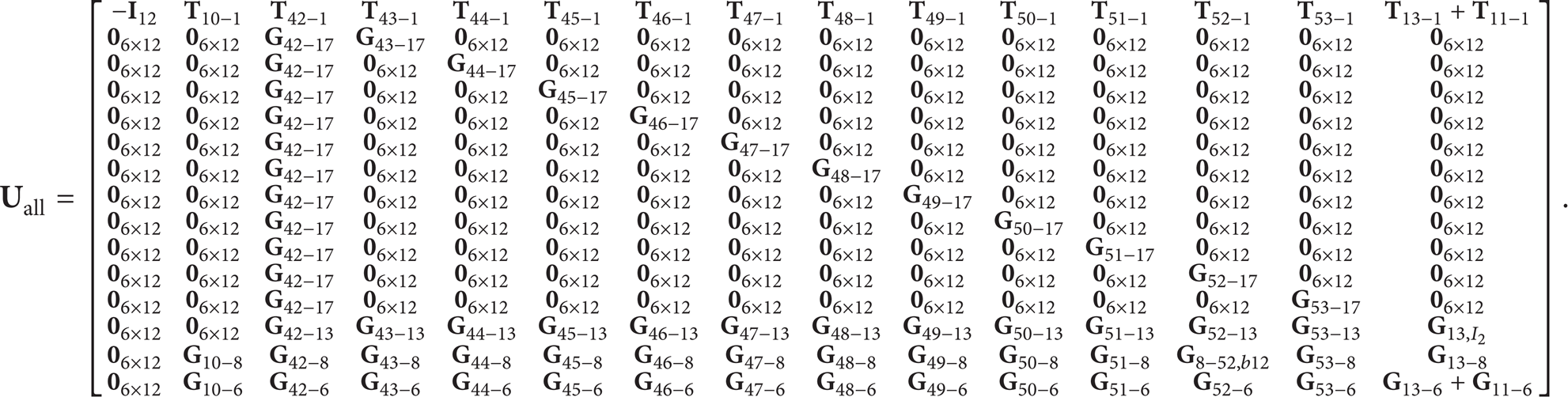
The overall state vector of all boundary points is given by

The elements of the overall transfer matrix
4. Characteristics Equation of Self-Propelled Artillery System
In (4),

Deleting the columns 7∼12, 19∼24, 25∼30, 37∼42, 49∼54, 61∼66, 73∼78, 85∼90, 97∼102, 109∼114, 121∼126, 133∼138, 145∼150, 157∼162 in

The components of
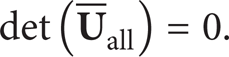
By solving (7), the eigenfrequency of self-propelled artillery, ω
k
(k = 1, 2,…), can be obtained. Solving (6), the state vector
It can be seen from (6) that the order of the overall transfer matrix of the self-propelled artillery system is only 96 and is much lower than that for other multibody system dynamics methods so computational speed is high and the computational ill-condition caused by high matrix order and large stiffness gradient is avoided.
5. Launch Dynamical Equation of Self-Propelled Artillery
5.1. Body Dynamical Equation of Self-Propelled Artillery
Body dynamical equation of self-propelled artillery can be written as

where j is the sequence number of all body elements of the self-propelled artillery and
5.2. Dynamic Response of Self-Propelled Artillery System
The dynamic response in the physical coordinate system may be expanded using augmented eigenvectors

Substituting (9) into (8), thus we obtain
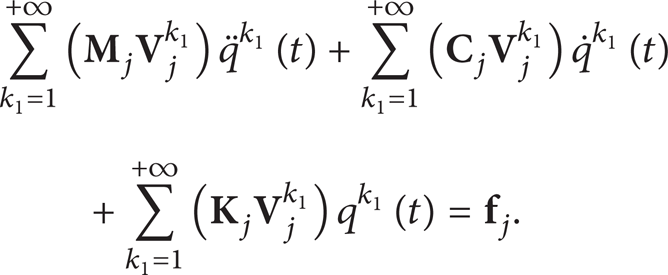
Taking the inner product of both sides of (10) with
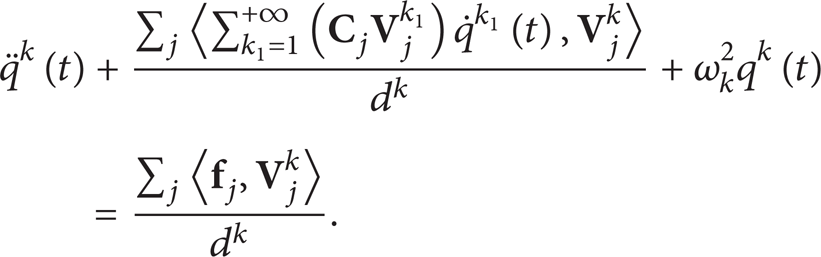
For proportional damping,

There are

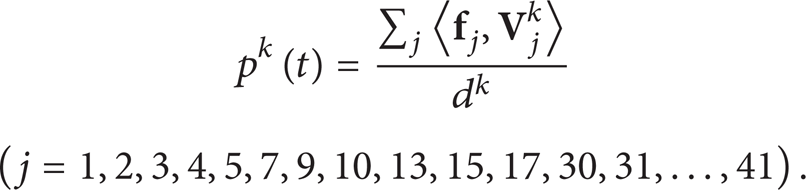
Generalized coordinate equation of self-propelled artillery is obtained,

where
5.3. Launch Dynamical Equation of the Projectile
Launch dynamical equation of a projectile is given by [1, 5]

where the specific meaning of all symbols is no longer given, which can be seen in [1, 5].
6. Numerical Simulation and Experimental Validation
Launch dynamics of self-propelled artillery can be computed by combining (14) and (16). Eigenfrequency, vertical target dispersion, the time history of barrel recoil displacement, and the time history of muzzle displacement in the plumb direction in cement ground for a self-propelled artillery got by simulation and test are shown, respectively, in Tables 1 and 2 and Figures 4 and 5. The simulation parameters can be seen in [1].
Eigenfrequencies of self-propelled artillery got by simulation and test (rad/s).

Vertical target dispersion of self-propelled artillery got by simulation and test.


The time history of barrel recoil displacement got by simulation and test.

The time history of muzzle displacement in plumb direction got by simulation and test.
It can be seen from Tables 1 and 2 and Figures 4 and 5 that results got by simulation and test have good agreements, which shows that the study on launch dynamics of self-propelled artillery by using MSTMM is very effective.
7. Analysis of Factors Influenced Firing Precision of Self-Propelled Artillery
Many shooting tests have shown that the difference of firing dispersion is big due to different ground conditions and different connection stiffness among the various components. In fact, different ground conditions mean that connection stiffness between road wheel and ground is different; the different ground hardness can be simulated by changing connection stiffness between road wheel and ground. The vibration characteristics and firing dispersion on the different ground are simulated for self-propelled artillery. Eigenfrequencies and firing dispersion of self-propelled artillery got by simulation are shown, respectively, in Tables 3 and 4.
Eigenfrequencies of self-propelled artillery on the different ground got by simulation.

Firing dispersion of self-propelled artillery on the different ground got by simulation.

It can be seen from Tables 3 and 4 that the effect of different ground conditions on the natural vibration characteristics is significantly great and then affects the firing precision of self-propelled artillery. The simulation results explained this phenomenon that firing precision of self-propelled artillery is different due to different ground conditions.
For self-propelled artillery, the vibration characteristics and firing dispersion on the cement ground are simulated by changing the connection stiffness between hull and revolving part; eigenfrequencies and firing dispersion got by simulation are shown, respectively, in Tables 5 and 6.
Eigenfrequencies of a self-propelled artillery got by simulation on the cement ground.

Firing dispersion of a self-propelled artillery got by simulation on the cement ground.

For a self-propelled artillery, the vibration characteristic and firing dispersion on the cement ground are simulated by changing the connection stiffness between revolving part and elevating part; eigenfrequencies and firing dispersion got by simulation are shown, respectively, in Tables 7 and 8.
Eigenfrequencies of self-propelled artillery got by simulation on the cement ground.

Firing dispersion of self-propelled artillery got by simulation on the cement ground.

It can be seen from Tables 5–8 that the connection stiffness between hull and revolving part, revolving part, and elevating part has great effect on vibration characteristic and firing dispersion of self-propelled artillery. The factors, such as different ground hardness, connection stiffness among various components, have a great influence on vibration characteristics, and then greatly influence firing precision of self-propelled artillery.
8. Conclusion
In this paper, the launch dynamics of self-propelled artillery is studied using MSTMM and the automatic deduction method of the overall transfer equation. Dynamical model of self-propelled artillery multibody system and its topology figure are developed. According to MSTMM, dynamical model of self-propelled artillery and its topology figure, overall transfer equation, characteristics equation, and launch dynamical equations of self-propelled artillery are developed. By solving launch dynamical equations of self-propelled artillery, eigenfrequency, firing dispersion, and dynamical response of self-propelled artillery are obtained. Results got by simulation and experiment have good agreements, which show that MSTMM and the automatic deduction method of overall transfer equation are useful to study the launch dynamics of self-propelled artillery.
Different ground conditions and connection stiffness among various components greatly influences vibration characteristics and firing precision of self-propelled artillery. Decreasing connection stiffness between hull and revolving part, revolving part, and elevating part makes firing dispersion of self-propelled change significantly. Firing precision of self-propelled artillery can be significantly improved by reasonable adjustment of the system stiffness or connection stiffness among various components.
Footnotes
Appendix
Conflict of Interests
The authors declare that there is no conflict of interests regarding the publication of this paper.
Acknowledgments
The research was supported by the Research Fund for the Doctoral Program of Higher Education of China (20113219110025), the Natural Science Foundation of China Government (11102089), and the Program for New Century Excellent Talents in University (NCET-10-0075).