




Abstract
Underwater acoustic sensor networks (UASNs) consist of remotely deployed sensor nodes under sea or other water environments. Due to the extreme limitations faced by radio signals under water, acoustic channels are utilized for communication in such networks. However, UASNs are challenged by the characteristics of underwater acoustic channels such as lower signal propagation speed and higher signal attenuation. On top of such a challenged physical medium, MAC schemes which are designed based on their terrestrial counter parts are required to add extra overheads to the communication channel wasting the limited network resources. MAC layer overheads such as bandwidth wastage for interframe spaces and contention for occupying physical medium put limitations to the maximum reachable throughput of UASNs. IEEE 802.11n has well defined various MAC and physical layer enhancements to overcome throughput barrier in wireless LANs which includes two frame aggregation schemes, namely, A-MPDU and A-MSDU. In this paper, we study the feasibility of applying those frame aggregations well defined in IEEE 802.11n for reducing MAC layer overheads in UASNs. Based on simulation studies, we evaluate that these frame aggregation schemes are applicable in UWSNs.
1. Introduction
While supporting various kinds of applications in the terrestrial environments, wireless sensor networks (WSNs) have evolved to be deployed undersea and other underwater environments with emerging applications. The undersea oil pipeline monitoring, intruder detection for harbor security, marine biology exploration, and so forth are examples of such promising UASN applications [1]. In these applications, the sensor network consists of sensor node with underwater communication capability and data collecting node(s), called sink(s), attached to the buoy(s) floating on the water surface. Radio communication techniques cannot effectively work in the underwater environment due to intrinsic limitations of the underwater channel. Therefore, the acoustic communication techniques are used in the underwater environment to carry out communication. Hence, this type of network is called underwater acoustic sensor network (UASN). The basic functionality of UASN is to monitor and collect various application based underwater physical parameters, for example, underwater pipeline pressure, temperature, and vibrations. These parameters are monitored by UASN nodes and communicated to the sink(s) attached to the buoy(s). These buoys then transmit this aggregated data to the remote locations via radio channel for further processing.
The acoustic communication is very useful in the underwater environment; however, there are many challenges that underwater acoustic channel poses to UASNs. Acoustic signals have slow propagation speed that is approximately 1500 m/s, in the underwater environments, which is extremely lower than the radio signal propagation speed in terrestrial environment. Therefore, the communication between two underwater sensor nodes faces the extra amount of communication delay, which in turn affects the performance of the higher layers of the communication protocol stack. For example, after successful transmission of data packet from one UASN node to another, the medium access layer of the sender node has to wait for longer time to send another data packet. The reason behind this delay is the long communication latency of data plus acknowledgement for the successful reception of that data packet. This significantly degrades the network throughput. Additionally, the other physical medium characteristics such as higher signal attenuation, multipath propagation, surface and bottom reflection, and absorption affect the communication capabilities of the UASN nodes. The communication techniques at physical, medium access, and the upper layers must consider the above said limitation to perform efficient communication.
The medium access control (MAC) schemes that have been proposed for UASNs are mainly based on their terrestrial counter parts such as CSMA with RTS/CTS [2]. However, due to intrinsic characteristics of the acoustic channel, compared to the radio channel, the distributed coordination functions (DCF) of these MAC schemes add extra overhead to the network, which further lowers the network performance. In addition to that, we highlight three main overheads introduced by the MAC layer of UASN: (a) increased transmission delay, (b) high energy consumption for communication, and (c) wastage of limited bandwidth of acoustic channels. As mentioned earlier, the large signal propagation delay in underwater environments significantly increases the successful communication delay. Moreover, until a sender node receives the relevant acknowledgement, its neighboring nodes should back off and delay their transmission. Therefore, during communication between the sender and receiver nodes, all of their neighboring nodes that have pending packets for transmissions have to keep their transceivers in active state for a longer time period. Hence, their energy is wasted. When a node successfully acquires the channel after multiple attempts with back-offs, it has to go through the same procedure again for its next transmission. Since a single MAC frame contains a considerable amount of header information, the overall amount of sensed data transmitted after multiple frame transmissions is lower in the acoustic channel. This is due to the wastage of the limited bandwidth of the acoustic channel for a large amount of control information in the MAC headers transmitted as separate frames. In terrestrial environments, IEEE 802.11n has well-defined MAC layer enhancements for frame aggregation schemes with low control overhead compared to IEEE 802.11 [3, 4].
The IEEE 802.11n has two frame aggregation schemes, called A-MSDU and A-MPDU, that provide performance improvements in the terrestrial wireless networks MAC layer [5]. In the former approach, an aggregation scheme is performed to the MAC Service Data Units (MSDUs) at the upper part of the MAC layer. However, the latter approach performs aggregation scheme to the MAC Protocol Data Units (MPDUs) at the lower part. By utilizing these frame aggregation schemes, a sender node delivers the contents of multiple packets by a single channel access by solving the issues in the CSMA based MAC schemes.
Even though the frame aggregation schemes improve the MAC layer performance, the corruption of an aggregated frame during the transmission causes retransmission of the whole aggregated frame. This significantly lowers the MAC Layer efficiency. Therefore, the IEEE 802.11n amendment includes a block acknowledgement mechanism, which is capable of notifying the missing frames in an aggregated frame. It enables the sender to include only the missed frames together with more new frames in the next aggregated frame transmission avoiding the redundant transmissions.
In this paper, we study the feasibility of applying frame aggregation mechanisms defined in IEEE 802.11n to the UASN. We compare the performance of A-MSDU and A-MPDU schemes against CSMA/CA with RTS/CTS in underwater scenarios. The rest of this paper is organized as follows. Section 2 discusses the related work in the literature relevant to MAC layer overhead reduction in UASNs. Section 3 introduces the design details of the two aggregation schemes defined in the IEEE 802.11n and explains how they are exploited for deployment on underwater acoustic physical medium. A comprehensive evaluation and the detailed discussion of simulations are given in Section 4. Finally, Section 5 concludes the paper and suggests the potential future directions.
2. Related Work
Various MAC schemes have been successfully tested for terrestrial wireless networks that use electromagnetic signals as the physical medium. The MAC schemes for underwater acoustic sensor networks (UASNs) have been adopted from their terrestrial counterparts and modified accordingly to cope with the unique characteristics of underwater channel.
Carrier sense multiple access (CSMA) based MAC schemes are the most widely applied and accepted MAC schemes in terrestrial wireless networks with promising results [6]. There have been many trials to use them for acoustic communications in UASNs [2, 7, 8]. CSMA requires a node to sense medium for the potential ongoing communication before it attempts to access the medium. Such scheme significantly prevents the possibility of collisions in the network. The CSMA based MAC schemes perform well in terrestrial wireless networks; however, their performance drastically degrades when applied over the acoustic channels due to extremely slow signal propagation speed in the underwater environment.
In [9], the impact of large signal propagation delay on various UASN MAC schemes is evaluated. When a node senses the medium for a potential ongoing communication, the extremely low signal propagation speed prevents the node from detecting an ongoing communication and causes the node to start transmission that leads to the collisions. Additionally, upon detecting a communication on the channel, a node has to defer a fair amount of time before the next attempt to acquire the acoustic medium due to the same reason of low signal propagation speed. Therefore, the efficiency of CSMA based schemes has huge impact on the acoustic medium characteristics and must be considered when designing MAC schemes for UASN.
Regardless of the specific MAC scheme, the performance of acoustic communication for varying size of data packets transmitted over the medium is studied in [5, 10]. The authors show that there exists an optimum packet size for acoustic channels that provides the best performance for a particular configuration. This configuration that affects the optimum packet size includes protocol characteristics, bit rate, and bit error rate (BER) of the network. It is shown through simulations that the selection of a packet size should not be done in an ad hoc manner for a particular scheme if the best performance is desired from the acoustic network.
Performance degradations caused by the MAC layer overheads still appear in terrestrial networks such as IEEE 802.11. In order to achieve high throughput in wireless local area networks (WLAN), further amendments have been made to IEEE 802.11 standard. The IEEE 802.11n amendment aimed at the next generations high throughput WLANs by making various modifications to the existing standard [3, 11]. Among many other enhancements, this amendment introduces two frame aggregation schemes in the MAC layer to overcome the performance overhead of the standard. These two schemes, namely, aggregation of MAC service data units (A-MSDU) and aggregation of MAC protocol data units (A-MPDU), are applied in the upper and lower parts of the MAC layer, respectively. Additionally, these two schemes can coexist at the same time to achieve better performance [4]. Next section discusses the above said MAC layer aggregation schemes adopted in the UASN scenario.
3. Frame Aggregation in MAC Layer
3.1. Overview
In wireless network, when a data packet is handed over from the network layer to the MAC layer of a node, the packet already contains the application data and header relevant to the upper layers. Since the packet is an input to the MAC layer, it is called a MAC service data unit (MSDU). Each MSDU in the MAC layer is encapsulated with a MAC layer header and frame check sequence (FCS) footer, as shown in Figure 1. The contents and size of the MAC header depend on the particular MAC layer protocol in use. The final output of the MAC layer is called a MAC protocol data unit (MPDU), which is delivered to the receiver node through physical layer. The receiver node disintegrates the received MPDU and the MSDU contents are handed over to the upper layer.
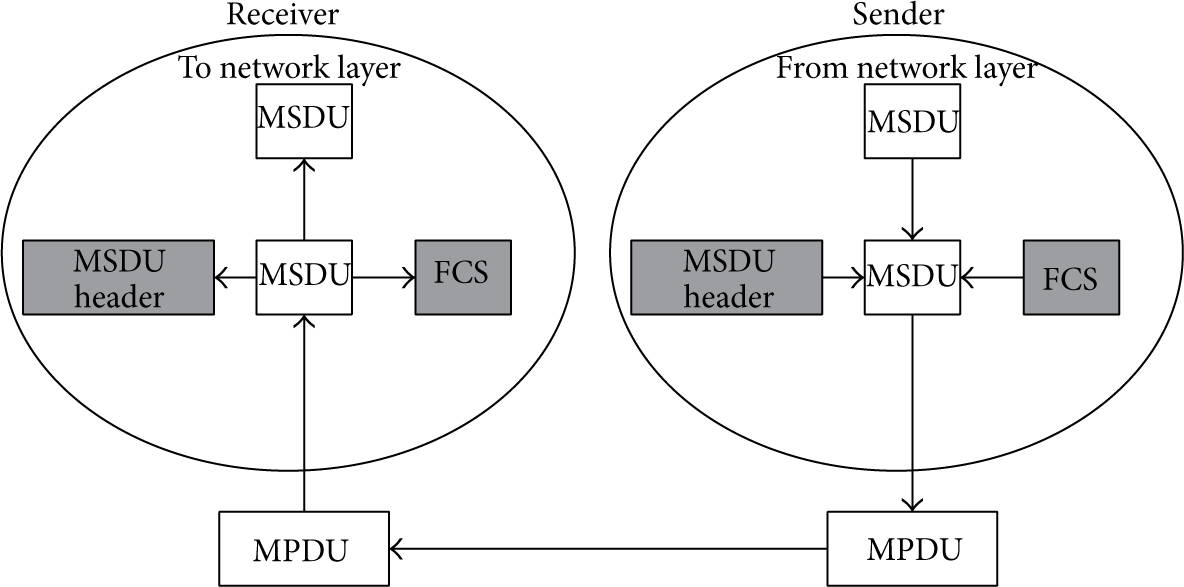
Ordinary mechanism of handling MSDU and MPDU frames.
According to the well-defined IEEE 802.11n amendment, A-MSDU and A-MPDU frame aggregation schemes define new MAC layer frame structures. In A-MSDU scheme, the aggregation is performed on the MSDU units at the upper layer over the MAC layer. The aggregated A-MSDU frames are added with the standard MAC header and then sent to the physical layer as an ordinary MAC frame without aggregation. In contrast, A-MPDU scheme generates aggregated frames, which clearly separate each MPDU inside the aggregated frame. Therefore, each MPDU included in the A-MPDU can be acknowledged uniquely and again provides more advantages. Further details of these two schemes are provided in the following subsections.
3.2. Aggregation of MAC Service Data Units (A-MSDU)
An A-MSDU frame, shown in Figure 2, has similar structure as that of basic MAC frame, which consists of a MAC header, frame body, and frame check sequence (FCS) footer. The frame body contains a sequence of A-MSDU subframes. Each subframe has a single MSDU which is enclosed by an additional header and some padding bits. An A-MSDU subframe header dedicates 6 bytes each for DA and SA fields that represent the destination and sender addresses, respectively. Another 2-byte field denotes the length of an enclosed MSDU frame. The size of each A-MSDU subframe has to be a multiple of 4 bytes and the padding size is adjusted to match this requirement. This rule is not applied to the last A-MSDU subframe in the aggregated frame.

A-MSDU frame aggregation mechanism.
Since multiple MSDU frames are included in a single aggregated frame of an A-MSDU, this approach is suitable for network scenarios where a large number of small sized frames are transmitted. In such cases, the interframe spaces that waste the channel space are significantly reduced. Additionally, all MSDU frames included inside an A-MSDU frame will be acknowledged by a single acknowledgment frame, which decreases acknowledgment overhead. Since each A-MSDU subframe contains DA and SA fields to specify the receiver and sender addresses, therefore, each of them should be addressed to the same receiver and sender addresses mentioned in the MAC header. To achieve such a functionality, a layer above the MAC layer should receive and buffer the MSDU frames arriving from the upper layer that are destined to the same receiver. That set of buffered MSDU frames is used to form an A-MSDU frame by enclosing with additional headers. A-MSDU mechanism has its drawback when physical medium corrupts an AMSDU subframe during the transmission because the frame check sequence (FCS) validation covers the whole A-MPDU frame. Therefore, the failure of FCS calculation indicates any possible corruption inside the whole frame. The inability of the receiver node to pinpoint the failure of a particular A-MPDU subframe causes the whole A-MSDU frame to be retransmitted, which creates unnecessary overhead.
3.3. Aggregation of MAC Protocol Data Units (A-MPDU)
The aggregation of MPDU frames results in a sequence of subframes that are directly enclosed with the physical layer header. An A-MPDU subframe consists of an A-MPDU delimiter, MPDU body, and padding bits, as shown in Figure 3. The 32-bit long A-MPDU delimiter contains (a) reserved field of 4 bits, (b) length field of 12 bits, (c) CRC checksum field of 8 bits, and (d) delimiter signature of 8 bits. The purpose of each CRC checksum value is to ensure the integrity of the respective A-MPDU subframe header.

A-MPDU frame aggregation mechanism.
Similar to the A-MSDU frame aggregation, each A-MPDU subframe that is destined to the same receiver must be included in the same A-MPDU frame. In order to form the above said A-MPDU, MAC layer of the sender node has to buffer multiple MSDU frames it received from the upper layer, sort them based on the destination address, and then aggregate accordingly. At the receiving end, the A-MPDU frame is searched to find each A-MPDU subframe enclosed inside it. A unique bit pattern is included in the delimiter signature of each A-MPDU subframe to detect A-MPDU subframes. Unlike the A-MSDU mechanism, CRC values included in each A-MPDU subframe facilitate the receiving end to detect corruption(s) in each subframe uniquely. The block acknowledgement mechanism that is well defined in IEEE 802.11n enables the receiver to notify the sender of the successfully received A-MPDU subframes after checking CRC in each subframe. It enables the sender to retransmit only the corrupted A-MPDU subframes in the next transmission together with new subframes to avoid the redundant transmissions. The CRC checksum in each A-MPDU subframe increases the reliability and reduces the need of retransmitting whole aggregated frames. However, the aggregation and deaggregation mechanisms add more computation cost for both sender and receiver, which can increase the latency.
4. Performance Evaluation
In order to evaluate the feasibility of exploiting the well-defined frame aggregation schemes in IEEE 802.11n, we performed simulations under a discrete event simulator. The performance of two frame aggregation schemes, A-MSDU and A-MPDU, is compared with CSMA/CA with RTS/CTS in underwater acoustic physical medium in our simulations. Following performance metrics are evaluated for the given three MAC layer schemes to evaluate their effectiveness.
Throughput efficiency is the network throughput achieved as a ratio of the maximum bit rate achievable on the physical medium.
Avg. packet delivery ratio is defined as the number of successfully delivered packets to the destination as a ratio of the number of packets transmitted from a particular sender.
Avg. end-to-end delay is the average time for a packet to be successfully delivered to the destination node from the point of packet generation and queuing at the sender buffer.
We consider a three-dimensional underwater territory of 1 km × 1 km × 1 km where varying number of nodes are randomly deployed in each simulation. The bandwidth of the network is set to 2000 Hz and the packets are forwarded towards a single sink in an ad hoc manner. Each simulation is performed for a duration of 100 s to evaluate the performance metrics discussed above.
The variation of throughput efficiency of the three compared schemes over different network sizes is shown in Figure 4. Both MAC layer frame aggregation schemes achieve higher throughput as compared to the CSMA/CA based MAC layer. Furthermore, among the two frame aggregation schemes, A-MPDU achieves higher throughput compared to A-MSDU. It is due to the frame structure and the block acknowledgement mechanism of A-MPDU; therefore, the reliability of the multiple frames being transmitting in the aggregated frame in A-MPDU is higher under lossy underwater acoustic physical medium. The frame corruptions are handled with minimum retransmission overhead in A-MPDU scheme compared to A-MSDU because A-MSDU causes retransmission of whole aggregated frame in case of frame corruptions.
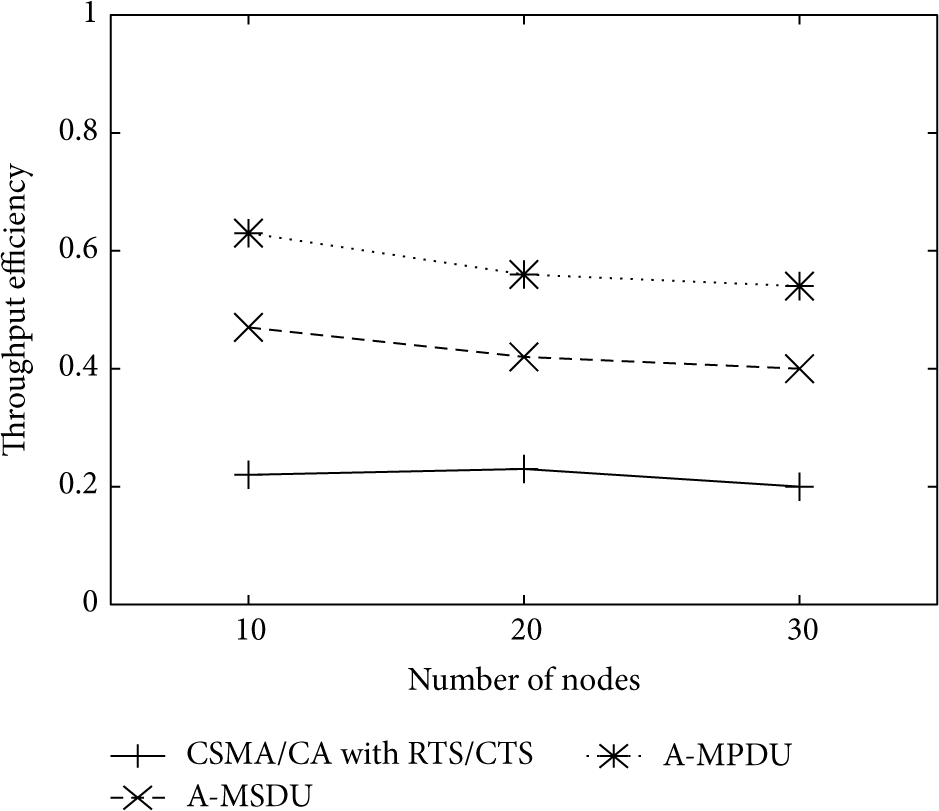
Throughput efficiency according to the number of nodes.
Figure 5 depicts the variation of the throughput efficiency under variable offered loads in the network. Under low offered loads, throughput achievement of the network with and without frame aggregation is similar. However, under higher offered loads, A-MPDU frame aggregation gains better throughput than A-MSDU and CSMA/CA without frame aggregation. Aligning with the results shown in Figure 4, this result clearly supports the evidence of performance improvement through frame aggregation of MAC protocol data units in underwater acoustic networks.
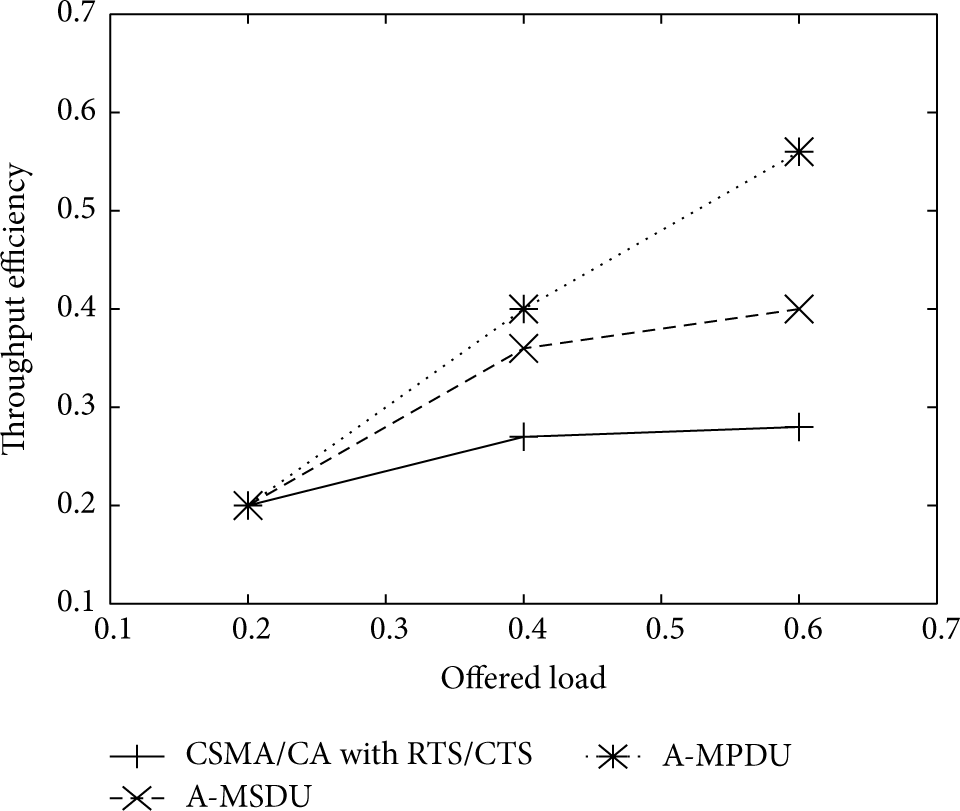
Throughput efficiency according to offered load.
The average packet delivery ratio variation of the three schemes is shown in Figure 6. It illustrates that A-MSDU performs similar to CSMA/CA with no MAC layer frame aggregations while A-MPSU achieves a higher average packet delivery ratio. Due to the unavailability of an integrity checking mechanism in A-MSDU frame aggregation, many retransmissions may occur in A-MSDU frame aggregation scheme under the highly unreliable physical medium due to corruptions and frame losses. Therefore, the performance of A-MSDU in terms of average packet delivery ratio does not differ considerably from CSMA/CA without frame aggregations. In contrast, higher reliability measures taken by A-MPDU scheme is capable of providing higher average packet delivery performance.
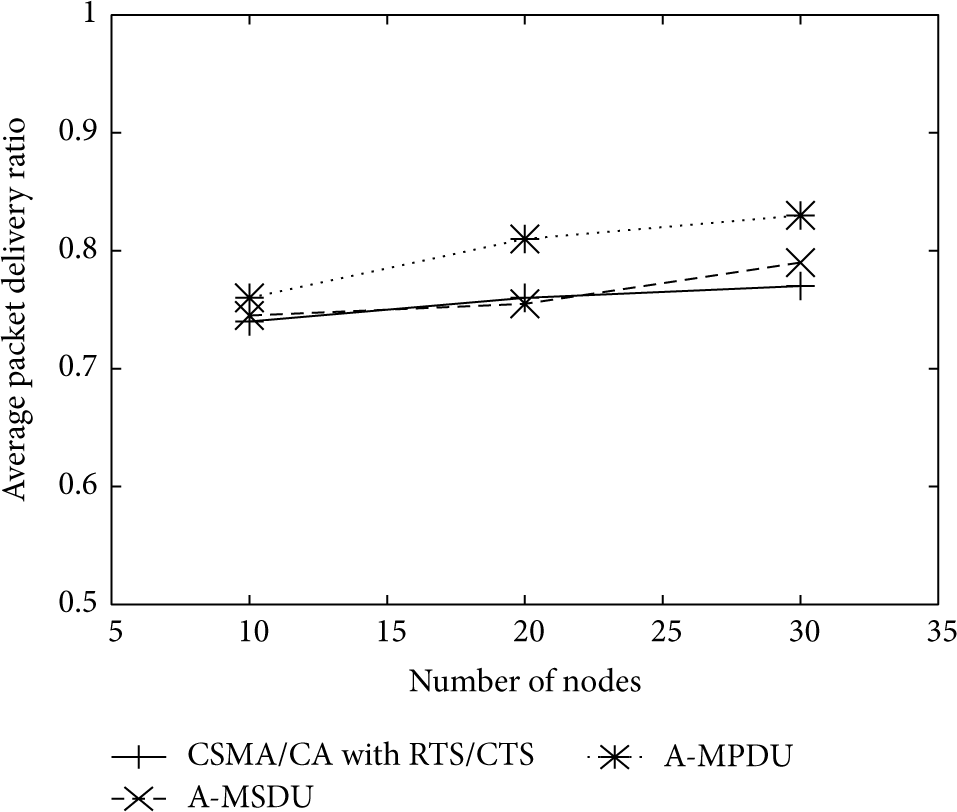
Avg. packet delivery ratio according to the number of nodes.
Figure 7 shows the end-to-end delay versus network size. The three MAC layer schemes with or without frame aggregation provide similar end-to-end delay capabilities for smaller network sizes. However, for higher network sizes, CSMA/CA without frame aggregation results in a higher end-to-end delay than both A-MSDU and A-MPDU frame aggregation schemes. By aggregating multiple MAC layer frames together, a single channel access can be used to deliver multiple frames in A-MSDU and A-MPDU. Therefore, from the networking layer perspective, packets are delivered to the destinations faster with aggregation than without aggregation. Furthermore, A-MPDU achieves slightly lower end-to-end delay than A-MSDU with the increasing network sizes due to the less number of subframe losses in the aggregated frames while A-MSDU frames get heavily affected by the acoustic physical layer characteristics.

End-to-end delay according to the number of nodes.
It is evident from the simulation results that the two frame aggregation schemes increase performance of the acoustic networks by lowering the overheads introduced by MAC layer. Among the two frame aggregation schemes that are well defined in IEEE 802.11n amendment, A-MPDU aggregation scheme achieves better results with acoustic channels as compared to A-MSDU aggregation scheme. The significant capability of CRC checksum calculation for each subframe and the block acknowledgement mechanism provided by A-MPDU increase reliability of the communication while decreasing the possibility of frame retransmission overhead. Such capabilities are quite suitable for a frame aggregation scheme for highly unreliable and lossy physical medium such as underwater acoustic channels.
5. Conclusion
In this paper, we evaluated the feasibility of applying MAC layer specific frame aggregation schemes for the underwater acoustic sensor networks (UASNs) which are well defined in IEEE 802.11n amendment for terrestrial wireless networks. Due to the throughput barrier faced by terrestrial wireless networks as a result of MAC layer, limitations are addressed by IEEE 802.11n amendment. Among various other MAC and physical layer enhancements, the two frame aggregation schemes, namely, A-MSDU and A-MPDU, are the key focus of this research on underwater acoustic sensor networks. Our evaluations show that even in underwater acoustic channels, the frame aggregation schemes well defined in IEEE 802.11n amendment outperform CSMA/CA with RTS/CTS to a considerable level. The simulation based evaluations were focused on the three aspects of the MAC schemes, namely, (a) throughput efficiency, (b) average packet delivery ratio, and (c) average end-to-end delay.
As shown in the related works, there exists a possibility of performance gains and degradations due to the size of the frames being transmitted through acoustic channels. Therefore, frame aggregation schemes such as A-MSDU and A-MPDU have to be evaluated to uncover the impact of the number of MAC frames being aggregated to a single frame to achieve better performance gains in underwater acoustic sensor networks in the future.
Footnotes
Conflict of Interests
The authors declare that there is no conflict of interests regarding the publication of this paper.
Acknowledgment
This work was supported by Defense Acquisition Program Administration and Agency for Defense Development under the Contract UD130007DD. This work was supported by the IT R&D Program of MSIP/IITP (10041145, Self-Organized Software Platform (SoSp) for Welfare Devices). This study was supported by the BK21 Plus project (SW Human Resource Development Program for Supporting Smart Life) funded by School of Computer Science and Engineering, Kyungpook National University, the Ministry of Education, Korea (21A20131600005).