




Abstract
Major parameters affecting the generation capacity of hydroelectric plants are resource regime, reservoir geometry, and water head together with flow rate and efficiency. For the same resource regime and flow rate, water head can be altered depending on generation planning. By means of holding water in the reservoir and consequent increase in head can lead to boost power generation. In this paper, a method to compare two different operational styles has been identified; a plant operating with a low fixed head has been compared to a plant with an increased water head by means of holding water. In order to achieve this objective, an economical model including annual power revenues and net income increase depending on the operational strategy has been developed. Parameters affecting net income gain of the developed model are power generation boost and loss during peak and nonpeak durations, and electricity prices during peak and nonpeak durations. Depending on this model, strategies that would increase the plant revenue streams with increasing reservoir head have been presented in the results section of the paper.
1. Introduction
In today's world, inclination to renewable energy has increased with the highly improved environmental awareness. Higher shares of renewable energy sources for power generation result in improved environmental effect. However, supply reliability of these sources is highly doubtful due to their inconsistent nature [1, 2]. Among the renewable energy sources, hydroelectric power is the only one that allows load compensation by means of storage. Thus, water reserving hydroelectric power plants become very crucial in power generation.
Three basic parameters affecting the power generation of hydroelectric power plants (HPPs) are the flow rate depending on resource regime, water head depending on reservoir geometry, and turbine efficiency. Seasonal changes and changes over the years of resource regime highly affect the generation capacity. In particular, low flow rates during drought years decrease the generation heavily. This fact points out that generation plans should be optimized in order to utilize the maximum capacity of water resources. There are studies in the literature that investigate long or short term generation optimization of power plants using the same resource [1, 3–9]. In these studies, multiple reservoirs had been considered and generation optimization had been calculated for all plants, but parameters affecting a single plant had not been investigated. Within the liberalization of the power market, each plant could be operated by different corporations. Thus, a single plant should develop a generation strategy to increase its own revenue stream. Objective of an HPP is a very important parameter to determine generation plan of the plant. Depending on the local demands, an HPP could be employed as base plant or as a peak plant. When peak electricity prices are higher than base prices, generation planning becomes more important for peak load plants. This fact reveals that an economical analysis should be carried out for the HPPs employed to meet peak demands. The situation gets more serious during drought periods. Generation with more water than incoming water to the reservoir decreases the load factor of the reservoir in such drought periods. Since the power generation is a function of reservoir head, lower generation would be obtained with the same amount of water and lower head. This is the reason why head is extremely important for generation planning.
In this study, importance of water head for generation planning has been highlighted and an economical analysis has been carried out for increasing undesired head by holding water. During water holding period, no generation has been forecasted and a consequent revenue loss has been considered in this period. A higher generation has been proven due to higher head as a consequence of water holding and this differential generation has been stated as a revenue gain. Two different operating modes have been taken into account for normal operation and water holding operation, and loss and gains have been modeled accordingly. In such case, water head is an important criterion affecting water holding duration. Besides the water holding duration, the time frame of this duration is also very important depending on local conditions. For this reason, an economical analysis has been implemented to maximize the revenue stream. In the economical analysis, base prices and peak prices had been considered to be different from each other. Chronological load-time curves have been employed to assess the loss and gains in these base and peak periods. Net revenue gain has been established as the objective function and parameters affecting this function have been investigated. In addition, a model has been developed by considering high head, since water holding not only affects one year but also has an influence over the years.
2. Methodology
Power generated in an HPP is a function of the water held in the reservoir (head), flow rate (Q), and overall efficiency (η). Annual power generation could be shown with E and stated with real time values in

In this equation, j is the operation hours; γ is the specific weight (kN/m3) of the water. Plant efficiency is a function of flow rate and increases with higher flow rates [2, 10]. Head (H) is a variable depending on reservoir volume and can be expressed as the difference between hydrostatic height (H s ) and losses (δH f ) [10, 11]:

Since losses are functions of flow rate, head also can be expressed as a function of flow rate. Thus, head and the flow rate are the basic parameters affecting power generation of the plant. Depending on the flow rate of the reservoir resource, head can be altered in a specific period by means of holding water and not generating power. At the end of this period, this method results in a higher generation rate due to higher head, even though there is not any generation during the holding period. However, analysis of overall revenue stream is the key point in this operation style. This analysis can be implemented for the water holding year, but also can be implemented for long term operation. Calculation methodology for both cases has been described in the next section.
2.1. Economical Analysis for the First Water Holding Year
Head fluctuation throughout the year should be known as well as flow rate, in order to determine annual generation of the plant. Annual fluctuation of head for the two operational cases is shown in Figure 1. In the first case, plant is operated with H1 head through the year. In the second case, water is held in the reservoir in a period of t1–t2 and head increased to H2, and plant is operated with this H2 head in the remaining period of the year.

Operations with two different strategies.
Annual power generation for the first operational plan is

Annual power generation for the second operational plan for the water holding period t1–t2 and consequent higher H2 is

For both operational conditions, the generations between 0 and t1 are equal because plant operates at the same conditions. ΔE1 has been defined as generation loss in the t1–t2 period due to water holding in the second case. However, in this case a generation boost defined with ΔE2 is achieved due to higher head between t2 and 8760 periods. These generation values are expressed in

If same resource regime is assumed for both cases, then generation boost is expressed in

Generation should be ΔE2 − ΔE1 > 0 and the greater the difference is, the higher the generation increase is achieved. When Figure 1 and the equations are examined, it can be clearly seen that water holding period (t1–t2) is the most important parameter for one year optimization. If this period extends, then ΔH increases and as a consequence ΔE2 increases also. However, period extension also increases ΔE1.
ΔH is limited by H min and Hmax depending on the reservoir load factor. Maximum achievable ΔH is the differential of Hmax and H min (ΔH = Hmax − H min ). In Figure 2, relation between ΔH and water holding periods has been shown, for two different operations with different water holding periods. Thus, ΔH has been stated as a function of water holding period. Mass balance of the reservoir and head depending on reservoir geometry are the parameters affecting this function.
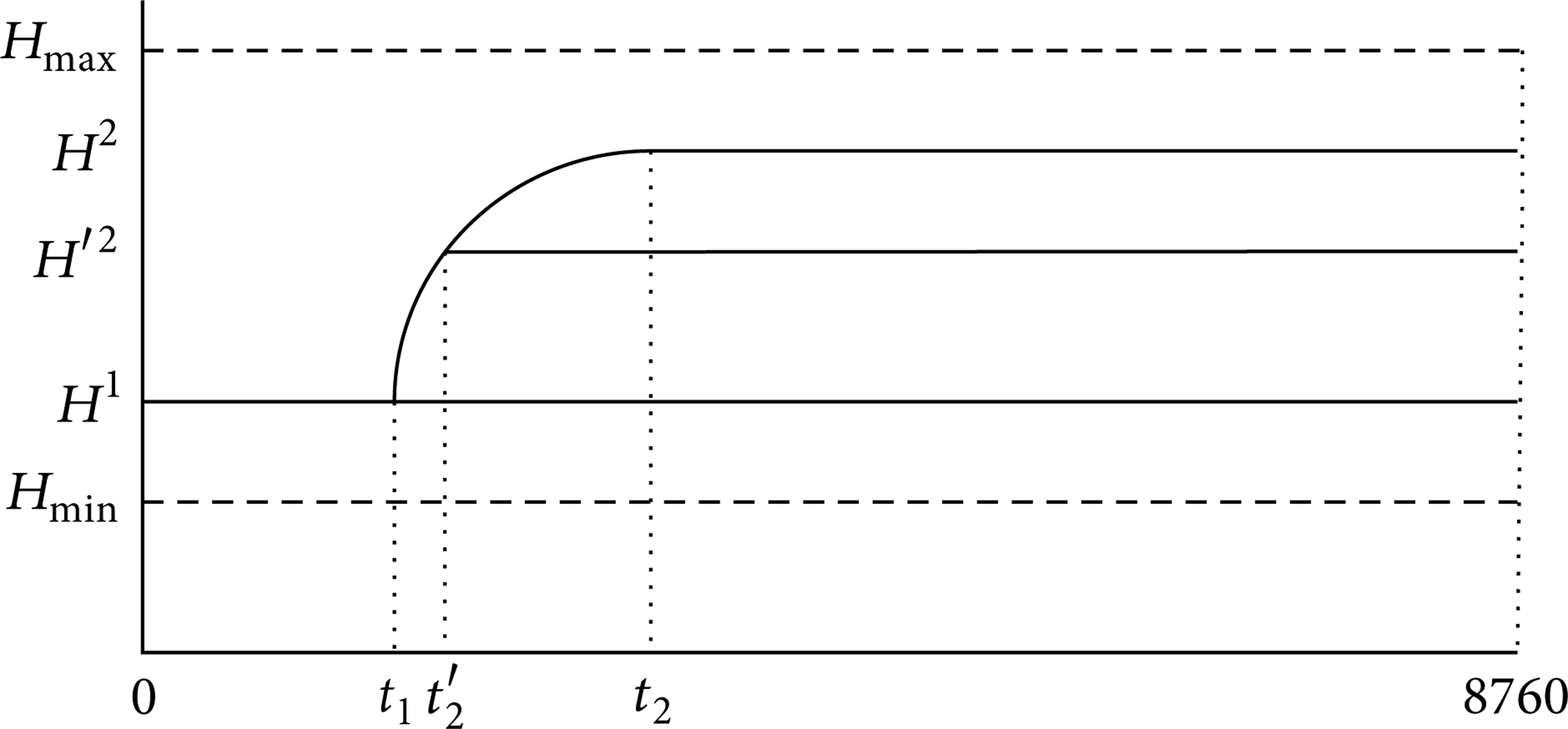
Time-head curves for different operational strategies.
Conservation of the mass in the reservoir for one hour time frame is shown in Figure 3. Mass balance in any given t moment is stated in

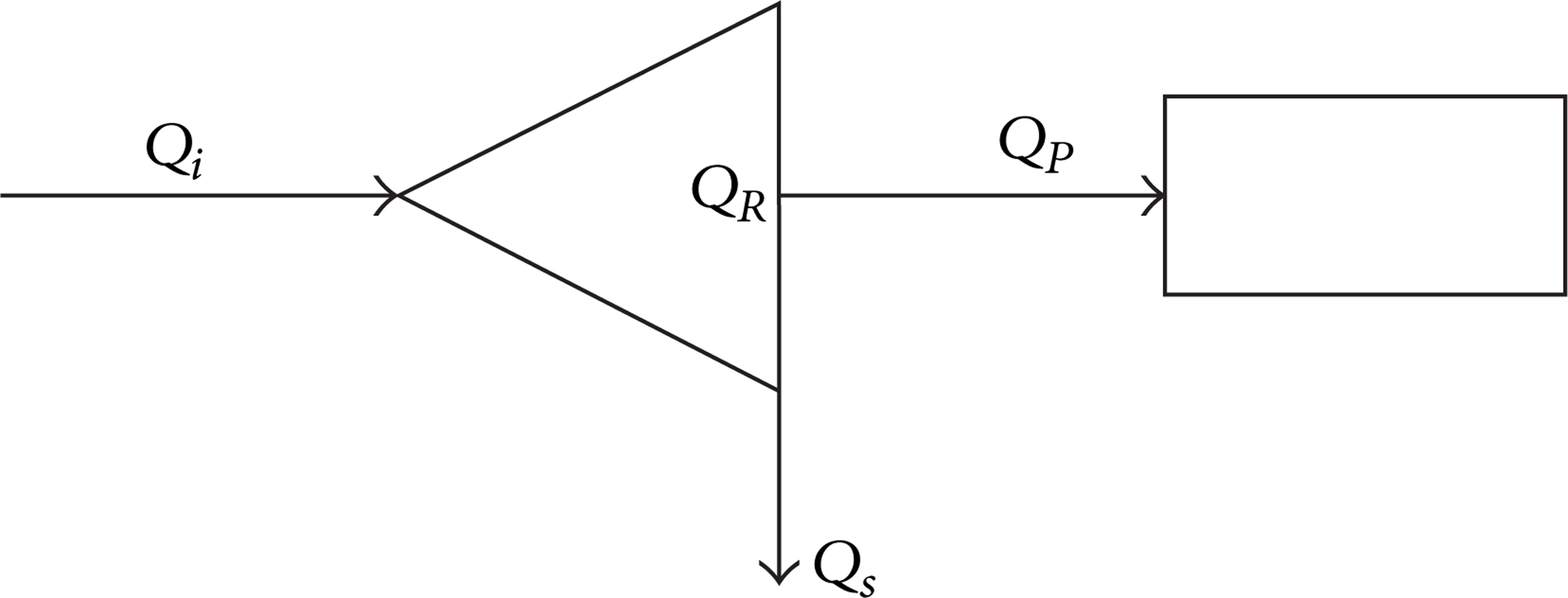
Mass balance of reservoir.
In this equation, Q Rt stands for the amount of water in t period, Q it stands for water coming from the resource, QRt − 1 stands for the amount of water at the (t − 1) moment, Q st stands for overflow water and Q Pt stands for the amount of the water employed for power generation, Qeva stands for the amount of evaporation, and Q L stands for the amount of leakage. Since Q st and Q Pt are not functional during water holding period, the following equation expresses this situation:

Change of the reservoir volume between t1 and t2 (Δt) is stated in

In this equation, Q Re stands for the amount of the water in the reservoir at the end of the water holding period, QR0 stands for the amount of water before the water holding period, and Q ij stands for the amount of water flow from the resource during the water holding period.
As it can be clearly seen from Figure 4, the amount of water required for a specific ΔH increase is dependent on QR0. Amount of water for specific ΔH is less when QR0 is low and higher when QR0 is higher. With increasing load factor, ΔE2 will also increase. The important value that should be known is the amount of water flow from the resource in any given Δt time frame. In order to determine this value, regime fluctuations of the resource should be evident. In Figure 5, annual regime fluctuations and cumulative water amount of the resource are shown. By employing this figure, resource water flow and total amount of water can be determined for any given time frame, by employing these amounts and Figure 4 head boost (ΔH), and also by employing the previously stated equations ΔE1 and ΔE2 can be calculated. Water holding period depending on water holding timing through the year can also be extracted from Figure 5. This period varies seasonally for the same amount of water held. Water holding period is longer in drought season and shorter in rainy season. However, this criterion is not sufficient to determine the advantage of water holding in any given season. Economical evaluation should also be carried out. Power generation during peak demands which have higher unit price would increase the revenue, and thus price should be considered together with water head in order to determine the best generation plan.
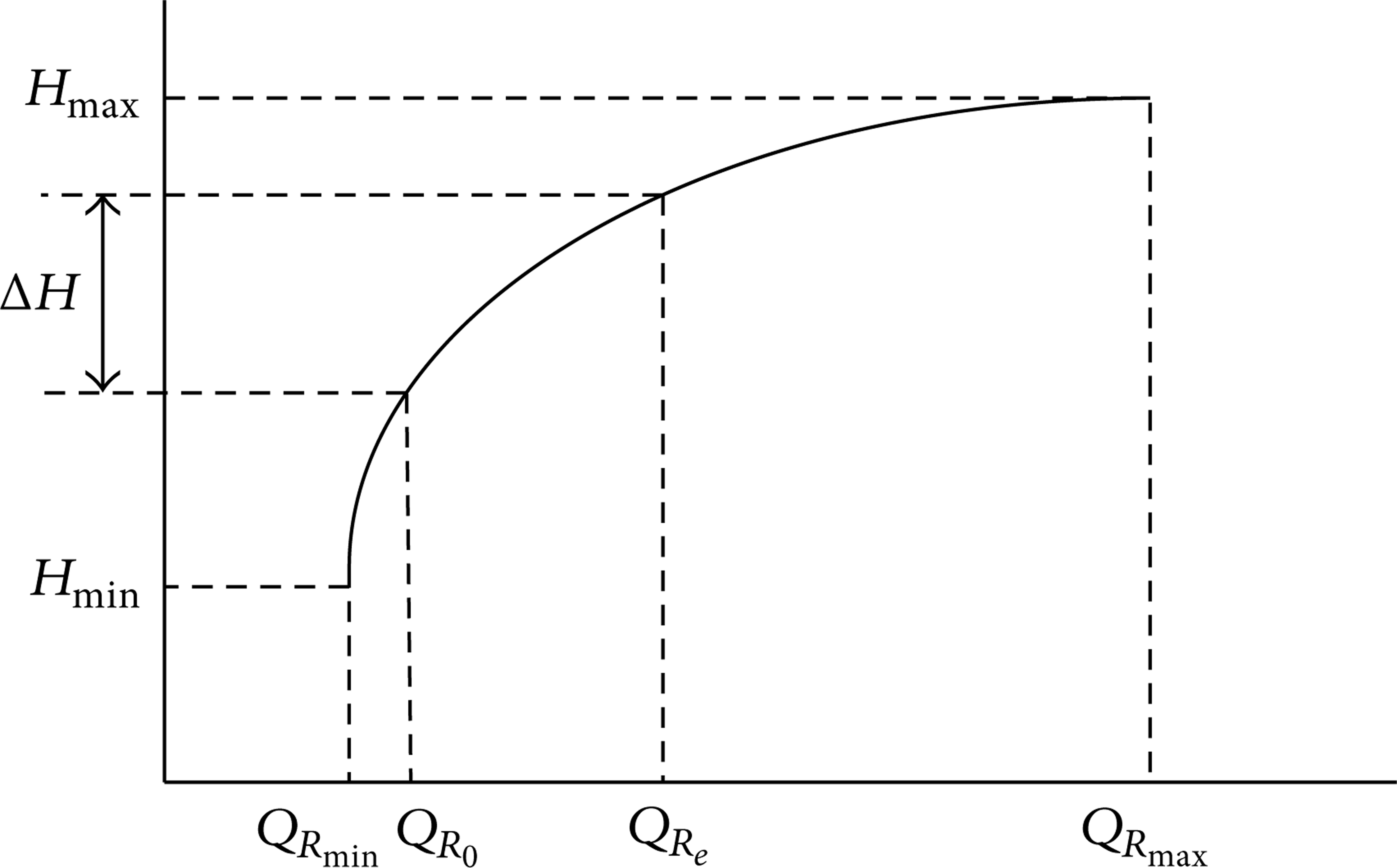
Illustration of head depending on the amount of water in the reservoir.
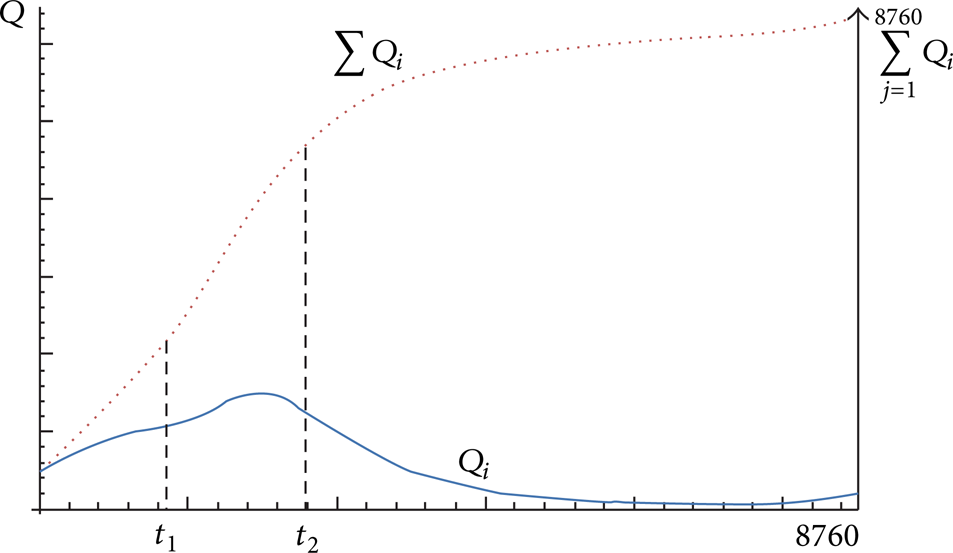
Annual resource regime and cumulative water amount.
Annual revenue increase in the water holding year (ANP) is

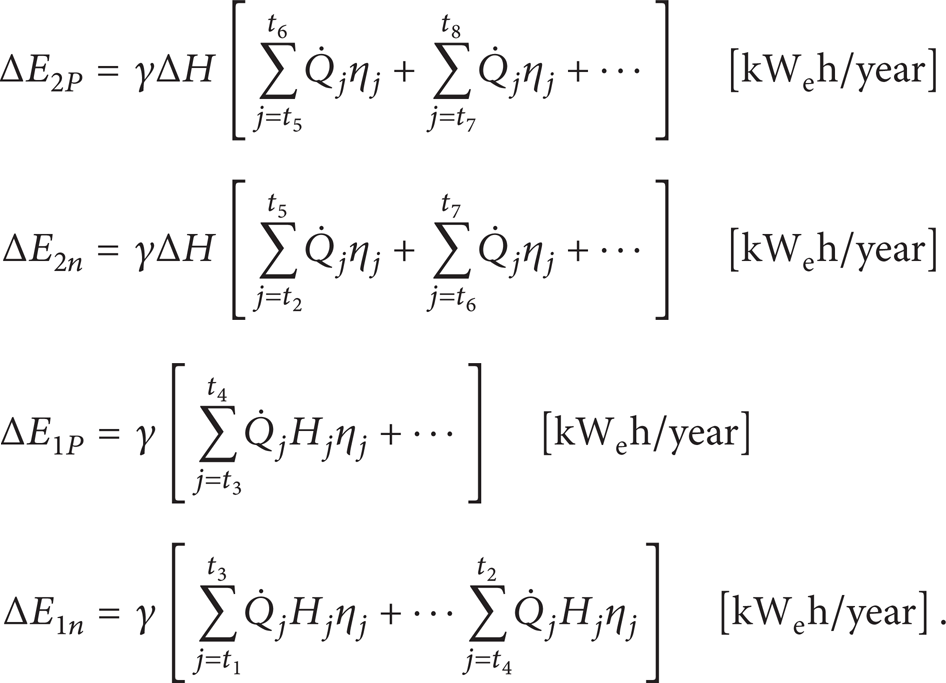
P, stands for peak load, n stands for remaining loads, and Fe stands for unit price of the electricity in the equation. When (10) is evaluated in order to achieve a higher ANP, peak price of electricity should be higher than normal price as much as possible and also share of the generation boost (ΔE2) at peak durations should be higher than the remaining period. For the determination of ANP, shares of peak loads and base loads over the generation periods are very essential data. Thus, ΔE2P, ΔE2n, ΔE1P, and ΔE1n should be found for economical analysis. For this purpose, chronological load-time diagram has been employed (Figure 6). Peak load and base load durations for the water holding period and the remaining period had been determined from this curve and plant generation has been calculated accordingly.

Chronological power generation curve.
Lined areas in Figure 6 express the peak generations. After determining the time frame and magnitude of peak loads, ΔE2P, ΔE2n, ΔE1P and ΔE1n can be calculated by employing plant's flow rate, water head, and efficiency. For these equations, peak and base load indices of Figure 6 had been employed but also arranged to express the overall situation:
ANP can be calculated when these values are executed in (10). Economical benefit of the load factor increasing can be calculated with this method.
As it is obvious from ANP expression, one of the most effective parameters is the peak hours. Thus, an analysis should be conducted to determine the strategy during peak hours, whether to generate power or to hold water. In this section of the paper, economical analysis of 1 m3 water during any given peak hour has been conducted for both generation and water holding operations. Boundary condition of the analysis is a zero ANP. If ANP is greater than zero, water holding is economical and if not, generation during peak hours is more economical. Since peak hour is taken into account for analysis, ΔE1n would be equal to zero in the ANP statement:

Since the analysis is for 1 m3, then

In the equation, H stands for the water head at which power is generated. Water head in case of water holding would be (H + ΔH). Reservoir geometry should be known in order to determine ΔH. If reservoir is assumed to be conical, then surface area of the reservoir (A) can be expressed as a function of reservoirs water head (H R ) (Figure 7).
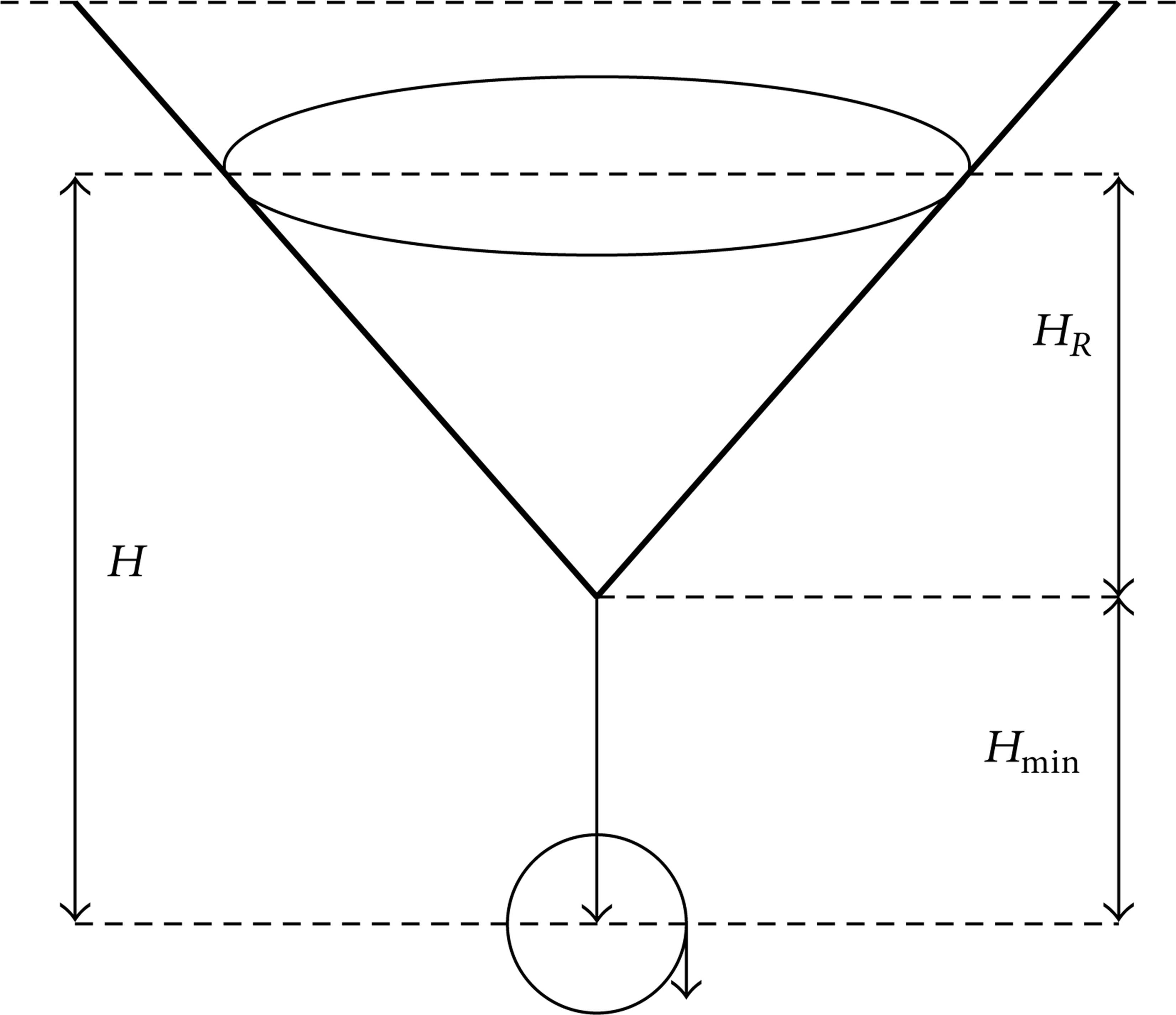
Reservoir.
For A = kH R 2 assumption,

Generation boost due to ΔH in the peak hour by holding 1 m3 water is as follows:

Annual generation has been calculated by employing annual average flow rate and efficiency in the equation. In this case, if annual average price is estimated as F or and generation hours as h, then (12) can be restated as follows:
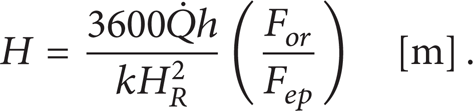
Peak price and optimum water head can be determined when equation is simplified and rearranged (H = H min + H R ) as follows:

Water head change depending on peak price can be seen from (17). Water holding decision depending on peak price can be made with the help of this function.
2.2. Economical Analysis for Long Term Operation
Since the generation and consequent revenue streams would decrease due to longer water holding period at low load factor or during a drought year, evaluations just for a year would not be sufficient always. On the other hand, increased load factor obtained by water holding not only would boost the generation for that specific year, but also would boost generation for the following years. Thus, overall generation period with increased load factor should be taken into account instead of a single year for analysis. Revenue stream increase (ANP) for the water holding year had been calculated in the preceding section of the paper. Net present value (NPW [$]) of the revenue stream increase over the years of interest can be calculated as shown in (12):

P and n indices in the equation stand for peak and base load durations, e stands for price escalation, r stands for discount rate, and s stands for the operation period at this load factor. Expressions in the equations can be calculated by employing chronological load-time curves as implemented in (11). Employing future forecasts to calculate these values is very difficult. For this reason, resource regime for a typical year can be employed to simplify calculations and NPW found.
3. Conclusion
Parameters affecting revenue gain in case of water holding depending on plant operational conditions have been discussed in this section.
Initial water head (H1) at the start of water holding period is an important parameter. Decreasing H1 leads to lower water head for the same amount of water and thus annual power generation decreases accordingly. Since ΔH would increase faster at low H1 values, reserve increase by water holding becomes more critical. At low load factor, more time and water are required to achieve desired water head at desired load factor. Another important parameter that should be considered is coinciding of water holding period with peak and base loads.
Geometry of the reservoir determines the relationship between load factor and water head (Figure 4). This relationship affects water amount required for a specific ΔH and required water holding duration depending on water regime.
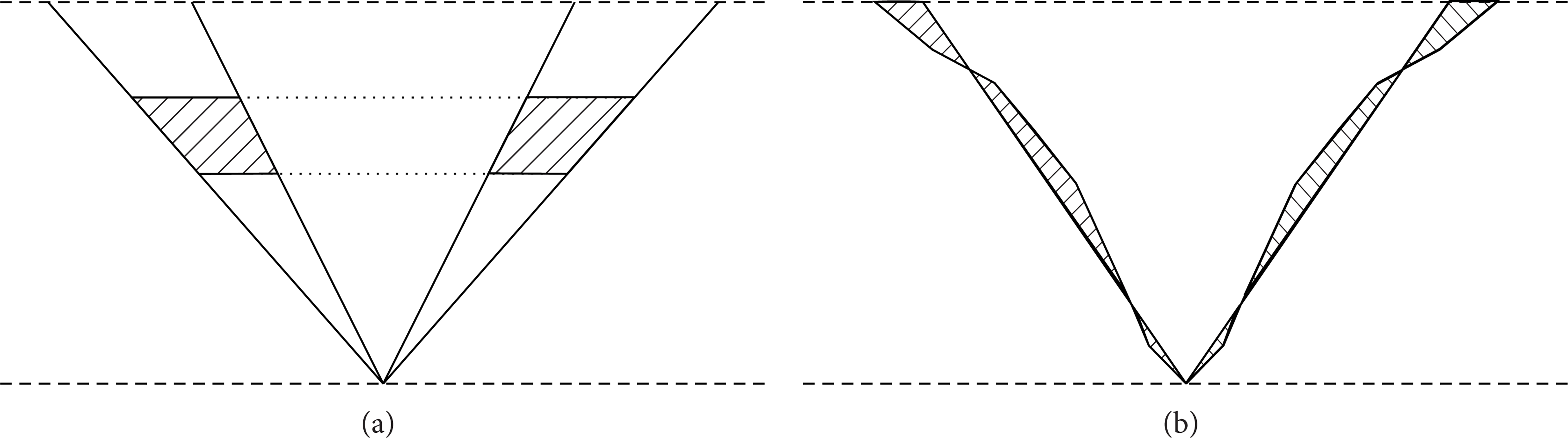
Amount of water required to achieve same ΔH is greater for a plant at the same reservoir height but with a bigger reservoir volume. This would increase the water holding period and amount of water held, resulting in less economical advantage (Figure 8(a)).
Changes in reservoir geometry with increasing height reveal that the existing water head is also very important factor. Amount of water and water holding periods required to achieve same water head would change depending on the geometry. Best water holding intervals can be determined according to this geometry (Figure 8(b)).
Long term operation of a plant at low load factor results in great amounts of revenue stream losses. Benefit achieved as a consequence of water holding strategy has been considered for one year but by preserving same load factor greater benefit can be achieved over the years. This would end up in outstanding revenue stream increases.
Higher load factor decreases sensitivity of head to incoming water flow. For this reason, working with high load factor not only increases power generation but also decreases sensitivity of generation to resource regime and seasonal factors.
Level of ΔH that could be achieved during water holding period is an important parameter. With shorter period and higher ΔH would increase the revenue streams.
Peak hours should be minimized as much as possible during water holding period. Water holding could be implemented for a period, but, depending on resource regime and load, it could also be implemented for multiple periods at different times. Water holding period could be distributed over the base load periods in order to maximize the revenue streams.
It is possible to operate at long term with conditions, which preserve the desired ΔH achieved by a single water holding period. Thus, generation loss during water holding period can be considered as an investment. Long term high performance of the plant and consequent increased revenue streams could be achieved.
Generation loss during water holding period should be covered by other power sources. Even a source at higher cost could be employed for this purpose. This would seem as a disadvantage at first glance, but an optimization study should be conducted depending on the amount of the water held and achieved water head. Final decision should be made according to the results of this study.
Two different electricity price rates as peak and base load had been employed in the study. Depending on local conditions, 3 different rates (peak, medium, and base) would also be valid. In such a case, shares of medium and base loads over the normal operating hours should be determined. Similar to determination of peak and base loads method employed in the analysis, medium and base durations can be determined by employing chronological load-time diagrams. Afterwards, ANP and NPW expressions can be rearranged considering triple rate and analysis can be conducted.
Evaporation increase depending on increasing water surface area and water leakages depending on higher water head had not been considered in the model. If these values are known, they can be included in the analysis.
Different reservoir geometries.
Conflict of Interests
The authors declare that there is no conflict of interests regarding the publication of this paper.