




Abstract
The rheo-squeeze casting (rheo-SQC) combining the rheocasting and the SQC was developed, in which semisolid slurry was produced by the low superheat pouring with a shearing field (LSPSF) process. The three-dimensional morphology of the primary α-Al phase and the rest spacing of slurry prepared by LSPSF process have been reconstructed and visualized, and the microstructures of squeeze cast A356 alloy have been obtained. Based on the three-dimensional microstructure reconstructed, their three-dimensional characterizations such as solid volume fraction and equivalent diameter of the extracted primary α-Al phase of the slurry were measured and calculated. And the microstructures of cross-section of squeeze cast product were investigated. Compared and analyzed the typical microstructure characteristics of parts in different positions produced by SQC and rheo-SQC, the results show that the primary α-Al phase was in the form of enriched dendrites across the whole section of parts produced by SQC. Nevertheless, in the relative case of the rheo-SQC, the whole formations of dendrites have been inhibited effectively, revealing a conspicuous modification in morphology and refinement of the primary α-Al phase. In addition, the solid fraction decreased from the centre to the verge of products along the slurry flow orientation.
1. Introduction
Semisolid metal (SSM) processing has been successfully established as a unique technique for production of metallic components, which can be further divided into rheoforming and thixoforming [1]. Achievement of a uniform fine grain structure in solidified alloys are fascinated as it reduces casting defects and improves structural uniformity, resulting in improved mechanical properties, solid-state forming ability, and various other desirable properties. Up to the present, multifarious processes of semisolid forming have been developed. These include the new rheocasting (NRC) process developed by UBE [2], the twin-screw rheomoulding process developed by BU [3], the serpentine channel process (SCP) developed by USTB [4], the continuous rheoconversion (CRP) process developed by WPI [5], the indirect ultrasonic vibration (IUV) process developed by HUST [6], and the low superheat pouring with a shearing field (LSPSF) and the limited angular oscillation (LAO) process developed by NCU [7, 8]. In this work, the rheo-squeeze casting (rheo-SQC) combining the rheocasting and the SQC was developed, in which semisolid slurry was produced by the low superheat pouring with a shearing field (LSPSF) process. The three-dimensional morphology of the primary α-Al phase and the rest liquid spacing of slurry have been reconstructed, and the microstructure of squeeze cast semisolid A356 alloy has been investigated.
2. Experimental
The rheo-SQC process is a processing technique for producing near net shape components directly from liquid metal. The rheo-SQC equipment mainly consists of a LSPSF unit and a SQC machine, as illustrated in Figure 1. The function of LSPSF unit is to prepare sound semisolid slurry in which the molten metal is rapidly cooled and sufficiently mixed during initial stages of solidification and works in a batch manner, providing semisolid slurry. The SQC machine is used to perform casting tasks using the prepared semisolid slurry.

Vertical semisolid squeeze forming machine.
A356 alloy was investigated in this study. The liquidus temperature of the A356 aluminum alloy is 614°C and solidus temperature 554°C. The experimental alloy was melt and held in a graphite crucible in an electric furnace at 720°C for 45 min. In each experiment, 1.7 kg of molten alloy was transferred into the ladle and slowly cooled down to the predetermined temperature about 640°C. Then the molten alloy was poured immediately into the LSPSF unit preparing slurry unit and was treated through the rotating tube, after which the semisolid slurry was transferred into the feeder of the SQC machine for shape casting. The die temperature was set at 200°C, and the feeder temperature was set at 450°C for all of experiments. As a reference, SQC for test samples was performed, in which about 1.7 kg of molten alloy was transferred into the feeder at a temperature of about 650°C. Figure 2(a) shows the serial products formed by squeeze casting and rheo-squeeze casting, and Figure 2(b) shows single product formed by rheo-squeeze casting.

(a) The serial products formed by SQC and rheo-SQC; (b) single product formed by rheo-SQC.
In addition, semisolid slurry samples, sampled and then quenched in a water pool, were prepared for metallographic analysis and three-dimensional reconstruction of microstructures. Afterwards by using the serial sectioning technique, the three-dimensional morphology of the primary α-Al phase and rest spacing of slurry were reconstructed. All of steps were shown in Figure 3. At the steps of preparation, 60 original metallographic images were obtained such as the first layer as shown in Figure 4. The stack of aligned serial section images would essentially be obtained at the original step of the reconstruction. The 60 original metallographic images were imported into the image processing software (Photoshop) for obtaining serial section images as shown in Figure 5. Then translational and rotational realignment was adjusted according to the position of hardness impression in the images as shown in Figure 4. After that the region was selected and segmented for reconstruction as shown in Figure 6. In the next step, images enhancement and feature extraction of primary α phase such as image segmentation were preprocessed as shown in Figure 7, respectively. The 60 images of feature extraction were obtained as shown in Figure 8. In the last step, the 60 images of feature extraction were imported into the three-dimension software (Mimics) for reconstruction and visualization and then measured and calculated.

Flow chart summarizing the methodical steps from the metallographic preparation to 3D reconstruction and visualization.

The first layer of metallographic image.

The layers of serial section images.

The first layer of region selected and segmented.

The first layer feature extraction of primary α phase.
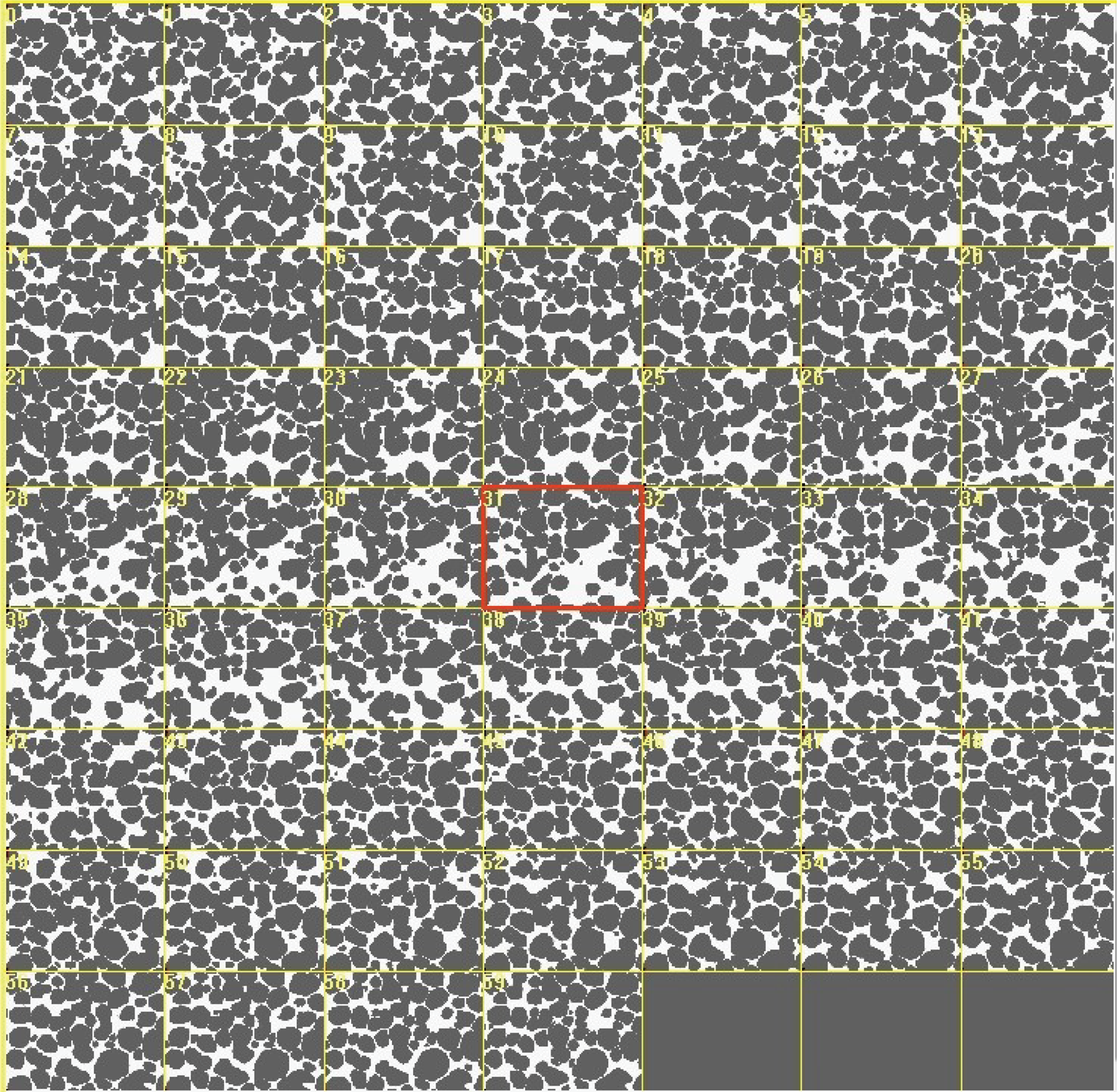
The 60 images of feature extraction of primary α phase.
3. Results and Discussion
3.1. Reconstruction and Visualization of Three-Dimensional Microstructure
In the present work, the montage serial section contained 60 successive microstructural fields of view grabbed at 100x. The 3D microstructure visualization can be achieved by volume rendering after reconstruction. Therefore, the resulting 3D data sets are useful for characterization and visualization of spatial distribution of the primary α-Al phase and the rest spacing of slurry. Figure 9(a) shows a segment of volume rendered 3D microstructure. The volume rendered visualization is useful for implementation of the 3D microstructure images in the simulation of rheological characteristics. Figures 9(b) and 9(c) show the extracted primary α-Al phase and the rest spacing, respectively, and their three-dimensional characterizations such as volume fraction and equivalent diameter of the extracted primary α-Al phase were measured and calculated. The results are 70.5% and 92.4 μm, respectively. Figure 9(d) shows the cross-section of reconstructed 3D microstructure of the primary α-Al phase. More microstructure characterization would be obtained from those cross-sections of different orientations. Figure 9(e) shows the reconstructed 3D characterization of single primary α-Al phase. And the volume, superficial area, and equivalent diameter of the extracted single primary α-Al phase were measured and calculated. The results are 514871 μm3, 33080 μm2, and 99.5 μm, respectively.

Three-dimensional morphology of slurry: (a) the segment of volume rendered reconstructed 3D microstructure of slurry; ((b) and (c)) the segments of reconstructed 3D microstructure depicting primary α-Al phase and rest spacing; (d) the cross-section of reconstructed 3D microstructure of the primary α-Al phase; (e) the reconstructed 3D characterization of single primary α-Al phase.
3.2. Microstructure Characteristics
Figures 10(a) to 10(c) show the typical microstructure produced by SQC. The primary α-Al phase was in the form of enriched dendrites across the whole section. Three distinct regions in the microstructure are analyzed. Firstly, as shown in Figure 10(c), there contain bulky and coarse dendrites in the centre region. Then as shown in Figure 10(b), including large primary dendrites but more eutectic part in connecting position. Lastly as shown in Figure 10(a), the primary α-Al phase is present a more vimineous dendritic grain. Nevertheless, in the relative case of the rheo-SQC, the whole formations of dendrites have been inhibited effectively, as shown in Figures 10(e) to 10(g), revealing a conspicuous modification in morphology and refinement of the primary α-Al phase. The primary α-Al phase is uniformly scattered across the whole product. The representative dendritic morphology grabbed as shown in Figures 10(a) to 10(c) for SQC is restricted in the rheo-SQC processed product. The morphology of the primary α-Al changed from the dendritic morphology to the predominantly globular shape by treatment from LSPSF unit in rheo-SQC processes. The molten flowing through the rotating tube and thermal transfer during LSPSF unit had been analyzed. The rotating tube was revolved consecutively with a given rotating speed on its axis, and the molten in LSPSF unit is characterized by positive shearing and mixing. During LSPSF unit, there is a vast amount of consecutive shifting interface area, providing reinforced heat transfer and fortified mixing. Therefore the LSPSF unit function can promote the heterogeneous nucleation of the primary α-Al phase, resulting in finer and more uniform primary α-Al grains. In addition, the solid fraction decreased from the centre to the verge of products due to the influence of primary α-Al phase. The flow velocity of primary α-Al phase was less than the liquid phase due to the influence of primary α-Al phase welded together. These welds formed under the pressure during the slurry flowed from the feeder through the centre to the verge of the cavity as shown in Figure 10(d).

The typical microstructures of A356 alloy produce by SQC ((a)–(c)) and by rheo-SQC ((e)–(g)); cross-section of product (d).
4. Conclusions
(1) Squeeze casting using semisolid slurry produced by LSPSF unit has been developed. Complete products with fine and uniform microstructure and little defects have been produced. (2) The results show that the primary α-Al phase was in the form of enriched dendrites across the whole section of parts produced by SQC. Nevertheless, in the relative case of the rheo-SQC, the whole formations of dendrites have been inhibited effectively, revealing a conspicuous modification in morphology and refinement of the primary α-Al phase. In addition, the solid fraction decreased from the centre to the verge of products along the slurry flow orientation.
(3) The three-dimensional morphology of the primary α-Al phase and the rest liquid spacing of slurry prepared by LSPSF process have been reconstructed and visualized. Their three-dimensional characterizations such as solid volume fraction and equivalent diameter were measured and calculated. The results are 70.5% and 92.4 μm, respectively. And the volume, superficial area, and equivalent diameter of the extracted single grain are 514871 μm3, 33080 μm2, and 99.5 μm, respectively. Further works should be done, involving the relationship between the three-dimensional characterizations and the rheological properties of the slurry, ultimate tensile strength, and elongation of semisolid cast samples investigated, optimizing rheo-SQC process for further improvement of process stability and mechanical properties of produced parts. And more typical aluminium alloys and magnesium alloys which are suitable to be rheo-squeeze-casted should be developed.
Conflict of Interests
The authors declare that there is no conflict of interests regarding the publication of this paper.
Footnotes
Acknowledgments
Financial support from the National Natural Science Foundation of China (51261019) and the Specialized Research Fund for the Doctoral Program of Higher Education (20113601110008) is gratefully acknowledged. The authors would like to express special thanks to Mr. Shuguo Zhang, Longfu Zhou, Lijun Wang, and Fengli Yu for the help in experiments.