




Abstract
Typical challenges that manufacturing enterprises are facing now are compounded by lack of timely, accurate, and consistent information of manufacturing resources. As a result, it is difficult to analyze the real-time production performance for the shop-floor. In this paper, the definition and overall architecture of the internet of manufacturing things is presented to provide a new paradigm by extending the techniques of internet of things (IoT) to manufacturing field. Under this architecture, the real-time primitive events which occurred at different manufacturing things such as operators, machines, pallets, key materials, and so forth can be easily sensed. Based on these distributed primitive events, a critical event model is established to automatically analyze the real-time production performance. Here, the up-level production performance analysis is regarded as a series of critical events, and the real-time value of each critical event can be easily calculated according to the logical and sequence relationships among these multilevel events. Finally, a case study is used to illustrate how to apply the designed methods to analyze the real-time production performance.
1. Introduction
Recent developments in wireless sensors, communication, and information network technologies (e.g., radio frequency identification-RFID or Auto-ID, Bluetooth, Wi-Fi, etc.) have created a new era of the internet of things (IoT). The term of the IoT has first been proposed by Kevin [1]. It refers to uniquely identifiable objects (things) and their virtual representations in an Internet-alike structure.
According to our investigation of several collaborative manufacturing enterprises, typical challenges that they are facing now are compounded by lack of timely, accurate, and consistent information of distributed manufacturing resources during manufacturing execution. In order to improve the rapid response and optimal decision of shop-floor level, real-time manufacturing data and information tracking and tracing play a significant role [2–4]. Automated identification, as the core technique of IoT, has been widely adapted to shop-floor for capturing the real-time data.
Two streams of literature are relevant to this research. They are real-time production management technique and real-time manufacturing information capturing. In the field of real-time production management technique, Huang et al. [2] designed a RFID-based wireless manufacturing for walking-worker assembly shops with fixed-position layouts. Considering the difference businesses in different companies, in our previous work, Zhang et al. presented an agent-based workflow management strategy [3] and a smart objects management system [4] for RFID-enabled real-time reconfigurable manufacturing. By extending and adopting the concept of cloud computing for manufacturing, Wang and Xu [5] proposed an interoperable manufacturing perspective. Huang et al. [6] discussed a conceptual WM framework by using the RFID technology to collect and manage the real-time data from manufacturing shop-floors. Equipped with active RFID tags, an innovative and ecological packaging/transporting unit named MT has been implemented by the Spanish company Ecomovistand for the grocery supply chain [7]. Zhang et al. [8] designed an RFID-based smart Kanban system to implement just in time (JIT) production and control the work in progress (WIP) stock. In the field of real-time manufacturing information capturing, Zang and Fan [9] implemented an event processing mechanism in enterprise information systems based on RFID, including the architecture, data structures, optimization strategies, and algorithm to address the challenges posed by the fast moving market. Jiang et al. [10] presented an “event-triggering time-state” graphical schema-based operation model for describing and formalizing material flow. Fang et al. [11] presented an event-driven shop-floor work in progress (WIP) management platform for creating a ubiquitous manufacturing (UM) environment to process the huge amount of RFID data into useful information for managerial uses. Zappia et al. [12] proposed a lightweight and extensible complex event processing system based on a layered architectural design to extract meaningful events from raw data streams originated by sensing infrastructures. Li et al. [13] presented a hybrid method of mixture of Gaussian hidden Markov model (MG-HMM) and fixed size least squares support vector regression (FS-LSSVR) for fault prognostic in equipment health management system. Xu and Liu [14] proposed a smart metering network system based on the IPv6 network protocol and ZigBee protocol for residential power measurement. Li et al. [15] proposed a fault diagnosis method combining wavelet packet decomposition (WPD) and support vector machine (SVM) for monitoring belt conveyors with the focus on the detection of idler faults. Based on the traditional theodolite measuring methods, Wu and Wang [16] introduced the mechanism of vision measurement principle and presented a novel automatic measurement method for large-scale space and large work pieces (equipment) combined with the laser theodolite measuring and vision guiding technologies.
The above researches have provided the advanced conception and technologies for improving the real-time management for production process. However, in the framework of [2], it is only responsible for one application (e.g., assembly shops) in applying RFID technique. It means the framework may be redesigned if the application is changed. In some frameworks in [3, 5], the conception is good. But how to easily apply the concept design into real-life manufacturing plants should be further investigated. For the real-time manufacturing information processing, the event model has been widely adopted as seen in [9–12]. References [13–16] describe some predicted models for manufacturing exceptions. Obviously, the event model has advantages in dealing with the events which occurred at the Auto-ID devices. However, in this research, for the purpose of analyzing the dynamical performance of the production process, some value-added information processing method should be designed based on the events. And the hierarchy and processing model of the different level events should be further classified and systematically designed.
According to the analysis of the above researches, the following challenges may exist in many real-life manufacturing companies in applying IoT technologies. The first challenge is to establish an overall architecture to form an active sensing manufacturing environment and to timely monitor, control, and optimize the production process by introducing Auto-ID devices to traditional manufacturing things. The second challenge is to build up an events-driven real-time production performance analysis model to process the huge real-time data captured by distributed Auto-ID devices to meaningful and value-added manufacturing information. The third challenge is to design the corresponding process method and procedures to calculate the real-time critical event related to production performance based on the captured manufacturing data.
Considering the advantages of IoT, in this paper, an overall architecture of the IoMT is presented to provide a new paradigm by extending the IoT to the manufacturing field. In contrast to previous framework, the proposed IoMT aims to design an easy to deployment infrastructure to form an active sensing manufacturing environment and to timely monitor, control, and optimize the production process. Under this architecture, the manufacturing things such as operators, machines, pallets, and materials can be embedded with sensors to interact with each other. Then, an event model is adopted to implement the real-time production performance analysis, which may provide important manufacturing information for up-level decision. The presented model and method of this research will improve shop-floor productivity and quality, reduce the wastes of manufacturing resources, cut the costs in manufacturing system, reduce the risk, and improve the efficiency of online supervision and the responsiveness to production changes.
The rest of the paper is organized as follows. Section 2 describes the definition and overall architecture of the internet of manufacturing things. The real-time production performance analysis model and method are designed in Section 3. Section 4 illustrates how to apply the designed critical event model to implement the real-time production performance analysis under the architecture of the internet of manufacturing things. Conclusions and future works are given in Section 5.
2. Overview of the Internet of Manufacturing Things
2.1. The Definition of IoMT
Before giving the definition of IoMT, it is better to define the manufacturing things first. In this research the manufacturing things are the physical manufacturing objects used to convert raw materials, components, or parts into finished products. For example, the man, machine, work in progress (WIP) items, tools, forklift, pallet, and so forth are typical manufacturing things.
IoMT is defined as multisource real-time manufacturing information driven optimal management system for shop-floors. It is used to timely monitor and optimally control the process from the production orders assigned to the shop-floors until the required WIP/products are produced. The multisource manufacturing information of the various manufacturing resources could be connected and timely sensed each other by introducing the IoT technologies (e.g., RFID, Auto-ID) to traditional manufacturing shop-floors. IoMT includes two main parts, hardware and software. In terms of hardware, IoMT includes a number of Auto-ID devices which are used to automatically capture the multisource manufacturing data. In terms of software, IoMT integrates a series of application services to provide decision supports (e.g., real-time scheduling) for process control based on the captured real-time manufacturing data.
2.2. A Referenced Architecture of IoMT
Based on the above definition, a referenced architecture of IoMT is designed as seen in Figure 1. It aims to build up a referenced real-time information capturing and integration framework to implement dynamical monitoring and controlling during the manufacturing execution stage.
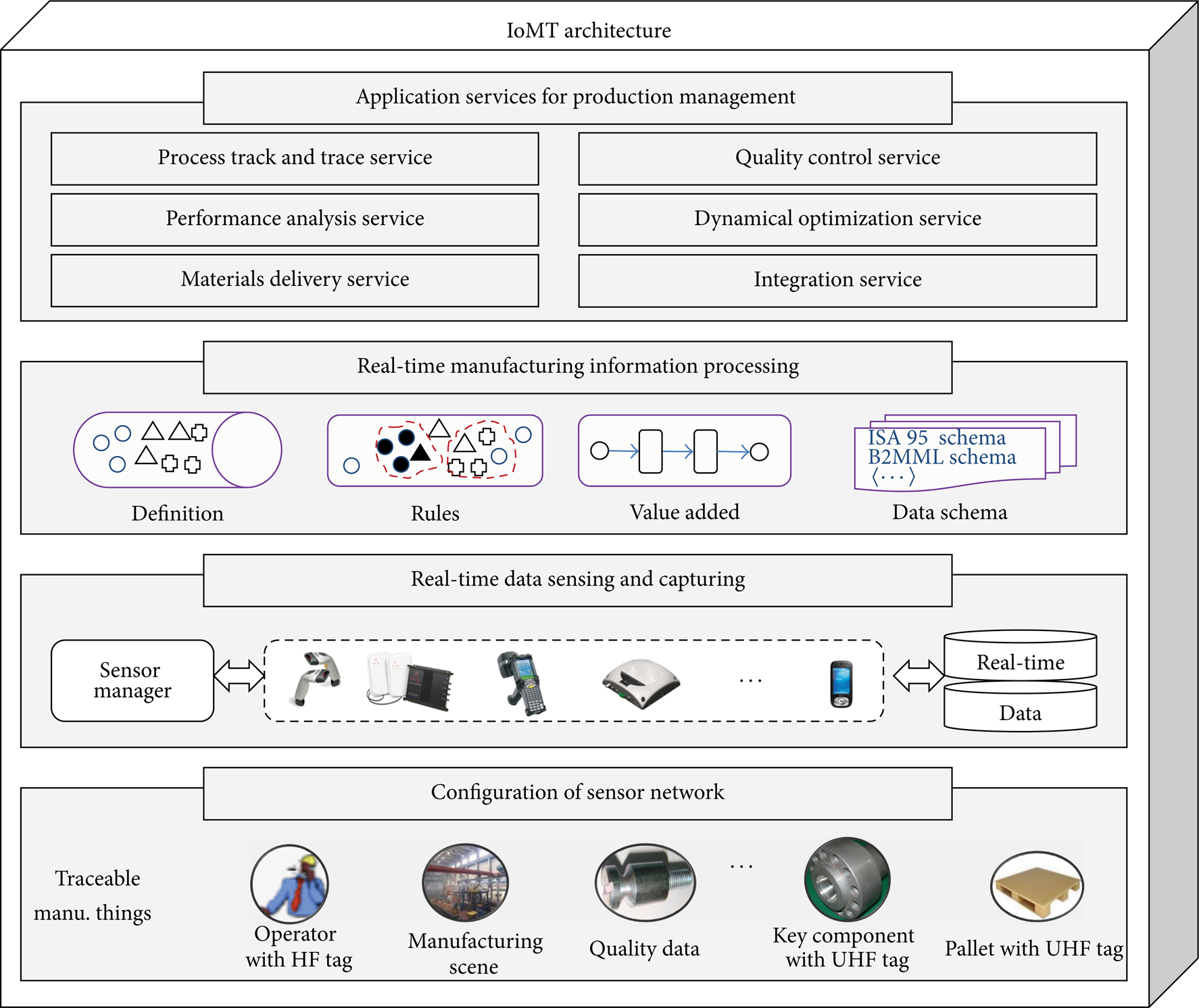
Overall architecture of IoMT.
Under this architecture, the dynamical parameters such as movement and real-time status of the manufacturing things can be timely sensed. Then, the real-time production performance can be dynamically monitored and analyzed. The proposed IoMT consists of four parts from the bottom to the top, namely, configuration of sensor networks, real-time data sensing and capturing, real-time manufacturing information processing, and applications services.
Configuration of sensor networks is responsible for building up a low-cost and a high-reliability sensing manufacturing environment for capturing the real-time manufacturing data. Based on the configuration result, the real-time data of manufacturing things during production process can be sensed and captured. For example, when a manufacturing thing comes to a sensing area, this event can be sensed by the registered sensor. Through the communication protocol, the sensor can capture the data of the coming manufacturing things. In this module, the sensor manager (SM) is used to centrally manage the different sensors and transmit the real-time data through web service technology. Manufacturing information processing is used to process the insignificant data captured by sensors to form meaningful manufacturing information. It includes four modules, namely, definition, rules, value-added, and data schema. The definition module is used to establish the manufacturing things and the sensors. Then, the changed data of manufacturing things can be timely captured by the auto-ID sensors. Rules module is used to classify the real-time data of different types of manufacturing things (e.g., man, machine, WIP items, tools, etc.). Value-added module is used to further calculate the distributed manufacturing data to form more meaningful information for up-level decision. Data schema module is responsible for providing a standard schema for real-time manufacturing information so that it can be easily shared and integrated in heterogeneous enterprise information systems. Application services are used to provide the upper level monitor and control of the manufacturing execution based on the real-time manufacturing information. Six types of services, namely, process track and trace service, production performance analysis service, materials delivery service, quality control service, dynamical optimization service, and integration with other enterprise information systems service, are designed in this module. These services can work as an independent tool, as well as a plug-in unit integrated with the third part systems.
3. Critical Event Based Real-Time Production Performance Analysis Model
3.1. Real-Time Production Performance Analysis Model
Figure 2 shows the model of critical event based real-time production performance analysis under the IoMT architecture. It includes three main modules.

Real-time production performance analysis model.
The first module is real-time production data collection. It is used to capture the real-time data of distributed manufacturing things embedded with smart sensors. The second module is information extracting process. In this module, the multilevel event model is used to process the distributed manufacturing data of the primitive events to meaningful manufacturing information. Four types of events (Primitive Event, Basic Event, Complex Event, and Critical Event) are involved in this research, which will be described in Section 3.2. The third module is real-time production performance analysis module. It is used to establish the relationships between the key performance monitor points and the relevant primitive events, and then the value of the key production performance could be easily calculated once primitive events occur at the corresponding manufacturing things.
3.2. Critical Event Based Real-Time Key Production Performance Analysis Method
Because each key production performance monitor point can be regarded as a critical event, in this section, the hierarchy and extraction process of critical event will be described in detail.
3.2.1. The Hierarchy of Critical Event
The key issue of event process is a precise event model, which reflects the different stages of event processing. In order to extract the useful information effectively, this paper divides the event process into four layers, as seen in Figure 3.

The hierarchy of the multilevel event.
Primitive events (PE) are events generated during the interaction between readers and tagged objects. Because of the high speed and automatic reading when the reader reads the tags, it is unavoidable to receive a high volume of data. However, those data are often missed and duplicated reading, and unreliable readings may cause outliers; the primitive events must be preprocessed in order to provide enough-quality data.
Definition 1. Primitive events can be defined as PE = (r, o, t), where r represents the reader_ID which is unique “String” type, o represents the content of the object (e.g., a tag), and t represents the observation time.
Basic events (BE) are events generated by the aggregation of cleaned data, which reflect the real-time space or space change of one or one class of product. While the cleaned primitive data is too fine-grained and still uncorrelated, they bear no business meaning and applications may only be interested in the case when an object enters one area (infield), when an object leaves the area (outfield), how long the object stays in the area (stay), and how many objects exist in one area (collected) in order to update real-time WIP situation automatically. The first three kinds of events infer the objects flow through one area, while the last infers the number of one kind of material.
Definition 2. Basic events can be defined as BE i,j k = (e or es, location, ts, te, context), j = (1, 2, 3, 4), i = (1,…, m), k = (1,…, n).
Here BE i,j k represents jth event of location i for material k; m and n are the total number of the readers and materials. E or es represent the EPC of object; location represents the location where event happens. Ts and te represent the start and end time, and ts equals te when the event is temporal event (e.g., infield, outfield, collected event). Context is used to interpret the event.
Complex events (CE) are events that reflect one class of product processing state, such as the progress of an assembly and the accept event of a product. While the basic events represent the time and space condition and have relation between each other according to the complex event rule, they can be used to acquire the status of complex events.
Definition 3. Complex events can be defined as CE = (CE_ID, Attributes, Context, Time), where CE_ID is the unique ID of event, Attributes stand for the attributes of the event, such as the event hierarchy, Context specifies the context information needed to describe the complex event, including the material and the process ID, or the relation between subevents, and Time is the point when event occurs and it can be a time point or a period of time.
Critical events (CrE) are methodically defined composite, high-level events; its state change will have a critical significance and often infers the change of shop-floor manufacture resources performance. The event can be diverse sides of the shop-floor according to the different needs of various applications, for example, the total cost of product and the overall operation status of machine.
Definition 4. Critical events can be defined as CrE = (CrE_ID, Attributes, Context, Time), where CrE_ID is the unique ID of the critical event, Attributes stand for the attributes of the event, Context specifies the context information needed to describe the critical event, and Time is the time when event occurs.
3.2.2. Extraction Process of Critical Event
The event hierarchy reflects the extraction process, which can be understood as a sequence of event processing steps. Based on the ECA rules and the SQL query language, this section gives the universal algorithm to acquire the upper level event.
(1) The Extraction Process of Basic Event. Basic events are derived by mapping the primitive data to space change data; for example, we can acquire the “Infield event” when the object is read for the first time, the “out event” when the smart object is read for the last time, the “stay event” based on the above two events, and the “collected event” based on the object read by the same reader at one time. The extraction process from primitive event to basic event can be described by the pseudo code shown in Algorithm 1.
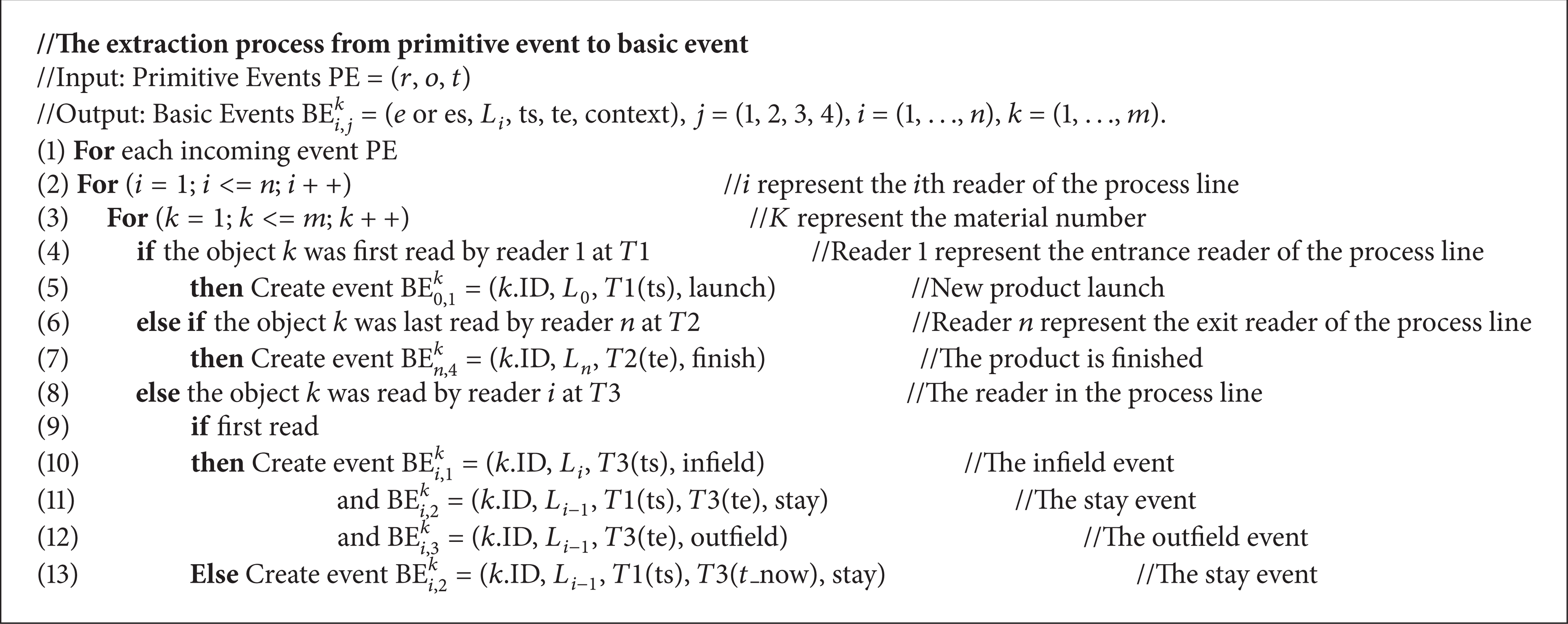
The extraction process from primitive event to basic event.
(2) The Extraction Process of Complex Event. To acquire the complex event, the process rule is the key issue. The rules can be acquired according to the inherent logical relationship of the basic events; for example, we can acquire the logistic of the material according to the read record based on its ID. Meanwhile the rules can also be defined by the application level, such that we can Figure out whether product is acceptable according to the direction after the detection process. Once the basic event is acquired, if the complex rule is ready, they will be processed to the complex event instances based on the algorithm shown in Algorithm 2.

The extraction process from primitive event to basic event.
(3) The Extraction Process of Critical Event. The critical event is composed of several complex events. To acquire the key monitor points, while the complex events represent one aspect of the process status of product, combined with the plan information, they can be aggregated to acquire the key monitor points according to the different needs of various level applications. The extraction process of progress and deviation from complex event to critical event can be described by the pseudo code shown in Algorithm 3.

The extraction process from complex event to critical event.
4. Application of Critical Event Based Real-Time Production Performance Analysis
This section presents an industrial case study on applying the proposed event model to a shop-floor to analyze its key production performance.
4.1. Description of the Case
The designed shop-floor has a complicated structure in the sense that numerous components are involved in the product assembly. However, it can be simplified into three major assembly lines: assembly line 1 which has two parts processed in the shop-floor, assembly 2 with one part processed in the shop-floor, and the final assembly procedure, while many parts and accessories manufactured are outsourced to suppliers and shareholding subsidiaries. All of the three parts have three processes, and both of the assembly processes were composed of two procedures, as shown in Figure 4.

Configuration of the internet of manufacturing things.
4.2. Real-Time Production Performance Analysis
4.2.1. Real-Time Progress and Deviation Analysis
The progress and deviation (PaD) is an important aspect of production management. The real process time can be acquired by querying the basic events, so the progress of assembly or product can be obtained according to the hierarchy relationship of the process. Compared with the plan process time, the deviation which can be acquired by the equation “the deviation time/the plan time” can be obtained.
The complex event that represents PaD of assembly can be represented as
CE_PaDh = (CE_ID, assemblyh.ID, p h , d h ),
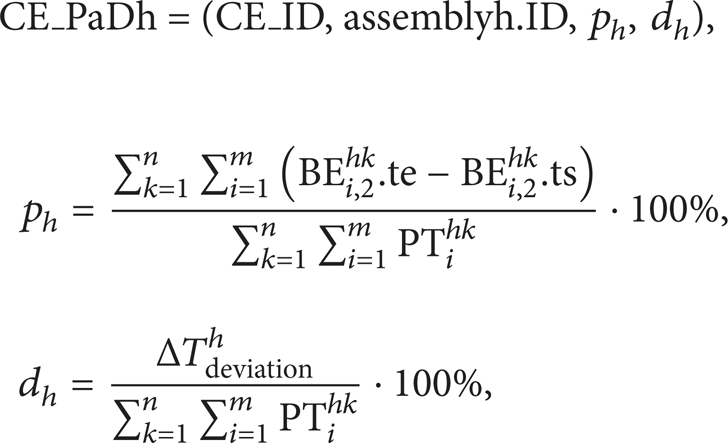
where CE_ID is the unique ID of the complex event assembly, ID is the unique ID of the assembly, BEi, 2 hk is the stay event of part hk, ts and te are the infield and outfield time, p h is the progress of the assembly, d h is the deviation, and PT is the process time in plan.
The critical event that represents the PaD of product can be represented as
Critical Event CrE = (CrE_ID, Product.ID, p, d), where
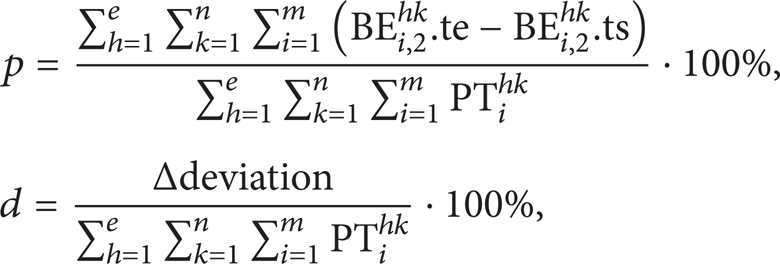
where CrE_ID is the unique ID of the critical event, p is the progress of the assembly, and d is the deviation. Figure 5(a) shows the real-time progress and deviation analysis of this case.

The screens of the developed production performance analysis prototype.
4.2.2. Real-Time Cost Analysis
There are two kinds of product cost: the fixed cost and the variable cost; the fixed cost is the salary, energy, and machine cost, which is often shared by every product at end. The variable cost is the cost related to the manufacture process including the logistic cost, the material cost, and the manufacture cost. The logistic and the manufacture cost can be computed by the logistic or the manufacture time, and the material cost is added if we detect the material that was used.
The logistic cost is the cost generated in the logistic process. The logistic time can be acquired from the sensor events according to the object ID; then, we can know the logistic cost combined with the unit time logistic cost (Clogistic). The complex event can be descripted as
CE_LC = (CE_ID, logistic cost, product.ID, cost, T), where

The manufacture cost is computed by the unit manufacture cost of machines (Cmanufacture i ) and the stay time in the machine. It can be descripted as
CE_ManC = (CE_ID, manufacture cost, product.ID, cost, T), where

The material cost can be got by searching the material that the product has used and the price of used material (Material i hk ). Then, it can be represented as
CE_MatC = (CE_ID, material cost, product.ID, cost, T), where

The critical event that reflect total variable cost of product can be depicted as
CrE_PC = (CrE_ID, product cost, product.ID, cost, T), where

Figure 5(b) shows the real-time cost analysis of this case.
4.2.3. Real-Time Quality Analysis
The complex event of single WIP can be represented as

Then we can have the collected events based on CE_pc. status. Here, we give the event reflect the accept process; the reject and remanufacture situation is similar.
Consider the following:

where CE_PC i .status = accept and size is the quantity of accept events.
Finally, we can have the pass condition of process I, represented as

where

Figure 5(c) shows the real-time quality analysis of the developed prototype for this case.
4.2.4. Discussion of Reducing the Deviations
The deviations between the real-time performances (e.g., progress, cost, and quality) and those of planned targets could be timely calculated by the proposed method. It provides important information and inputs for further decision. The optimization strategy and method can be used to reduce the deviations. For example, if the progress deviates from the target far away, an outsourcing strategy should be considered to reduce the deviation. If the progress deviation is controllable, a rescheduling method should be used to reorganize the manufacturing resources to reduce the deviation.
5. Conclusion
Real-time production performance analysis plays an important role. Currently, due to the lack of real-time status information of the manufacturing resources, it is very difficult to evaluate the runtime key production performances which provide significant information for up-level production decisions. Therefore, applying the IoT concept and multievent based real-time monitor of the production process to manufacturing system could improve the online supervision, shop-floor productivity and quality, reduce the wastes of manufacturing resources, and cut the costs in manufacturing system.
This paper has described an overall architecture of the internet of manufacturing things to sense the changed status of distributed manufacturing things and provide the real-time data driven application services for improving the performance of the manufacturing system. Three contributions are important in this research. The first contribution is the definition and architecture of the internet of manufacturing things (IoMT). The designed IoMT and its key components can be used to sense the real-time manufacturing data of the manufacturing things such as operators, machines, pallets, and materials and process and exchange the real-time information in the heterogeneous enterprise information systems. The second contribution is the critical event based real-time production performance analysis model, which aims to establish the logical relationships between the key production performance monitor point and the distributed primitive events which occurred at the distributed manufacturing things. Then, the real-time value of each key production performance monitor point could be easily calculated. The third contribution is the application of three key production performance monitor points, namely, real-time progress and deviation analysis, real-time cost analysis, and real-time quality analysis. The prototype illustrates the feasibility of the model and method designed in this research.
Future works will focus mainly on how to predict the new trend of the manufacturing system according to the real-time production performance information. In addition, the integration of this research with the real-time data driven production scheduling method is also considered.
Conflict of Interests
The authors declare that there is no conflict of interests regarding the publication of this paper.
Footnotes
Acknowledgments
The authors would like to acknowledge financial supports of National Science Foundation of China (51175435), the Program for New Century Excellent Talents in University (NCET-12-0463), the Doctoral Fund of Ministry of Education of China (20136102110022), and the 111 Project Grant (B13044) of NPU.