




Abstract
The processes of heat and mass transfer accompanied by phase changes and chemical reactions are numerically modeled for the ignition of a liquid droplet formed from a condensed substance hitting the surface of a high-temperature metallic plate (substrate). The time delay of a droplet ignition is determined as well as the influence scope of a substrate, droplet, and oxidizer temperature, together with sizes and speed of droplet spreading on the ignition response. Conditions are revealed when spreading and deformation of a liquid droplet dominate during the ignition process.
1. Introduction
The processes of deformation and spreading of liquid droplets on solid surfaces are usually investigated theoretically [1–5]. The experimental research is complicated by the high rates of the physical processes, chemical reactions, and low thermal effects [6, 7]. Currently there are a group of mathematical models describing heat and mass transfer of liquid droplet spreading on the substrate surface, which consider processes of solidification, deformation, rollback, and bounce of droplets [4–6]. It is known investigation results [8] where the liquid fuel droplet is ignited at the colliding with massive hot bodies. However, available models [8] do not consider an important factor such as spreading a liquid droplet over a hot surface before ignition. Thus, this paper analyzes a complex of interrelated heat and mass transfer processes at the ignition of typical liquid fuel droplet and considering a process of it spreading over the surface of a massive hot object (substrate).
Systems comprising “liquid substance droplet-massive heated substrate” are widely used in defining kinetic and dynamic characteristics of physical and chemical transformations for various applications (evaporators, heaters, special thermal furnaces, aircrafts, ballistic ranges, spacecrafts, etc.). Consequently, it is necessary to have physical and mathematical models describing real processes with maximum approximation for the analysis of influence of heat and mass transfer processes and phase changes on the macroscopic level. Based on these models it will be possible to create a theoretical framework and as a result a mathematical apparatus for defining possible modes and critical and optimal conditions for the ignition process.
The present work is aimed at numerical modeling of heat and mass transfer processes in the system comprising of “spreading liquid fuel droplet-hot metal substrate-air” and analysis of the influence of droplet spread on the ignition characteristics.
2. Problem Statement
It is known [4–6] that at the moment of colliding with solid surfaces, liquid droplets do not have semisphere shape, but they are characterized by a complex structure. It is a combination of a spheroidal segment and a toroidal disk (Figure 1(a)). Earlier, authors studied the ignition of a fixed and undistorted droplet on a heated metallic substrate. Thus, the expansion of the model is of special interest in terms of the investigation of heat and mass transfer processes with phase changes and chemical reactions of liquid droplet ignition composed of a condensed substance that is spreading over the surface of massive substrate (Figure 1(a)).
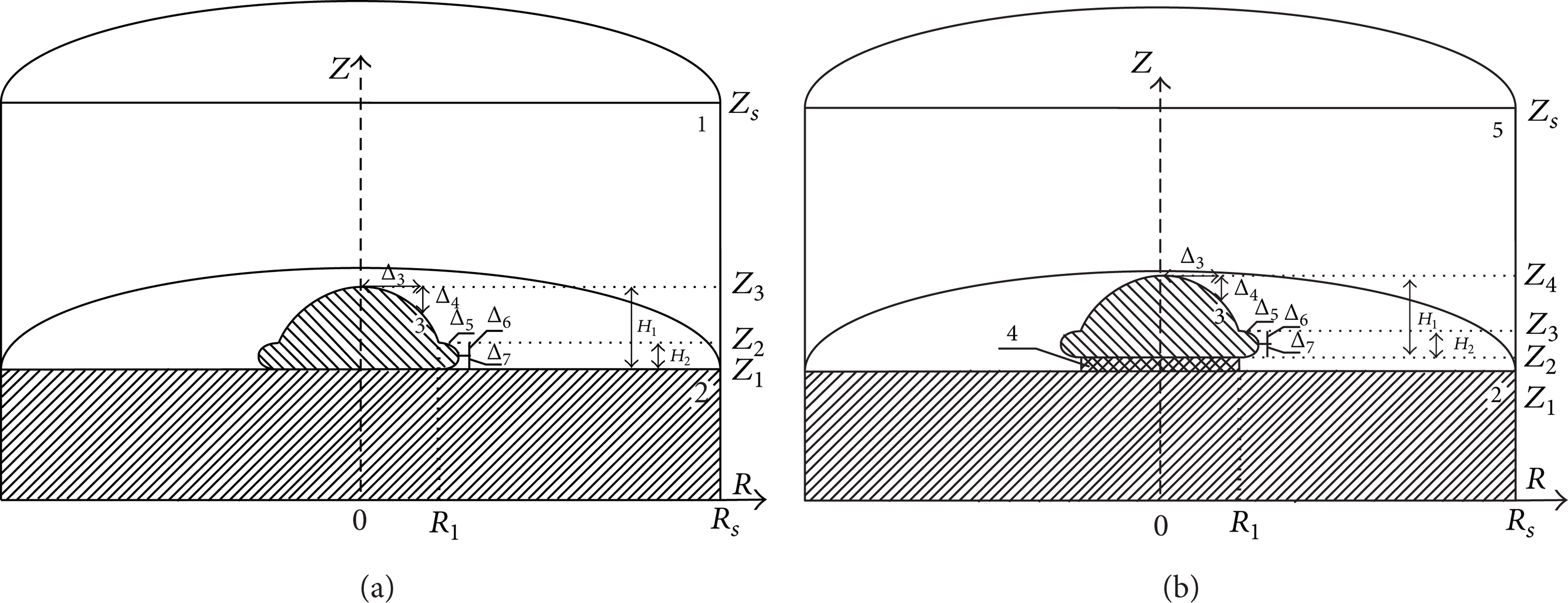
Scheme of problem solution area at (a) τ = 0 and (b) 0 < τ < τ d : 1—air, 2—steel substrate, 3—droplet of liquid condensed substance, 4—fuel vapors gap, 5—gas-vapor mixture.
It was assumed that a spherical liquid droplet of a condensed substance with radius Rdr falls on the surface of a high-temperature metal substrate and becomes distorted, that is, has a shape of a spheroidal segment with the base in the form of a toroidal disk (Figure 1(a)). Under the action of inertia and surface tension, the droplet begins to spread over the surface. The droplet is heated and then it becomes evaporated. A thin fuel vapor gap is formed between the spreading droplet and the hot solid surface (Figure 1(b)). The liquid vapors are mixed with the air (oxidizer). The gas-vapor mixture is formed. After the critical temperature of the mixture and fuel concentration is reached the chemical oxidation rates increase rapidly. As a result, the ignition of gas-vapor mixture occurs.
We considered a droplet of the best-studied liquid condensed substance, kerosene, which spreads over the surface of a high-temperature steel disk-shaped substrate with sizes R s and Z1 being much larger than the droplet. The problem was solved in cylindrical symmetry in the axisymmetrical configuration (Figure 1).
The ignition conditions were accepted as traditional for the condensed substance ignition theory [9].
The heat generated as a result of the fuel vapor oxidation in the air is greater than energy transferred from the hot substrate to the liquid fuel droplet and the gas-vapor mixture.
The temperature of the fuel vapor and air mixture exceeds the initial substrate temperature.
3. Mathematical Model
The heat and mass transfer processes in the “spreading liquid fuel droplet-hot metal substrate-air” system (Figure 1(b)) in the dimensionless variables were described by the following set of nonlinear nonstationary differential equations [10, 11]: 0 < R < R s , Z1 < Z < Z2; R1 + Δ5 < R < R s , Z2 + Δ7 < Z < Z2 + 0.5H2; R1 + Δ5 < R < R s , Z3 − Δ6 < Z < Z3; Δ3 < R < R s , Z4 − Δ4 < Z < Z4; 0 < R < R s , Z4 < Z < Z s ; the continuity equation:

the equation of gas-vapor mixture movement:

the energy equation for gas-vapor mixture:
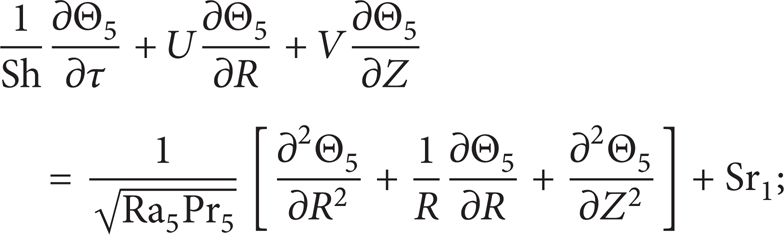
the equation of fuel vapors diffusion in air:
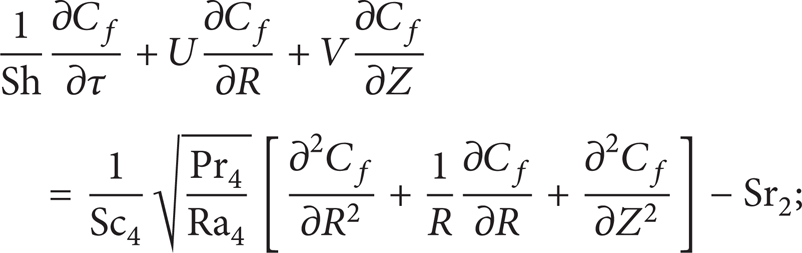
the equation of water vapors diffusion in air:
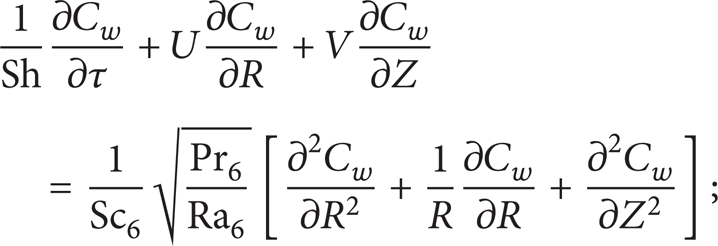
the balance equation:

the equation of heat conductivity for metallic substrate (0 < R < R s , 0 < Z < Z1):

the equation of heat conductivity for droplet of liquid condensed substance (0 < R < Δ3, Z4 − Δ4 < Z < Z4; 0 < R < R1, Z2 < Z < Z3; R1 < R < R1 + Δ5, Z3 − Δ6 < Z < Z3; R1 < R < R1 + Δ5, Z2 + Δ7 < Z < Z2 + 0.5H2):

Dimensionless complexes:

The initial conditions (Figure 1(a)): Θ1 = Θ0, Θ2 = Θ p , Θ3 = Θ0, Ω = 0, Ψ = 0, C f = 0, and C w = 0.
The boundary conditions (Figure 1(b)): on the borders “substrate-combustible vapors” (Z = Z1, 0 < R < R1), “substrate-vapor-gas mixture” (Z = Z1, R1 < R < R s ) there are boundary conditions of type IV for the equations of energy and thermal conductivity; on the borders “combustible vapors-liquid fuel droplet” (Z = Z2, 0 < R < R1), “combustible vapors—vapor-gas mixture” (R = R1, Z1 < Z < Z2), “liquid fuel droplet-vapor-gas mixture” (AKFD in Figure 2) there are boundary conditions of type IV with allowance for evaporation of the liquid; for the equations of diffusion and motion, as well as the Poisson equation, we set boundary conditions of type II; on the symmetry axis and boundaries (Z = 0, Z = Z s , 0 < R < R s ; R = R s , 0 < Z < Z s ) for all of the equations, we set the condition of vanishing of the gradients of the corresponding functions.

Computed droplet shape spreading over the solid surface.
The transition to the dimensionless variables was performed for the following scale values:

where z S is characteristic size of the solution area (z S = 0.02 m); t m is time scale (t m = 1 s); and T m is temperature scale (T m = 1000 K).
Mass rate of fuel vapors oxidation in the air was calculated by the following expression [12]:

where k0 is preexponential factor and E is activation energy for oxidation in the “kerosene vapors-air” system (according to the present-day theory of diffusion and heat transfer in chemical reaction conditions [12], we used the “effective” values of kinetic constants).
To calculate mass rate of liquid droplet evaporation W e the following correlation was used [13–15]:

The linear injection velocity of fuel vapors from the droplet surface was calculated by the formula V e = W e /ρ4 (subject to the expression [13–15]).
The solution method for the system of equations (1)–(8) with corresponding initial and boundary conditions is similar to those described in [16, 17]. The system of equations (1)–(8) was solved by the finite difference method. The numerical algorithms of [18, 19] were used for solving the continuity equation (1) and the equation of movement (2) in variables for the “current function—vortex velocity” variables. To solve difference analogs of differential equations the locally one-dimensional method was applied. Nonlinear difference analogs of differential equations were solved by the iteration method. To solve one-dimensional differential equations the double sweep method with the implicit four-point scheme was applied. We select no less that 400 knots of the difference net for each of the coordinates (near the borders of phase transition the difference net is made denser) and use time step 10−6 s. The reliability of the obtained results has been verified by the test of conservatism of the utilized difference schemes, whose algorithm is given by [17].
The spreading of the liquid condensed substance droplet over the massive heated solid surface in the conditions of phase change was modeled according to the scheme [5] shown in Figure 2.
The geometrical characteristics of both spheroidal and toroidal parts of the deformable droplet (Figure 2) were determined on the basis of the energy conservation law while transforming a part of droplet potential energy to the kinetic one. The algorithm of solution and the expressions binding the energy equations and the geometrical parameters are represented in [5]. Formulas connecting the geometrical parameters of the droplet with the main principles of the theory [5] are presented further.
The velocity field inside the droplet (Figure 2) was specified as follows: inside the ABK segment, the velocity is characterized by Vdr = Vdr(τ), whereas inside the BCDFK toroidal disk, it is characterized by the radial component Udr = Udr(R, τ) [5]:

The velocity Vdr was found from the expression [5]:
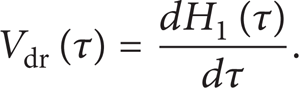
At the initial time moment, Vdr was taken equal to the falling velocity of the droplet coming in contact with the solid surface.
The toroidal disk thickness H2(τ) was defined by the following formula [5]:

The radius of the contact spot between the droplet and the heated substrate surface was found from the expression [5]:

It was assumed that R1 = Rdr at the initial moment.
The problem statement took into account the gap between the droplet and the heated substrate. It sizes (R v = R1 and Z v = Z2 − Z1, Figure 1) were found similarly [17].
4. Results and Discussion
The numerical investigations of heat and mass transfer processes in the considered system (Figure 1) were carried out with the following values of interacting substances [16–19]: initial temperatures of kerosene droplet, air and steel substrate Θdr = 0.283, Θ a = 0.283, Θ s = 1.3 correspondingly; thermal effect of kerosene vapor oxidation in air Q o = 42·106 J/kg; thermal effect of kerosene evaporation Q e = 0.026·106 J/kg; preexponential factor k0 = 9·108 s−1 and activation energy E = 0.193·106 J/mol for oxidation in the “kerosene vapors-air” system; initial radius of kerosene droplet Rdr = 0.1; substrate thickness Z1 = 0.5; and solution area sizes R s = 0.5, Z s = 1. The thermophysical characteristics of kerosene, its vapor, steel substrate, air, and water vapor are the same as [16–19].
The typical parameter, ignition time delay, is selected for analysis as a characteristic of the considered process. The range of heating source temperature changing Θ s used in modeling is the same as in experiments with kerosene droplets colliding with massive hot substrate [8]. The obtained dependence of τ d from Θ s for “kerosene droplet-hot metal substrate-air” system without droplet spreading is presented in Figure 3.
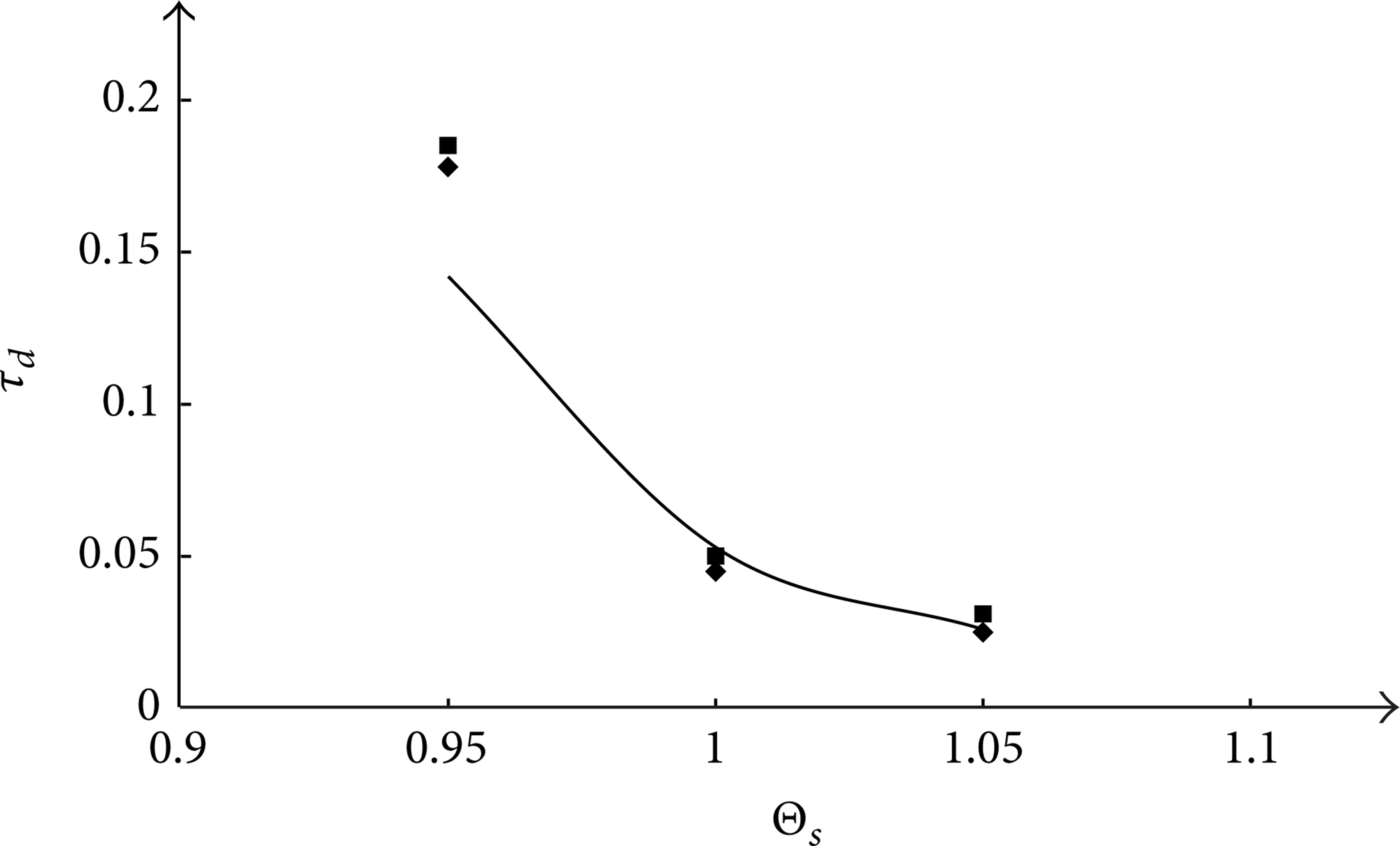
The deviations of calculated ignition time delay from experimental τ d values [8] can be explained by several reasons. Firstly the deformation and spreading of droplet over the solid body surface was not considered in numerical modeling. Secondly, the thermophysical characteristics of kerosene droplets, steel substrates, and air could differ both in numerical modeling and experiment [8].
The result of analysis of Figure 3 allows for making a conclusion that deviations of calculated ignition time delay from experimental τ d values [8] within the range of temperature Θ s of heating source do not exceed 25%. These deviations decrease from 25% to 3% with the increase of dimensionless temperature of substrate Θ s from 0.95 to 1.05. The obtained result can confirm the correctness of the developed heat and mass transfer model and satisfactory matching of theoretical and experimental [8] τ d values.
The isotherms in the system of “spreading liquid fuel droplet-hot metal substrate-air” at the ignition moment (τ d = 0.018) at Θ s = 1.05 are presented in Figure 4. The temperature gradients reach the maximum near the contact border of droplet with surface of metallic substrate. Such disposition of isotherms can be explained by the vapor gap formed between droplet and substrate at heating. Some amount of energy is absorbed in this vapor gap. Consequently ignition does not occur in the gap. The fuel vapors are heated while moving in the gap along the metal substrate surface and enter in chemical reaction with an oxidizer when achieving the side face of the droplet (point D in Figure 2). An intensive interaction of heated fuel vapors with air begins in this area. It leads to the further ignition of the formed gas-vapor mixture.

Isotherms (Θ) of system “kerosene droplet-hot metal substrate-air” at the ignition moment (τ d = 0.018) at Θ s = 1.05.
Unlike heat and mass transfer processes within the ignition conditions for liquids in system “hot particle-liquid fuel-air” the ignition zone in system “kerosene droplet-hot metal substrate-air” is not displaced in the area of vapor gap or a gas phase above a droplet in case of changing temperature of energy source [16, 17]. The ignition occurs only in a small vicinity around the heated substrate (Figure 4). It is caused by the fact that dimensionless temperature Θ s variation creates more influence on the conditions of interaction hot particle with flammable liquid than on the conditions of interaction of fuel droplet with heated body surface.
It is necessary to note that at Θ p = Θ s = 1 values of τ d differ considerably for ignition of kerosene droplet by massive heated bodies and ignition of kerosene by small hot metal particle with limited energy content [16, 17]. So, for example, kerosene droplet ignition in the system (Figure 1) with a steel substrate is τ d = 0.053 and for the ignition of kerosene thin layer by steel particle it is τ d = 0.915 (at Θ p = Θ s = 1). The difference of ignition time delay is caused by the fact that the massive hot body provides enough energy for the heating of fuel droplet, evaporation, and subsequent heating of forming gas-vapor mixture over a relatively short time interval (τ d = 0.053). For heated particles with small sizes the rates of heating, evaporation of liquid, and subsequent heating of gas-vapor mixture decrease owing to the limited energy content. As a result, ignition time delay increases. The ignition time delay of kerosene by single steel particle is equal to τ d = 0.053 only at Θ p = 1.42 and other corresponding parameters of process. Thus, ignition time delay in the system with a steel substrate under any condition does not achieve 0.915. The ignition of kerosene droplets with the change of substrate temperature within the range 0.9 < Θ s < 1.5 occurs at τ d values less than 0.25.
Dependences of dimensionless ignition time delay on dimensionless temperature Θ s for droplet spreading (curve 1) and without its deformation (curve 2) are presented in Figure 5 to illustrate the influence of the initial temperature of massive heated bodies (metallic substrate) on the ignition characteristics.

Dimensionless ignition time delay of droplet versus dimensionless initial temperature of heated substrate at Θ a = Θdr = 0.283, Rdr = 0.1, Vdr = 0.05 (1—at spreading of droplet, 2—without spreading and deformation of droplet).
Ignition time delay grows in several times at decreasing dimensionless temperature Θ s from 1.5 to 1. Time τ d changes not linearly at temperature Θ s increasing. This effect can be explained by the nonlinear dependence of the mass rates of droplet evaporation and fuel vapor oxidation in the air from the temperature.
In order to estimate the influence of spreading process on the ignition time delay of droplet (Figure 5), the deviation values of τ d at spreading and without deformation (Δ, %) were determined. The deviations Δ exceed 10% only at rather low substrate temperatures (Θ s < 1.1). The deviations decrease substantially at Θ s increasing. For example, the Δ values do not exceed 5% at dimensionless substrate temperature of more than 1.4. Thus, we concluded that at Θ s > 1.4, the energy of source consumed on heating and evaporation of the droplet and also on heating of the gas-vapor mixture is sufficient for the ignition at small τ d values (under 0.005) regardless of the dynamics of droplet deformation. During these time intervals the droplet spreading does not substantially affect the ignition characteristics. Upon touching the substrate surface, the droplet begins to spread, but the characteristic times of droplet heating, evaporation, and gas-vapor mixture oxidation are much smaller than the characteristic hydrodynamic time (time of spreading). The ignition conditions are fulfilled under a slight (under 6%) deviation of the droplet contact radius (R1 in Figure 2) from the initial one.
The heating and evaporation of the liquid droplet becomes slower in the case of decreasing the substrate temperature. As a result, the role of the spreading becomes more important. The droplet radius increases at the border where it contacts the substrate surface; thus, the droplet evaporation area increases too. However, the mass rate of evaporation in each sector of the area decreases due to the displacement of the droplet layers during spreading. For this reason, the τ d values for nondeformable droplet are lower than τ d for deformable droplet (Figure 5).
Figure 5 presents dependences of dimensionless ignition time delay τ d on dimensionless temperature Θ s at constant low initial spreading rate of a droplet (Vdr = 0.05). It is of interest to estimate the influence scale of this parameter on τ d .
It was established that at Vdr > 0.25, the droplet spreading retards substantially the stages of liquid evaporation and heating. As a consequence ignition time delay τ d is increasing considerably. This effect allows us to conclude that at rather low substrate temperatures (Θ s < 1.1) and high spreading rates (Vdr > 0.25), the probability of droplet spreading over the hot substrate surface without the ignition grows. At low Vdr and high Θ s , the probability of droplet ignition is high with an insignificant change in the droplet contact radius (R1) relative to the initial one (at the moment of collision of the droplet and the heated substrate).
The ignition peculiarities are caused by the fact that while spreading the liquid droplet over the heated surface, the droplet contact radius and the liquid evaporation area increase. However, the increasing evaporation area leads to a growing droplet area that interferes with the fuel vapor escape. At low spreading rates and high substrate temperatures, the rate of fuel vapor escape exceeds hydrodynamic flow velocities of droplet layers. The heated fuel vapors enter into a chemical reaction with the oxidizer. The reaction is accelerated upon reaching critical temperatures and fuel vapors concentration. At high spreading rates (Vdr > 0.25), the droplet layers “close” the evaporation area. The fuel vapors generate contours of vortices near the droplet base. Only a small fraction of the vapors goes out into gas phase and enters into a chemical reaction with the oxidizer. Decreasing the rate of fuel vapor injection into the gas-vapor mixture leads to an increase of the ignition inertia. Thus, ignition time delay grows with Vdr.
Figure 6 represents dimensionless ignition time delay versus Vdr with varying dimensionless temperature Θ s in order to illustrate the limiting values of parameters that characterize the substrate energy content and the spreading process, at which the liquid droplet is ignited.
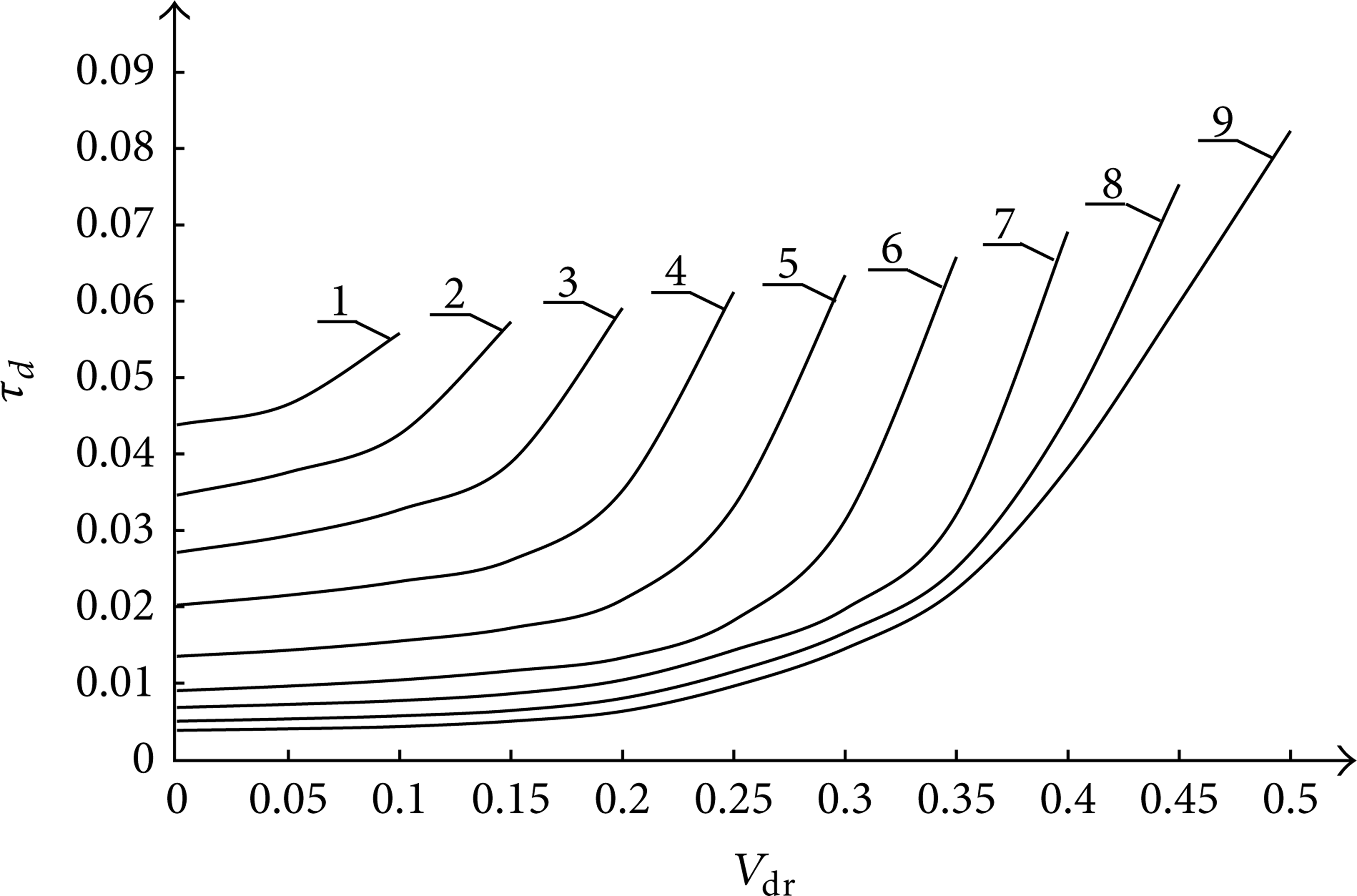
Dimensionless ignition time delay of droplet versus initial spreading speed Vdr (1—at Θ s = 0.7; 2—at Θ s = 0.8; 3—at Θ s = 0.9; 4—at Θ s = 1; 5—at Θ s = 1.1; 6—at Θ s = 1.2; 7—at Θ s = 1.3; 8—at Θ s = 1.4; 9—at Θ s = 1.5).
It is established that the ignition occurs even at high Vdr (more than 0.35). However, the ignition conditions are realized at Θ s > 1.4 only and are characterized by rather large ignition time delay (τ d > 0.07). We should note that at high substrate temperatures (Θ s > 1.4), the dependence of τ d on Vdr with the spreading rate varying in the range 0 ≤ Vdr ≤ 0.15 is practically linear (ignition time delay varies within 1%). This result shows that there exist conditions of droplet ignition, at which the source temperature predominates, whereas the influence of other factors is insignificant.
The presented dependences (Figure 6) allowed setting the group of approximate expressions for ignition time delay at various velocities of droplet spreading (0 ≤ Vdr ≤ 0.5). For example:

Figures 7 and 8 present dimensionless ignition time delay versus sizes and temperature of a kerosene droplet in order to estimate the influence of the droplet parameters on the ignition characteristics.

Dimensionless ignition time delay of droplet versus initial radius Rdr at Θ a = Θdr = 0.283, Θ s = 1.3, and Vdr = 0.05.
Dimensionless ignition time delay of droplet versus initial temperature of liquid at Θ a = 0.283, Θ s = 1.3, Rdr = 0.1, and Vdr = 0.05.
Upon analyzing Figure 7 we can conclude that the influence of droplet sizes on the ignition inertia is insignificant. As a result of varying the droplet radius in the range 0.05 ≤ Rdr ≤ 0.25, the τ d values change within 2%. The insignificant decrease of τ d with Rdr decreasing shows that the ignition inertia for small droplets is lower than that of large ones.
The influence of the dimensionless initial droplet temperature Θdr on the ignition characteristics is greater (Figure 8) than that of Rdr as a result of acceleration of droplet evaporation and heating with increasing Θdr.
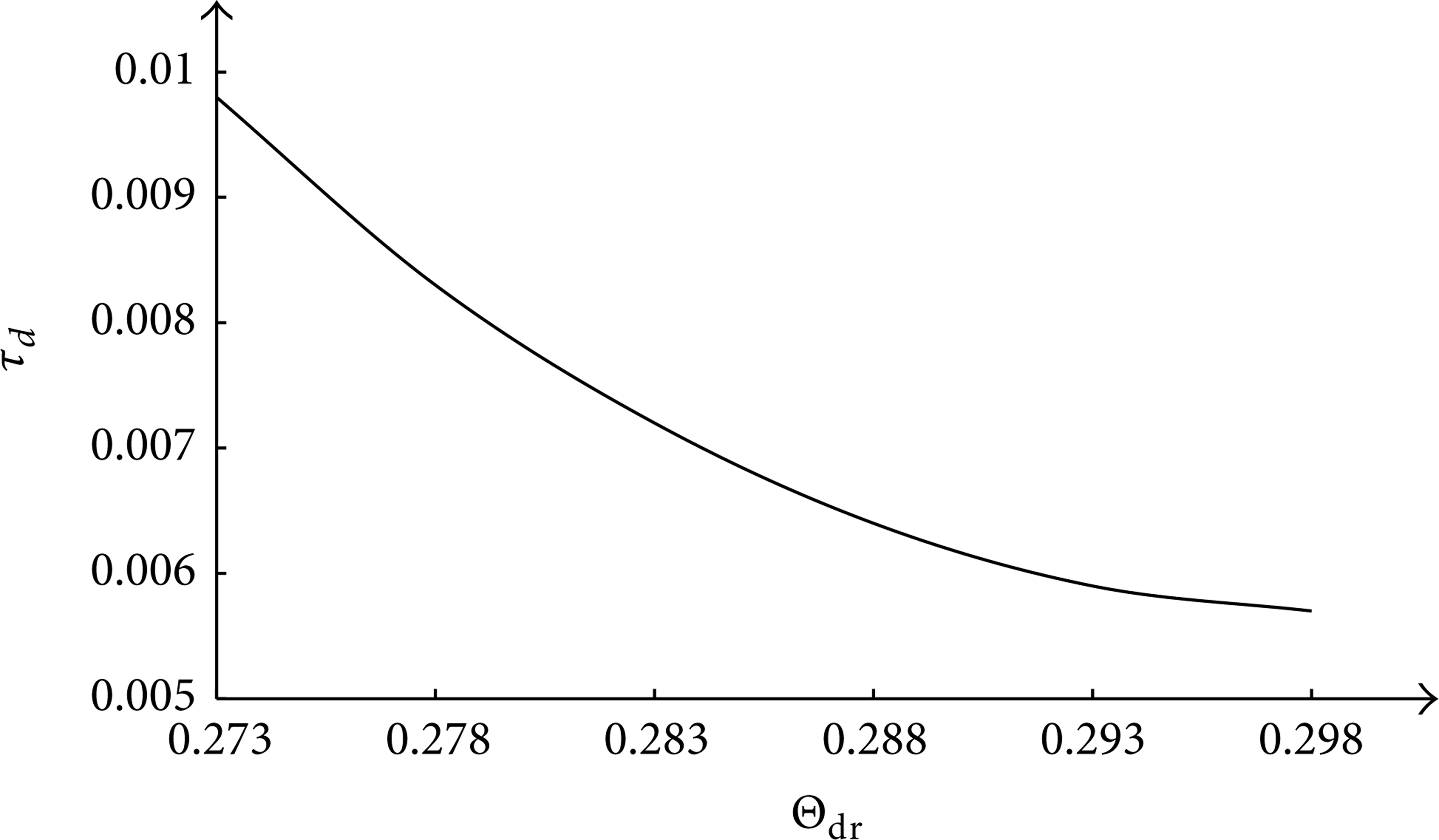
Results of numerical investigation of the ignition processes in “single hot small particle-liquid fuel-oxidizer” system [16, 17] show that the dimensionless initial oxidizer temperature Θ a can substantially affect the ignition time delay with certain parameters of the process (low temperature and small sizes of the heating source together with high air humidity). Figure 9 represents the dependence of dimensionless ignition time delay on the initial dimensionless oxidizer temperature in order to compare the influence of this factor on τ d with the results in [16, 17].

Dimensionless ignition time delay of droplet versus initial temperature of oxidizer at Θdr = 0.283, Θ s = 1.3, Rdr = 0.1, and Vdr = 0.05.
It is established when the dimensionless temperature of the oxidizer is varied in the range 0.273 ≤ Θ a ≤ 0.298, the τ d values change less than by 7%. At higher substrate temperatures (Θ s > 1.4) and other appropriate parameters of the process, the change in τ d for the mentioned range of Θ a is less than 4%. For “single hot particle-liquid fuel-air” system the initial temperature of the oxidizer exerts a greater effect on the ignition characteristics even at higher (above 1500 K) temperatures of the heating sources. Thus, in the ignition systems with a massive heating source (see Figure 1), the role of minor factors (in particular, at a high temperature Θ s ) is not as significant as that in similar systems [16, 17] for a small local source (metal and nonmetal particles).
Analyzing the obtained results, we concluded that there are ignition conditions at which the influence of such a complex factor as droplet spreading over the surface of hot bodies, which is accompanied by phase transition, is insignificant (at high temperatures of the substrate Θ s , liquid droplet Θdr, and oxidizer Θ a and also at low rates Vdr).
5. Conclusions
As a result of completed numerical analysis of heat and mass transfer processes the following conclusions were formulated.
Physical and mathematical models were developed. It allows for analyzing macroscopic dependencies of heat and mass transfer processes accompanied by phase changes and chemical reactions for the ignition of the liquid condensed substance droplet colliding with a high-temperature metallic surface.
The processes of deformation and spreading of liquid condensed substance droplet reduce its ignition on high-temperature metallic substrates.
The rates of fuel vapor escape are comparable with the velocities of droplet layers flow at the spreading liquid droplet. The droplet blocks the fuel vapor injection into gas phase at high spreading rates. For this reason the probability of liquid ignition becomes lower as the droplet spreading rate grows.
Footnotes
Nomenclatures and Units
Conflict of Interests
The authors declare that there is no conflict of interests regarding the publication of this paper.
Acknowledgment
The reported study was partially supported by RFBR, research project no. 12-08-33002.