




Abstract
Wireless Body Area Networks (WBANs) are widely used for applications such as modern health-care systems, where wireless sensors (nodes) monitor the parameter(s) of interest. Nodes are provided with limited battery power and battery power is dependent on radio activity. MAC protocols play a key role in controlling the radio activity. Therefore, we present Adaptive Medium Access Control (A-MAC) protocol for WBANs supported by linear programming models for the minimization of energy consumption and maximization of dataflow. Our proposed protocol is adaptive in terms of guard band assignment technique and sleep/wakeup mechanism. We focus on specific application to monitor human body with the help of nodes which continuously scan body for updated information. If the current value is within normal range, nodes do not try to access channel. However, if the current value rises or falls beyond the permissible range, nodes switch on their transceiver to access channel. Moreover, A-MAC uses TDMA approach to access channel and well-defined synchronization scheme to avoid collisions. Furthermore, we conduct a comprehensive analysis supported by MATLAB simulations to provide estimation of delay spread. Simulation results justify that the proposed protocol performs better in terms of network lifetime and throughput as compared to the counterpart protocols.
1. Introduction
In modern day life, people want to get information about their body. A special purpose of Wireless Sensor Network (WSN) that enables remote monitoring is termed as WBAN. An important application of WBAN is to health care monitoring. This application enables the patient to be observed, diagnosed, and prescribed remotely. Hence, WBANs flourished as promising networks in the field of medical sciences as compared to traditional health care methods. On large scale, WBAN is classified into invasive and noninvasive networks [1].
Nodes scan the body to gather the required information and send this information to the respective station. Station is usually equipped with high power; however, nodes are provided with limited power source. In a typical WBAN/WSN, most of the power is consumed by transceiver. In these networks, a change in a single physiological parameter triggers many on-body nodes for data transmission at the same time. This traffic correlation in WBANs leads to high competition for medium access. As the nodes are supplied with limited battery power, so radio activity of transceiver to access channel becomes significant. As MAC layer controls the radio activity, therefore, it is obligatory to aim at an energy efficient MAC protocol. For this purpose, many MAC protocols are proposed; however, we only discuss some of these works in related work section.
Our proposed A-MAC protocol controls sleep and active mode in a well-organized manner. Nodes sense body regularly; however, they do not transmit regularly. Transmissions differ from application to application. For a specific one, these occur whenever data fluctuates from normal range. If the readings continue to be in normal range, nodes continue to be in idle mode. Moreover, guaranteed time slots for communication and adaptive guard band allocation further facilitate energy efficiency. Linear programming models for the minimization of energy consumption and maximization of dataflow along with delay spread analysis supported by MATLAB simulations enrich the level of design and understanding.
The rest of the paper is organized as follows: in Section 2 related work is provided, Section 3 contains motivation, Section 4 deals with a brief explanation of our proposed protocol, Sections 5, 6, and 7 contain energy consumption analysis, linear programming based network model, and delay spread, respectively, Section 8 is provided with the simulation results, conclusion along with future work is in Section 9, and finally references are given.
2. Related Work
The IEEE 802.11 and its further enhancements like IEEE 802.11 b/g/n are designed for medium range high speed wireless networks, like Wireless Local Area Networks (WLANs). It supports high data rate. However, IEEE 802.11 has high energy requirements and deprived bandwidth management, which makes it completely inappropriate for WBANs. IEEE 802.15.4 has been designed for Wireless Personal Area Networks (WPANs) with a range of 10 to 20 meters. This protocol can be used in healthcare and consumer electronics applications. However, it does not support devices heterogeneity and life-critical guaranteed transmission. Beacon enabled mode of IEEE 802.15.4 MAC does not efficiently work in long term monitoring applications due to beacon broadcast which results in overhead. The nonbeacon enabled mode of IEEE 802.15.4 MAC uses simple CSMA/CA which increases energy requirements for Clear Channel Assessment (CCA).
Omeni et al. in [2] present MAC protocol for single-hop WBANs which has important feature of wakeup/sleep mechanism along with wakeup fall-back time. Core process of this protocol is master-slave relation; when slave node attempts to communicate with master node and it fails, slave node goes to sleep mode. Moreover, central control mechanism avoids overhearing and continuous time slots avoid collision.
Timmons and Scanlon propose MedMAC in [3] which uses TDMA based approach. Guard band is introduced between two adjacent slots which helps to avoid overlapping, and it depends upon practical situations. Moreover, guaranteed time slots are used to overcome collisions.
Proposed S-MAC in [4] solves the problem of idle listening by assigning fixed duty cycles. Coordinator node assigns fixed time slots to nodes for wakeup. After wakeup period nodes go back to sleep mode and collisions are reduced by its synchronization mechanism.
The authors in [5] discuss H-MAC which works on synchronization mechanism. This protocol uses natural heart beats for the synchronization of nodes. So, nodes are independent in terms of extra energy needed for their synchronization. Dedicated time slot assignment is used to overcome collision.
Proposed McMAC in [6] deals with multi-constrained QoS in WBANs. This technique introduces a superframe structure that depends on the traffic of a node. A node is transmitted during a particular period of time, if the corresponding QoS is achievable; moreover it also presents a mechanism to handle emergency traffic.
Proposed AR-MAC in [7] uses a star topology with a central node and for channel access TDMA approach is used. It uses a novel scheme for synchronization, and central node uses dedicated time slots for communication. To avoid collision, an adaptive guard band approach is implemented.
The authors in [8] analyze two models of packet drop across the link. These are Random Uniformed model and Gilbert-Elliott model. Both models are briefly discussed and simulation results are provided.
3. Motivation
Main objectives to design MAC layer protocols for WBANs are high reliability and less energy consumption. In beacon enabled mode of IEEE 802.15.4, beacon packets are required for broadcast, which results in overhead. The nonbeacon enabled mode of IEEE 802.15.4 and needs extra energy for Clear Channel Assessment (CCA) operation. In protocols like S-MAC, MedMAC, and McMAC sleep schedules are periodically exchanged resulting in high synchronization overhead. Most of the earlier work based on the improvement of MAC protocols for WBANs is just like painting one side of the picture. Researchers seem to be focused on issues related to synchronization, collision avoidance, time slots assignment, guard band assignment, emergency data priority, and so forth. In [5] the authors present WBAN MAC requirements: energy efficiency, support of simultaneous operations, and Quality of Service (QoS). In [9], a comprehensive study on MAC protocols for WBANs is presented which focuses on energy minimization techniques like low power listening, schedule contention, and TDMA. However, the other side of the picture, that is, the number of transmissions, remains like a dark shadow. Let

4. A-MAC
Our proposed protocol uses the available resources efficiently because it is based on specific application scenario which helps in reducing energy consumption. A-MAC uses TDMA technique, and Guaranteed Time Slot (GTS) is assigned to each node for communication.
We assume star topology (shown in Figure 1) for simplicity in implementation; individual nodes sense required information from body and send it to a Coordinator Node (CN). CN forwards received information to Monitoring Station (MS), directly or indirectly via an Access Point (AP). CN is endowed with larger battery and higher computational abilities. We assume a single transceiver within CN. Total time frame

WBAN topology.
4.1. Adaptive Sleep and Wakeup Mechanism
Nodes sense human body to gather required information like temperature, blood pressure, pulse rate, and so forth. Nodes access channel only if the criterion of interest is satisfied; otherwise, nodes continue to be in idle mode. Criteria of interest vary from application to application. For example, let us consider the case of blood pressure; if the current blood pressure sensed is normal, node continues to be in idle mode. When the current sensed value drifts from its normal range, node switches to active mode, where it tries to access channel in order to transmit data to CN. In this way, nodes minimize the number of transmissions by an adaptive sleep and wakeup mechanism, ultimately saving a huge amount of energy.
4.2. Channel Selection
At the beginning, CN scans for free Radio Frequency (RF) channels. If busy, CN switches off the current RF channel and switches on another RF channel. The process continues till CN finds a free RF channel, and then it broadcasts the channel packet to nodes. Channel packets include information about the address of CN and channel information. Parallel to this process, nodes scan for free RF channel, and if busy, they wait for time
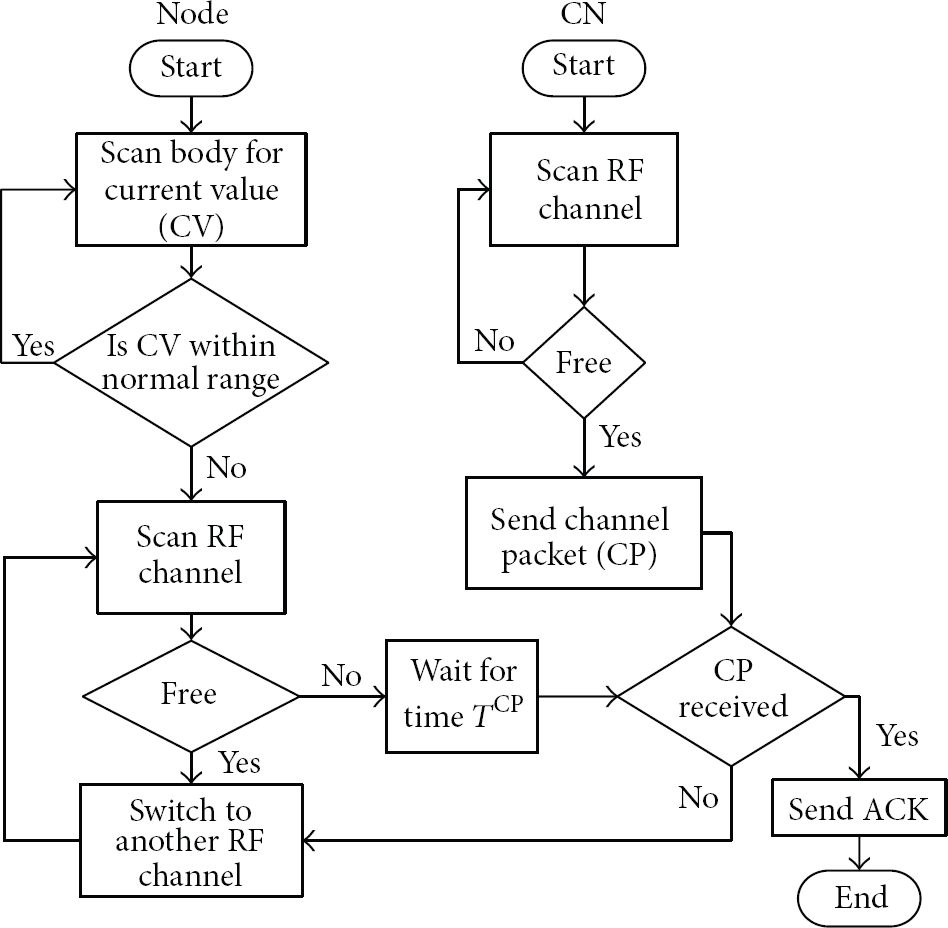
Channel selection.
4.3. Time Slots Assignment
The selection of free RF channel is followed by Time Slot Request (TSR) packet; transmitted by nodes to CN which includes information about the node's Time Slot (TS) for communication as well the data rate. In order to efficiently utilize the available resources, CN assigns TSs and guard band time (

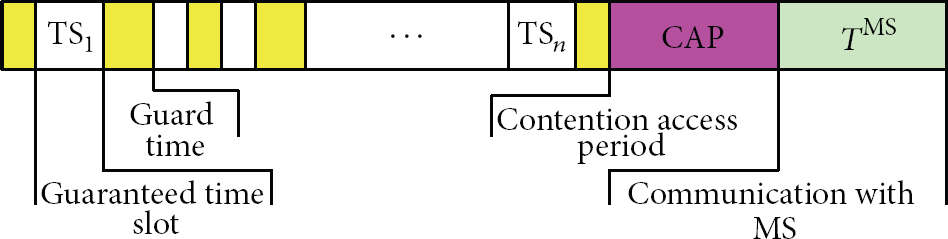
Time slots assignment with guard-band time.
4.4. Synchronization Mechanism
In order to communicate efficiently within the assigned TSs, CN needs synchronization with nodes. Within expected TS, CN listens for data packet. Upon the reception of data packet, CN compares expected reception time with current reception time. Let D be acceptable delay. Drift value
4.5. Packet Types
A-MAC deals with two types of packets: data packets and control packets. Data packet includes node's sensed data, and control packets are as follows.
Channel Packet (CP): it includes CN's address and channel information. Time Slot Request (TSR) packet: request information to CN for GTS is embedded in TSR packet. Time Slot Request Reply (TSRR) packet: this packet includes CN's reply to node along with GTS information. SYNChronization-ACKnowledgment (SYNC-ACK) packet: DV along with ACK of the last received data are coupled in SYNC-ACK packet. Data Request (DR) packet: CN sends DR packet to node in order to meet on-demand traffic. Acknowledgment (ACK) packet for the ACK of data packet.
5. Energy Consumption Analysis
Energy consumption model is based on the transceiver's activity, and we assume constant consumption of energy regarding sensing and processing units. To minimize energy consumption, sleep and wakeup mechanism play a vital role. Let

Total energy consumption for n the number of cycles is given by

Energy is a function of time and power, and power itself is a function of voltage and current. In sleep mode, nodes consume less energy as compared to active mode:


To switch between sleep and active modes, transceiver consumes energy

Let l be length of packet (control or data), let

Similarly, energy consumed at the receiver end

Time interval, after the transmission of an ACK packet and before its reception, is called time-out period (

6. Problem Formulation and Modeling via Linear Programming
We consider a WBAN scenario where nodes collect data from the body and send the collected information to the sink directly or indirectly via an access point. So, WBAN consists of two types of nodes: monitoring nodes and sink node which collects the information at receiving end. In WBAN model, the position of nodes and sink is predetermined according to the application. Let S be the set of nodes, where

We use the propagation radio model used in [10]. The path loss coefficient between i and j (or i and k) is denoted by
6.1. Energy Consumption Minimization
The main problem is to maximize the network lifetime. To maximize network lifetime, energy consumption of all the nodes needs to be balanced. Nodes equipped with less residual energy should decrease their energy consumption.
We consider WBAN model as a directed graph


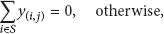



Constraints (13a) and (13b) indicate the full coverage. Constraint (13c) provides the flow balance of traffic from node i to sink. The term
6.2. Maximum Flow Problem
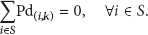
Consider V is a set of vertices and E is a set of edges between two nodes, where S is a set of nodes. Each node has a capacity







7. Delay Spread Analysis
To develop some general guidelines for wireless systems, different multipath channels are compared and due to variation in path lengths the impulse response of a wireless channel looks like a series of pulses. Time domain analysis from the measured frequency domain transfer function
For evaluation purpose, mostly we focus on a class of channels rather than a single impulse response. Delay spread is generally quantified by different metrics like maximum delay spread Maximum excess delay Propagation delay relative to that of the shortest path and characterized by the first central moment is called mean excess delay Mostly, root mean square

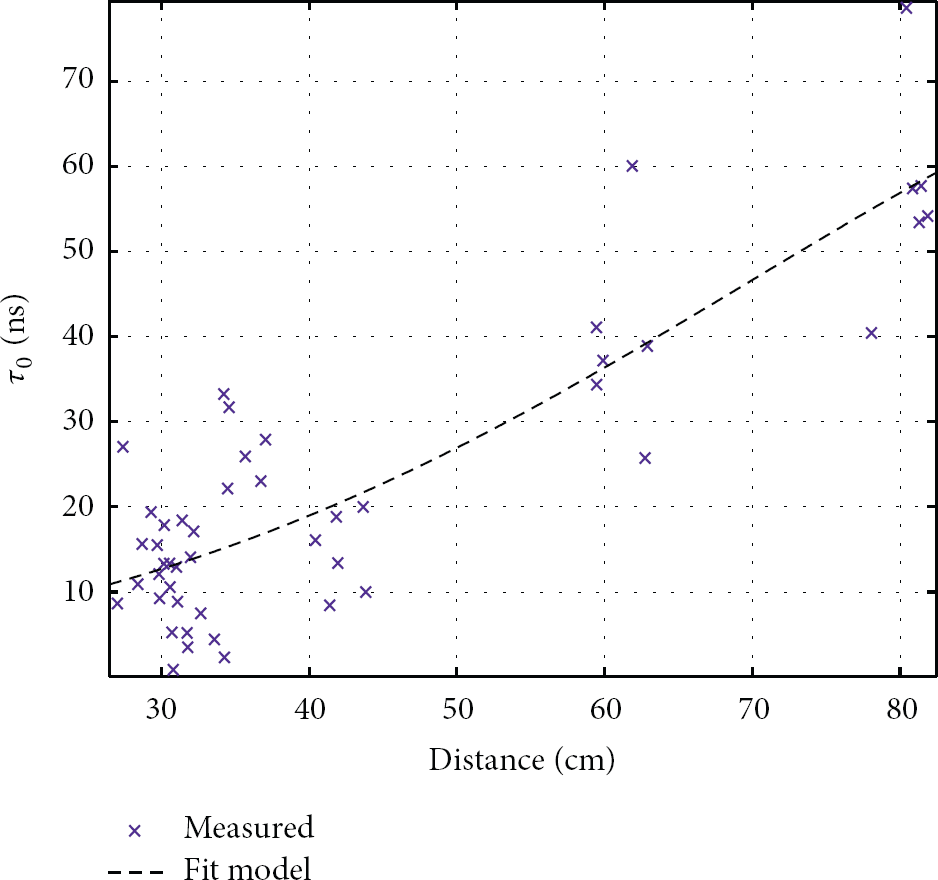
Mean excess delay spread.

Parameter values of the models for


rms delay spread.
8. Simulation Results
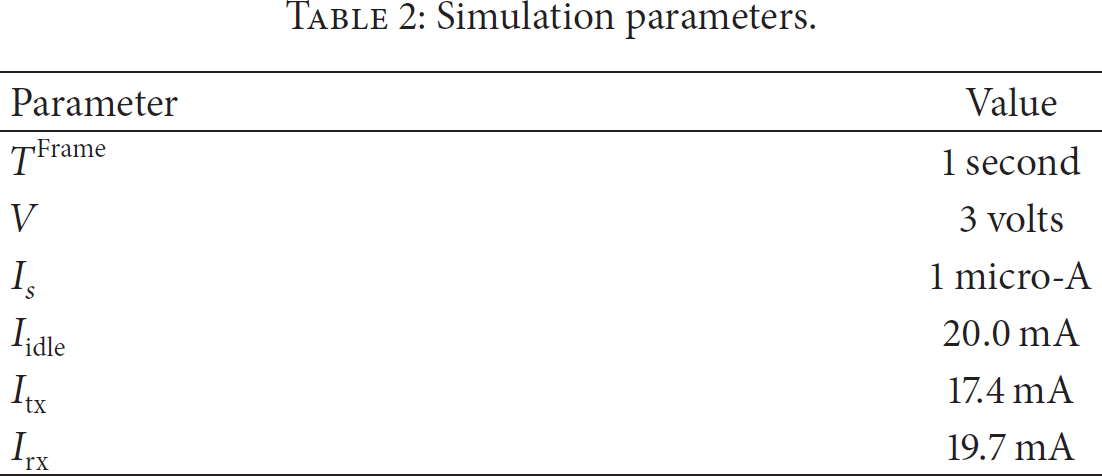
This section provides a brief description related to MATLAB simulations of the proposed A-MAC protocol as well as IEEE 802.15.4 and AR-MAC. We consider star network of 10 nodes, where a single node is implanted on the body of each patient. As our approach is application specific, we consider a specific application here, that is, Blood Pressure (BP). Different ranges for BP are provided in Figure 6. We use energy model from the data sheet of Crossbow MICAz as shown in Table 2. For this purpose, we execute our protocol 5 times and calculate its mean value with possible deviation from mean value in terms of upper and lower bounds. The interval or range of values within upper and lower bounds is the confidence interval. For our simulation, there is 90% probability that the outcomes of interest lie within the error bars. We use Random Uniformed model for packets drop calculation.
Simulation parameters.

Blood pressure range.
From Figure 7 it is clear that A-MAC performs better than IEEE 802.15.4 and AR-MAC. In CSMA/CA operation of IEEE 802.15.4, with an increase in average packet error rate probability, the number of back-offs increases. With every additional back-off, extra energy is consumed to perform clear channel assessment operation leading to more energy being consumed. AR-MAC uses adaptive guard band and adaptive TS allocation, to decrease the number of collisions which results in relatively less energy consumed. A-MAC further minimizes energy consumptions by minimizing the number of channel access tries, adaptive guard band allocation, and GTSs for communication. When the current value of blood pressure is within normal range (systolic BP = 90–120 mmHg and diastolic BP = 60–80 mmHg), transceiver associated with each node is off and nodes do not try to access channel.

Energy consumption analysis for 1000 cycles.
For lifetime and throughput analysis, we assume that each node is initially provided with
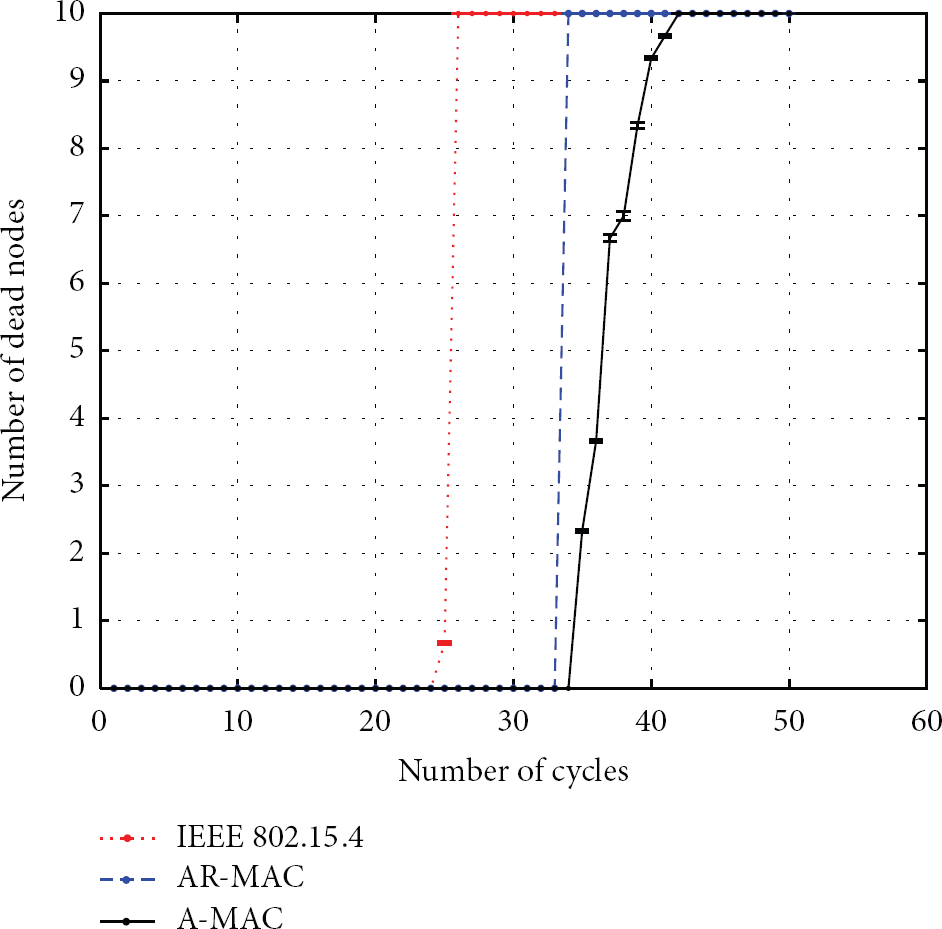
Network lifetime.
IEEE 802.15.4 uses CSMS/CA approach, in which if after the maximum number of back-offs the channel is still busy, packet is discarded, whereas AR-MAC uses TDMA approach, that is, guaranteed time slots assignment to nodes. Moreover, the minimum number of transmissions in A-MAC should result in lower number of packets sent to CN. However, witnessing A-MAC's curve in Figure 9 really grabs the attention. A-MAC sends more packets to CN than IEEE 802.15.4 and the same number of packet as AR-MAC. Why this kind of behaviour occurs? Let us justify this behaviour by taking cycle number 26 under consideration. Packets sent to CN at cycle number 26 are A-MAC 234, IEEE 802.15.4 250, and AR-MAC 250. At this cycle, A-MAC shows the minimum number of packets sent which is justification of its minimized number of transmissions. In IEEE 802.15.4, after cycle number 26, no more packets are sent to CN because after this particular cycle all nodes are dead. Similarly, in AR-MAC packet sending ends after cycle number 34. At cycle number 34, AR-MAC's sent packets to CN are more than that of A-MAC. However, in A-MAC packet sending continues till cycle number 41. These additional cycles compensate for the lower number of packets sent to CN.

The average number of packets sent to CN (aggregated).
In real scenarios, the total number of packets sent is not equal to the total number of packets received. Packets are always dropped. For our simulations to be more realistic, we choose two states of link reliability, that is, good (having 70% probability) and bad (having 30% probability). If the link status is good, packet is received successfully, else it is dropped. According to Figure 10 packets dropped order is IEEE 802.15.4 > AR-MAC > A-MAC. Reasons are as follows: CSMA/CA and fixed guard band assignment in IEEE 802.15.4 means high contention leading to more packets being dropped, adaptive guard band assignment in AR-MAC means relatively low contention leading to less number of packets being dropped, and adaptive guard band assignment as well as minimizing the number of transmissions means minimizing the contention for channel access thereby further decreasing the number of packets being dropped. Figure 11 shows the network throughput, that is, the number of packets received at CN. In this regard, A-MAC's performance is superior to the other two protocols due to well-defined synchronization mechanism as well as the reasons stated for packet drops.

The average number of packets dropped (per round).
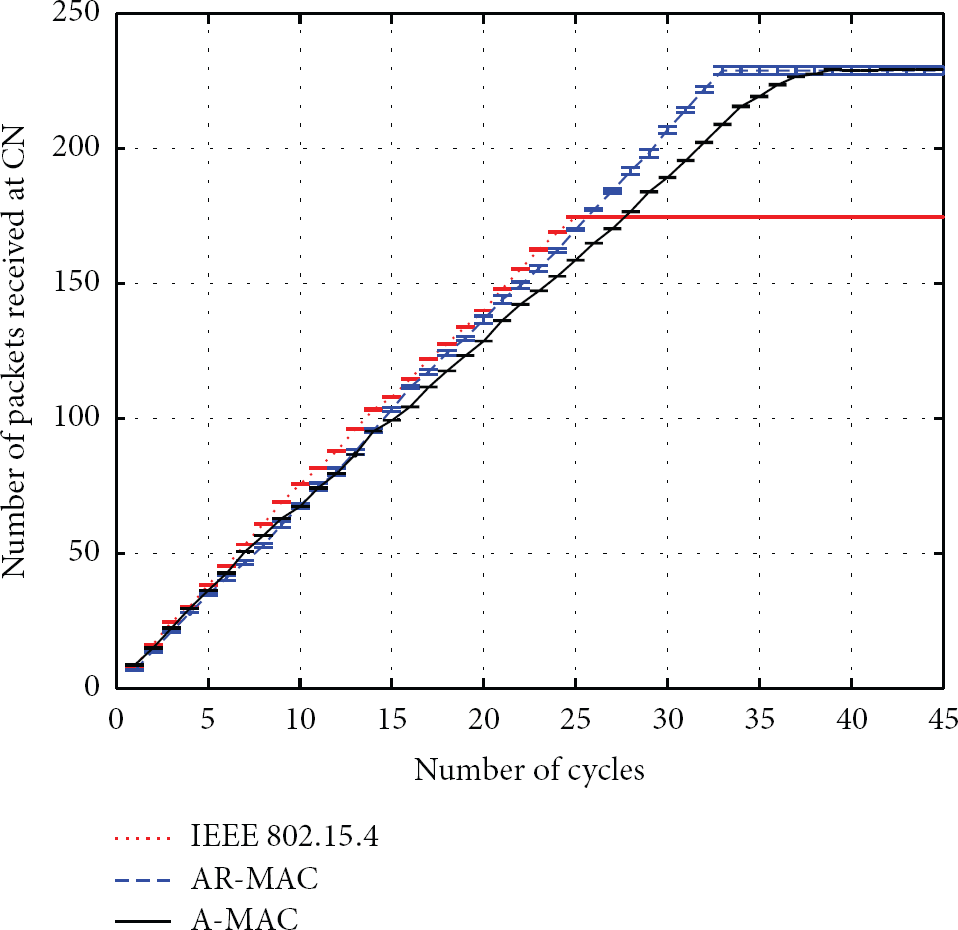
The average number of packets received at CN (aggregated).
9. Conclusion and Future Work
Nodes keep updating their readings and on the arrival of fresh information they access the channel. In order to access channel, nodes switch on their transceiver which consumes energy. Our approach does not allow nodes to access channel after every fresh reading. Furthermore, GTSs for communication, adaptive guard band allocation, and well-defined synchronization mechanism are used to overcome collision and overhearing. A linear programming approach is adopted to maximize data flow and minimize energy consumption. Time domain analysis of the proposed protocol in terms of delay spread is also conducted. From simulation results, we conclude that all of the mentioned features throughout the paper enable A-MAC to outperform the counterpart protocols.
Our future directions will focus on working on joint physical and MAC model as well as the effect of temperature on link quality [13].
Footnotes
Conflict of Interests
The authors declare that there is no conflict of interests regarding the publication of this paper.