



Abstract
Heat transfer enhancement has been always a significantly interesting topic in order to develop high efficient, low cost, light weight, and small heat exchangers. The energy cost and environmental issue are also encouraging researchers to achieve better performance than the existing designs. Two of the most effective ways to achieve higher heat transfer rate in heat exchangers are using different kinds of inserts and modifying the heat exchanger tubes. There are different kinds of inserts employed in the heat exchanger tubes such as helical/twisted tapes, coiled wires, ribs/fins/baffles, and winglets. This paper presents an overview about the early studies on the improvement of the performance of thermal systems by using different kinds of inserts. Louvered strip insert had better function in backward flow compared to forward one. Modifying the shape of twisted tapes led to a higher efficiency in most of the cases excpet for perforated twisted tape and notched twisted tape. Combination of various inserts and tube with artificial roughness provided promising results. In case of using various propeller types, heat transfer enhancement was dependent on higher number of blades and blade angle and lower pitch ratio.
1. Introduction
Using passive techniques in order to enhance heat transfer characteristics in heat exchanger has been an interesting topic for scientists and researchers during recent decades. Numerical and experimental studies have been conducted in order to improve heat transferred by these techniques. The demand of reduction of the cost and dimensions of heat exchanger has motivated the searchers to investigate different ways of heat transfer enhancement. Passive heat transfer enhancement techniques are mostly preferred due to their simplicity and applicability in many applications. Furthermore, in passive techniques, there is no need of any external power input except to move the fluid.
The devices in this category include surface coating, rough surfaces, extended surfaces, turbulent/swirl flow devices, convoluted (twisted) tube, and tube inserts. Various kinds of inserts have been employed in the heat exchangers such as helical/twisted tapes [1, 2], coiled wires [3–5], ribs/fins/baffles [6–8], and winglets [9, 10]. Enhanced tubes with different inserts are used extensively in the refrigeration, air-conditioning, and commercial heat pump industries as well as in the chemical, petroleum, and numerous other industries. Using inserts in tubular heat exchangers not only reduced the heat exchanger size but also provided thermal, mechanical, and economic advantages in heat exchangers. The quantities of the two fluids resident in heat exchangers, as an important safety consideration, have been greatly decreased by compact enhanced designs.
2. Inserts
The heat transfer coefficient improvement capability beside a minimum loss in friction factor defines the thermohydraulic performance of an insert. Tube inserts have been utilized for heat transfer enhancement and fouling mitigation in different industrial fields such as petroleum refineries and chemical plants for several years. In this paper, the literature reviews are classified into louvered strip insert twisted tape, swirl flow devices insert, wire coil insert, conical ring insert, winglet-type vortex generators, and brush and pin elements inserts.
2.1. Louvered Strip Insert
In case of using louvered strip insert, several parameters such as inclination angles, distance of wings, shape of wings, and direction of flow can be modified to improve the heat transfer enhancement. Schematic of forward and backward louvered strips are shown in Figure 1 [11]. Eiamsa-ard et al. [11] reported that, in case of using louvered strips, the general backward flow has better performance compared to forward one. Figure 2 also shows a better thermohydraulic performance was achieved with use of bigger inclination angles together with a smaller pitch (smaller distance between wings) [11, 12].

Forward and backward arrangements of louvered strips [11].

Effect of different inclination angles (θ) and different ditance between wings (S) of conical strip inserts on PEC at different Reynolds number [12].
2.2. Twisted Tapes
Eiamsa-ard et al. [13, 14] experimentally studied the effect of peripherally cut twisted tape (PTs) and serrated-edge twisted tape (STT) insert on the heat transfer and pressure loss behaviors. It was observed that the mean heat transfer rate was increased up to 72.2% with use of the serrated twisted tape STT and the peripherally cut twisted tape. It can be observed in Figure 3 that the thermal performance factor, related to the peripherally cut and serrated-edge twisted tapes, increased with increasing the depth ratio and ratio of serration depth over twisted tape width (d/W) and decreasing the serration width ratio and the ratio of peripherally cut tape width over twisted tape width (w/W) [13].

Effect of the serration width ratio (w/W) and depth ratio (d/W) on thermal performance factor [13].
Murugesan et al. [15] experimentally showed that, for v-cut twisted tape (VTT) insert, the thermal performance factors were greater compared to the plain twisted tape (PTT) at the same Reynolds number. Thermal performance factor versus Reynolds number for VTT and PTT is shown in Figure 4 [15].
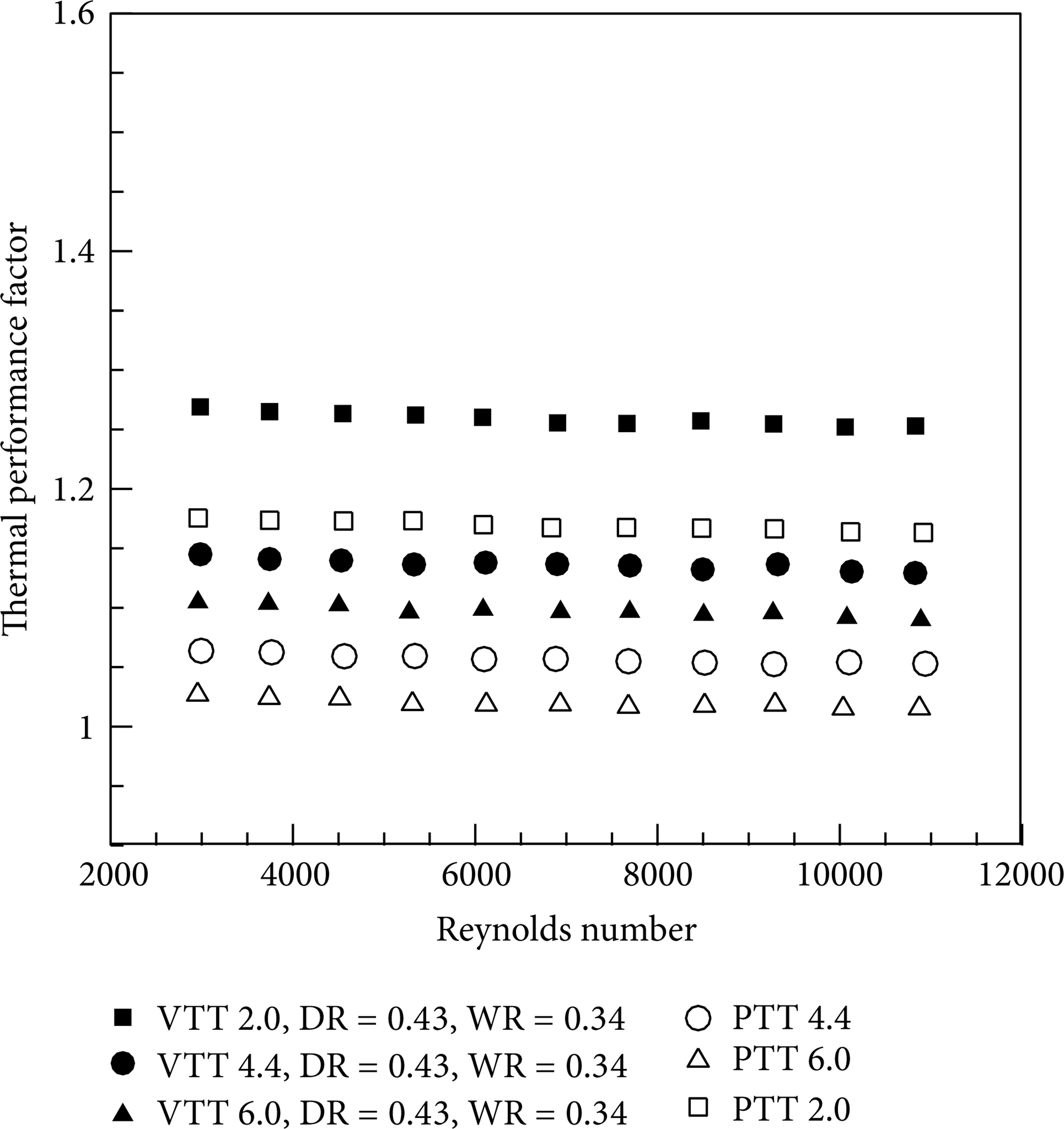
Thermal performance factor versus Reynolds number for VTT and PTT [15].
Experimental results showed that, among different kinds of twisted tapes including classic twisted tape, perforated twisted tape, notched twisted tape, jagged twisted tape, and butterfly insert, the Nusselt number and thermal-hydraulic performance of the jagged insert were higher than other ones followed by classic twisted tape, perforated twisted tape, and notched twisted tape as shown in Figure 5 [16]. It can be concluded that the holes on the classic twisted tape negatively affected the heat transfer ratio. This trend was also same for the notched one and the results revealed that none of these changes in insert shapes were promising [16–18]. However, a new designed perforated twisted tape with parallel wings had the heat transfer enhancement up to 208% compared to plain tube [18].

Effect of different twisted tape inserts on performance ratio [16].
Studies on effects of single twisted tape, regularly spaced twisted tape, full-length dual twisted tape, and regularly spaced dual twisted tape on heat transfer enhancement were carried out by Eiamsa-ard et al. [19, 20]. They concluded that the smaller space ratio (S) provides higher heat transfer rate. Their results also showed that the dual twisted tapes improve efficiency around 12–29% compared to single ones and it increases with reduction of twist ratio (y/w).
Krishna et al. [21] studied the heat transfer characteristics of circular tube fitted with straight full twist insert which is shown in Figure 6. Results showed that decreasing of space distance causes an increment in heat transfer coefficient. Performance evaluation analysis showed that the maximum performance ratio was achieved at Reynolds number of 2550.

Diagram of straight full twist insert [21].
Investigating the effect of twist ratio (H/D) of twisted tapes on heat transfer enhancement showed that, for all Reynolds numbers and all kinds of working fluids, the heat transfer enhancement was increased as the twist ratio increased. The twist ratio also can affect the friction factor, Nusselt number, pressure drop, and velocity fields [22–27]. Figure 7 shows the variation of Nusselt numbers for different twisted tape inserts with different twist ratios [27].

Effect of different twist ratio on Nusselt number for different Reynolds number [27].
Guo et al. [28] studied the heat transfer in a tube enhanced with a center-cleared twisted tape in laminar region. It was observed that the friction factor decreased with increment of the central clearance ratio (c) as it makes less baffled area at larger central clearance ratio. As it is shown in Figure 8, the thermal performance factor of the tube was improved by 7–20% with use of the center-cleared twisted tapes [28].
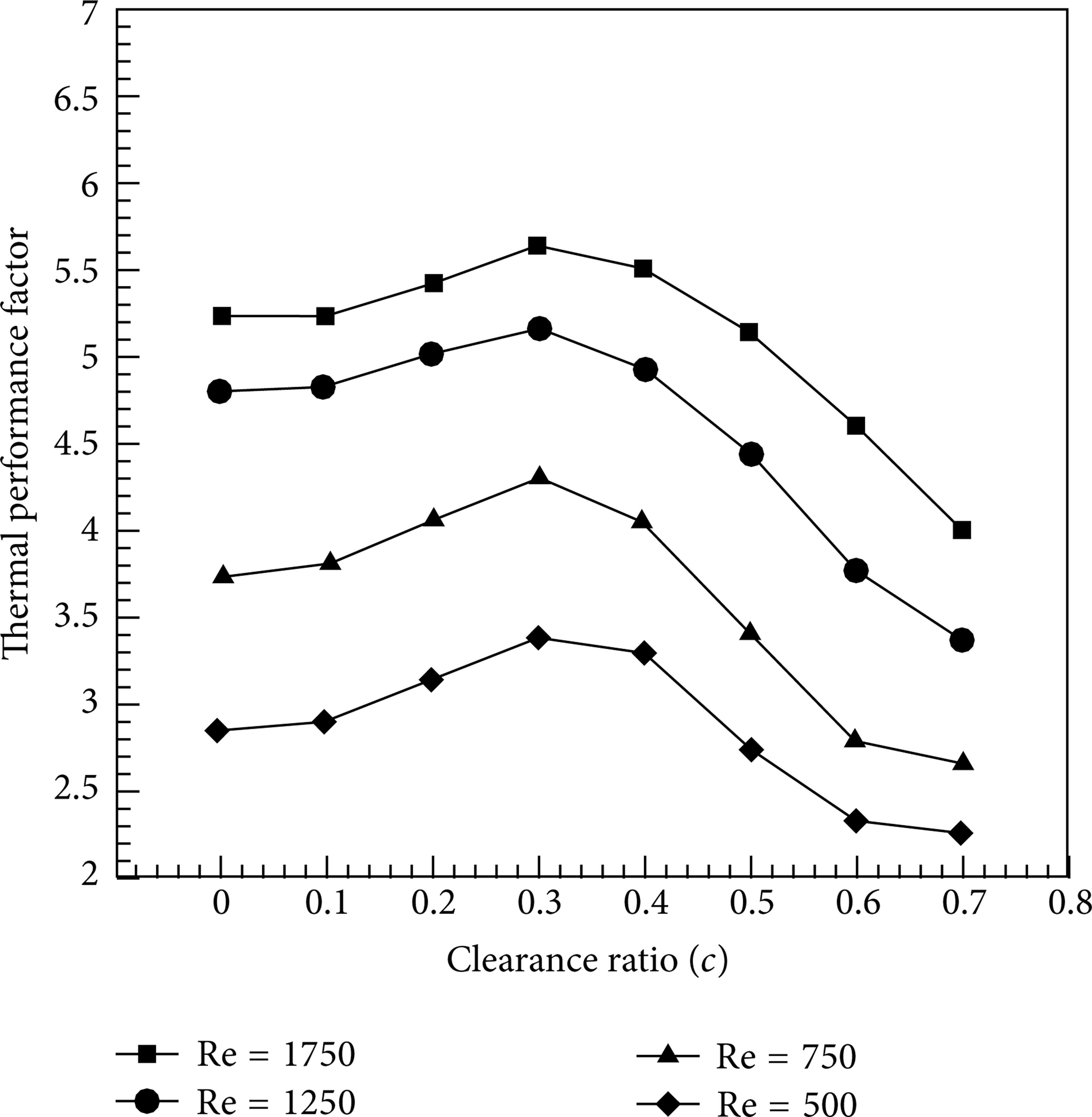
Effect of central clearance ratio (c) on the thermal performance factor (η) for tube fitted with center-cleared twisted tape [28].
Heat transfer enhancement can be affected significantly by the ratio of clearance between the edge of tape and tube wall to tube diameter, also known as the effects of the clearance ratio (CR) [27, 29]. As it is revealed by the results, by the decrease of the clearance ratio, the Nusselt number rises. Also, it was detected that the swirl flow intensity would heighten by the increment of the clearance ratio [27, 29].
As it is shown in Figure 9, alternate clockwise and counter-clockwise twisted tapes (TA) are considered to be the other modified shapes of twisted tapes [30]. Also, as it is suggested by the empirical data, alternate axis (TA) can provide a twisted tape with a higher Nusselt number compared to the typical twisted tape (TT) [31, 32]. The fact that the friction factor and the Nusselt number have direct relation with twist angle can be concluded from determining the effect of twist angle (θ) of alternate clockwise and counter-clockwise twisted tapes on heat transfer characteristics. Considering the Reynolds number, for various twist angles of θ = 30°, 60°, and 90°, improvement in friction factor was about 2.7–4.0, 3.1–4.65, and 3.42–5.1 times more than the plain tube. Figure 10 shows that higher mean enhancement index is provided by the counter-clockwise twisted tape with twist angle θ = 90° compared to θ = 30° and 60° which are around 9.3% and 2.2%, respectively [30].

The illustration of alternate clockwise and counter-clockwise twisted tapes [30].

Effects of twisted angles at y/w = 3.0 on enhancement index (η) [30].
2.3. Modified Tube with Twisted Tapes
The combination of twisted tape with corrogated tubes caused significant improvement in heat transfer. The achieved results also revealed that the combination of twisted tape and corrugated tube in a single device in the counter arrangement (CA) is more efficient in terms of heat transfer enhancement compared to the parallel arrangement (PA) [33, 34]. Bharadwaj et al. [35] presented that 75-start spirally grooved tube with twisted tape insert provided the maximum improvement of 600% in the laminar and 140% in the turbulent ranges. Moreover, Hong et al. [36] studied the impact of a converging-diverging tube with evenly spaced twisted tapes (CD-T tube) on heat transfer characteristics. It is concluded from their studies that the best performance among the four types of tested twisted tapes can be expected from the one with twist ratio y = 4.72 and rotation angle θ = 180°.
The investigations of Thianpong et al. [7] were concentrated on the friction and compound heat transfer behaviors of a dimpled tube fitted with a twisted tape insert. As it is illustrated in Figure 11, the Nusselt number of the dimpled tube with twisted tape insert was 66 to 303% higher than the plain tube and 15 to 56% higher than the dimpled tube without twisted tape in all Reynolds numbers [37]. In the combined devices, the average friction factor raised up to 2.12 times more than the dimple tube acting alone and 5.58 times of that in the plain tube. Another finding also suggested that the friction factor as well as the Nusselt number in the tube with the smaller pitch ratio was higher than in the one with the larger pitch ratio.

Nusselt number of dimpled tube fitted with twisted tape with Reynolds number [37].
A three-dimensional numerical was performed by Cui et al. [38] in order to study the convection-condensation of mixture with vapor in a tube with edgefold-twisted-tape inserts. The condensation model investigated the influences of gap width and operating parameters on thermal-hydrodynamics performance. The results showed that, by increasing of the gap width, convection and condensation heat transfer increased at first but then fell down, while convection heat transfer increased sharply and then decreased slightly. The increase in inner wall temperature decreased both convection and condensation heat transfers, while an increase in inlet temperature mainly has influence on convection heat transfer.
2.4. Helical Screw Insert
Studies on heat transfer characteristics in a circular tube fitted with helical twist inserts were carried out. The diagram of helical tape inserts is shown in Figure 12 [39]. The heat transfer enhancement increased with increase of Reynolds number and decreased with the increase of twist ratio. Figure 13 compared the heat transfer rates of water and nanofluids; the increase in Nusselt number was 5% to 31% for different helical inserts [39]. A greater heat transfer enhancement was also observed for all fluids compared as twist ratio decreased [39–41].

Schematic diagram of helical tape inserts [39].

The effect of twisted ratio on Nusselt number for a range of Reynolds numbers at 1.5% volume concentration of Al2O3 [39].
An empirical study was done by Eiamsa-ard and Promvonge [1, 42] on the impact of various types of helical tapes which are shown in Figure 14. Higher heat transfer, as it is presented in Figure 15, was provided by the full-length helical tape with rod compared to the one without rod [42]. The average Nusselt number enhancement, according to the observations, was about 145% to 165% with and without rod, separately. Moreover, it is perceived that a higher heat transfer rate can be provided by the smaller space ratio (S). Also, the effectiveness of the helical screw-tapes was heightened between 1.00 and 1.17, 1.98, and 2.14, for the tapes with and without core-rod, separately.

The inner tube fitted with different helical geometries insert: (a) full-length helical tape with a rod, (b) full-length helical tape without a rod, and (c) regularly spaced helical tape without a rod [42].

Comparison of Nusselt number for the tube with full-length helical tape inserts and plain tube [42].
Bhuiya et al. [43] investigated experimentally the enhancement of heat transfer of a tube fitted with double helical tape inserts with different helix angles. It was clearly noted that the Nusselt number, friction factors, and thermal enhancement efficiency were increased by decreasing of helix angles under the same operating conditions. As it is shown in Figure 16, the maximum thermal enhancement efficiency (η) of 215% was found with use of the double helical tape insert with helix angle 9° at high Reynolds number [43].

Variation of enhancement efficiency (η) with Reynolds number [43].
A three-dimensional numerical study on heat transfer and fluid flow in a tube with helical screw tape inserts with four different widths (w = 7.5 mm, 12 mm, 15 mm, and 20 mm) was performed by Zhang et al. [44]. The results concluded that the overall heat transfer coefficient with helical screw-tape was enhanced as much as 212 to 351% at a constant tube-side temperature and the friction factor was also improved by as much as 33% to 1020%. It was also shown that, as the inserts widths increased, the heat transfer characteristics improved.
2.5. Wire Coil Insert
The heat transfer coefficient for the tube with coil-wire insert was higher compared to the plain tube according to the studies on the impact of coil-wire insert on the heat transfer characteristics [25, 45, 46]. The fact that the maximum heat transfer enhancement can be achieved for tube with thickest wire was discovered by an investigation on the effect of coiled wire thickness on heat transfer enhancement during forced convection-condensation of R-22. Although, for low vapour qualities, tubes with thinnest coiled wire may generally provide the maximum enhancement [47]. On the other hand, the Nusselt number increased with the increase of wire thickness and decrease of pitch ratio, as it is suggested by the other empirical studies [48]. In another empirical study, Saeedinia et al. [49] concluded that, at the highest Reynolds number inside the tube which was fitted with wire coil with the highest wire diameter, average of 45% enhancement in heat transfer coefficient and 63% penalty in pressure drop can be obtained.
An experimental comparison was done by García et al. [50] regarding the influence of three kinds of augmentation techniques based on artificial roughness including corrugated tubes, wire coils, and dimpled tubes on pressure drop and heat transfer. As Figure 17 suggests, corrugated and dimpled tubes should be used for Reynolds numbers higher than 2000, and wire coils should be used if the Reynolds numbers are between 200 and 2000; however, smooth tubes should be used for Reynolds numbers lower than 200 [50].

Nusselt number versus Reynolds number. Experimental results for the wire coil in the laminar region (I), transition region (II), and turbulent region (III) [50].
Figure 18 illustrates the empirical study of Chandrasekar et al. [45] on the heat transfer and friction factor characteristics of spiraled rod inserts. It is suggested that, under turbulent flow, the Nusselt number for spiraled rod inserts increased about 10 to 48% compared to the plain tube. A better heat transfer augmentation would be provided by the spiraled rod inserts with 15 mm pitch in comparison with the spiraled rod inserts with 30 mm pitch.

Wire coil inserts of pitch ratio 3 (WC3) and 2 (WC2) [45].
2.6. Different Swirl Flow Generator Inserts
Yildiz et al. [51] studied the influence of fluid rotation on the thermodynamic behavior of a double tube heat exchanger. It was detected that the enhancement of heat transfer was about 250% more than the smooth tube and the increase of pressure loss was reported to be within the range of 500 to 1000%. The thermodynamic features of a pipe fitted with propeller-type vortex generators at three different positions in the axial direction have been investigated by Saraç and Bali [52]. Using this method, the increase in the heat transfer was reported to be 18% to 163% more than what it would be in the plain tube. Also, the heat transfer efficiency in a heat exchanger tube equipped with propeller type swirl generators at several pitch ratios (PR) and blade angles (θ) has been studied by Eiamsa-ard et al. [53]. Figure 19 illustrates different propellers [53]. The results obtained from empirical studies as shown in Figure 20 suggest that substantial enhancement in the heat transfer rate over the plain tube around 2.07 to 2.18 times for pitch ratios PR = 5, blade numbers N = 8, and blade angles θ = 60° can be provided by the tube with the propeller inserts [53].

Various propeller types [53].

Effects of (a) number of blades, (b) blade angle (θ), and (c) pitch ratio (PR) on Nu [53].
It was Yang et al. [54] who introduced rotor-assembled strand without limitation of tube length for the first time. The heat transfer and friction factor of a rotor-assembled strand fitted in a plain tube in turbulence region were investigated by Zhang et al. [55]. This technique, as it is revealed by the obtained results, can significantly increase the friction factor by 158.5–295.9% and the Nusselt number by 91.4–178.7%. The decreasing lead of rotor assembled strands as well as the increase of diameter would heighten the friction factor. The thermal performance factor (PEC) value also increases with an increase of the rotor diameter as it is presented in Figure 21 [55].

Comparison of PEC value for rotor-assembled strands with different diameters [55].
A numerical simulation by Habchi et al. [56] was done in order to investigate the impact of inclined baffles on the heat transfer. In Figure 22, it can be seen that, during the first phase, generators were aligned and inclined in the flow direction (reference geometry); then, a periodic 45° rotation was applied to the tab arrays (alternating geometry); and, finally, the reference geometry was used in the opposite direction of the flow (reversed geometry) [56]. The best heat transfer coefficient and the best efficiency followed by the alternating array and the reference geometry, according the observations, were provided by the reversed geometry. Figure 23 illustrates the flow pattern and temperature fields in a cross section at r/R = 0.8 for aligned, alternating, and reversed arrays [56]. Another empirical investigation which is carried out by Wang et al. [57] was about the heat transfer improvement in a shell-and-tube heat exchanger by utilizing sealers in the shell-side. In the mentioned study, the results suggest that the shell-side heat transfer coefficient of the heat exchanger with sealer was increased by 18.2–25.5% and the total coefficient of heat transfer was improved by 15.6–19.7%.

The geometries of (a) aligned arrays, (b) alternating arrays, and (c) reversed arrays [56].
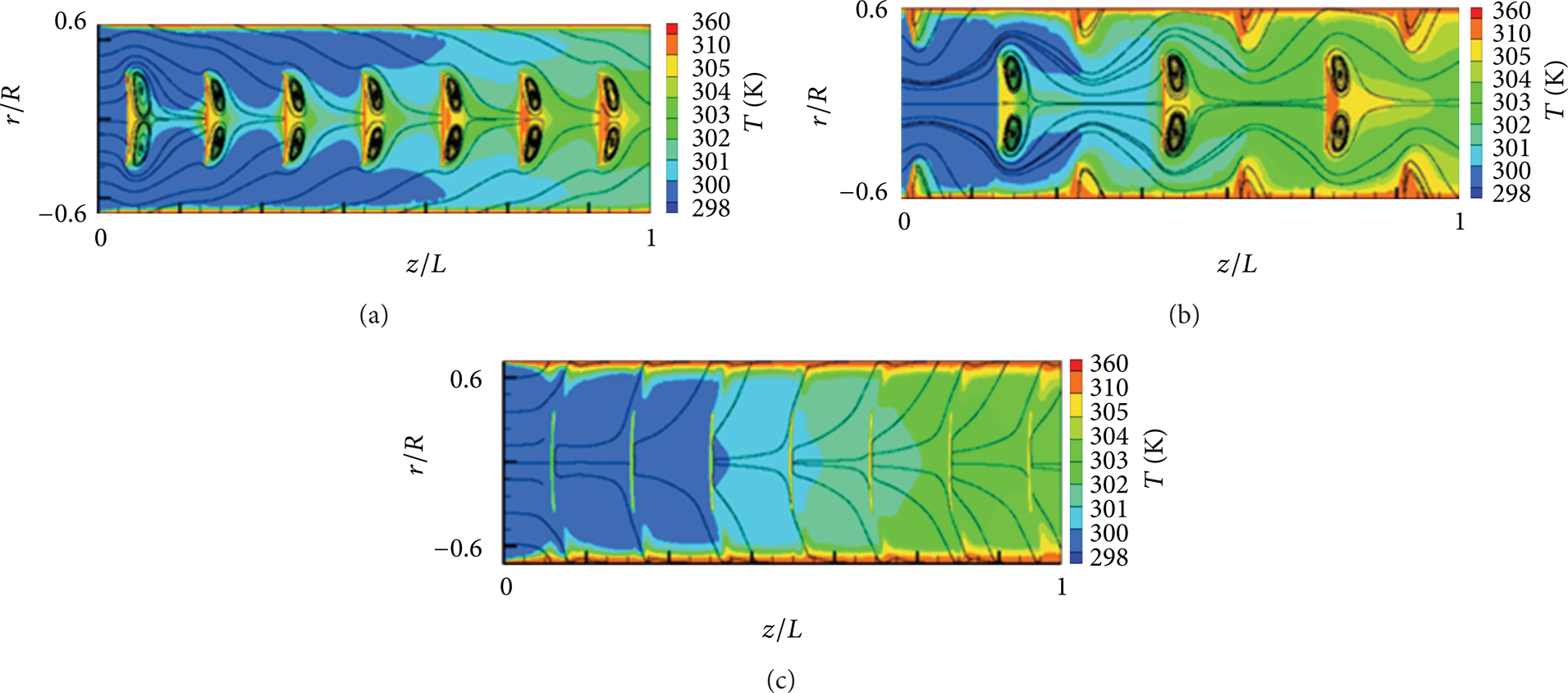
The temperature con in a cross section at r/R = 0.8 for (a) aligned, (b) alternating, and (c) reversed arrays, Re = 15,000 [56].
An empirical as well as numerical study about heat transfer in a helically baffled heat exchanger which is combined with a three-dimensional finned tube was performed by Zhang et al. [58]. An illustration of a petal-shaped finned (PF) tube enwound with helical baffles is presented in Figure 24 [58]. As it is implied by the results, fins disturbed the cross-sectional velocity field in the shell-side and the fluid gained a helical flow pattern along PF tube. The Nusselt number and pressure drop in the shell-side, as it was observed, would increase with increase of Reynolds number. The pressure drop will also increase due to the enhancement of heat transfer rate.
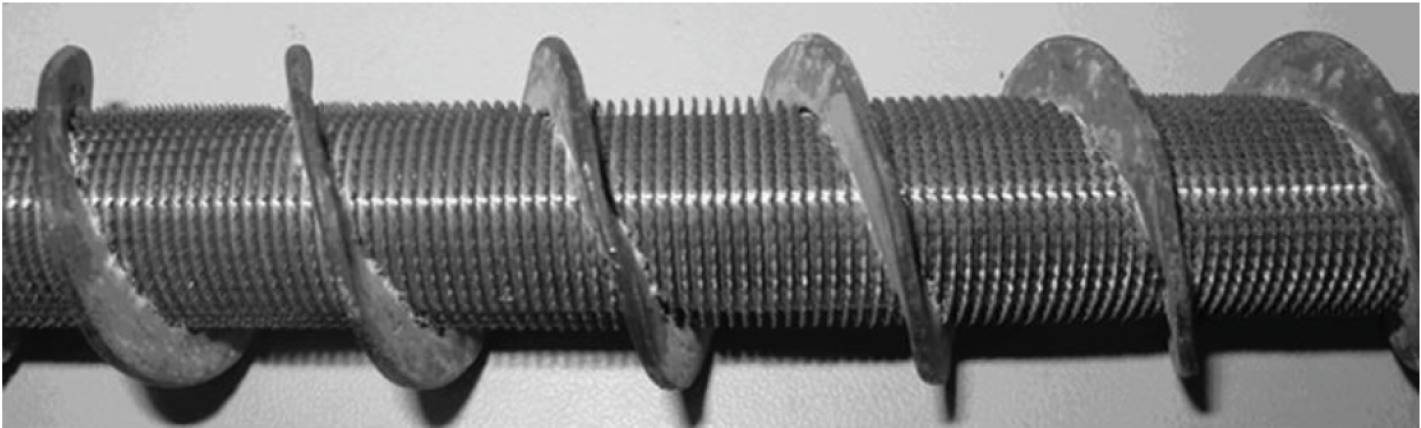
Photography of PF tube enwound with helical baffles [58].
3. Conclusions
The literatures about the effect of inserts on heat transfer characteristics have been reviewed. Different types of inserts in various conditions and arrangements have been considered. The main conclusions can be briefly drawn as follows.
Louvered strip insert had better function in backward flow compared to forward one.
Increasing of the inclined angle from 10 to 30 can increase the heat transfer performance by 5–11%.
The mean heat transfer rate was increased up to 72.2% with use of the serrated twisted tape STT and the peripherally cut twisted tape.
V-cut twisted tape provided better heat transfer by around 10% compared to plain twisted tube at the same condition.
Among different kinds of twisted tapes including classic twisted tape, perforated twisted tape, notched twisted tape, jagged twisted tape, and butterfly insert, the Nusselt number and thermal-hydraulic performance of the jagged insert were higher than other ones followed by classic twisted tape, perforated twisted tape, and notched twisted tape. Nusselt number provided by jagged insert can be up to 40% more than Nusselt number provided by perforated one.
In helical screws and twisted tapes, the heat transfer enhancement was increased by up to 12% as the twist ratio increased.
The twisted tape with alternate axis (TA) provided a higher Nusselt number than the typical twisted tape (TT).
Combination of various inserts and tube with artificial roughness provided promising results.
The helical tape with rod provided higher heat transfer rate than that without rod.
Propeller-type vortex generators can increase the heat transfer by 18% to 163% more than what it would be in the plain tube.
A rotor-assembled strand fitted in a plain can significantly increase the friction factor by 158.5–295.9% and the Nusselt number by 91.4–178.7%.
Utilizing sealers in the shell-side can improve heat transfer coefficient by 18.2 to 25.5%.
4. Outlook and Future Challenges
Further studies are essential in future to discover and optimize geometries of various inserts and vortex generators in order to enhance the thermal characteristics of heat exchangers. Additionally, the recent development in nanotechnology has widened a promising field in heat transfer investigation. Combination of inserts and nanofluids might be a kind of propitious idea to enhance the thermal systems performance which has been rarely reported in the open literature. Numerous opportunities will be available when authors focus their efforts on using nanofluids combined with different kinds of inserts in large or even microscale heat exchangers and heat sinks. The comparison of nanofluids and conventional fluids in different shapes of compact heat exchangers and heat sinks in terms of heat transfer and pressure drops has shown huge improvement.
Conflict of Interests
The authors declare that there is no conflict of interests regarding the publication of this paper.
Footnotes
Acknowledgment
The author would like to thank University of Malaya for providing the Research University Grants RP006C-13AET and FP021-2010B.