




Abstract
Due to the nonexistence of end-to-end path between the sender and the receiver in delay tolerant networks and mobile social networks, consequently successful message transmission faces great challenges. In this paper, an adaptive routing algorithm taking full use of gregariousness characteristics of moving nodes is proposed. We first abstract all social relationships and uniformly represent them using friendship. Then by dynamically dividing nodes into different social groups, we finish flooding message among the target social group where destination node resides. In addition, we propose a social group based flooding model and a message redundancy control model to select fewer but better relay nodes and further reduce message redundancy. Extensive simulations have been conducted based on the synthetic traces generated by working day movement model and the results show that the proposed routing algorithm can get a higher message delivery ratio and a lower overhead ratio compared to Bubble Rap, Epidemic, and ProPHET, thus proving a better routing performance.
1. Introduction
TCP/IP protocol is based on certain assumptions, such as continuous end-to-end connections, low delivery latency, symmetrical bidirectional data transfer rate, and low error rate. In this case, TCP/IP protocol is able to shield heterogeneous networks. So with the TCP/IP protocol stack, traditional Internet has achieved a great success. However in recent years, some emerging challenged networks deployed in extreme environment are unable to meet the above assumptions, for example, vehicular ad hoc networks [1], pocket switched networks [2, 3], underwater sensor networks [4], interplanetary internet, mobile social networks [5, 6], and so forth. These special networks are characterized by intermittent connectivity, sparse node density, limited network resource, node mobility, and so forth. In these networks, there may never be a complete end-to-end path between the sender and the receiver, so traditional TCP/IP protocol is difficult to get efficient achievements. Consequently successful message delivery in such networks faces great challenges.
In 2003, Kevin Fall first put forward the concept of delay tolerant networks (DTNs). Soon afterwards, the DTN architecture [7–9] is proposed, which introduces a bundle layer between the application layer and the transport layer. With the bundle layer, DTNs can shield heterogeneous networks, thus communicating across multiple regions that have different types of network architectures and protocols. In order to cope with frequent network topology partitions and finish end-to-end data communications, DTN routing adopts the store-carry and forward strategy to relay messages hop by hop.
So far, a large number of routing protocols have been proposed to optimize the next hop relay node selection in the case of lacking of global topology knowledge. In order to select appropriate next hop relay nodes to gradually move closer to the final destination node so as to improve message delivery ratio, most of the proposed algorithms forward or replicate messages by taking into account nodes’ physical attributes such as link status and geographic location. However, for specific DTN application scenarios, there usually are some more useful characteristics or information, and making good use of them can further improve routing performance, for instance, the DTN application scenarios in social networks, in which nodes are not completely isolated. On the contrary, a node usually has social relationships or social ties with other nodes. For a university, the students in the same class have strong relationships that we call classmates. In this case, such students will encounter each other much more frequently than the students outside of the class. Another example is that people having similar interests will regularly get together and eventually form a stable group. In other words, nodes in social networks are characterized by gregariousness. This gives us a heuristic that we can first forward message to the target social group where destination node resides and then flood message among the group in order to quickly and successfully finish message transmission.
In this paper, taking full use of the gregariousness characteristics of nodes in social networks, we proposed dynamic groups based adaptive DTN routing algorithm (DGA). For the reason that nodes in social networks have a variety of social relationships and common interests, we first abstract these social ties and then uniformly represent them using friendship. We do not care about the type of the relationship between two nodes. But we seriously focus on the strength of the relationship, which is usually reflected by the encounter probability between the two nodes. According to nodes’ social circles and similarities, we dynamically add nodes into different social groups and then implement the social group based flooding routing. Our main contributions are summarized as follows.
We abstract all social relationships and uniformly represent them using friendship. And then we use encounter probability to measure the strength of the friendship between two nodes. We first propose an ego group model to describe the friend circle of a certain node. And then based on the ego group, we add the node into a certain social group. We propose a social group based flooding model to estimate encountered nodes, thus selecting fewer but better relay nodes so as to improve message delivery ratio. We also present a message redundancy control model to avoid generating unnecessary redundant message copies, thus further controlling message redundancy.
The rest of this paper is organized as follows. Section 2 discusses some related works. Section 3 gives detailed descriptions of the proposed algorithm. The performance evaluations and comparisons, as compared to Bubble Rap, Epidemic, and ProPHET, are presented in Section 4. Finally, Section 5 summarizes this paper.
2. Related Works
Currently, scholars have proposed a large number of DTN protocols to address the end-to-end communication problem. Firstly, we gave a brief description of the two typical routing strategies Epidemic [10] and ProPHET [11] for the reason that our routing idea is inspired by them. Secondly, we introduced some latest social-based routing protocols.
Epidemic is a typical flooding-based routing algorithm, which tries to replicate messages to all encountered nodes for the purpose of quickly delivering message to destination node. In case of sufficient buffer resource and bandwidth, Epidemic may be able to get the best message delivery ratio. But in most DTN application scenarios, the buffer resource is extremely restricted. In this case, Epidemic is difficult to get satisfying overall routing performance. Despite this, we still think this flooding idea is acceptable, but the key issue is that Epidemic does not evaluate encountered nodes, thus leading to flooding message in the whole network. If we can control the flooding scope to a small group where the destination node resides, then we will get a better routing performance. Our routing idea comes in part from this.
ProPHET is a typical history utility based routing algorithm, which takes full use of the encounter history information and transitivity to predict delivery possibility. There are three delivery predictability metrics in ProPHET. The first metric is defined in (1), where


Bubble Rap [12] was the first proposed community based routing protocol, which relies on two social characteristics: community and centrality. Each node in the network belongs to at least one community and has a global rankness and a local rankness, which, respectively, represents the global popularity in the whole network and the local popularity in its local community. The delivery process of a certain message includes two phases. It first bubbles message up based on the global popularity until the message is delivered to the destination community to which the destination node belongs. Then in the local community, it bubbles the message up based on the local popularity until the message is delivered to its destination or its TTL is exhausted. In order to reduce the resource consumption, the original carrier deletes this message once the message has been successfully delivered to the destination community. The simulation results in this paper show that Bubble Rap gets certain advantages in delivery latency and average hop count.
Taking full use of human contact features, Wu and Wang propose a hypercube-based multipath social feature routing algorithm [13], which includes two unique phases: social feature extraction and multipath routing. Specifically, in social feature extraction process, it first uses Shannon Entropy to capture the m most informative features to build social feature space and then transforms the routing problem into hypercube-based feature matching problem. In the second phase, it proposes two kinds of multipath forwarding strategies. The extensive simulations using the real datasets show that the proposed algorithm achieved a significant improvement in the message delivery ratio and the end-to-end delivery delay.
ComPAS [14] is a typical community-based routing protocol proposed by Xia et al. By exploiting social relationship while replicating message in community, ComPAS can significantly improve routing performance and achieve better efficiency and consistency while keeping the replica relocation cost as low as possible.
Xiao et al. propose a distributed optimal community-aware opportunistic routing (CAOR [15]). By using a home-aware model, they turn mobile social networks into a network that only includes community homes. Besides, they also prove that, in the network of community homes, the minimum expected delivery delay can be computed through a reverse Dijkstra algorithm. Based on the home-aware model, CAOR achieves a satisfying opportunistic routing performance.
HS [16] is a zero-knowledge assisted mobile social network routing algorithm proposed by Wu et al., which spreads a given number of message copies in an optimal strategy by theoretical analysis when assuming that the intermeeting times between any two nodes and between a node and a community follow exponential distribution. In addition, by constructing a Markov chain, HS can also calculate the expected delivery delay and derive an upper bound, thus getting a better routing performance.
3. Routing Framework
Before presenting our DGA routing algorithm, we first define two groups: Ego Group and Social Group in this section, and then introduce our social group based flooding model and message redundancy control model.
3.1. Friendship Definition
There are too many kinds of social relationships in social networks. Besides, nodes’ social behaviors driven by common interests are also complicated. In this case, it may be very difficult to analyze and capture these relationships. In order to reduce routing complexity, we extract their common key features: a pair of nodes with certain social relationship or specific common interest will encounter each other more frequently than strange nodes. Moreover, the strength of their relationship can also be accurately measured by their encounter probabilities. In other words, frequent communications between two nodes indicate higher encounter probability values, which can in turn prove the existence of a strong relationship between two nodes. The key issue we are concerned with is the strength of the relationship, rather than the type of the relationship. Consequently, we abstract all social relationships and uniformly represent them using friendship. Furthermore, we use encounter probability to measure relationship strength.
In this paper, we use (4) to measure the friendship degree and estimate whether two nodes could become friends, where

3.2. Ego Group Definition
In social networks, due to different social behaviors and interests, a node will have different friends. Under normal circumstances, most friends of a node are not each other's friends or even do not know each other. The only social tie is that they have a common friend for a certain reason. In this case, the friends of a certain node are usually not closely associated. However, these friends information are very useful and can be used to determine the social group (defined in next subsection) where the node resides. Here, we define an Ego Group to describe all the friends of a node. As shown in Figure 1, nodes

The Ego Group of node S.
We assume that each node in social networks has one and only one ego group, in which the node is the unique ego node (i.e., the owner of the ego group) and other nodes are all its friends. The special instance is the ego group only containing the ego node itself. For an ego group, we do not care about the relationships between the friends of the ego node, but we do care about the composition of the ego group. Using (4), a node can easily establish its ego group and maintain it. As time progresses, if a node is no longer the friend of the ego node, then it should be deleted from the ego group.
3.3. Social Group Definition
In social networks, due to complicated relationships and common interests, the behaviors of nodes are characterized by gregariousness. In other words, there is a node set, in which member nodes are closely associated with each other and encounter each other much more frequently than nodes outside of the node set. If we can find such a node set where destination node resides, we can flood message only among the node set in order to improve message delivery ratio in the case of controlling network overhead. In this paper, we call the above node set the social group. Note that ego group can only reflect that the ego node encounters its friends very frequently but cannot reflect the encounter frequencies between the friends of the ego node.
Now there is a key problem: how to dynamically establish these social groups. Usually, the similar nodes should be added into the same social group. Ego group can reflect the friend circle information of an ego node, which is very useful and can be used as the metric to estimate the similarities between nodes. In this paper, we use the ego group information of a node to determine the social group where the node resides. Concretely, grouping decisions can be made when one of the following cases occurs.
If the friend circles of two ego nodes are almost the same and they are also each other's friends, then the two nodes are assigned to the same social group. If most member nodes of a certain social group are the friends of a node, then the node should also be added to the social group.
The detailed establishment process of social group is presented in Algorithm 1. For the above two cases, we, respectively, define the threshold parameters
ego group of node a: ego group of node b: social group of node a: social group of node b: threshold parameters: when node a encounters node b
(6) (7) update (8) (9) update (10) (11) update (12) (13)
3.4. Social Group Based Flooding Model
Based on the above social group information, we can finally implement our flooding routing model. Here we first define the node sets
The core strategy in our routing model is that message is flooded to all member nodes once the message is propagated to the target social group where the destination node resides, which we call social group based flooding. For the purpose of successfully and quickly spreading message into the target social group, we also need to seek help from some intermediate relay nodes. Consequently, the choice of these intermediate relay nodes will greatly affect final routing performance and becomes the emergent thing we need to tackle with. In order to select fewer but better intermediate relay nodes, we attempt to compute the potential likelihood that a node can finish message transmission based on social group flooding. For this purpose, we first need to model group flooding process as a two-virtual-hop routing model. Then we can easily compute the potential likelihood of successful message transmission when the message has been delivered into the target social group through a group member (e.g., node

A two-virtual-hop flooding model of
In the above abstracted model, there will be


By controlling the cost to

Now with
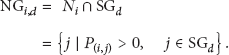
Here we can get the matrix
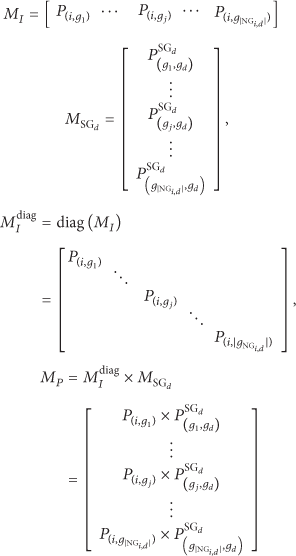

3.5. Message Redundancy Control Model
In most DTN application scenarios, the node buffer resource is extremely limited, which determines that the number of message copies should be controlled to get a better routing performance. As a result, improving the utilization efficiency of network resources for each message copy can further increase message delivery ratio. For this purpose, we make attempts to reduce message redundancy when selecting intermediate relay nodes to spread message to target social group. Assuming that node i and node j both carry a same message copy, then for the node encountered by both i and j, one of the two message copies is redundant. Concretely, if most nodes that node i may meet will also be encountered by node j, then one of the two message copies is considered to be unnecessary. Here based on these considerations, we propose a message redundancy model to avoid creating such redundant message copies when selecting next hop relay nodes.
Here, we assume that the nodes encountered by a node in the past are possible to be encountered again. Then we use the encountered node set to predict the node set that a node will encounter in the near future. For current node i and its neighbor node j, we denote the node set




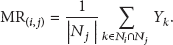

Encounter history of node i and node j.
3.6. Detailed DGA Routing Algorithm
Based on the above works, we finally implement our routing algorithm as illustrated in Algorithm 2. There are two cases that current node should deliver message to a node: one is that the node belongs to the social group of destination node, the other is that destination node belongs to the node's ego group. Lines 6-7 are to test these cases and finish message transmission. Otherwise, by using the proposed social group based flooding model to compute the potential delivery probability and using the message redundancy control model to reduce redundant messages, lines 8–14 select fewer but better relay nodes to spread message copies in order to quickly deliver message to the target social group.
one-hop neighbors of messages stored in the value of MRthreshold: MR
(1) (2) dest ← message.destination (4) (6) (7) replicatemessage to node (8) (9) (10) replicate message to node (11) (12) (13) (14) replicate message to node (15) (16) (17) (18)
4. Simulation
By using the ONE [17] simulator, we conduct extensive simulations to evaluate the performance of DGA under various settings. The compared algorithms, simulation settings, evaluation metrics, and results are described as follows.
4.1. Compared Algorithms
For evaluations in this paper, we only focus on the routing algorithms similar to DGA. Firstly, considering that DGA takes advantage of social behaviors among nodes, we add the typical social-based routing algorithm Bubble Rap [12] to the comparisons. This can evaluate the improvements of DGA in terms of using social properties. Secondly, taking into account that DGA abstracts all social relationships and further uses encounter probability to measure relationship strength, we also add ProPHET to the evaluations. The concept of encounter probability presented by ProPHET can be considered the most essential form of social relationships. So in this case, ProPHET can also be regarded as a social tie based routing algorithm. The concept of abstracting social relationships is also from ProPHET. Lastly, the core routing strategy of DGA is flooding based on social group, which comes in parts from Epidemic but different from Epidemic. Introducing Epidemic to the simulations is to find out the improvements of local flooding (DGA) compared to typical global flooding (Epidemic).
4.2. Simulation Settings
To evaluate the routing performance of DGA based on social behaviors, we conduct all simulations on synthetic traces generated by the working day movement (WDM) model [18]. This is because the WDM model brings more reality to the human movement by modeling three major activities typically performed by humans during a working week: sleeping at home, working at the office, and going out with friends. Beyond the activities themselves, the WDM model also includes different transport models. The nodes can move alone or in groups by walking, riding, or driving. The ability to move alone or in groups at different speeds increases the heterogeneity of movement which has impact on the performance of, for example, routing protocols. In addition, WDM introduces communities and social relationships. The communities are composed from nodes which work in the same office, spend time in the same evening activity spots, or live together. Moreover, we can modify the model parameters as needed, so that it can reproduce various empirical mobility properties, which is beneficial to the routing performance evaluations. This is another reason that we use the traces generated by WDM.
In the trace-driven simulations, there are 50 working offices and 10 meeting spots. Working day length is 4 hours and office wait time is about 10 minutes to 4 hours. The probability of shopping after work is 0.5 and shopping time is about 1-2 h. We totally use 110 nodes, which consist of 10 bus nodes and 100 human nodes. In detail, bus nodes are based on bus movement model and divided into 5 bus groups. Each bus group travels along different traffic routes and consists of two bus nodes. Each bus node moves with speed of 7–10 m/s, wait time of 10–30 s, transmit speed of 10 Mbps, and transmit range of 1000 m. The human nodes are based on WDM model and also divided into 5 groups. Each human group consists of 20 nodes and they have their own meeting spots, homes, and working offices. Each human node moves with speed of 0.8–1.4 m/s, transmit speed of 2 Mbps, and transmit range 20 m. All other default simulation settings are shown in Table 1.
Default simulation settings.
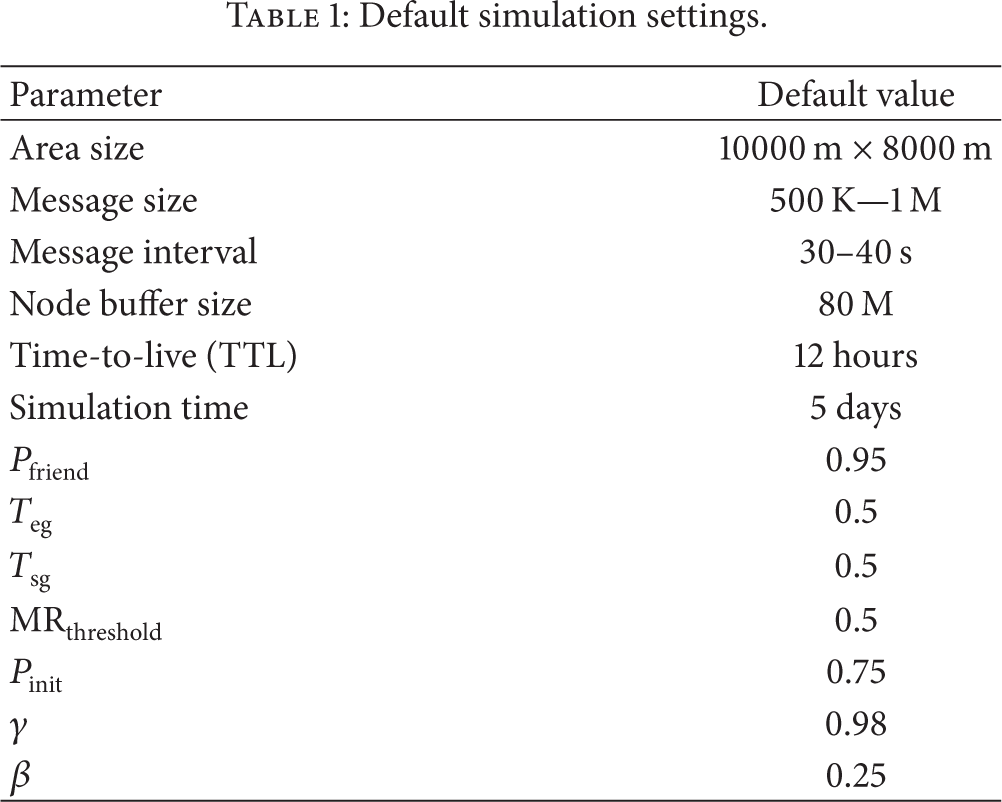
The simulations are grouped into the three categories: varying buffer size, varying message's time-to-live, and varying message generation internal. When varying a single setting parameter in simulations, the other setting parameters follow the default settings in Table 1. Firstly, we investigated the routing performance of the four algorithms when varying buffer size from 20 M to 120 M. Secondly, we evaluated their routing performance when varying message's time-to-live from 4 hours to 24 hours. Lastly, we conducted the simulations when varying the message generation interval from 20 seconds to 100 seconds. All evaluation results are shown in Section 4.4.
4.3. Evaluation Metrics
Under the same guideline, we evaluated the above four routing algorithms based on the following metrics.
Delivery ratio: normally, the ultimate routing goal in DTNs is to successfully deliver message to its destination. This metric is the measure of delivery capability for each algorithm. Overhead ratio: it is desirable to have a low overhead ratio, since it reflects the efficiency of message transmission. Average latency: end-to-end latency is another important routing goal. A lower average latency means a better routing performance. Average hop count: minimizing the number of hops that a message must take in order to reach the destination is a routing goal to reduce transmission cost, such as bandwidth and energy.
4.4. Simulation Results
4.4.1. Performance Evaluations by Varying Buffer Size
Regarding the simulation results in Figure 4, DGA achieves the highest delivery ratio and the lowest overhead ratio. The average hop count of DGA is almost as few as Bubble Rap and is fewer than Epidemic and ProPHET. In addition, DGA is also able to get some advantages in delivery latency compared to Epidemic and ProPHET. All these results can verify the great improvements of DGA in routing performance.

Delivery ratio, overhead ratio, average latency, and average hop count versus buffer size (WDM).
As shown in Figures 4(a) and 4(b), DGA can outperform Bubble Rap, Epidemic, and ProPHET in terms of message delivery ratio and overhead ratio. This is because DGA takes full use of the gregariousness characteristic of moving nodes. Based on the proposed ego group model and social group model, DGA can find out the friend nodes that are closely associated with destination node and then only floods message among the target social group. Besides, based on the social group based flooding model, current node is also able to select better nodes as next hop relay nodes to quickly and successfully deliver message to the target social group. In this case, DGA achieves a higher delivery ratio than Bubble Rap. In addition, the proposed message redundancy control model further helps DGA to get a lower overhead ratio. DGA and ProPHET both use the encounter probability to measure the strength of the social tie between two nodes, but ProPHET does not take further optimization strategy to improve routing performance. On the contrary, ProPHET just naively delivers message to the encountered nodes that have bigger probabilities than current node. Therefore the routing performance of ProPHET is worse than DGA. Compared to the global flooding strategy of Epidemic, DGA accurately controls the flooding scope based on social group model, thus greatly avoiding creating too many redundant messages and further controlling network overhead ratio. And DGA takes into consideration nodes’ social relationships for improving routing performance. As a result, DGAs significantly outperform Epidemic.
From Figures 4(c) and 4(d) we can see that the average latency and average hop count of DGA and Bubble Rap are lower than those of Epidemic and ProPHET when buffer size is more than 40 M, which reflects the fact that the routing strategies of DGA and Bubble Rap are more accurate, thus efficiently reducing the cost of message transmission.
Finally from the whole Figure 4, we can make a conclusion that DGA can outperform Epidemic and ProPHET in social networks in terms of delivery ratio, overhead ratio, average latency, and average hop count. And although the average latency and average hop count of DGA are slightly higher than those of Bubble Rap, the message delivery ratio of DGA is higher than Bubble Rap and the overhead ratio of DGA is only about 50% of that of Bubble Rap. As a result, from the point of view of high delivery ratio and low overhead ratio, DGA is able to outperform Bubble Rap.
4.4.2. Performance Evaluations by Varying Message TTL
The results in Figure 5 show that DGA gets the highest delivery ratio when message time-to-live is more than 8 hours and achieves the lowest overhead ratio when message TTL is less than 16 hours. As same as shown in Figure 4, DGA can still achieve satisfying delivery latency and average hop count. These simulation results prove once again the improvements and routing efficiency of DGA.

Delivery ratio, overhead ratio, average latency, and average hop count versus message TTL (WDM).
From Figure 5(a), we can find that message TTL can significantly affect the message delivery ratios of the four algorithms when buffer size is relatively sufficient. When message TTL is less than 12 hours, the delivery ratios of the four algorithms all keep increasing. This is because that message has a longer time to seek destination node in this case. But when message TTL is more than 12 hours, their delivery ratios keep decreasing. The reason is that long message TTL also leads to the presence of more messages, which exacerbates the consumption of cache resource. However, DGA can keep a higher delivery ratio compared to Bubble Rap, Epidemic, and ProPHET when message TTL is more than 8 hours. To a certain degree, Bubble Rap is able to avoid generating too many redundant messages by selecting relay nodes based on social behaviors of nodes. But DGA can further reduce redundant messages by using the proposed message redundancy model while selecting relay nodes based on social behaviors. On the contrary, Epidemic and ProPHET do not take efficient strategy to control message redundancy. In this case, they will inevitably create many redundant messages. Therefore from the perspective of the message redundancy, the increases of message TTL help DGA to get a higher delivery ratio. In Figures 5(b), 5(c) and 5(d), DGA and Bubble Rap can also keep their advantages in overhead ratio, delivery latency, and average hop count with the increases of message TTL.
To sum up, considered from message delivery ratio and network overhead ratio, DGA can outperform Epidemic and ProPHET and achieve certain advantages compared to Bubble Rap.
4.4.3. Performance Evaluations by Varying Message Generation Interval
As shown in Figure 6, DGA achieves the highest message delivery ratio and the lowest overhead ratio when message generation interval is more than 20 seconds. In addition, DGA gets significant advantages in delivery latency and average hop count compared to Epidemic and ProPHET. From these results, we can verify the great improvements of DGA.

Delivery ratio, overhead ratio, average latency, and average hop count versus message interval (WDM).
In Figure 6(a), the delivery ratios of the four routing algorithms all keep increasing with the increase of message generation interval, but DGA can keep the highest delivery ratio. The key reason is that the number of new messages generated by network will be reduced when message generation interval keeps increasing, thus weakening the competition for cache resource. In this case, all algorithms can use these relatively sufficient buffer resources to better deploy their routing strategies. Furthermore, DGA can efficiently select fewer but better relay nodes to deliver message to the target social group based on the proposed social group flooding model and find out the nodes that are closely associated with destination node for locally flooding message based on social group model. Thus, DGA can get a higher delivery ratio. Moreover, in Figure 6(b), the overhead ratio of DGA keeps decreasing, while the overhead ratios of the other three algorithms are increasing. This is because DGA can further control message redundancy by using the proposed message redundancy control model, which can verify the efficient improvements of DGA in controlling network overhead ratio. Consequently, DGA gets a lower overhead ratio with the increase of message generation interval.
Similar to Figures 4 and 5, DGA can get the lower delivery latency and fewer average hop count compared to Epidemic and ProPHET, although the delivery latency and average hop count of DGA are still slightly higher than those of Bubble Rap. But taking into account the message delivery ratio and overhead ratio, DGAs still outperform the other three routing algorithms.
5. Conclusion
In this paper, we proposed the dynamic groups based adaptive DTN routing algorithm DGA for social networks. Taking into consideration a variety of social relations and their different forms, we first abstract these social relationships and then measure them using the encounter probability. In order to take full use of the gregariousness characteristic of moving nodes, we define the ego group model and social group model to dynamically establish different social groups. Based on social group information, we only flood message among the target social group where destination node resides, thus efficiently controlling the flooding scope in the case of improving message delivery ratio. In order to quickly and successfully deliver message to its target social group, we proposed a social group based flooding model to help current node to select better next hop relay nodes. Furthermore, we also present a message redundancy control model to avoid generating unnecessary message copies, thus further controlling message redundancy and reducing network overhead ratio. Extensive simulation results show that the proposed DGA can outperform Bubble Rap, Epidemic, and ProPHET in terms of message delivery ratio and overhead ratio.
Footnotes
Conflict of Interests
The authors declare that there is no conflict of interests regarding the publication of this paper.
Acknowledgments
This research is supported in part by Foundation Research Project of Qingdao Science and Technology Plan under Grant no. 12-1-4-2-(14)-jch and Natural Science Foundation of Shandong Province under Grant no. ZR2013FQ022.