




Abstract
To study how to design different grades of individualized wheelchairs according to users' needs, a personalized wheelchair design method based on AHP and Kano model is proposed. The AHP model determines the relative importance of characteristics of customers' demands. The subfunctions of manual wheelchairs and their attributes are given. The weight coefficients are calculated. 20 experts (10 are the members of the research team, 5 are doctors, and 5 are wheelchair designers) are involved in the above two parts of the work. Kano model represents the types of user requirements. 30 participants' (wheelchair users) needs are divided into 5 categories: M, O, E, I, and R. According to the types of user needs and the weight of each subfunction, three manual wheelchair models are built. Traditional design method usually cannot satisfy the requirements of users and product structure, so this paper makes a contribution to solve this problem. The method can be used to design individualized wheelchairs which may improve the product quality and customers' satisfaction. Meanwhile it also can reduce the design time, thereby reducing the design cost.
1. Introduction
Individualized wheelchairs refer to those designed according to the special needs of specific people or groups (including the price, structure, function, and material). The wheelchair is an important means of transport for the disabled, and users often need to sit in a wheelchair for a long time. If the wheelchair is not suitable or comfortable, the body will be hurt. For example, too narrow seat not only can make patients feel discomfort, but also compress the nerve and blood vessel, leading to increased incidence of hemorrhoids, while too spacious seat can make patients lean on one side, increasing the stress of this side which may lead to deformation of the trunk. It is often difficult for users to choose suitable wheelchairs in size, function, price, and comfort, and so forth. According to the literature review, few studies are conducted on the wheelchair system design. These studies can be summarized as follows.
Studies on single component: Ding et al. studied the influence of wheels’ direction and driving speed on the stability when the electric wheelchair moves backward [1]. DiGiovine et al. studied wheelchair users’ vibration with different cushions and backrests [2]. Crane et al. evaluated a new type of adjustable wheelchair seat system from the view of comfort [3]. Stockton and Rithalia researched the wheelchair cushion [4]. Yamagami et al. evaluated the relationship between driving posture and comfort by self-designed driving control system [5]. Requejo et al. studied the influence of rear shock absorber and wheelchair speed on the seat counterforce and head acceleration [6]. Crane et al. studied the on-board wheelchair safety guarantee system [7].
Studies on single function: Ding et al. researched the use of wheelchair on the wheelchair seat electric function in daily life [8]. Ren designed an intelligent wheelchair with standing and lying function [9]. Li studied a real-time voice control method of the intelligent wheelchair [10]. Zhang et al. and Li studied how to freely interact with the intelligent wheelchair through the wrist gesture recognition and head gesture recognition, respectively [11, 12]. Elshamli studied the problem of path planning for the intelligent wheelchair in static and dynamic environment [13].
Studies on the design methods: only a few literatures researched wheelchair design methods. They usually just considered different factors separately, ignoring the links between various factors [14]. The author's research team has made some researches on the wheelchair comfort [15]. In addition, we conducted a preliminary study on the wheelchair design for some specific people [16].
The wheelchair still lacks personalized design. The main reason is that users’ demands for wheelchair are diverse and fuzzy, which are easy to be missed or misinterpreted, leading to difficulties in extracting design requirements. In this paper, a design method of individualized wheelchair based on AHP (analytic hierarchy process) and Kano model is proposed, which combines the wheelchair comfort and users’ functional requirements. A structure model of different grades is built according to manual wheelchair. Kano model defines the relationship between users’ needs and satisfactions. In the design stage, it can guarantee the customer requirements into the product. But not all the requirements are equally important. The AHP model determined the relative importance of customers’ demands. It is helpful in improving the design efficiency and enriching the product types.
2. Methods
2.1. AHP (Analytic Hierarchy Process)
The AHP method was first proposed by Satty [17]. It has been applied in different areas to solve the complex decision problems. Qualitative indicators are divided into different levels, so that decision makers can measure the importance of each index easily. And the consistency of classification can be evaluated. AHP is a systematic and hierarchical analysis method; it is a combination of qualitative and quantitative method. The steps for AHP method are as follows.
Establish the hierarchical structure model.
Construct comparison matrices based on the criteria in Table 1.
Calculate the weight vector and check the consistency.
Scales of judgment matrix.
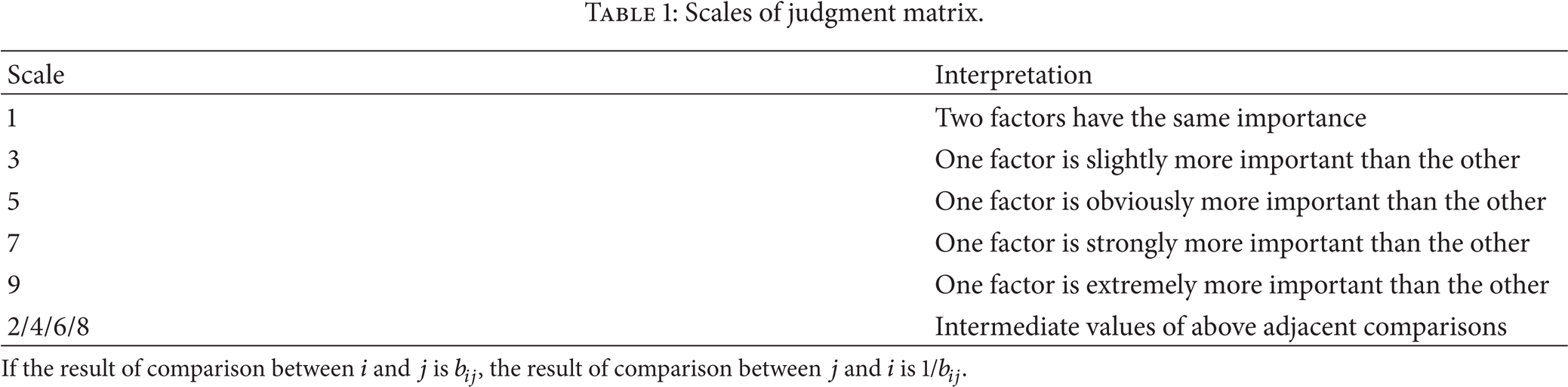
If the result of comparison between i and j is b ij , the result of comparison between j and i is 1/b ij .
Consistency is determined by the value of consistency index CR. If CR < 0.1, the consistency of judgment matrix is satisfactory; otherwise, judgment matrix needs to be adjusted until the consistency is qualified. The formulae are
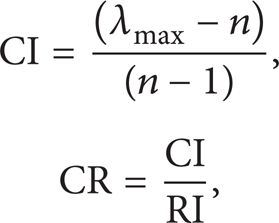
where λmax is the largest eigenvalue, n is the order of judgment matrix, and RI is consistency index.
2.2. Kano Model
The Kano model is a two-dimensional diagram proposed by Kano et al. in 1984 [18]. It divides users’ requirements into the following categories, and depicts the relationship between the realization of different requirements and users’ satisfaction, as shown in Figure 1.
M (must-be requirements) are the functions or attributes that the product must have. If the product meets the requirements, customer satisfaction will not be greatly improved; otherwise, user satisfaction will be greatly reduced.
O (one-dimensional requirements) are features or attributes that users expect. The demands and users satisfaction have linear relationship; they increase or reduce at the same time.
E (excited requirements) are features or attributes that users feel excited about. If these requirements are met, user satisfaction will be greatly improved, if not, user satisfaction will not be obviously reduced.
I (indifferent requirements) are features or attributes that users do not care about. Under certain conditions, this kind of requirements can be transformed into excitement requirements. Therefore, they should not be completely ignored.
R (reverse requirements) are features or attributes that users do not want the products to have. Reverse requirements and user satisfaction have opposite relationship.
Q (questionable requirements) are when users misunderstand the survey questions or problems and do not express their opinions correctly.
This study used AHP to determine hierarchical structure of the products’ property and the weight coefficients which reflected the importance of each part. In addition, we make use of the users’ demand type to reflect the customers’ requirements on the products’ functions. The two methods are combined to build different levels of structure models. The design process is shown in Figure 2.
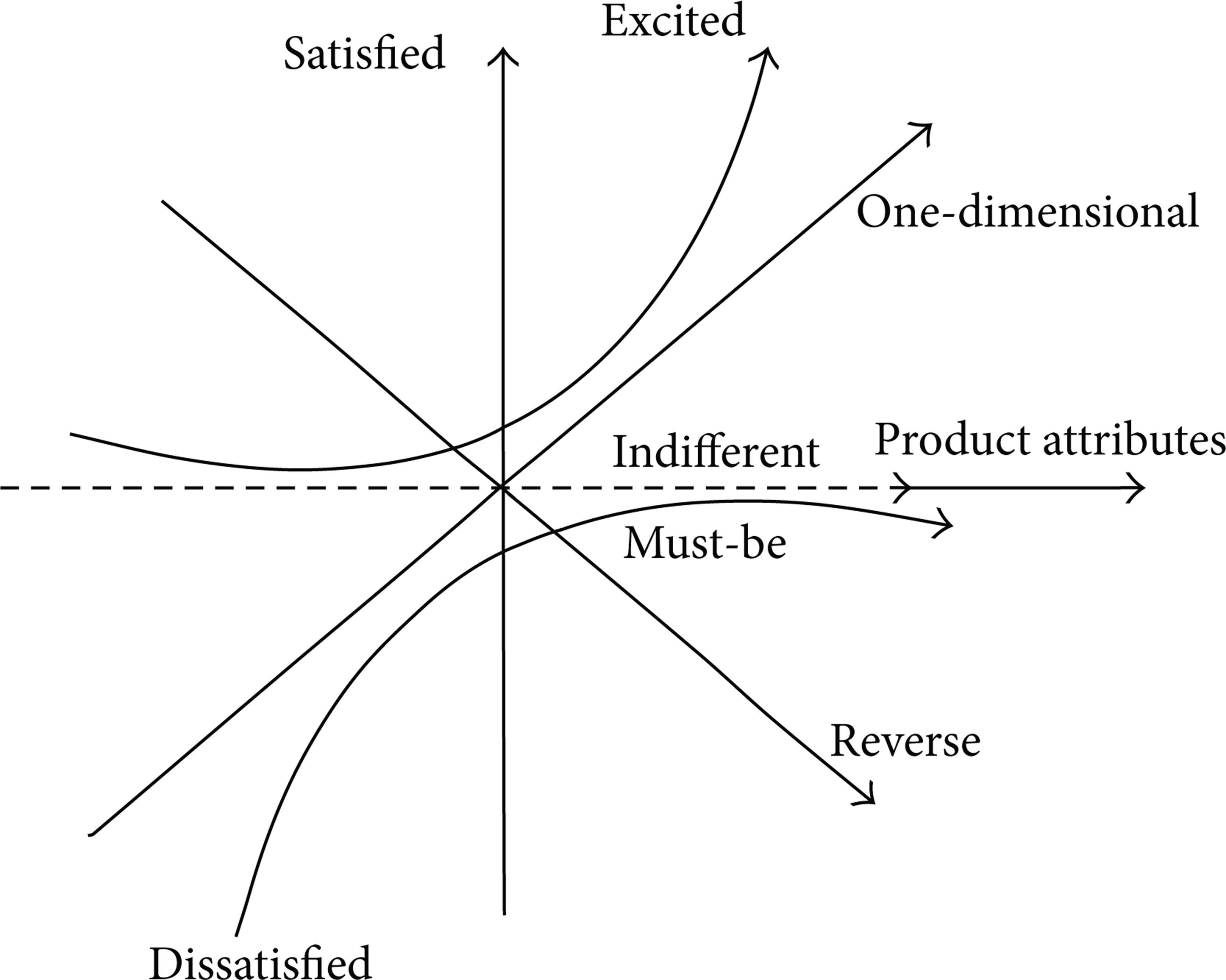
Kano model.

Product model design flow chart.
3. Results
3.1. Wheelchair Function Model
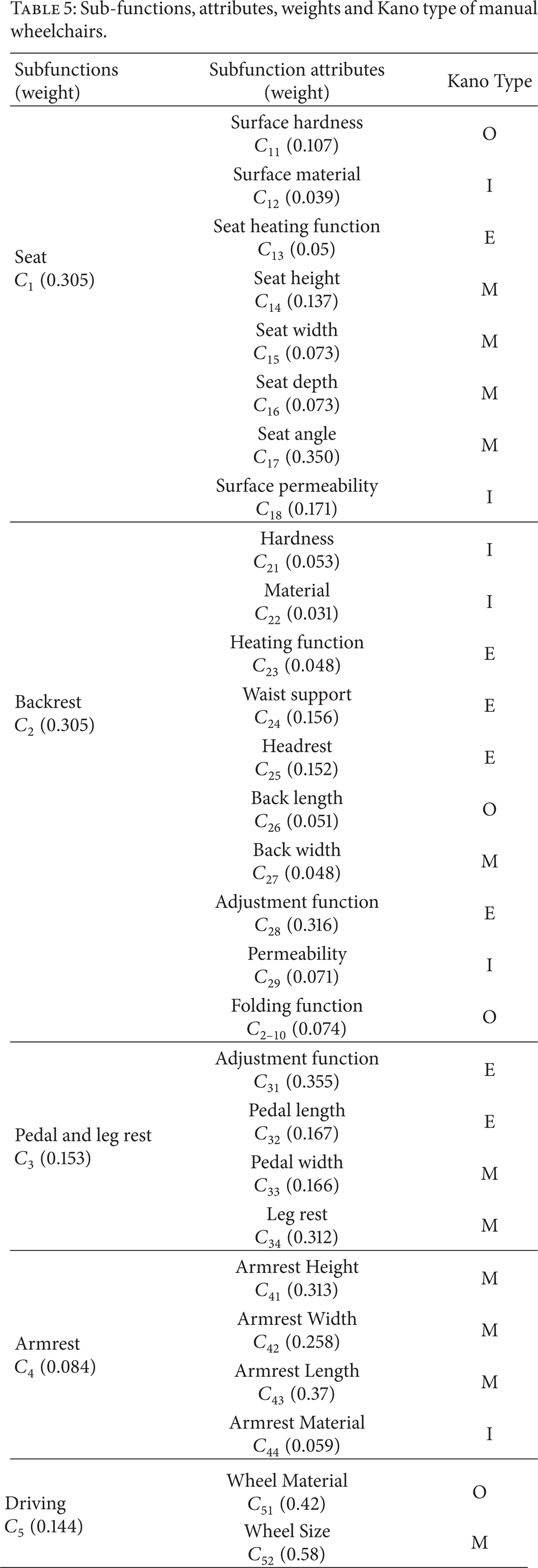
According to the drive mode, wheelchair can be divided into manual wheelchair, electric wheelchair, and intelligent wheelchair. In the current market, manual wheelchairs occupy the largest proportion of the market. Therefore, this study takes the manual wheelchair as the studying object. Wheelchair subfunctions are determined according to ISO7176 wheelchair international standard [19], and they are divided into such subfunctions: seat, back, pedal and leg rest, armrest, and driving function. Subfunction attributes are determined by the research team's experiences, as shown in Table 5.
The wheelchair is a kind of assisted living and rehabilitation tool, and users often need to use it continuously. Therefore, on the premise of satisfying basic functions, a wheelchair should have a certain comfort. According to each factor's influence on the wheelchair comfort and the comparison matrices shown in Table 1, judgment matrixes are constructed by the Delphy method [20]. Take the armrest (C6) as an example; its judgment matrix is shown in Table 2. Follow the comparison matrices; values were assigned for all subfunction attributes (C4x) of the armrest by 20 experts. Then, they are averaged and placed in each cell.
Judgment matrix of armrest.

In order to ensure the rationality of the judgment matrix, the consistency is checked [21]. Driving function just has two attributes; its CI is 0. The other consistency test results are shown in Table 3.
Consistency test results of judgment matrixes.
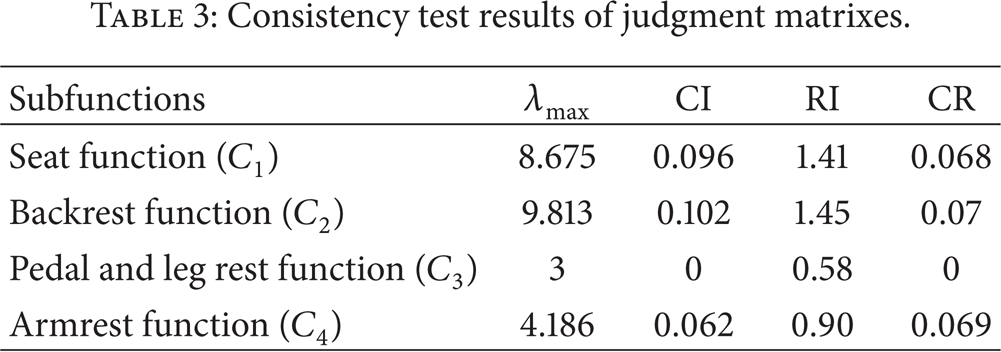
If CR < 0.1, the judgment matrix has right consistency; otherwise, you have to adjust element values, until the consistency is right. The values of CR in Table 3 are less than 0, judgment matrixes are consistent. The feature vector W is normalized to obtain the weight vector of each of the subfunctions, as shown in Table 5.
3.2. Function Classification Based on Kano Model
Users’ requirements are classified by 30 participants based on Kano model's requirements classification assessment criteria (Table 4) [22]. The classification is determined by two questions: if the product has or does not have this feature or attribute, how about the user's attitude to the product? The answer to each question is divided into the following 5 types: M (must-be requirements), O (one-dimensional requirements), E (excited requirements), I (indifferent requirements), and R (reverse requirements). According to the principle of maximum frequency, the type selected most was the final classification result. Before the classification, each index is described in detail, so that subjects could understand every option easily. Classification results are shown in the column “Kano type” of Table 5. When wheelchair users chose a Kano type, they assume that the attributes meet their own needs, so there are no reverse requirements (R).
Assessment criteria for the classification of Kano model requirements.

Sub-functions, attributes, weights and Kano type of manual wheelchairs.

4. Discussion
Table 5 shows the manual wheelchair's subfunctions, the properties of each subfunction, and user requirements’ types. The weight of each item is shown in the bracket. In the design of the wheelchair, we combine demand types and weight coefficients and take them as reference indexes. Weight coefficients reflect the influence of each factor on the comfort of wheelchairs. Those factors with high weights should be focused on. For example, seat surface and backrest have the highest weights, and they were the most important parts. Demand type describes the requirements of the customer to the product. According to users’ needs, different structure properties are selected to construct personalized product models. These models could improve the customers’ satisfaction. They meet the must-be requirements, and they can also focus on the one-dimensional and excited requirements with high weight coefficients.
(1) Low-Grade Wheelchair. For this grade of products, the cost factor proportion is the most important. They must meet the basic needs but have low price. The core of the design is the reasonable basic size. Therefore, we select all must-be requirements and one-dimensional requirements with high weight coefficients such as seat surface hardness and folding function.
(2) Middle-Grade Wheelchair. The users of these types of products pay attention to product comfort and ride comfort but cannot accept the high price. The product model should take into account the reasonable price and ride comfort. Hence we select not only the must-be one-dimensional and excited requirements, but also indifferent requirements which have higher weight.
(3) High-Grade Wheelchair. For the design of high-grade products, ride comfort, the perfect functions, and the degree of novelty are the most important factors. Must-be, excited, one-dimensional and indifferent requirements with high weights are selected to build product model.
5. Conclusions
This paper investigated the design of wheelchairs. Current wheelchair products cannot fully meet the users’ individual requirements, while there are few systematic researches on the design of the individual wheelchair. Therefore, the research proposed a design method of the personalized wheelchair based on Kano model and AHP method.
From the point of the wheelchair comfort, manual wheelchair functions are divided into hierarchical model by AHP method, and weights are given to each factor by Delphy method.
Based on Kano model, wheelchair functions were classified to different types of users’ demands.
According to the different weights and demand categories, wheelchair functions are restructured into low-grade, middle-grade, and high-grade product models.
The proposed method combines the customer demands, the importance of customer need, users’ satisfaction, and the product design models. It can help wheelchair designers rapidly develop various types of products to meet the needs of different users. This study has certain practical significance for analyzing the users’ needs and personalizing the design of wheelchairs or other rehabilitation products.
Conflict of Interests
The authors declare that there is no conflict of interests regarding the publication of this paper.
Footnotes
Acknowledgments
This research is supported by funding from Liaoning Project (no. 2009216012) and Liaoning Department of Education Project (L2012165). The authors thank all members of Liaoning Province Key Laboratory of Man-machine engineering for their hard work of collecting data. The authors also acknowledge the experts and wheelchair users who participated in the discussions and questionnaires.