




Abstract
Conventional electronic acupuncture can stimulate only one acupuncture point, and patients have to decide the time and the strength by themselves. In order to solve these problems, intelligent electronic acupuncture using biometric sensors and fuzzy technology was developed in this paper. And wireless electronic acupuncture system using sensor modules was developed in this paper. We used the sensor modules to obtain a patient's diagnosis signals. These sensor modules consist of 5 parts. The signals were analyzed to make instructions for the treatment, and the sensing pad for electronic acupuncture was designed. In addition, adaptive wireless acupuncture system was developed to adjust strength and time of acupuncture and several acupuncture points of patients by using fuzzy technology. We implemented efficient wireless electronic acupuncture system to get acupuncture easily using intelligent diagnosis system.
1. Introduction
The electronic acupuncture is different from the traditional acupuncture in their shape and treatment method. But its basic principle of treatment is the same. More than 60 percent of the electronic acupunctures developed in the country use low frequency and the rest is developed using instantaneous electro stimulation. Existing low-frequency therapeutic apparatuses are simple frequency generator (16~32 Hz) which attaches electrodes to patient's diseased area. Patient cannot be treated effectively because it does not provide detailed frequency. Furthermore, it cannot find acupuncture points since it has no consideration of the patients’ sex, age, weight, illness, and so forth. And it causes a problem that some children and elderly people are bruised or wounded after getting electronic acupuncture due to inappropriate acupuncture time and strength [1].
Intelligent electronic acupuncture means that the acupuncture system can treat a patient automatically with acupuncture adapted voltage, current, and frequency. To perform this electronic acupuncture the system has function of sensing and treatment simultaneously. And the system requires an accurate analysis and processing technique of logical and statistical data using fuzzy [2, 3].
The pulse is considered an important factor in oriental medicine because a person's pulse rate may reflect his or her health condition. For example, if a patient's heart stops, it is a very serious situation and this situation can be judged by pulse. Oriental doctors have considered pulse rates as important data in diagnosis. But the existing blood pressure pulse analyzers have some problems. It is uncertain whether the blood pressure pulse analyzing sensor is located precisely on the radial artery and it is also difficult to diagnose pulse exactly depending on the thickness of forearm. Furthermore, the analogue type of blood pressure pulse analyzers has problems with quantification of the blood pressure pulse. Although some people may have the same forearm length but the thickness of their blood vessel may differ. Therefore there is no set of data that is considered reliable enough to judge the accuracy of blood pressure pulse rates. Oriental doctors should not only judge the basic biological signals such as the pulse's size, strength, and speed, but should also consider the basic and quantitative analysis of the pulse in order to make an accurate diagnosis. Also, the doctors should consider physical characteristics, such as the thickness of the skin and blood vessels, in order to reach an accurate conclusion. Therefore, measurement of the blood flow rate is a vital indicator in understanding the blood pressure rate and how the substances in the blood are transported [4–6].
The method of exiting diagnosis has a problem which cannot diagnose the old and the infirm exactly because the patient's condition including gender, age, skin is not taken into consideration. To solve this problem, we analyzed the fine distinction considering thickness of skin and blood vessels and pulse, whether they are big or small, strong or weak and fast or slow. We proposed the algorithm that diagnoses the condition of a patient optimally using intelligent fuzzy technique [7, 8].
Adaptive wireless acupuncture system was developed in this paper by using pulse diagnosis system to adjust strength and time of acupuncture and several acupuncture points of patients to whom intellectual fuzzy technology is applied. Conventional electronic acupuncture cannot find the acupuncture points at once. However, SW which can stimulate multiple acupuncture points and calculate the time of the electronic acupuncture was developed in this paper. Conventional electronic acupuncture only stimulates the acupuncture point, but the electronic acupuncture with KIT (SW + HW) developed in this paper made remote or self-diagnosis possible, using the conditions of the patients and disease reasoning function. Doctors’ help is needed to find the acupuncture point with conventional electronic acupuncture. Intelligent electronic acupuncture that easily calculates optimal acupuncture time considering the patients’ health condition with smart phones was developed in this paper.
Figure 1 shows the whole system diagram of the intelligent electronic acupuncture system. It consists of 4 parts. The first part is a sensor module, the second part is a main part which analyzes the transferred signals and generates the treatment signals. The third part is an electronic acupuncture part which applies electronic acupuncture according to treatment signals from the main part. The last part is a program for monitoring and generating DB.

Whole system diagram of the intelligent electronic acupuncture system.
The composition of this paper is as follows. Section 2 is about a sensor module for electronic acupuncture, and Section 3 is about intelligent pulse diagnosis algorithm. Section 4 deals with implementation of the electronic acupuncture system. Finally the conclusion is made in Section 5.
2. Sensor Module for Electronic Acupuncture
We used several sensor modules to obtain a patient's diagnosis signals. These sensor modules consist of 5 parts, and they detect and analyze the abnormal signals from human body.
Figure 2 shows the sensor modules for electronic acupuncture system. The measured signals from the each sensor of modules are transferred to main the part.
Pulsimeter module: It measures pulse rate. It measures the data from the finger connected to the finger sensor. EGC module: It measures electrocardiogram. SPO2 module: It measures oxygen saturation of blood. Skin conduction module: It measures conductivity of palmar skin. Body temperature module: It measures temperature of human body.

Sensor modules for electronic acupuncture system.
3. Intelligent Pulse Diagnosis Algorithm
The intelligent pulse diagnosis system is composed of three parts. The first part is composed of the sensor to detect the conductance which is appropriate for injured part of human body and reference signal generator to adjust the signal generated from the patients. The second part is composed of DSP (Digital Signal Processor) board in which the signals are measured and classified using fuzzy algorithm. The last part is composed of a computer system that displays the signal from DSP board to the monitor and analysis software to diagnose the patients. Figure 3 shows the whole diagram of physical signal data network for electronic acupuncture. The algorithm consists of 3 parts. First step is sensing methods, the second step is indexing methods and the third step is classification methods.

Whole diagram of physical signal data network for electronic acupuncture.
Pulse is beat-wave pattern of chest wall and great arteries according to heartbeat. The main purpose of pulse is to observe cardiomotility and blood movement. Recently study using physical characteristics shows that pulse wave pattern can change depending on condition of blood vessels and blood circulation. The pulse wave pattern can be obtained by second differentiation of digital plethysmogram using physical specific status such as uncertain inflection points. In this paper, we classified a patient's physical condition into three categories, as dangerous, ordinary and normal condition adapting pulse diagnosis algorithm using acceleration pulse wave pattern [9].
Fuzzy rules are generally presented with IF-THEN format. Fuzzy inference is procedures that infer new relations or facts from the given rules, and max-min reference is used.
Input: x is OR
OR Conclusion: z is C
Combination Function of Trust Value. 1 and 2 type of fuzzy creation rule reduced from type of 5 and 6 can come to the same node and conclusion through different inference path to infer fuzzy. In this node the same conclusion reached two of more different trust value. In this case combination function of trust value is used to recalculate trust value of conclusion [2, 8].

When the patient's height is between 151 and 170 cm and the weight is between 46 kg and 70 kg, the value is displayed as 0.4–0.7, and when the height is 171 cm–200 cm and weight is 71 kg–130 kg, the value is displayed as 0.8–1.0. In Figure 3 the process to calculate fuzzy correction factor according to patient's physical condition is shown.
4. Implementation of the Electronic Acupuncture System
Electronic acupuncture system with built in multi pad which can find out the condition of the patients automatically and treat the patients simultaneously. The system includes the function that can treat the patients with acupuncture and adjust voltage, current, frequency oscillation automatically according to their physical conditions. To perform the function, the system senses and treats acupuncture simultaneously, and requires logical and statistical data processing technique using fuzzy and exact analysis. Installing the 5 round pads underneath the palm, we can change the signal, and then adaptive acupuncture treatment can be given.
At this point, measurement of the signal uses the wireless type instead of cable type. Because the wireless type has advantage of convenience to get acupuncture, reduction of noise by using cable connected to a computer system and prevention of electric shock depending on abrupt high-tension electricity [10, 11].
In order to treat acupuncture, it is important not only to get information from the human body but also to learn ages, sexes, height and weight of the patients. To do this, control variables using fuzzy algorithm are made before treatment of acupuncture.
Figure 4 shows Circuit of the acupuncture signal. The part of sensing pad and contact point of the fingertip made of stripe array type to distribute contact point area evenly after being plated with gold to reduce electric resistance.

Circuit of the acupuncture signal.
In this paper, we designed the optimal algorithm which could judge the remote medical diagnosis using fuzzy logic and fuzzy inference rules, and we simulated the process to calculate the optimal acupuncture time of the body condition of patients. We produced the wireless communication part to transmit condition of patients’ pulse, skin conductance and oxygen saturation data to user's terminal or remote medical terminal, and to receive the control signal from user's terminal or remote medical terminal.
To do this, we made the sensing pad, the circuit of AMP and acupuncture signal, wireless communication module and charging circuit for storage battery. And also we proposed the software including algorithm of analysis and control using fuzzy technique. Existing acupuncture system using DSP has a complex structure, uses up a lot of electricity and it's big and expensive. But the adaptive wireless acupuncture system proposed in this paper is simple, inexpensive and safe. Figure 5 shows simulation of the glove type electronic acupuncture.
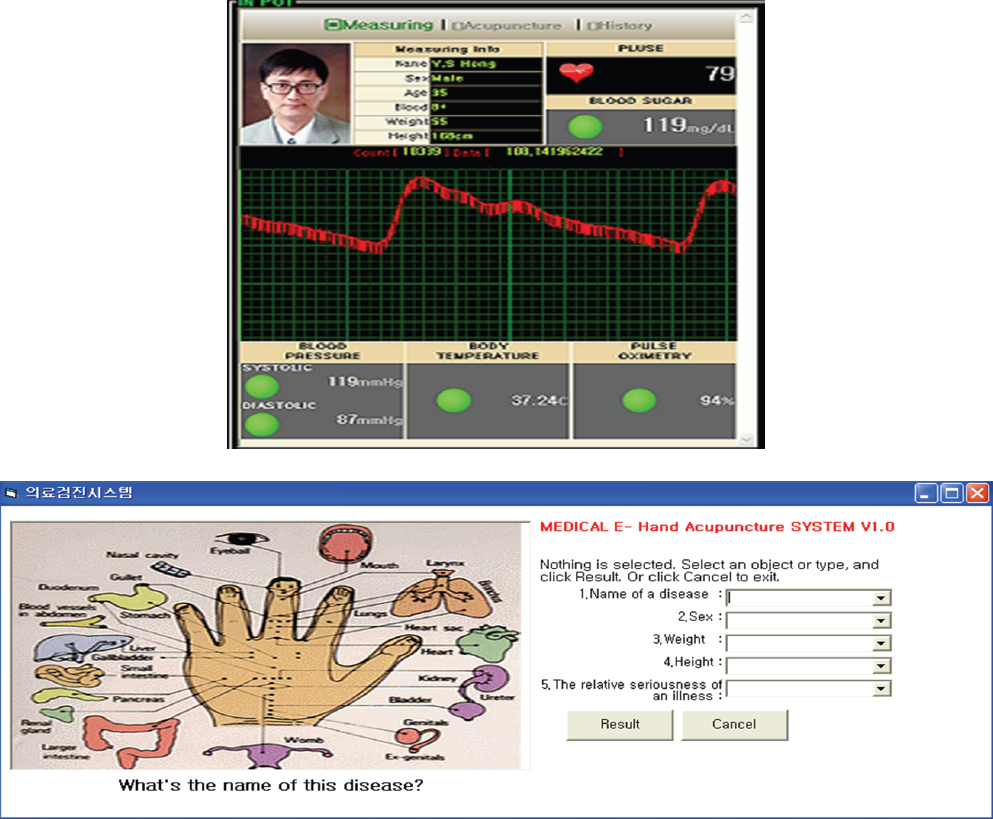
Simulation of the glove type electronic acupuncture.
To implement wireless system, we used the way of RF data modem for wireless communication using Narrowband FSK. The feature of this way is robust to noise and it can transmit data easily by simple communication protocol. And this system is adapt to design multi type data communication system and can be designed by low power, one 3 V battery, in case of short distance. We considered not only resistance measurement but capacitive component to reduce error depending on several conditions of human body. To do this, we applied the pulse wave DC 50 V~200 V, 500 uA~1,500 uA, intermittent stimulation of 5 Hz~5 KHz to the main pad and fingertip and measured the voltage peak and phase frequency [12, 13].
We used 470 MHz band frequency and designed the system to change 21 physical frequency. And logical address of a channel corresponding to each adaptive acupuncture was assigned using polling technique and then called. The system supports half duplex communication. This way is suitable for the system because the system requires low data and uses relatively low speed communication. The output power of wireless signal using button type battery is 1 mW, and it is adequate to transmit data without noise. The speed of transmission is 1200~9600 bps and wireless encoding uses a way of Bi-phase Manchester code. Communication between notebook computer and wireless modem uses RS232C. Figure 6 shows the data transmitter and receiver using RF communication. For remote medical treatment, the transmitter acquires data from 4 sensors, and then transmit the data to receiver using RF communication.
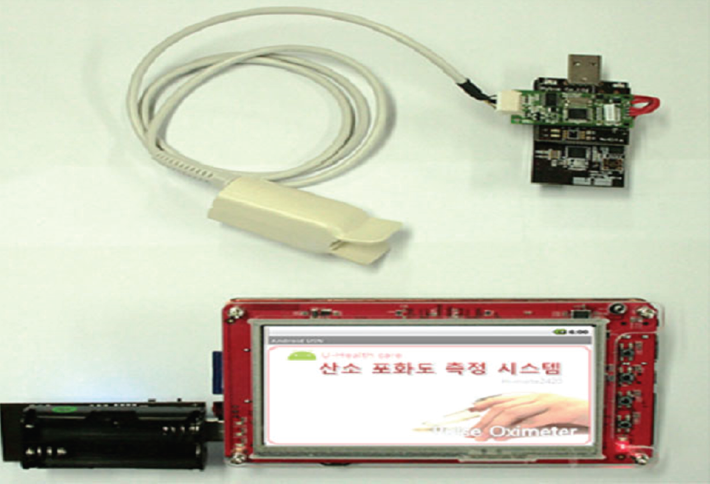
Data transmitter and receiver using RF communication.
In Figure 7 the system consists of transmit and receive system parts for ubiquitous network. It is made of MSP240CPU and CC2420 RF chip. Figure 8 shows analysis of electro stimulation to fingertips using pads. To obtain signal, we send a reference signal to palm, and then decide body condition of patients on the basis of data obtained from pre-investigation using sensing pads and MCU attached to fingertips. As soon as signal processing is completed, electric stimulation signal generated by fuzzy algorithm is transmitted to sensing pads.
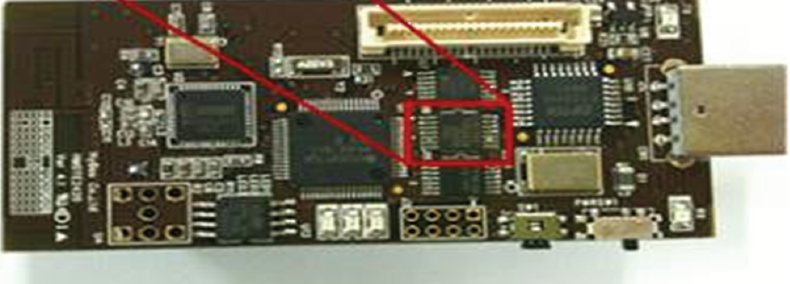
Transmit/receive system for ubiquitous network.

Analysis of electro stimulation to fingertips.
Table 1 explains fuzzy inference of a variety of patients with the same disease according to varying blood pressure condition, Heart rate condition, and vascular aging condition. In other words, Table 1 clearly shows that the system calculate varying time of acupuncture for different patients physical conditions.
Electronic acupuncture needle time simulation.

Figure 9 shows the Output of electronic acupuncture needle time simulation using Fuzzy Inference System Matlab. It explains how the system calculates the output condition of the time for acupuncture from the input data of the 3 conditions of patient physical conditions.
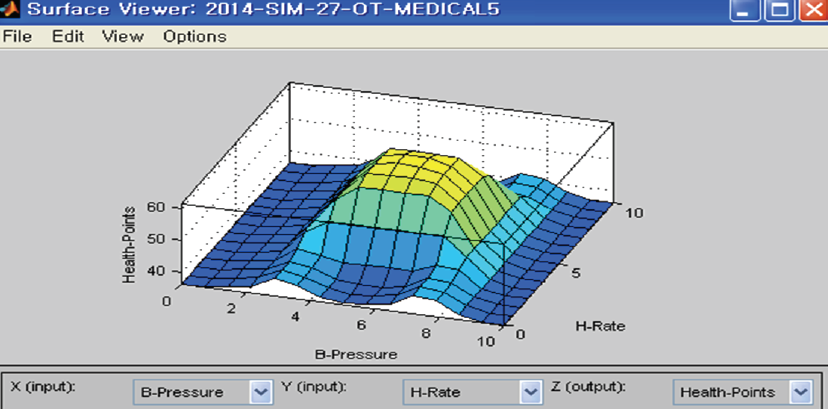
Output of electronic acupuncture needle time simulation using FIS matlab.
5. Conclusion
In this paper, we implemented intelligent electronic acupuncture system using sensor modules. We used the sensor modules to obtain a patient's diagnosis signals. These sensor modules consist of 5 parts. These sensor modules detect and analyze the abnormal signals from human body. We analyzed the signals to make instructions for the treatment. And then we designed the sensing pads for electronic acupuncture. And we also developed adaptive wireless acupuncture system to adjust strength and time of acupuncture and several acupuncture points of patients by using fuzzy technology. We made the sensing pads, the circuit of AMP and acupuncture signal. We implemented efficient electronic acupuncture system to get acupuncture easily using intelligent diagnosis system. The intelligent acupuncture system proposed in this paper is simple, inexpensive and safe compared with conventional acupuncture systems.
Footnotes
Conflict of Interests
The authors declare that there is no conflict of interests regarding the publication of this paper.
Acknowledgment
This research was supported by the MSIP (Ministry of Science, ICT and Future Planning), Korea, under the IT/SW Creative research program supervised by the NIPA (National IT Industry Promotion Agency)” (NIPA-2013-H0502-13-1112).