




Abstract
We propose a mathematical interference model of cognitive wireless networks based on two channels suffering different fading. The primary channel between primary transmitter and primary receiver is under Rayleigh fading. The secondary interference channel between secondary transmitter and primary receiver is under Rice fading. By employing various factors, such as the spectrum sensing scheme and the spatial distribution of the secondary users, the proposed model gives an accurate expression of interference probability compared to the statistical models that just approximate the probability model of the interference or bounds models that aim at finding the bounds of the interference. The proposed probability density function (PDF), cumulative distribution function (CDF), and the mean and variance of interference can be extended to a number of applications including power control, spectrum sensing evaluation, secondary users density analysis, and setting interference toleration threshold. Moreover, the framework developed in this paper can be applied to the interference analysis for the nodes of cognitive networks distributed in irregular geographical shapes like finite or infinite zone. The simulation result verifies our theory and is in agreement with the expectation.
1. Introduction
With the increasing demand for frequency bandwidth, the traditional spectrum allocation policy is getting more and more unsuitable for this trend. By dynamically utilizing the spectrum sensing, the cognitive radio technology allows the unlicensed users to share the bandwidth that has been allocated to the licensed users. However, before large-scale applications of cognitive radio, it is necessary to fulfill the prerequisite that the behavior of the unlicensed users should not interfere in the normal communication conducted by the licensed users. Then, it is reasonable to require the unlicensed users reliably to sense the existence of the licensed users. Nevertheless, in fact, due to the uncertainty in spectrum sensing process such as channel fading and distance, it is inevitable for unlicensed users to generate the false-detection for licensed users and to produce interference on licensed users. Therefore, to understand the potential interference influence on licensed users is of great importance in achieving the goal of cognitive radio.
In the structure of cognitive radio networks, there are two kinds of channel: (1) the primary channel between primary transmitter and primary receiver and (2) the secondary interference channel between secondary transmitter and primary receiver. Most of the literatures [1–9] consider that the channels just experience the same channel environment, that is, Rayleigh fading in [10] and Rice fading in [1]. However, in practice, the channels are often under different channel environment. For example, in urban environment, the primary receiver may be a wireless television receiver in a building, and secondary transmitters are also placed in the same building, while the remote primary transmitter is outside the building. Then, the indoor channel from the secondary transmitter to the primary receiver is usually Rice fading, and the channel from the remote primary transmitter outside the building to primary receiver can be described as Rayleigh fading. Therefore, the main objective of the paper is to deal with such scenario that is the primary channel is under Rayleigh fading and the secondary interference channel is under Rice fading.
The paper is organized as follows. We introduce the related works to illustrate the motivation and insight of our paper in Section 2. In Section 3, we introduce the system model and the relative information for the interference model. In Section 4, based on the proposed system model, we analyze the detail of the probability model of the interference including CDF, PDF, the mean and the second moment of the interference. In Section 5, we show the numerical result and discuss the application of the proposed model. Section 6 draws the conclusion.
2. Related Work
Although there is already a significant body of researches on cognitive radio, only few papers are being conducted in the area of the interference caused by cognitive secondary users. In addition, the current researches on the interference model mainly focus on identifying the statistical models or bounds of the interference. Statistical model can be derived by characteristic function (CF) [1, 3–7] or moment generating function (MGF) [2, 8, 9]. Based on the cumulants from the CF and MGF, the aggregate interference is approximated to a number of distributions such as
three-parameter shifted lognormal distributions [1], the truncated-stable distributions considering three types of secondary spatial reuse protocols [3], the log-normal distribution under power control and contention control [4], the symmetric stable distributions [6], the Levy distribution for some conditions [7], and the Gaussian distribution [2]. By using the Edgeworth expansion, the interference model in [10] is approximated by the skewed stable distribution or the symmetric stable distribution according to the positions of interferers. Other than the cumulant-based analysis, [11] uses the heavy tail and saddle-point approximation theories to find that the outage probability decays polynomially (interference-to-noise ratio (INR) below threshold) or superexponentially (INR above threshold). In [12], the upper bound for the outage probability was derived where the locations of primary users and secondary users follow two independent Poisson point processes (PPP).
The above statistics models to approximate the interference give a good way to evaluate the statistical probability values of the interference such as the mean, the second moment, and the third moment of the interference. However, these models only show some characteristic points of the interference, which is insufficient to depict the exact interference and will introduce error in evaluating the interference. Moreover, the method finding interference bounds is roughly describing the interference compared to the statistical model. Thus, in this paper, in order to overcome the insufficiency in the statistical and bounds model, we propose an accurate mathematical model including the PDF, CDF, mean and variance of the interference.
Spectrum sensing is the key component of cognitive radio; therefore, the interference model should consider this factor. Unfortunately it is just a small fraction of proposed schemes [1, 3, 7] to consider spectrum sensing. Therefore, this paper incorporates the spectrum sensing schemes in the interference model in order to analyze mathematically the effect of the cognitive network interference on the performance of the primary network.
3. System Model
The system model of the interference should capture the physical characteristics of cognitive network such as the spatial structure, spatial distribution of secondary nodes, spectrum sensing, and radio propagation model.
3.1. Spatial Structure and Distribution
In the cognitive radio network, there are four types of nodes: primary transmitter (PT), primary receiver (PR), secondary transmitter (ST), and secondary receivers (SR). The first two of them belong to the primary user (PU), and the last two of them belong to secondary user (SU). It is reasonable to assume that PR only receives the signal from PT without transmitting signal to the PT. Therefore, it is responsible for SUs reliably to monitor PT's activities using spectrum-sensing technique. Based on the result of spectrum sensing, ST can use the channel when the cochannel is vacant for PU and withdraw from the channel when PT is active. Their relationship is shown in Figure 1, where
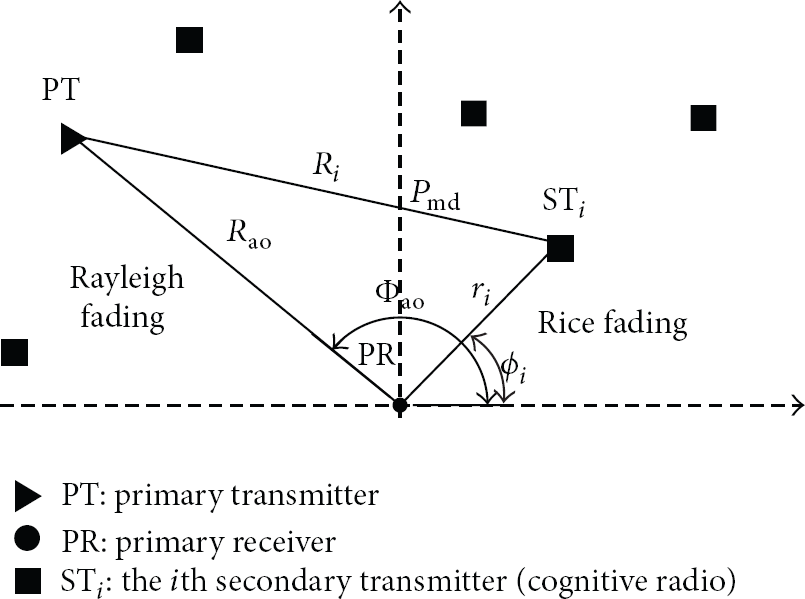
Spatial structure.
The spatial distribution of ST nodes follows the Poisson point process (PPP). The probability that n SUs lie inside a region just depends on the area of the region,

3.2. Spectrum-Sensing Influence on Interference
Spectrum sensing is a prominent feature of cognitive radio network. As discussed in the last section, when ST fails to sense the existence of PT, it is possible to interfere in the normal transmission among PUs. A common spectrum sensing probability, value can be used to evaluate the interference caused by SUs, which is the missed detection probability (
3.3. Radio Propagation Model
We have defined two kinds of channels: the primary channel and the interference secondary channel. In the paper, the primary channel from PT to PR is under Rayleigh fading and the interference secondary channel from ST to PR is under Rice fading as shown in Figure 1. The distribution of the squared envelope of the signal (denoted by

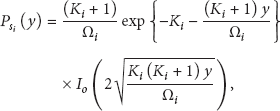
3.4. The Composite Probability of ST Signal
In spatial domain, the spatial existence of ith

4. Interference Modeling
4.1. Cumulative Distribution Function of Outage Probability
Suppose that the total interference,
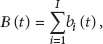



Make the substitution for


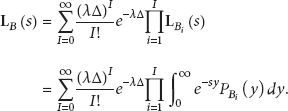
Inserting (3) and (4) into (13) and using variable substitution, then

We assume that the interference is iid uniformly distributed on the disk with radial density [2]. Then the mean of the


Interpreting the sum as the Taylor expansion of the exponential function, we obtain

Plugging (17) and (12) into (10), therefore the exact form of outage probability

4.2. Probability Distribution Function of Interference
We define

Plugging (2) and using the variable substitution,


4.3. Statistical Mean and Second Moment of Interference
The mean of

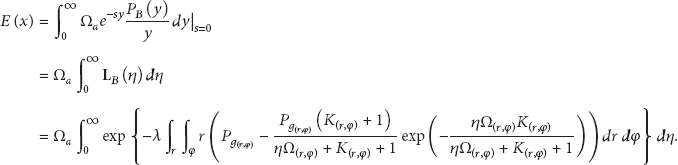
Similar to the derivation of

so that

since


5. Numerical Results and Discussions
In this section, we present numerical results based on the proposed model to illustrate the influence of interference on PUs in cognitive radio networks. To verify the effectiveness of the proposed model, the simulation considers the following conditions: (1) secondary user density, (2) transmitting power of the PT and STs, and (3) interference toleration threshold of PR.
5.1. Default Parameters
Unless otherwise specified, we use the following parameters in the simulation as shown in Figure 2. Figure 2(a) is the spatial structure for the simulation. As similar description in Section 3.1, there are one PT and one PR, respectively, and several STs distributed according to the Poisson point process with spatial density
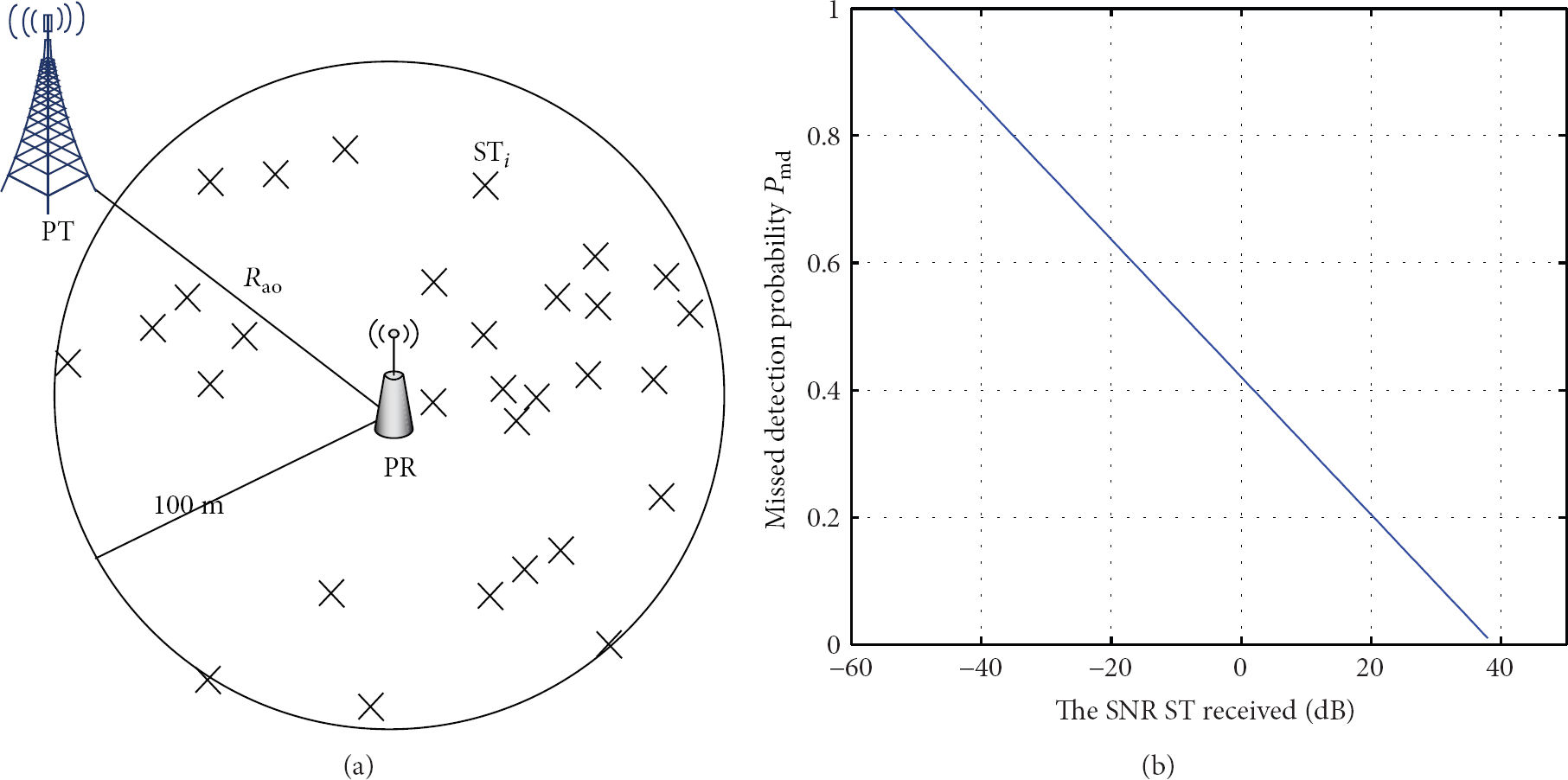
Simulation environment.
5.2. Numerical Results
We firstly investigate the effect of the spatial density of ST nodes and the ST power control on the cumulative distribution function

CDF of the cognitive network interference as function of the ST spatial density when ST power
Figure 4 shows the CDF of the cognitive network interference as function of ST power when PT is transmitted at different level power. From Figure 4, the outage probability rises as the ST power increases or the PT power decreases. In this example, the changing trend of the ST power with outage probability is further confirmed in the example of Figure 3. It can be observed from this figure that the ST power and PT power can greatly affect the outage probability. Therefore, it is reasonable to apply power control at SUs in order to lower the potential interference.
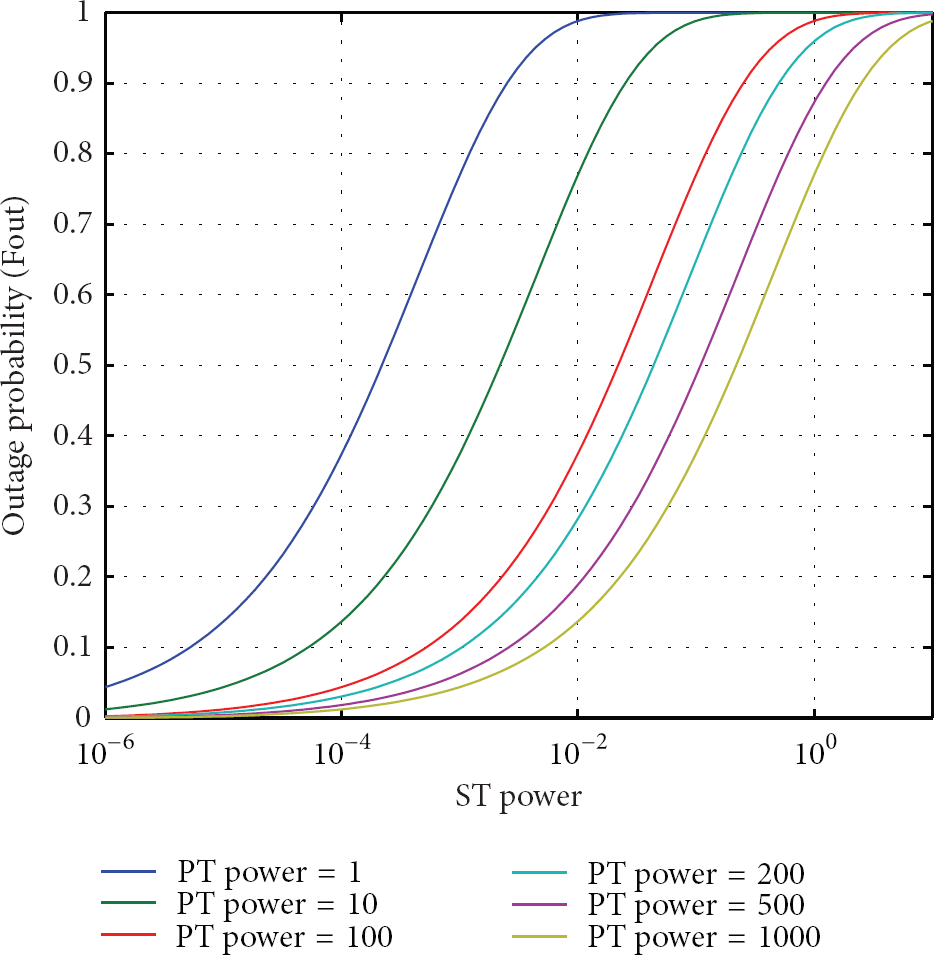
CDF of the cognitive network interference as function of ST power when PT power
The effect of PT power on the interference is illustrated in Figure 5 when different interference toleration threshold is adopted. We can see from the figure that the interference decreases as the PT power increases for a fixed threshold

CDF of the cognitive network interference as function of PT power for the interference toleration threshold
To further demonstrate the effect of the threshold
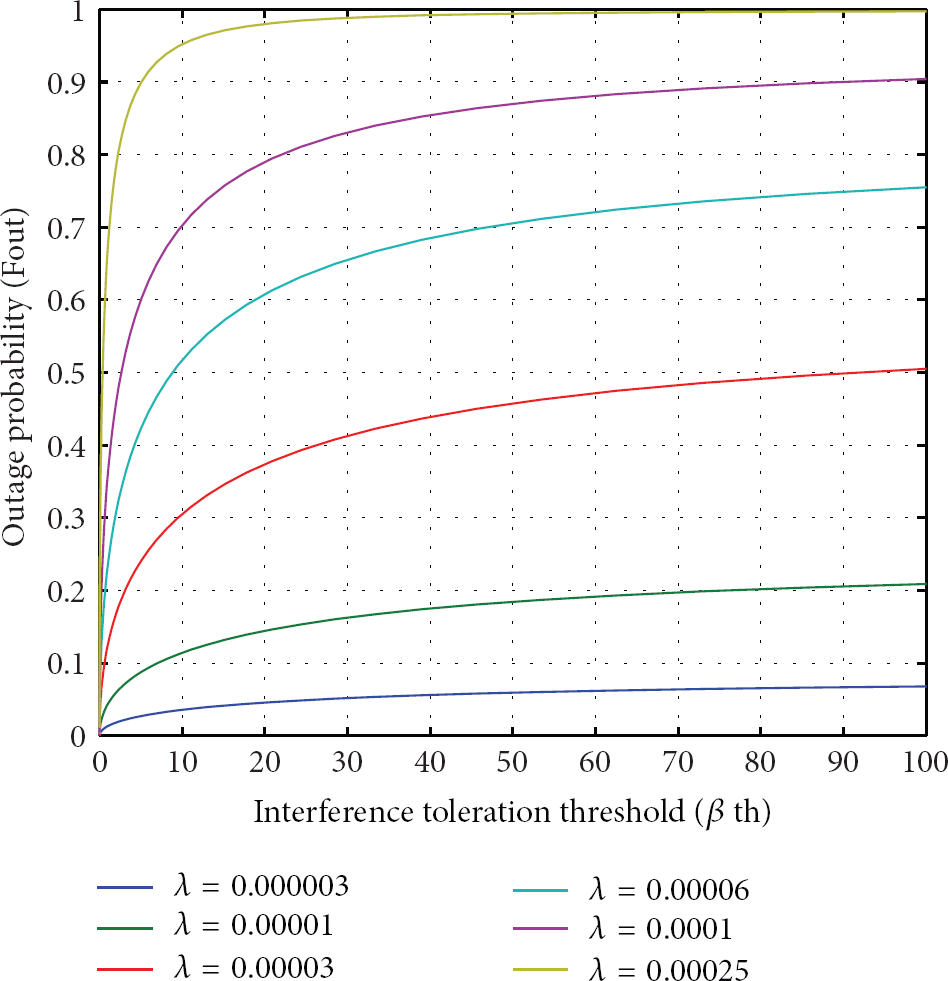
CDF of the cognitive network interference as function of the interference toleration threshold
In fact, the PDF is also important to understand the cognitive network interference. In Figure 7, the PDF of interference as function of ST power is plotted for different spatial density λ. From the figure, it is observed that the PDF is like the log-normal distribution. In addition, with the increase of λ, the peak of the curve shifts to the left because the more ST nodes easily cause the interference under certain ST power level. Moreover in Figure 7, these curves display similar second moment

PDF of outage as function of ST power when the spatial density

Mean of outage as function of ST power when the spatial density
5.3. Application of the Model
The probability model presented in this paper can be extended to cover more applications. We can see from the above numerical results that the ST power is a very important parameter to influence the interference on the primary networks. Thus for the primary network users, it is desirable to reduce the ST power in order to reduce the interference they suffered. However, for the secondary network users, it is better to transmit signal at high power level to ensure quality of the communication. Therefore, how to balance these two objectives is a challenging problem faced by cognitive networks designers. By setting the threshold
Some literatures [8, 12] are just specified in the given spatial shape regions like circular or rectangle and cannot evaluate the special shape regions. In this paper, the shape region is changed into the integral zone integration region in (18), (22), (24), and (28). Therefore, the proposed model can be applied to evaluate the cognitive networks with regions of any shape, such as finite or infinite region.
In the numerical examples, we considered one default spectrum sensing scheme. In practice, it is also necessary to know the effect on the primary networks for the be-installed spectrum sensing schemes.
6. Conclusion
It is challenging to analyze the interference in cognitive radio network considering a number of factors such as spatial distribution, the spectrum sensing schemes, the transmission, and channel propagation characteristics of nodes. Based on the primary channel and the secondary channel suffering different fading, this paper proposes a mathematical interference model of the cochannel interference at the primary receiver caused by SU networks taking into account PPP distribution, spectrum sensing schemes, ST and PT power, spatial density of ST nodes, and spatial shape of the regions. The CDF, PDF, and mean and variance of the interference are derived mathematically. The proposed model can be used in the applications including the settling spatial density of ST nodes, ST power control, and evaluation for spectrum sensing schemes, analyzing the cognitive radio network spatial region with irregular shape. The numerical results help to understand the influence of the interference in cognitive radio and verify the analysis of the proposed model.
Footnotes
Notations
Conflict of Interests
The authors declare that there is no conflict of interests regarding the publication of this paper.
Acknowledgments
This work was supported by the National Natural Science Foundation of China (nos. 61071152 and 61271316), the National Basic Research Program (973) of China (nos. 2010CB731406 and 2013CB329605), and the National “Twelfth Five-Year” Plan for Science & Technology Support (no. 2012BAH38B04).