




Abstract
Cyber-physical system (CPS) is an integration of physical processes with computation and communication. It has the ability to add more intelligence to social life. Wireless sensor networks (WSN) can be a vital part of CPS as strong sensing capability is one of the major driving factors for CPS applications. CPS is still considered to be a nascent technology, and there are many challenges yet to be addressed. A few CPS applications in healthcare have been proposed to date, and they lack the flexibility of technology integration, such as integration of computing resources with sensor networks. This paper presents a survey of CPS in healthcare applications that have been proposed to date by academia as well as industry. A comprehensive taxonomy is also provided that characterizes and classifies different components and methods that are required for the application of CPS in healthcare. The taxonomy not only highlights the similarities and differences of the state-of-the-art technologies utilized in CPS for healthcare from the perspective of WSN and Cloud Computing but also identifies the areas that require further research. It is expected that this taxonomy and its mapping to relevant systems will be highly useful for further development of CPS for healthcare.
1. Introduction
Cyber-physical system (CPS) is attracting a lot of attention in recent years and is being considered as an emerging technology. It combines computation and communication capabilities with the physical world. CPS was identified as a key research area in 2008 by the US National Science Foundation (NSF) and was listed as the number one research priority by the US President's Council of Advisors on Science and Technology [1]. CPS relies on sensing, processing, and networking. The recent advances in wireless sensor networks (WSN), medical sensors, and Cloud Computing are making CPS a powerful candidate for healthcare applications including in-hospital and in-home patient care [2]. These advances promise to provide CPS the ability to observe patient conditions remotely and take actions regardless of the patient's location. Considerable research is being conducted on medical sensors [3, 4]. These sensors are able to collect vital patient information containing health data. Collected data are sent to a gateway via the wireless communication medium. Wired sensors can also be used; however, wireless sensors provide more flexibility and comfort to both the caregiver and the patients. The data collected by the sensors can be stored in a server and made accessible to clinicians. Security is a vital concern here as patient data is confidential from legal and ethical perspectives. So, while designing CPS architecture for healthcare applications, special attentions need to be paid to ensure data security. There are also a number of other important issues to consider, for example, the requirement to store and manage the huge volume of data collected from thousands of medical sensors. Therefore, database management systems should be efficient and reliable. As medical data can provide useful insight into actions (treatments) necessary to save a patient's life, all data should be readily available and accessible to authorized medical personnel anytime from anywhere. In addition, healthcare applications require huge computing resources for intelligent decision making based on the massive patient data. However, the networks of wireless sensors collecting the patient data are severely constrained in energy, processing, and storage capacity. They neither have the capacity to store large amount of data nor have the resources required to process the data. Cloud Computing can potentially provide solutions to some of these issues. The ongoing research in this area is endeavouring to use state-of-the-art Cloud Computing technologies as the computational backbone of CPS to improve the scalability of the system and to enable real-time data analysis. Cloud Computing is referred to as Computing Infrastructure that can be accessed by any consumer organization or individual anytime from anywhere in the world. It is a service that offers computing, storage, networking, and software “as a service.” Buyya et al. [5] have defined Cloud Computing as follows: “cloud is a parallel and distributed computing system consisting of a collection of interconnected and virtualized computers that are dynamically provisioned and presented as one or more unified computing resources based on service-level agreements (SLA) established through negotiation between the service provider and consumers.”
So, from the definitions, it can be assumed that the cloud should have following characteristics: (1) self-service, (2) per-usage metering and billing, (3) elasticity, and (4) customization. Two aspects of Cloud Computing are appealing to the end users; first, users can access personal data and applications using any computer connected to the Internet, and, second, software applications are not required to be installed in the user's computer and they are available on the cloud. Moreover, Cloud Computing providers offer various software services, APIs, and development tools for developers. These enable the customers to shift their computing infrastructure to the cloud. The Cloud Computing is the result of advancement of a few technologies, such as distributed computing, Internet technologies (service oriented architecture, web services), system management (autonomic computing), and hardware (virtualization, multicore chips) [6]. Combined sensor-cloud infrastructure is an integral part of CPS, where the cloud supports the cyber (computing) activities and the sensors support the physical activities. A comprehensive review on sensor-cloud can be found in [7].
As CPS technology is still considered new, many issues are open for future research. Real-time processing, data query, storage, and security are among those issues. Therefore, one of the aims of this paper is to indicate some unanswered questions in CPS for healthcare such as completeness, efficient communication, and accurate alarm generation.
1.1. Motivation
The motivations behind this paper include the following.
As a promising and emerging field, a clear demarcation and usability of different components of CPS for healthcare is necessary. As there is no CPS standard available yet, a comprehensive study of related CPS in healthcare systems proposed to date is necessary for designing CPS for healthcare applications. Although some review papers are available on cyber-physical systems, however, to the best of our knowledge, there is no review paper on cyber-physical systems in healthcare to date.
1.2. Contributions
The contributions made by this paper include the following:
a survey of existing cyber-physical systems aimed at healthcare applications; depiction of the CPS scenario with respect to the essential components such as application, architecture, sensing, data management, computation, communication, security, and control/actuation; a detailed taxonomy related to CPS in healthcare; research challenges related to implementation of CPS in healthcare.
This paper presents a review of CPS for healthcare applications, identifies the essential components of a CPS in healthcare, and explores the challenges associated with it. Section 2 provides an overview of cyber-physical system and related background of CPS in healthcare. In Section 3, a taxonomy for CPS in healthcare applications is introduced. Based on this taxonomy, a mapping of cyber-physical systems for healthcare is presented in Section 4. Section 5 discusses the research challenges in CPS for healthcare and Section 6 concludes the paper.
2. General Overview of CPS in Healthcare
In this section, we provide an overview of CPS in general, its essential components, and characteristics.
2.1. What Is Cyber-Physical System (CPS)
Cyber-physical system (CPS) connects the virtual world with physical world. It has the ability to add more intelligence to social life. It integrates physical devices, such as sensors and cameras, with cyber components to form an analytical system that responds intelligently to dynamic changes in the real-world scenarios. CPS can have wide ranging applications, such as smart medical technology, assisted living, environmental control, and traffic management.
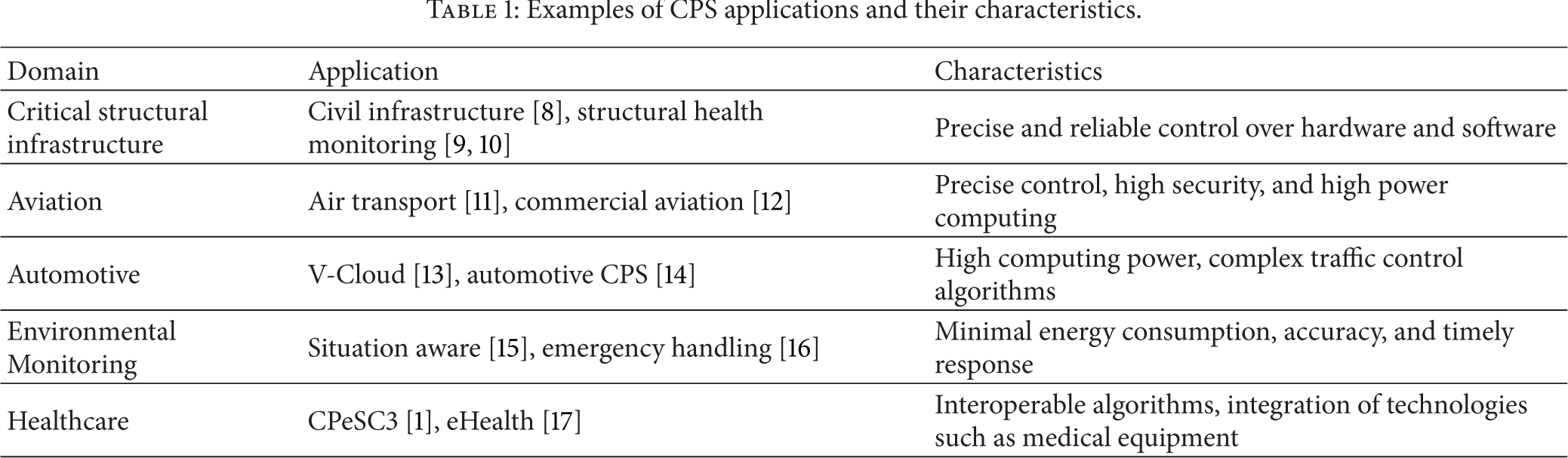
An important part of CPS is the integration of WSN and Cloud Computing. A few works have been done on the CPS for healthcare applications [1, 17, 52]. The CPS architectures proposed by Rajkumar et al. [53] and Xia et al. [54] investigated different applications, such as assisted living and monitoring network. Authors emphasize that the CPS architectures must capture a variety of physical information, reliable data analysis, event detection, and security. General characteristics of a few CPSs proposed for various applications are summarised in Table 1.
Examples of CPS applications and their characteristics.
2.2. Advantages of Cyber-Physical Systems (CPS)
CPS is a promising solution for the integration of physical and cyber world due to several benefits such as the following.
Network Integration. CPS has the interoperability with WSNs and Cloud Computing. This may provide the compliance with networking standards. CPS involves multiple computational platforms interacting over communication networks. CPS provides network integration characteristics such as media access control techniques and their effects on system dynamics, middleware, and software that provide coordination over networks, control over timing of network transactions, and fault tolerances. Interaction between Human and System. Modeling and measuring situational awareness-human perception of the system and its environmental changes in parameters are critical for decision making. This is an absolute necessity for complex and dynamic systems. Some CPSs include human as an integral part of the system which makes the interaction easier because usually humans are difficult to model using standalone systems. Dealing with Certainty. Certainty is the process of providing proof that a design is valid and trustworthy. Evidence can include formal proofs or exhaustive tests in simulations and prototypes. CPS is designed to be able to evolve and operate with new and unreliable environment. CPS is able to demonstrate unknown system behavior to study further and evolve into better system. Better System Performance. With the close interaction of sensors and cyber infrastructure, CPS is able to provide better system performance in terms of feedback and automatic redesign. Better computational resources and cyber subsystems in CPS ensure the presence of multiple sensing entities, multiple communication mechanisms, high-level programming language, and end-user maintenance which further ensures the better system performance by CPS. Scalability. CPS is able to scale the system according to demand utilizing the properties of Cloud Computing. Users are able to acquire necessary infrastructure without investing additional resources. CPS is inherently heterogeneous as it combines physical dynamics with computational processes. The physical domain may combine mechanical motion control, chemical processes, biological processes, and human involvement. The cyber domain may combine networking infrastructure, programming tools, and software modelling. CPS can provide design methodologies and tools that support those methodologies, which scale to large designs and promote understanding of complex systems. Autonomy. CPS can provide autonomy due to having sensor-cloud integration. Typically, CPS is a closed-loop system, where sensors make measurements of physical dynamics. These measurements are processed in the cyber subsystems, which then drive actuators and applications that affect the physical processes. The control strategies in the cyber subsystems are adaptive and usually predictive. Flexibility. Present systems based on CPS provide much more flexibility compared to the earlier research efforts in WSN and Cloud Computing alone. Optimization. Present biomedical sensors and cloud infrastructure offer large optimizations for variety of applications. This capability opens the pathway for CPS to optimize the system in wide extent. Faster Response Time. CPS can provide faster response time due to faster processing and communication capability of sensors and cloud infrastructure. Fast response time can facilitate the early detection of remote failure, proper utilization of shared resources such as bandwidth.
2.3. CPS in Healthcare
In this subsection, we focus on the cyber-physical systems aiming specifically for healthcare applications. The research on CPS in healthcare is still in the early stages. In CPS, the combination of active user input such as smart feedback system, digital records of patient data, and passive user input such as biosensors and/or smart devices in healthcare environments can support the data acquisition for efficient decision making. This combination of data acquisition and decision making system is yet to be rigorously explored in healthcare applications and, therefore, such combination is a matter of high research interest. Opportunities of utilizing CPS in healthcare include the introduction of coordinated interoperation of autonomous and adaptive devices, as well as new concepts for managing and operating medical physical systems using computation and control, miniaturized implantable smart devices, body area networks, programmable materials, and new fabrication approaches.
Although many CPS architectures have been proposed in the literature, the number of CPS architectures proposed for healthcare applications [22, 55] is very few. Hu et al. [56] proposed service-oriented architecture (SOA) based medical CPS concept; however, it lacks the complete architectural framework. Wang et al. [1] presented a secured CPS architecture for healthcare, which utilizes WSN-cloud integrated framework. Banerjee et al. [42] proposed modelling and analysis of medical CPS. However, it lacks addressing the security and privacy issues. Figure 1 depicts a CPS for healthcare conceived based on this literature to facilitate the further discussion in subsequent sections of this paper.
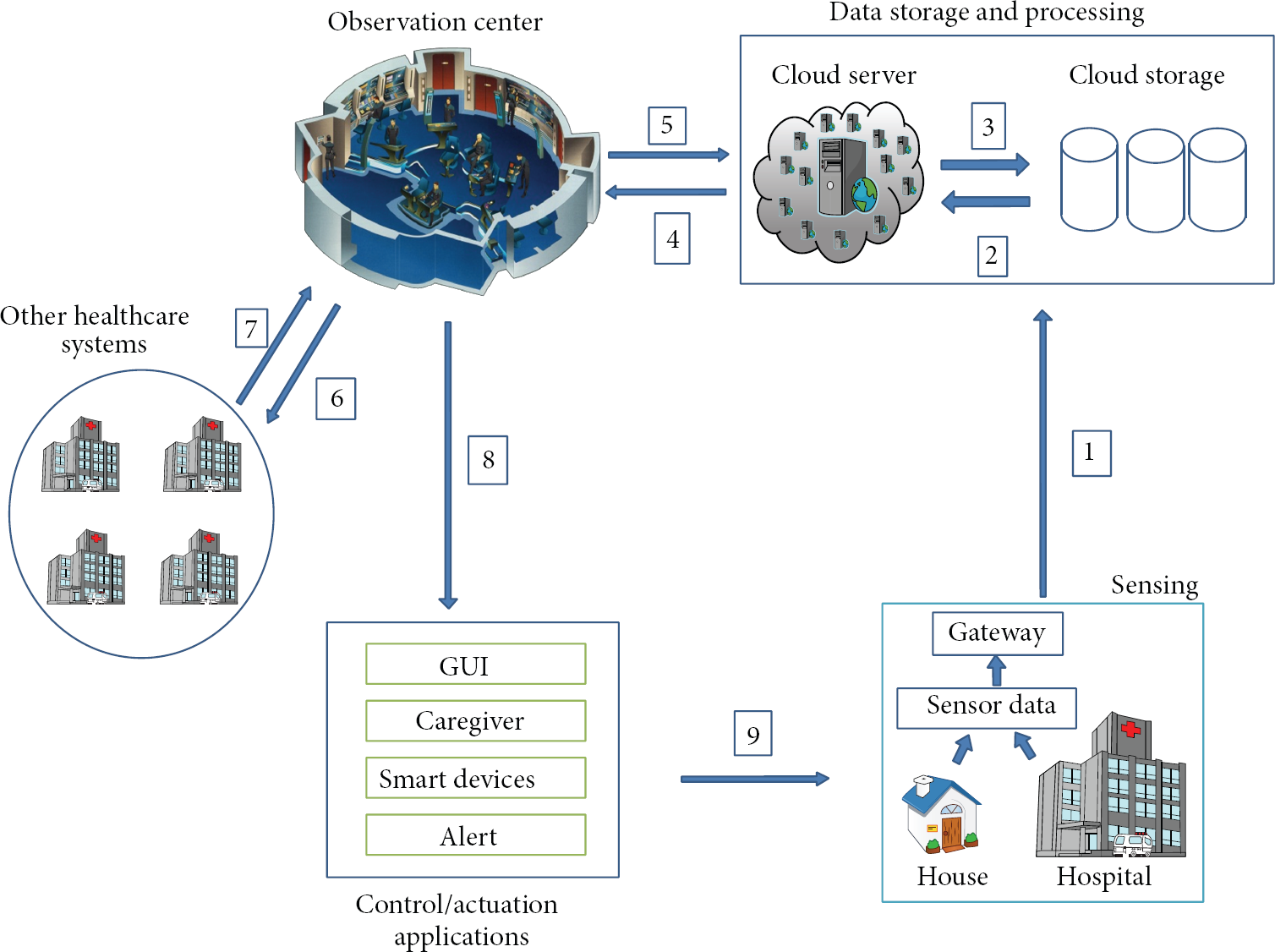
A CPS for healthcare conceived from literature [1, 22, 55]: (1) data collected from patients using various sensors and sent to cloud storage via gateway; (2) processed sensor data sent to cloud server; queries are processed in real time; (3) historic sensor data processed in case of query reply; (4) computation is done; alarm is generated and sent to observation centre if necessary; (5) clinicians in observation centre access patient data from cloud; (6) if required, clinicians approach other healthcare systems for consultation; (7) response received from other healthcare systems; (8) clinicians and specialists send decisions to the actuation component; (9) necessary measures conducted on the patients.
3. Taxonomy of CPS in Healthcare
It is desirable to have a set of taxonomies that characterizes and classifies approaches of CPS in healthcare. From a survey of the literature available to date, we summarize in Figure 2 such a taxonomy for CPS in healthcare. It consists of the following elements: (1) application, (2) architecture, (3) sensing, (4) data management, (5) computation, (6) communication, (7) security, and (8) control/actuation. In this section, the classifications within each of these elements are discussed in detail.

Taxonomy of CPS for healthcare.
3.1. Application
CPS in healthcare offers varied applications such as hospital, assisted living, and elderly care. System complexity largely depends on the specific application. Elements in architecture may need special organization according to the applicable area. In case of controlled environment such as intensive care unit in a hospital, the architecture may include controlled elements. On the other hand, in assisted living home, it may be required to include much automated elements in the architecture. CPS in healthcare applications can be divided into two areas: (a) assisted and (b) controlled.
3.1.1. Assisted
Assisted application includes the health monitoring without restricting independence in a person's normal living. It is possible to provide medical advice to individual patients by acquiring physiological data via biosensors in real time. With the individual medical requirements taken into account, it is possible to support and care increasing number of elderly people both in elderly living and individual homes. Partial and progressive loss of motor, sensorial and/or cognitive skills render elders unable to live autonomously, eventually leading to their hospitalization. This results in both relevant emotional and economic costs. Computing technologies can offer interesting opportunities for in-house safety and autonomy such as ANGELAH [50].
3.1.2. Controlled
Application in controlled environment consists of hospital and intensive care where the medical support is readily available. In a controlled environment, the level of observation is high and intense. In hospitals, information from many sources, such as bedside monitors, biosensors, and clinicians observations, is combined to inform interventions. The networked closed-loop systems with humans in the loop can improve medical workflows and patient safety. Emerging technologies aimed at enabling remote care of patients will provide care practitioners with information on how activities of daily living affect healthcare and allow practitioners to make more informed decisions about interventions. The combination of these two currently separate aspects of healthcare would transform the healthcare system into one large and complex and safety-critical cyber-physical system with many advantages as well as challenges [22].
3.2. Architecture
The architecture of CPS in healthcare is very important for the quality and performance of the system. In order to facilitate the CPS for healthcare applications, the architecture needs to be developed based on the application domain, user data requirement, and system integration. Architecture in CPS can be characterized by three elements: (a) infrastructure, (b) data requirement, and (c) composition.
3.2.1. Infrastructure
The CPS architecture for healthcare can be designed from the perspective of infrastructure such as server-based or cloud-based ones. Server-based infrastructure is suitable for small architecture and requires individual maintenance, whereas recent works utilize the cloud-based infrastructure for scalability, cost effectiveness, and accessibility. Due to the complexity and resource limitations, cyber and physical components can be vulnerable due to various challenges; thus, special efforts are necessary while designing CPS for healthcare applications.
3.2.2. Data Requirement
Managing CPS architecture for healthcare requires handling different types of data such as input data, historic data, and output data. In healthcare, based on the type of biosensors, the data size can be different. There can be simple data such as temperature, whereas large image data such as magnetic resonance imaging (MRI) is also required to be processed. Yilmaz et al. [57] stated that depending on applications, the data acquisition and transmission may vary. Examples of low data rate application are temperature and blood pressure, whereas high density surface Electromyogram (EMG) is an example of high data rate application. In addition, it may be necessary to access the historic data from storage. Thus, the data requirements of the architecture can be categorized into two types: light and heavy.
3.2.3. Composition
The architecture of CPS in healthcare often requires both computation and communication processes to be conducted in parallel. System architecture should be able to identify the system composition according to application. The applications need to be composed either dynamically or manually as per system configuration or users requirement. For example, Avrunin et al. [23] proposed smart checklist to support and guide human participants with their tasks; however, the system composition can be considered as user-defined. Interaction with the devices and software applications are also supported by the system. Dynamic composition would involve the computation and communication processes to be performed without human intervention.
3.3. Sensing
The physical entity of CPS in healthcare is performed by sensing. Biomedical sensors are responsible for collecting important physiological data and these data are fed to the processing and communication system for further use [58]. Sensing is the key concern for the healthcare applications as sensed values are used as input parameters to the system. Sensing may often be painful to patients. For example, the blood glucose level (BGL) detection for diabetic patients requires pricking the finger and collecting sample. To remedy this, a noninvasive method of BGL monitoring leveraging radio-based sensors is used [57]. The elements from the sensing perspective are (a) sensor type, (b) method, and (c) parameter.
3.3.1. Sensor Type
In healthcare applications, the number and types of sensors can vary widely. The sensors can be both homogeneous and heterogeneous. There can be single parameter sensing system for a group of people as well as multiple sensors for a person to monitor the health status. The complexity of the system largely depends on the type of sensing strategy. CPS consists of a large number of sensors with multiple sensor information. Sometimes, the sensors report unusual or abnormal readings, which may jeopardize the fundamental monitored data and prediction of high significance. To benefit the system's performance and user's decision making, it is important to analyse the sensed data with multidimensional information in an efficient manner [59].
3.3.2. Method
Present biosensors have the capability to collect vital patient information efficiently [37]. These sensors can collect patients’ data in hospital or home and the collected information is forwarded to a sink (or controller) that can use that information locally or transmit to other networks (e.g., cloud network) through a gateway [60]. The sensors can be part of a wireless sensor network. As part of the sensing, the data can be obtained in either active or passive manner. For example, ECG data can be obtained by active sensing, whereas heart rate can be obtained passively from the ECG data. So, it is important to specify the sensing method for better efficiency for CPS in healthcare [32].
3.3.3. Parameter
For better computation and communication strategy, the parameter specification is important. A simple single parameter system may be sufficient for a personal health application; however, a detailed status monitoring system may require multiple parameters. Wearable and wireless sensors seamlessly monitor vital information such as heart rate [38], oxygen level, blood flow, respiratory rate, muscle activities, movement patterns, body inclination, and oxygen uptake [2–4, 39, 40] and input these to a multiparameter system. The wide range of sensor parameters in terms of metrics, schemes, and techniques can be a challenging task for monitoring health status.
3.4. Data Management
Data management in CPS for healthcare provides the strategy to manage the collected data to satisfy the user requirement. Data need to be integrated and stored from multiple sensors for future use. Processing the data provides better information accumulation and communication. Sensed data may not be usable in raw format as this requires large bandwidth and inefficient processing. However, there are some exceptions.
Kang et al. [61] presented a novel information centric approach, where network-enabled real-time embedded databases (nRTEDBs) communicate with each other and control and communicate with wireless sensors in a secure and timely manner. The unique characteristic of this database is that it can handle raw data. Some other characteristics of nRTEDB are real-time data processing and routing, reliable event detection, security, and robustness. Data management process consists of three elements: (a) data integration, (b) data storage, and (c) data processing.
3.4.1. Data Integration
Data integration provides the service of data gathering from distributed sensors for obtaining better knowledge. This also decreases the amount of data required to transmit. The volume of sensed data in CPS is usually far beyond the capacity of manual control and human management. The answer to this ever increasing gap between the ability of humans to extract data and the ability to process the collected information can be data merging or integration [43]. Data integration process can be divided in two elements, such as combined and individual. In combined data integration, data collected from multiple sensors can be integrated for further processing. The wide range of data from individual sensors are collected and integrated in individual data integration.
The sensed data used by Wang et al. [1] included human health data or human activity detection data. The sensors are either attached to the body or placed in the surrounding environment, such as the wall. Zhang et al. [62] proposed social network based interference mitigation sensing for wireless body area network (WBAN). They used the ability of the mobile phones having speakers and microphones which can send and receive acoustic waves. Acoustic signal processing techniques along with the Bluetooth technology are used to measure the physical distance among the mobile phones which act as a gateway of WBANs.
3.4.2. Data Storage
The data in the real-time database must be able to provide information about the present state of the system they represent, especially when the application area is critical such as a patient care system. Two main approaches to storage and querying data are generally considered; they are warehousing (central) and distributed. The warehousing approach stores data in a central database and then queries may be performed to it. In a distributed approach, sensor devices are considered as local databases and data are managed locally. Thus, research efforts are going on to propose a hybrid approach for real-time data management that combines the advantages of both warehousing and distributed approaches and avoids the limitations. Figure 3 shows an overview of a generic real-time data management system. The data collected by sensors must represent the current state of the environment; for this reason, they are subject to logic and time constraints [63].
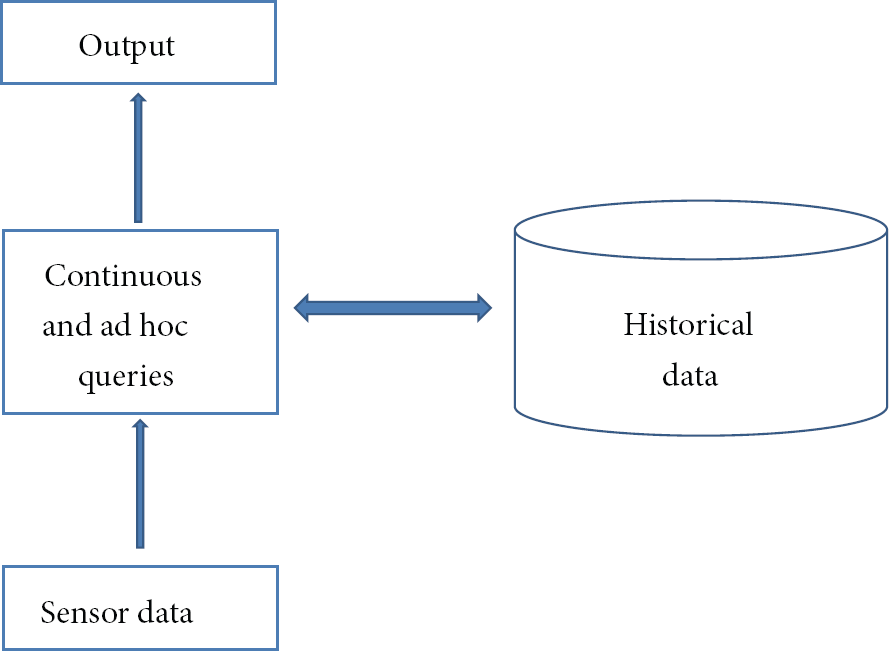
A generic real-time data management system.
3.4.3. Data Processing
For efficient computation and communication, the data need to be processed properly. Data processing can be performed in distributed manner, in based station or in cloud. The data processing decision has to be made according to the application and available resources. The timely access and processing of sensed data from sensors are critical for CPS in healthcare applications.
The elements to consider in designing real-time data processing for CPS in healthcare are data response time and data arrival update [43]. Kang [43] proposed a mechanism to make systematic trade-offs between transaction timeliness and data freshness for data-intensive CPS applications. The proposed solution does not require the entire data to reside in the main memory; hence, it has much broader application for CPS than previous real-time database approaches.
3.5. Computation
Computations in CPS for healthcare are performed for two elements: (a) modeling and (b) monitoring. Computation in model specification plays an important role in the CPS for healthcare application to identify the necessary method to implement. Doctors and clinicians need to monitor and observe patients from anywhere and anytime. They need the ability to access the required patient data accurately. Cloud Computing can perform large-scale and complex computation and communication so that doctors can easily collect patient data by biosensors from hospitals and remote observation centers. It is necessary to execute some algorithms for reduction of data bottleneck, calculation of data size, and so forth, to ensure system efficiency. Cloud Computing can provide the required computation service. Cloud Computing also supports high performance computing, mobile device integration, different operating system platform, and so forth.
3.5.1. Modeling
Designing cyber-physical system in healthcare requires vast computation due to the involvement of large network and environment. The environment often involves multiple domains such as control, communication, feedback, and response. To validate the design, model based computations are performed. These models can be static or dynamic. Static models are designed with user-defined values or simulation environment. On the other hand, dynamic models involve prediction and just in time approach which require complex computation and design. Model based computations provide a concept based idea before implementation. This allows the designer to shape the design with more perfection and efficiency.
3.5.2. Monitoring
Cyber-physical systems in healthcare involves monitoring of patients and elderly people. The level of computational complexity depends on the level of monitoring. Normal health status may require usual computation, whereas the computational complexity may be in higher level in intensive care. Daily living monitoring for patients may involve moderate computation in the system. In healthcare, the monitoring may involve health status monitoring, daily living monitoring, and intensive care monitoring.
Rolim et al. [35] provided a promising telemedicine solution which gathers bedside patient data for monitoring using wireless sensor network and transmits to the cloud for further storage, processing, and distribution. Berndt et al. [64] proposed similar idea as part of their eHealth-MV projects. Designing emergency medical system using patient health record in cloud environment has been proposed by the authors in [45, 65]. Karthikeyan and Sukanesh [44] proposed cloud-based emergency healthcare management which uses palm vein pattern recognition technology. This data is utilized for patient identification and for the users of an image processing tool called digital imaging and communications in medicine.
3.6. Communication
In CPS architecture for healthcare, the main communication is done in two parts: sensing the patient data and communicating with the cloud. However, minor communications happen throughout the whole system, for example, communications of the observation centres with healthcare services. Recent developments in image communication over wireless multimedia sensor networks (WMSN) [66–70] have the potential to extend the capabilities of CPS by allowing extracted and/or compressed images to be communicated in an energy efficient manner. This will assist with patient monitoring and observation, as well as examination of image data related to specific physiological parameters. Scheduling and communication protocol are necessary for efficient communication.
Huang et al. [46] proposed a design protocol for management and analysis of large patient health data. Research has been performed to provide the efficient connectivity to the healthcare provider [45, 65]. Table 2 shows the possible wireless connectivity technologies for CPS in healthcare.
Possible wireless connectivity for CPS in healthcare.

3.6.1. Scheduling
Scheduling is a process of finding the efficient communication time mapping, so that the communication tasks are performed with satisfaction. Achieving the timeliness of data transactions in real-time from the biosensors can be ensured by the task scheduling, concurrency control, and data management. Scheduling can be categorized as combined and publish/subscribe. Combined scheduling is a synchronized approach, whereas publish/subscribe based scheduling is an asynchronous approach.
3.6.2. Protocol
The interaction among the sensors is coordinated by utilizing some particular communication protocols that can be divided into three types: centralized, hierarchical, and decentralized. Due to the heterogeneity of the sensors, determining the suitable communication protocol is important for efficient and reliable communication. Limited data availability from various sensors may cause problem for the protocol design.
Karthikeyan and Sukanesh [44], Poulymenopoulou et al. [45], Rolim et al. [71], and Koufi et al. [65] attempted to propose the connectivity protocol for limited patient data access during medical service delivery. However, the problem still persists due to the heterogeneity of data types and further research efforts are necessary.
3.7. Security
Security is a vital concern here as patient data is confidential from legal and ethical perspectives. So, while designing CPS architecture for healthcare applications, special attention needs to be paid to ensure data security. Security has two components: (a) privacy and (b) encryption.
3.7.1. Privacy
In healthcare, the professionals are bound with patient-doctor confidentiality as well as patient data privacy. The number of sensors, services, and personal patient information available in healthcare are increasing continuously. Managing all of these is a burden, given that the system configuration is unable to take action for future unknown situations. So ensuring data privacy is an important issue from application level and data level.
Multiple users and clinicians are involved in healthcare applications; thus, the communications among them have to be secured. Though cloud servers are secured by security protocols, encrypting the data at user level provides better security [17]. It is possible to deploy mechanism to detect unauthorized data access and data corruption [17]. It is assumed that the observation centre is a central command authority which cannot be compromised by an adversary. A failure verification of anonymity mechanism can be used where the base station will be able to detect the attack [1]. Poon et al. [40] used biometrics to ensure security in wireless WBAN. Data privacy can be provided in application level and data level. The selectivity of the data privacy type can vary depending on the type of applications.
3.7.2. Encryption
As multiple users and clinicians are involved in this healthcare application, the communications among them have to be secured. Data encryption can be a solution for security assurance. Data encryption can be performed in user level and network level depending on the level of application and security requirement. Although cloud servers are secured by security protocols, encrypting the data at user level provides better security [17]. Attribute based encryption (ABE) can be adopted for data encryption. Any authorized personnel can decrypt the data applying a security key. Because the public cloud service provider acts as a third party, security is vital especially when we deal with sensitive and confidential patient data. Any disclosure of patient data may cause ethical and legal issues. Also it is possible to deploy mechanism to detect unauthorized data access and data corruption [17].
3.8. Control/Actuation
Current healthcare systems have limited effectiveness in detecting emergency patient data and alerting the authorized medical caregiver. Currently most alert systems are configured as threshold alarm. Threshold alarm is generated when a vital sign crosses a threshold value. Control/actuation has two components: (a) decision making and (b) mechanism.
3.8.1. Decision Making
As medical data can provide useful insight into actions (treatments) necessary to save a patient's life, all data should be readily available and accessible to authorized medical personnel anytime from anywhere. In addition, healthcare applications require huge computing resources for intelligent decision making based on the massive patient data [72].
Current healthcare systems have limited effectiveness in detecting emergency patient data and alerting the authorized medical caregiver. At present, most alert systems are configured as threshold alarm. Threshold alarm is generated when a vital sign crosses a threshold value. Threshold alarm is very efficient in timely detection of emergency condition. But this alarm strategy causes a high number of alarms [73] and has a high rate of false alarms [74], which leads to caregiver fatigue [37] and may lead them to ignore or turn off alarms [75]. This has been shown to decrease the quality of care [47, 74, 76]. So, it is of utmost importance to utilize a technique that will reduce false alarms.
3.8.2. Mechanism
Based on the application scenario, the control/actuation mechanism can be automatic or manual. As CPS is a system which encompasses computing, communication, and physical entities with emphasis on its interactions, it is important to study the CPS mechanisms. Mechanism is the identification of how to provide a platform for developing CPS and how to analyse the performance of the overall system. Mechanism addresses the issue of the design and implementation of real-time healthcare applications and indicates whether the system feedback is automatic or user-defined.
Many efforts have been made to improve the accuracy of threshold alarms in healthcare [48, 49, 77]. But all of them are device specific. This high rate of alarm generation in independent threshold alarm system also creates false alarms. False alarm causes fatigue to the caregivers. Since CPS in the healthcare scenario will consider different types of sensors, an approach needs to be taken for reliable coexistence of heterogeneous sensors. Authors proposed a Tru-Alarm method based on battle ground situation in [78], which can find out trustworthy alarms and increase the feasibility of CPS. As vital information is assessed to determine the state of the patient and multiple sensors may provide different data, trustworthiness analysis can be a useful tool. The generic smart healthcare alarm architecture is given in Figure 4.

Generic smart healthcare alarm architecture.
4. Taxonomy Based Mapping of CPS in Healthcare
This section utilizes the taxonomy presented in the previous section to characterise the cyber-physical systems proposed to date for healthcare application. The aim of this characterisation (or mapping) is to help visualize how the various cyber-physical systems proposed for healthcare applications integrate physical and virtual capabilities through the elements of application, architecture, sensing, data management, computation, communication, security, and control/actuation.
4.1. Notable CPS Applications
4.1.1. Electronic Medical Records (EMR)
EMR [18] is the design of a cyber-physical interface for automated vital sign readings. This approach is a solution for vital sign reading which is usually error prone and time consuming. This is a design of a cyber-physical interface that integrates sensors over a wired network that allows retrieving and storing information into EMR system as structure data. This prototype has following elements: EMR, data handler (software adapter), vital signs reading station (hardware topology), and customized vital signs form. This is a system design document (SDD), where the cyber-physical approach is discussed and decomposed using three-tier architecture. In this architecture, the components are classified in layers that are independent of the other layers and depend only on the components in the next layer down. The main advantage of this approach is that the components can be modified without effecting components in the other layers. The interface layer contains the components that are necessary for viewing the application, the application logic layer contains the components that implement the business logic, and the data layer coordinates the connections to the databases.
4.1.2. CPeSC3
Wang et al. [1] proposed a CPeSC3 architecture which is composed of three main components, namely, (1) communication core, (2) computation core, and (3) resource scheduling and management core. Relevant models such as Cloud Computing, real time scheduling, and security models are analyzed in detail by the authors. A medical healthcare application scenario is presented here based on the practical test bed for validation purpose. Authors adopted Cloud Computing technology in the context of healthcare application. However, it lacks the details of sensing data in the proposed architecture. CPeSC3 does not highlight complete reliability of system which is vital for any CPS in healthcare application. Rolim et al. [35] tried to answer the limitation of CPeSC3 but they did not propose a complete workable CPS architecture. Further research can aim to address this shortcoming.
4.1.3. CYPSec
Venkatasubramanian et al. [19] proposed a cyber-physical security (CYPSec) solution which is environmentally coupled security solutions, that operate by combining traditional security primitives along with environmental features. Authors illustrate the design issues and principals of CYPSec through two specific examples of this generic approach: (a) physiological signal based key agreement (PSKA) and (b) criticality aware access control (CAAC). PSKA is designed to enable automated key agreement between sensors in the body area network (BAN) based on physiological signals from the body and CAAC is provided with the control of enabling the system for emergency management.
4.1.4. Cyber-Physical WBAN System Using Social Networks
Zhang et al. [20] proposed a power game based approach to mitigate the communication interferences for WBANs based on the people's social interaction information. Authors contributed in the following areas: (1) modeling the inter-WBANs interference and determining the distance distribution of the interference through both theoretical analysis and Monte Carlo simulations, (2) developing social interaction detection and prediction algorithms for people carrying WBANs, and (3) developing a power control game based on the social interaction information to maximize the system's utility while minimizing the energy consumption of WBANs system. Authors also claimed to prove the existence of the Nash Equilibrium in the power control game and gave the power update and price functions.
4.1.5. Medical CPS (MCPS) and Big Data Platform
Don and Dugki [21] proposed a Big Data processing framework for MCPS, which combines the physical world with dynamic provisional, fully elastic cyber world for decision making system in healthcare. Authors claim that this framework is capable of reducing hospital expenses and ease the task of routine checking of patients by the clinicians. In remote healthcare monitoring system, the patient body is connected with various sensors to measure different physiological data, such as ECG, oxygen level, and pulse rate. These data are then sent to the remote application server to analyze by the physicians to determine the health condition of the patients.
4.1.6. Smart Checklist
Avrunin et al. [23] proposed smart checklist to support and guide human participants with their tasks. Interaction with the devices and software applications are also supported by the system. This system is expected to assist the medical staff in intensive care to prepare medication, data collection, and other routine activities for patients. Authors have developed system architecture and infrastructure, process monitoring, context awareness facility, profile-based and time-based analysis, and safety envelops. However, this system is yet not applicable to all medical processes.
4.2. Daily Living Applications
4.2.1. AICO
Ambient-intelligence compliant objects (AICOs) [24] are virtual layer overlaid by ordinary household objects integrated by various multimodal and unobtrusive wireless sensors. AICO extracts the features of interactions between objects and residents for data fusion and estimation. To represent an activity, multiple naïve Bayes classifiers are used. More than one activity is identified using this system such as listening to music while studying.
4.2.2. WISP
Wireless identification and sensing project (WISP) [25] utilizes the enhanced passive RFID tags with sensors to facilitate the data communication from sensor to receiver. The tags that are capable of sending data are called wisps and the prototype tag capable of sending 1 bit data is called α-wisp. By using ID modulation and mercury switch, the communication between two different IDs in different inertial situation is performed. A prototype is presented by the authors claiming power efficient sensing technology incorporation with RFID technology.
4.2.3. LiveNet
Disease specific activity is studied in LiveNet [26]. It is a real-time distributed mobile platform to monitor the activities of Parkinson's disease and epilepsy patients. Main components of this system are a mobile wearable PDA platform, software architecture, and real-time context engine. This system can successfully differentiate the varied symptoms such as bradykinesia and hypokinesia in Parkinson's disease and epilepsy disease patients.
4.2.4. Fall-Detecting System
Wang et al. [27] have proposed a system to detect fall by using an accelerometer on the head level and identified the fall via algorithm. This system can identify eight kinds of falling posture and seven types of daily activities such as jogging, lying, sitting, standing, walking, jumping, and movement in stairs. The algorithm works by calculating the difference between the body contact on ground and the body on rest in a particular time.
4.2.5. HipGuard
HipGuard [28] is a posture analysis application to be used for detecting the posture for the recovery period of eight to twelve weeks after hip replacement surgery. The system integrates seven sensors positioned in specific locations near surgery. Sensors send the collected data to the data processing unit, which is able to detect the position of the hip and applied load on it. Alarm is raised and clinicians are notified if any harmful movement or load is applied to the operated hip.
4.3. Medical Status Monitoring Applications
4.3.1. MobiHealth
MobiHealth [29] represents the effort to gather data from the wearable sensor devices that people carry all day. This project is one of the early efforts made to monitor medical statuses from sensors. It tries to collect audio and video signal to provide early response in case of accidents.
4.3.2. CodeBlue
CodeBlue [30] is a platform integrated of biomedical sensors such as pulse oximeter, two-lead ECG, and motion sensor with pub-sub based routing framework based software architecture. CodeBlue manages and communicates among medical devices. This system is a pioneering project in terms of early use of in-network aggregation and smart routing.
4.3.3. AlarmNet
AlarmNet [31] is a wireless biosensor network system prototype consisting of heart rate, pulse rate, oxygen saturation, and ECG. Environmental parameters such as temperature and humidity provide spatial contextual data. Privacy, power management, and query management are also considered in the system. A gateway is used between data collection and storage unit. This system also provides graphical user interface to assist healthcare professionals to monitor vital signs from patients.
4.3.4. Mobile ECG
Mobile ECG [32] system uses smart mobile phones as base station for ECG measurement and analysis. Smart mobile phone receives ECG data from mobile ECG recording devices via Bluetooth. Mobile phones store and analyze the ECG data and forward them to the medical professionals if necessary. Graphical interface is capable of displaying ECG recordings and heart rate.
4.3.5. Predicting Vital Signs
Researchers developed a system, which can predict the blood pressure, heart rate, and other vital signs around 20 seconds earlier [79]. Data are taken in every 3 milliseconds and fed to the system to predict the vital signs. This system can also trigger real-time warnings, then query surgical decisions and store information from an operation.
4.4. Medication Intake Applications
Medication noncompliance is common in elderly and chronically ill especially when cognitive disabilities are encountered.
4.4.1. iCabiNET
iCabiNET [33] utilizes smart RFID packaging that can record the removal of pill by breaking an electric flow into the RFID circuit. This system of medication intake can be monitored by the RFID reader using residential network at home. The availability of the medication and the necessity to purchase the medication can also be monitored if smart appliances are used. For example, an interactive TV application can also be integrated with the system that allows the purchase of the new packet of the medication when the supply is decreased. As an alternative scenario, iCabiNET system can be integrated with the cellular network or ordinary telephone network in order to remind the patients of taking their medication properly.
4.4.2. iPackage
An intelligent packaging prototype is proposed and developed by Pang et al. [34]. The system consists of remote medication intake monitoring and vital signs monitoring. The intelligent package prototype is called iPackage. The system is different from the design of RFID attached intelligent packages as it uses an array of controlled delamination material (CDM) films with integrated control circuits. The CDM film is three-layer foil composed of aluminium bottom and top layers and an adhesive middle layer made of electrochemical epoxy. When a voltage higher than a particular threshold is applied on the bottom layer and top layer, an electrochemical reaction occurs in the middle layer. When the voltage is applied for a certain amount of time, the epoxy layer is destroyed and delaminated. Therefore, the iPackage sealed with a CDM film can only be opened by the special control appliance, which also enables the control of the dosage. The identification of the correct pill is accomplished by RFID.
4.5. Emerging CPS for Healthcare Applications
Research efforts are going on to develop CPS for healthcare applications based on integrating sensor and cyber infrastructure, which can be summarized as follows.
4.5.1. Secure and Scalable Cloud-Based e-Health Architecture
Lounis et al. [17] proposed a secure and scalable architecture for collecting and accessing large amount of data generated by medical sensor networks. The architecture proposed by the authors has following components: (a) medical sensors to collect patient data, (b) monitoring application, (c) healthcare authority (HA) that specifies and enforces the security policies of the healthcare institution, and (d) cloud servers to ensure data storage. Storing data in cloud provides scalability and ability to provide data to the authorized user on demand and ensures security.
4.5.2. Cloud Based Patient Data Collection
Rolim et al. [35] proposed a two level contribution in social and scientific fields. In social contribution, authors demonstrated innovative and low cost solution for improved medical assistance quality. In scientific contribution, authors attempted to integrate sensors with Cloud Computing services in healthcare perspective. Modules responsible for storing and processing the collected data are implemented and run on virtual machines, which are managed by freely available Open Nebula and ANEKA as the middleware for Cloud Computing in Microsoft Windows networks.
4.5.3. WSN-Cloud Based Automated Telemedicine
Perumal et al. [36] proposed an architecture that involves wireless sensor networks and community cloud together. Proposed system provides a number of featured components, such as security and privacy control, WSN-cloud integration mechanism, and dynamic collaboration between clouds to enable e-healthcare services. The experiments were conducted with mote kits having transceivers operating at 2.4 GHz with a typical range of 750 m. The test bed uses a medical server with 5 user nodes for medical specialist, caretakers, and patients for monitoring and analyzing medical data. ECG sensor (PASCO CI-6539A), heart rate sensor (PASCO CI 6543B), and temperature sensor (CI6605A) were interfaced with mote kits to monitor patient's physiological parameters. The output terminals of the body sensors are attached to the mote kit. Mote kit transmits the physiological signals to the corresponding gateway through mesh networking. The medical professionals can access the particular patient's data from any of the hospital server through front-end web service.
4.5.4. Plug-and-Play for Medical Devices
Arney et al. [37] proposed a system prototype to support any device that is plug-and-play compatible. In the current implementation, the supervisor shuts off the pump in the presence of a permanent respiratory depression based on a preset threshold. Authors envision using smart algorithms that integrate data from multiple sensors together with the patient history and statistical data from other patients to calculate the threshold for each individual. The case study presented by the authors is a tool for presenting the ideas of medical device plug-and-play and a means of exploring the clinical patient safety applications enabled by interoperable systems.
4.5.5. Cyber-Physical Cardiac Medical Device Modeling
Jiang et al. [38] proposed a framework for implantable cardiac device validation and verification model. A formal model is developed to capture the timing properties of the electrical conduction system of the heart. The formal model of the device, closed-loop verification, is performed to evaluate device software safety against safety requirements. The heart model is able to perform closed-loop device validation by generating synthetic electrogram signals to the devices and respond to a functional pacing signal from the device through functional interface. Formal model framework assists with device certification based on a validated and verified device model.
4.5.6. Radio-Frequency Identification (RFID) Application in CPS
Wu and Li [41] proposed an active RFID system with a potential for building a highly mixed system of information and the physical devices. Authors compared the RFID system with a traditional wireless sensor network system and discussed the applicability of the type of RFID systems. They also proposed and studied the design idea, methodology, product, and experimental results of an active RFID based relative positioning system.
4.5.7. CPS-MAS
Banerjee et al. [42] proposed CPS-MAS, a cyber-physical medical system modelling and analysis framework for safety verification. Authors attempted to answer the challenging problem of modelling and analyzing the complex nature of interaction of the medical devices with the human body, characterized by nonlinearity, transport delay, spatiotemporal effects, and nontrivial aggregation of interaction during networked operation of devices. As formal model examples, drug delivery for pain relief and chemotherapy were provided by the authors.
4.5.8. CPS Smart Living
Bai and Huang [51] presented designs and implementation of an Intelligent Control Box to convert different wireless signals. The developed Intelligent Control Box can be treated as a multiple control platform, which integrates the living system appliances such as lighting, air conditioning, access control, video surveillance, and alarm that eventually decreases the difficulties in establishing smart living space with CPS. For evaluation, the total number of signal conversions during the simulation process and the number of successful signal conversions during the simulation process are taken as parameter. The success rate of converting wireless signals is high from Zigbee and Bluetooth signals to WiFi signal because WiFi signals have the feature of nonline of sight. Further, when the WiFi and Zigbee signals are converted into Bluetooth signals, the result is that Bluetooth signals also have a good signal conversion success rate. Whether WiFi, Zigbee, or Bluetooth signal is converted to infrared signal, the signal conversion success rate is relatively low. The Intelligent Control Box is developed by the authors to efficiently reduce the difficulties in creating smart living space with CPS technology.
4.6. Mapping of CPS in Healthcare
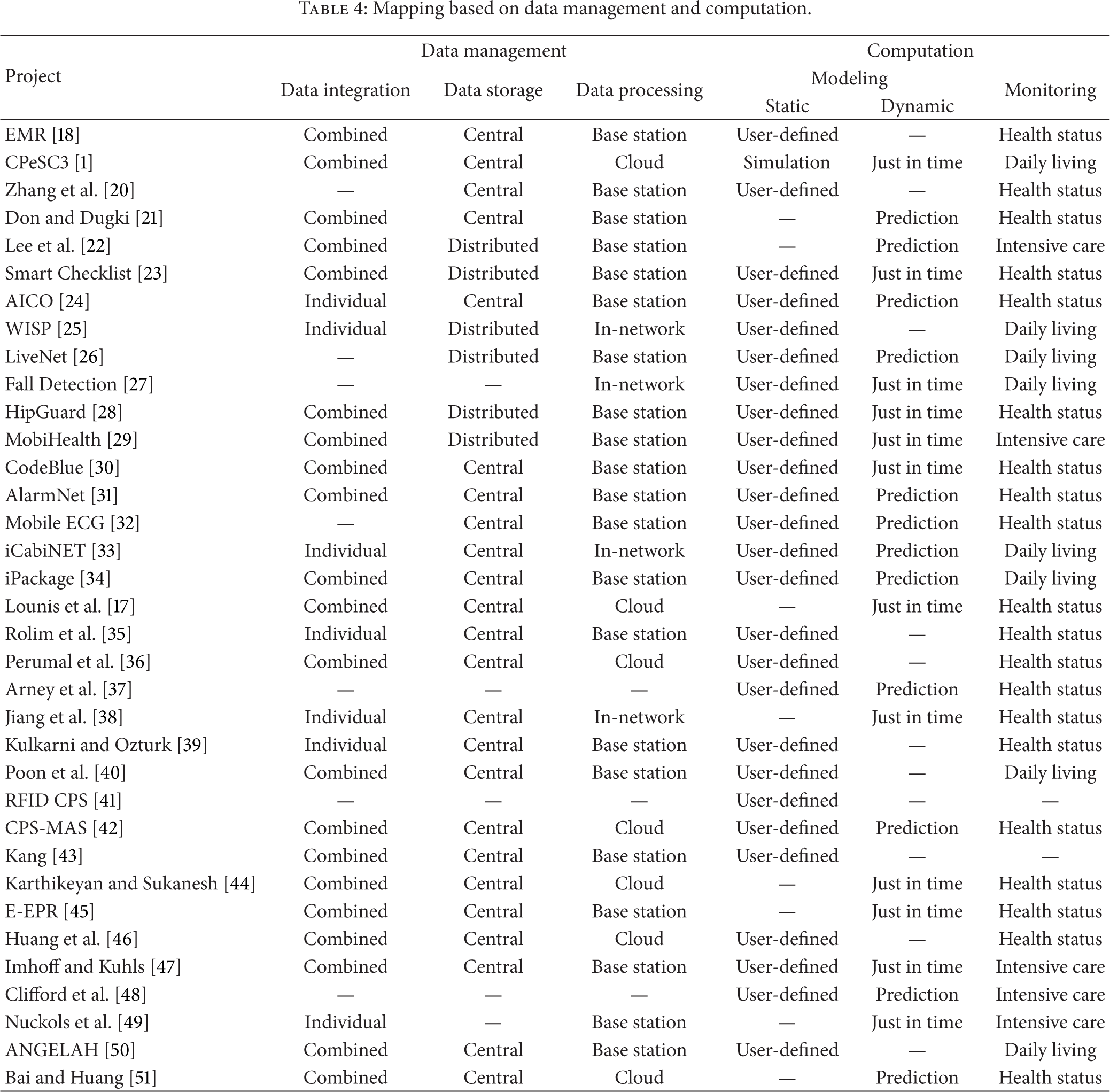
This section provides the mapping of the projects described so far in this section. The mapping is presented in three separate tables (Tables 3, 4, and 5), each covering a subset of the eight elements identified in the taxonomy of CPS in healthcare presented in Section 3. In order for this study to be as comprehensive as possible, Tables 3–5 also include mapping of WSN based projects as well as cloud based projects that appear to be promising contenders [80] for medical applications.
Mapping based on application, architecture, and sensing.

Mapping based on data management and computation.
Mapping based on communication, security, and control/actuation.

5. Challenges and Issues in CPS
A number of barriers are hindering the progress of designing, developing and deploying cyber-physical systems in healthcare as well as in other application domains. Designing CPS for healthcare is a challenging task as it involves several issues such as software reliability, system interoperability, computational intelligence, security and privacy, and context-awareness. Software is an integral part of medical devices and hardware functions in close interactions with software. In this section, we first discuss some of these challenges related to cyber-physical systems in general. The latter part of this section discusses challenges specific to CPS in healthcare.
5.1. Challenges of CPS in General
Lack of CPS Standard. It is scientifically challenging to identify the knowledge based definitions and measurement for the concepts such as security, privacy, and safety. Even if the concepts are identified, it is uncertain how utilization and reasoning will be performed. For example, in healthcare, the professionals are bound with patient-doctor confidentiality as well as patient data privacy. So the question remains under what level of concern the privacy will be considered violated. Lack of Verification and Validation Tool. A CPS application can integrate the WSN and Cloud Computing paradigm. Although WSN and Cloud Computing modelling and simulation tools are available, however, new simulation tools are necessary to completely model the CPS system as they collect, analyse, process, and actuate heterogeneous sensors, communication layers, and other data types that are the part of system. Time Management in Architectural Design. Time synchronization is a critical issue in CPS for healthcare due to the application of heterogeneous sensors and cloud integration. Due to the necessity of real-time CPS for healthcare application, time management is of utmost importance in the form of time synchronization, time scaling, defining reference time, and the way to communicate with different sensors considering the timing characteristics. CPS Architecture. CPS faces the challenges of the complexity of computing and physical dynamics, such as time management, system structure, process integration, data correctness, and standard. A general or unified architecture that is capable of addressing these issues will play an important part in future CPS design. Some challenges related to CPS architecture are summarized in Table 6.
Challenges in designing CPS architecture.

5.2. Challenges of CPS in Healthcare
Software Reliability. Software is an integral part of medical devices. Device functionality and multiple functions are ensured via software. Software also ensures the proper cooperation between medical devices and the patients. So, the safety and efficiency of the system rely on the proper software design, development, and management. Medical Device Interoperability. Multiple medical devices may have different communication interfaces. A well-maintained management system should be there to integrate heterogeneous medical devices in a safe, secured, and certified manner. Data Extraction. Medical devices collect multiple physiological parameters from the patients. These parameters are widely varied in nature and capable of providing not only general information about patients but also early prediction of future illness, possible nullification of emergency situation. However, it is a challenging task to design such system that can seamlessly extract complex physiological parameters from patients. Security and Privacy. It is indeed a critical task to ensure the privacy of collected patient data. Unlawful use of patient data may cause damage in reputation and the loss of personal privacy. It may even cause mental unrest and abuse leading to further physical illness. System Feedback. Development of feedback system is a challenging task for CPS in healthcare because the design stability will be void without feedback system or patient care improvement. CPS in healthcare scenario depicts a perfect feedback system via smart alarm system. Alarm system is of paramount importance to notify the caregiver for any possible illness or emergency situation. However, the alarm system needs to address some challenges such as types of physiological parameter, system complexity, and implementation ability. It is important to select the right physiological parameters to design the alarm system. With a wide range of possible illnesses, it is a challenging task to select parameters that can identify a specific illness from multiple possibilities. Feedback system needs to be simple to use and understand as well. Complexity must not hinder the efficient use of patients and care givers. Finally, the implementation ability needs to be for wider domain. Although alarm system is efficient in hospitals, it is still a challenging issue to implement the efficient feedback system in elderly homes or assisted living homes. Complex Query Processing. Due to the presence of heterogeneous biosensors, sometimes wireless-battery operated sensors present a few challenges such as low energy consumption and limited processing capability which hinders the pavement for complex query processing. Complex query processing can help reduce the amount of transmission and context aware predictions. These functionalities can reduce the energy consumptions in a limited energy network. Complex queries can utilize the access to multiple physiological parameters, thus predicting possible illness. However, this approach requires complex design and computational skill sets. Lack of Prototype Architecture in CPS for Healthcare. At present, there is a lack of secure and trustworthy prototype architecture for testing, evaluation, and system developments which includes healthcare devices. For the very reason, there is inability to ensure the correctness of CPS in healthcare architecture in the uncertain environmental scenario.
5.3. Issues Worth Further Investigation
Form the study presented in this paper so far, it is obvious that the following issues are worth pursuing for improving the performance of future cyber-physical systems in healthcare.
Parameter Variability. Present proposals of CPS in healthcare consider very few parameters or vitals, limiting their possibilities. For context-aware system, multiple parameters will increase the credibility of overall system. Data Workflow. As CPS in healthcare is considered as a complex system, the proper and carefully designed data workflow will improve the system quality. Implementation. Proposed CPS architectures in healthcare to date are mostly still in design and simulation stage. Practical implementation will be an excellent research direction and this will open further research problems related to real-world implementation.
6. Conclusion
This paper has presented a review of cyber-physical systems in healthcare. To facilitate this, a brief overview of CPS in general is first provided. A characterization (mapping) of cyber-physical systems for healthcare applications is then presented based on a comprehensive taxonomy involving eight different perspectives (or elements): (i) application, (ii) architecture, (iii) sensing, (iv) data management, (v) computation, (vi) communication, (vii) security, and (viii) control/actuation. This characterisation is helpful for visualizing the trends, techniques, and potential CPS solutions around specific applications. The mapping of the taxonomy to CPS projects has also included healthcare projects solely utilising wireless sensor networks (WSN) or Cloud Computing. Thus, the taxonomy and the mapping presented in this paper can therefore be used to identify the gaps between WSN or cloud based healthcare solutions and CPS based solutions. This will help leverage the existing WSN and cloud based healthcare solutions to develop more reliable and efficient cyber-physical systems for healthcare. From the study presented in this paper, security and privacy issues are identified as the least explored in CPS for healthcare applications. Further, the control/actuation part of CPS is still mostly dependent on manual intervention of the healthcare professional when it comes to decision making and feedback. Although CPS can facilitate event prediction in healthcare, few research efforts have been performed in this area.
Footnotes
Conflict of Interests
The authors declare that there is no conflict of interests regarding the publication of this paper.