




Abstract
A study on heat and mass transfer behaviour on porous medium embedded in a square annulus is conducted. The inner surface wall is considered to have a cool temperature T c while the outer surface is exposed to a hot temperature T h . Finite element method (FEM) is used to solve the governing partial differential equations. The results present the influences of the Dufour and Soret effects on the heat and mass transfer of a square annulus. The effects of various physical parameters on the temperature and concentration profiles together with the local Nusselt and Sherwood numbers are presented graphically. It is found that when Dufour parameter is increased, Nusselt number increases. Dufour effect has more influences on velocity profile, while it has no significant effect on the concentration and can be deemed negligible. It is observed that the local Nusselt number is highest at the bottom wall for low values of Dufour parameter; however, the top wall Nusselt number is highest for higher values of Dufour parameter. Soret effect tends to make more significant contribution to the concentration profile than Dufour effect.
1. Introduction
The enormous interest in the double diffusive convection in the recent years has led researchers to an extensive study on this topic due to its applicability in the industry as well as in engineering fields. The various aspects related to the heat and mass transfer have been addressed in the extensive literature [1–12]. The effect of various geometrical and physical parameters on the rate of heat and mass transfer issues the important information that would be useful in evaluating the various key aspects regarding the porous medium fixed inside the annular vertical cylinder [13]. Similar methodology was adopted to investigate the heat transfer in different geometries subjected to the thermal equilibrium as well as thermal nonequilibrium approach which provides fundamental and helpful information to understand the complex phenomena of heat transfer in porous medium [14–20]. The thermal-diffusion (Soret) and diffusion-thermo (Dufour) effects in the combined heat and mass transfer affect the flow field in free convection significantly [21]. Thus both Soret and Dufour effects have considerable implications on the flow field. A study made by Nithyadevi and Yang [22] and Weaver and Viskanta [23] discovered that the Soret and Dufour effects will become very significant when the temperature and concentration gradients are high. The fluid velocity and heat transfer rates increase when Dufour parameter is very high. For Soret effect, as the parameter is high, the mass transfer increases but the velocity decreases. Joly et al. [24] also studied the importance of Soret effect on natural convection in a vertical cavity filled with binary fluid. Weber [25] studied the temperature gradient effect on the problem of thermal convection on porous media. Alam and Rahman [26] have included Soret and Dufour effects in their studies on the mixed convection flow past a vertical porous flat plate. They concluded that the effect by thermal and concentration gradient affects the flow field appreciably. Aouachriaa et al. [27] considered the Soret and Dufour effects on convection in a vertical plate embedded in porous medium. Bejan and Khair [28] examined the effect of temperature and concentration gradients on the boundary layer of the flow characteristic. Prasad et al. [29] found that Soret and Dufour effects are significant when there is a difference in density in the flow especially in biotechnology chromatography. Abdou and El-Kabeir [30] and Zueco et al. [31] studied the effect of magnetic field on the flow in porous medium but did not include Soret and Dufour effects. Due to the existence of a significant amount of density difference, the secondary effects could be important. Postelnicu [32] studied heat and mass transfers influenced by magnetic field and included the Soret and Dufour effect. He used natural convection flow for vertical surfaces. Cheng [33] studied the Dufour and Soret effects on an inclined plate in a porous medium with constant wall temperature and concentration. It was found that when Dufour parameter is increased, the local heat transfer decreases. Also an increase in Soret parameter causes a decrease in local mass transfer.
Thus the present study emphasizes the Soret and Dufour effect in case of the square annulus fixed with porous medium inside, subjected to the outside heating. The various parameters such as the buoyancy ratio, aspect and radius ratios, Lewis and Rayleigh numbers, and radiation parameter were discussed in detail.
2. Analysis
In the current study, the heat and mass transfer rate for porous square annulus as shown in Figure 1 are investigated. The boundaries are such that the outer walls of domain have a higher temperature T h and concentration C h than the inner wall with temperature T c and concentration C c . Both temperatures are maintained isothermally. The velocity of the fluid u and v along the walls are assumed to be zero. The following assumptions are used.
The flow regime is obeying Darcy law for porous medium.
All the involved properties such as the porous medium and the fluid are isotropic and homogeneous.
Most of the properties of the fluid are constant except for the density that is proportional to temperature.
Fluid is assumed to be transparent to radiation.
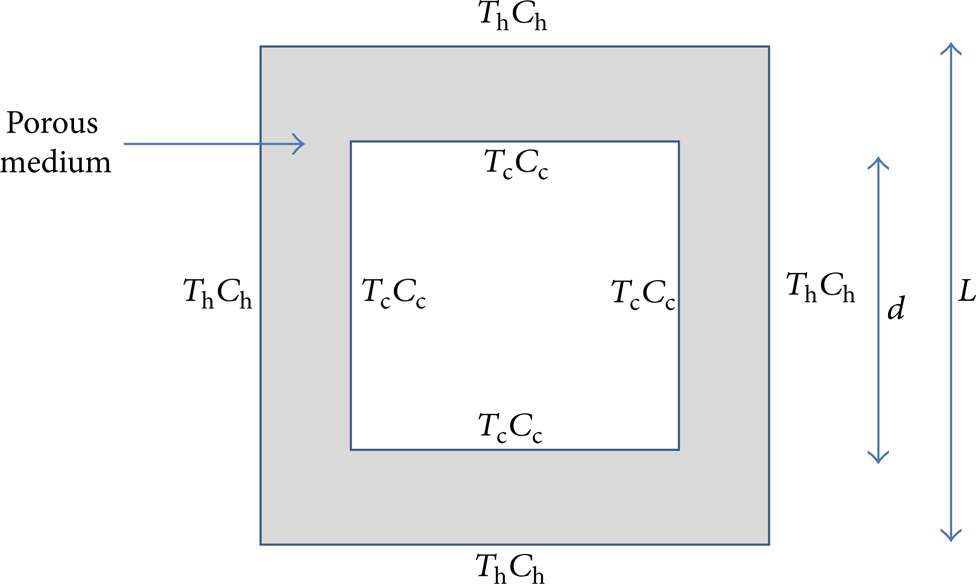
Porous square cavity.
The governing equations in dimensional forms are presented below by using the above assumptions.
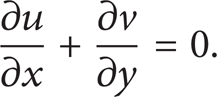
Continuity equation:
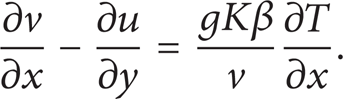
Momentum equation derived based on Darcy's law:
Energy equation taking into account radiation effect and Dufour effect:

Species concentration transport equation with the embedded Soret effect:

In order to satisfy continuity equation in (1), stream function is introduced. Consider the following:

The above dimensional governing equations are transformed into nondimensional forms by using the following parameters.
Extent x:
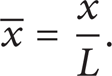
Extent y:

Stream function:

Temperature:
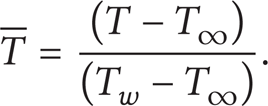
Concentration parameter:
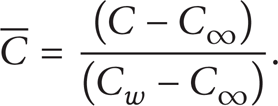
Dufour parameter:
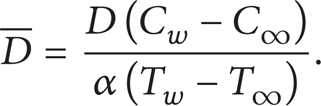
Soret parameter:

Radiation parameter:

Rayleigh number:

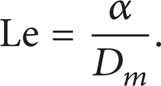
Lewis number:
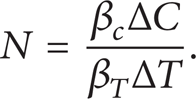
Buoyancy ratio:
An estimation of q r is derived by using Rosseland approximation, and, according to Chen et al. [34],
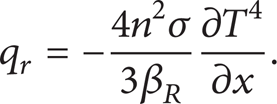
The term T4 in (17) is a nonlinear term that can be expanded and derived by using the Taylor series based on Raptis [35] where

By substituting all the above dimensionless parameters into the governing equations, a new set of dimensionless equations are obtained as follows.
Dimensionless momentum equation:

Dimensionless energy equation:
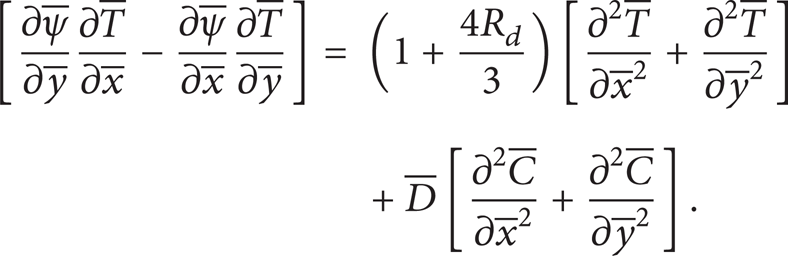
Dimensionless concentration equation:

The following conditions at the boundary are used in the computation:
At
At
At
At
(L − d)/2 ≤ x ≤ (L + d)/2,
(L − d)/2 ≤ x ≤ (L + d)/2,
(L − d)/2 ≤ y ≤ (L + d)2,
(L − d)/2 ≤ y ≤ (L + d)/2,
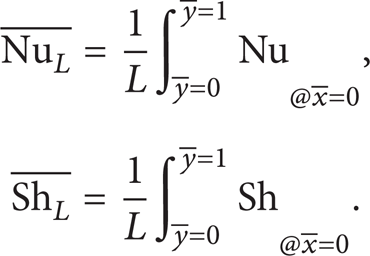
The following equations are used in the calculation of Nusselt and Sherwood numbers at the hot surfaces.
At the horizontal/vertical hot wall:
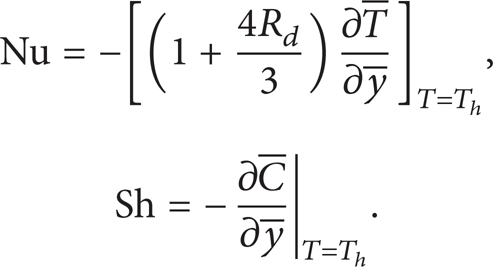
Average at the left hot surface:
Average at the right hot surface:

Average at the bottom hot surface:
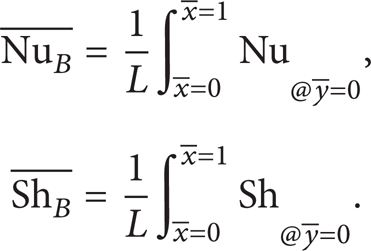
Average at the top hot surface:

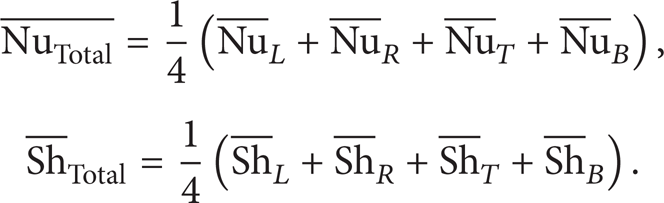
Average number:
3. Numerical Method
The equations derived in the previous section are continuous equations for heat and mass flow in porous media. The end result is the equations that are coupled and nonlinear partial differential equations and cannot be solved analytically. Solving the equations will enable us to predict the heat transfer and mass transfer behavior of the problem. The governing equations are discretized by using finite element method using three-node elements. The properties of interest can be expressed as

where N1, N2, and N3 are called the shape functions. Now, the Galerkin method is used to convert the partial differential equation into the algebraic form

For more elaborate explanation of the finite element method, the following literatures by Lewis et al. [36] and Segerlind [37] can be referred.
For validation of this particular case study, the results are compared with the data obtained by different researchers as shown in Table 1. It should be noted that there are no results available to compare with the considered geometry in this paper. Thus the problem is reduced to the case of square cavity by taking d = 0. The boundary conditions are applied such that the left vertical wall is heated isothermally to T h and right vertical wall is cooled isothermally to T c . The top and bottom walls are adiabatic. The results are obtained by setting the parameters as R d = 0, N = 0, Le = 1, D = 0, and S = 0. Based on the results from Table 1, it can be said that the present method is accurate enough to do simulation of heat and mass transfer characteristic for the problem of porous square annulus.
Validation of average Nusselt number.

4. Results and Discussion
4.1. Local Nusselt and Sherwood Number
Figures 2 and 3 show the variation of Nusselt number along annulus length for a range of W = 0.25, W = 0.5, and W = 0.75 for Dufour parameters D = 0.1 and D = 1, respectively. When Dufour parameter is low as shown in Figure 2 the bottom wall has higher Nusselt number than the rest of the walls. The Nusselt number for the top wall is low when width ratio is low but increases with the increment of width ratio. Vertical walls have maximum values at the upper walls. When Dufour parameter is increased to D = 1, the bottom wall has an overall higher Nusselt number than the other walls. Heat transfer rate is dominated by convective force at the top wall and by conduction at the bottom wall when Dufour parameter is increased. The bottom wall has two smaller peaks at both ends together with higher maximum point happening at the centre. When W = 0.5, the two peaks vanish and Nusselt number is almost zero for a small span at the two ends. Maximum Nusselt number is still at the center. As for the vertical walls, the maximum values shifted to the lower walls but there is a small peak created at the upper wall. However, all the graphs for both cases of Dufour parameter reach almost the same values when W = 0.75. One clear observation that can be obtained from the graph is that local Nusselt number decreases when Dufour parameter is increased. Dufour effect is also known as the diffusion-thermo effect and it is a coupled effect because of concentration gradient inducing energy flux. In this case when Dufour parameter is increased it causes increasing of energy flow into the porous medium; thus it reduces the thermal gradient that in turn reduces the Nusselt number. Nevertheless, Dufour effect is negligible for high width ratio because of restriction in space. The bottom wall still has higher Nusselt number, while the top wall has the lowest in some parts.
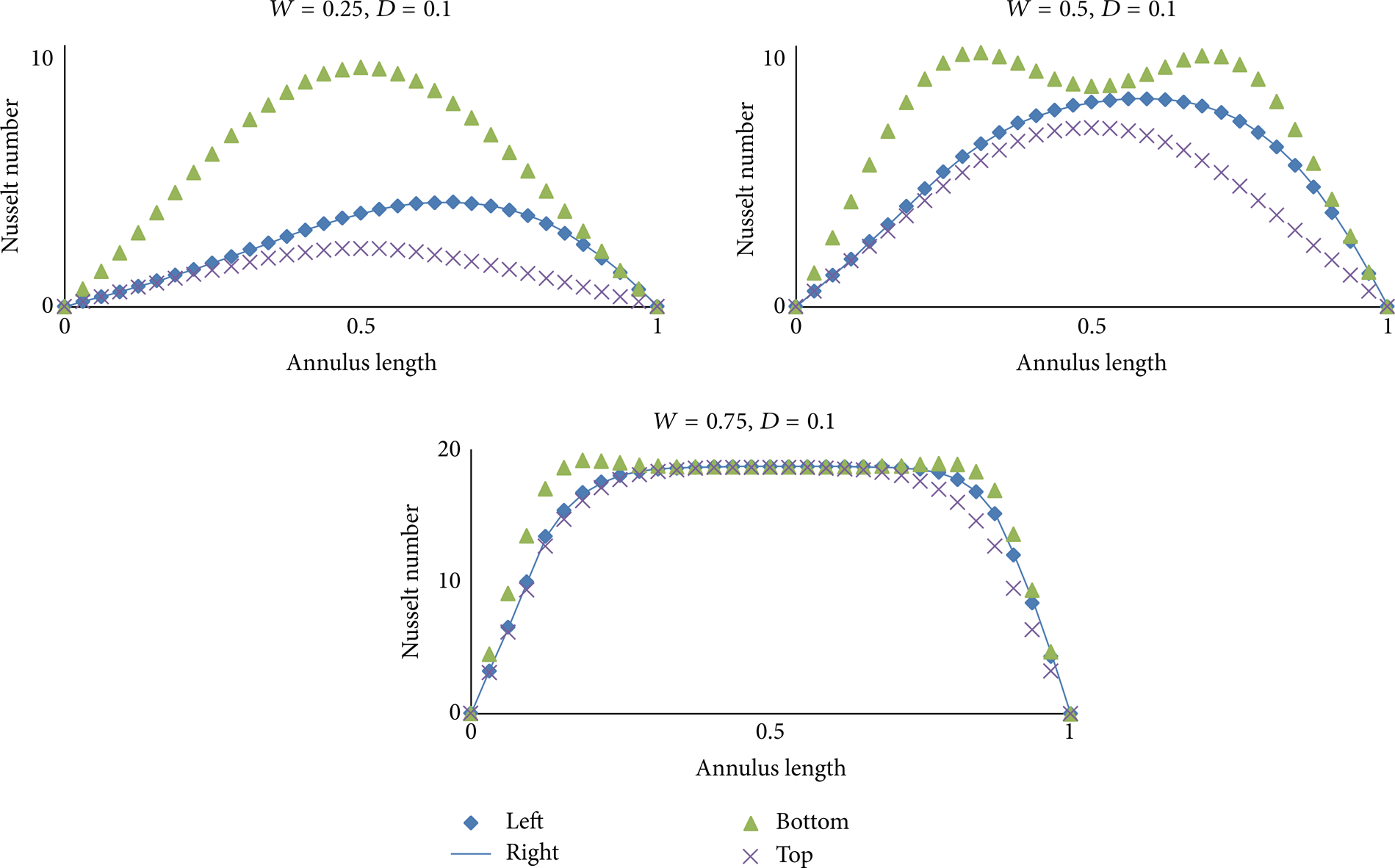
Nusselt number for D = 0.1, Ra = 100, N = 0.5, Le = 2, S = 0, and R d = 1.

Nusselt number for D = 1, Ra = 100, N = 0.5, Le = 2, S = 0, and R d = 1.
By increasing Dufour parameter and keeping Soret parameter constant, a little effect on the Sherwood number was observed as shown in Figures 4 and 5. This is due to the fact that the influence of Dufour parameter is more on heat transfer rate than on the mass transfer. However, there is a small reduction in Nusselt number when W = 0.5, especially for the bottom and the vertical walls. Upon close examination of the figures, it was found that only when W = 0.75 there is an overall increase in Sherwood number, but when W = 0.25 and W = 0.5 both of them show some reductions. It can be concluded that Dufour effect has no significant effect on the concentration of species and can be deemed negligible.
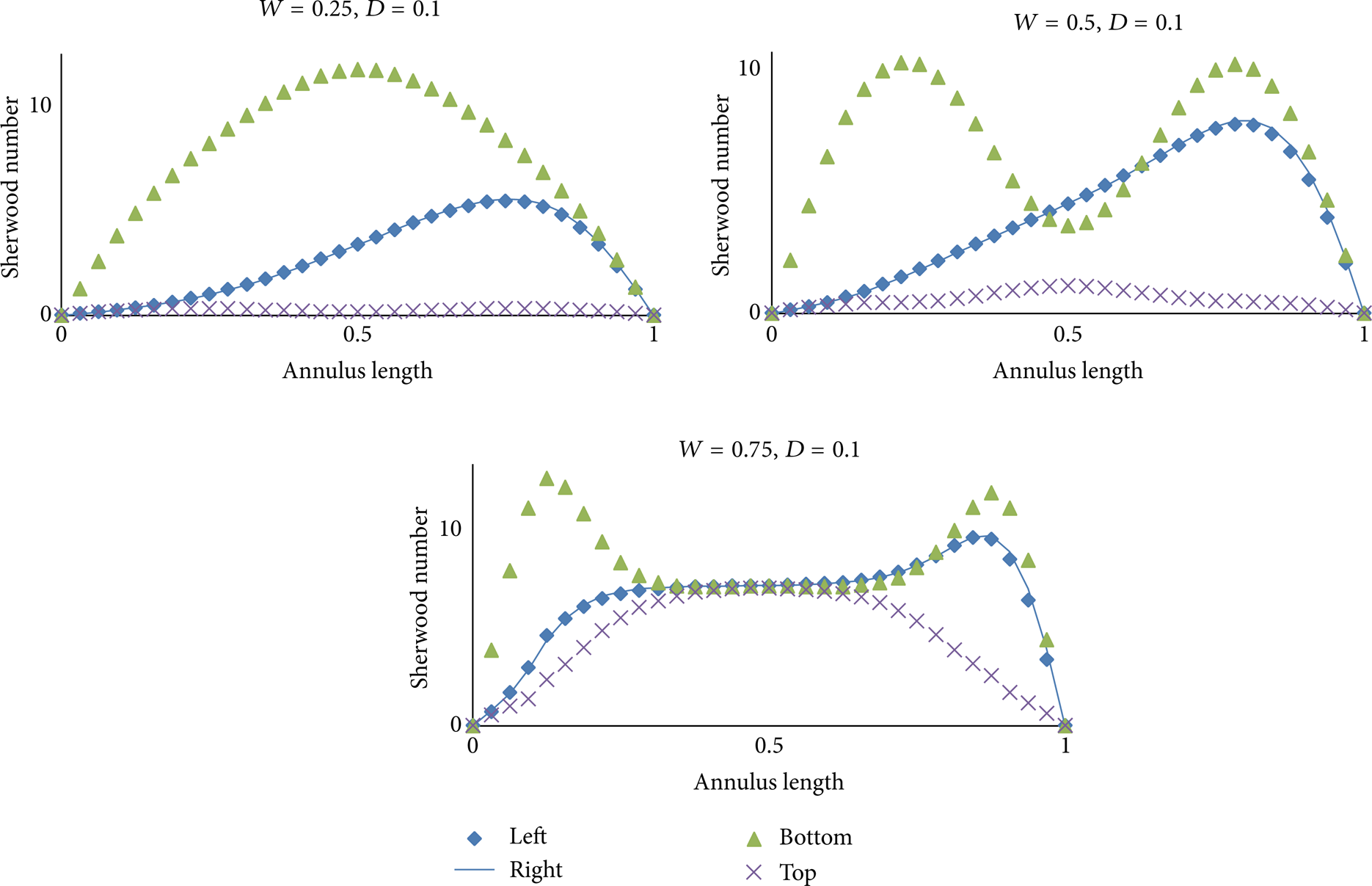
Sherwood number for D = 0.1, Ra = 100, N = 0.5, Le = 2, S = 0, and R d = 1.

Sherwood number for D = 1, Ra = 100, N = 0.5, Le = 2, S = 0, and R d = 1.
4.2. Average Nusselt Number
Figure 6 illustrates the plot of average Nusselt number versus width ratio with variation of Dufour parameter from D = 0.1 to D = 1 for Soret parameter fixed at S = 0. When D = 0.1, the bottom wall has higher Nusselt number compared to the other walls as shown in Figure 6. The top wall has the lowest Nusselt number indicating that convective heat transfer is more dominant at the bottom wall than at the top wall. Nevertheless, with similar parameters, when Dufour parameter is increased to D = 1, the top wall now has higher Nusselt number than the other walls. This can be explained in a way that the velocity increases when Dufour parameter is increased. The higher momentum gain enables the fluid to reach the top wall with more strength. The increased velocity will enhance convective heat transfer and thus increment in Nusselt number.
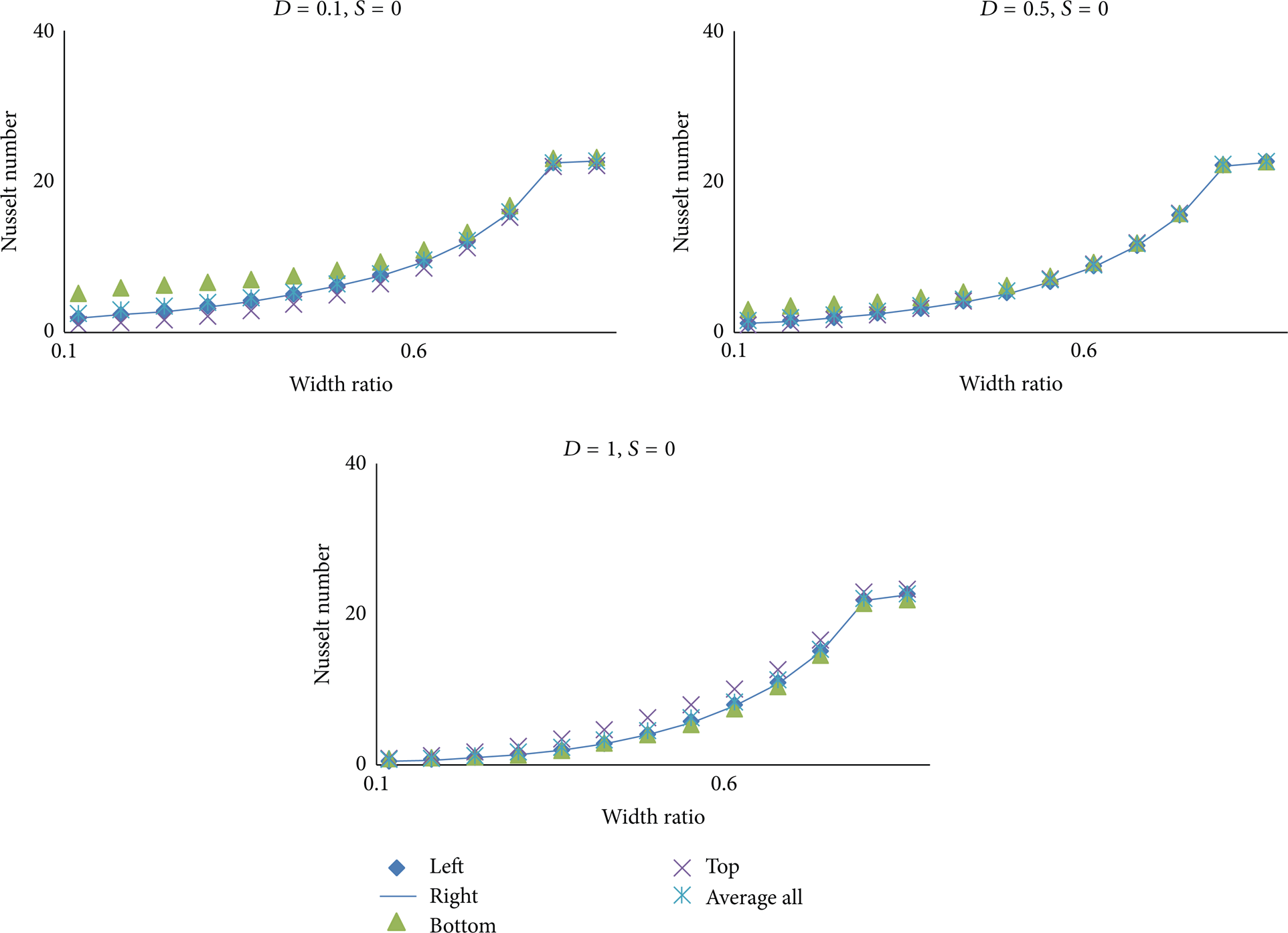
Nusselt number for S = 0, Ra = 100, N = 0.5, Le = 2, and R d = 1.
Figure 7 is the plot of a similar case but with Soret parameter increased to S = 1. One obvious observation is that, by increasing Soret parameter, the pattern and the values of Nusselt number remain the same. The effect of varying Soret parameter on the plot of Nusselt number is negligible. This is corroborated by findings of Aouachriaa et al. [27]. The temperature profile remains unchanging for different values of Soret parameters. This is because Soret effect is the influence of temperature gradient on the concentration equation and not the energy equation.

Nusselt number for S = 1, Ra = 100, N = 0.5, Le = 2, and R d = 1.
4.3. Average Sherwood Number
Figures 8 and 9 show the Sherwood number when Dufour parameter is varied at 0.25, 0.5, and 0.75 for Soret parameter fixed at S = 0 and S = 1, respectively. The bottom wall has higher Sherwood number in all the cases while the top wall has the lowest Sherwood number. Average Sherwood number is almost equal to the Sherwood number for vertical walls in all the cases. The mass transfer rate is dominated by diffusion. Based on these plots, it can be stated that, by varying Dufour parameter at a constant Soret parameter S = 0, the changes of the Sherwood number are almost negligible. This is expected since Dufour parameter affects the energy transport to a greater extent. When the Soret parameter is increased to S = 1, there is an overall increment in Sherwood number except when the Dufour parameter is very small. There could be some countereffect between the low Dufour parameter and the high Soret parameter.

Sherwood number, for S = 0, Ra = 100, N = 0.5, Le = 2, and R d = 1.
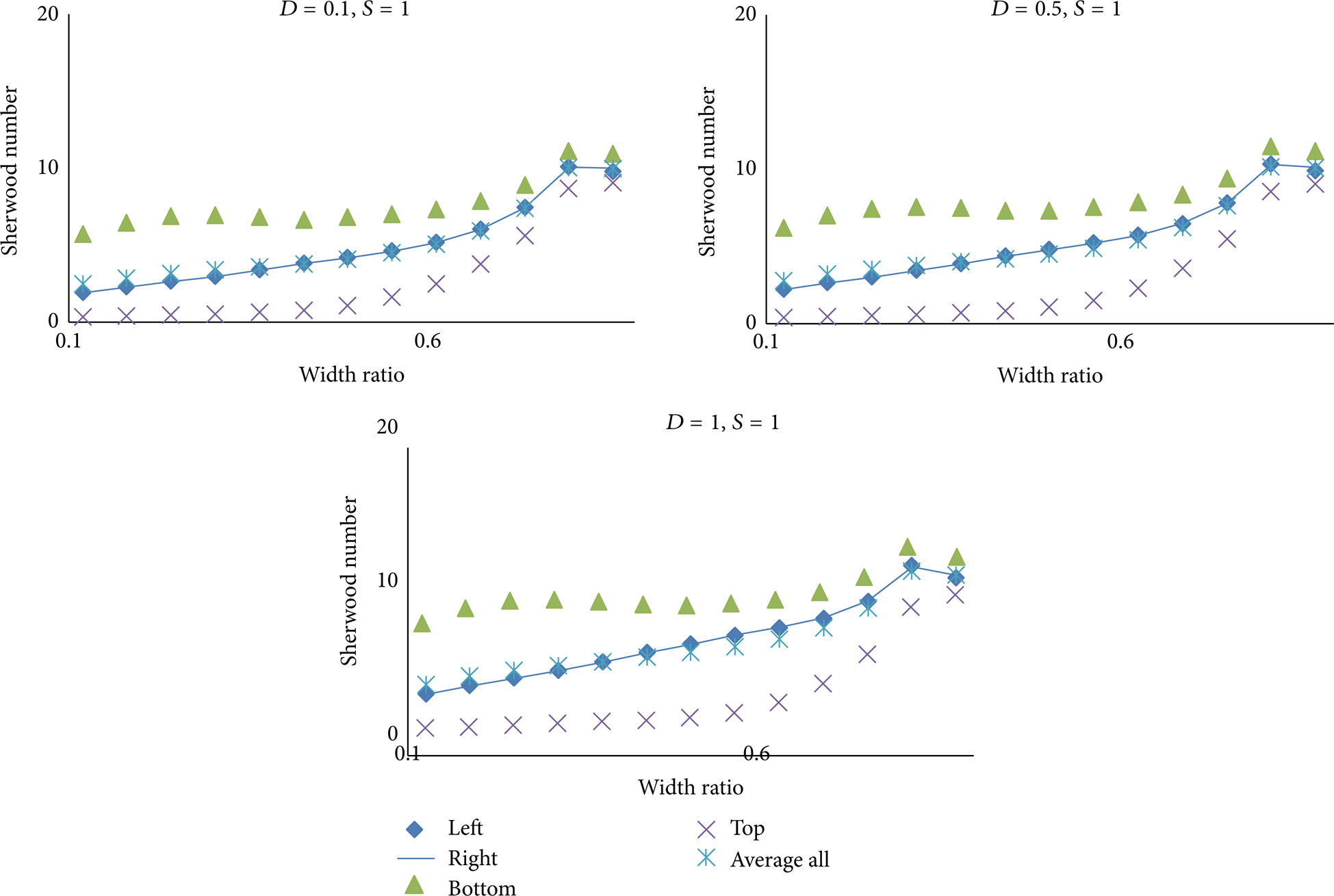
Sherwood number, for S = 1, Ra = 100, N = 0.5, Le = 2, and R d = 1.
4.4. Isolines for Dufour Effects
Figure 10 shows the plot of streamlines for Dufour parameters D = 0.1 at the top and D = 1 at the bottom with increasing width ratio from left to the right of Figure 10. As it is shown in the figure, the flow covers almost the whole domain for W = 0.25. Only the middle top and bottom wall have seen no fluid activity. Two primary circulations with oval shapes created symmetry in the middle as shown in Figure 10. As the width ratio is increased, the oval shape becomes thinner and fluid activity at the top and bottom wall decreases. When W = 0.75, there is almost no fluid activity at the top and bottom walls. When Dufour parameter is increased, the strength of the flow spreads to the middle of the circulations. The fluid strength has increased when the thermal gradient is increased.

Streamlines, top: D = 0.1, bottom: D = 1; left to right: W = 0.25, 0.5, 0.75, with Ra = 100, N = 0.5, Le = 2, S = 0, and R d = 1.
Figure 11 shows the plot of isotherms similar to the previous case. For small Dufour parameter, when W = 0.25, isothermal lines tend to be moved towards the bottom wall and the top of the cavity as shown in the figure. But when the Dufour parameter is increased, the fluid has more strength; thus it forces the isotherm line to have direction prone to the center of the cavity and away from the four walls. However at W = 0.75, due to restriction in space and movement of the fluid, the isotherms lines for both Dufour cases are almost equal.

Isotherms, top: D = 0.1, bottom: D = 1; left to right: W = 0.25, 0.5, 0.75, with Ra = 100, N = 0.5, Le = 2, S = 0, and R d = 1.
The isoconcentration plot is shown in Figure 12. For all the plots, concentration accumulates at the bottom and top and around the vertical walls of the cavity. The mass of concentration at the top wall is minimal. When Dufour parameter is increased, the effect on concentration isolines is very little. This is because the Dufour effect is associated with the effect of concentration gradient on the heat transfer.

Isoconcentration, top: D = 0.1, bottom: D = 1; left to right: W = 0.25, 0.5, 0.75, with Ra = 100, N = 0.5, Le = 2, S = 0, and R d = 1.
4.5. Isolines for Varying Soret Parameter
Figures 13, 14, and 15 are the contour plots of streamlines, isotherms, and isoconcentration with different Soret parameters but without Dufour effect. Since Soret effect is related to the effect of thermal gradient on the concentration equation, this time the contour plot of isotherms remains, the same when Soret parameter increases. But the concentration plot as shown in Figure 15 has shown some changes. The isoconcentration lines when S = 0.1 are more distorted at the top of the cavity and the bottom wall, but when Soret parameter is increased to S = 1, the lines become straighter especially at the top of the cavity. The thermal gradient is inducing a more uniform concentration distribution across the domain.

Streamlines, top: S = 0.1, bottom: S = 1; left to right: W = 0.25, 0.5, 0.75, with Ra = 100, N = 0.5, Le = 2, R d = 1, and D = 0.
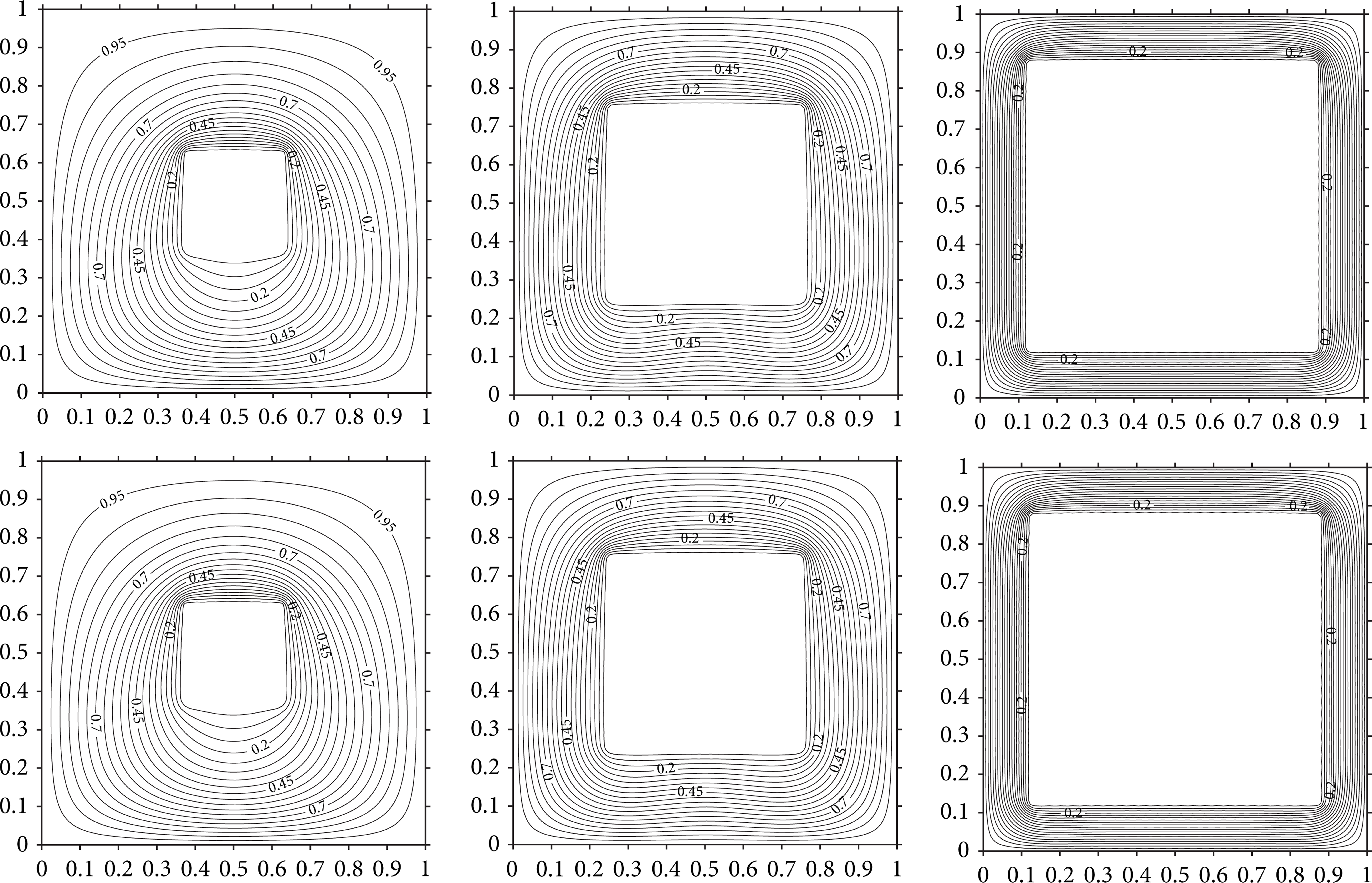
Isothermal, top: S = 0.1, bottom: S = 1; left to right: W = 0.25, 0.5, 0.75, with Ra = 100, N = 0.5, Le = 2, R d = 1, and ε = 0.

Isoconcentration, top: S = 0.1, bottom: S = 1; left to right: W = 0.25, 0.5, 0.75, with Ra = 100, N = 0.5, Le = 2, R d = 1, and ε = 0.
5. Conclusion
The problem of heat and mass transfer in a square annulus is investigated with emphasis on Dufour and Soret effects. Finite element method is employed to solve the governing partial differential equations with the help of a three-noded element. It is observed that the local Nusselt number is highest at bottom wall for low values of Dufour parameter; however, the top wall Nusselt number is the highest for higher values of Dufour parameter. It is interesting to note that the two-peak values of Nusselt number at bottom wall vanished and resulted in maximum heat transfer at center of wall when Dufour parameter is increased. It is found that the Sherwood number fluctuates along the bottom wall as the width ratio increases.
Footnotes
Nomenclature
Conflict of Interests
The authors declare that there is no conflict of interests regarding the publication of this paper.
Acknowledgment
The authors would like to thank University of Malaya for providing the Research University Grant RP006C-13AET.