




Abstract
Wireless sensor networks (WSNs) consist of a number of autonomous sensor nodes which have limited battery power and computation capabilities with sensing of various physical and environmental conditions. In recent days, WSNs adequately need effective mechanisms for data forwarding to enhance the energy efficiency in networks. In WSNs, the optimization of energy consumption is a crucial issue for real-time application. Network topology of WSNs also is changed dynamically by anonymous nodes. Routing protocols play a major role in WSNs for maintaining the routes and for ensuring reliable communication. In this paper, on demand acquisitions of neighborhood information are used to find the optimal routing paths that reduce the message exchange overhead. It optimizes the number of hops for packet forwarding to the sink node which gives a better solution for energy consumption and delay. The proposed protocol combines the on demand multihop information based multipath routing (OMLRP) and the gradient-based network for achieving the optimal path which reduces energy consumption of sensor nodes. The proposed routing protocol provides the least deadline miss ratio which is most suitable to real-time data delivery. Simulation results show that the proposed routing protocol has achieved good performance with respect to the reduction in energy efficiency and deadline miss ratio.
1. Introduction
WSNs [1] are consisting of sensor nodes that are connected through wireless media. Multihop transmission is occurring to route the data from the source to destination. Large number of sensor nodes can deploy in environment that assemble and configure themselves. A tiny sensor device has the capability of sensing, computation, and communication into other devices. WSNs are used to monitor and measure the environmental conditions like temperature, humidity, sound, pollution levels, pressure, and so forth. The energy efficiency is a challenging [2] issue in multimedia communication due to the resource constraints, efficient channel access, and low transmission delay. The energy-efficient routing is a key research area in wireless sensor networks for dynamic topology nature property. Therefore we need to design the effective routing protocols. In recent days, various energy-efficient routing protocols have been proposed for WSNs [3, 4]. The energy-efficient routing protocols are based on the node uniformity which is considered to be deployed uniformly in the field. The design of routing protocols is based on the network topology which might change dynamically. Data delivery ratio is a key challenge in WSNs. Data can be delivered effectively if the energy efficiency is achieved through effective communication among all nodes. It also provides optimal communication in both point-to-point and broadcast networks in terms of energy usage. Topology information of the networks is key challenge for energy-efficient routing. It provides position information [5] in order to relay the received packets to certain regions in the networks. Nodes can enable us to learn the location of neighboring nodes to find optimal path from a source to destination for minimum energy consumption. Reliable routing has achieved the load-balancing and has satisfied certain QoS metrics [6] including the jitter, delay, latency, and bandwidth. Fault tolerance routing protocols are designed based on the reliable routing structure with QoS metrics. Gradient-based routing (GBR) protocols are suitable for the WSNs in which a node maintains its gradient and represents the direction toward a neighboring node to reach a destination. Existing protocols [7] allow a sensor node to construct its gradient using the cumulative traffic load of a path for load-balancing. However, they have a critical drawback that a sensor node cannot efficiently avoid using the path with the most overloaded node. The natural information gradient can be used to design efficient information driven routing protocols for WSNs.
Pantonia and Brandão [8] proposed gradient-based routing scheme for street lighting wireless sensor networks using a confirmation mechanism for different neighbors. It is based on the longest distance and has a satisfactory package delivery rate in severe conditions which has been specified to the application that agrees with point-to-point message confirmation.
Yu et al. [9] proposed energy aware temporarily ordered routing algorithm (E-TORA). It is the extension of TORA that focuses on minimizing the energy consumption of the nodes. The classic TORA made the least cost hops for selecting the routing paths in the networks. In this, same node repeatedly involved in routing phase and also the repeated nodes are run out of its energy that makes routing over head and degrade the routing performance. This mechanism used shorter path approach which is not considering their power that decreases entire network lifetime. E-TORA solved this problem that takes into account power of each node. It also avoids nodes with low energy for participating routing process. In this, node's energy consumption is balanced in order to avoid the same nodes drawn from their energy earlier that are used frequently for routing. E-TORA takes into account energy left on the nodes in order to use nodes with more power that increases the lifetime of the network.
Jung et al. [10] proposed an on demand multihop look ahead based real-time routing protocol that offered on demand acquisition of neighborhood information around the data forwarding paths. It allows lighter message exchange overhead. In order to consume battery power evenly, OMLRP provides load-balancing within the elliptical region. When a source and forwarding node forward the data to a destination, the source and the forwarding node select the optimal paths that satisfy a desired speed.
Two-hop velocity based routing (THVR) [11] is based on two-hop neighborhood information based geographic routing protocol to enhance the quality of a real-time packet delivery for WSNs. It used mapping packet deadline approach and the routing decision is made based on the two-hop velocity integrated with the energy balancing mechanism. An energy-efficient packet drop control is incorporated when keeping less packet deadline miss ratio. THVR might lead to heavy message exchange overhead and high computing complexity. THVR does not optimize the number of hops needed to relay the packet to the destination that consumes more energy and delays than OMLRP.
Quang and Kim [12] proposed a two-hop neighbor information based gradient routing (THVRG) for enhancing energy efficiency and real-time performance in WSNs. The routing decision was considered based on the two-hop information. They introduced control scheme that reduces computational complexity and enhances energy efficiency of the sensor nodes. This method could be implemented on IEEE802.15.4 without major changes. They also suggested multichannel access mechanisms which can be combined with the gradient routing to enhance the real-time performance meantime.
Gao and Wang [13] proposed the algorithm of wireless sensor network routing based on the gradient and the residual energy ant algorithm. The ant algorithm integrates link quality into pheromone based on the gradient to enhance the real-time performance, whereas Yoo et al. [14] introduced a new gradient-based routing protocol for load-balancing with a new gradient method to prolong network lifetime in which the least loaded path is selected for data forwarding which avoids the overloaded sensor node.
Ren et al. [15] introduced the packet attribute to identify different packets generated by heterogeneous networks. They also proposed an attribute aware data aggregation (ADA) scheme for making the data aggregation more efficient. They used a packet driven timing algorithm and a dynamic routing protocol for energy efficiency. In the attribute aware data aggregation scheme, packets are treated as ants for finding paths and attracted the packets with the same attribute to gather them. They combined adaptive timing control algorithm with attribute aware data aggregation scheme which make the packets with the same attribute spatially convergent for improving the effective data aggregation. The ADA scheme provides various properties including scalability and reliable routing with respect to the network size. The following data aggregation schemes [16–21] have been proposed to save the limited energy on sensor nodes in WSNs.
Mittal et al. [22] have proposed the improved LEACH (low-energy adaptive clustering hierarchy) communication protocol which is an extension of the classic LEACH because classical LEACH does not dissipate energy evenly throughout a network. In this, cluster based mechanism is used for minimizing energy dissipation in sensor networks. Improved LEACH is performed better than classical clustering algorithms by using adaptive clustering mechanism and rotating cluster heads for load-balancing.
TEEN (threshold sensitive energy efficient sensor network protocol) [23] utilized multilevel clustering mechanism to save more energy. Cluster head broadcast three parameters including attribute, HT, and ST to its members when changing the cell. Nodes in the networks are sensed information continuous from environment. If the information value is beyond HT or the varied range of characteristic value is beyond ST, the node will send sensed information to cluster head that reduces network traffic and increases networks lifetime.
PEGASIS (power-efficient gathering in sensor information systems) [24] used greedy algorithm to form data chain for gathering data. Each node aggregates the data from downstream node and sends it to upstream node along the chain. The distance between nodes on chain is shorter than from member nodes to cluster head. PEGASIS save much energy because they reduce the routing overhead for dynamic formation of cluster. In this approach, distance between a pair of sensors is too long. In this condition, this pair of sensors will consume more energy than other sensors in transmitting data phase.
2. Materials and Methods
In recent days researchers have proposed various routing schemes and challenges [25, 26] for enhancing real-time properties of WSNs to provide reliable transmission. In that one-hop information is used to select forwarding nodes. GBR does not recognize the whole network topology of WSNs. In GBR, each node selects the next hop forwarding node, its neighbors, and destination based on its location. The gradient of the cost field is established in GBR in which each node can find a minimum cost path to the destination. The cost metric is the hop count between two nodes. The source node finds the minimum hop count in routing path. The purpose of GBR is to maximize transmitting distance of each hop and to reduce maintenance information and energy consumption. GBR cannot optimize the number of hops that is the main reason of energy expenditure and delay. OMLRP allows a minimum message exchange overhead when affording on demand acquisition of neighborhood information among forwarding paths. In order to achieve optimal reliable routing, OMLRP and GBR are combined in terms of the number of hops and energy efficiency.
2.1. Gradient-Based Network Setup
Gradient-based network setup takes the minimum hop count and remaining energy of a node while routing data from source node to the sink. The optimal route is established autonomously; the scheme is composed of three sections.
2.1.1. Gradient Setup
It can optimize the transmission energy and reduce the energy consumption of each node to prolong the network lifetime. In this sink broadcasts a packet which contains a counter set to 1 initially. After receiving a packet, the receiving node sets its height equal to the counter in the packet and increases the counter by 1 and then forwards the packet.
2.1.2. Height Calculation
The sink sets its height to 0. The heights of other nodes are equal to the smallest number of hops to the sink which reduced the routing overhead because it selects the minimum hop to involve the routing.
2.1.3. Data Forwarding Approach
Each node calculates joint parameters for forwarding the packets to sink. A node compares with its joint parameters to neighboring nodes and selects a neighbor to relay its packets to the sink. The semiminor axis of the elliptical region denoted by

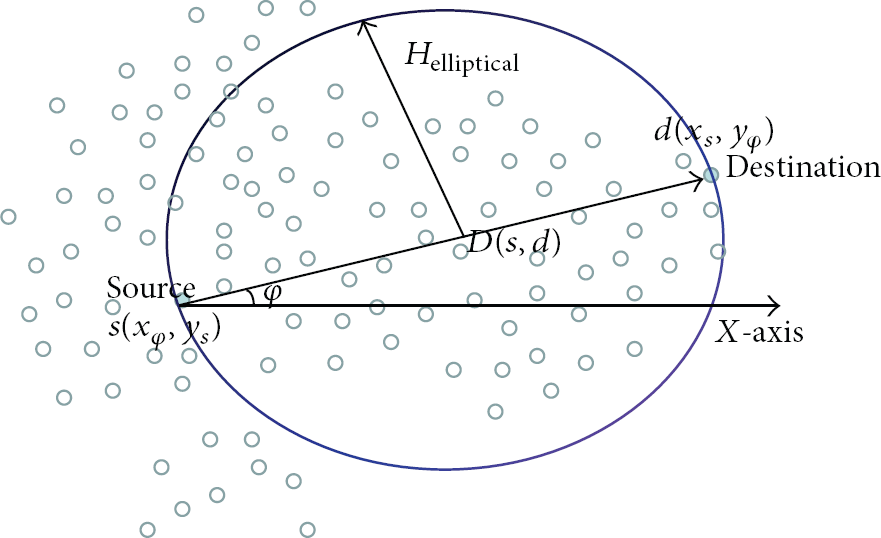
Elliptical region of source and destination.
Acknowledgment mechanism is applied to calculate the delay of the packets. A node will stamp the time to identify the delay of packets of each node when it receives the packet and then compare it with the time when the ACK packet is received. The delay estimation of

2.2. On Demand Multihop Information Based Multipath Routing
OMLRP considered the following assumptions for real-time routing.
Homogeneous sensor nodes are deployed in the network. Global positioning system (GPS) is used by each sensor node to be aware of its location in the field. One of them initiates generating packets that became the source node.
This approach performed multihop lookahead around the paths from the source to destination within an elliptical region. It selects an optimal path among multiple paths within the elliptical region. Figure 2 shows on demand multihop information based multipath routing within elliptical region with

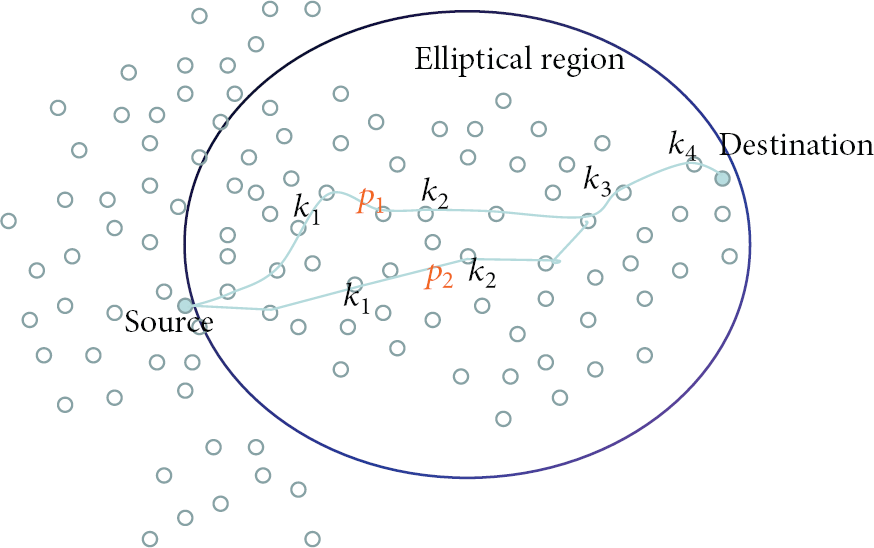
On demand multihop information based multipath routing within elliptical region with
Lookahead Algorithm 1. As a sensor node can distinguish whether it is within the elliptical region determined by the function (*), lookahead algorithm is used to find out each sensor node located within elliptical region.
Sensor node If the If the
Algorithm 1
This algorithm provides an effective way to retain the energy efficiency and scalability. Hybrid metrics such as link quality and latency are used as the criteria for optimal path selection. Lookahead message mechanism is used which includes five tuples
where

It calculates average speed of every path from the source to the destination until
OMLRP maintains the multihop neighborhood information in the linked tables that restricts flooding of the multihop lookahead termination message within the elliptical region. OMLRP also calculates multihop transmission speed and maintains the location and the speed of the information of multihop neighborhoods into linked tables. All the columns in the linked tables having information of multihop neighborhoods would be deleted except columns of optimal path selection. OMLRP provides optimal paths from a source to a destination based on the multihop information. It calculates average speed


3. Results and Discussions
The proposed energy-efficient optimal gradient-based routing protocol (EEOGRP) is evaluated and simulated in network simulator (NS2). In this evaluation, the EEOGRP has been compared with two existing real-time routing protocols in sensor networks such as OMLRP-4hop and THVR. The simulation parameters for WSNs are shown in Table 1.
Simulation parameter.

3.1. Energy Consumption
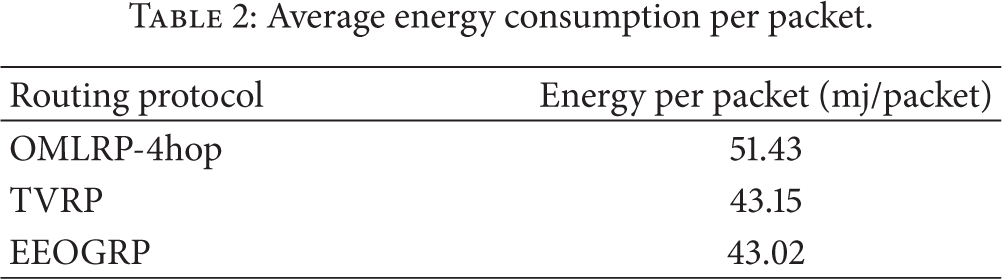
Each node is initialized with initial energy source of 2J to evaluate the energy balancing performance. Figure 3 shows total amount of energy consumption in which EEOGRP consumes less energy. Each node exchanges beacon signals with its neighbors every 50 ms. A source node transmits data at 50 ms. THVR and OMLRP-4hop show higher energy consumption of the all nodes in terms of two-hop lookahead approach, because THVR has heavy message exchange overhead and high computational complexity. The EEOGRP has selected the minimum hop for end-to-end data delivery compared to other two protocols. EEOGRP consumes lower energy compared to others. Table 2 showed average energy consumption per packet for three protocols.
Average energy consumption per packet.
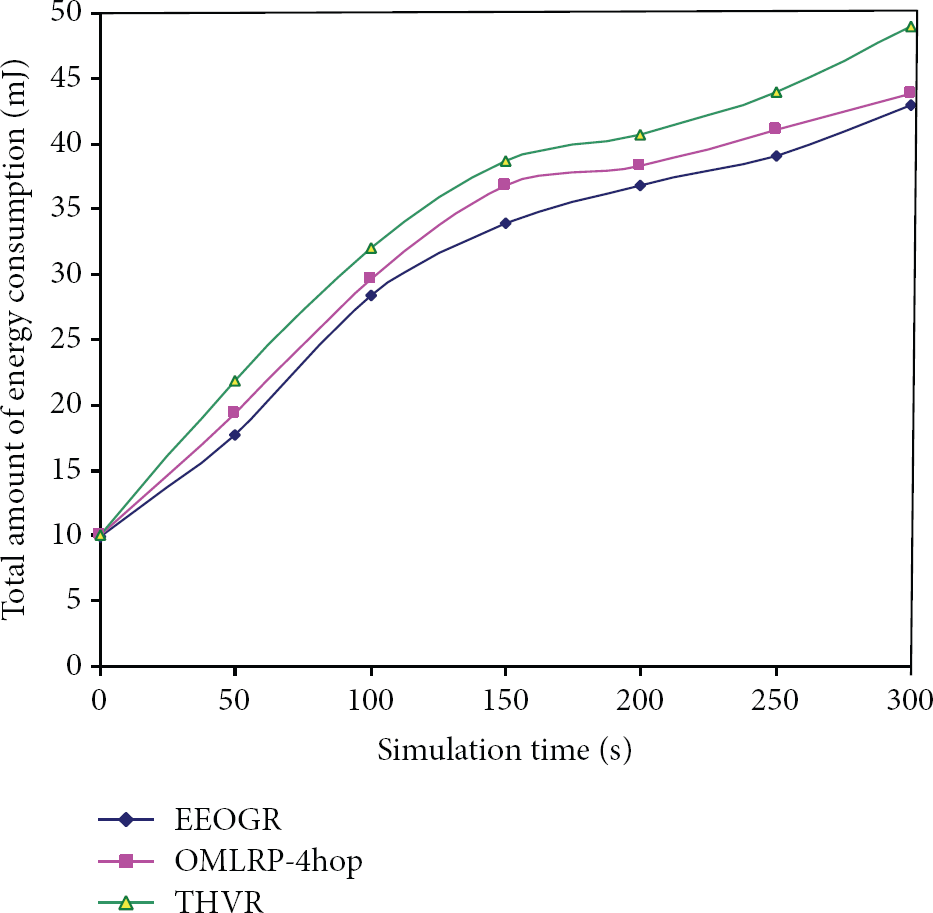
Total amount of energy consumption of sensor networks.
EEOGRP used the lookahead algorithm to make the network energy-efficient. EEOGRP shares large number of paths between a source and a destination. Figure 4 shows optimal path selection and average energy consumption for selecting an optimal path to route data since sensor nodes in the elliptical region between the source and the destination consumed energy evenly.

Average energy consumption of sensor networks.
3.2. Deadline Delivery Success Ratio
Deadline delivery success ratio (DDSR) is the ratio of successful received packets at the sink by the deadline. DDSR is evaluated for three routing algorithms with varied deadlines. When the deadline increases, more packets are received prior to the deadline. EEOGRP optimizes the number of relaying hops in routing phase. Figure 5 shows deadline delivery ratio in case of one source. EEOGRP has the highest DDSR as compared to other two protocols and provides better performance than THVR and OMLRP-4hop because it uses more relaying neighborhood's information. EEOGRP also used the selective forwarding ACK scheme that leads to the reduction of the network traffic to make a reliable routing. Figure 6 showed deadline delivery ratio in case of multiple sources. In this, EEOGRP achieved more than 89% of DDSR because it has forwarded the packets to destination with less message exchange overhead, whereas THVR and OMLRP achieved less DDSR compared to EEOGRP because THVR uses proactive updating ACK scheme that makes the overhead traffic for updating two-hop information and OMLRP-4hop has longer waiting time for retrieving multihop information to route the packets to destination.

Deadline delivery ratio in case of one source.
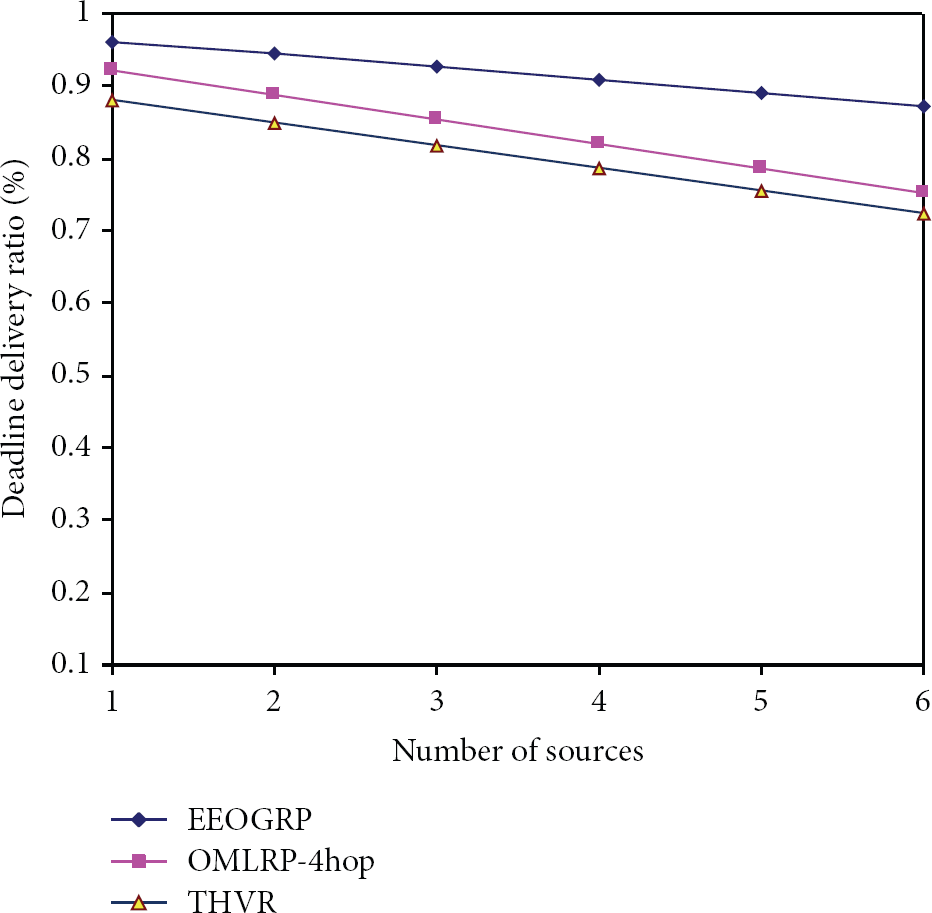
Deadline delivery ratio in case of multiple sources.
4. Conclusion
In this paper, an energy-efficient optimal gradient-based routing protocol is proposed which is in combination with OMLRP and a gradient-based routing. Optimal routing path and reduced energy consumption of senor nodes are achieved through lookahead mechanism within elliptic region. Simulation results have shown that the EEOGRP used gradient-based routing and lookahead algorithm within an elliptic region for achieving better performance with respect to energy efficiency and DDSR compared to other two protocols like OMLRP-4hop and THVR. In addition, the EEOGRP reduced the computational complexity and enhances the energy efficiency of the sensor nodes by selecting optimal path and also provides effective routing that increases network lifetime.
Footnotes
Conflict of Interests
The authors declare that there is no conflict of interests regarding the publication of this paper.