




Abstract
The full-automatic optical-fiber coil winding equipment is a complex electromechanical system which contains signal acquisition, data processing, communications, and motor control. In the complex electromechanical system, the subsystems rely on wired or wireless network technology to complete the real-time perception, coordinate, accurate, and dynamitic control, and information exchange services. The paper points to the full-automatic optical-fiber coil winding equipment with the characteristics of cyber-physical system to research its numerical design. We present a novel compound tension control system based on the experimental platform dSPACE to achieve semiphysical simulation of compound tension control system and examine the functions of control system.
1. Introduction
A gyroscope is an inertial instrument used to detect rotational angular velocity in inertial space and it is based on the light interference fringes of the Sagnac effect [1]. Optical-fiber coil is an important part of fiber-optic gyroscopes (FOG) and has great influence on the accuracy of FOG. Research on high-performance fully automatic optical-fiber coil winding equipment will promote the manufacture of FOG and improve production efficiency. The fully automatic optical-fiber coil winding equipment is a complex electromechanical system which contains signal acquisition, data processing, communications, and motor control. There are some uncertainty and risk in the manufacturing process, which lead to an increase in the development cycle and development cost. Therefore, it is especially important to create a design that increases the manufacturing efficiency of the complex electromechanical product, reduces development cost, and shortens the development cycle.
At present, the design and development of a complex electromechanical system need computers as auxiliary tools to support the entire process from the initial system requirements to the final system test [2]. In the process of digital design, system modeling and simulation analysis provide key technical support for the functional description and design of the system. By using a computer, simulation tools can describe the investigated subject as a mathematical model and establish the logical relationship; they also can solve and analyze the models and relationships to verify the correctness of the algorithm and model [3–5]. Universal simulation software can simulate accurately, but it focuses on a single area of engineering; however, since the model and integral algorithm are more complex, universal simulation software is not the right simulation software for real-time analysis. Under the conditions of the simplified controlled object and a given simulation accuracy, the simulation time can increase, but the controlled system model and control logical model are too complicated because of the limits in the procedural modeling method. So Matlab/Simulink is used for the development of a general electromechanical system with relatively simple structure. As technology developed, multifield coupling became a notable feature of the complex electromechanical system [6]. The development of a complex electromechanical system involves cross-disciplinary knowledge spanning many fields, so the simulation tool that focuses on single-domain simulation meets the overall design needs of a complex electromechanical system. The modeling and simulation technologies of a complex electromechanical system move in the direction of multidomain and unified modeling [7–9].
The paper discusses the digital design of fully automatic optical-fiber coil winding equipment used for the cyber-physical system and focuses on tension control around the digital modeling and semiphysical simulation technology.
In the process of fiber coil winding, winding tension is an extremely important control parameter. FOG mainly relies on fiber coil to acquire angular rate information. Additional stress will produce harmful modulation to the transferring wave, which will reduce the measurement accuracy of FOG [10]. For tension control, we study how to adjust the tightness of fiber winding by exerting tension on the winding fiber. The tension control of the winding fiber coil should consider the following aspects.
Analyze the mechanical and physical properties of the fiber and select appropriate tension range via analyzing mechanical and physical properties of optical-fiber.
Design the method of control tension and actuator.
Consider the precision of tension control.
2. The Structure of Complex Electromechanical System Based on CPS
CPS is the new trend in the technique and application of complex electromechanical systems. CPS compromises computation, communication, and control to achieve close integration of computing resources and physical resources. The basic modules of CPS consist of sensor, actuator, and decision-making control unit. The basic modules and feedback loop control mechanism [11] constitute the basic functions in the logic unit of CPS (shown in Figure 1). CPS is the closed-loop system running at different time and space; its perception, decision-making, and control execution subsystem are mostly not in the same position. The basic function unit which is logically tight coupled relies on the strong computing resources and data transmission networks, which constitute the complete architecture of CPS formed by the decision-making layer, network layer, and physical layer [12, 13], as shown in Figure 2.

The logic diagram of CPS basic functions.

CPS complex electromechanical systems architecture.
The physical layer is the CPS interface with the physical world, reflecting the perception and control calculations. When implementing the fully automatic optical-fiber coil winding equipment, the detection and perception unit-tension sensor, rotary encoder, and the grating ruler constitute the sensor network operating through a wireless/wired communication mode, which jointly detects tension, speed, and fiber position. The perceived information processed by the sensor network is transmitted to the decision control unit by the data transmission network. The decision-making layer achieves a logical coupling of user, perception, and control system through a semantic logic calculation. The mechanical and physical properties parameters of the optic-fiber, sensor, and information processing circuit parameters and mechanical constants can be transmitted to the decision control unit by the data transmission network. The decision control unit estimates appropriate tension and then, while online, revises user rules according to sensor and actuator parameters. The control instructions can be obtained by the computer through a user controlled ruler, which are then transmitted to the execution unit by the data transmission network. The decision control unit and actuator jointly achieve decision-making and control by transmission calculation of the network layer. The actuator controls the fully automatic optical-fiber coil winding equipment and its transmission system according to the control instruction to wind the optic-fiber coil.
3. The Principle of Compound Tension Control System
According to the principle of tension measurement and control, a tension control system can be divided into the indirect tension control system, the direct method tension control system, and the compound tension control system. In this paper, we adopt the compound tension control system; the functional block diagram is shown in Figure 3. This consists of the release fiber unit, take-up fiber unit, tension detection unit, and auxiliary equipment components.
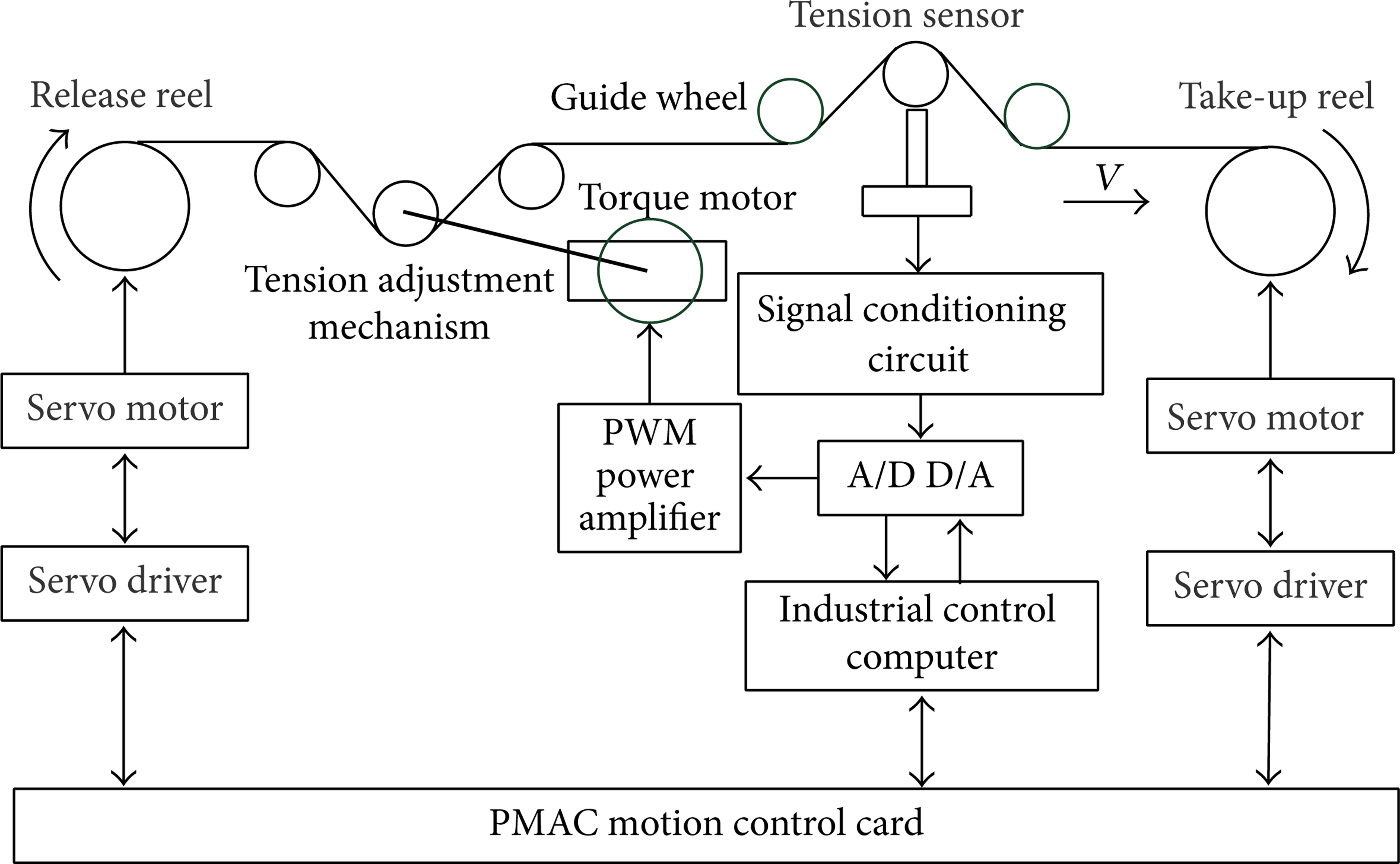
Compound tension control system overall program.
Release fiber unit: the release fiber unit mainly consists of a servo motor, actuator, and release fiber wheel. In the process of winding, the industrial computer controls the PMAC motion control card which drives the servo motor to drive the release fiber wheel that rotates and releases fiber at a certain speed. There are several guide wheels between the release fiber wheel and take-up fiber wheel to control the direction of the fiber for stable winding.
Take-up fiber unit: it rotates for the take-up fiber at a defined speed.
Tension detecting unit: the system uses a tension sensor to detect tension necessary for acquiring the feedback signal. The tension sensor transmits the detected tension signal to the signal modulating circuit, in which the signal is amplified and converted by an AD converter and then transmitted to the main control circuit to achieve closed-loop control.
Tension control unit: it by, using a combined tension control system, includes indirect-control and direct-control.
The indirect-control tension unit induces tension through the linear velocity difference between the release fiber wheel and take-up fiber wheel. When the velocity of the releasing fiber is less than the velocity of the taking-up fiber, winding tension is generated. The greater the linear velocity difference is, the greater the change in the tension is. The drive current is revised dynamically by accurately measuring real-time roll radius and angular velocity with software algorithms to keep constant tension. The indirect-control tension can adjust tension in a wide range.
The direct-control tension unit consists of a controller and actuator, which can accurately adjust tension. The system uses a DC torque motor as the tension actuating part to generate winding tension. The torque motor has a stall state and it joins the dance wheel directly. Because the stall torque is proportional to the armature voltage and because the DC torque motor has a stall feature, the system can adjust the armature voltage to control the output torque and thus control the tension. We will describe the specific working process in detail. When the winding tension is constant, the dance wheel maintains the equilibrium position in the horizontal direction. If the winding tension changes, the dance wheel cannot maintain equilibrium in the horizontal direction. After the tension sensor detects tension variation and converts it into a voltage signal, the voltage signal is digitized by the AD converter and transmitted to the main control circuit. Control instructions are converted into an analog signal by DA converter to control the output regulation current of PWM amplifier, which can change the output torque of the motor. Then the rotating speed of the tension control motor is adjusted by a given control algorithm to recover the equilibrium of the dance wheel and control the tension within a stable range.
4. The System Model of Compound Tension Control
4.1. Servo Motor Model
A permanent magnet synchronous motor is a strong coupling nonlinear system [14]. To better control the system and to achieve the system design requirements, we must extract the mathematical model out of the complex system. In the actual mechanical movement, we must consider the role of various disturbances. The transfer function of the AC servo motor can be obtained by using the method of mechanism modeling analysis [15]. The relationship between the motor and its driven model is shown in

where I
m
is the control current loaded on the permanent magnet synchronous AC servo motor and G
PI
is the current loop gain; K
u
is the motor torque coefficient. ω
r
is angular velocity of the motor. ω
n
is the natural oscillation angular frequency and ω
n
= K
t
K
u
/JL
a
. ξ is the damping ratio,
As long as the servo motor works within the rated load, the load torque does not affect its output speed. When modeling in Matlab, the effect of the load torque, T L , can be ignored. In addition, the value of the current loop gain, G PI , is much greater and the motor output is basically proportional to the input current. K PI can be also simplified. Finally, the AC servo motor transfer function is shown in

where K m is the gain coefficient of the motor; T L is the mechanical time constant of the motor; T s is the electrical time constant of the motor.
4.2. DC Torque Motor Model
In the compound tension control system, the dance wheel and torque motor are connected together with a rigid straight rod. Using this torque motor and using mechanism modeling analysis, the mathematical model was obtained in the stall state (diagram shown in Figure 4).

DC torque motor mathematical model diagram in blocking state.
The open-loop transfer function of DC torque motor [16] is given in

where K L is the correlation coefficient between the motor torque and motor armature angular velocity (N·m·s/rad); K M is the electromagnetic torque coefficient (N·m/A); J is the total moment of inertia acting on the motor shaft (g·cm·s2); L is the total equivalent inductance in the motor armature circuit (H); R is the total resistance in the motor armature circuit (Ω); B is the viscous damping ratio in the mechanical system; K e is the EMF coefficient (N·m/A).
4.3. Sensor Model
The tension sensor is a linear sensor, which transforms tension change into a voltage value. The mathematical model of the transfer function is given by

The two quantities are proportional.
4.4. The Compound Tension Control System Model Diagram
The compound tension control system includes indirect-control and direct-control. The system model is shown in Figure 5. The indirect-control tension unit induces tension through the linear velocity difference between the release fiber wheel and take-up fiber wheel. This will adjust tension over a wide range. The system can calculate the real-time speed of the release fiber motor and take-up fiber motor by counting the pulse number of the optical encoders. The real-time speed is fed back to the PID controller by a speed loop. This achieves a consistent instruction speed with the real-time speed through the PID regulation. The tension sensor detects tension variation and converts it into a voltage signal; the voltage signal is digitized by the AD converter and then transmitted to the main control circuit. Then the rotating speed of tension control motor is adjusted by a fuzzy control algorithm to adjust tension over a wide range. The direct-control tension unit consists of a controller and actuator; the system uses a DC torque motor as a tension actuator to generate winding tension. Because the stall torque is proportional to the armature voltage and the DC torque motor has a stall feature, while the torque motor works in a stall state, the system can adjust armature voltage to control output torque and thus accurately control tension.
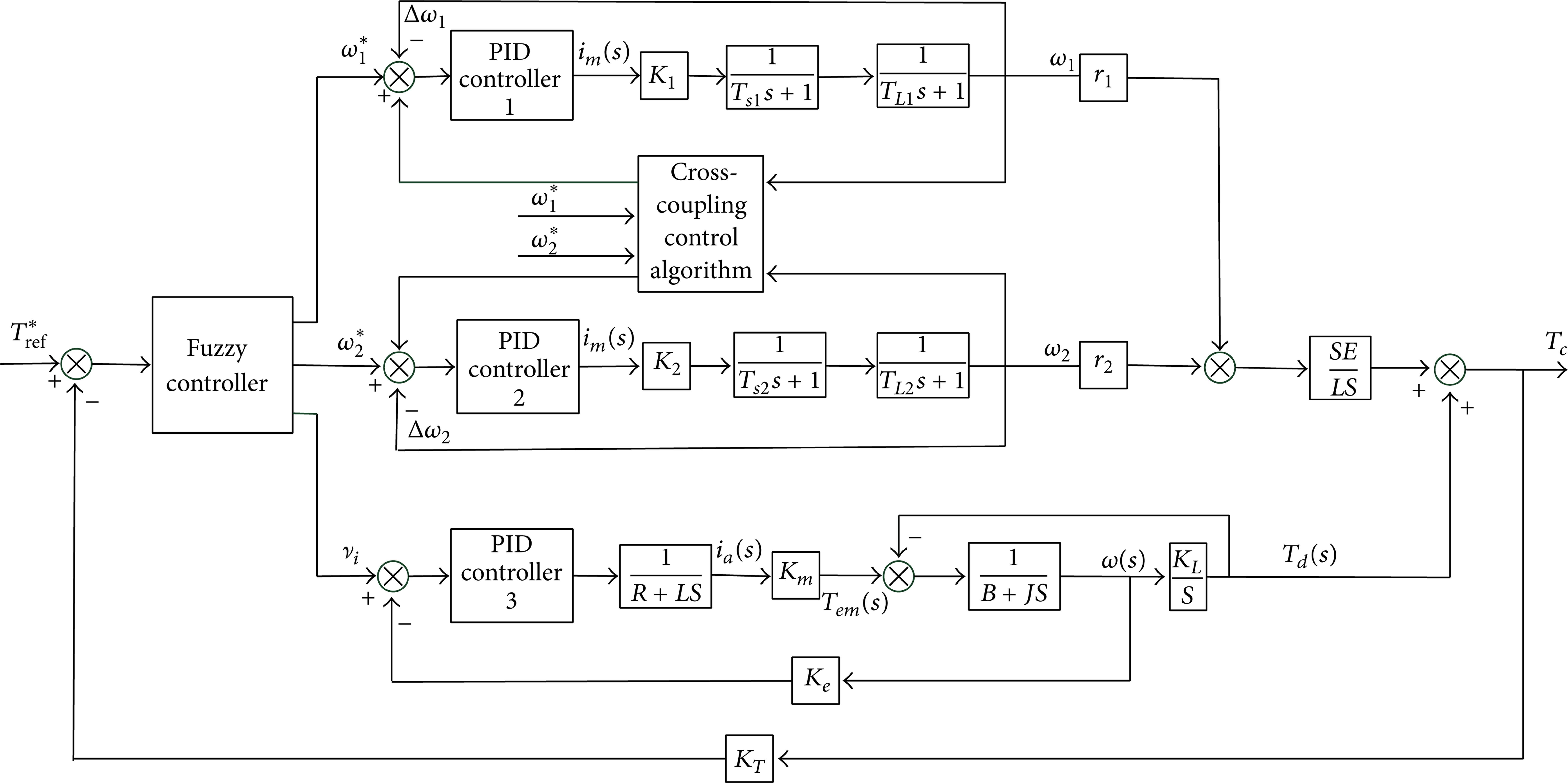
Compound tension control system model diagram.
The cross-coupling control algorithm [17] compares the speed signal of the take-up fiber motor with the speed signal of the release fiber motor to obtain difference values as feedback signals. These feedback signals are, respectively, introduced into the take-up fiber motor and the release fiber motor to adjust motor speed. This can achieve high precision-synchronization control between the take-up fiber motor and the release fiber motor.
5. The Design of Fuzzy Controller
In Figure 5 (model diagram), the compound tension control system has a multilayer control at different sampling periods. The secondary loop uses PID to control the speed of the release-fiber motor, the take-up fiber motor, and torque motor. Due to its quick response, the secondary loop can restrain burst interference. In the main loop, the secondary loop and the main controlled object (tension) as a generalized object are controlled by a fuzzy algorithm, which can ensure dynamic tracking performance and robustness of the system. The fuzzy control diagram of the compound tension is shown in Figure 6.

Compound tension fuzzy control diagram.
The compound tension control system is a multi-input, multioutput control system [18]. Fuzzy controller input signals include tension error marked as e and its change rate marked as ec. Output signals include instruction rotation speed of the take-up fiber motor marked as ω1*, instruction rotation speed of the release fiber motor marked as ω2*, and control voltage of the DC torque motor marked as ν i . Assuming that the tension error is within (± 10) g, the discourse domain of tension error is [− 10, 10], the discourse domain of the change rate is [− 1, 1], the language variables for e and ec are [NB, NM, NS, ZERO, PS, PM, PB], which are represented, respectively, by {Negative Big, Negative Middle, Negative Small, Zero, Positive Small, Positive Middle, Positive Big}. The discourse domain of ω1* and ω2* is [− 6, 6], the discourse domain of ν i is [− 4, 4], the language variables for ω1*, ω2*, and ν i are [NB, NS, ZERO, PS, PB], which are represented, respectively, by {Negative Big, Negative Small, Zero, Positive Small, Positive Big}, and the membership functions of e and ec are Gaussian. Fuzzy control rules are shown in Table 1.
Fuzzy control rules.

6. The Semiphysical Simulation of Compound Tension Control System
6.1. Semiphysical Simulation Platforms
The connection between the compound tension control system simulation model and the actual physical system hardware forms a semiphysical simulation system, which makes it closer to the actual object for debugging and real-time testing. DSPACE was developed by the German dSPACE company; it is a set of development equipment and test control systems based on Matlab/Simulink. It implements a completely seamless connection with Matlab/Simulink, which can be very helpful in completing the design, testing, and implementation of the control algorithm [19].
In this design, we use the DS1005PPC dSPACE controller board as the core, with DS1005 standard components [20, 21], and the expansion of the external circuit includes an isolation circuit, a signal processing circuit, and a driver circuit. These components make up the tension control system semiphysical simulation platform. The structure diagram is shown in Figure 7.

Compound tension control system block diagram of semiphysical simulation based on dSPACE.
The signal of the semiphysical simulation is transmitted by the DS1005 standard component implementation of the real-time simulation model. Within the component, there is a DS3002 rotary encoder interface board, which can bring the encoder signal of the servo motor directly into the DS1005PPC and complete the motor speed detection. The analog output voltage signal controls the output torque of the DC motors. Through the DS2102DA output board, using the DS2001AD acquisition board, we can obtain real-time acquisition multiple analog signals, such as the tension sensor output signal, grating position signal, motor voltage, and current analogue. The CP4002 multi I/O board can control the switch turn-on and turn-off.
It is impossible for the dSPACE hardware interface to transmit data between the physical system and compound tension control system simulation model. It needs the support of RTI [22] to realize semiphysical simulation and data exchange between the tension control system simulation model and physical system. When designing the software, we need to replace all the input/output interface modules in the Matlab/Simulink simulation with the RTI modules of dSPACE and carry out some simple operations such as transformation of units, then input, or output an actual physical quantity.
6.2. The Steps of Experimental Development
In the hardware experimental platform, the processes of compound tension control system simulation development based on dSPACE are as follows.
Use the input/output interface (I/O) access to generate experimental models. Reserve those that need to be downloaded to the dSPACE module in Matlab/Simulink, select the I/O module that controls real-time from the RTI library, replace the original logical connection by a hardware interface, and configure the I/O parameters.
Use tools provided by RTW and dSPACE to automatically generate code and download the code. Because of the Matlab and dSPACE seamless connection, we can therefore complete the real-time C code generation, compile, and link and then download the model for the target board from which DS1005PPC can run the program with only a simple operation.
Regarding dSPACE comprehensive experiments and debugging, we can use the control desk software of dSPACE to acquire the real-time data, change parameters, and implement real-time control.
6.3. Simulation
During a semiphysical simulation, the simulation model of the compound tension control system in the form of C code is downloaded to the dSPACE processor, then the detection signal and the control instruction in the physical system is input to dSPACE by DS3002, DS2102DA, DS2001AD, and CP4002 to achieve the semiphysical simulation of the compound tension control system, and we can examine the functions of control system.
The parameters are set as follows. The mechanical time constant of the release motor TL1 = 12.25 ms and the electrical time constant of the release motor Ts1 = 1.48 ms. The mechanical time constant of the take-up motor TL2 = 11.95 ms. The electrical time constant of the take-up motor Ts2 = 1.25 ms. The parameters about DC torque motor, which are the correlation coefficient between motor torque and motor armature angular (K L = 0.15 N·m·s/rad), the electromagnetic torque coefficient (K M = 0.1 N·m/A), the total moment of inertia acting on the motor shaft (J = 44 g·cm·s2), the total equivalent inductance in motor armature circuit (L = 0.00612 H), the total resistance in motor armature circuit (R = 7.5 Ω), and the EMF coefficient (K e = 0.014 N·m/A). The speed of motors winding is set to 3 rad/s, acceleration time and deceleration time of the motors are 200 ms, arraying motor row is 0.125 mm, the sampling period of tension data is 5 ms, the diameter of fiber optic ring is within the range 40∼90 mm, and the outer diameter of the optical fiber is 125 um. And with the photoelectric encoder with 11 bits, the encoder signal is multiplied by 4 under the control of PMAC.
(1) Cross-Coupled Motor Synchronous Simulation. We performed the semiphysical simulation experiment, which is based on the cross-coupled synchronous control algorithm for the take-up servo motor and release servo motor. The selected servo motor photoelectric encoder has a resolution of 13 bits, as seen in Figure 8. Also seen are the acceleration of the motor's three point mutations (location of small circles) outside and the speed errors within 5 cts (counts are the number of pulses). The follow accuracy is 0.061% (5 cts/213 cts × 100% = 0.061%). While changing motor speed, it is possible for the cross-coupled synchronous control strategy for a dual-motor to be followed by another motor with good performance and good stability.
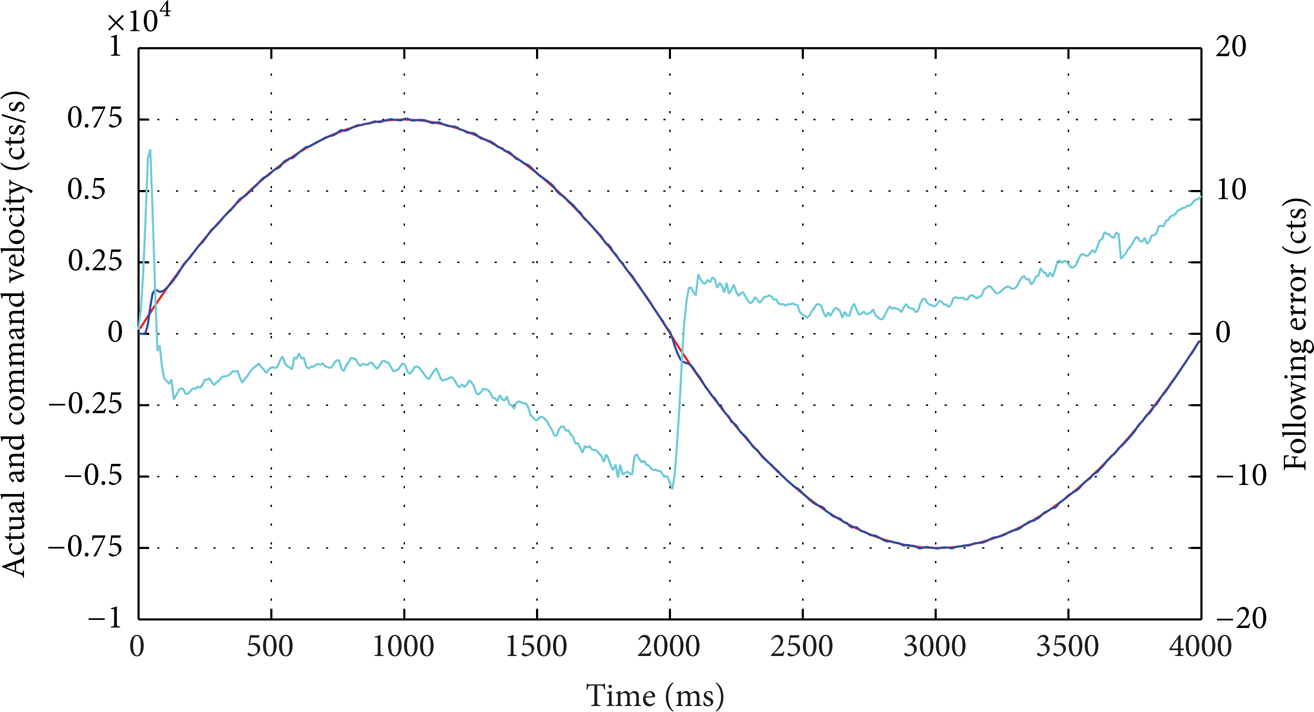
The rotational speed difference between take-up motor and release motor.
(2) Compound Tension Control Simulation. While controlling tension with the compound semiphysical simulation experiment and using an SCX-type tension sensor, we have the following: the measuring range: 0 to 300 g; the sensor amplifier output voltage: 0 to 5 V; sensitivity: 1.0; and the linear precision: 0.05% FS. The initial value of the tension experiment is 30 g; the compound effect of the tension control as it varies with time is shown in Figure 9. We can conclude that the SCX-type tension sensor output voltage is generally stable. Fluctuations remain at 0.5 V (corresponding to the tension value of 30 g). Tension values fluctuate in the range of 24∼36 g, and the error is ± 6 g. The static difference ratio and fluctuation ratio of the Compound tension control system are 26.67%. In addition to tension fluctuations caused by the algorithm control, there are other factors that must be considered in precision tension control system during sampling process, such as the drift of the signal amplifier and random error in the AD conversion. We obtain the fluctuations of tension having the signal acquisition amplification and AD conversion by experimental measurements in case of unloaded tension sensor, which are the values within the range ± 4 g. Therefore, we conclude that the static difference ratio and fluctuation ratio of the compound tension control system should be 6.67%. The actual value of the tension variation curve is approaching the tension experiment initial value with small fluctuations and stability.
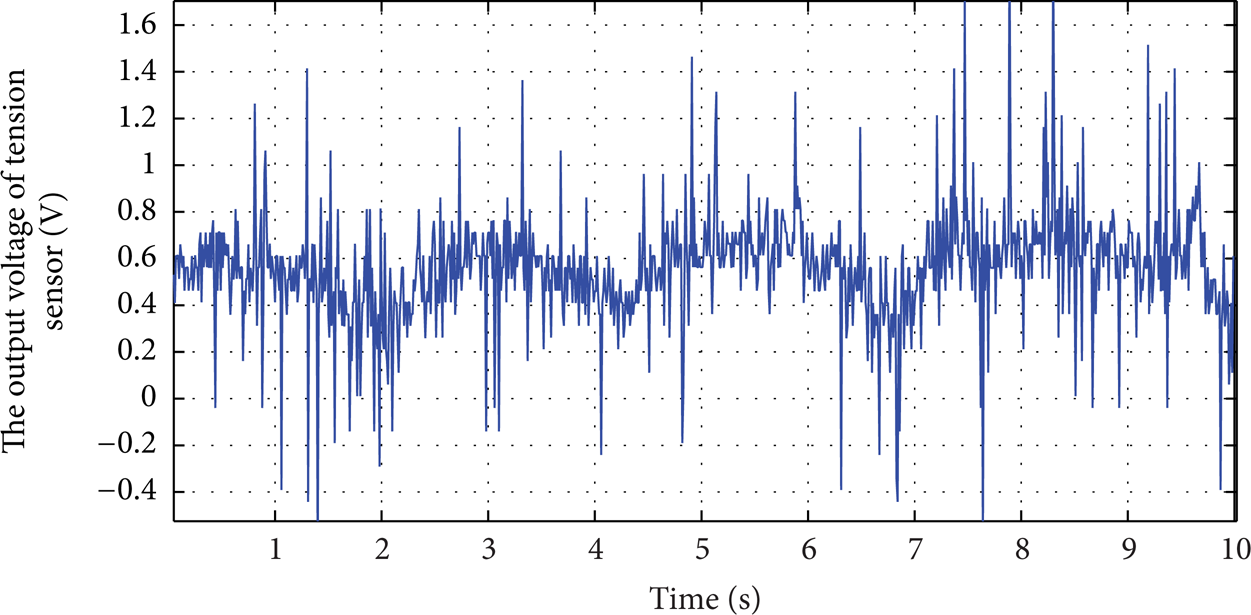
Process of tension control.
7. Conclusion
The paper researches the numerical design of fully automatic optical-fiber coil winding equipment with the characteristics of a cyber-physical system. We propose a compound tension control system overall program, which is based on the principle of speed difference tension generation. The actuator is a DC torque motor to achieve the precise control of the winding tension. It can be verified by the semiphysical simulation that the digital design method of the complex electromechanical system based on CPS is feasible and the parameters of the compound tension control model are correct. It can better reflect the actual working conditions of the production line. The results showed that the compound tension control system works well and can provide theoretical references for other complex electromechanical systems in the process of design and debugging.
Conflict of Interests
The authors declare that there is no conflict of interests regarding the publication of this paper.
Footnotes
Acknowledgments
The project is supported by the National Natural Science Foundation of china (Grant no. 51375462) and the Specialized Research Fund for the Doctoral Program of Higher Education (Grant no. 20121420110003).