




Abstract
Pedestrians are some of the worst victims, as one of the weaker groups in road traffic accidents, but, at the same time, their unsafe behaviors are also an important factor in traffic accidents. This paper builds a pedestrian crossing hazard automatic-balance model and waiting-time threshold model by analyzing the process by which pedestrians cross the street. Then, the reasons for pedestrians’ unsafe behavior when crossing the street are analyzed by using traffic psychology. Finally, this paper puts forward some measures, based on aspects of pedestrian psychology, to reduce or alleviate pedestrians’ unsafe behaviors.
1. Introduction
According to statistics, accidents related to pedestrians directly make up approximately one-third of the total number of Chinese road traffic accidents. The death toll of pedestrian traffic accidents accounts for 27% of the total death toll from traffic accidents [1]. Most pedestrians in China have a low likelihood of obeying traffic laws, with many breaking the traffic rules when crossing the street every day. In recent years, the “Chinese style of crossing roads” has led to many serious traffic accidents. The growing death toll caused by pedestrians’ unsafe behavior when crossing the street is drawing more and more attention. How the safety of pedestrians when crossing the street can be assured and how casualties can be reduced have become a sensitive and thorny issue for road traffic safety experts.
The cause of the traffic accident is often complicated but ultimately comes down the human unsafe behavior and the object unsafe state. Among them, the unsafe behavior of people is the main factor of causing a traffic accident [2, 3]. Generally speaking, unsafe behavior refers to that which causes or may cause an accident. In the field of traffic research, pedestrians’ unsafe behavior means behavior that violates road traffic safety laws and regulations. Pedestrians’ unsafe behavior is one of the main reasons for pedestrian traffic accidents. In this paper, Changchun is selected as the study object. According to the statistics from the traffic management department of Jilin Province, pedestrian accidents are a rather serious issue, as shown in Figure 1.

Pedestrian-related accident investigations in Changchun city in 2012.
Although most traffic accidents are caused by human factors, the cause is generally only recorded as human error in public information. There is rarely any systematic analysis on the fundamental causes of this human error [4–6]. In the field of road traffic safety, scholars have recently conducted specific research on the relationship between pedestrian traffic behavior and age and gender, both at home (in China) and abroad [7–9]. Various pedestrian crossing simulation models and pedestrian behavior models have been established [10–12]. However, the amount of psychological research on pedestrian behavior and waiting times is relatively small [13–15]. Pedestrian behavior and safety studies represent a relatively new research field around the world, making the research task a very difficult one. This paper analyzes the causes of unsafe behavior, based on pedestrian crossing psychology, and uses principles of psychology, from the perspective of pedestrians, to improve pedestrian safety when crossing the street.
This paper first analyzes the process of pedestrians crossing the street and then introduces the unsafe behaviors and pedestrian crossing automatic-balance model and the risk of pedestrian crossing waiting-time threshold model and then finally combines with case analysis and summarizes the causes of unsafe behavior.
2. Building the Models
2.1. Pedestrian Crossing Process Model
The pedestrian crossing process includes several main stages, which include the pedestrian arriving at the street, being ready to cross, waiting to cross, and actually crossing. This process is shown in Figure 2. Firstly, pedestrians arrive at the waiting area and are ready to cross the street. Then, they look at the surrounding traffic environment, which includes whether there are signal lights, the color of the signal lights, the length of the crosswalk, the number of other pedestrians crossing the street, and vehicles and nonmotorized traffic. If pedestrians have the right of way, they will implement the process of crossing; if not, they will decide whether to wait for a gap or wait until the lights turn green.

The process of pedestrian crossing.
The pedestrian's observation of the road environment is perceptual. Cognitive psychologists hold that three stages (perception-judgment-reaction) make up the human information-processing system [16]. Due to the limitations of pedestrian awareness of outside information, any phase error may cause pedestrians to exhibit unsafe behavior when crossing the street.
2.2. Pedestrians’ Risk Self-Balancing Model
Pedestrians’ unsafe behavior is a kind of false behavior in a trip. The motivation is a kind of demand whereby the pedestrians obtain benefit maximization in the process of travel by violating traffic rules. This demand has a contradiction. On the one hand, pedestrians want to get the maximum benefit in terms of passage time and space. On the other hand, their violation of traffic rules would be subject to legal sanctions and may even lead to accidents.
As is depicted in Wilde's Risk Homeostasis Theory [17], pedestrians’ risk levels when crossing streets can be divided into the alert risk degree, the acceptable risk degree, the perceived risk degree, and the actual risk degree [18]. Pedestrians rely on their own control mechanism to keep a stable balance between these risk degrees. As shown in Figure 3, the limitations on pedestrians’ understanding of road traffic information cause the differences between the perceived risk degree and the actual risk degree.

Automatic risk balancing relationship.
In most cases, the perceived risk degree is within the acceptable risk degree. Namely, pedestrians cross the road only under an acceptable risk degree. If the pedestrians’ acceptable risk level is close to or reaches the alert risk degree, their alertness improves in that moment, and then the perceived risk decreases. On the contrary, if the pedestrians’ awareness of road traffic information is good, then their alertness falls and their acceptable risk degree rises.
At any moment, pedestrians will compare their perceived risk degree with their acceptable risk degree and estimate what their unsafe behavior would cause to happen in different scenarios, so as to decide whether to change their behavior or not. As shown in Figure 4, these two kinds of risk degree (perceived and acceptable) are not the same. How a balance is achieved between the pedestrians’ walking level and their perception level mainly depends on their abilities in terms of sense perception, judgment, decision, and behavior. The pedestrians’ perception of the risk degree fluctuates according to their behavioral variation.
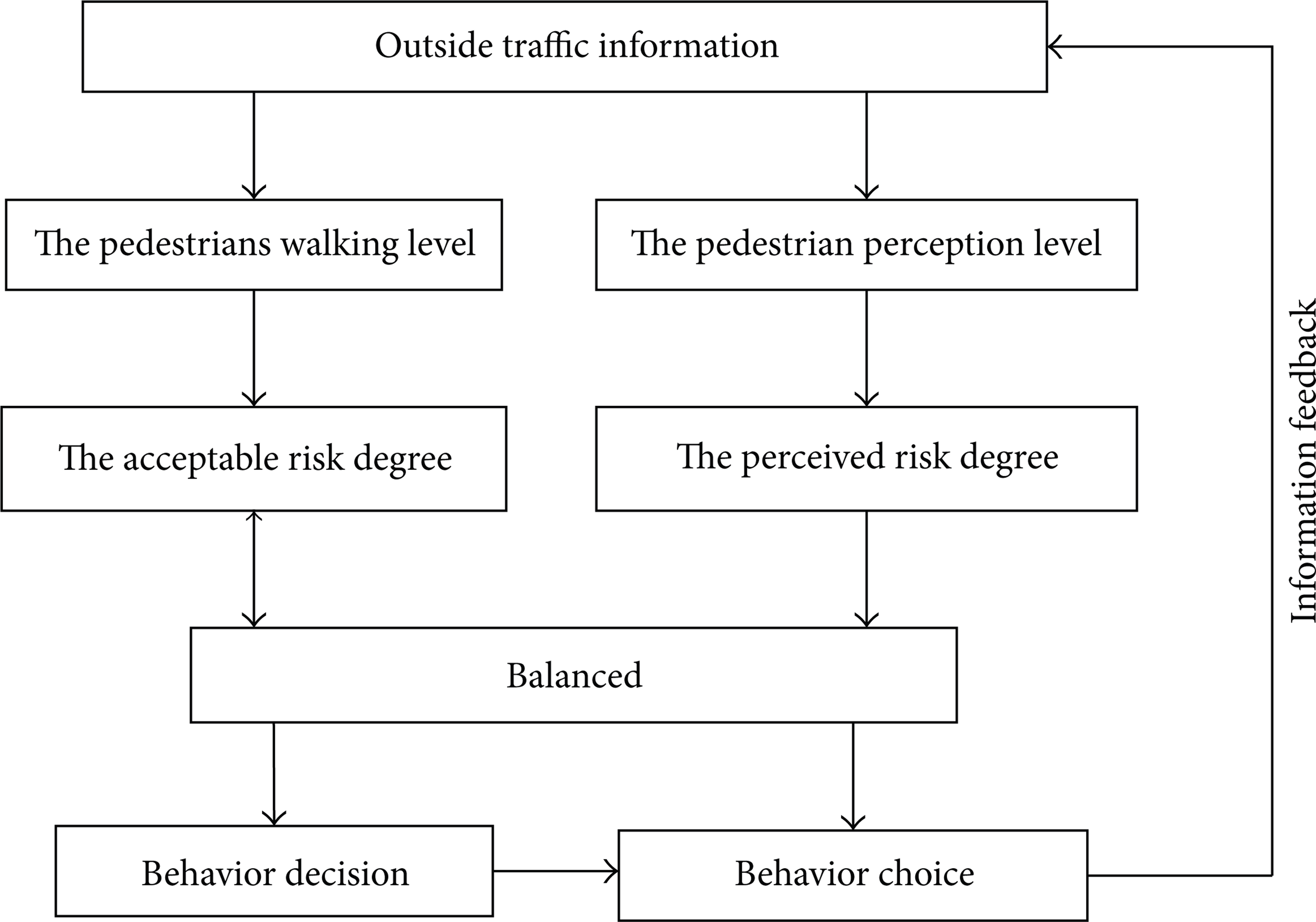
Pedestrians’ risk decision-making process.
The pedestrians’ crossing decision is a self-controlled behavior. When pedestrians conflict with vehicles in the process of crossing the street, they may choose to pass through a traffic gap. Before crossing, they firstly judge the street's risk degree psychologically. The main basis of their judgment includes comfort, safety, convenience, and reliability. Pedestrians choose their own acceptable risk degree when crossing the street. If the risk is beyond their own tolerance range, they will choose to wait.
2.3. Pedestrians’ Waiting-Time Threshold Model When Crossing
French Bergson put forward the concept of space time and psychological time. He called traditional time “space time” or “objective time,” while he referred to psychological time as “subjective time.” He argued that the more the human is into the deep consciousness, the less the space time was used. Only psychological time has significance [19].
In fact, we usually tend to ignore the differences in perceptions of time and space time caused by pedestrians’ ages, trip purposes, and other factors [20, 21]. Our investigation into pedestrians according to different ages and trip purposes carried out in Changchun city shows that there is no significant difference between psychological time and objective time within a certain range; in other words, the psychological time fluctuates around the objective time. However, beyond a certain scope, the gap between the two kinds of time increases significantly, with the psychological time clearly higher than the objective. We selected 90 subjects, including children, adults, and the elderly, and recorded the relationship between psychological waiting time and objective waiting time. The result is shown in Figure 5.

The relationship between objective time and psychological time.
Objective time and psychological time can be related, but the function between them is affected by age, cognitive factors, environment, length of time, personality, and so on. The function is shown in

where t s represents the objective time; t p represents the psychological time; f(α, β, γ) represents the correction factor; and α, β, and γ represent psychological factors. Due to different pedestrians’ travel motivations, their requirements regarding waiting time also differ. According to different purposes of travel, pedestrians’ travel can be divided into four categories: work (school), leisure (entertainment), business (office), going home, and so forth. The time threshold values are shown in Table 1.
The pedestrians’ psychological time threshold values.

Due to different group compositions in different regions, trip purposes and age levels will not be the same, and a unified waiting time threshold value will not objectively reflect the real situation. Therefore, in order to accurately and reliably determine the value of pedestrians’ waiting-time threshold, this paper determines the appropriate threshold value depending on the different sections of the composition ratio of pedestrians [22].
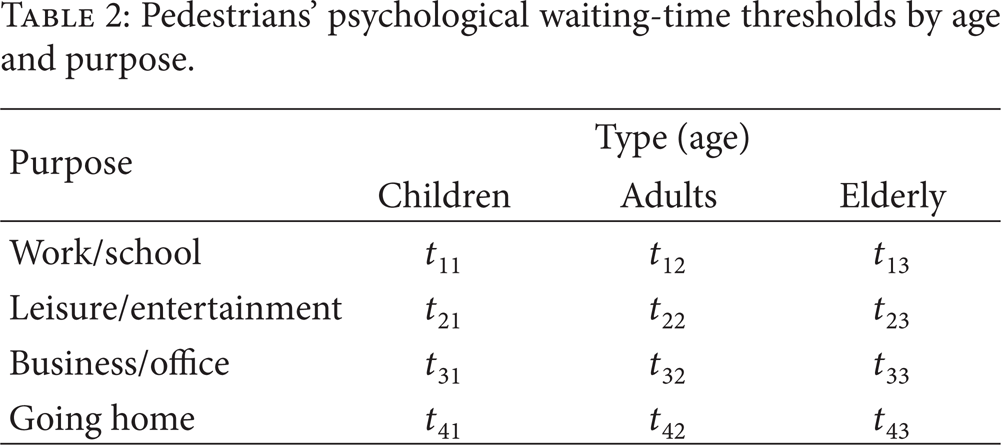
According to a survey of pedestrians in different areas, we determine the share of different types of pedestrians and also survey their crossing threshold values, as shown in Table 2. We then set up a crossing-the-street waiting-time threshold model for different sections of pedestrians. Its function is shown in
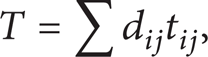
where T represents the pedestrians’ waiting-time threshold; d ij represents the proportion of pedestrians of type (age) i and trip purpose j; and t ij represents the objective time of pedestrians of type i and trip purpose j.
Pedestrians’ psychological waiting-time thresholds by age and purpose.
3. Examples of Verification
This paper summarizes unsafe behaviors based on questionnaires about the mental activity of pedestrians crossing various intersections in Changchun. Thanks to the cooperation of traffic police, we identified some reasons why pedestrians fail to abide by traffic regulations when crossing the street. The survey results are shown in Figure 6. To sum up, pedestrians’ unsafe behavior is mainly caused by two factors. One is that the pedestrians’ perceived risk does not properly reflect the deviation between actual risk and perceived risk. The other is that the pedestrians’ waiting time is greater than the threshold of their psychological waiting time.

Investigation into the causes of pedestrians’ unsafe road-crossing behavior.
And the reasons should be “red light lasts too long,” “cars cannot hurt people,” “even if caught there is no punishment,” “pedestrian crossing too far away,” “everyone else is running across the street during a red light,” and “else.”
3.1. Insufficient Understanding of Traffic Risk
For the sake of personal convenience, some pedestrians are eager to cross streets in an adventurous manner. They think that if they are careful the vehicles will not hurt them. Moreover, some believe that the vehicles’ drivers would not dare to hit a pedestrian. Pedestrians who are psychologically fluky often fail to observe road traffic information, hence, underestimating the risk and making the wrong choice. Meanwhile, because the majority of people have not experienced a traffic accident or witnessed the tragic scenes that can result from them, they subconsciously lack awareness of the hazards.
When many people are waiting for the green light at an intersection at the same time, if one person breaks the rule and crosses during the red phase, other people will often follow, resulting in a lack of punishment due to the number involved. Moreover, many pedestrians believe that accompanying pedestrians will act as a barrier, producing a false sense of security psychologically. Regardless of the traffic police's commands, pedestrians break the law, failing to give way to motor vehicles and crossing regardless.
Every pedestrian wants to gain the maximum benefits from time, space, or economy. When they feel that the risk of unsafe behavior exceeds the level acceptable to them, they will abandon the unsafe behavior.
3.2. Waiting Time beyond the Psychological Threshold of the Pedestrian
With the increasing number of road vehicles, road designers are meeting the needs of vehicles and ignoring those of pedestrians, gradually limiting their options. In our investigation of Changchun city, our survey found that there were no pedestrian crosswalk lines on many roads or that the distance between pedestrian crosswalks was too far beyond pedestrians’ expectations of a reasonable detour distance. At some large intersections, the pedestrian red light time was found to be more than 100 seconds, which is far longer than the pedestrians can withstand psychologically. Long waiting times lead to pedestrians losing patience and crossing roads illegally.
This paper now puts forward some suggestions for improving the intersections of Changchun city. First of all, traffic islands should be put in place to reduce the risk to pedestrians while waiting in the middle of the road. Secondly, the risk to pedestrians of unsafe crossing behavior should be increased using penalties and safety promotion. Finally, the pedestrian-crossing waiting time should be reduced. Using the pedestrian-crossing waiting-time threshold model, the authors calculate that the intersection's pedestrian waiting time should be 72 seconds in the evening rush hour. The calculation process is shown in Tables 3 and 4.
The pedestrians’ waiting-time threshold value at an intersection.

Pedestrian ratio at an intersection crossing (%).

4. Conclusions
Pedestrian traffic accidents are caused mainly by pedestrians’ unsafe behavior. The main point of this paper focuses on two aspects: on the one hand, pedestrians’ unsafe behavior is a result of the pedestrians’ waiting time being beyond their psychological expectations. On the other hand, it is due to differences between the perceived risk degree and the actual risk degree. Through psychological analysis based on pedestrians’ unsafe behavior when crossing the street, this paper finds that pedestrians’ unsafe behavior can be effectively reduced by increasing the perceived risk degree and reducing the waiting time.
To reduce the incidence of unsafe behavior by pedestrians when crossing roads, road managers should focus on people-oriented road systems, carry out an analysis of crossing behavior from the angle of pedestrian psychology, and meet the psychological needs of pedestrians. If this was done, ultimately, the goal of reducing pedestrian road traffic accidents would be reached.
This study suffers from some limitations due to the field setting. The observers could not measure the exact waiting time, and some data collected were categorized dichotomously. In addition, the fact that observations were made in only one location restricts the conclusions that can be drawn from the study. Further research needs to be conducted at a variety of places.
Conflict of Interests
The authors declare that there is no conflict of interests regarding the publication of this paper.