




Abstract
The satisfaction of passengers plays an important role in choosing the transportation mode which directly influences train service quality. Based on passengers’ needs, the evaluation index system of train service quality was built. A field example was applied in Chinese high-speed rail, G33 passenger train. The evaluation value of service quality can be calculated by the hybrid method based on grey correlation analysis (GCA) and fuzzy comprehensive judgment (FCJ). The result indicates that the index system and the integration of GCA and FCJ could effectively evaluate passenger train service quality.
1. Introduction
The train service quality directly influences the satisfaction level of passengers which plays an important role in choosing the transportation mode. Therefore, it is significant to study passengers’ requirements continuously, in order to satisfy them and improve the train service quality. Some problems in Chinese passenger train services are obvious. For example, much equipment is usually different; some establishments are dated; a lot of train attendants have a lack of activeness; and punctuality rates of some passenger trains are low. The passenger train service quality is evaluated based on needs of passengers. In this paper, several proposals are given to improve the service quality.
Many researchers had built evaluation index system to the passenger train service quality. Nathanail [1] presented a framework which can be used to assist railway operators into monitoring and controlling the service quality. This framework was based on the estimation of 22 indicators, grouped under six criteria. Ling and Chong [2] thought the service quality included 5 elements, such as reliability, reactivity, supportability, empathy, and tangibility. They built 34 evaluation indexes which influenced the engineering service quality. Andreassen [3] and Carey [4] surveyed rail passengers’ satisfaction with various features of the rail services, including trains themselves, railway stations, and the rail network in their country. Some index systems were built and the service quality of railway was evaluated as discussed elsewhere [5–8].
Some evaluation models had been applied in the field railway service quality. Grey correlation analysis was used to integrate objectives and provide a relative measure to a particular switching plan associated with a chromosome without any prior knowledge of the system under reconfiguration [9, 10]. AHP or fuzzy-AHP was used to determine correlation factors to estimate the impact on profit of various product issues that must be addressed by a company during the product development process [11, 12].
Many hybrid methods were usually used to evaluate service quality. Based on SERVQUAL and fuzzy TOPSIS [13, 14], a hybrid approach was presented for evaluating service quality of urban transportation systems. Liou et al. [15] proposed a hybrid model, combining a decision making trial and evaluation laboratory (DEMATEL) and analytical network process (ANP) method, which addressed dependent relationships between various criteria to better reflect the real-world situation.
Based on passengers’ needs, a new evaluation index system was built for evaluating train passenger service quality. The hybrid method based on grey correlation analysis (GCA) and fuzzy comprehensive judgment (FCJ) was used to calculate value of service quality. Finally a field example was applied in Chinese high-speed rail, G33 passenger train.
2. Introductions of GCA and FCJ
2.1. GCA
GCA, named grey correlation analysis, is a method which weighs the gray correlation degree between elements based on the similar level or dissimilar level of their development trends. Calculation steps are as follows.
Determine reference sequence which reflects system character and compared sequence which influences system behaviour.
Reference sequence is usually denoted by X0:

Compared sequence is usually denoted by X i :

Calculate the grey correlation coefficient between reference sequence and compared sequence.
Calculate maximum difference value and minimum difference value:

Calculate grey correlation coefficient:
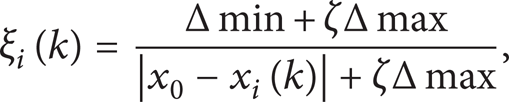
where ζ is resolution coefficient, and it usually is 0.5.
Calculate correlation degree:

Sort correlation degree.
2.2. FCJ
FCJ, named fuzzy comprehensive judgment, is a synthetic evaluation method based on fuzzy mathematics. It can transfer qualitative evaluation into quantitative evaluation based on the membership grade theory of fuzzy mathematics. Calculation steps are as follows.
Build evaluation index set:

Build evaluation grade set:

Calculate membership matrix:
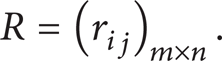
Calculate weight vector of indexes:

Calculate fuzzy comprehensive judgment result.
The result can be obtained by the product of weight vector and membership matrix.
2.3. Integration of GCA and FCJ
Basic steps are as follows.
Build the index set, evaluation grade set, and index weight set.
The index set includes all indexes of the evaluation index system. The evaluation grade set could be built as {Very Good, Good, Common, Not Good, and Very Bad}, and the scores of each rank are 5, 4, 3, 2, and 1. Numbers of grades are alterable in various circumstances. Weights of terminal indexes in index system compose the index weight set.
Determine reference sequence and compared sequence.
The score value sequence of terminal indexes is regarded as reference sequence; score value sequences of five evaluation grades are regarded as five compared sequences.
Calculate correlation coefficient matrixes of each compared sequence and reference sequence.
The membership matrix of FCJ can be obtained by transposition of correlation coefficient matrix. The evaluation result can be calculated.
3. Evaluation Index System of Passenger Train Service Quality
Maslow's hierarchy of needs is a theory in psychology about human motivation, proposed by Abraham Maslow. Maslow used the terms including physiological, safety, and belongingness and love, esteem, and self-actualization needs to describe the pattern in which human motivations generally move through. The paper regards the need of train passengers as two parts, basic need and advanced need. Each part could be divided into material need and spiritual need. The evaluation index system based on passengers’ needs is composed of all indexes as Table 1.
Evaluation index system of passenger train service quality based on passengers’ needs.

4. Application Example
4.1. Determination of Evaluation Object and Index Weight
Passenger train G33 is the object of evaluation. G33 is a high-speed railway train which starts from Beijing South railway station, passes Tianjin South, Dezhou East, Jinan West, Qufu East, Xuzhou East, Nanjing South, Wuxi East, Shanghai Hongqiao, and Jiaxing South, and finally arrives at Hangzhou railway station. The total distance is 1487 km and the runtime is 6 hours 40 minutes from 9:33 to 16:13.
Every index differently affects the whole evaluation system. The expert scoring method is used to determine weights of hierarchy I, hierarchy II, and 35 terminal indexes. Final index weights are obtained by calculation of arithmetic mean values of 10 experts’ scores. All weights are shown in Table 2.
Weight and scores of evaluation indexes.
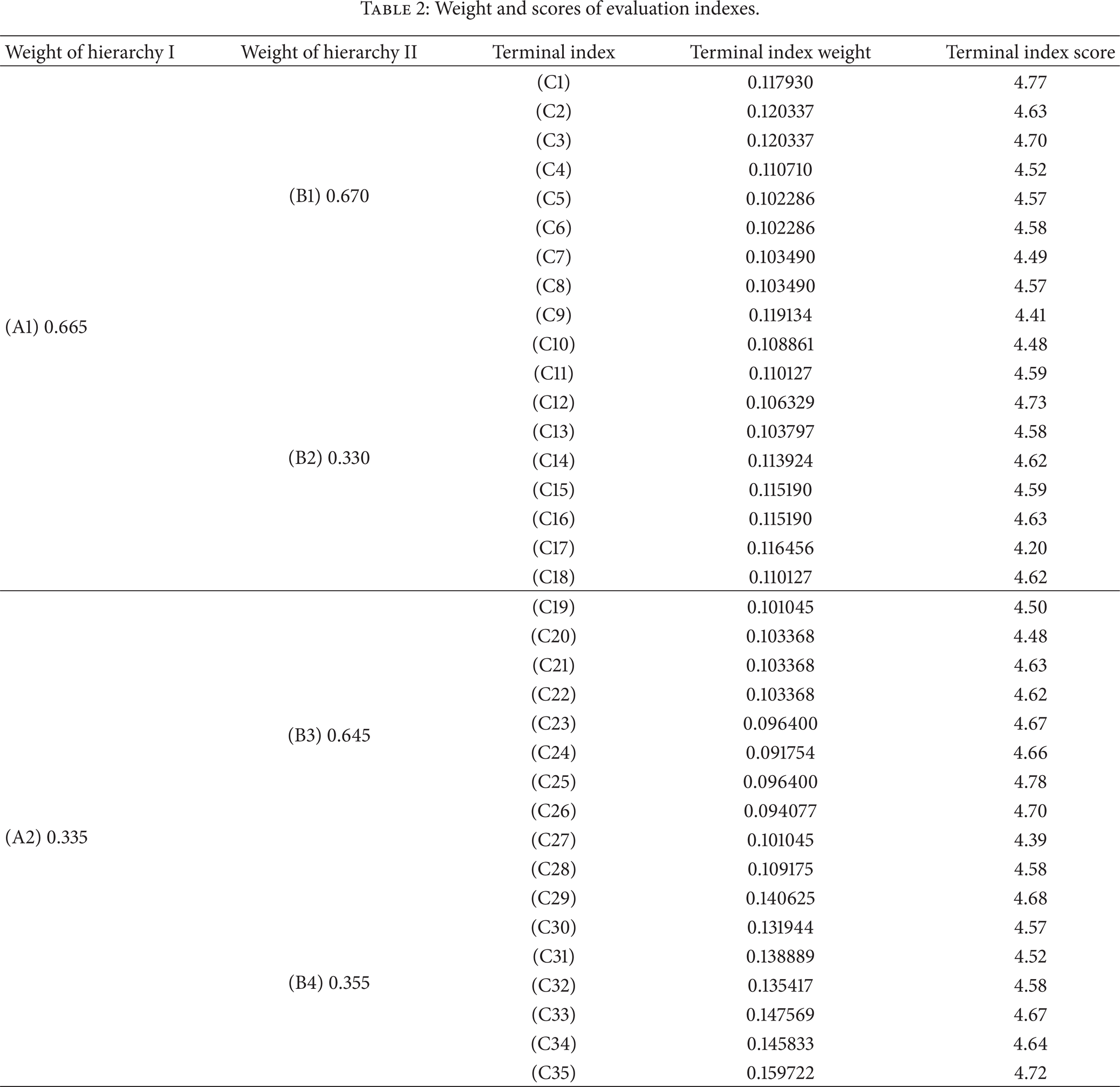
Terminal index scores of G33 train are also obtained by questionnaire investigation. Five ranks are set including Very Good, Good, Common, Not Good, and Very Bad. Scores of ranks were 5, 4, 3, 2, and 1, respectively. Evaluation scores are also listed in Table 2.
4.2. Evaluation Result
The grey correlation matrix of basic material needs (B1), basic spiritual needs (B2), advanced material needs (B3), and advanced spiritual needs (B4) can be calculated by use of GCM. Membership matrices are obtained by transposition of correlation coefficient matrices as shown in Tables 3, 4, 5, and 6.
Membership matrix of basic material needs.

Membership matrix of basic spiritual needs.

Membership matrix of advanced material needs.

Membership matrix of advanced spiritual need.

The evaluation result of hierarchy I can be obtained by the product of terminal index weight vector in Table 2 and membership matrix in Tables 3–6, respectively. The evaluation result of hierarchy II is the product of the weight of hierarchy II and the evaluation result of hierarchy I, respectively. The evaluation result of hierarchy III uses a similar method. The final evaluation result of G33 passenger train, the sum of four results of hierarchy III, is (0.919132, 0.856840, 0.608945, 0.472377, 0.385866).
It is obvious that 0.919132 is the biggest among values in the vector. Thus the service quality of G33 passenger train is Very Good.
Security problems are drawing more attention to the high-speed of railway train-set. The security of train (C9) is relevantly low from statistics results of questionnaire. Some indexes need to be improved such as skills of attendants in dealing with emergencies (C17) and various and higher quality food in the dining carriage (C27). Passengers have higher expectations to high-speed railway train-set from basic needs to advanced needs; thus they would only be satisfied in transportation service when all parts of wave service quality are improved.
5. Conclusion
Passengers pay much attention to service quality of various transportation modes when they choose travel mode. Passenger train service is a major part of railway transportation which influences the competition and the market share. This paper proposes an evaluation index system of the passenger train service quality based on passengers’ needs. The evaluation result of service quality of G33 passenger train is calculated by use of the integration method of grey correlation analysis and fuzzy comprehensive judgment. It reveals that the service quality of G33 passenger train is Very Good. This new index system and the integration of GCA and FCJ can evaluate passenger train service quality effectively.
Conflict of Interests
The authors declare that there is no conflict of interests regarding the publication of this paper.