




Abstract
IEEE 802.15.4 has become the de facto standard in many areas of wireless sensor network (WSN) such as body area networks, industrial automation, and healthcare domains. In many WSN applications, the sensor nodes could be mobile, and indoor communications are limited in terms of signal propagation. Therefore, a large number of access points need to be deployed to cover large areas. To maintain the sensor connectivity, sensor node should frequently change the serving access point by performing a mechanism known as a handover. We observed that the amount of time required for the association process is the key reason IEEE 802.15.4 is unable to handle the mobility. In this paper, we show what is required for node mobility support and propose three strategies for the support. First, the proactive algorithm is developed to anticipate the future link breakage. Second, a new greedy scanning technique is presented, which prevents nodes from scanning multiple channels. Third, the coordinator selection algorithm is developed which chooses the best coordinator that gives the longest connectivity time reducing the handover frequency. Experimental results have verified that our schemes work well in the mobile sensor network environment.
1. Introduction
A wireless sensor network (WSN) is a network of self-organizing low-powered devices having sensing and communication capabilities [1]. The need for Low Rate Wireless Personal Area Networks (LR-WPANs) has been driven by the large number of emerging applications such as home automation, factory automation, healthcare monitoring, and environmental surveillance [2]. IEEE 802.15.4 standard for LRWPAN has been widely accepted as the de facto standard for WSN that focuses on short-range wireless communications. The goal of the IEEE 802.15.4 LRWPAN is to support low data rate connectivity between wireless sensors with low complexity, cost, and power consumption [3]. In many WSN applications, the sensor nodes need to be mobile. Healthcare wireless sensor networks (HWSNs) are one such area where node mobility is dominant [4]. A number of smart physiological sensors can be integrated into a wearable wireless network, which monitor vital body signs such as heart rate, temperature, blood pressure, ECG, and EEG. If an emergency is detected, the physicians will be immediately informed through the computer system by sending appropriate messages or alarms. Furthermore, HWSN (connected to the Cloud) can also be deployed in home environment which monitors not only human health but also human activities to provide low-cost, high-quality healthcare and social network services to users [5, 6]. HWSNs used to monitor patients should offer mobility support of the sensor nodes carried by the patients. However, supporting mobility in IEEE 802.15.4 brings lots of new challenges and issues.
IEEE 802.15.4 has small coverage area. Thus, large numbers of access points are deployed to cover large areas. Each access point covers a limited area, also called its personal area network (PAN). Hereafter we use the term PAN coordinator or just coordinator to refer to an access point. Mobility of devices causes frequent loss of connection. To maintain the sensor connectivity, sensor node should frequently change their access point by performing a mechanism known as a handover. However, providing IP connectivity to mobile devices means that the devices need to be empowered with sophisticated mobility related IP protocols like MIPv6, and HMIPv6 [7]. Thus, it is not feasible to run complex and sophisticated mobility protocol on a mobile node. Thus, in this paper, we proposed light weighted handover mechanism that can be handled solely by IEEE 802.15.4. In beacon-enabled IEEE 802.15.4, a node is considered to lose connectivity if it is unable to receive beacons from the coordinator for the certain amount of time. Node reassociation defines the procedures for searching new PAN and joining it. There are 16 channels in the 2.4 GHz band, 10 in the 915 MHz band, and 1 in the 868 MHz band allocated for IEEE 802.15.4 [3]. The association starts with the beacon scanning in every channel from the neighboring PANs. Since every channel has to be scanned, it takes certain time, where duration is proportional to the number of channels scanned. Furthermore, the connection is lost once the mobile node moves away from the transmission range of the coordinator. Therefore, the service continuation depends on how and which coordinator is selected in the mobile WSN environments. To support mobility, the association procedure should be modified in such a way that the node's loss of connectivity should be realized quickly, the channel scanning time should be minimized, and the coordinator connectivity time should be maximized.
In this paper, it is shown that handover cannot be handled promptly and energy efficiently in the mobile WSN without proper methods. Thus, the contribution of this paper is threefold. First, using link quality indicator (LQI) history, a proactive algorithm is developed which tries to anticipate if the node is going to lose connectivity before it really happens. Second, we develop a fast coordinator discovery scheme that prevents a node from scanning all available channels. Third, we develop an intelligent algorithm to choose the best coordinator to prolong the node connectivity time as long as possible. All three updates are designed considering the low computational power of the sensor node. In a beacon-enabled network, nodes have to scan every single available channel to discover coordinators around. Here, we present a novel association scheme called greedy channel scan (GCS) that prevents node from scanning all available channels. The main idea of GCS is to scan only first few channels. However, the network setup algorithm has been developed in such a way that scanning only few channels is sufficient for the efficient neighbor discovery and association. The first algorithm tries to anticipate the link breakage by analyzing the LQI history. Thus, the algorithm decreases the time required by node to realize the link breakage from the coordinator. The second algorithm enables mobile node to scan only few channels and acquires network information about all the coordinators in the vicinity. The third algorithm increases the node connectivity time with a coordinator by performing handover to the coordinator that gives the longest connectivity time. The algorithm tries to anticipate if a node is moving away from or toward a coordinator by examining the LQI of the multiple beacons received from the same coordinator. The proposed association scheme provides support for mobility without involvement of any higher layer. Furthermore, the proposed modifications to IEEE 802.15.4 are simple and limited.
The remainder of this paper is organized as follows. In Section 2 existing research efforts have been surveyed. Section 3 presents the brief description on association procedure of beacon-enabled IEEE 802.15.4 followed by the network model in Section 4. Section 5 shows the operation and the main features of the proposed association scheme. The numerical and simulation analysis of the proposed scheme have been described in Sections 6 and 7. Finally, we conclude the paper in Section 8.
2. Related Works
There are some efforts done to minimize the association duration in IEEE 802.15.4. In IEEE 802.15.4e [8], optional fast association (FastA) is defined, which allows a device to associate in a reduced duration. However, most of the efforts are limited to mobility management, decreasing the duration of association message exchange [9], increasing connectivity [10] or coordinator discovery [11], whereas the channel scanningpart has been left untouched. The authors in [12] have presented an interesting solution to decrease the scanning duration by using dedicated channel for the beacon transmission. Although the results presented were impressive, using dedicated channel for beacon may be the waste of available bandwidth. Similarly, there are several works on multichannel solutions, but they are limited to throughput improvement or beacon collision avoidance [13–15]. To our best knowledge, we are the first to propose the handover solution in IEEE 802.15.4 considering channel scanning also.
In [9], Zhang et al. proposed an improved association scheme called Simple Association Process (SAP) that eliminates the redundant primitives, thus decreasing the packet collisions and the association delay.
A fast association mechanism [16] is proposed for real-time WPAN applications. Delay caused by scanning multiple channels is reduced because the scanning process is stopped as soon as a beacon is received. Although this scheme prevents nodes from scanning all available channels, nodes still need to scan multiple channels before finding a coordinator. Furthermore, the first beacon received may not always be the suitable coordinator.
Similarly, there are other works which focus on the neighbor discovery for quick association. In [11], algorithms are proposed for the optimized discovery of IEEE 802.15.4 static and mobile networks operating in multiple frequency bands and with different beacon intervals. In [10], a scheme to increase coordinator connectivity time with mobile nodes is presented for IEEE 802.15.4 beacon-enabled networks. Nodes use time-stamp of received beacons during the scan, along with link quality to determine the appropriate coordinator for association. Other mobility management schemes for cluster tree based WPAN have been proposed by Chaabane et al. [17] and Bashir et al. [18]. These approaches use the speculative algorithm for node association based on LQI. Based on LQI value, the mobile node anticipates cell change based on LQI before the loss of connection and tries to associate with the next coordinator. However, in all the cases, nodes have to scan multiple channels to find coordinators.
3. Beacon-Enabled IEEE 802.15.4
The IEEE 802.15.4 standard supports three kinds of topology: star, peer-to-peer, and cluster tree topologies, which can operate on beacon and nonbeacon-enabled modes. In this paper, we consider beacon-enabled mode only. Therefore, in the remaining of this section, we explain the beacon-enabled mode and node association process. In the beacon-enabled mode, communication is synchronized and controlled by a PAN coordinator, which transmits periodic beacons. The beacon contains information related to PAN identification, synchronization, and superframe structure. The period between two consecutive beacons is called a superframe and can have an active portion and an inactive portion as shown in Figure 1. The structure of superframe is determined by coordinators using two parameters: superframe order (SO) and beacon order (BO). SO determines the length of active portion of superframe, whereas BO defines the beacon interval. The relationship between BO and SO can be expressed as

The superframe structure of IEEE 802.15.4.
PAN coordinator should perform the energy detection (ED) to detect the peak energy of a channel and choose an appropriate channel for data transmission. In each channel, ED scan is performed for the duration of
3.1. Coordinator Discovery and Association
In order to start association, a sensor node needs to know the PAN's physical channel, coordinator ID, addressing mode, and PAN ID. Thus, the passive scan is performed for the coordinator discovery. As shown in Figure 2(a), during the passive scan, a device searches for beacon frame in each channel for the duration of
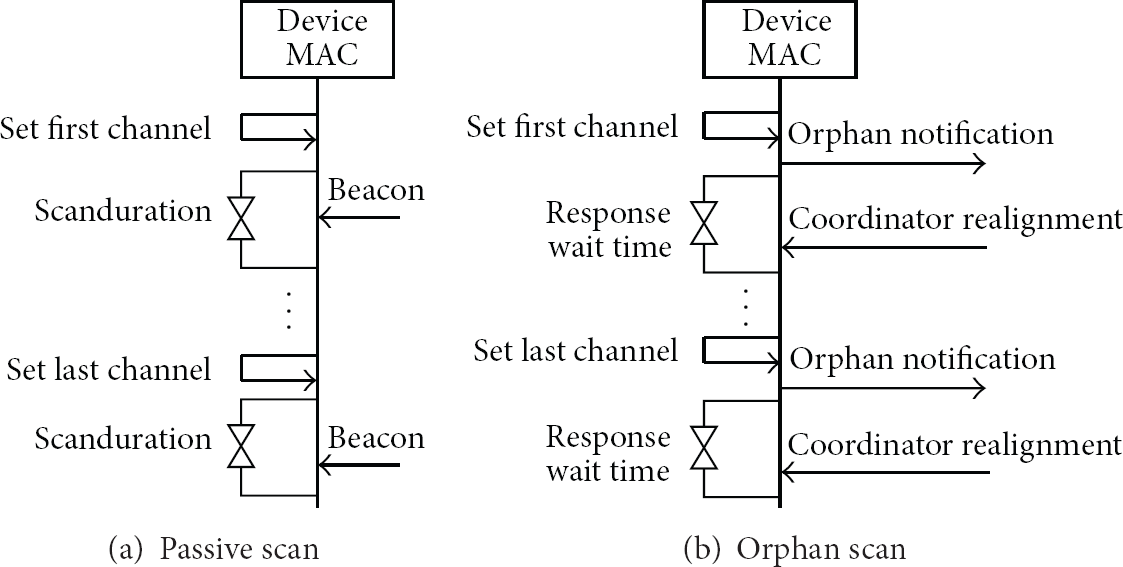
Channel scanning mechanism in beacon-enabled IEEE 802.15.4.

Association procedure in IEEE 802.15.4.
3.2. Loss of Connectivity and Reassociation
Node loses connectivity if it moves beyond the coverage of PAN. A node considers itself as orphan node if it cannot receive beacon from the coordinator for aMaxLostBeacons times. Orphan scan allows a device to attempt to relocate its coordinator following a loss of connectivity. The device shall first send the orphan notification command frame and waits for coordinator realignment command frame for at most macResponseWaitTime symbols as shown in Figure 2(b). This procedure is repeated until it receives the coordinator realignment frame or all the available channels are scanned. If the orphan scan is unsuccessful, the device looks for a new parent by performing the passive scan. During an orphan scan, the node discards all frames received that are not coordinator realignment MAC command frames. For a mobile node, the connection with coordinator can frequently break and the reassociation procedure is time consuming because the mobile node has to go through the orphan scan first followed by the passive scan and then the association message exchange. We use the term reassociation to explicitly denote the association procedure used by the mobile node. From our study, it is observed that IEEE 802.15.4 can be used in the mobile sensor network applications if somehow this whole reassociation duration be shortened to some tolerable level.
4. Network Model
One obvious choice for IEEE 802.15.4 to cover a large areas is by using cluster tree topology. However, a cluster tree topology presents two major problems. First, the collision probability is high since all nodes transmit on the same channel. Second, the IEEE 802.15.4 standard does not specify how to synchronize a cluster tree network [17]. Thus, we select the start topology to balance the network load. But, communication between different PAN coordinators is not possible unless they belong to the same channel, or if they define a common transmission channel. In this paper, we consider that different wiredly connected PANs can form a unique heterogeneous network composed of star PANs. All PANs are assumed to be connected with the base station through the wired connection. Messages between nodes that do not belong to the same PAN Id can then be routed through the base station.
The basic network design is shown in Figure 4, which models a typical HWSN. The construction of a HWSN comprises three main elements, namely, (i) a base station or gateway that acts as a bridge between the HWSN and Internet, (ii) PAN coordinator that support communication to/from the sensor nodes, and (iii) the sensor nodes themselves that collect body parameters and send them wirelessly over the network. Due to the limited coverage area of each PAN in indoor environments, several PAN coordinators are deployed to cover the monitored zone as shown in the figure. Furthermore, to prevent interference, each PAN may operate in a different transmission channel. Mobile node changes the point of attachment as it pass from a PAN to another in the network. For the maximum coverage of the area, the coordinators are assumed to be septated by the distance of transmission range. However, adjacent PAN does not interfere each other as they operate in different channels.

Network model.
In this work, LQI value is used to detect the movement of a sensor node. In IEEE 802.15.4, every MAC frame contains LQI value that ranges from 0 to 255. The LQI measurement is a characterization of the strength and/or quality of a received packet. However, the calculation of the LQI is not specified in the IEEE 802.15.4 standard. However, receiver ED, signal-to-noise ratio (SNR), or combination of these methods can be used. In order to observe the change in LQI with respect to distance, mobility, and background traffic, we conducted a simple experiment in NS-2. In PAN1 of Figure 4, node 1 is moved toward node 5 at the speed of 1 m/s. Transmission range of PAN was set to 10 meters. The effect of interference is also accounted by introducing background traffic from nodes 2, 3, and 4. LQI values of beacon received from the coordinator as node 1 moves are shown in Figure 5. In NS-2, the LQI is calculated based on the received signal strength and the signal-to-noise ratio. A packet is only received if its LQI is equal or greater than 128. Thus, LQI obtained ranges from 128 to 255 because the packets whose LQI is below 128 are dropped. Also, the LQI value of 255 is observed when the distance between node and coordinator is less than 7 m and the gradual decrease in LQI is observed once the distance from the coordinator exceeds 7 m. With movement, some false LQI values are observed, and the LQI drops as the sensor node moves away from the coordinator. LQI is also affected by the background traffic because of interference and, especially, when the node is moving, where sudden drops in LQI values are observed. However, in this work, the normalized value of LQI is used to detect node movement. In [10, 18], authors also obtained similar LQI result.
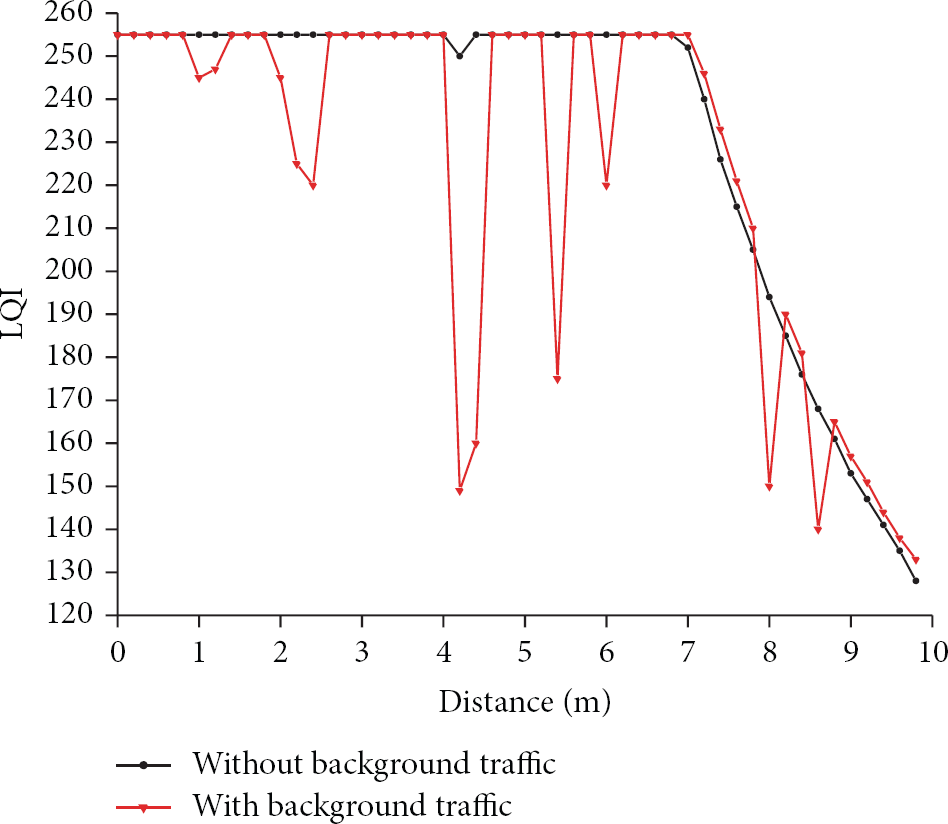
Change in LQI with distance and background traffic.
5. Proposed Scheme
From the detailed study of IEEE 802.15.4, it is observed that mainly three updates are possible to enable IEEE 802.15.4 to efficiently handle mobility. The first update is the early detection of loss of connectivity. The detection of loss of connectivity by counting loss of beacons for aMaxLostBeacons times is time consuming. A proactive method can significantly reduce the detection time of link breakage. The second update is the reduction of neighbor discovery time. The channel scanning for neighbor discovery is the most time consuming procedure. If somehow the nodes are prevented from scanning multiple channels, the mobility can be handled efficiently. And, the third update is to retain the node connectivity as long as possible. IEEE 802.15.4 does not specify how to select a coordinator. However, if the coordinator that gives longest connectivity time is selected, the frequency of handover can be reduced. In our proposed scheme, we implement all above mentioned updates to handle the mobility efficiently. Also, all the three updates are simple and can be easily implemented.
5.1. Initialization of PAN Coordinator
IEEE 802.15.4 has 16 working channels from channel 11 to 26 in 2.4 Ghz band. Among them, channels 15, 20, 25, and 26 are interference free from Wi-Fi networks [19]. The set of these channels
5.2. Beacon Frame
Once the PAN is initialized, it starts transmitting periodic beacon. However, 1 more parameter is transmitted in the beacon. The occupied bandwidth (OBW) of the PAN is transmitted in the beacon payload field. The OBW represents the volume of traffic handled by the PAN. In every superframe, each PAN obtains the bandwidth occupied for data transmission during one superframe period which is expressed as


5.3. Proactive Reassociation Decision
LQI is an important metric available in IEEE 802.15.4 for detection of link quality between two communicating nodes. Make-before-break approach requires either sensor node or coordinator to monitor the LQI for triggering the handover. However, the frequency of beacons can be low or high depending on BO of the coordinator. At higher BO, beacons are received after longer intervals resulting in delayed detection of link quality. In our proactive reassociation decision (PRD) scheme, sensor node monitors all packets from the coordinator and are used for analyzing the LQI. PRD algorithm shown in Figure 6 is used to take handover decision. The algorithm first observes the LQI value of each packet received from the coordinator. The node anticipates the link breakage by analyzing the LQI history and missing of a beacon. But, the link quality can be degraded due to increasing in distance, interference, and collision of packets. Thus, instantaneous LQI alone is not a reliable parameter for taking handover decision. Furthermore, observed LQI values can fluctuate at any instance of time. Therefore, successive LQI readings are considered. A counter shown in Figure 6 keeps track of how many times the LQI is less than previously recorded LQI. In addition to LQI drop, missing of beacon is used to ensure the link breakage. If LQI drops continuously for MaxCounter number of times followed by missing of a beacon, the reassociation decision is taken. The algorithm is designed in such a way that the fluctuation in the reading is compensated by decreasing the counter as shown in the flow chart.

Flow chart of proactive reassociation decision.
5.4. Greedy Channel Scan
Channel scanning is the most time consuming part of the association procedure. The time spent on association for various values of BO is shown in Figure 7. For each value of BO, the time required for association as the number of channels to scan varies from 1 to 16 is shown in the figure. The figure illustrates that the association time increases as the number of channel increases. Thus, to prevent the node from scanning every channel, greedy channel scan (GCS) scheme is proposed. In the GCS scheme, a mobile node scans the clear channels first. However, if the last used channel is also a clear channel, then it will scan clear channels excluding the last used one. For example, if the last used channel is 20, then it will scan channels 15, 25, and 26 only. The idea behind omitting its last used channel from scanning is because the adjacent PANs will not use the same channel. However, if somehow the greedy algorithm is unable to find PAN, then all channels are scanned again starting from channel 11. Thus, in an average mobile node scans only 3 channels.

Time required for the association as BO and number of channels are varied.
5.5. PAN Selection and Association
The PAN selection algorithm (PSA) is explained with an example. Figure 8 shows an intersection hall way in a hospital where 4 PAN coordinators W, X, Y, and Z are deployed for network coverage. The mobile node M (initially associated with X) moves toward coordinator Y at the speed of 1 m/s. The circle of coordinator is the coverage region of a PAN. IEEE 802.15.4 maintains a list called PANDescriptor that records all the beacons received and contains fields such as PAN ID, coordinator address, logical channel, and LQI (LQI of beacon received). In IEEE 802.15.4, the multiple beacons received from the same coordinator are ignored. However, in PSA, we analyze LQI of the multiple beacons from the same coordinator to anticipate the node's direction of movement. Two more fields are added in PANDescriptor as shown in Table 1. At the point P2 (in Figure 8), M starts the passive scan. Table 2 shows the instance of PANDescriptor maintained by M during the passive scan. If a beacon is received for the first time, LQI_Prev and LQI are made the same. If the beacon is received again from the same coordinator, observations are done such that LQI holds the current LQI and LQI_Prev field holds the average value of LQI of beacons received. Direction field (initially zero) is decreased by one if the current LQI is less than the LQI_Prev, and otherwise, it is increased. The positive value of Direction field indicates that the node is moving towards that PAN and negative indicates that node is moving away. But, getting associated with the PAN that gives longest connectivity is not sufficient for a reliable and stable handover. The new PAN should also be able to support the continuous transmission service even after the handover. Thus, the occupied bandwidth of PAN that is broadcast in beacon is also considered for the coordinator selection. Using the observed average LQI (LQI_Prev) and OBW, the PAN weightage (PANW) is calculated as follows:

Added fields of PANDescriptor in GCS.

An example of PANDescriptor maintained by the mobile node M.

(1) Compare the Direction and PANW of every PAN (2) Select that PAN which has positive Direction and lowest PANW (3) If all Directions

Selection of PAN.
6. Numerical Analysis
Let aBaseSuperFrameDuration be the number of symbols forming a superframe when SO = 0. In IEEE 802.15.4, it takes equal duration in performing ED, active, and passive scan on a channel which is given by

6.1. Association
The total time spent for association is the sum of time spent in the channel scan and the time spent in the association message exchange (Asso

6.2. Detection of Connectivity Loss
In IEEE 802.15.4, the beacon interval (BI) is given by the following equation:


6.3. Reassociation
Once a node realizes that it has lost connectivity with the PAN, the node performs the orphan scan on each channel for duration of 
6.4. Connectivity Time
To evaluate the device connectivity time with its coordinator, we consider a four-way intersection, which models the corridor of a hospital as shown in Figure 8. We assume that all coordinators have the same transmission range and are uniformly spaced. The figure shows a situation in which the mobile node M can take any direction at the intersection. In this kind of situation, choosing the furthest coordinator will give the longest connectivity provided that the mobile node is moving toward it. Let
6.5. Numerical Example
Assuming network parameters of Table 4, we get aBaseSuperFrameDuration of 15.36 ms and macResponseWaitTime and Assomsg of 0.49 s [3]. Thus, using these values and above equations the association time and DLC duration for both IEEE 802.15.4 and proposed scheme is calculated and shown in Table 3. For GCS, (
Total time spent for association.

Network parameters and values.

7. Performance Evaluation
The proposed scheme is implemented on the NS-2 network simulator [20]. The simulated nodes were configured by using the parameters listed in Table 4. The parameters of Table 4 are taken from CC2420 datasheet [21]. 16 PANs were deployed for the coverage of 50 by 50 m area as shown in Figure 9. At the simulation time of 50 s, the mobile node (node 1) starts to transmit data and also moves to the direction as indicated by the arrows and simulation stops when it comes to its end position (left bottom position). The mobile nodes switches PAN as it moves. The total distance travel by the mobile node is 86 m. The mobile node transmits data at the rate of 4 Kbps to the base station (black node at the center). Coordinators choose their operational channel giving priority to clear channels. The communication link between a PAN and the base station is wired. Coordinators transmit beacons at the rate corresponding to

Network topologies used in the simulation.
7.1. Association Time and Energy
The total time spent for DLC and the re/association in the various values of BO is obtained from numerical analysis and NS-2 simulations as shown in Figure 10. On an average, GCS performed the passive scan on 3 channels, thus
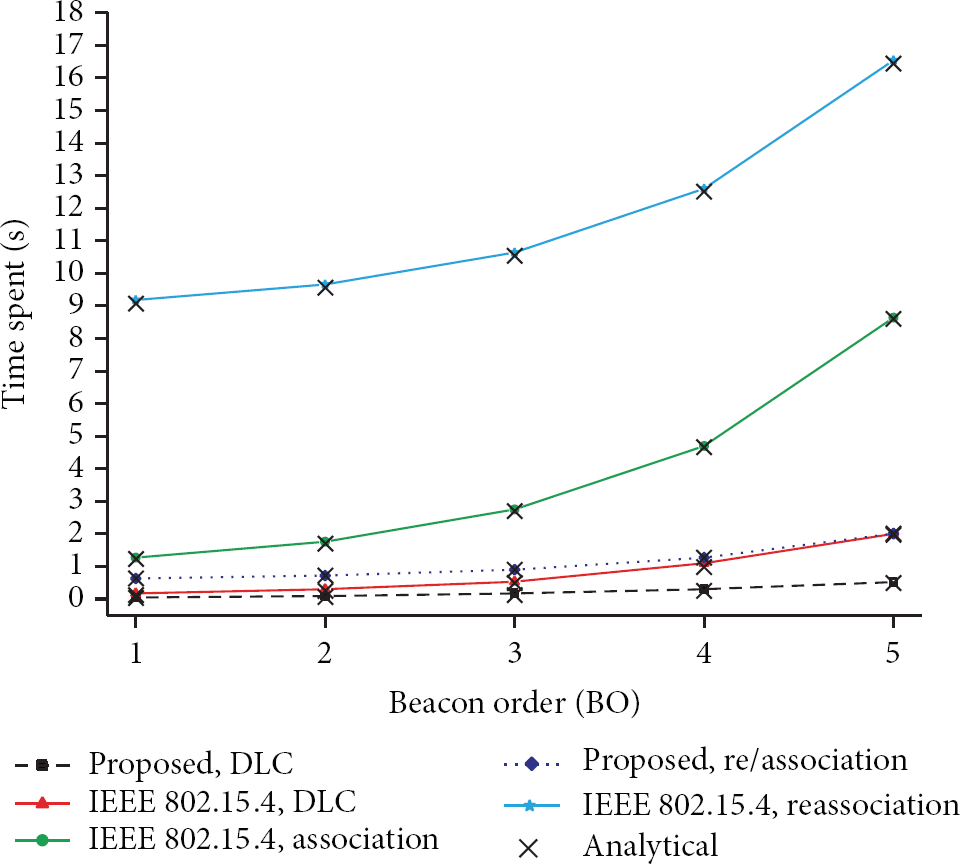
Total time spent for association at different beacon intervals.
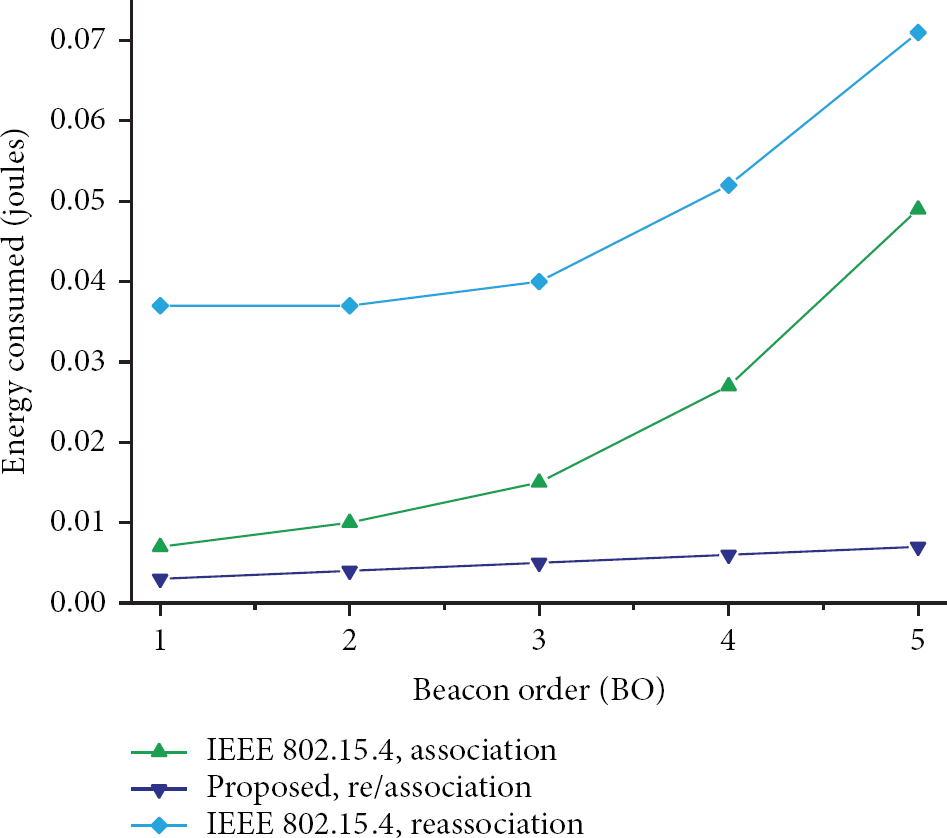
Total energy spent for association at different beacon intervals.
7.2. Connectivity and Connection Time
Percentage of connectivity is calculated as the ratio of the time that a node is associated with the network to the total simulation time. In the proposed scheme the total time spent on passive discovery of a coordinator and the detection of link breakage is less. Furthermore, nodes do not perform orphan scan. Thus, the node quickly gets associated with a new PAN as soon as it lost connection with the old one. The percentages of node connectivity at different BO(s) and node speeds are shown in Figure 12. As shown in the figure, nodes in the proposed scheme are able to be connected to the network during the most of the time, whereas IEEE 802.15.4 has low connectivity. We observed that even a slight mobility has a significant negative impact on the node connectivity in the case of IEEE 802.15.4. At the human walking speed of 1.5 m/s, IEEE 802.15.4 had poor connectivity even at the lower values of BO and nodes were unable to connect when

Node connectivity at different BO using proposed scheme and IEEE 802.15.4 at 0.5, 1, and 1.5 m/s.

Connection time with coordinator at different BO using proposed scheme and IEEE 802.15.4 at 0.5, 1, and 1.5 m/s.
7.3. Throughput
The effect of handover on throughput of node 1 is shown in Figure 14. The figure shows the throughput of node 1 calculated every second. The mobile node is using superframe duration corresponding to BO = 3 and speed of 1 m/s. Throughput of proposed scheme drops while performing handover because packets cannot be transmitted in the periods of passive discovery and association. However, nodes quickly get associated with a new coordinator and restart data transmission. Nodes can buffer packets. Therefore, buffered data are also transmitted after new association is completed, resulting into increased throughput immediately after the association. The total transferred rate was 3600 bps for the proposed scheme whereas 2200 bps for IEEE 802.15.4. As can be seen from the figure, during handover, throughput of the proposed scheme never dropped to zero, whereas it dropped to zero in every handover in case of IEEE 802.15.4. Also, the packet delivery ratio was observed 90% for proposed scheme and 55% for IEEE 802.15.4, respectively.

Throughput observed in the PAN coordinator at BO = 3, speed = 1 m/s, and data rate of 4 Kbps.
8. Conclusion
In this paper, three strategies are proposed for the efficient handover in IEEE 802.15.4. The first algorithm (PRD) anticipates if the node is going to lose connectivity by analyzing the LQI history before it really happens. Thus, helps in early detection of future link breakage and handover decision. Second algorithm called GCS is presented that can decrease both time and energy required for association. GCS algorithm scans the clear channels first preventing nodes from scanning all the available channels and looking for beacon. The third algorithm anticipates the nodes direction of movement with respect to the coordinator and selects that coordinator which has maximum available bandwidth and towards which the node is moving. Our analytical and simulation results demonstrated that our scheme is highly efficient in terms of both energy and time. With the implementation of our scheme, we give IEEE 802.15.4 the new ability to handle mobility.
Footnotes
Conflict of Interests
The authors declare that there is no conflict of interests regarding the publication of this paper.
Acknowledgment
This study was supported by research funds from Chosun University, 2012.