




Abstract
Rhombic mild-steel plate damper (also named rhombic added damping and Stiffness (RADAS)) is a newly proposed and developed bending energy dissipation damper in recent years, and its mechanical properties, seismic behavior, and engineering application still need further investigations. In order to determine the basic mechanical performance of RADAS, fundamental material properties tests of three types of mild-steel specimen including domestically developed mild-steel material with low yield strength were carried out. Then, a quasistatic loading test was performed to evaluate the mechanical performance and hysteretic energy dissipation capacity of these rhombic mild-steel dampers manufactured by aforementioned three types of steel materials. Test results show that yield strength of domestically developed low yield strength steel (LYS) is remarkably lower than that of regular mild steel and its ultimate strain is also 1/3 larger than that of regular mild steel, indicating that the low yield strength steel has a favorable plastic deformation capability. The rhombic mild-steel plate damper with low yield strength steel material possesses smaller yield force and superior hysteretic energy dissipation capacity; thus they can be used to reduce engineering structural vibration and damage during strong earthquakes.
1. Introduction
Earthquake input energy is dissipated by engineering structures in traditional structural design methodology over a long period of time, while the unacceptable structural damage even collapses and heavy casualties are almost inevitable in severe earthquakes events. Active control, semiactive control, and passive control technology have been developed by a great deal of scholars and engineers in the past four decades to dissipate seismic energy imposed on engineering structures and control the structural vibration behavior. Passive vibration control and shock absorption technology have been implemented widely in many engineering structures by installing several displacement-dependent or velocity-dependent equipment on certain location in virtue of the satisfactory control effectiveness and stable control robustness [1]. In recent years, mild-steel plate dampers, which mainly utilize yield plastic deformation of the mild-steel device to dissipate seismic energy, have become one of the most rapidly developed passive energy dissipation and shock absorption dampers. During strong earthquakes, the mild-steel plate damper yields earlier than other regular structural components, achieving the purpose of energy dissipation. In addition, the mild-steel damper has advantages of simple structure, clear energy dissipation mechanism, strong capacity of energy dissipation, ease of replacing, and immunity against environmental influence; thus it will also provide additional stiffness to fundamental structures [2]. Due to the mentioned advantages, mild-steel dampers can be applied to new buildings and can also be helpful for strengthening and repairing existing buildings [3]. Research scholars and engineers around the world have paid special attention to mild-steel plate dampers, conducting amounts of scientific investigations and engineering practice. Kelly et al. [4] put forward the concept on energy dissipation and shock absorption utilizing mild-steel damper in 1972. Current steel dampers include axial tension-compression devices [5], bending beams and plates, torsion beams, U-shaped steel plates, and other forms of dampers. Whittaker et al. [6] and Tsai et al. [7] investigated the mechanical properties and seismic performance of X-shaped and triangular type steel plate dampers. In addition, the mechanical performance and damping effect of X-shaped and triangular steel plate dampers were investigated by Bin and Jinping [8], the design criterion of steel plate damper based on fatigue performance was presented, and the membrane effect of steel plate dampers was also investigated [9]. In general, mild-steel plate dampers developed mainly involve tensile yield energy dissipation damper (e.g., buckling restrained brace [10] (BRB)), bending yield energy dissipation damper [11] (e.g., triangular device added damping and stiffness (TADAS) and X-shaped device added damping and stiffness (XADAS)), and shear yield energy dissipation damper [12] (shear panel device for energy dissipation (SPD) [13]).
The top and bottom of traditional X-shaped steel plate are installed between the bottom of the beam and the bracing fixed on the lower story. After the transverse deformation by bending loading, the axial force of steel plates will impose great influence on energy dissipation capacity. Triangular steel plate damper can overcome this disadvantage; however, the effect of energy dissipation and hysteretic behavior will be greatly affected by the qualities of welding bond between triangular steel plate and junction plate and triangular steel plate and the bottom of the beam. Additionally, the economy of this type damper is also satisfactory, although local fracture on X-shaped and triangular steel plate damper [14] is a troublesome problem to be solved. While, as a new type of damper with favorable energy dissipation performance, the rhombic mild-steel plate damper can avoid or reduce adverse effect of above-mentioned types of dampers as far as possible, the rhombic steel plate damper will be a promising passive control device in the future. In 2004, Taiwan scholars Shih et al. [15] developed a new type of rhombic mild-steel plate damper using low yield strength steel produced by China Steel Corporation in Taiwan. Loading tests were performed to verify the hysteretic performance of a full-scale rhombic plate damper made of low yield strength steel material and validate the stable energy dissipation capacity of this damper. This new damper is made up of two triangular steel plates by edge-to-edge connection. Shih and Sung [16] proposed a modified Wen's model by considering nonlinear strain hardening characteristics of low yield strength steel under the circle reciprocating loading. Comparing the results of numerical simulation and experiment testing, it was shown that the modified Wen's model can closely reflect the hysteretic behavior of the rhombic steel plate damper. The low yield point steel has been produced by steel companies in China in recent years and applied in many types of energy dissipation devices such as buckling restrained braces installed in many engineering structures. So, the material properties and energy dissipation performance of the low yield point steel produced by domestic steel companies in China should be evaluated by scientific experiments and engineering practice. At the same time, the seismic behavior and energy dissipation capacity of the rhombic steel plated dampers should be further investigated and discussed for the engineering application.
Fundamental mechanical properties of three types of mile steel materials were tested and analyzed in this study and the scaled rhombic steel plate dampers with corresponding steel material were manufactured. In addition, quasistatic hysteretic loading test was performed to investigate the hysteretic behavior and energy dissipation capacity, providing fundamental evidence for the application of rhombic steel plate damper to engineering practice.
2. Simplification of Mechanical Performance for Rhombic Mild-Steel Plate Damper
Rhombic mild-steel plate damper can be regarded as two-triangular-steel-plate damper edge-to-edge connected on the basis of structural form and its mechanical properties generally can be described as combination of two-triangular-steel-plate damper. For a single triangular steel plate damper, the mechanical performance can be described as a cantilever loaded by a concentrated force in the free end, as is shown in Figure 1. The mechanical performance of a single triangular steel plate damper can be calculated by equations as follows:

where K d = elastic stiffness of triangular steel plate damper, P y = yield force, P p = plastic force, Δ y = yield displacement, t = thickness of the steel plate, h = height of the steel plate, b = bottom width of steel plate, E = elastic modulus of steel, and σ y = yield stress of steel. Steel plate damper performs bilinear characteristics; although extremely low yield strength steel has significant strain hardening effect, the bilinear modulus still can be applied to hysteretic mechanical modulus of steel plate damper.

Simplified mechanical model of triangle plate damper.
3. Tensile Mechanical Performance Test of Steel
In general, the force-displacement hysteretic behavior of steel plate dampers is determined by stress-strain property of steel material. Stress-strain property of steel material used for steel plate dampers should be tested before the experiment of mechanical performance of rhombic steel plate dampers. Rhombic steel plate dampers used for experiment verification adopt three kinds of steel material including regular Q235 steel, low yield steel named AQ225GJC (LYP225 for short) and AQ160GJC (LYP160 for short) developed by a domestic steel corporation. The specimens for material property test were cut from steel plate for dampers and then manufactured to fundamental tensile test specimens according to the Chinese tensile test specification [17]. In this study, three cylindrical specimens of each steel material are fabricated with the diameter of 10 mm. The material properties of the three types of steel materials were tested using Zwick electronic universal material testing machine with displacement control at a rate of 5 mm/min in the Mechanics Test Center of Harbin Institute of Technology shown in Figure 2. All the specimens were first preloaded to 50 N, which is within the elastic range, to check installation alignment. All the test data, including strains, loads, and displacements, were recorded simultaneously by a data log system. The whole and preliminary stage of stress-strain constitutive relation during tensile testing regular Q235 steel material, LYP225 steel material, and LYP160 steel material are shown in Figures 3 and 4. The key material property parameters of nine specimens are shown in Table 1, including elastic modulus, upper and lower yield point, ultimate strength, ultimate strain, and shrinkage in area. Elastic modulus of tested steel material is the slope of linear stage obtained by fitting the above three curves during preliminary stage of testing process. The calculation range of linear strain is 0.05%–0.12%, 0.03%–0.09%, and 0.01%–0.03% for the three types of steel material, respectively. The other property parameters can be acquired from definitions in metal tensile test specification. There are several results as follows which can be presented from the tensile testing of steel specimens as shown in Figures 3 and 4 and Table 1.
Mechanics properties of tested steel material.


Material performance testing of low yield point steel: (a) standard specimen; (b) testing settlement on Zwick automatic tensile system made in Germany.

Constitutive relation of steel material: (a) Q235, (b) LYP225, and (c) LYP160.

Constitutive relation in preliminary stage of steel material: (a) Q235, (b) LYP225, and (c) LYP160.
4. Experiments on Hysteretic Behavior of RADAS Dampers
According to the test requirements, 6 scaled rhombic steel plate dampers using Q235 steel plate, LYP225 steel plate, and LYP160 steel plate were manufactured according to the designed size as shown in Figure 5(a), and the fabricated RADAS specimen is also shown in Figure 5(b). Every damper is made up of rhombic steel plate and supporting axle on both sides. Three holes for screw are drilled along the short diagonal line to fix the RADAS damper to loading equipment. The hysteretic performance test of rhombic steel plate damper was performed on a MTS electric-hydraulic servo system with a capacity of 2500 kN.
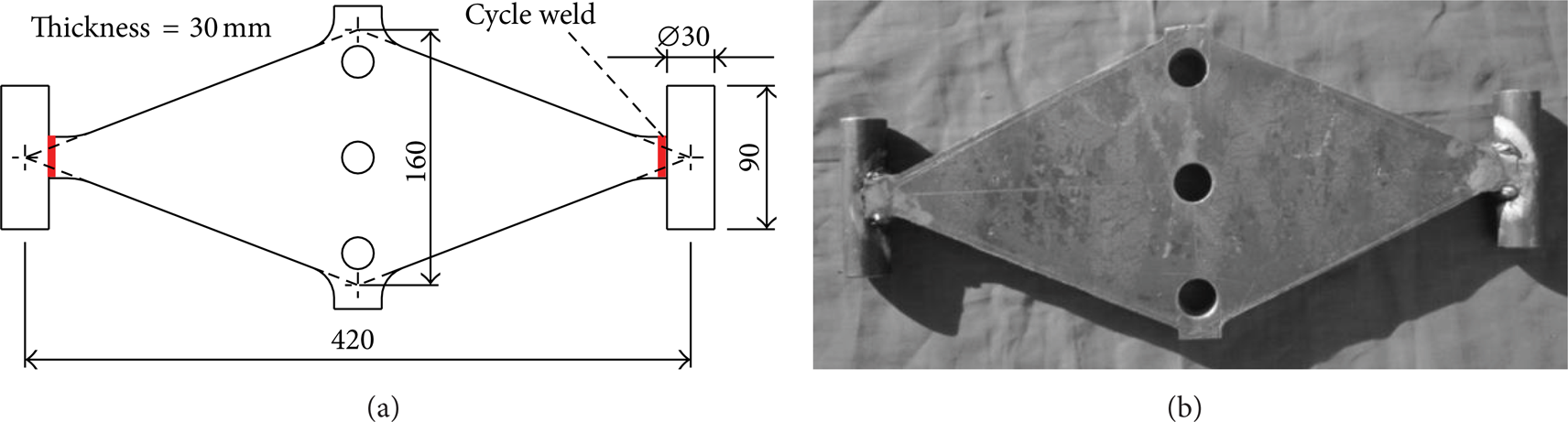
Schematic size and specimen of the rhombic steel plate damper: (a) dimensional drawing of RADAS and (b) picture of RADAS specimen.
Displacement control mode was adopted for the performance testing of RADAS dampers, and the loading protocol is shown in Figure 6; three circles are settled in each loading level; the transverse loading displacement from 2.5 mm to 50 mm and the displacement increment of 5 mm beginning from 5 mm are scheduled. And the sketch map and experiment layout of the performance testing are shown in Figure 7. Detail of the loading sequence is summarized below.
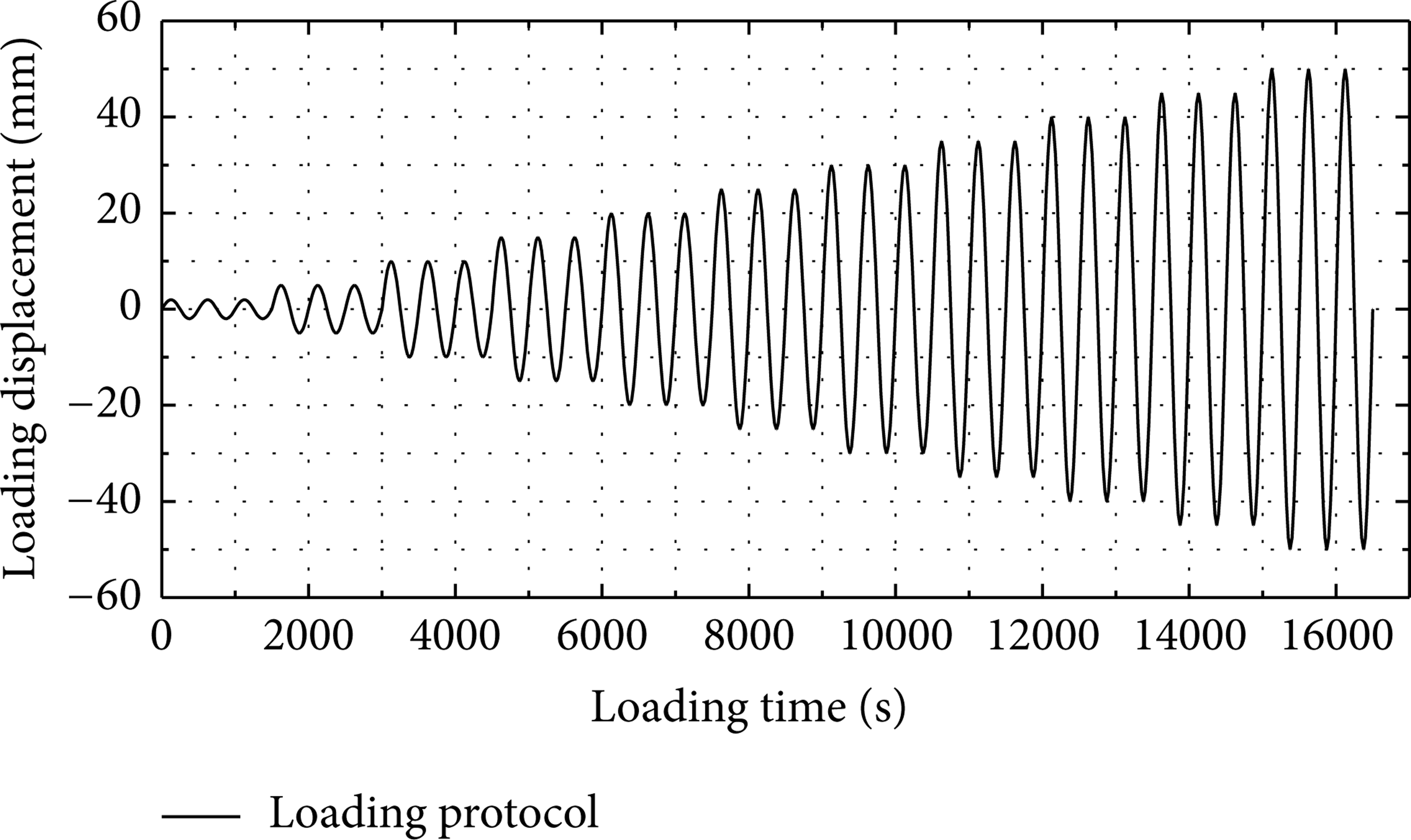
Loading protocol of hysteretic behavior testing of rhombic steel dampers.

Sketch map and testing layout of RADAS damper.
Firstly, the specimen was subjected to three cycles with the maximum displacement value of 2.5 mm. This step can be regarded as a preloading measure to check alignment and the workability of the data logger system.
Afterwards, the cyclic loading process continued with the maximum displacement value ranging for 5 mm to 50 mm, with the displacement increment value of 5 mm. During the test, the values of transverse displacement, transverse load, and all other values were automatically recorded by a data acquisition system.
5. Analysis of Experimental Results
Hysteretic behavior of the RADAS damper with three kinds of steel material, that is, regular Q235 steel, LYP225, and LYP160, is shown in Figures 8, 9, and 10. From hysteretic curves of three kinds of steel dampers, the plump hysteretic behavior of the rhombic steel plate damper is revealed, which shows the satisfactory energy dissipation capacity of the RADAS damper with these three kinds of steel material. In addition, hysteretic performance of every steel plate is very stable during the whole testing process; LYS damper will begin to dissipate energy under lower loading force. It is obvious that rhombic steel plate damper made by regular Q235 steel has a better bilinear property, while LYS damper, especially LYS160, reflects obvious strain hardening effect. Therefore, the skeleton curve of force-displacement relationship no longer satisfies bilinear behavior and its skeleton curve model is relatively complex, and the damping force model of LYS is investigated and put forward [16]. Comparison between the theoretical value computed by simplified bilinear model shown in (1) and the testing value of elastic stiffness, postyielding stiffness, and plastic yielding strength is shown in Table 2. It can be observed from the results that the theoretical values of three kinds of dampers are fairly close to the testing value with an approximate error of 10%, which is larger than LYS160 damper. It can be attributed to strength hardening of skeleton model of LYP160 steel material. And the calculation method of the damper with low yield strength steel material will be further investigated in future study. This is mainly related to material properties of low yield steel; so bilinear model is no longer suitable for extremely low yield steel.
Parameters of the tested specimen of RADAS dampers.


Hysteretic behavior of Q235 steel plate.

Hysteretic behavior of LYS225 steel plate.
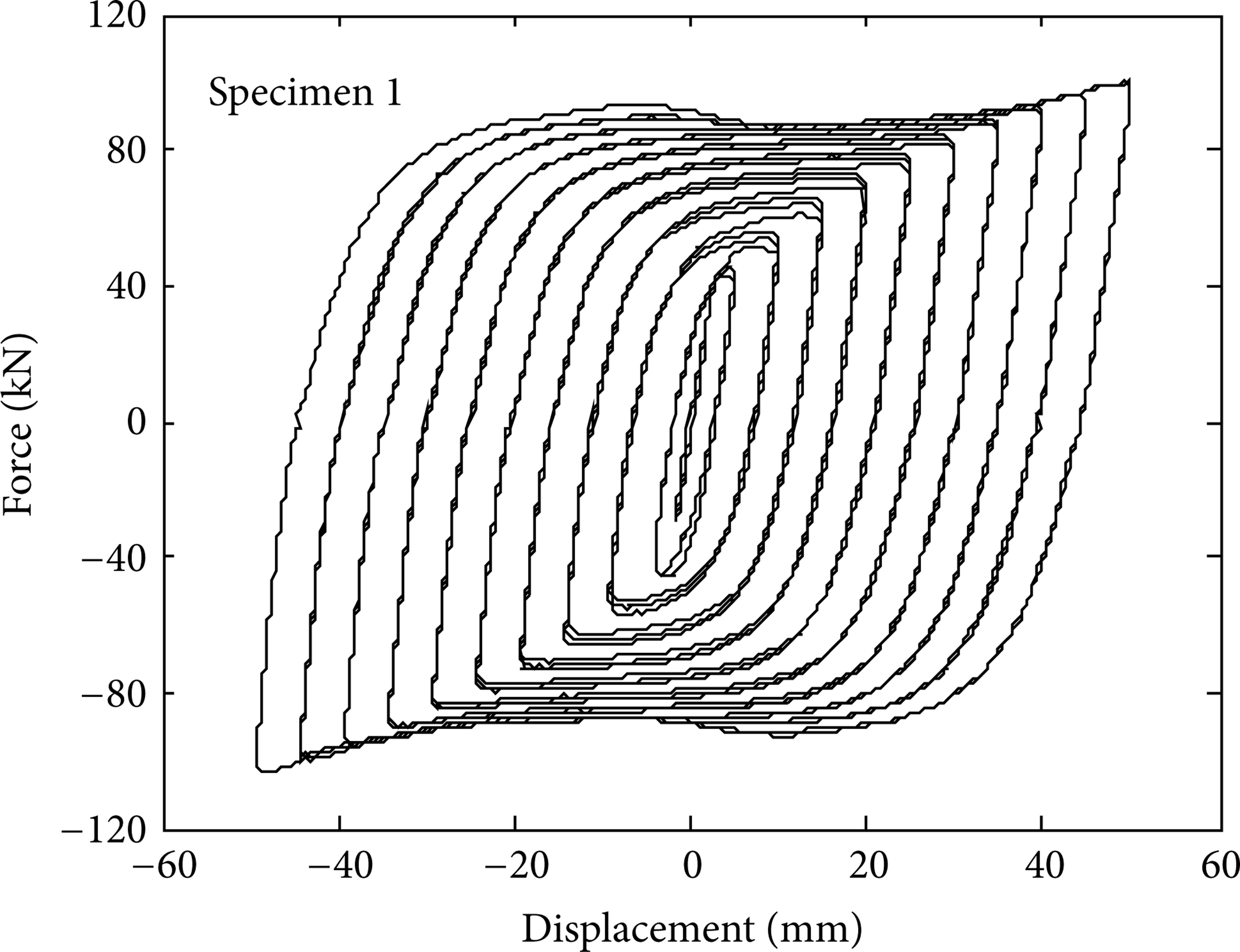
Hysteretic behavior of LYS160 steel plate.
6. Conclusions
This paper has presented the results of a series of tensile test results of three kinds of steel material and quasistatic cyclic test results on three batches of RADAS dampers. Based on the experimental results and the discussions given in this paper, the following conclusions can be drawn.
Mechanical property test of three kinds of steel material including regular Q235, LYP225, and LYP160 steel revealed that more favorable ultimate deformation capacity and lower yield strength of LYS are satisfactory for energy dissipation of RADAS dampers. It is more suitable to be used as passive damper devices and LYS will be in yield state during strong earthquakes. In addition, the nonlinearity property in the preliminary stage of stress-strain curve for low yield steel material, especially for LYS160 steel, is obvious and worthwhile to be paid attention to in the future study.
Plentiful energy dissipation and stable hysteretic behavior of the RADAS damper with three kinds of steel material are verified by quasistatic cyclic loading tests. Low yield strength steel will be a favorable substitute for present regular mild-steel, and the superior property of LYS damper can be widely utilized in passive control technology and engineering practice. On the other hand, obvious stain-hardening property of loading skeleton curves is also revealed especially for LYS160 steel damper, leading to more complex hysteric behavior and design method, which will be key issues in the following research.
Conflict of Interests
The authors declare that they have no conflict of interests regarding the publication of this paper.
Footnotes
Acknowledgments
This research is jointly funded by the National Natural Science Fund of China (Grant no. 51208015), China Postdoctoral Science Foundation funded project (Grant nos. 2012M510300, 2013T60047), and Specialized Research Fund for the Doctoral Program of Higher Education of China (Grant no. 20121103120022). Their supports are gratefully acknowledged.