




Abstract
Engineering design changes constantly occur in a complex engineering design process. Designers have to put an appropriate procedure in place to handle these changes in order to realize successful product development in a timely and cost-effective manner. When many change propagation paths are present, selection of the best change evolution paths and distribution of change results to downstream tasks become critical to the progress management of the project. In this paper, based on the available change propagation simulation algorithm, a global sensitivity analysis method known as elementary effects (EE) is employed to rank the importance of each potential propagation path with those involved design dependencies in the process. Further, an EE-based heuristic design dependency encoding method is applied to the genetic algorithm which is then adopted to schedule the change updating process. Finally, the optimal results obtained by the complete search and the heuristic dependency encoding methods are compared to illustrate the improvements and effectiveness of the latter method.
1. Introduction
Design reuse and design change propagation play important roles in product development cycles. It has been shown that nearly 75 percent of products in the market are developed by modifying the existing ones [1, 2]. Even for entirely new products, design changes often occur during their development processes due to requirement changes, technological innovation, design errors and supplier changes, and so forth. It is recognized from management perspective that, to a large extent, product development schedule, cost, and quality are driven by design change and rework activities [3]. Therefore, to optimize design change or rework activities is essential to realize the full value of total quality management and to decrease product development cost. The key measure for controlling design changes is to analyze and predict the impacts of change propagations so as to draw a careful plan for carrying out the rework activities.
Complex products are composed of many parts or components, and these parts or components usually have complicated interdependencies, which result in their development processes being interconnected. When a design change is initiated from a design task or a product component, it can propagate to many other components or tasks; thus great impacts may be incurred to the whole product development process. For a single design change, there could be different paths representing different solutions for the change that can be selected to resolve the change requirement, and the different corresponding solutions cost differently for the enterprise. Therefore, investigating the pros and cons of each solution from the management perspective becomes useful, so that the right decision for the design change path can be made. This paper starts with introducing a model representing the available change propagation paths. Then, a global sensitivity analysis method, based on elementary effects, is given to rank each potentially involved design dependency relation by combining the change propagation paths with a simulation algorithm. Then a global sensitivity index (GSI) based heuristic dependency encoding method is applied to a steady state genetic algorithm, which is then used to optimize the change propagation path selection. An example change occurring in the motorcycle engine design process is taken as the case study for testing the proposed method. Optimal results obtained by the complete and heuristic dependency encoding methods are compared, which illustrate that the heuristic method can greatly improve the optimal results of the genetic algorithm.
2. Literature Review
Design change is defined as an active revisiting of a task that has been considered completed, and it can occur throughout the stages of design life cycles from when the first partial designs are released to later modifications during production and even when products have been in service [4]. To predict or analyze the impacts of the change on the product development process, different techniques can be used to model change propagations. Examples can be found with Program Evaluation and Review Technique (PERT) [5], Critical Path Method (CPM) [6], Graphical Evaluation and Review Technique (GERT) [7], Generalized Precedence Relations (GPRs) [8], Design Structure Matrix (DSM) [9–12], and so forth.
2.1. Change Propagation Analysis and Prediction
Eckert et al. [13] made a change analysis based on a detailed case study in a helicopter company. Change types, reasons, and propagation patterns were identified in the study. Clarkson et al. [14] proposed a risk based change prediction method, where a risk measure was defined as the product of the likelihood of the change occurring and the impact of subsequent change. In a change propagation analysis report given by Giffin et al. [15], frequency of change patterns and strength of product components on the absorber-multiplier spectrum were introduced to indicate what kind of solutions can be taken for future design changes in the similar scale development programs. In another change analysis paper presented by Siddiqi et al. [3], a multidimensional approach was taken in the analysis to identify better design and management strategies in similar systems and projects. Lee et al. [16] introduced an analytic network process approach to measuring design change impacts in modular products. Morkos et al. [17] took higher order design structure matrices as requirements for change modeling tools to predict requirement change propagation through two large-scale industrial design projects. Koh et al. [18] present a model building on the house of quality and the change prediction method to predict the effects of potential change propagation brought about by different change options. Jarratt et al. [4] recently made a broad review of engineering changes in both industry and academia. They pointed out that the extent to which models constructed according to generic data derived from multiple instances supplied by experts can predict specific changes remains an open question.
2.2. Impact Sensitivity and Activity Criticality Analysis
Browning and Eppinger [19] proposed a rich model to compute and compare the impacts of process architectures adopting different concurrency and iteration policies on cost and schedule risk in product development using the discrete event simulation method. The interface criticality index was given in the approach to analyze the relative importance of interfaces among activities, while the sensitivity of change impacts on the product development process was not computed. In the project management field, a few methods have been proposed to measure the criticality indices of the activities and paths in stochastic activity networks [20–22], where the activity networks were represented by PERT models and the criticality of an activity was defined by the sum of the criticality indices of the paths containing it, and the criticality of a path was defined by the probability that its duration was greater than or equal to the duration of any other path. But these models cannot be applied to looped network models.
3. The Change Propagation Model
An original design process model is proposed to describe the change propagations in [23]. The model includes two parts, namely, the task duration models and change propagation duration models. The task duration model represents the change impact on a design task and the rules for propagating its effect to downstream tasks. The change propagation duration models handle design changes by different task blocks including the change constraints associated with them. These two models are summarized as follows.
3.1. Task Duration Model
To model the logic relationships among design tasks, three kinds of input and output patterns, namely, “Join-And” (Figure 1(a)), “Join-Or” (Figure 1(b)), “Join-Xor” (Figure 1(c)), “Split-And” (Figure 2(c)), “Split-Or” (Figure 2(a)), and “Split-Xor” (Figure 2(b)), are taken into consideration. The “Split-Or” and “Split-Xor” disjunctions provide the choices for optimizing the design process routing. The two variables, propagation likelihood, pl
ij
, and propagation impact, pi
ij
, represent the information transferred between two directly dependent design tasks i and j. The propagation impact, piij0, is used to describe the largest rework proportion of the task when the upstream task transfers the change to the downstream one with the maximal propagation probability. Suppose a design task


Input logics for modeling design process.

Output logics for modeling design process.
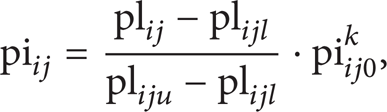
In formula (1), piij0
k
means the kth power of piij0. Formula (2) represents the change effect on a downstream task
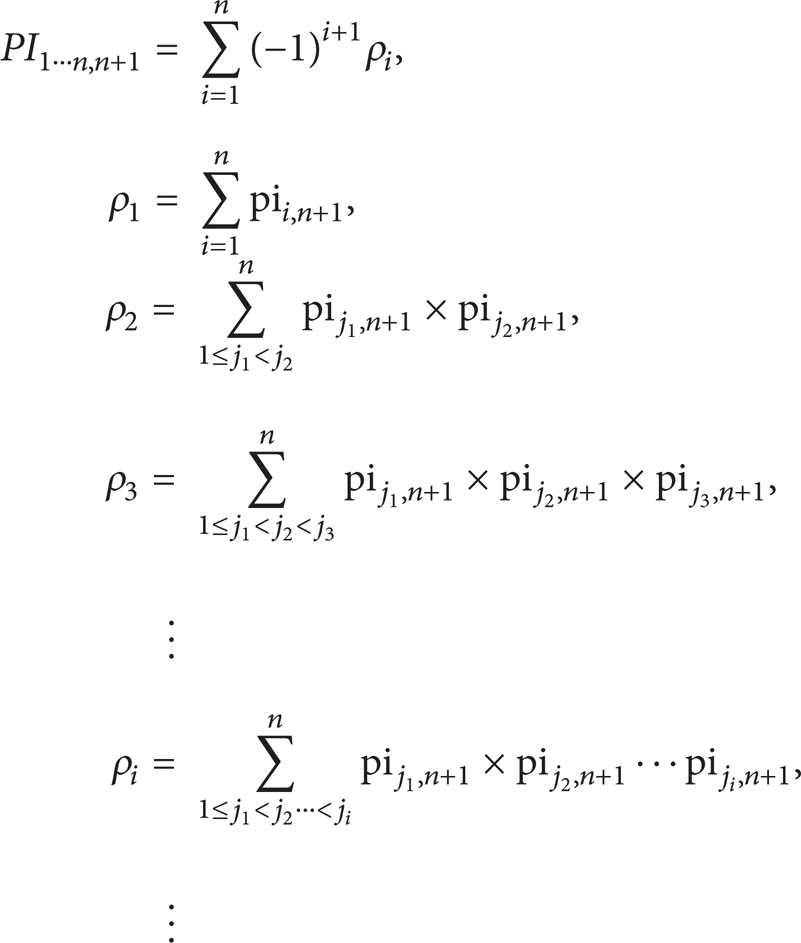
Formula (5) computes the total propagation impacts on the dependent task in the “Join-And” process scheme. It is the summation of impacts from the precedent tasks that are reworked for design changes. In the “Join-Or” process scheme, because any precedent design task can activate the dependent task, the task processing duration is calculated from the time it's activated to when all the impacts from its upstream tasks are handled, so the total impact, PI1⋯n, n + 1, is computed by formula (6), where n is the number of the total precedent tasks. The “Join-Xor” merge scheme can be taken as an extreme case of the “Join-Or” scheme, in which only one upstream task is effective to activate the dependent one.
3.2. The Change Propagation Duration Model
The scheduling objective of change propagation process is to minimize D(P), the change propagation duration. The duration can be described by the following formulae and constraints:


If a design process is composed of a tandem queue of n sequential blocks B
i
(i = 1,…, n), then the process duration D(P) is formula (7); D(B
i
) is the duration of change propagation through block B
i
. If a project running process consists of m parallel queues, each of which comprises n
i
(i = 1, 2⋯m) sequential blocks, then the process duration is formula (8). For the “Join-And” block, formula (9) is used to account for the waiting strategy and tasks solving process, where n is the number of input branches before the “Join-And” task, and D(BJA) is the duration of change propagation through the “Join-And” block; D(Tn + 1) is the expected duration of task
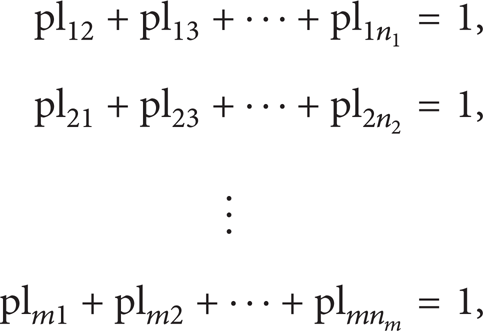
To model the “Split-” junctions uniformly, a design variable is given to each branch emanating from the junction. For the “Split-Xor” junction, the variable can be 1 or 0, which indicates whether the corresponding branch is traversed or not. For the “Split-Or” junction, the variable is assigned a value between the upper and the lower bounds of the propagation likelihood, and the total propagation likelihood must be 1 for the “Split-Or” and “Split-Xor” junctions, which means all the proportions of change results from the upstream tasks must be propagated to the downstream tasks in order to completely handle the original design change. For the two “Split-” junctions, the constraints (11) are concomitant, where m is the number of “Split-” junctions, and n i , i = 1, 2⋯m is the number of branches for the “Split-” junction:
and for the kth iteration, we have

4. Scheduling of Design Changes
Usually many different paths that represent different solutions are available for a design change to evolve along. When a change requirement can be satisfied by several different solutions simultaneously, parallel change propagations can be carried out to implement the change rework in order to reduce process duration. A simulation based method is proposed to compute the process duration when a designer simultaneously distributes changes to downstream tasks, as shown in Figure 3. Detailed information about the simulation algorithm can be found in [23]. By combining the optimization method, such as genetic algorithms, with the simulation algorithm, the optimal scheduling of changes can be carried out. However, for a complex engineering design problem, there are tens or hundreds of design dependencies, which lead to the fact that the alternative paths a change can evolve along are numerous. But for a particular design change, firstly, not all of the dependencies may be involved in the change propagation process. Secondly, even for some dependencies that are traversed, their contributions to the total process duration or cost are negligible. For GA based optimization method, encoding the design variables is the first step in conducting the optimization process. When a number of variables that are trivial to the optimization objective exist in the encoded chromosome, the search efficiency of the algorithm will decrease. Therefore, the removal of trivial dependencies from the process network is an important measure to improve the efficiency of GA based optimization method for this change scheduling problem. The sensitivity of process duration of parallel change propagations with respect to each optional dependency is a critical measurement for evaluating the importance of dependency. The global sensitivity analysis, namely, the elementary effects method, is adopted in the paper to screen the important input factors among the many that are contained in the process network model.

The algorithm for calculating the change impacts [23].
4.1. Elementary Effects Method for Change Propagations
Elementary effects (EE) method belongs to the One-at-a-Time (OAT) designs, but it can partially overcome the main limitations of the OAT design [24]. The concept of elementary effects was first introduced by Morris [25]. Consider a model with k independent inputs X i , i = 1,…, k, and each input varies in the k-dimensional unit cube across p selected levels. The elementary effect of the ith input factor is defined as

where Y is the process duration for handling the change, Δ is a value in {1/(p − 1),…, 1 − 1/(p − 1)}, the factor X i represents the propagation likelihood for each involved dependency, X = (X1, X2,…, X k ) is any selected value in the p-level grid Ω such that the transformed point (X + e i Δ) is still in Ω for each index i = 1,…, k, and e i is a vector of zeros but with a unit as its ith component. The mean μ i of all the EE i assesses the overall influence of the factor on the output. Campolongo et al. [26] proposed replacing the use of the mean μ i with μ i *, which is defined as the estimate of the mean of the distribution of the absolute values of the elementary effects. This paper takes μ i * as the estimate of the elementary effect of input factor X i . Another critical point for conducting EE analysis is sampling a number of points for the computation of effects. Morris [25] suggested an efficient design that builds r trajectories of (k + 1) points in the input space, each providing k elementary effects, one per input factor, for a total of r(k + 1) sample points. A randomized version of the sampling trajectory is given by the equation [24]:

where
With the above sampling strategy, r trajectories in Ω can be constructed. Each trajectory corresponds to (k + 1) model executions and allows the computation of an elementary effect for each factor X
i
, for i = 1,…, k. If

Once r elementary effects per input are available (EE i j , i = 1, 2,…, k, j = 1, 2,…, r), the statistics μ i * for measuring the importance of factor i is
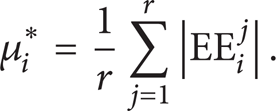
In the formula (15), Y(
Task durations and input-output types.


A motorcycle engine design process model.

Global sensitivity index for each dependency based on EE analysis.
4.2. GA Based Optimal Scheduling of Change Propagations
The scheduling of the change propagation process involves the selection of change evolution paths and proportional allocation of the changes to the downstream tasks. To obtain the optimal solution steadily, a steady state genetic algorithm [27] is adopted to solve this kind of quadratic combinatorial problems. After the genetic population is initiated, the algorithm mainly includes 4 steps, namely, population selection cross and mutation, new population generation and evaluation, population scaling and replacement, and population statistics. Based on the above global sensitivity analysis, some dependencies do not play important roles in the change propagation process although they may be traversed in the propagation process. To seek the optimal propagation path for a change efficiently, it is expected by designers that these nonimportant dependencies are not encoded in the individual genome during the GA initialization and evolution stages. A heuristic encoding scheme is chosen to encode the first N important dependencies (the number N is decided by designers) ranked according to their global sensitivity indexes. The GSI based heuristic and complete encoding processes for preprocessing the dependencies are shown in Figure 6. For the change originating from the “rear crankshaft design” task, the first 54 dependencies are encoded in the individual genome according to the global sensitivity index shown in Figure 5.

The complete and heuristic encoding methods.
For the selection scheme of the algorithm, ordinal-based selection scheme, namely tournament selection, is adopted in the research work considering that fitness proportionate selection scheme often fails to provide selection pressure when the variance in the population is high or low. The simulation based evaluation of individuals is divided into two steps, namely, determination of propagation paths (Figure 7) and computation of propagation impacts (Figure 3). As described in the change propagation process model, there is a constraint for each “Split-Or” and “Split-Xor” task node. For the “Split-Xor” node, a simple selection method is used; that is, the first downstream path with propagation likelihood of 1 is selected as the change propagation path. If all the genes for the downstream dependencies emanating from the “Split-Xor” node are 0, then the last encoded dependency is selected as the propagation path. Dependencies that are not encoded in the genome are treated as the dependency with the gene of 0. For the “Split-Or” task node, a weight based method is used to determine the propagation likelihood of each “Split-” downstream path; that is, all the decoded PL values of paths are added together to get the sum, and then the PL of each path is divided by the sum to make the constraint exactly satisfied. For those “Split-Or” downstream dependencies that are not encoded in the individual genome, a random value in the PL range is assigned for the path. But their final values will also be divided by the sum in order to satisfy the constraint. The flowchart for computing the propagation impacts for each “Join-” node is shown in Figure 3, and detailed information about the procedure can be found in [23].

Determination of change propagation paths.
4.3. Comparisons of Optimization Results
Change propagation optimization results based on complete process model encoding and global sensitivity index based heuristic process model encoding methods are obtained, as shown in Figures 8–12. Figures 8 and 10 are the optimization histories for the two encoding methods. It is shown that the optimal values, 5.1 and 5.03 days, are obtained for the two methods. Based on these two numbers, it seems that the heuristic encoding method has no significant improvements compared to the complete encoding method. The change ratio for the emergent design change originating from the “rear crankshaft design” task is 0.6, which means the time required for solving this change without considering its propagation effects is 0.6 × 8 = 4.8 days (the complete duration for solving this task is 8 days). So the durations for the parallel execution of downstream tasks are 0.3 and 0.23 days, respectively, for the two encoding methods. The heuristic encoding method reduces more than 23% of the total duration for resolving the change impacts generated by the instigating design task. This shows that the removal of nonimportant dependencies from the chromosome is effective for improving the final optimal results.

Optimization history based on complete process model encoding.

PL values for each involved dependency based on complete process model encoding.

Optimization history based on heuristic process model encoding.

PL values for each involved dependency based on heuristic process model encoding.
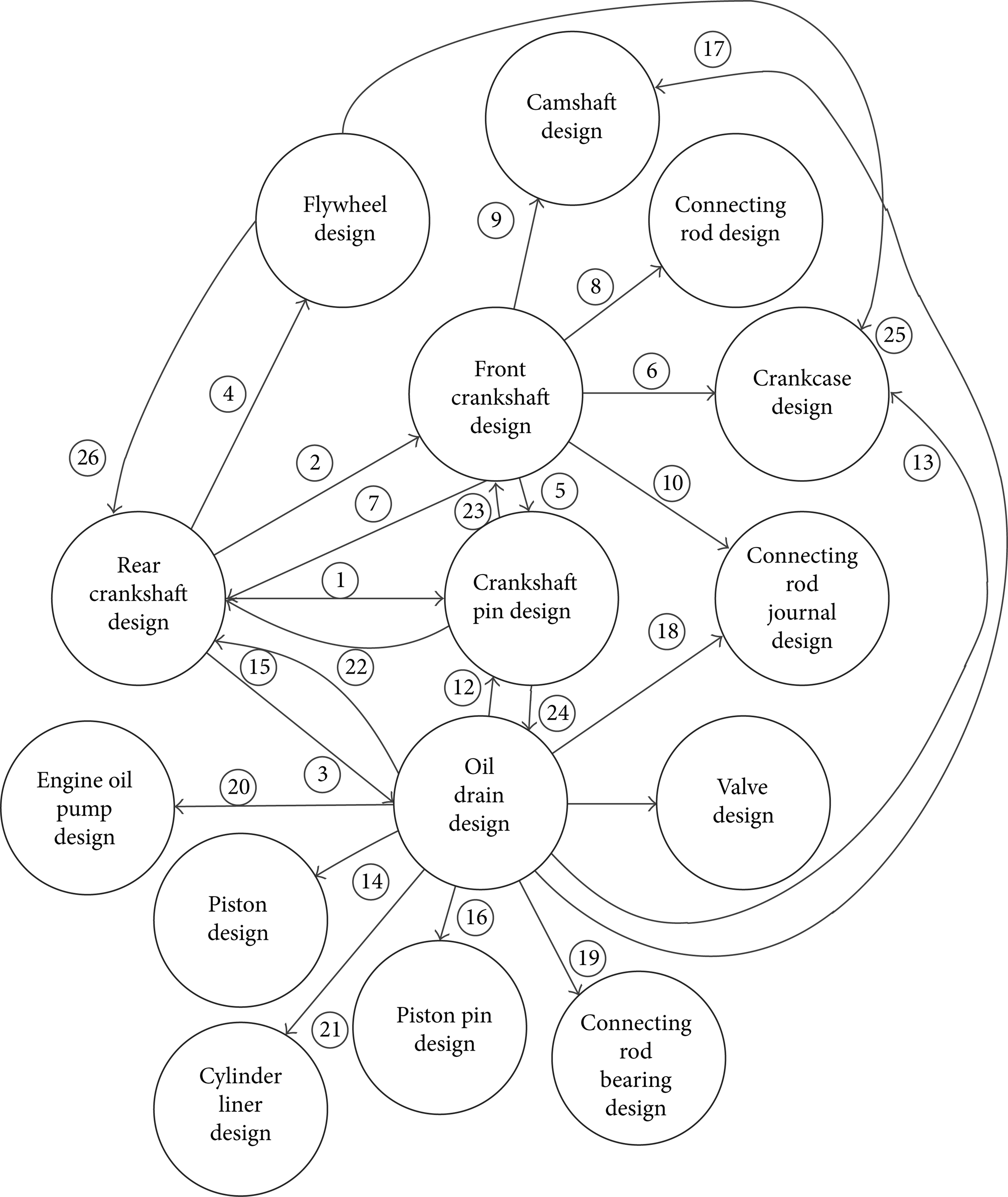
Propagation paths for the change originating form “rear crankshaft design” task.
Figures 9 and 11 show the propagation likelihood for each involved dependency. The radar plots show the propagation likelihood for optional change evolution paths in the process model in a concise way. Each ray in the figure represents an optional output path for changes to propagate along, the circles as well as the decimals beside them are the scale of figure, and the red portion of ray indicates the propagation likelihood value for the corresponding path. The higher the value is, the further the red portion will be from the midpoint. According to these figures, there are only 26 dependencies involved in the change propagation process. The algorithms based on two encoding methods can find the same dependencies simultaneously, as shown in Figure 12. However, different PL values are assigned to these dependencies which result in different final change process durations. Although the final solution has 26 dependencies, it does not mean that other dependencies are not traversed during the optimization process. In the heuristic encoding method, 54 dependencies are selected to include all possibly traversed dependencies. According to the propagation process shown in Figure 12, the change ratio for the emergent change originating from the “rear crankshaft design” task is 0.6, and most propagation processes in this figure have 3 change transmissions. This result is consistent with the actual change propagation cases according to the author's survey in the China Qingqi Motorcycle Group. As has been pointed out in the global sensitivity analysis, four dependencies, namely, “rear crankshaft design-flywheel design,” “rear crankshaft design-front crankshaft design,” “rear crankshaft design-oil drain design,” and “rear crankshaft design-crank shaft pin design,” are most important in the change propagation paths. To decrease the change propagation duration as much as possible, the PL values for the four dependencies in the optimization results based on the complete and heuristic encoding methods are 0.06, 0.15, 0.37, 0.42 and 0.13, 0.14, 0.26, 0.47. The former results merit further improvement to increase the PL values of dependencies “rear crankshaft design-flywheel design” and “rear crankshaft design-front crankshaft design” and to decrease the PL values of dependencies “rear crankshaft design-oil drain design” and “rear crankshaft design-crankshaft pin design.” Thus the concurrency of parallel executing of change results from the original design task can be increased, and the complete duration for handling the change requirements can be shortened further. The above values also indicate that the less impact the change can cause to a task, the more change proportions are allocated to it. For example, the task “crankshaft pin design” is given the greatest change proportions in the two optimization results.
5. Conclusions
In this paper, a global sensitivity analysis method based heuristic genetic algorithm is developed to schedule design changes in complex engineering design process. The contributions of the paper include the following. (1) Elementary effects based global sensitivity analysis is conducted on change propagations in order to obtain the importance of each involved dependency. (2) An integrated simulation-optimization method is developed to schedule design changes; optimal results obtained by using the complete and heuristic dependency encoding methods are compared. According to the optimal results, the heuristic method has advantage over the complete search method for the quality of the recommended change propagation path. Future work would be directed to apply the change propagation model and the optimization method to more complex product development process models to test their efficiency and effectiveness.
Conflict of Interests
The authors declare that there is no conflict of interests regarding the publication of this paper.
Footnotes
Acknowledgments
This research work is funded by the National Natural Science Foundation of China with the Grant no. 51175457. The first author is also supported by the Fundamental Research Funds for the Central Universities of China.