




Abstract
A cruising sensor network works as an online monitoring system for industrial liquid environments such as oil tanks and nuclear storage ponds. The cruising sensor network consists of a few submerged nodes which can actuate themselves to execute tasks like “cruising.” This paper presents a multicarrier spread spectrum scheme, which is designed for communications between the nodes and the control station. Although underwater acoustic communication has been widely researched due to the growing demands from ocean development and marine research, communication in confined underwater space is an unexplored domain as most research focuses on communication in spacious water areas. The occasions that the cruising sensor network works in are confined. The main distinction in confined underwater spaces is the existence of strong multipath arrivals reflected by the boundaries, which can cause more severe intersymbol interference (ISI). We propose a communication scheme which applies spread spectrum in orthogonal frequency-division multiplexing (OFDM) to address severe frequency selective fading channels. This scheme can be robust in confined underwater channels when coupled with turbo code. The simulation and experimental results prove the feasibility and reliability of this scheme. It is demonstrated that significantly better performance is achieved than that of the conventional OFDM method.
1. Introduction
The research of this paper is based on cruising sensor network which takes charge of large oil storage tank online detection. Cruising sensor network consists of several actuated wireless sensor nodes. These wireless sensor nodes are ball-shaped, carry various types of sensors, and could independently move about in the large oil storage tanks. The advantage is that the sensors could get more detail messages by “cruising” to a specified place when monitoring the industrial process. The sketch map of the working cruising sensor network is shown in Figure 1. Cruising sensor network has promising application in the online multiparameter detection and supervision of industrial liquid environments such as oil tanks, industrial ponds, and reservoirs.
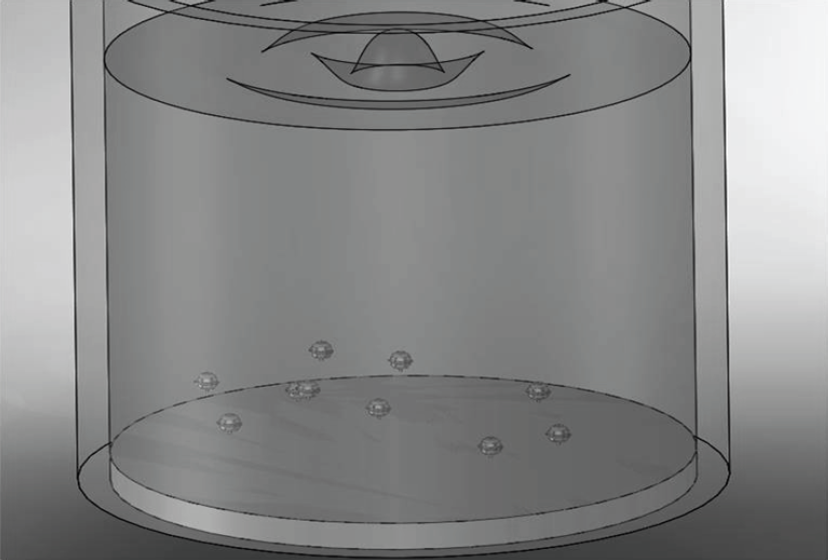
The sketch map of cruising sensor network working in the oil tank.
Data exchange between the nodes and the control station necessitates a reliable and high-speed underwater acoustic (UWA) communication scheme. Underwater acoustic communication has always been considered to be difficult but research has made great progress in combating the negative effects of the underwater channel [1]. Most existing research concentrates on spacious environments such as seas and lakes; however, many of the industrial reservoirs such as large oil tanks and nuclear storage ponds are confined. The main difficulty to realize robust underwater communication in such a limited space is the more severe multipath influence caused by numerous reflections from the boundaries.
To deal with the multipath fading in UWA channels, traditional methods resort to a decision-feedback equalizer (DFE) at the receiver. Although good performance is achieved, it comes at the price of high computational complexity, especially when used in channels with a long delay spread and rapid time variation [2–4]. Passive phase conjugation (PPC) has attracted much attention recently as it alleviates the burden of computational complexity and reduces intersymbol interference (ISI); however, it relies on large arrays [5, 6]. For this reason, PPC is not suitable for our application on account of power consumption limitations and simplicity of the nodes.
Direct sequence spread spectrum (DSSS) technique has been demonstrated to be reliable in UWA communication [7–11]. The DSSS technique not only features a low probability of interception but also is immune to multipath interference. In DSSS modulation, the spread spectrum process is achieved by multiplying the information signal with a spreading code. Due to the strong autocorrelation property of the spreading sequence, multiple arrivals can be separated via the despreading operation which suppresses the multipath interference. Researchers have done a great deal of work to enhance the performance of a DSSS system. Stojanovic and Freitag applied adaptive channel equalization to suppress ISI [8]. Sozer et al. applied a RAKE receiver to combine multipath arrivals [9]. In T. C. Yang and W. Yang's research, DSSS was coupled with passive-phase conjugation to achieve communication with low SNR input signals [10]. However, due to the conflict between the spread spectrum process and a limited available bandwidth of UWA channels, the main drawback of DSSS technique is the bandwidth efficiency, which is lower than 0.5 bit/s/Hz [12]. Therefore, DSSS systems are most commonly used in low-speed UWA communication where the data rates are often in the order of hundreds of bps.
Orthogonal frequency-division multiplexing (OFDM) is a prevailing technique used in wireless communication [13, 14]. The main idea of OFDM is to divide the bandwidth into many subchannels and transmit relatively low-speed data streams in a parallel way over these subchannels, each of which experiences frequency-flat fading. Therefore OFDM performs robustly in multipath environments with a high spectral efficiency [15]. Another advantage of OFDM systems is low complexity. OFDM modulation and demodulation can be easily implemented using fast Fourier transforms (FFT). In Frassati et al.'s research, an experiment was conducted to compare the performances of OFDM and DSSS in shallow waters of the Mediterranean Sea, and the result showed that OFDM outperforms DSSS [16].
In order to decrease ISI, one method is to split the bandwidth into more subchannels in the OFDM system. However, this method also introduces some negative effects, for example, a larger implementation complexity and more sensitivity to phase noise and frequency offset, as well as an increased peak-to-average power ratio. Another method is to insert a cyclic prefix (CP) in front of each OFDM block. Although using a cyclic prefix (CP) can cancel out most ISI and intercarrier interference (ICI), the cyclic prefix may be undesirably long where there is a long time spread [4]. In addition, the attenuation of multipath arrivals is very weak in confined underwater space. The strong multipath interference calls for a more powerful antimultipath scheme.
In this study, we propose an SS-OFDM scheme, which combines spread spectrum and OFDM, to overcome the severe interference of ISI in confined underwater channels. In the proposed scheme, the data sequence undergoes the procedure of spectrum spreading before OFDM modulation; thus, the residual multipath interference is significantly suppressed. The working process and principle of SS-OFDM are addressed. We compare the proposed scheme with conventional OFDM schemes and demonstrate superior antimultipath performance based on the simulation analysis and experimental results.
This paper is organized as follows. Section 2 introduces the system model and the mathematical description of the antimultipath performance of OFDM and SS-OFDM. Section 3 presents the simulation results. Section 4 shows the experimental design and results. Section 5 summarizes the paper.
2. System Description and Analysis
In this section, we develop an SS-OFDM system model for communication in confined underwater channels. Then, we introduce the transmitter structure in detail and analyze the antimultipath performance of an SS-OFDM system.
2.1. System Description
In our proposed scheme, turbo code, which is known as a strong channel code, is adopted to enhance the system performance. The basic principle and procedure of SS-COFDM (coded OFDM) are given in Figure 2.

The framework of the SS-COFDM communication system.
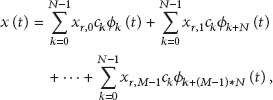
The source signal is turbo-encoded, interleaved, and then mapped into a QPSK constellation (the most commonly used modulation mode in OFDM). The data sequence is then converted into M parallel data streams, as for conventional OFDM systems. For SS-OFDM, the next step is to replicate each stream to N copies. The signal will enter the spread spectrum process which is shown in Figure 3. N is equal to the length of the spreading code—a pseudonoise (PN) sequence, which is multiplied with each of these copies. Now there are
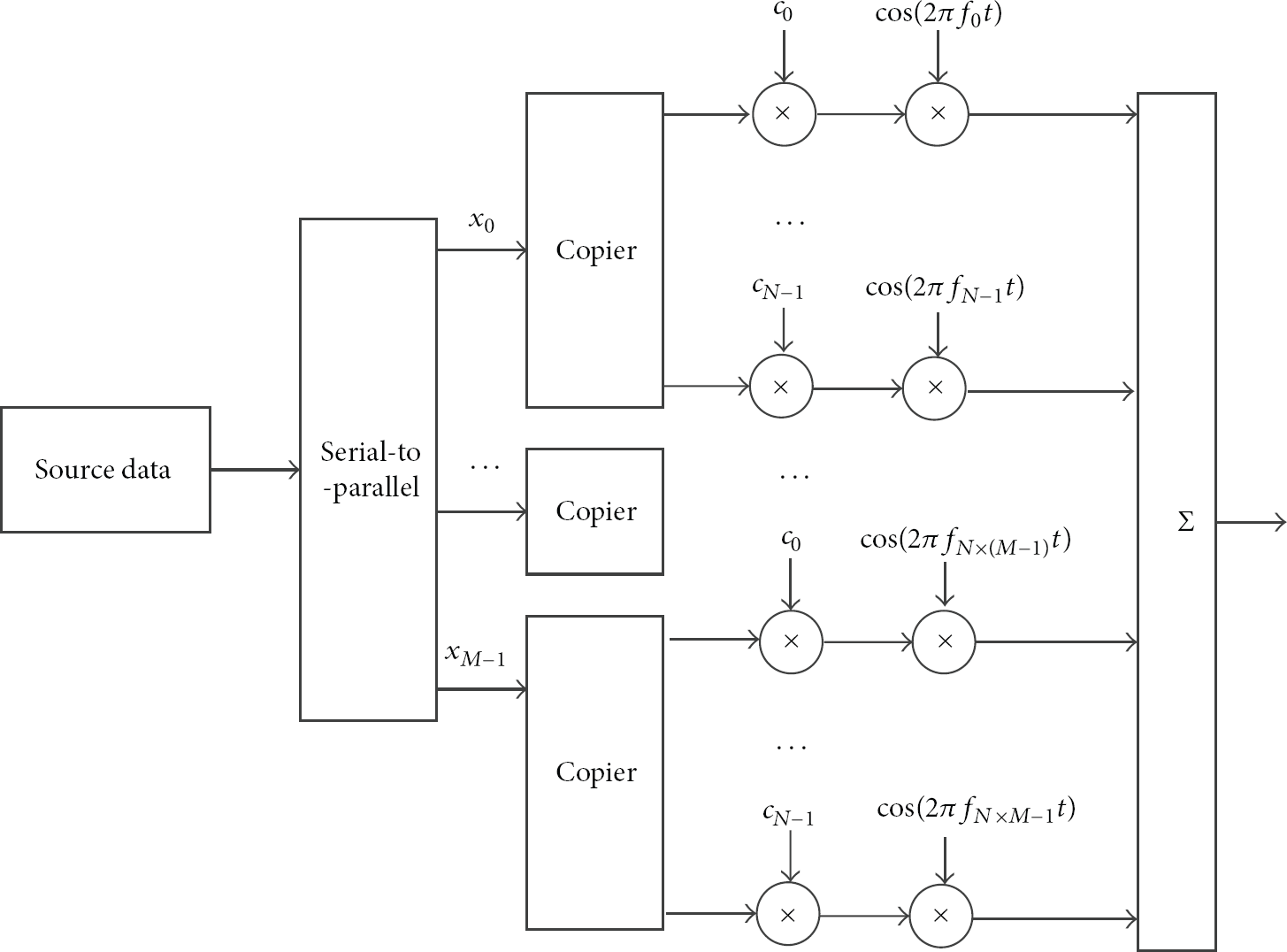
Process of spread spectrum in SS-OFDM at the transmitter.
Let
The orthogonal basis functions are

In the demodulation process, based on the orthogonality between the subcarriers, the result for the lth subcarrier for the rth block (assuming

The demodulation process in (3) can be extended to all the subcarriers. After demodulation, the received array is

Then, after the despreading process, we obtain the data sequence
2.2. Antimultipath Performance Analysis
In this section, we provide the antimultipath performance analysis of the proposed SS-OFDM scheme. In (2), without loss of generality, we only consider the first term. The transmitted symbol sequence is

We consider two types of possible multipath interferences that the conventional OFDM system is not able to eliminate in confined underwater space. The first is interference caused by echoes exceeding the guard time and the second is frequency selective fading when the symbol duration of each subcarrier is not long enough.
In order to facilitate this discussion, we consider the transmission of the signal over a two-path channel. Ignoring the Doppler shift, the received signal can be written as


By analyzing the antimultipath performance of SS-OFDM, we can conclude that the spread spectrum process eliminates the residual ISI that a conventional OFDM system is not able to address.
3. Simulation Results
In this section, we present simulation results in order to validate the performance of OFDM and SS-OFDM in the theoretical analysis.
3.1. Channel Model
We begin by establishing an acoustic channel suitable for confined underwater space. Usually, UWA channel simulation studies are modeled on the sea. In such a UWA channel, complex time-varying oceanographic processes and ocean surface waves often produce a channel with short coherence time [17], so channel variation is an important issue which must be taken into account. However in oil storage tanks, the liquid is in a stationary state. Thus we refer to a time-invariant response acoustic channel proposed in [18].
In the model, each multipath acts as a low-pass filter. The transfer function of the pth propagation path is
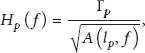

The overall channel response is

3.2. Simulation Results
Our considered channel for the simulation does not include the Doppler shift, and the lengths and relative delays of multiple propagation paths in the model are calculated from the geometry of the oil tank. There are totally 130 paths in the channel. The maximum time delay of the channel we propose is 45 ms.
We provide the BER analysis of OFDM and SS-OFDM in the channel. We set the number of effective subcarriers to 512 in OFDM, the carrier frequency is 10 kHz, and sample frequency is 50 kHz. QPSK modulation is used on each carrier. The IFFT size is 2048, the block duration is 41 ms, and each subcarrier is spaced by 24.4 Hz. In SS-OFDM, the number of effective subcarriers decreases because of the spread spectrum process. We adopt different lengths of cyclic prefix in OFDM and different lengths of PN sequence in SS-OFDM to analyze the system performance. The parameters are shown in Table 1.
The system parameters of OFDM and SS-OFDM in the simulation.

Figure 4 shows performance results of the SS-OFDM and OFDM system. We can see the BER decreases as the cyclic prefix elongates in OFDM system. To address the long time delay of the channel, the length of the cyclic prefix could be longer than 100 ms. Correspondingly, SS-OFDM shows better performance in this multipath fading channel with the cyclic prefix length only 8.2 ms. The BER decreases as the length of PN sequence increases in SS-OFDM; however, the data rate also decreases.

BER performance of SS-OFDM and OFDM.
4. The Experiment
4.1. Experimental Environment
The experiment was conducted in the quadrate tank in the laboratory, and the side length of the tank is 1.5 m. Since no sound absorption measure is adopted, this is a typical confined underwater channel with severe multipath fading. The transmitter and receiver were deployed in opposite corners of the tank.
To test the channel, a sine signal of 50 kHz frequency lasting 20 cycles was sent, and the received signal is shown in Figure 5. The direct signal is enclosed by the rectangle and the amplitude in the picture is a relative value. We can see that the channel condition is particularly harsh in the test, the multipath arrivals decay slightly in the first 20 ms we intercept, and the multipath signal next to the direct signal nearly has the same amplitude with the direct signal. We can see more details in Figure 6 which displays a 10 ms capture. The multipath arrivals are numerous and intensive with large amplitudes.

Channel condition of the tank in the laboratory.
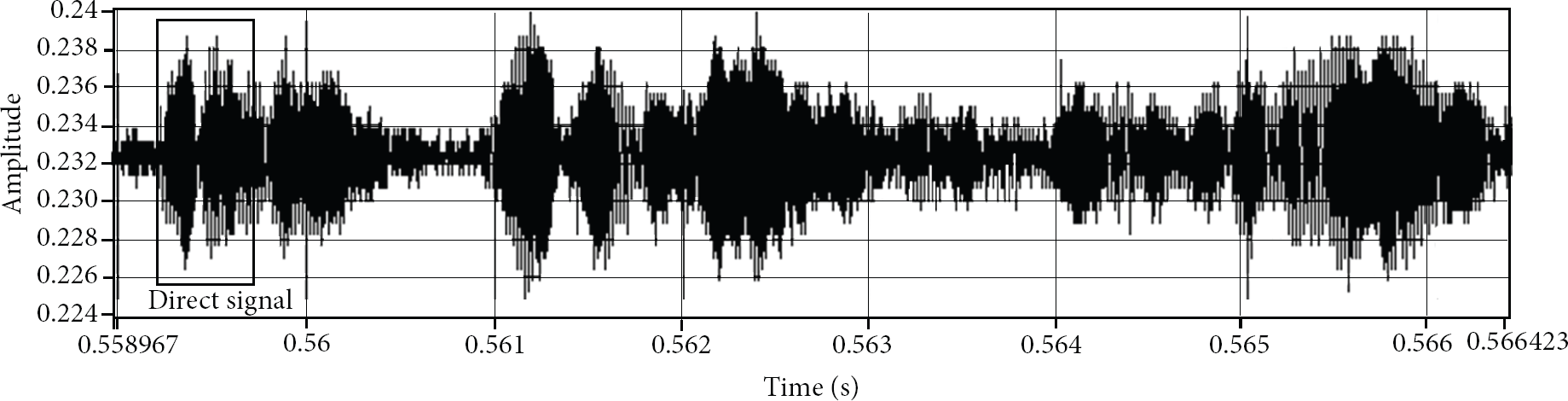
Front 10 ms received signal.
Then we measured the channel impulse response by transmitting a 100 ms LFM signal with frequency swept from 30 kHz to 80 kHz. By calculating the cross-correlation functions between the received signal and the original LFM signal, the measured channel response can be shown in Figure 7. The maximum time delay is more than 50 ms.
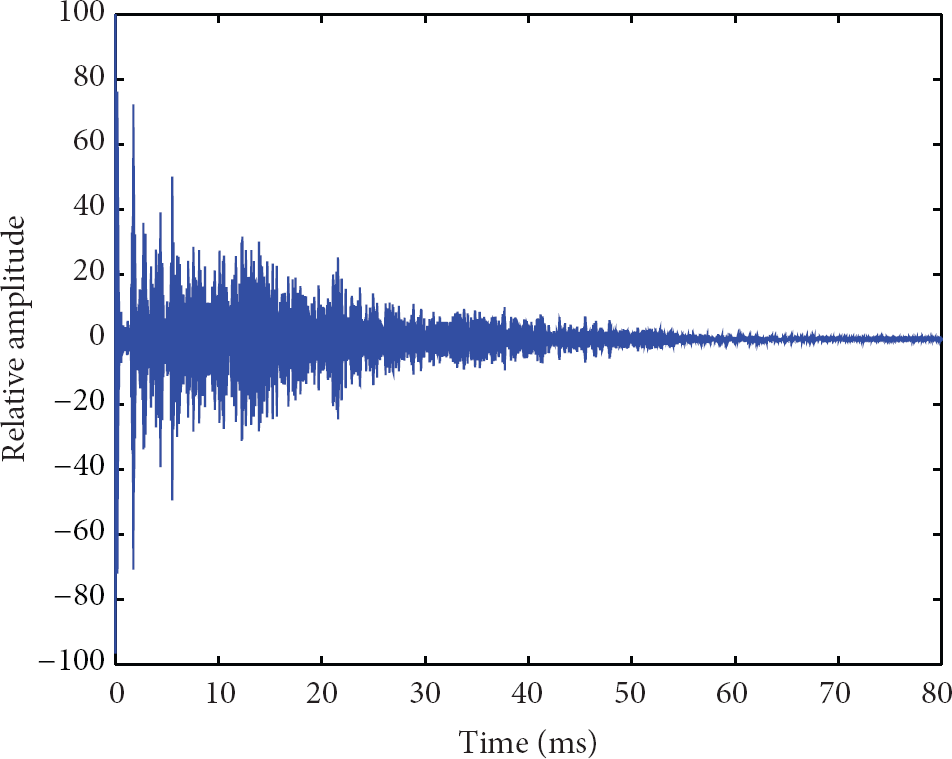
Channel response in time domain.
4.2. Experimental Results and Analysis
At the transmitter, we set the sample frequency 500 KHz to make the carrier frequency 50 kHz, which is also the resonant frequency of the transducers. The OFDM modulation is realized by an IFFT with a size
We evaluate the OFDM system performance with different lengths of cyclic prefix and the results are shown in Table 2. The BER reduces as the guard interval length is increased, but the system performance is unsatisfactory even with a guard interval of 32.8 ms, the same length as the symbol duration of OFDM.
Performance of OFDM scheme with different lengths of guard interval.

We can enhance the IFFT size of the OFDM system in order to increase the time duration of each subcarrier. The length of the guard interval
Performance of OFDM scheme with different IFFT sizes.

The SS-OFDM scheme has similar parameters to the experiments in Table 2. The difference is that the bandwidth is widened by the spread spectrum sequence. We use M sequence with length of 15 as the spread spectrum sequence. We compare the performance of the SS-OFDM with different lengths of cyclic prefix. The experimental result is shown in Table 4.
Performance of SS-OFDM scheme with different lengths of guard interval.

We can compare the experimental results with Table 2 and notice that much better performance is achieved with the same parameter settings in the SS-OFDM system. When
In order to further improve the system performance, turbo code, which is a strong channel coding method, is adopted to construct SS-COFDM scheme and compared with the last two schemes. In a turbo coding system, the data rate is halved because the coding rate is
Performance of SS-COFDM scheme with different subcarrier numbers.

5. Conclusions
In this paper, we focused on building a reliable and high-speed communication scheme in confined underwater environments due to the need for application of cruising sensors network in online detection of oil tanks. Conventional OFDM scheme performs inferiorly in this environment, and we investigated SS-OFDM, the combination of DSSS and OFDM, and better performance was achieved when turbo code was employed simultaneously. We were able to demonstrate error-free transmission at data rate up to 5.66 kbps and low BER at 11.32 kbps in the experiment. In addition, this scheme offers convenient method for multiple users to access the channel simultaneously and asynchronously, an important research direction for the future.
Footnotes
Conflict of Interests
The authors declare that they do not have any commercial or associative interest that represents a conflict of interests in connection with the paper they submitted.
Acknowledgments
This work has been supported by the National Natural Science Foundation of China under Grant no. 61074181 and Tianjin Research Program of Application Foundation and Advanced Technology (13JCYBJC18000).