




Abstract
It is impossible to directly measure the thermal radiative properties of shading nets because of the net's perforated structure and the difficulty to distinguish the transmitted, reflected, and emitted radiation on the net surface. In addition, Kirchhoff's identity was derived for an object in thermal equilibrium and exchanges only thermal radiation with its surrounding, and the assumption that is valid for an object exchanging solar and thermal radiation and convection with the surrounding is unclear. This study was to (i) develop a theoretical model to predict the absorptivity, α n ; transmissivity, τ n ; reflectivity, ρ n ; and emissivity, ∊ n , of plastic nets and (ii) examine the equality (∊ n = α n ) under natural conditions. Nets with different porosities, texture structures, and colors were tacked onto a wooden frame, fixed horizontally over a black substrate. Thermal radiation balance was applied to the net-substrate system. The model input parameters (i.e., the thermal radiation fluxes below and above the net; the net and substrate temperatures) were measured on sunny days. The estimated values of α n and τ n were in the ranges 0.41–0.82 and 0.16–0.55, respectively, whereas ρ n ≤ 0.08 for the nets tested. Under the steady-state natural conditions, ∊ n = α n for a net in thermal equilibrium. However, the solar and thermal radiation absorbed by the net did not equal the emitted radiation.
1. Introduction
Low-cost high density polyethylene (HDPE) nets are extensively used for shading purposes in hot and sunny regions such as in the Arabian Peninsula. For example, nets are used for external or internal shading in greenhouses or used alone as net houses to protect plants against intensive solar radiation [1, 2]. Perforated nets act as barriers between the plants and the ambient environment and thus protect crops from frost in winter and sun spots in summer [3, 4]. Many farmers worldwide use net houses (shade netting) for crop production instead of greenhouses because plastic net coverings have many economical and environmental advantages over the greenhouse coverings (i.e., plastic films) [3, 5]. Plastic nets are also used to shade car parks, roofs of residential and industrial buildings, playgrounds, and swimming pools to reduce the solar radiation heat load in summer [3]. In order to investigate the heating or cooling load in structures covered with nets, different modes of energy exchanges with the net need to be determined. Knowledge of solar and thermal radiation exchanges with the net covering is essential for such an energy analysis. Several studies have examined the solar radiative properties of plastic shading nets and the nets’ exchange of solar radiation. For example, Hemming et al. [6] used a light model, developed mainly for greenhouses, to analyze the radiometric performance of a structure covered with plastic nets. Castellano et al. [7–9] examined the influences of construction parameters (i.e., net porosity, color, and shading factor) on the spectral transmittance of different plastic net-covered structures on the ultraviolet, visible, and near infrared spectrum wave bands. Al-Helal and Abdel-Ghany measured the solar radiative properties of several shading nets under natural conditions [10] and Abdel-Ghany and Al-Helal investigated equivalent optical constants for these nets similar to the homogeneous translucent materials [11]. On the other hand, few laboratory studies, when found, have investigated the thermal radiative properties of plastic shading nets and/or metallic shade screens [12–17]. In general, studies related to thermal radiation exchanges with plastic shading nets under natural conditions (in the presence of solar and thermal radiation and convective heat) are limited.
The thermal radiative properties (over wave lengths > 3 µm) of homogeneous materials such as glass or plastic films used to cover greenhouses (i.e., usually opaque to transmit thermal radiation) are measured with infra-red (IR) detectors and other instruments in the laboratory. However, for perforated materials (plastic nets with nonhomogenous surfaces), IR detectors cannot correctly measure the emission from the net surface (E n ) as well as the radiative properties. This is because the IR detector would measure not only the thermal radiation that is emitted from the net surface but also the thermal radiation emitted from the surrounding objects and the sky dome that is transmitted through the net pores to the detector. On the net surface, the reflected, transmitted, and emitted thermal radiations exist together and cannot be separated. Therefore, it was impossible to measure the thermal radiative properties of a net (i.e., absorptivity, α n ; transmissivity, τ n ; and reflectivity, ρ n ) under natural conditions correctly by using measuring devices. In addition, to determine the net emissivity (∊ n ), the emitted radiation from the net surface (E n ) needs to be determined separately from the reflected and transmitted thermal radiation.
For an object in a large enclosure at a constant temperature that experiences no energy input or output other than thermal radiation, thermal radiation absorbed by the object increases its internal energy, whereas the transmitted and reflected radiation do not. In order for the temperature of the object to remain constant, the object must emit (radiate) the same amount of energy that it absorbs and under these conditions the object is in thermal equilibrium. Based on these criteria, Gustav Kirchhoff in 1859 concluded that, for presumed gray surface, the emitted thermal radiation is equal to the absorbed thermal radiation [18]. Accordingly, Kirchhoff's identity for a gray surface as “the total hemispherical emissivity of a surface (∊) is equal to its total hemispherical absorptivity (α)” was established [18]. On the other hand, the gray surface under natural conditions (in the presence of solar and thermal radiation and surrounding air that conducts convective heat) will be in thermal equilibrium as long as its temperature does not change. In other words, the sum of absorbed solar and thermal radiation, emitted thermal radiation, and convective heat exchange for the surface is zero. In practice, thermal equilibrium is possible to be achieved within short period for an object exchanging solar and thermal radiation and convective heat with its surrounding if the object temperature remains constant over this period. Large number of studies used the approach α = ∊ in their analysis with considering only thermal radiation exchange and neglecting convection. For example, Wen and Mudawar [19] measured the effect of surface roughness on ∊ of aluminum alloy; Sazhin and Sazhina [20] evaluated the effective emissivity of combustion gases by considering only the thermal radiation exchange between two surfaces of the enclosure; Edalatpour and Francoeur [21] used this approach to investigate the effect of the film thickness on its emissivity; Baldwin and Lovell-Smith [22] measured the emissivity of four stainless steel commercial samples, under natural conditions, to be used for dairy plant thermal design; Xia and Strieder [23] calculated the effective emissivity in a gas-soil fluidized bed; Gebhart [24] developed relations for determining the temperatures of opaque and nonopaque surfaces subjected to thermal radiation exchange. Although previous studies assumed that α = ∊ under different conditions considering only thermal radiation exchanges, the validity of this equality is still unclear under natural conditions (in the presence of solar and thermal radiation and convection) and needs to be examined in the practical situations.
Accordingly, the objectives of this study were to (i) develop a mathematical model (thermal radiation balance) aided with measured input parameters (i.e., downward and upward thermal radiation fluxes below and above the net; temperatures of the net and substrate) to precisely calculate the thermal radiative properties (absorptivity, α n ; transmissivity, τ n ; reflectivity, ρ n ; and emissivity, ∊ n ) for a net under natural conditions (in the presence of solar and thermal radiation and convection) and (ii) examine the applicability of Kirchhoff's identity to different types of plastic nets under such natural conditions. Nets with different colors, texture structures, and porosities (white, beige, green, and dark green) were selected for the study.
2. Materials and Methods
2.1. Shading Net Materials
Shading nets in the markets are usually designated by the net color followed by the nominal shading power. For example, white-50 means the net is white and it blocks 50% of the incident solar radiation. Four nets made from high density polyethylene (HDPE) were selected for the experiments. The net texture was made from colored threads or robs; the threads and robs were opaque to transmit solar and thermal radiation. The nets porosities (φ) were measured previously using an image processing method [25]. The estimated porosities of these nets were as follows: white-50, φ = 0.28; green-50, φ = 0.51; beige-80, φ = 0.12; and dark-green-80, φ = 0.21 [25]. The scanned photos of the nets were magnified several times and are illustrated in Figure 1 to show their different textures. Description of the net textures is as follows: white-50 is longitudinal interlaced threads (like woven robs, 2 mm, diameter) held by wires (1 mm, diameter); green-50 is also longitudinal interlaced threads (1.75 mm, diameter) held by wires (1 mm, diameter); beige-80 is longitudinal strips (1.2 mm thick; 2 mm width) held by interlaced strips; and dark green-80 is knitted wires (1 mm, diameter) performed with irregular openings.
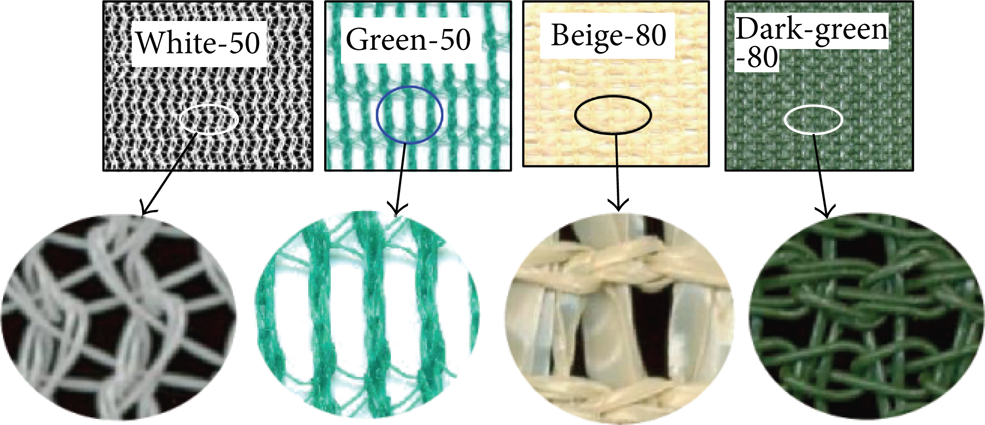
Magnified scanned photos for the tested nets with black background except the green-50 net with white background.
2.2. Experimental Setup and Measuring the Required Parameters
Experiments were conducted on clear sunny days under solar and thermal irradiance on the roof of the building of the Agricultural Research and Experiment Station at King Saud University (Riyadh, Saudi Arabia, 46°47′E, longitude and 24°39′N, latitude). Each net sample was tested during 24-hour period (from 6 a.m. to 6 a.m. of the next day); the experiments were conducted from April 3 to June 11, 2012. A wooden frame was constructed for the experiment (Figure 2), its base was covered with black cloth having an emissivity (∊ w ) of 0.93, and its sidewalls and top were hollow. The frame was 1.5 m width × 2 m length × 0.5 m height. Layout dimensions and locations of the instruments used to measure the required parameters are illustrated, not to scale, in Figure 2. The frame in Figure 2 was oriented longitudinally in the E-W direction and mounted horizontally at 1 m above the roof of the building. Unstretched net samples were tacked onto the frame, draped, and fixed on the frame upper sides. Horizontal bars were mounted 0.25 m above and below the center of the frame in Figure 2 to support the net-radiometers that were used to measure the net (downward-upward) solar and thermal radiation fluxes and the downward thermal radiation. The positions of the radiometers were optimized based on several pretrials carried out before starting the actual measurements. The measured parameters were as follows.
Net solar and thermal radiation above [Sn1 and (L1 − L2)] and below [Sn2 and (L3 − L4)] the net using net radiometers CNR-2 (Kipp & Zonen, B. V. Inc., USA): the net radiometers have a time response of 1 s, an accuracy of ± 3%, a working temperature range of −10°C to +50°C, and a wave length range of 3 µm to 25 µm.
Downward thermal radiation flux above and below the net (L1 and L3) using CGR-3 pyrgeometers (Kipp & Zonen, B. V. Inc., USA) has a time response of 1 s, an accuracy of ± 5%, and a wave length range of 3 µm to 25 µm. The net radiometers and the pyrgeometers were calibrated before use by the supplier.
The net temperatures (T n ) were measured in three locations using thermocouple junctions of 0.3 mm in diameter (copper constantan, type-T) inserted into the net texture. The inserted junctions were shielded using aluminum foil to eliminate the effect of radiation on the junction reading. A detailed description and validation of this method are reported in [26].
Substrate temperatures (T w ) at three locations using type-T copper constantan thermocouples of 0.3 mm in diameter: T w was expressed as the average of the three temperatures. The thermocouple junctions were attached to the substrate surface in such a way that they were exposed to solar and thermal radiation. The overestimation effect of solar and thermal radiation on the junction used to measure T w was excluded using correction factor reported in [27].
Air temperature (T a ) at 1 m above the net surface using aspirated psychrometer in which type-T thermocouple (copper-constantan) of 0.3 mm diameter was used: the psychrometer was calibrated with an Assmann type psychrometer, and the error was ≤1.1% for an air temperature ≤50°C. Each of the above parameters was recorded at 1-minute intervals and saved in a data logger (CR3000 Micrologger, Campbell Scientific Inc., USA).

Schematic diagram of the experimental setup and the locations of the measuring devices used to measure the required parameters, dimensions in m, not to scale.
2.3. Thermal Radiation Balance
The diffuse emission from the upper and lower surfaces of a net (E n ) would have the same directional characteristics as the transmitted and reflected diffuse thermal radiation. In other words, the thermal emission, transmission, and reflection of a net are all together and cannot be separated into three components. Therefore, a mathematical model is presented to determine the emission from the net surface (E n ) separately, and consequently the net emissivity (∊ n ). This model is also used to predict the other radiative properties of the net (i.e., τ n , ρ n , and α n ). Thermal radiation balance was applied below and above the net sample and above the substrate (Figure 3) assuming the following.
The net sample is sufficiently large that the end effects can be neglected in the radiation exchange.
The substrate and net surfaces are gray; that is, their thermal radiative properties are independent of the wavelength and direction.
The entire surfaces are diffuse reflectors and diffuse emitters; both the reflected and the emitted energy are diffuse, having the same directional characteristics.
Thermal radiation exchanges between the lower surface of the net and the black-substrate (Figure 2) undergo multiple reflections. In general, value of ρ n for perforated plastic nets made from high density polyethylene (HDPE) is low (ρ n < 0.1 according to [16]); therefore, value of ρ n to higher power (ρ n 2, ρ n 3, etc.) will be even lower. To simplify the analysis, the first reflection of thermal radiation on the lower surface of the net and on the substrate was considered and the multiple reflections were neglected. In such cases, neglecting the multiple reflections did not jeopardize the accuracy of solution.
All of the parameters in the analysis are time dependent, and to simplify the expressions, the functional relationship of time is omitted from all the symbols hereafter. The different modes of thermal radiation exchanges among the net surface, sky dome, and the substrate are illustrated in Figure 3. The thermal radiation balance per unit area of the net or substrate surfaces can be described as follows.

Simplified illustrations of thermal radiation exchange among the sky dome, the net sample, and the substrate.
The upward thermal radiation flux above the net surface (L2) can be expressed as

The downward thermal radiation flux (L3) underneath the net surface is given by

The upward thermal radiation flux above the substrate (L4) can be expressed as

In (1)–(3), the instantaneous values of thermal radiation fluxes L1, L2, L3, and L4 are determined from measurements. The emissive power of the substrate (E w ) was estimated assuming the substrate as a gray surface having an emissivity (∊ w ) of 0.93 and a measured temperature (T w ). Thus, the total hemispherical reflectance of the substrate (ρ w ) was estimated as

Accordingly, the unknowns in (1)–(3) are the emissive power of the net (E n ) and its transmittance and reflectance (τ n and ρ n ). These unknowns were determined by solving (1)–(3) simultaneously using a Fortran program connected to the IMSL mathematical library [28]. The input parameters to the simulation are the measured values of L1, L2, L3, and L4, and the net and substrate temperatures (T n , T w ). The output parameters are the values of τ n , ρ n , and E n ; then the corresponding value of the absorptivity, (α n = 1 − τ n − ρ n ) can be determined. Value of ∊ n is directly related to the absolute temperature of the net (T n ); ∊ n was estimated as ∊ n = E n /(σT n 4) and the absorbed solar and thermal radiation by the net (S a and A n ) were determined as

3. Results and Discussion
The time courses of α n and τ n for the nets tested were averaged at 15-minute intervals during a 24 h period and are depicted in Figures 4 and 5, respectively. Unlike homogeneous materials, net color did not strongly affect the value of α n . However, the combination of the porosity, texture structure, and color of the net together showed a comparable effect on α n . Therefore, the dark green-80 net (φ = 0.20) showed the higher α n values (0.59–0.82) and the green-50 net (φ = 0.51) showed the lower α n (0.41–0.68). The transmissivity, τ n , depends mainly on the net porosity and the texture structure rather than color. Therefore, the green-50 net (φ = 0.51) showed the higher τ n and the dark green-80 net (φ = 0.20) showed the lower τ n (Figure 5). Even though the lowest porosity was for the beige-80 net (φ = 0.12), the values of τ n were relatively high compared to the other nets. This is mainly due to the texture structure of the beige-80 net (see Figure 1) which enhanced the forward scattering of the incident radiation on the texture surfaces and consequently enhanced τ n values. Based on Figures 4 and 5, the values of ρ n are very low and did not exceed 0.08 for any of the nets tested. In addition, variation of the net temperature (T n ) during the time of the day (i.e., 20–45°C) did not affect the values of α n and ∊ n because the range of T n was low.

Time course for the estimated total hemispherical absorptivity (α n ) for the four nets tested.

Time course for the estimated total transmissivity (τ n ) for the four nets tested.
The time courses of the emitted thermal radiation from the upper and lower surfaces of the net (2E n ) and the absorbed solar and thermal radiation (S a + A n ) for the nets tested are illustrated in Figures 6(a)–6(d) for the white-50, green-50, beige-80, and dark green-80 net, respectively. Under natural conditions, air around the net is a medium for convective heat to be either added or released from the net surface based on the temperature difference between the net and air. Consequently, the absorbed radiation (S a + A n ) was not equal to the emitted radiation (2E n ) in Figures 6(a)–6(d). The difference between the (S a + A n ) and the 2E n is the heat convicted to or from the net surfaces. In such cases, it is possible to assume that the net is under equilibrium conditions within small time intervals and the net temperature (T n ) remains constant within each time interval. In order to better understand the convective heat exchanges with the net (added to or released from the net surfaces), the temperature difference between the net and the surrounding air (T n − T a ) was measured at each time interval and illustrated in Figure 7. According to this figure, convection heat fluxes are added to all the net tested during the day and night times except the dark green net which released convective heat during the day time.
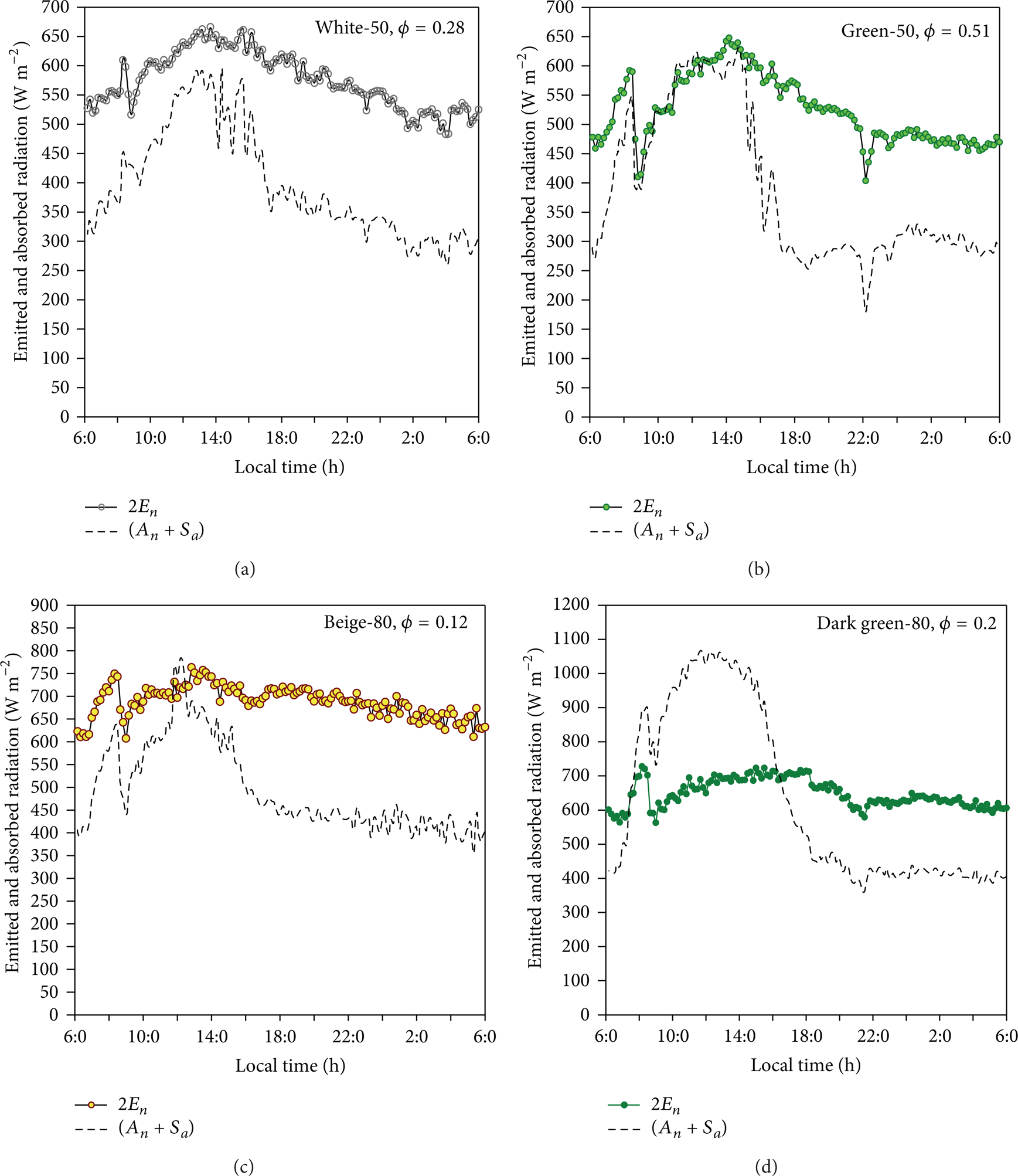
Time course for the estimated absorbed (A n + S a ) and emitted (2E n ) radiation by the nets: (a) is for white-50 net; (b) is for green-50 net; (c) is for beige-80 net; and (d) is for dark green-80 net.

Time course for the measured temperature difference (T n − T a ) for the four nets tested.
The net is considered as an object irradiated by solar flux; therefore, 2E n equals neither A n nor (S a + A n ). The question now is whether Kirchhoff's identity is valid under these conditions. That is, when the net is in thermal equilibrium and the absorbed radiation does not equal the emitted radiation, does ∊ n = α n for the net? To answer this question, the values of α n and ∊ n were estimated at each time interval independently (as we previously described in Section 2.3) and illustrated in Figures 8(a)–8(d) for the white-50, green-50, beige-80, and dark green-80 nets, respectively. The values of ∊ n are in good agreement with the values of α n within the 24 h period for all nets tested. Accordingly, Kirchhoff's identity can still be applied to an object (e.g., plastic nets) that is under natural conditions and exchanging solar and thermal radiation and convective heat with the surrounding air. The only condition is that the object is in thermal equilibrium (releasing energy as fast as it is absorbed and its temperature is remaining constant). Even though ∊ n equals α n under natural conditions, the value of E n mainly depends on the characteristics of the net and its absolute temperature (T n ). However, the value of A n depends on the thermal radiation incident on the upper and lower surfaces of the net (L1 and L4) and the temperatures of L1 and L4 sources.

Time course of the absorptivity (α n ) and emissivity (∊ n ) for the nets: (a) is for white-50 net; (b) is for green-50 net; (c) is for beige-80 net; and (d) is for dark green-80 net.
4. Conclusions
A radiation balance method was presented and used to determine the thermal radiative properties of high density polyethylene (HDPE) nets and to examine the equality of ∊ n and α n under natural conditions. The main conclusions of this study are as follows.
Under natural conditions, if a net is in thermal equilibrium, the absorbed solar and thermal radiation does not equal the emitted radiation; the difference is due to convective heat added to or released from the net surfaces.
Thermal radiation reflected from nets is very low whereas the transmitted, absorbed, and emitted thermal radiations are comparable.
The thermal radiative properties of plastic nets depend on a combination of the net porosity, color, and texture structure.
The equality (∊ = α) can be used for an object that is exchanging solar and thermal radiation and convective heat with its surrounding, if the object is in thermal equilibrium (i.e., under the steady-state conditions) and its temperature is constant.
Conflict of Interests
The authors declare that there is no conflict of interests regarding the publication of this paper.
Footnotes
Nomenclature
Acknowledgment
The authors would like to extend their sincere appreciation to the Deanship of Scientific Research at King Saud University for its funding of this research through the Research Group no. RG-1435-074.