




Abstract
In some microelectronic products, one or several components can be idealized as simply supported beam type and viewed as vulnerable elements or critical component due to the fact that they are destroyed easily under impact loadings. The composite cushioning structure made of expanded polyethylene (EPE), and expanded polystyrene (EPS) was utilized to protect the vulnerable elements against impact loadings during transportation. The vibration equations of composite cushioning system were deducted and virtual mass method was applied to predict impact behavior of critical component. Numerical results indicate that virtual mass method is appropriate for computing impact response of composite cushioning system with vulnerable element of simply supported beam type, which is affirmed by the fact that the impact responses of structure element in terms of velocity- and displacement-time curves are almost unchanged when virtual mass is smaller than a certain value. The results in this paper make it possible for installation of packaging optimization design.
1. Introduction
Newton [1] first proposed damage boundary curve concept, based on assumption that the damage to product function begins from critical components inside the product which are easily failure under excitation of shock loadings due to their fragile characteristics. Burgess [2] developed this concept to more representative models of common products. Based on above research result, product is needed cushioning materials, such as expanded polystyrene (EPS) [3] and expanded polyethylene (EPE) [4], which are most widely used in packaging industry due to their low cost, light weight, and good energy-absorbing capabilities. Then cushioning structure such as corrugated [5, 6] or honeycomb paperboard [7, 8] is utilized to store products during transportation and undergo permanent deformation if the big impact level occurs; hence a portion of kinetic energy is absorbed by outer packaging box, which is neglected in practical design. Lu et al. [9, 10] proposed virtual mass method to investigate impact responses of multilayered cushioning materials based on each single-layer constitutive relationship. Gao and Lu [11] used Newton-Raphson iteration method to explore the mechanical behaviors of composite cushioning system consisting of polymeric foam and corrugated paperboard. Because packaged electronic products are damaged firstly at the so-called critical component, Wang et al. [12–14] proposed the three-dimensional shock spectrum and damage boundary surface for typical nonlinear packaging systems, which are novel and promising. Then they were widely applied for studying nonlinear response of packaging systems. But in some cases, Subir [15] indicated that it is the maximum stress, not the maximum acceleration, which is responsible for structural strength of beam element. Gao et al. [16, 17] studied the responses of the electronic products with bar and cantilever beam type critical component, respectively.
This paper aims to establish mathematical model of composite cushioning system comprising expanded polyethylene (EPE), expanded polystyrene (EPS), the main body of the product, and critical component with simply supported beam type when experiencing dynamic loading and then obtain impact response of critical element by virtual mass method previously proposed, to provide useful means for complicated cushioning packaging system.
2. Dynamic Modeling of Composite Cushioning System considering the Effect of Critical Component with Simply Supported Beam Type
The simply supported beam type structure such as an electrical interconnection is a so-called vulnerable element for most electronic products, which should be treated as continuous system to consider its flexibility for this typical structure [15]. The electronic products require cushioning packaging materials to protect vulnerable element from damaging when subjected to drop impact loadings during transportation. In this section, composite cushioning system consists of two-layered cushioning structure stacked by EPS and EPE is given to absorb the impact energy generated by accidental free drop of product. Figure 1 shows schematic diagram of critical component-product-EPS-EPE cushioning system to represent the typical cushioning packaging.

Schematic illustration of packaging system with simply supported beam type critical component.
The vibration equation of beam structure can be written as [18, 19]

where I is moment of inertia, E is modulus of elasticity, ρ is density, A0 is the cross-section area, and y2 is the displacement function of simply supported beam.
The boundary conditions of (1) are
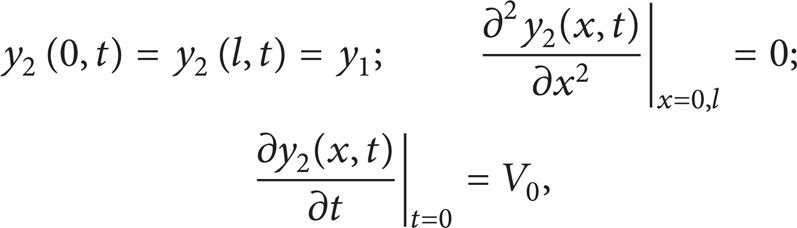
where l is length of beam and y1 denotes displacement of product.
The vibration equation of the main body of the product is given by

and its conditions are

where function f1 is constitutive relationship of EPS and can be determined from quasi-static and impact experimental data.
The vibration equation at the interface between EPS and EPE can be written as

and corresponding initial conditions

where m1 is virtual mass and function f2 is constitutive law of EPE under uniaxial compression.
The constitutive relationships for the two kinds of polymeric foam are determined from static and impact tests on EPS and EPE specimens, respectively. The constitutive relationships for EPS and EPE are depicted as [9]
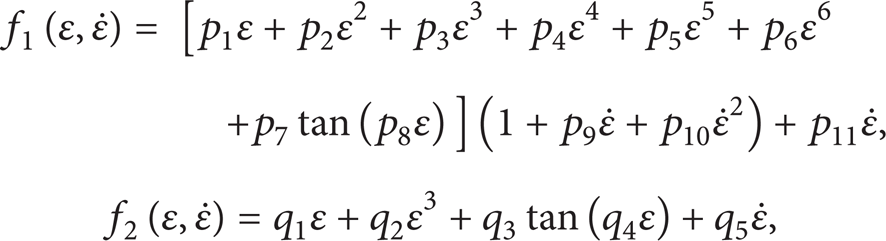
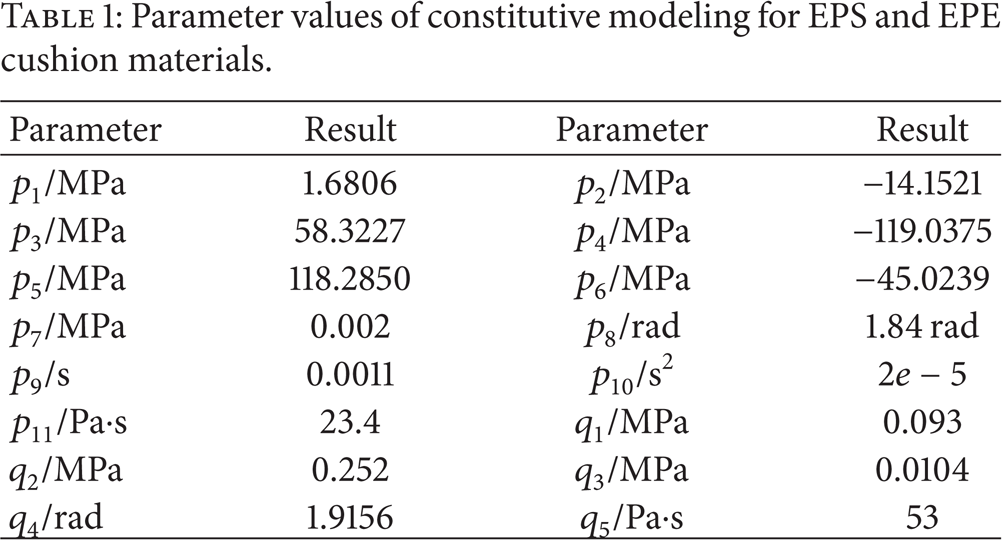
where values of parameter p i (i = 1, 2,…, 11) and q i (i = 1, 2,…, 5) are parameters to be determined. The corresponding parameter results are identified and listed in Table 1 [9].
Parameter values of constitutive modeling for EPS and EPE cushion materials.
The coupling dynamic equations for this composite cushioning structure are summarized as follows:
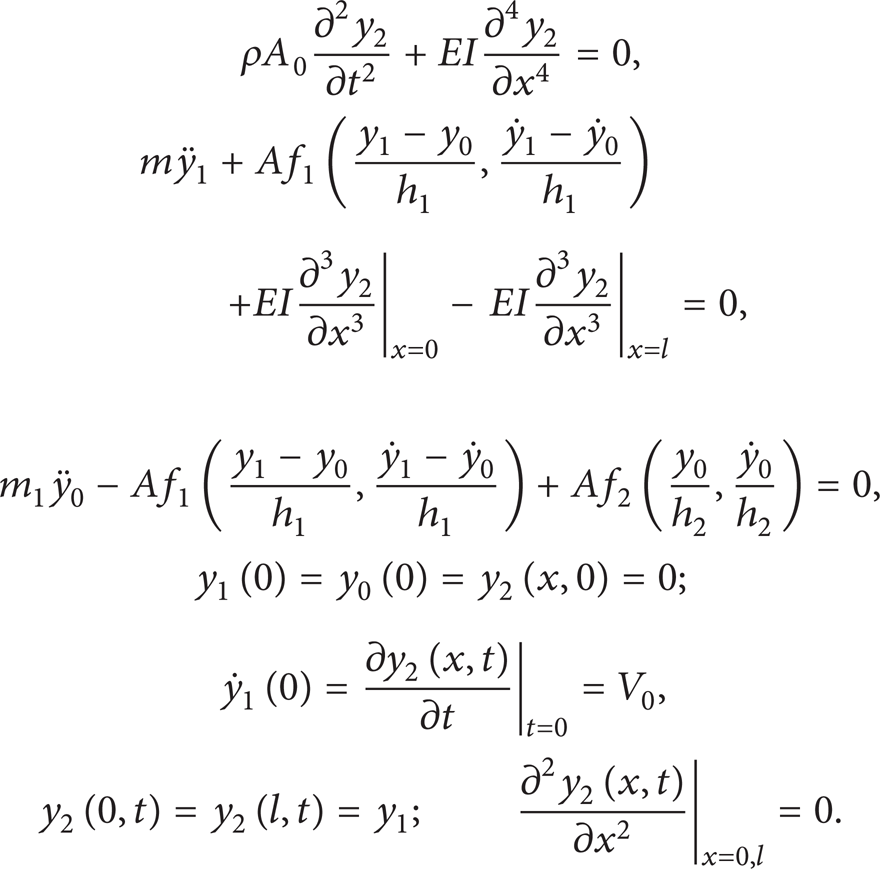
The numerical solution of (8) for the cushioning system can be estimated by finite difference method [15], and the difference schemes used are presented as

3. Numerical Examples
A numerical example was given to investigate the effect of virtual mass on the impact response of critical element of simply supported beam which existed in an electronic product. The parameters are as follows: m = 12 kg, ρ = 500 kg/m3, E = 100 MPa, l = 0.03 m, A0 = 5 × 10⁻⁶ m2, h1 = h2 = 0.02 m, and A = 0.02 m2.
The relative displacement shown in Figure 2(a) between center of critical element and main body of product is calculated by using virtual mass of 0.1, 0.05, 0.01, and 0.005 kg, respectively, at the initial impact velocity of 3.96 m/s, corresponding to 0.8 m drop height that is typical in practical transportation packaging process. The results with 0.01 and 0.005 kg are almost overlapped in Figure 2(a), indicating the results remain unchanged when virtual mass is smaller than 0.01 kg, which is similar to the phenomenon reported in [9]. The relative velocity of center of the beam to main body is depicted in Figure 2(b). It can be seen that the effect of virtual mass on velocity response exhibits the same regularities compared with Figure 2(a). Although the velocity-time curve with mass of 0.1 kg is very different from that extracted by using 0.05, 0.01, and 0.005 kg, the velocity history converges when virtual mass is smaller than 0.01 kg.
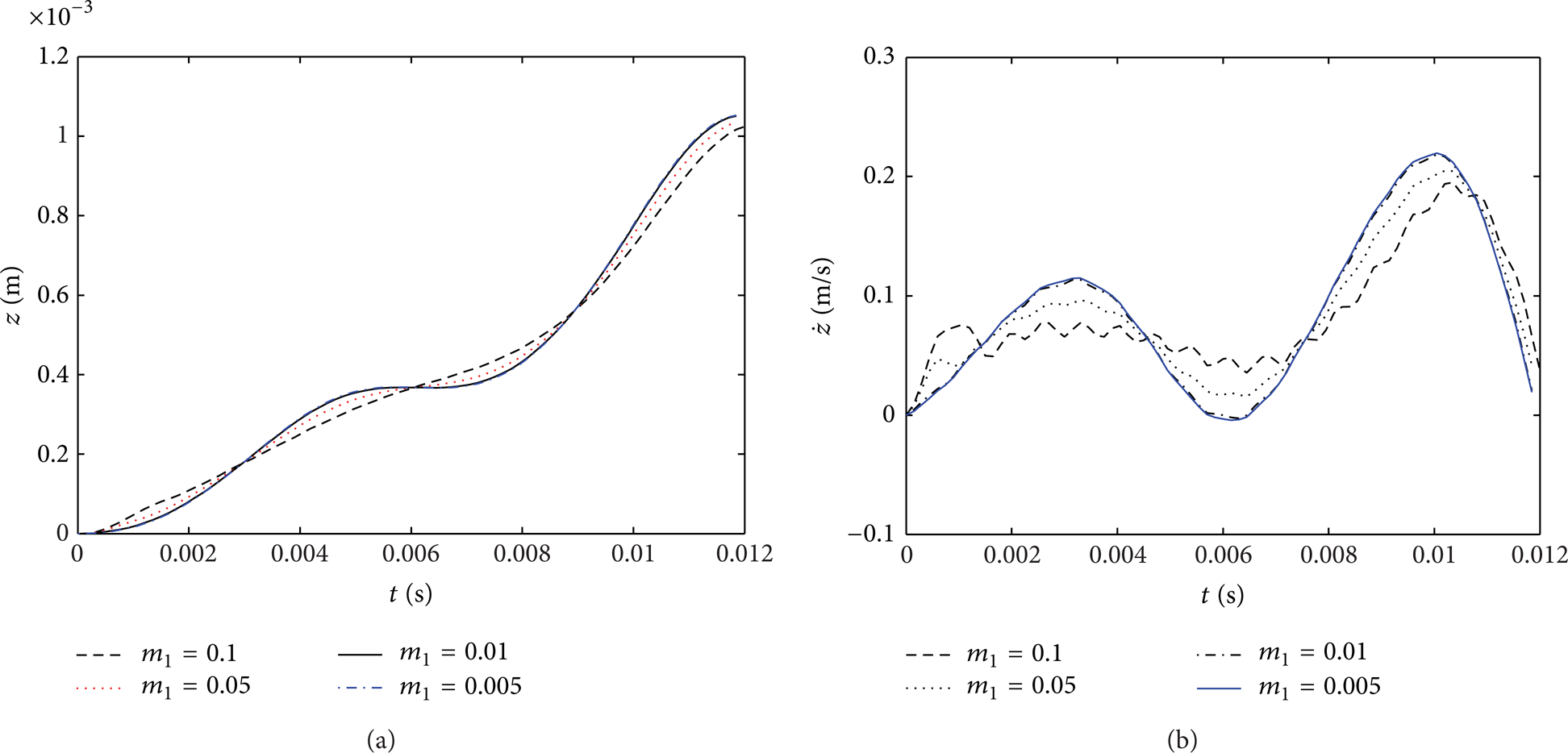
Relative responses-t curves at the centre of the beam. (a) Relative displacement. (b) Relative velocity.
The impact response curves at 1/4 length of beam relative to the main body of the product are given in Figure 3 with the same conditions. The displacement response converges reasonably well, comparing to velocity history shown in Figure 3(b), where the velocity-time behavior with mass of 0.1 kg is unsatisfactory by contrasting that explored by 0.05, 0.01, and 0.005 kg.
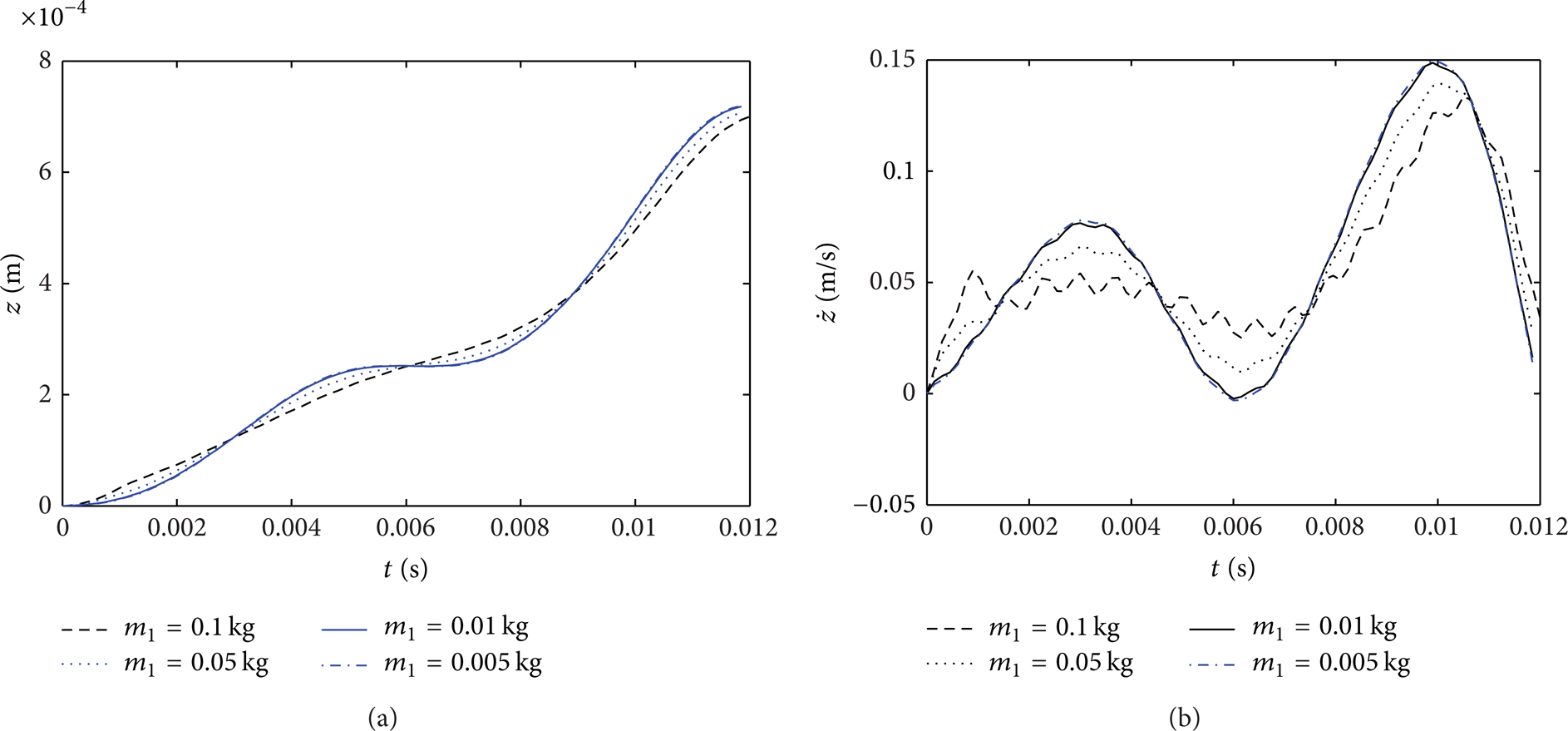
Relative responses-time curves at the 1/4 length of the beam. (a) Relative displacement. (b) Relative velocity.
Based on the above analysis, mass of 0.005 kg can give satisfactory result for this cushioning packaging system with critical component of simply supported beam type. The response surface relative to time t and coordinate x of the simply supported beam is shown in Figure 4. Introduction of virtual mass into dynamic equations of composite cushioning system with critical element makes it easy to investigate the impact response for the system, avoiding the nonlinear iteration process if mass is included in (5). The virtual mass method is appropriate for solving dynamic response of complex packaging system with simply supported beam critical component.

Relative responses versus x and t (m1 = 0.005 and V0 = 3.96 m/s). (a) Relative displacement. (b) Relative velocity.
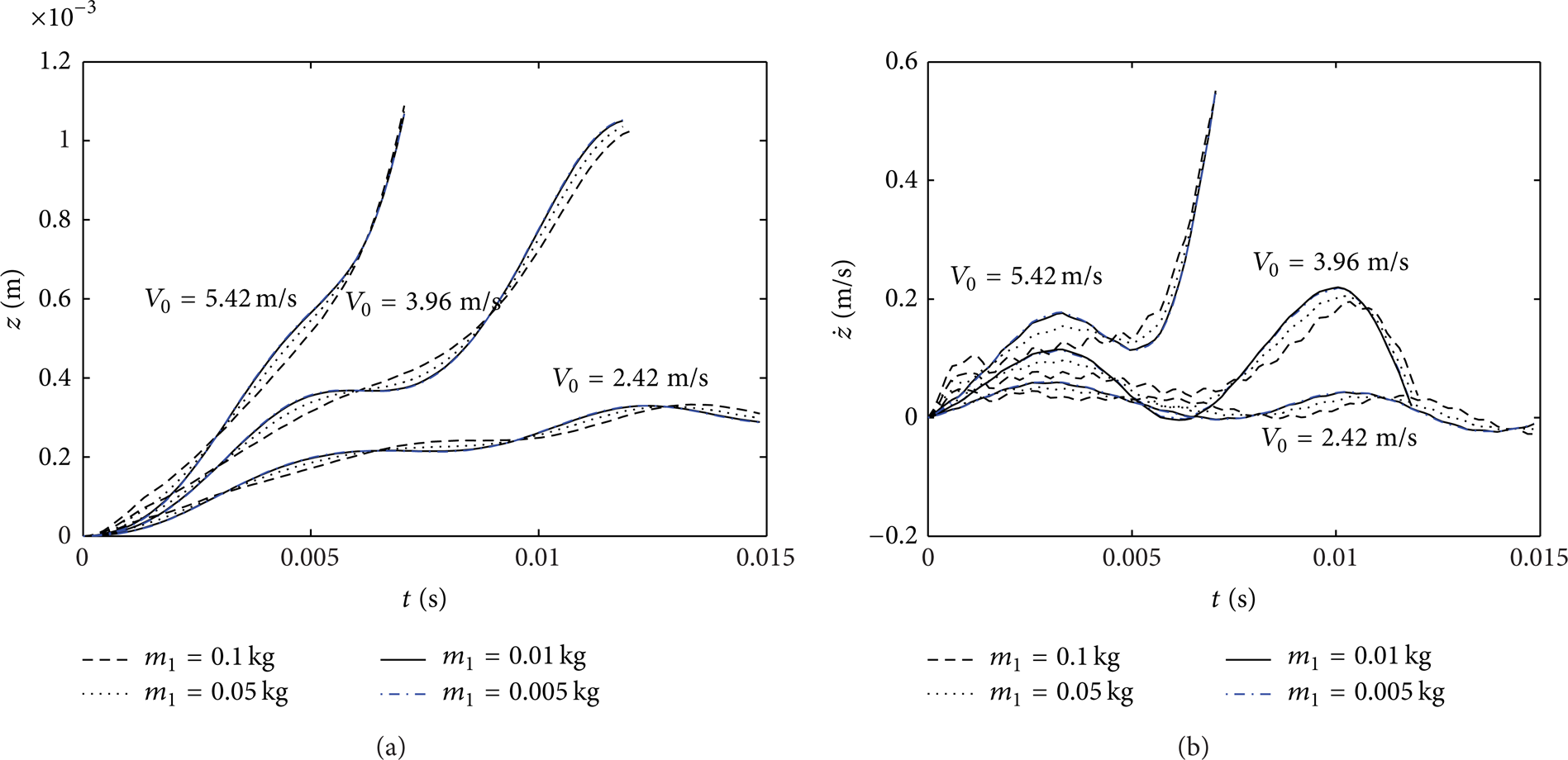
In order to examine feasibility of virtual mass method extensively, the initial impact velocity of 2.42 and 5.42 m/s denoting typical drop height of 0.3 and 1.5 m is chosen to explore the relative displacement and velocity between beam structure and main body for this composite cushioning packaging system with virtual mass of 0.05, 0.01, and 0.005 kg, respectively. It can be seen easily from Figure 5 that the value of 0.005 kg is also sufficient to obtain the impact response of beam structure at the initial impact velocity of 5.42 m/s or 2.42 m/s.
Relative responses versus x and t (m1 = 0.005 and V0 = 3.96 m/s). (a) Relative displacement. (b) Relative velocity.
4. Conclusions
The dynamic modeling for EPE-EPS composite cushioning system with critical component of simply supported beam type was established. The effect of virtual mass on the impact response of simply supported beam structure was investigated thoroughly, showing that the impact response converges when virtual mass parameter is smaller than a certain value. Accordingly the virtual mass method is feasible to study complex cushioning packaging system under consideration.
Footnotes
Conflict of Interests
The authors declare that there is no conflict of interests regarding the publication of this paper.
Acknowledgment
This work was supported by the Twelfth National Five-Year Science and Technology Projects (nos. 2011BAD24B01 and 2012BAD32B02).