




Abstract
The availability of inexpensive hardware such as CMOS cameras and microphones has fostered the development of wireless multimedia sensor networks (WMSNs). In WMSNs, wirelessly interconnected devices enable ubiquitously retrieving multimedia contents such as video and audio streams, and still images along with scalar data from surroundings for wide range of applications are constrained by processing, memory, and power resources. Image compression via low-complexity and resource efficient transforms has been addressed by several researchers to prolong network lifetime where energy conservation is achieved through sharing computational load among sensor nodes and by adjusting the transmission ranges of camera nodes. However, those schemes are not adaptive to the presence and changes of energy level of computational sensor nodes and to the amount of computational load. We propose a resource and energy efficient distributed image compression algorithm that dynamically configures according to the energy levels and the forwarding strategy that is based on the entropy of the image. The simulation results show that our adaptive distributed image compression scheme significantly prolongs the network lifetime and improves the network utilization efficiency, while maintaining adequate image quality.
1. Introduction
A wireless multimedia sensor network (WMSN) consists of sensor nodes deployed over a geographical area for monitoring physical phenomena like temperature, humidity, vibrations, seismic events, and so forth [1]. In WMSNs, a sensor node is a tiny device that includes three basic components: a sensing subsystem for data acquisition from the physical surrounding environment, a processing subsystem for local data processing and storage, and a wireless communication subsystem for data transmission. Moreover, a power source supplies the energy needed by the device to perform the sensing and reporting tasks. The power source often consists of a battery with limited energy. In an unattainable environment, it could not be possible or inconvenient to recharge the battery. Therefore, the sensor network should have a lifetime long enough to fulfill the application requirements. A single node failure, due to limited energy, could affect WMSNs lifetime and/or overall utilization.
To prolong network lifetime in environmental monitoring and process control applications, the bulk amount of monitored multimedia data needs to be efficiently compressed before transmission. But, multimedia compression algorithms, image compression, are constrained by processing and communication efficiency of sensor nodes in WMSNs.
In this paper we consider energy and resources efficient distributed image compression in environmental monitoring and process control applications. Our scheme uses distributed lapped biorthogonal transform- (LBT-) based compression scheme to compress and transmit the data to base station. Our scheme has the following key contributions.
We prune out low-energy nodes through energy-level driven clustering algorithm and classify the potential nodes for processing LBT-based image compression. As a result, both the network lifetime and network utilization efficiency are improved significantly. Distributed LBT-based image compression is made adaptive to the current energy level of the different sensor nodes within the local cluster. We pointed out that the entropy (average information contents) is directly proportional to the percentage of higher frequency contents in the image of scenario (structure elements, i.e., edges and contours), so by using the condition based on entropy, our algorithm restricts the forwarding decisions.
Combining the energy-level classification scheme with entropy based forwarding helps in reducing energy consumption by allowing the forwarding role to stronger nodes in the cluster. Moreover, pruning out low-energy nodes from compression and communication process significantly improves the network lifetime and network utilization efficiency.
The rest of the paper is organized as follows. In Section 2, we present a background on LBT and our implementation of LBT and encoding scheme for LBT-based compression. In Section 3, simple clustering algorithm is addressed in the aspect of power consumption in each node. In Section 4, our distributed LBT-based compression algorithm that implements energy-level selection scheme and entropy based information quantification scheme is presented, while performance evaluation through extensive implementations and simulations is presented in Section 5. Section 5 concludes the paper with summary of the important contribution and directions for future work.
2. Related Works
One of the key research issues in information and communication technologies is how to reduce power consumption in wired as well as wireless networks. As network equipment such as routers, switches, and storages is currently consuming lots of power, it has started to research green technologies for not only reducing power usage efficiently but also maintaining its performance. In [2], some strategies for energy efficiency in fixed networks are categorized as reengineering, dynamic adaptation, and sleeping/standby approaches and addressed. In case of mobile environment like wireless sensor networks, it is more critical to consider power consumption because of the limited battery usage. Also [3] is addressing distributed image compression in WSN for power efficiency.
The work in [4–7] proposed distributed lossless coding frameworks and techniques to compress multiple correlated images. However, these schemes have high complexity and are inefficient to be used for resource constrained WMSNs. Also, distributed image compression scheme [8] is based on JPEG2000 for still images, which leads to rate-distortion loss and blocking artifacts as the number of tiles increases or bit rate lowers, as shown in the right bottom corner of Figure 1. The JPEG2000 transform (CDF9/7) and its coding process (EBCOT) are computational complex and require much energy to compress images. The strip-based wavelet transform [9] and line-based wavelet transform [10] try to simplify, to some extent, the computational complexity; yet they lessen processing energy requirements. However, the memory needed for these transform schemes is related to the level of transformation and width of the image but not to the height.
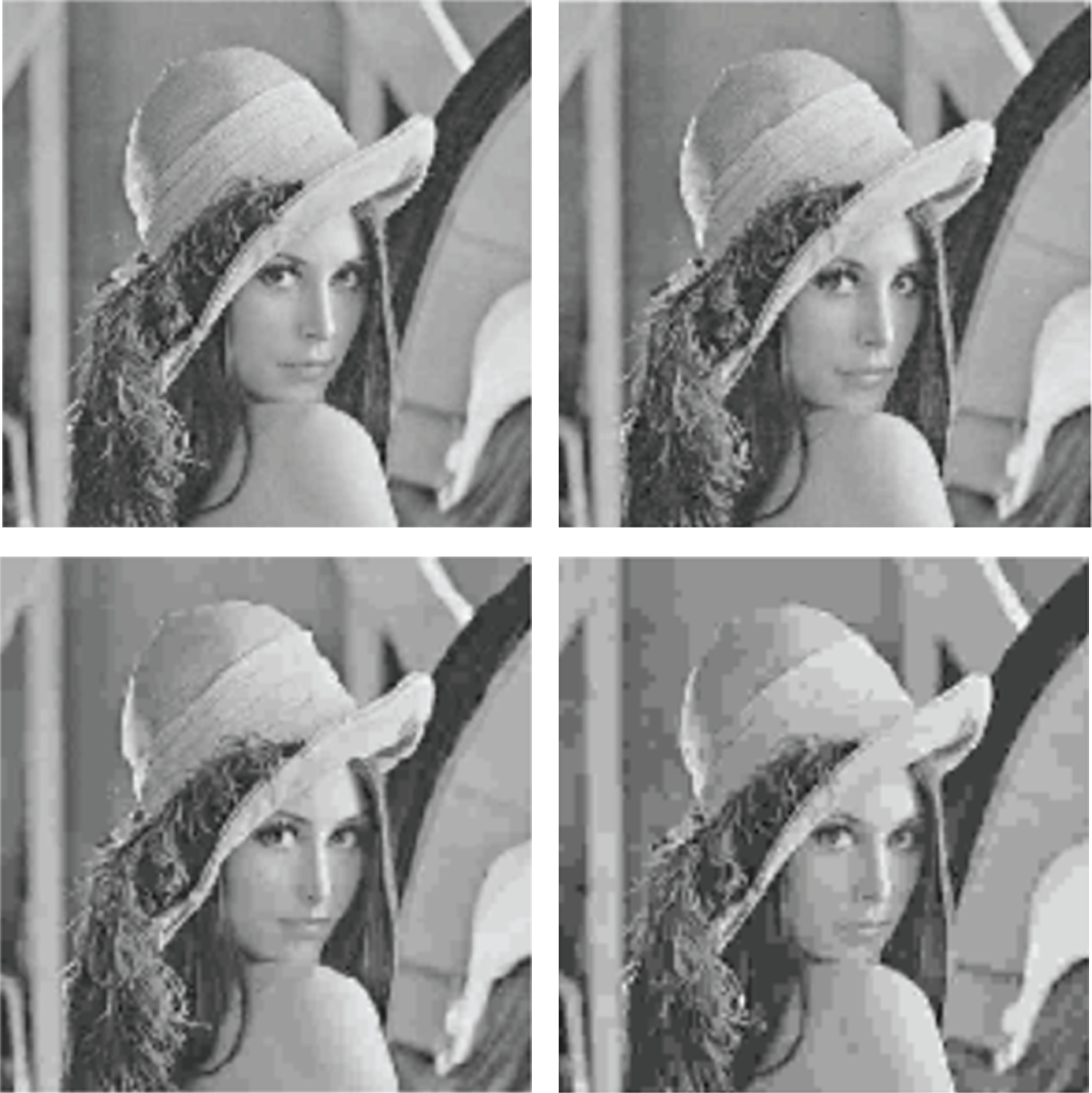
LBT-based compression (left column (PSNR, bit rate (R)) = 33.03 dB, 0.25 bpp and 27.06 dB, 0.1 bpp for top and bottom, resp.) compression and JPEG2000 (right column (PSNR, bit rate) = 31.59 dB, 0.25 bpp and 25.07 dB, 0.1 bpp for top and bottom, resp.).
A low-complexity and resource efficient image compression technique [11], for still images, reduces the processing and memory requirements. In the proposed approach, lapped biorthogonal transform (LBT) is used instead of discrete wavelet transform (DWT) or discrete cosine transform (DCT) to reduce the computational costs of about half of the computational cost by binary CDF9/7 wavelet. Also, it requires only 1 = 15th of the memory as required for CDF9/7. Due to these salient features along with elimination of blocking artifacts and rate distortions, LBT is recommended for distributed implementation over WMSNs. The scheme [11] lowers the computational cost of an individual node by sharing the compression task among the sensor nodes, while the communication cost is reduced by adjusting the transmission range between camera node(s) and computational nodes. However, the distributed implementation of LBT-based compression [11] is not efficient enough to improve the network lifetime and network utilization. The less effective selection of idle nodes for transform computations and transmission range adjustments is insufficient when the sensor nodes have uneven distribution of energy and are deployed randomly, respectively.
2.1. LBT-Based Compression
Lapped biorthogonal transform achieves high image quality with low complexity and memory requirements. LT can be constructed from preprocessing or postprocessing of DCT coefficients time or frequency domains, respectively [12]. We have used time-domain preprocessing of DCT coefficients for distributed image compression and followed the detail in [11] referring to Procedure 1. The analysis polyphase matrices of type II fast lapped orthogonal transform (LOT) (from type II DCT [13]) can be obtained as given in


(1) (2) LBT pre-processing + DCT on all rows; (3) LBT pre-processing on all columns; (4) DCT on all columns;
The three lifting steps (5) are followed by dyadic denominator to transform the floating point multiplication to integer addition and hence uplift the performance by 62% with reasonable quality measure PSNR [11]. Our results have clearly highlighted in Figures 1 and 2 the efficiency of LBT-based compression over JPEG2000 based compression scheme:


For constant R our implementation of LBT-based compression has improved PSNR values than JPEG2000.
2.2. Efficient Source Encoding
Arithmetic source encoding technique [14–17] is used to achieve highly compressed DCT and DWT coefficients. However, its use for WMSNs is inefficient because of its computational complexity and large memory requirements are too much for sensor nodes. The complexity and memory requirements are reduced by combining zero tree coding with quantization [6]. The use of Golomb codec reduces memory requirements by eliminating the need to maintain encoding list. Encoding list whereas MQ codec is geometrically distributed to compressed LBT coefficient. The processing of source encoding scheme [11] is implemented as given by Procedure 2.
(1) (2) LBT coefficient quantization; (3) (4) (5) (6)
3. Energy Efficient Clustering and Distributed Image Compression
Several researches for clustering technique have been proposed in wireless sensor network. LEACH [18] is cost effective clustering technique where cluster heads help in broadcasting and collecting the message within their own nonoverlapping clusters. Instead of transmitting data directly to base station (BS), sensor nodes send their data to their cluster header (CH) for relaying toward remote BS. The techniques in [19–22] tried to improve the performances of LEACH by computing the optimal values of the algorithm parameters. Still the quest is how to configure cluster and distribute, compress, and forward the image data for LBT-based image compression in WMSN which is the theme of our scheme, described in the following subsections.
3.1. Energy Consumption Model
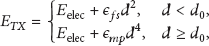
In the cluster, all nodes are assumed to control their transmission power. We also assume that member node (MN) is part of the cluster and shares the clustering tasks. The nodes have to transmit the final compressed data toward a remote base station BS via CH. The transmission energy

3.2. Energy-Level Driven Clustering
It is assumed that every node is able to operate as a camera node, intermediate node, and CH and switch its role depending on energy level. For energy level of node, there exist 3 different classes such as
We now propose clustering algorithm which is considering energy level at each node. At the first step, nodes communicate with neighbor nodes within radio coverage and exchange node information including current power consumption defined in (7) and distance between them as shown in Figure 3(a). After receiving neighbor information, each node updates neighborhood table with given information. In this step, unit functions

Cluster configuration process: steps for describing our power efficient distributed LBT-based image compression.
Node selected as CH sends cluster advertising message with its information such as current power scale and the number of hops the message can deliver (Figure 3(c)). When MN receives cluster advertising messages, it responds and becomes a member of cluster. In case MN receives multiple advertising messages from multiple CHs, it responds to the CH which has the least energy consumption scale. After receiving cluster join message from MN, CH updates neighborhood table and calculates energy class of MN as in the following procedure. In Figure 3(d), nodes 4 and 6 are
Node classification for image compression in Figure 3(e).

(1) ClusterSet ←search(localCluster) (2) where (3) sort(ClusterSet, d, (4) ELCTable ← calNeighborTable (ClusterSet, (5) (6) SNRole← assignRole ( (7) (8) sendToNodes(
(1) set class ← 0; snelclasses (2) CameraNode ← sort(ClusterSet, (3) (4) snelclasses[i] = (5) (6) (7) (8) (9)
3.3. Initializing Image Compression
Unlike [11], we assume that the camera node participates in clustering process and is located away from its CH. Therefore, transmitting raw data to CH is not the method of choice, Scheme (B) in [11]. Transmission power of camera node is constrained by transmission distance and the amount of data to be transmitted. So mere transmission range adjustments are not effective for randomly dispersed clusters, Schemes (A) and (C) proposed in [11].
3.4. Information Quantification Measure
In order to quantify the information contents provided by images from camera node, we define a measure of information utility. The intuition exploited is that information content is inversely related to the size of the high probability uncertainty region of the estimate of image captured by camera node. Covariance based measurements give unimodal posterior distribution of uncertainties that can be approximated by a Gaussian distribution but there are cases, thin edges, where this method is ineffective to measure the uncertainty.
Similarly, covariance ∑ is a poor statistic of the uncertainty when the estimate is highly non-Gaussian (e.g., multimodal). In this case, one possible measure is the information-theoretic notion of information, the entropy of a random variable. For the intensity level of grey scale image, 
The entropy can be interpreted as the log of the volume of the set typical values for random variable X, while this measure which relates to the volume of the entropy requires knowledge of the distribution 
An image becomes meaningful if the structural information, high frequency contents, exceeds the fixed portion, that is, low frequency contents, as shown in Figure 4. Fine line drawings represent the pertinent contours and, possibly, impart three-dimensional information to facilitate recognition of the scene and the presence of more and more lines (edges) adds to the information content in a scene captured by image sensor. Our scheme uses the rudimentary measure of visual entropy as an estimate for selecting the number of nodes in distributed image compression. Equipped with energy level and entropy of the captured image, computational helpers significantly reduce the communication and computational cost. Moreover, the notion entropy helps the

Relationship between percentage presence of high frequency X and entropy
3.5. Distributed LBT
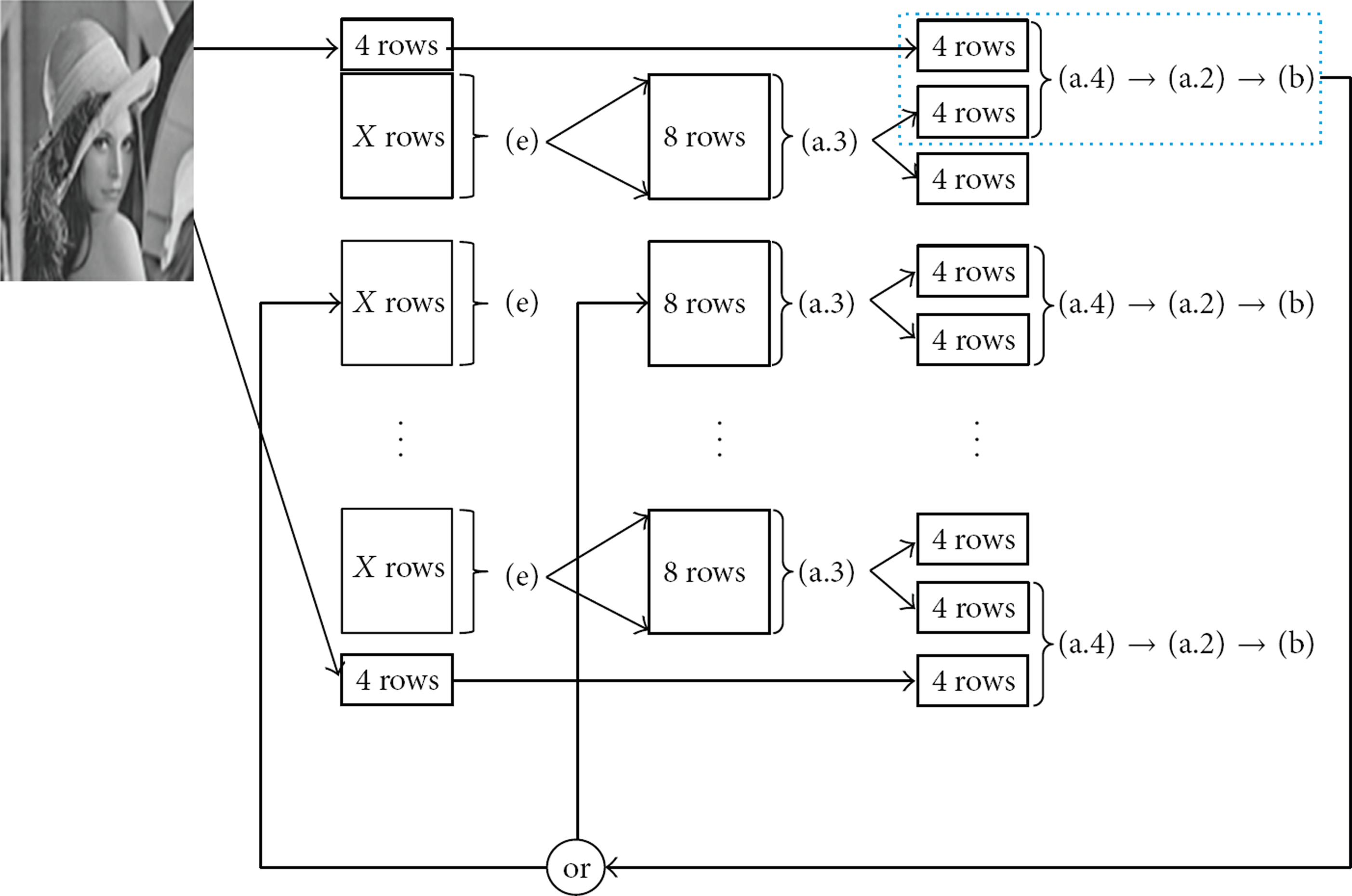
Our distributed LBT in Figure 5 is adaptive to the energy levels of computational helpers and entropy of sensed image. We used these two parameters for forwarding decisions and distributing computational load among the computational helpers. The X rows of image data from camera node are forwarded to the computational helpers subtrees, with
(1) (2) (3) (4) (5) (6) (7) (8) From (9) CameraNode, MNList, entropy}; where (10) On each
4. Performance Evaluation
To study power efficient clustering, we performed simulation studies in MATLAB. In our scenario, we assumed a WMSN of 100 nodes, distributed randomly over an area of 
The simulation is halted when certain percentage of computational nodes die out. MNs choose the best CHs to compress Lena, Cameraman, and Peppers in distributed fashion. The steady state performance improvements, Figures 6 and 7, of our scheme reveal that the energy-level classification of computational help in striping out the idle but weak and energy-starved sensor nodes from computational loads hence contributes to the prolongation of the network lifetime. From Figures 6 and 7, it can be deduced that mere transmission range adjustments are insufficient to increase the network lifetime with diverse sensor (in the sense of energy) nodes located sparsely. Combining the energy classification scheme with entropy-based forwarding helps in reducing energy consumption by allowing the forwarding role to stronger nodes in the cluster. Moreover, pruning out low-energy nodes from compression and communication process significantly improves the network lifetime and network utilization efficiency.
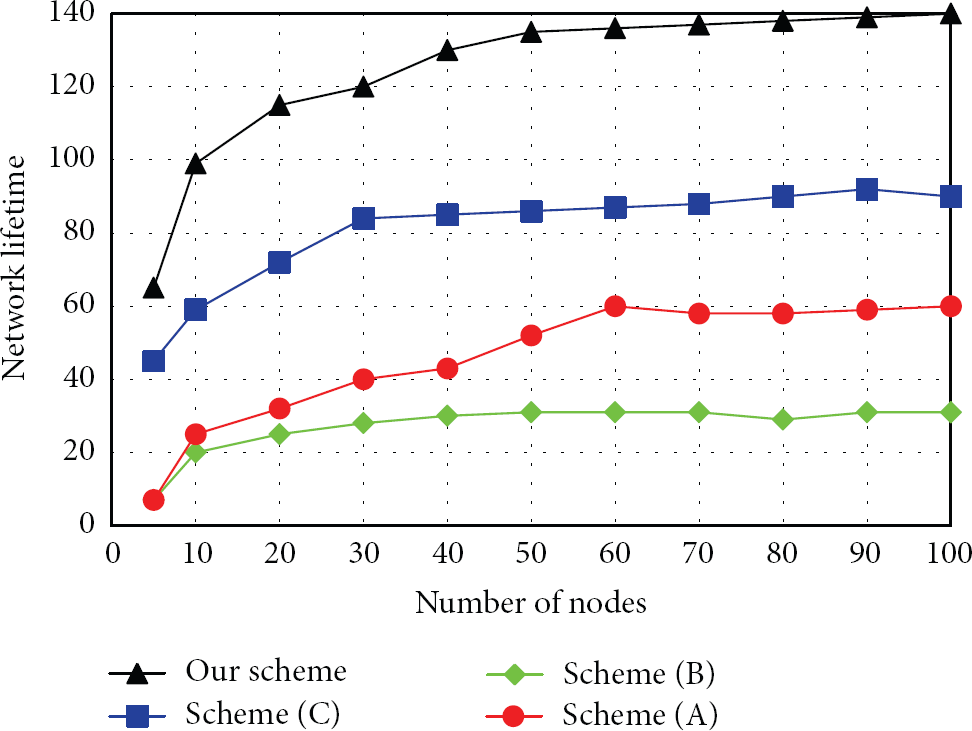
Network lifetime comparison of our scheme with the schemes in [11].

Network utilization efficiency comparison of our scheme with the schemes in [11].
5. Conclusion
The availability of cheaper CMOS camera fostered the development of WMSNs for interesting applications. Habitat and process monitoring applications have resource and energy requirements in WMSNs. In such applications, resource and energy constrained sensor nodes capture images of environment or process and aggregate it on the base station. To prolong the network lifetime and utilization and hence provide useful applications, WMSNs require efficient image compression scheme. In this paper, we propose an improved distributed image compression scheme for WMSNs. Our scheme is based on lapped biorthogonal transform that requires less resources, memory, and processing power, as compared with JPEG2000 on individual sensor node. Based on available energy of sensor nodes, we classified and clustered them into computational clusters to distribute computational load, that is, image compression. This approach sensibly selects sufficient energy nodes for computations and as a result prolongs lifetime and network utilization in WMSNs. We are working on incorporating throughput efficiency and QoS supports along with broader analysis of our scheme.
Footnotes
Conflict of Interests
The authors declare that there is no conflict of interests regarding the publication of this paper.
Acknowledgments
This research was funded by the Ministry of Science, ICT and Future Planning (MSIP), Korea, in the ICT R&D program 2013 and also supported by Basic Science Research Program through the National Research Foundation of Korea (NRF-2013R1A1A2013740).