




Abstract
This study focuses on the design, simulation, and load power optimization for the development of a novel frequency-tunable electromagnetic vibrational energy harvester. The unique characteristic of a magnetorheological elastomer (MRE) is utilized, that the shear modulus can be varied by changing the strength of an applied magnetic field. The electromagnetic energy harvester is fabricated, the external electric circuit is connected, and the performance is evaluated through a series of experiments. The resonant frequencies and the parasitic damping constant are measured experimentally for different tuning magnet gap distances, which validate the application of the MRE to the development of a frequency-tunable energy harvesting system. The harvested energy of the system is measured by the voltage across the load resistor. The maximum load power is attained by optimizing the external circuit connected to the coil system. The analysis results are presented for harvesting the maximum load power in terms of the coil parameters and external circuit resistance. The optimality of the load resistance is validated by comparing the analytical results with experimental results. The optimal load resistances under various resonance frequencies are also found for the design and composition of the optimal energy harvesting circuit of the energy harvester system.
1. Introduction
Developments in low-power electric devices and sensors highlight the need to develop and implement methods for harvesting, conserving, and optimally utilizing energy. In particular, a variety of efficient energy-harvesting techniques for the recovery of waste energy have been studied and developed by many researchers [1–12]. Many different energy sources are utilized in these energy-harvesting systems, such as photonic, kinetic, thermal, and biochemical sources, among others. Of these energy sources, ambient vibration energy has become one of the most attractive and frequently studied, because of its easy availability and highly efficient conversion mechanisms [1]. In general, three types of transducers are used for the conversion of vibration to electricity: electromagnetic [2, 3], electrostatic [4], and piezoelectric [5, 6]. In this work, an electromagnetic transducer is selected to convert vibrational energy into electrical energy.
However, an inherent shortcoming of a traditional linear-vibration energy harvester is the limited bandwidth and invariable resonant frequency. This implies that the efficiency of the energy-harvesting will be guaranteed only within a narrow frequency-band around a single fixed (resonant) frequency. In order to overcome this drawback, researchers and engineers have exerted much effort on the development of broadband and/or frequency-tunable vibration energy harvesters [7–9]. As part of this research effort, this study used magnetorheological elastomer (MRE), a type of smart material, to configure a novel frequency-tunable vibration energy harvester, by the application of a variable-strength magnetic field strength in order to change the boundary conditions.
For the development of a high-efficiency energy harvester, the composition of the electrical circuitry is also critical to extract the maximum load power. In this study, instead of optimizing the as-designed energy harvester system structure, we optimize the external system, comprising the coil and the load resistor, because of the flexibility and low cost of this process. The external circuit system is optimized to maximize the load power over the possible resonance-frequency tuning range, and the relationship between the variable frequency and the optimal load resistance is identified.
2. Modeling and Analysis
This study deals with the dynamic and energetic characteristics, particularly their optimization, of the frequency-tunable energy harvester depicted in Figure 1 [10].

Schematic of a frequency-tunable electromagnetic-type energy harvester.
The proposed system is composed of a rigid beam with a magnetic tip mass, a variable-stiffness torsional spring, and an externally fixed coil system. The variable-stiffness torsional spring is constructed of a pair of MRE blocks, which enables the system's natural frequency to be changed. Based on the conceptual design shown above, a physical model was fabricated as shown in Figure 2. This model was mainly comprised of two subsystems: One for the frequency tuning and the other for energy conversion/harvesting. The frequency tuning system includes the keeper, MRE blocks, tuning (permanent) magnets, and rigid beam. The electromagnetic energy conversion/harvesting system is composed of the tip magnet and the energy-harvesting coil. The selected baseline design parameters are listed in Table 1.
Baseline design parameters of the system structure.


Schematics of the physical design model: (a) three-dimensional view of the electromagnetic energy harvester system and (b) cross-sectional view (section A-A′).
The system can be represented by the following one degree of freedom (1-DOF) torsional system, including a parasitic torsional damping constant C p and an electromagnetic damping constant C e :

where J O is the system's mass moment of inertia about the pivot point O, θ(t) is the rotational angle of the beam with respect to the beam's static equilibrium position, L is the beam's length, k t is the stiffness of the torsional springs, y(t) is the base displacement, M is the equivalent mass of the beam combined with tip magnet, and l is the distance from the pivot point O to the equivalent mass center. In this system, k t and C e are mainly controlled by the external magnetic field strength and the configuration of the coil, respectively. From (1), the maximum relative amplitude z between the coil and the tip magnet is deduced at resonance and can be expressed as

where
3. Design of the Electromagnetic Coil and the Load System for Maximum Power Harvesting
The proposed system can be divided into two subsystems: the tuning system and the electromagnetic harvesting subsystem. In this study, the design parameters of the tuning system are kept unchanged, and the load power is maximized with respect to two major design variables: number of coil turns and load resistance. Assuming that the generated electric power is completely dissipated in the coil and load resistance, the electromagnetic damping can be obtained as

where K is the flux linkage gradient; φ is the average flux linkage per turn of the coil; N is number of turns in the coil; and R l , R c , and L c denote the load resistance, coil resistance, and coil inductance, respectively. Since the inductive reactance of the coil is much smaller than the coil resistance at low frequencies, the inductive effect of the coil can be ignored. Therefore, the total impedance can be approximated as the sum of the coil and load resistances. The instantaneous power delivered to the load resistor is given by
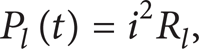
where the current

From (2)–(4), the average load power with the present configuration can be derived as
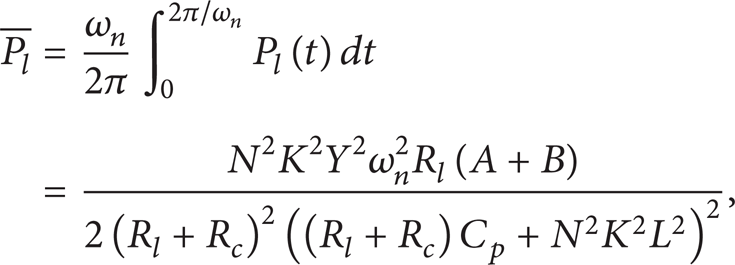
where
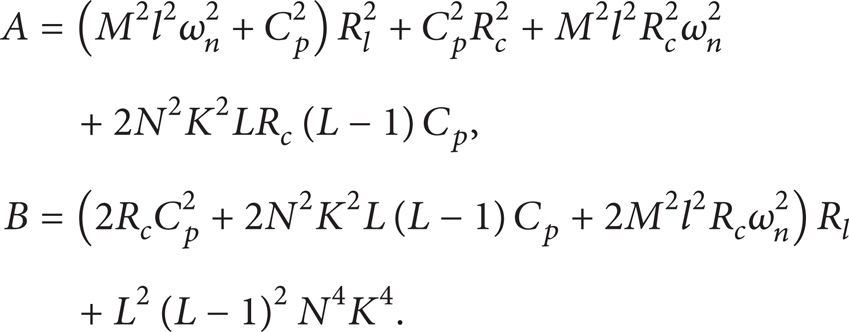
The flux linkage gradient is assumed to be constant if the flux linkage varies linearly with the displacement of the tip magnet relative to the coil and varies inversely with the total impedance [1]. The flux linkage is calculated using the FEM software ANSOFT Maxwell. For the cylindrical wire-wound coil system shown in Figure 3, the two design parameters (the number of turns and the resistance of the coil) are mutually dependent. For a fixed coil volume, their relationship can be expressed as

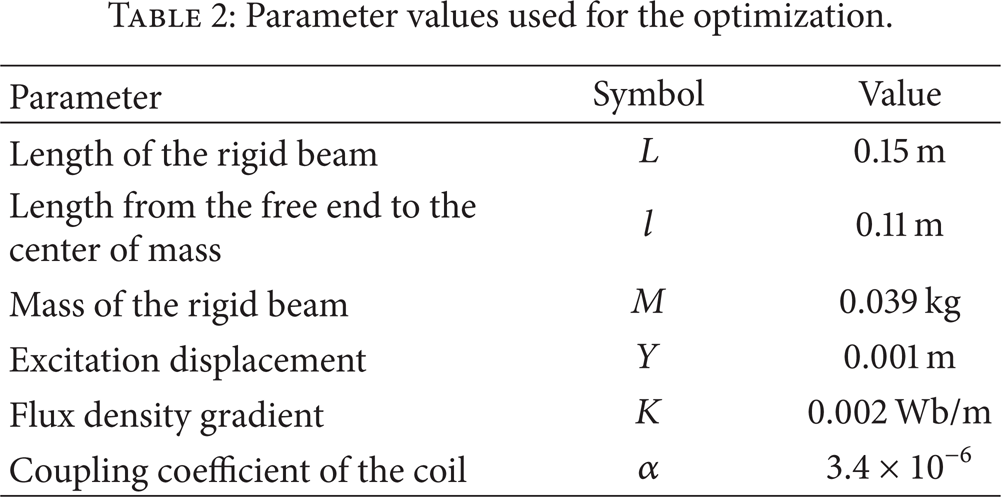
where ρ is the conductor resistivity, which is assumed to be the resistivity of copper of 1.68 × 10⁻⁸ Ω·m; L w and A w are the total length and the cross sectional area of the wire; r o , r i , and t are the external diameter, internal diameter, and height of the coil, respectively; and f is the fill factor, which is 0.62 for the proposed coil system. From (6), it can be found that the coil resistance has an approximately quadratic relationship with the number of coil turns. Therefore, we can let R c = αN2, where α is a constant that depends on the configuration of the coil system. For a fixed coil volume, it is apparent that increasing the number of coil turns increases the coil resistance, which causes a reduction in electromagnetic damping. However, since it is desirable to increase the induced voltage, it is important to optimize the number of coil turns, so that the coil can produce a sufficient voltage while not having an excessive resistance, which would affect power generation. The necessary basic parameters of the proposed energy harvester are listed in Table 2, where the mass center of the rigid beam is obtained by the assistance of the commercial CAD software Solidworks.
Parameter values used for the optimization.

3D view of the tip magnet and the energy conversion coil.
As previously mentioned, this study focuses on the maximization of the load power by the adjustment of two major design variables: number of coil turns and load resistance. To this end, a study without the use of frequency tuning is first performed (Case 1). After substituting the parameters listed in Table 2 into (6), the objective function to be maximized can be expressed as

Note that two variables, the coil turns and the load resistance, are contained in this function. Following (5), the load voltage surface with respect to the load resistance and the number of coil turns is presented in Figure 4.
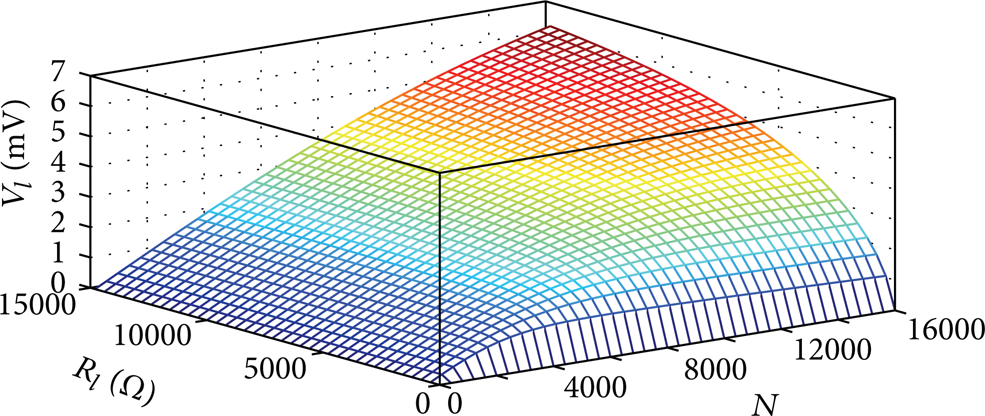
Average load voltage with respect to the load resistance and the number of coil turns.
Using (9), we can sketch the surface plot for the maximum power, as shown in Figure 5. As seen in the figure, there is a set of maximal points that can determine an appropriate number of coil turns and load resistance, at which the average load powers are almost identical and not one maximum point for the entire surface. The maximum load power can be reached even in the case of a small number of coil turns or a small load resistance value. We can track this set of points where the maximum power is reached and their associated number of coil turns and load resistance and treat them as the optimal design points, shown in Figure 6. It can be observed that the maximum load power can be obtained even with a low number of turns, which is associated with a low voltage delivered to the load. Generating a low AC voltage is not desirable, because this can lead to difficulty in performing effective rectification and power management [11]. Considering both the voltage delivered to the load and the convenience of the coil system fabrication, a total number of 8000 coil turns and a wire diameter of 0.2 mm were selected for the construction of the proposed energy harvester's coil system.
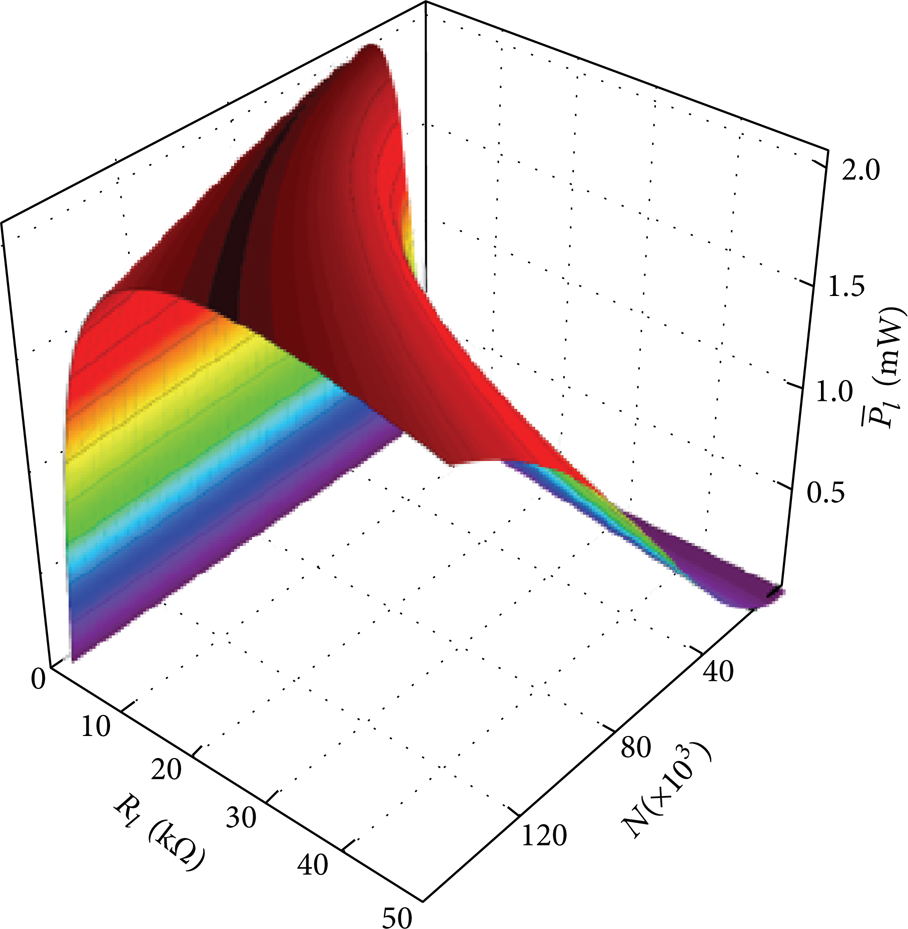
Average load power with respect to the load resistance and the number of coil turns.

Optimal loads and voltage on the load versus the number of coil turns.
In the above analysis regarding maximum load power, only the case in which there is a single fixed resonant frequency (not tuned) was considered. In this study, we defined the characteristics of the coil, and research into the optimal state of the system in the case of a resonant frequency tuning system is presented in the next section.
4. Experiments and Discussions
The experimental platform illustrated in Figure 7 is constructed in order to validate the aforementioned simulation results, and to investigate the performance of the proposed energy-harvesting system. The energy harvester is excited by a shaker (B&K type 4808), at a selection of excitation frequencies. A power amplifier (B&K 2719) incorporating a function generator (Tektronix AFG3021B) is connected to the shaker. An accelerometer (PCB 352034) is attached to the shaker to directly measure the input acceleration. A laser distance sensor (LDS; WELOTEC AWL71/50) for large-displacement measurement is used to detect the deflection of the free end of the rigid beam. The signals obtained from the accelerometer and LDS were transmitted to a PC via a signal analyzer. An oscilloscope (DPO 4034) is connected to the variable load resistor to measure its voltage.

Schematic block diagram of the experimental setup.
Firstly, the feasibility of resonant-frequency tuning of the proposed model is verified by measuring the resonant frequency under a varying tuning-magnet gap distance. A swept sine wave excitation generated by the function generator is applied to the keeper, and the time domain response of the rigid beam is transmitted to the PC for data processing. The final experimental results are shown in Table 3, from which it can be observed that both the resonant frequency and the parasitic damping tend to increase when the tuning-magnet gap distance increases.
Properties of the energy harvester and associated tuning-magnet gap distances.

Following the above verification results, the actual electrical load voltage and load power are investigated. The load power is calculated on the basis of the measured load voltage at various load resistances. Figure 8 shows a comparison between the measured load voltage and load power and their theoretical values for Case 1.

Load voltage and power versus load resistance.
The measured and theoretical results agree quite closely when the load resistance is relatively small (R l < 500 Ω); however, as the load resistance increases, the difference between the measured and theoretical results increases. Although the theoretical model cannot precisely predict the real load power when the load resistance is large (R l > 500 Ω), the model seems to be quite acceptable in predicting optimal load resistance when considering the complexity of the system. As shown in Figure 8, the theoretical model can predict the optimal load power within 12% error. The resulting optimal load resistance with respect to the case listed in Table 3 is shown in Figure 9, which indicates that in order to obtain the maximum load power, the optimal load resistance should be reduced as the resonant frequency increases.

Optimal load resistance with respect to the case listed in Table 3.
5. Conclusions
In this study, a novel frequency-tunable electromagnetic vibration energy harvester employing an MRE was designed, fabricated, and optimized. In order to model the proposed system, the unique property of an MRE was utilized; that is, the system's stiffness and damping values can be varied by the application of an external magnetic field. The mathematical modeling of the system was performed and analyzed. The model was validated through a preliminary test, and it was identified that the frequency-tunable range is from 20.372 to 24.750 Hz with the gap distance of the tuning magnets varying from 60 mm to 30 mm. Finally, the design concept was experimentally validated.
In order to produce the maximum load power within the entire frequency-tunable range, the objective function was first defined. For this purpose, a parametric optimization was performed in order to achieve the maximum load power. By optimizing the number of coil turns and the load resistance, it was identified that the maximum load power could be obtained over a wide range of coil turn numbers and that even a low number of turns could produce the maximum power when an appropriate load resistance is chosen to compensate for the coil resistance. The appropriate parameters of the coil were determined by considering the magnitude of the induced voltage and fabrication convenience. The number of turns was 8000 and the wire diameter was 0.2 mm.
We experimentally measured the load voltage and power for a variety of load resistances. There was good agreement with the theoretical results. The variation in the optimal load resistance with resonant frequency was investigated in order to obtain the optimal energy-harvesting circuit. The optimal load resistances were obtained, with which the proposed system can obtain the maximum power at different resonant frequencies. The measurement of the maximum power was conducted at the different resonant frequencies, which indicated that the optimal load resistance tended to decrease as the resonant frequency increased.
Conflict of Interests
The authors declare that there is no conflict of interests regarding the publication of this paper.
Footnotes
Acknowledgments
This research was supported by the Industrial Strategic Technology Development Program [10042651, Development of a 5-Axis Machining Center-Based Compound Machine Tool with an Energy Saving of More Than 10%] funded by the Ministry of Trade, Industry and Energy (MI, Korea). This research was also supported by the Chung-Ang University Excellent Student Scholarship in 2014.