




Abstract
Because of the increasing energy demand, coalbed methane (CBM) which is a high-quality, clean new energy gets more and more national attention. As one of the keys of CBM's successful development, the investment of surface gathering system accounts for a significant proportion of the entire field's investment. This paper studied the optimization of CBM gathering system, combined with system process characteristics and the status of extraction and production. We chose a phased optimization method such that the optimization of entire system was divided into several subproblems, including well group's optimal partition, determination of gathering valve set's optimal position, optimization of trunk and branch pipe network's layout, and optimization of pipe diameter. Then we established optimization model such that the least investment costs of each stage were to be as objective function. When solving the model, full consideration of the low pressure and high complexity by which the CBM gathering and transportation pipeline network was characterized should be given. Through an example calculation, compared with artificial design result, the total investment decreased by 9.56%. We proved that the method has a good optimization effect by comparably analyzing the investment and construction scale of the existing pipe network and optimal pipe network.
1. Introduction
Gas field gathering pipeline network is a huge investment and complex system in gas field surface engineering. China has entered into a large-scale development period of coalbed methane (CBM) fields, but it is still in the initial stage overall [1]. The rational design of the ground pipe network system directly determines the system parameters and investments. Optimizing this system, significant economic benefits can be obtained. With the development of coalbed methane field, the engineering economic issues will become much more apparent.
The main problem in the design process of these networks is searching for the network topology and the features to meet the flow and pressure requirements in the nodes. Furthermore, we may be interested in finding the optimal pipelines networks’ features in order to define the cheapest network.
Pipelines networks’ features refer to the number of station, the position and the connected relationship of nodes, the materials of which they are made, and pipelines diameters. The relationships between these feathers are difficultly expressed with mathematical functions; we only have empirically adjusted formulae in many cases and the relationship is not linear.
The optimization design of coalbed methane field surface pipeline network is a complex problem of large-scale hybrid optimization design, which involves discrete topological, nonlinear parametric, and multiobjective optimizations, and so forth; some of them belong to NP hard problems. Recently, more researches are related to the network optimization of gas pipelines network, given the network structure other than the design of the network topology. The optimal sizing of pipe networks has been studied from different viewpoints, for example, the linear programming gradient approach [2–4], the branch and bound approach [5], or intelligence algorithm [6–8].
Papers dealing with the design of network topology are few; Coats [9] treats the problem of optimally locating the single or multiple trunklines for a given system to minimize both the total length of piping connecting the individual wells to trunklines considering varying line sizes and grouping of wells. Rothfarb et al. [10] propose a tree generating algorithm to design the network topology using the so-called starting routine and local Δ-opt method and solve the problem of selection of pipe diameters in a specified pipeline network to minimize the sum of investments and operation costs. But it is possible that a Δ-opt tree will not be globally optimal because of using different starting points. Shamir [11] describes a technique, which makes possible to select the optimal route for a pipeline designed to carry oil and gas in two-phase flow. Dynamic programming is used to solve the minimization problem. Bhaskaran [12, 13] distinguished several stages in designing pipeline collection networks as a tree collecting gas from a set of wells and transported it to a gas plant prior to dispatch along a main trunk line. The stages contain the configuration problem, the junction location problem, and the diameter assignment problem.
In this paper, by using grading optimization, the whole of the complex optimal design of gas gathering network system is divided into several subproblems, “element set” problem and “element property” problem. In Section 2, the coalbed gas gathering and transportation system structure is described. In Section 3, the problems are presented in succession as optimization problems and their mathematical models are stated based upon graphs. In Section 4, the proposed algorithm is presented. In Section 5, a case is tested by using the above method to optimize the actual pipeline network, showing that the result is intuitive and better than the empirical one in practice.
2. Mathematical Problem Modeling Using Graphs
Compared with conventional natural gas, CBM gathering technology is unique; its extraction has characteristics of low production, low pressure, multiwells, high methane content, little heavy hydrocarbon, and little hydrogen sulfide [14]. The CBM gathering and transportation system is composed of well sites, valve sets, plant, and pipelines. Water withdrawn from the tubing by pumping is directly discharged into the sewage pool near the well sites and CBM is output from the annular space between the casing and tubing and then flow into the gas pipeline. Gas from several well sites through individual production line is conveyed to set valve where the gas flow rate is measured; it is then separated and pressurized in the plant. The constitution of the system is shown in Figure 1.

Constitution of CBM gathering and transportation system.
Due to higher investment, lower output, and larger risk, CBM well's networks are more crowded than conventional natural gas's one. CBM pipeline network layout is a complex systemic problem. Graph has been shown to be the best tool to model network problem. In our problem, the CBM net may be considered as a directed acyclic graph G = (N, A), where N is a set of nodes and A is a set of directed arcs.
Throughout this section we will see what the configuration of the two sets should possess, as well as the mathematical model, which indicate the size and the specific element in the set. Besides, the features of these two sets and the model are described
We shall determine the pipe network topology. This means that the sets of N and A are not defined. The number of the elements, such as the number of the valve sets, is not known as well as the relationship between the nodes.
In a CBM network system, we need to know the optimization variable. The well site is given by the technical team and the number of plants is suggested by experts, usually one plant in a filed. So the only unknown variable is the number of the valve sets.
Connection relationship contains the location of the nodes and connectivity relationship, which influence each other, thereby affecting the investment.
The network topology is defined as above. This means that the set of arcs A has been defined. However, the topology of this graph presents some constraints as follows.
No Cycles. In the gathering system there is no feedback flow and nodes only have one outlet; therefore, they will only have one direct descendant in the graph.
Pipelines. The physical features we need about pipeline to solve our problem are diameter, length and relative roughness, and the slope or height.
In the view of the characteristics of coalbed methane, equation of state BWRS is used to calculate the thermodynamic parameters to ensure the check veracity for calculations of physical properties, pressures, and temperatures during the optimization and for the constraint condition of optimized models as well.
Flow Rate. Obviously, the well production rate is known.
Internal Roughness of Pipelines. This can be given by experiment.
Pressure. The suction pressure at plant is defined by the designers and in the remaining nodes; pressure is determined by the configuration of the network. That is to say, the pressure in any internal node in the network must allow pressure forward propagation from the well site to the plant, so that at the inlets the pressure would be exactly the one specified. Pressure at nodes depends on the pressure at the plant and the pressure drop between the nodes.
Speed and Diameter. At fixed flow rates, the relationship between the pipeline diameter and the flow speed is fixed, as well. However, speed plays an important role in the calculation of the final price of the installation. If the speed is too high (the diameter is too small), though pipelines will be cheaper, the pressure drop will be high and easily cause pipe corrosion. Conversely, if the speed is too low (the diameter is too big), then pipelines will be more expensive, but the liquid is easy to be stranded in the pipe. Really, these two parameters are the same and they are the real variables in our problem.
3. Mathematical Model
The optimization goal of CBM pipeline network is to find the least economic investment of pipeline network. The network topology takes a star shape, in which several well sites are connected to valve sets. The objective is that the distance between the well sites and the valve sets is shortest under certain constraints. In addition, dispatching should take different well's production rate into account, since it may lead to different pipe diameters. The concept of the production length is introduced here to define a new model:

The constraint is as follows:
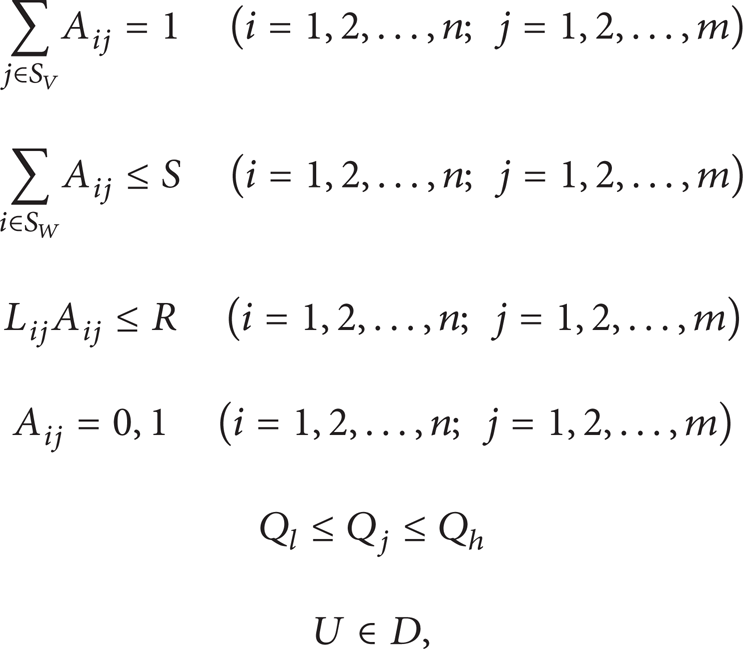
where m is the number of valve sets; n is the number of well sites; A ij shows if node i has an output to node j, it is equal to 1, otherwise 0; and L ij is pipeline length, km. Consider

where x i , y i , z i are coordinates of the well sites; x i , y i , z i are coordinates of the valve sets, which is the weighted center of well sites connected to the valve sets; q i is well production rate, m3/d; S is the maximum well number under the jurisdiction of a valve set; S W is the set of well sites; S V is the set of valve sets; R is maximum allowable distance between well site and valve sets, 2 km; and Q j is the gas flow rate at valve sets, m3/d; Q l = 11400 m3/d, Q h = 38000 m3/d. Consider

where Q l , Q h are upper and lower limits for the gas flow rate at valve sets, m3/d; U is coordinate area for valve sets; and D is feasible region.
After knowing the number and the position of valve sets, we need to determine the connection relationship between the valve sets to make the total production length shortest. In theory, it could have a pipeline for any two valve sets. This problem can be turned into a modified minimum spanning tree problem:

The constraint is as below:

where m is the number of valve sets; L ij is pipeline length, km; q j is the gas flow rate at valve sets, m3/d; and A ij shows if node i has an output to node j, it is equal to 1, otherwise 0.
If the location of the plant is not specified in advance, we need to determine the position of the plant. The plant is the center of the surface gathering pipeline network system. The change of the position directly affects the flow distribution and the economy of the system. Therefore, in order to gain a reasonable network, we can choose appropriate valve sets as the plant considering the land cost. This problem can be converted into the weighted center of network problem.
The weighted length between valve sets i and valve sets j is

The objective function is to solve the shortest path as follows:

where q i is the gas flow rate at valve sets, m3/d and L ij is pipeline length, km.
After the confirmation of the layout of the surface gathering pipeline network, we need to determine the optimal combination of each section of pipe diameter in circumstances that could satisfy the gathering requirement and further reduce the cost of investment. Choose Beggs-Brill-Moody model for hydraulic calculation of CBM.
Objective function is

The constraints are as follows:

A correlation formula is fitted for cost with the diameter by least square method:

where γ p is coefficient of the present value, 0.95; L(i) is pipeline length, m; C is the cost function of diameter; D i is pipe diameter, cm; R(i) is flow conversion coefficient; P i is pressure of start point, MPa; and Pi + 1 is pressure of end point, MPa.
4. Algorithm
In engineering design, for the models mentioned above, an optimization framework is proposed to solve these problems. The framework is combined with the level of system and will achieve the best overall result relatively. The framework of pipeline network optimization of CBM branched pipeline network is shown in Figure 2.

Framework of CBM pipeline network.
5. Application
The Panhe CBM fields are located in Qinshui County, Jincheng City, Shanxi Province, China. The throughput of fields is 40*104 Nm3/d. Average production per well is 2000 m3/d. According to the expert's experience knowledge, mainly trial and error, the Panhe CBM field main gathering network is designed as shown in Figure 3. This system consists of 193 single wells, 16 valve sets, and 1 plant.
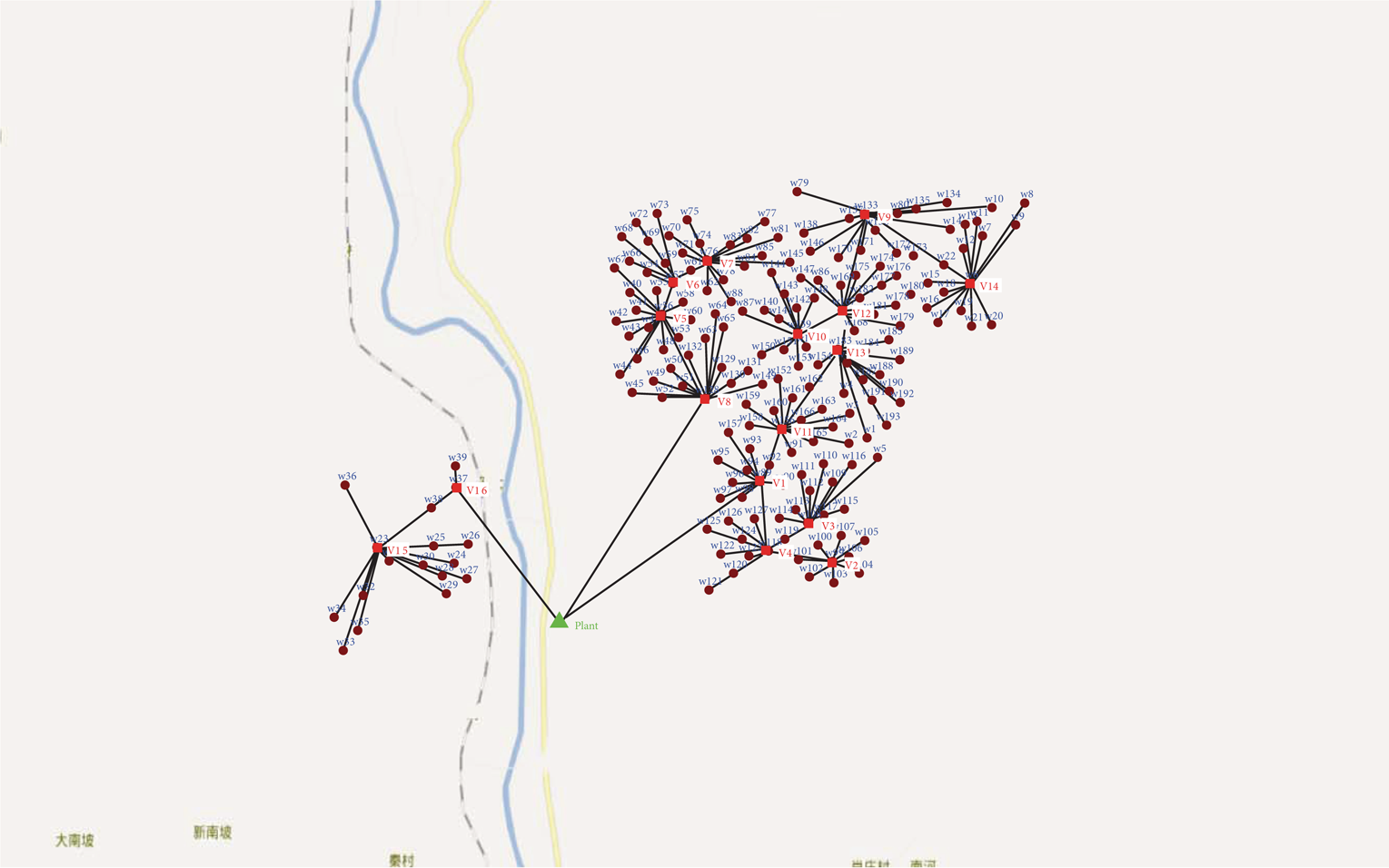
Panhe CBM field gathering main pipeline network.
The composition of coalbed methane in Panhe's field is shown in Table 1.
The composition of coalbed methane in Panhe field.

The pressure in CBM gathering system is low, and the system pressure ranking is shown in Table 2.
Pressure ranking in the Panhe field CBM gathering system.

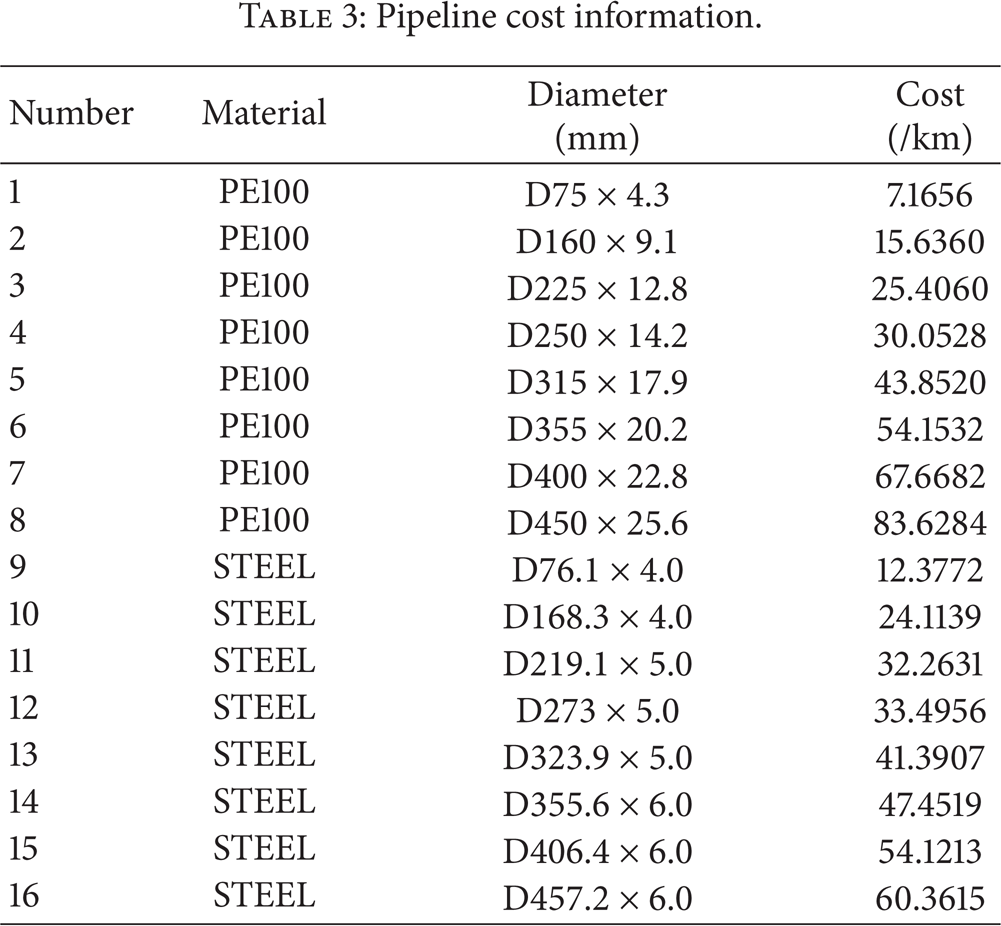
PE pipe can better adapt to CBM gathering requirement because of low cost and small friction. After the economic comparison, choose PE pipe when inner diameters are less than 250 mm and choose spiral submerged arc welded steel pipe when inner diameters are bigger than 250 mm as shown in Figure 4 and Table 3.
Pipeline cost information.

Comparison of PE and steel material cost.
5.1. Optimization of the Panhe CBM Field Pipeline Network
All the well sites in Panhe field are single well and their location is defined by development engineer, which is shown in Figure 5.

Coordinates of well sites on site.
5.2. Layout Optimization
The plant's location is given in advance considering the terrain and environment in Panhe's field. Using the above optimization framework, the results of layout optimization are shown in Figures 6, 7, 8, and 9. But the program can also deal with the problem without giving the coordinates of plant.
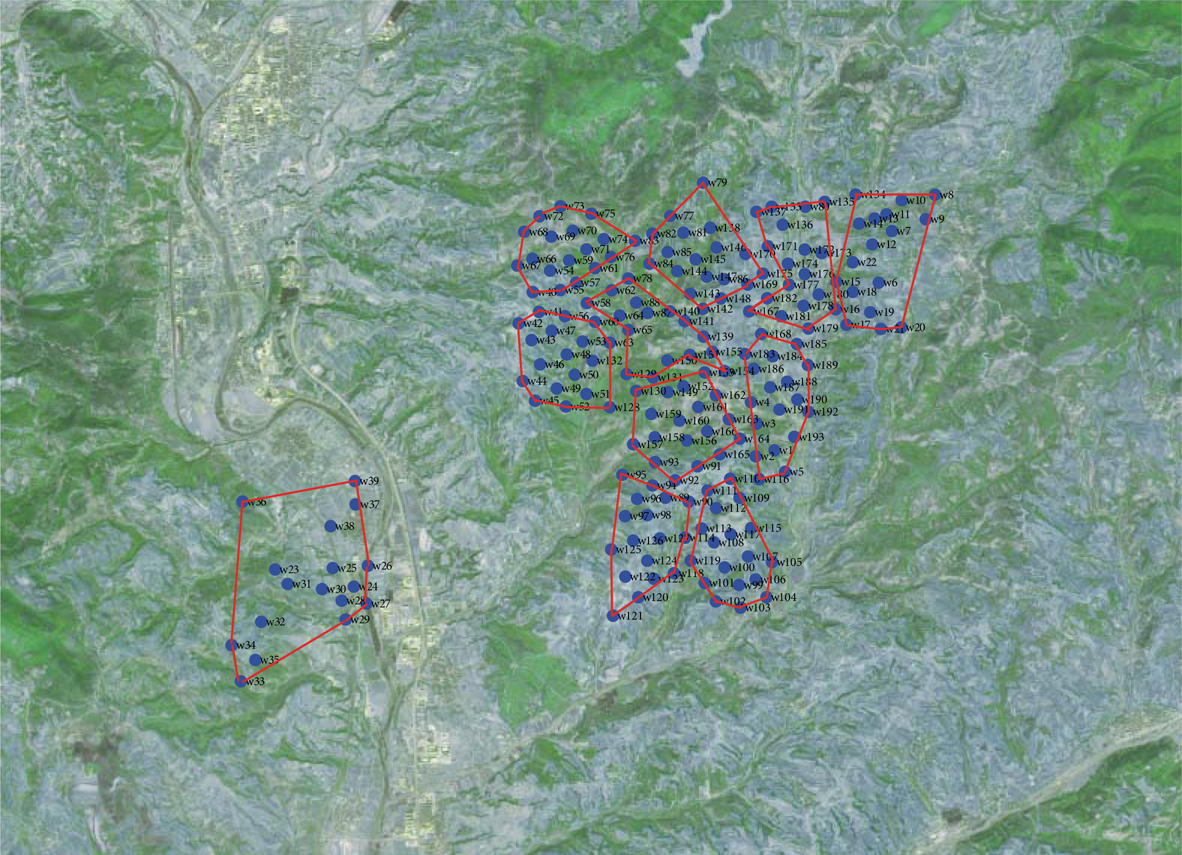
The clusters of well sites.

The optimal locations of valve sets.

Layout of the main pipeline.

Final layout of the Panhe CBM gathering system.
Optimization design is made by using the method mentioned above. Tables 4 and 5 are comparisons of data. Comparing optimization results with artificial design result, the total length of pipeline decreases by 4.576 km, pipeline investment decreases by 45.6215 × 10⁴ RMB, decreasing by 19.57% and 4.89%, respectively, so the optimization effect is evident.
Pipeline investment of artificial design.

Pipeline investment of optimization result.

The number of valve sets in system fell by 31% from 16 to 11, as shown in Table 6.
Investment of valve sets.

Finally, the performance of the optimization model presented above is demonstrated by applying it into the Panhe CBM field and the total investments have been reduced by about 108.52 × 10⁴ RMB.
6. Conclusion
CBM field in China is of low production and low pressure with hundreds of well sites. The topological structure is mainly a star-branched type. Optimization of this complex system is difficult. The framework of optimization is composed of wells clusters, node location problem, pipeline layout, and pipeline parameters.
In this paper we approached the problem of finding the optimal design of pipeline network in CBM network from an economic viewpoint. We proposed a way to model these problems by graphs and designed a framework for obtaining the solution. We have also seen all the variables that should be taken into account simultaneously. We have to study all these parameters and decide which parameters are really variables. We cannot take all of them into account because the system would certainly be too much difficult, and only part of them can be obtained by a method at a time.
No general optimization method could be used to optimize the design of CBM pipeline networks because of its complexity. A framework was developed for this specific application.
Investment has saved about 108.52 × 10⁴ RMB by design optimization for the Panhe CBM field, which contained 193 wells. Comparing optimization results with artificial design result, the total length of pipeline decreases by 4.576 km, pipeline investment decreases by 45.6215 × 10⁴ RMB, decreasing by 19.57% and 4.89%, respectively, so the optimization effect is evident.
Conflict of Interests
The authors wish to confirm that there is no known conflict of interests associated with this paper and there has been no significant financial support for this work that could have influenced its outcome.
Footnotes
Acknowledgments
The authors thank the financial support from the National Science and Technology Specific Project (Grant no. 2011ZX05039-002), the Key National Science and Technology Specific Project (2011ZX05026-004-03), and the National Natural Science Foundation of China (51104167).