




Abstract
This paper numerically examines laminar natural convection in a sinusoidal corrugated enclosure with a discrete heat source on the bottom wall, filled by pure water, Al2O3/water nanofluid, and Al2O3-Cu/water hybrid nanofluid which is a new advanced nanofluid with two kinds of nanoparticle materials. The effects of Rayleigh number (103≤Ra≤106) and water, nanofluid, and hybrid nanofluid (in volume concentration of 0% ≤ ϕ ≤ 2%) as the working fluid on temperature fields and heat transfer performance of the enclosure are investigated. The finite volume discretization method is employed to solve the set of governing equations. The results indicate that for all Rayleigh numbers been studied, employing hybrid nanofluid improves the heat transfer rate compared to nanofluid and water, which results in a better cooling performance of the enclosure and lower temperature of the heated surface. The rate of this enhancement is considerably more at higher values of Ra and volume concentrations. Furthermore, by applying the modeling results, two correlations are developed to estimate the average Nusselt number. The results reveal that the modeling data are in very good agreement with the predicted data. The maximum error for nanofluid and hybrid nanofluid was around 11% and 12%, respectively.
1. Introduction
In the past years, many different techniques were utilized to improve the heat transfer rate for reaching a satisfactory level of thermal efficiency. A way for this purpose is enhancement in thermal conductivity. So many efforts for dispersing solid particles with high thermal conductivity in the liquid coolant have been conducted to enhance thermal properties of the conventional heat transfer fluids. Maxwell [1, 2] was the first to show the possibility of augmentation of thermal conductivity of a solid-liquid mixture by increasing the volume fraction of solid particles. However, large particles cause many troublesome problems such as sedimentation of large sized particles in base fluid. Thus, a new class of fluids for improving both thermal conductivity and suspension stability was developed that is known as nanofluid.
Choi [3] presented the benefit of using the nanoparticles dispersed in a base fluid in different thermal systems to enhance the heat transfer rate. Eastman et al. [4] presented that with 0.3% volume concentration of Cu nanoparticles dispersed in ethylene glycol, its thermal conductivity increased by 40%.
Almost all published papers in nanofluid field until now defined “nanofluid” as a base fluid with suspended nanosized particles from just one type of material. They have studied the effect of size, shape, concentration, and material of nanoparticles on thermophysical properties of nanofluid and its influence on heat transfer and pressure drop characteristics. Nevertheless, very recently, an experimental study has been carried out on nanofluid with two types of nanoparticles dispersed simultaneously in a base fluid that is called “hybrid nanofluid” [5].
The most important exclusivity of hybrid nanofluid refers to composition of two variant types of dispersed nanoparticles in a base fluid. Thus, when materials of particles are chosen properly, they could enhance the positive features of each other and cover the disadvantages of just one material. For example, alumina (i.e., a ceramic material) has many beneficial properties such as chemical inertness and a great deal of stability, while Al2O3 exhibits lower thermal conductivity with respect to the metallic nanoparticles. Aluminum, zinc, copper, and the other metallic nanoparticles encompass great thermal conductivities. However, the use of metallic nanoparticles for nanofluid applications is limited due to the stability and reactivity. According to these features of metallic and nonmetallic nanoparticles, it can be expected that the addition of metallic nanoparticles (such as Cu) into a nanofluid composed based on Al2O3 nanoparticles can enhance the thermophysical properties of this mixture.
Suresh et al. carried out an experimental study to synthesize Al2O3-Cu/water hybrid nanofluid [5]. To reach the stable hybrid nanofluid, they used a thermomechanical method (two-step method). They added Cu nanoparticles to Al2O3/water nanofluid and synthesized Al2O3-Cu/water hybrid nanofluid by different volume concentrations as 0.1, 0.33, 0.75, 1, and 2%.
According to the above mentioned benefits of hybrid nanofluids, it is clearly expected that this advanced nanofluid plays a vital role in the future of science of nanofluid and researchers show a greater tendency toward investigation of hybrid nanofluids and effect of such fluids on heat transfer and pressure drop characteristics.
Natural convection heat transfer is an important phenomenon in engineering systems due to its wide applications in nuclear energy, double pane windows, heating and cooling of buildings, solar collectors, electronic cooling, microelectromechanical systems (MEMS) [6–8]. Therefore, the investigation of thermal and hydrodynamic behaviors for different shapes of the heat transfer surfaces is necessary to ensure the efficient performance of the various heat transfer equipment.
The problem of laminar natural convection in two-dimensional enclosures has been widely studied in several literatures. Many of these investigations (e.g., [9–11]) focused on natural convection heat transfer in enclosures with corrugated surfaces. Ali and Husain [12] examined the effect of corrugation frequencies on natural convection heat transfer and flow characteristics in a square enclosure of vee-corrugated vertical walls. In addition to regular geometries like square or rectangle, many studies on wavy-walled enclosures were performed in the literatures due to their application in many engineering problems related to geometrical design requirements [13]. Natural convection in a wavy enclosure like double-wall thermal insulation, underground cable systems, and cooling of micro-electronic devices has several applications in industrial and engineering purposes [14]. Therefore, because of the practical importance of flow and heat transfer in corrugated geometry many researchers have reported results on this geometry theoretically as well as experimentally (e.g., [15–17]).
Saha [18] performed a numerical investigation of the steady sate magneto convection in a sinusoidal corrugated enclosure with a heat source on the bottom wall. He showed that as the heat source surface area increased, the average Nusselt number decreased, indicating that the heat source size has significant effect on the heat transfer rate. In addition, Hussain et al. [19] numerically analyzed the effect of inclination angles on natural convection in the geometry introduced by Saha [18]. They reported that Nusselt number firstly increased by rising inclination angles and then decreased for all values of Hartmann number.
In this paper, laminar natural convection flow of Al2O3/water nanofluid and Al2O3-Cu/water hybrid nanofluid in a sinusoidal corrugated enclosure with a discrete heat source on the bottom wall is investigated. In fact this paper concerns the flow and heat transfer characteristics in the same geometry which was studied by Saha [18] and Hussain et al. [19] and develops their works by considering the effect of existence of nanoparticles from one and two types of materials in working fluid on heat transfer rate.
2. Mathematical Modeling
Figure 1 shows the considered geometrical configuration, with the important geometric parameters. This enclosure consists of two vertical sinusoidal corrugated and two flat horizontal walls with dimensions of H and W, respectively. A constant low temperature (T c ) is subjected to two sinusoidal sidewalls and a fixed flux heat source (q″), is discretely imposed at the bottom wall, while the remaining parts of the bottom wall and the upper wall are considered to be thermally insulated. The enclosure has the same height and width, H = W. The sidewalls profile is assumed sinusoidal with single corrugation period and the amplitude of 10% of the enclosure length. The ratio of the size of the heating element to the enclosure width is taken at ε = 0.4. Rayleigh number is defined as


Schematic of configuration under investigation.
Ra has been varied from 103 to 106, where Pr is Prandtl number and is specified in

2.1. Thermophysical Properties of Nanofluid and Hybrid Nanofluid
As previously mentioned, although some literatures studied the determination of thermophysical properties, the classical models are not certain for nanofluids. Of course, experimental results allow us to select an appropriate model for a specified property.
The effective properties of the Al2O3/water nanofluid and Al2O3-Cu/water hybrid nanofluid are defined as follows:

Equation (3) was originally introduced in [20] for determining density and then widely employed in [21–24]. So, the density of hybrid nanofluid is specified by

ϕ is the overall volume concentration of two different types of nanoparticles dispersed in hybrid nanofluid and is calculated as

Equation (6) that is utilized for specifying heat capacity was first employed in [20] and then used in many articles [22, 23, 25]:

According to (6), heat capacity of hybrid nanofluid can be determined as follows:

The thermal expansion coefficient of nanofluid can be determined by (8) employed in some literatures [26, 27]:

Hence, for hybrid nanofluid, thermal expansion can be defined as follows:

In addition, for calculating conductivity of nanofluids equation (10) was proposed by Hamilton and Crosser [28].

Here n is the empirical shape factor in order to account the effect of particles shape and can be varied from 0.5 to 6.0. The shape factor n is given by 3/ψ, where ψ is the particle sphericity, defined as surface area of a sphere to the surface area of the particle. Therefore for spherical nanoparticles n equals 3. This case of Hamilton and Crosser model (n = 3) is the same as Maxwell model [2]; see the following:

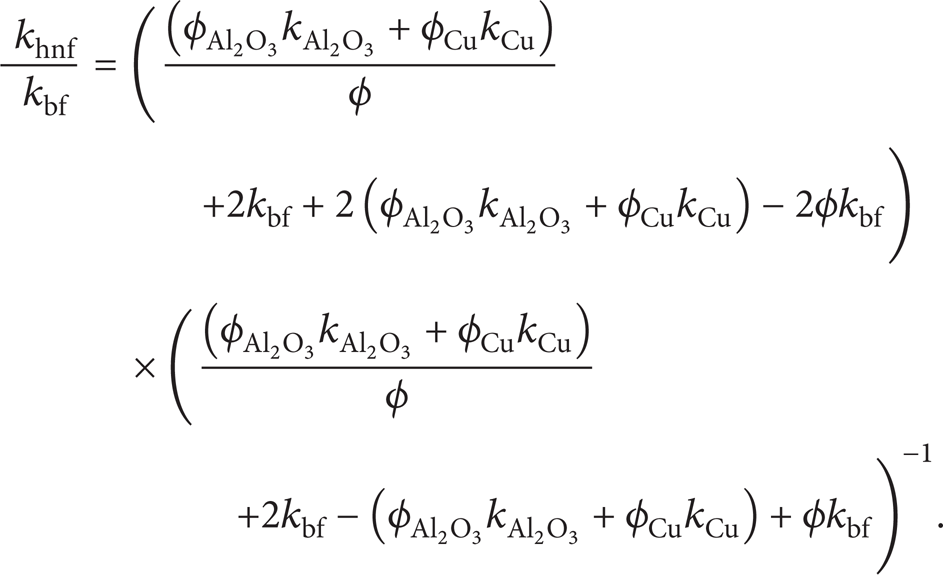
If the thermal conductivity of hybrid nanofluid is defined according to Maxwell model, (12) must be employed for this purpose:
To thermal conductivities of hybrid nanofluid in different volume concentrations, as shown in Figure 2, a comparison is made between the predicted values by Maxwell and Bruggeman models and experimental results by Suresh et al. [5]. It shows that these classical models could not precisely calculate the thermal conductivity, especially for higher volume concentrations. Even though Bruggeman model predicts better results compared to Maxwell model, the classical models, generally, could not be as useful and efficient as experimental data. Therefore, to accomplish the most accurate numerical results in this study, thermal conductivity values for both nanofluid and hybrid nanofluid in different concentrations have been extracted from experimental data reported by Suresh et al. [5].
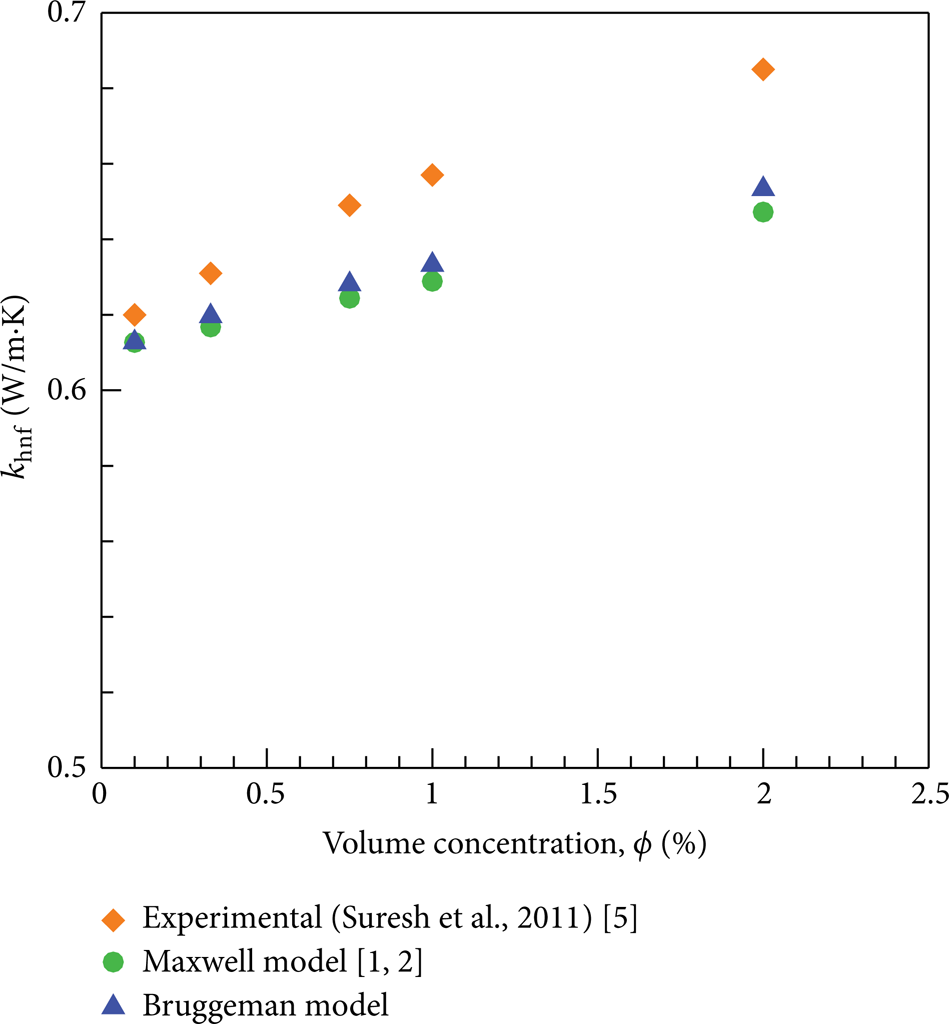
Thermal conductivity of Al2O3-Cu/water hybrid nanofluid.
To predict the viscosity of nanofluid, three models frequently were employed theoretically. These models are presented as follows.
Einstein model [29]:

where Kμ = 2.5.
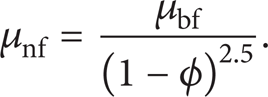
Brinkman model [30]:
Batchelor model [31]:

where K1 is 2.5 and K2 describes the deviation from the very dilute limit of suspension; by allowing a superimposed Brownian motion, the value of the coefficient K2 is calculated as 6 [5].
In (13)–(15), for calculating the viscosity of nanofluid, ϕ is the volume concentration of Al2O3 nanoparticles in nanofluid; whereas to define this property of hybrid nanofluid (μhnf), ϕ must be the overall volume concentration of nanoparticles indicated in (5).
Considering Figure 3, it can be understood that these classical models significantly underestimate the hybrid nanofluid viscosity, particularly in high volume concentration. Therefore, to have a high accuracy in numerical results, in the present study, viscosity of hybrid nanofluid is obtained from experimental data [5]. This result that the classical models underpredict μhnf and khnf for hybrid nanofluid has been also reported in the earlier literature [5].
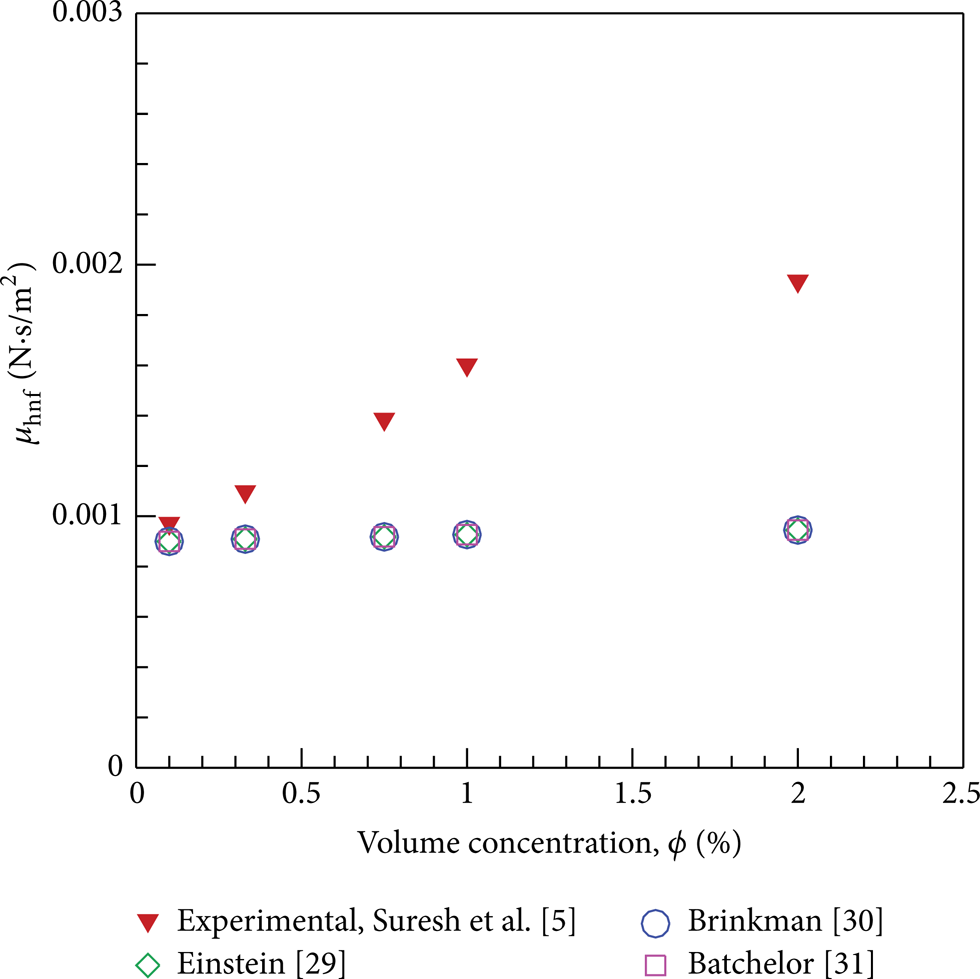
Dynamic viscosity of Al2O3-Cu/water hybrid nanofluid.
The thermophysical properties of both Al2O3/water nanofluid and Al2O3-Cu/water hybrid nanofluid for all volume concentrations are available in Table 1. In addition to this, the volume concentrations of Al2O3 and Cu are separately presented.
Thermophysical properties of nanofluid and hybrid nanofluid.

2.2. Governing Equations
The governing equations for laminar natural convection in an enclosure are continuity, momentum, and energy equations. Flow assumed to be steady state and incompressible. The density of fluid is assumed to be constant except in the body force term in the momentum equation, which varies linearly with temperature (Boussinesq's hypothesis). Also the behavior of fluid flow is supposed to be Newtonian. Assumption of Newtonian behavior for Al2O3-Cu/water hybrid nanofluid with volume concentration of lower than 2% seems acceptable according to Suresh et al. [5]. They have reported viscosity of hybrid nanofluid as a function of shear rate and showed an independency between viscosity and shear rate of this hybrid nanofluid with volume concentration of lower than 2%. In addition, other physical properties of fluid (thermal conductivity, thermal expansion coefficient, and specific heat) are taken constant in a specific volume concentration. Hence, the governing equations are transformed into a dimensionless form under the following nondimensional variables [18]:

where X and U represent the nondimensional coordinate and velocity along the horizontal axes, respectively; Y and V also define the nondimensional vertical component and velocity. According to (16), the Rayleigh number is defined as Ra = gβH3Pr(q″W/k)/ν2. The nondimensional forms of the governing equations are expressed in the following forms.
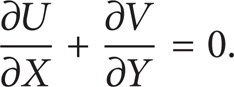
Continuity:
Momentum:

Energy:

where Ra and Pr are Rayleigh and Prandtl number which are specified in (1) and (2), respectively.
The average Nusselt number

where θ s (X) is the local dimensionless temperature distribution of the heated surface; θ has been defined in (16).
The corresponding boundary conditions for the above problem are given by

3. Numerical Method and Validation
The set of coupled nonlinear governing equations have been discretized using finite volume approach. The second-order upwind and linear methods are employed to approximate the convection and diffusion terms in the momentum and energy equation, respectively. Also pressure field is corrected utilizing the well-known pressure correction algorithm SIMPLE.
To achieve inconsistency of the numerical results to the grid resolution, ten different grids (from very coarse grid of 10 × 10 cells to very fine grid of 200 × 200 cells) have been produced and the most critical case of the present study (highest Rayleigh number filled with hybrid nanofluid by ϕ = 2%) is solved using these grids. The variation of average Nusselt number along the heated bottom wall with grid refinement is illustrated in Figure 4. This graph shows that an acceptable grid independency is achieved by refining the grid and the results obtained from grids finer than 10000 cells can be assumed to be grid independent. The difference of average Nusselt number of each grid from that of the finest grid is less than 0.4% for grids 120 × 120 and finer. Hence, the grid 120 × 120 is selected for the rest of calculations. As can be seen in Figure 5, this nonuniform grid is finer near walls and also the cell faces are aligned with enclosure walls.

Variation of average Nusselt number along the heated bottom wall with grid refinement for hybrid nanofluid of ϕ = 2% at Ra = 106.

Grid used in this study.
For the validation of the employed code, two different problems of natural convection in a square and a corrugated enclosure are studied. Firstly, the problem of natural convection in a square enclosure with two vertical isothermal walls (one hot and one cold) and two horizontal adiabatic walls, which is a common problem and there are many published results on, in Ra = 106 and Pr = 0.71, is investigated. The dimensionless temperature and vertical velocity along horizontal midline inside the enclosure obtained from the present numerical code, experimental results of Krane and Jessee [33], and numerical results of Khanafer et al. [34] are shown in Figure 6. This comparison reveals a very precise match between results of present study and numerical results of Khanafer et al. [34] and also a good agreement with experimental results of Krane and Jessee [33]. The differences between the numerical and experimental results can be explained to not considering the radiation heat transfer due to the high and low temperatures exposed on the walls of the enclosure, in numerical procedure. In addition, the assumptions employed for the numerical method (such as Boussinesq's hypothesis) can be another source of the error.

Comparison of results for natural convection in square enclosure along horizontal midline with those in the previous literatures. (a) Dimensionless temperature (b) dimensionless vertical velocity.
As the second case of validation, the problem of natural convection of air in sinusoidal corrugated enclosure is solved. A comparison is made for isotherms based on dimensionless temperature (θ) in various Grashof numbers (Gr = Ra/Pr) between the current study and Saha results [18] in Figure 7. A good accordance is found between the present results and Saha results [18].

Comparison of the isotherms in different Grashof numbers between the present study and results by Saha [18].
4. Results and Discussion
The laminar natural convection in a sinusoidal corrugated enclosure, the effect of adding the nanoparticles in one and two kinds of materials to a base fluid on heat transfer characteristics and hydrodynamic behavior have been investigated in this paper. This enclosure is partially heated via a discrete heat source with a constant heat flux located in the middle of the bottom wall. Also, the effect of Rayleigh number (103 ≤ Ra ≤ 106) and different working fluids including pure water, nanofluid, and hybrid nanofluid (in volume concentration of 0% ≤ ϕ ≤ 2%) on heat transfer and hydrodynamic performance of this enclosure is investigated.
To get a deep understanding of the thermal and flow behavior, the temperature and velocity profiles along the midsection of the enclosure are assessed in the present study. Accordingly, Figure 8(a) shows the profile of nondimensional temperature along the horizontal midline inside the enclosure, in a fixed Rayleigh number (Ra = 106) for pure water and hybrid nanofluid in different volume concentrations as the working fluid. In Figure 8(a) a bump can be seen near the center of temperature profiles which is clearly due to the presence of partially heated surface on the bottom wall. It is revealed from this figure that by increasing the volume concentration of hybrid nanofluid, the temperature decreases. This fact signifies that employing hybrid nanofluid, especially in higher volume concentrations, can enhance the cooling performance of the enclosure. This favorable effect on temperature is also observed in Figure 8(b) along the vertical midline inside the enclosure. As is expected, the temperature decreases by increasing Y. In addition, the temperature profile gradients on bottom and top walls certify the accuracy of imposing temperature boundary condition on these walls (finite and zero temperature gradients on heated surface and top wall, resp.).

Profile of nondimensional temperature for pure water and hybrid nanofluid in different volume concentrations in Ra = 106 along the (a) horizontal midline (Y = 0.5), (b) vertical midline (X = 0.5) in sinusoidal corrugated enclosure.
Figure 8 has made a comparison between pure water, nanofluid 2%, and hybrid nanofluid with the same volume concentration as the working fluids. Figures 8(a) and 8(b) clearly illustrate that hybrid nanofluid has a better cooling performance compared to that of nanofluid and also a conventional one.
Figure 9 shows the nondimensional temperature distribution along the horizontal and vertical midlines in enclosure for different Rayleigh numbers. It is observed in Figure 10(a) that by increasing Ra up to 105, the maximum of dimensionless temperature on horizontal midline increases and also slightly tended towards the right of enclosure due to its geometry. Nevertheless, this behavior is not observed for higher Rayleigh number, in a way that in Ra = 106 the temperature profile is totally changed. This fact can be explained that for lower Ra (Ra ≤ 105), the natural convection flow is weak and, thus, conduction dominates the flow and heat transfer regimes, although when Rayleigh number increases (Ra > 105), the bouncy forces are gradually more pronounced compared to viscous forces. As a consequence, convection becomes dominant which results in a better cooling performance. Hence, the maximum temperature for Ra = 106 is decreased. The vertical temperature distribution along line X = 0.5 can be seen in Figure 10(b). It is found out that the temperature near the partially heated surface is reduced by increasing Ra that indicates enhancing the cooling performance of the enclosure. According to the aforementioned explanation, the similar behavior of temperature profile is seen near the top wall that is far from the heat source which means that temperature distribution far from the heat source increases when conduction is dominant (Ra ≤ 105) and decreased when convection dominates the flow regime (Ra > 105).
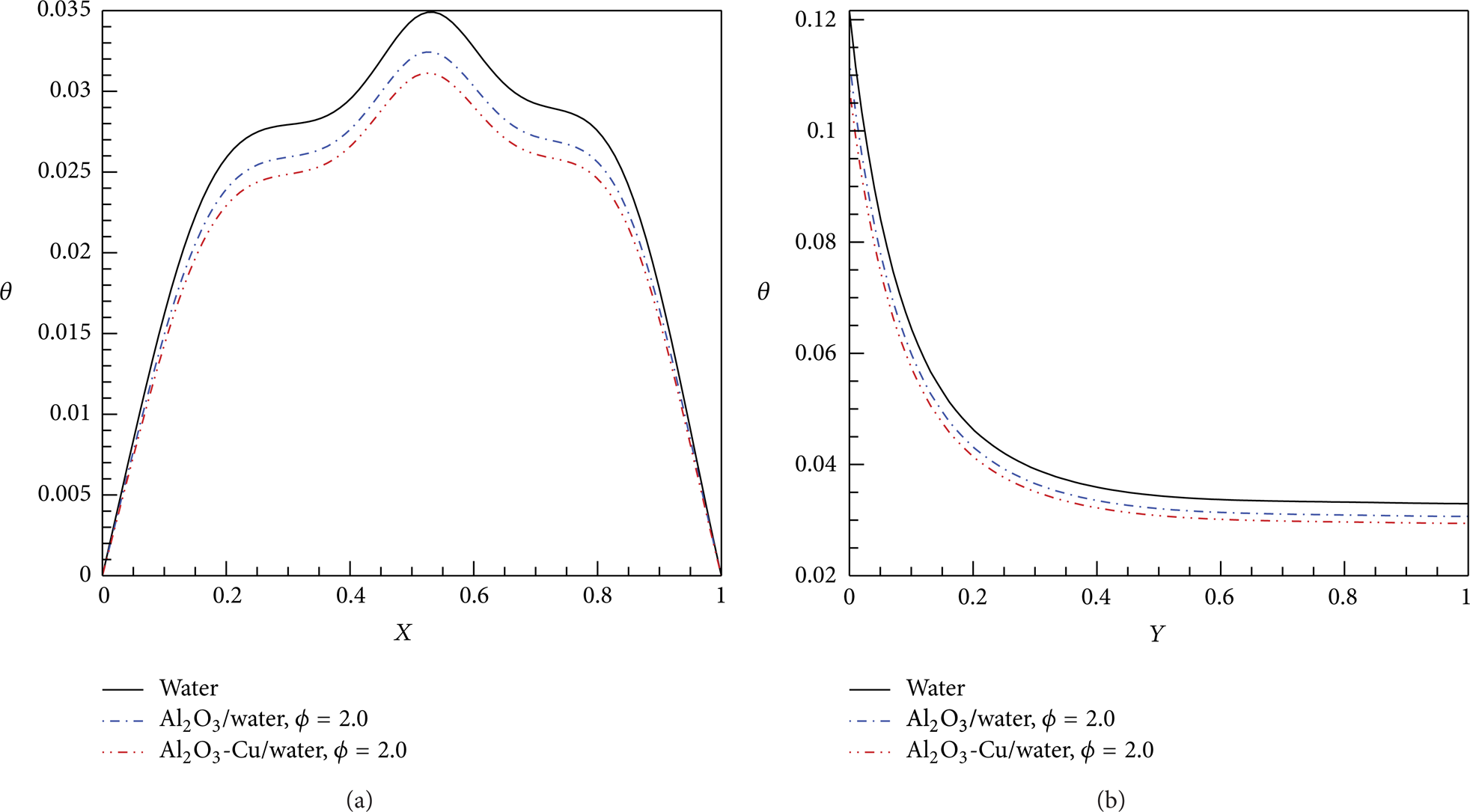
Profile of nondimensional temperature for pure water and nanofluid and hybrid nanofluid 2% in Ra = 106 along the (a) horizontal midline (Y = 0.5), (b) vertical midline (X = 0.5) in sinusoidal corrugated enclosure.

Profile of nondimensional temperature for hybrid nanofluid 2% in range of Ra along the (a) horizontal midline (Y = 0.5), (b) vertical midline (X = 0.5) in sinusoidal corrugated enclosure.
Figure 11 illustrates the velocity distribution on the horizontal and vertical midline of the sinusoidal corrugated enclosure or hybrid nanofluid 2% in range of Ra. It is understood from Figure 11(a) that the absolute magnitude of vertical velocity along the horizontal midline increases by Ra. This fact is because of stronger buoyant flow due to higher Rayleigh numbers. Moreover, the maximum of this parameter is seen at the midsection of the enclosure that is due to the place of heat source on the midline of the bottom wall. See Figure 11(b) where the nonsymmetrical horizontal velocity profile is presented which indicates the direction of the flow rotation within the enclosure due to its geometry and boundary condition. It can be seen that horizontal velocity along the vertical midline also increases by Ra and then the natural convection flow becomes stronger.

Velocity distribution for hybrid nanofluid 2% in range of Ra (a) V y along the horizontal midline (Y = 0.5), (b) V x along the vertical midline (X = 0.5) in sinusoidal corrugated enclosure.
The evolution of thermal fields of nanofluid and pure water and also hybrid nanofluid and pure water in range of Rayleigh number and volume concentration for a sinusoidal corrugated enclosure with ε = 0.4 is presented in Figure 12. It is realized that for lower Ra (103 and 104) the convection intensity inside the enclosure is very weak. Thus, viscous forces are more dominant than the buoyancy forces and diffusion is the principal mode of heat transfer; such phenomena have been already reported by Saha [18] and Hussain et al. [19]. Hence, the isotherm profiles remain similar to conduction heat transfer pattern and are almost invariant up to Ra = 104. At higher Rayleigh numbers, when the intensity of convection increases, the isotherm pattern is significantly changed which indicates that the convection is the dominating heat transfer mechanism in the enclosure. In Ra = 105 and more significantly for Ra = 106 the isotherm profiles start getting shifted towards the side walls and they break into two symmetric contour lines, as shown in this figure. It can be seen that with the increase of Rayleigh number, the isotherms are squeezed toward the heated part of the bottom wall. Therefore, the developing thermal boundary layer thickness at the bottom wall becomes thinner and thus indicates higher heat transfer rate and results in higher average Nusselt number. Moreover, in this figure, it is clear that the isotherm patterns are affected by the presence of nanoparticles. In fact, the existence of nanoparticles results in compression of isotherms near the heat section of bottom wall which means improving in heat transfer performance. This effect is more obvious for hybrid nanofluid rather than nanofluid.

Isotherms for different Rayleigh number and volume concentration of nanofluid and hybrid nanofluid (red line) and pure water (blue line).
In the electronic components with a constant heat flux, the temperature on the heated section is not uniform. This uncontrolled surface temperature has an adverse effect on the life and functionality of these components. Accordingly, in this part of the current study, the variation of local Nusselt number along the heated section on the bottom wall (0.5(1 − ε) ≤ X ≤ 0.5(1 + ε)) is investigated in Figure 13. It is seen in Figure 13(a) that for each working fluid there is a point on which the Nusselt number is minimum. It can be noted that the maximum of the temperature profile of the partially heated surface is located at this point, where the temperature difference with the adjacent flow is minimal. It is understood from this figure that employing hybrid nanofluid 2% is more effective compared to the similar nanofluid and base fluid on decreasing the maximum temperature. Moreover, it is found out from Figure 13(b) that by increasing the volume concentration of nanoparticles in hybrid nanofluid, the maximum surface temperature of the heat source decreases. This fact can be clearly observed in Figure 6(b) and 7(b). Also, the similar behavior is reported in the previous works (i.e., [35]). This reduction is less evident as the heat transfer mechanism within the enclosure shifts from conduction (low Rayleigh numbers) to convection (high Rayleigh numbers) dominated flow.

Variation of local Nusselt number along the partially heated surface in Ra = 106 for (a) pure water and hybrid nanofluid in different volume concentrations (b) water, nanofluid, and hybrid nanofluid 2%.
As previously mentioned, the decrease in the maximum temperature of the heated section is a result of the augmented thermal energy transfer from the wall to fluid. However, since the inclusion of nanoparticles enhances the effective thermal conductivity of the nanofluid and hybrid nanofluid, the decrease in the maximum temperature of the heated section is more remarkable where the conduction regime prevails. This phenomenon can be described in two microscopic and macroscopic perspectives. From microscopic standpoint, the nanoparticles hit the wall, absorb thermal energy, reduce the wall temperature, and mix back with the bulk of the fluid. In macroscopic viewpoint, by adding nanoparticles in one kind of material (nanofluid) and two types of it (hybrid nanofluid), the thermal properties of the resulting mixture have improved. Therefore, hybrid nanofluid possesses a higher thermal conductivity than that of nanofluid and also a conventional one. Thus, this higher thermal conductivity has the positive effect on the heat transfer performance.
Figure 14 presents the effect of Rayleigh number on the local Nusselt number of heated section for hybrid nanofluid 2%. According to the above mentioned explanation about the maximum temperature of the heated surface, it is expected that the local Nusselt number increases by Rayleigh number and this trend is seen in this figure.

Variation of local Nusselt number along the partially heated surface in different Rayleigh numbers.
Figures 15(a)–15(c) show the effect of Rayleigh number on the average Nusselt number of discrete heated bottom wall for pure water, Al2O3/water nanofluid, and Al2O3-Cu/water hybrid nanofluid in a fixed volume concentration. As is expected, the average Nusselt number increases by Rayleigh number. Also, it is obvious that adding nanoparticles enhances heat transfer characteristics. These results are in agreement with previous observations [18, 19, 34]. In addition, comparison between Figures 15(a), 15(b), and 15(c) reveals that augmentation of heat transfer of hybrid nanofluid and nanofluid compared to pure water increases by volume concentration in a constant Rayleigh number. More importantly, it is found out that employing hybrid nanofluid ameliorates the average Nusselt number more than that of nanofluid in the same volume concentration. This behavior could be explained in enhancing thermophysical properties of the mixture compared to pure water, thanks to particles inclusion. Consequently, hybrid nanofluid possesses a higher thermal conductivity that results in augmentation of the heat transfer rate. For example, in Rayleigh number of 106 one can find 8.4% enhancement of average Nusselt number for nanofluid with ϕ = 2% compared to pure water; however hybrid nanofluid with the same volume concentration provides an increase of 13.3%. The average Nusselt numbers for all the considered cases are reported in Table 2. These scenarios also can be observed for other cases.
Average Nusselt numbers for all studied cases.


The average Nusselt number of sinusoidal corrugated enclosure versus Rayleigh number for pure water, Al2O3/water nanofluid, and Al2O3-Cu/water hybrid nanofluid by (a) ϕ = 0.1%, (b) ϕ = 1%, and (c) ϕ = 2%.
Two correlations based on the numerical results have been developed to predict the average Nusselt number for nanofluid (see (22)) and hybrid nanofluid (see (23)) as follows:


These equations coefficients were assessed with the help of classical least square method and the correlations are valid for laminar regime (103 ≤ Ra ≤ 106), Al2O3/water nanofluid, and Al2O3-Cu/water hybrid nanofluid with the volume concentrations less than 2%.
A parity plot for the above correlations is shown in Figure 16. It shows that the correlated Nusselt data were in good agreement with the simulated ones. The maximum error observed in Figures 16(a) and 16(b) was around 11% and 12%, for nanofluid and hybrid nanofluid, respectively.
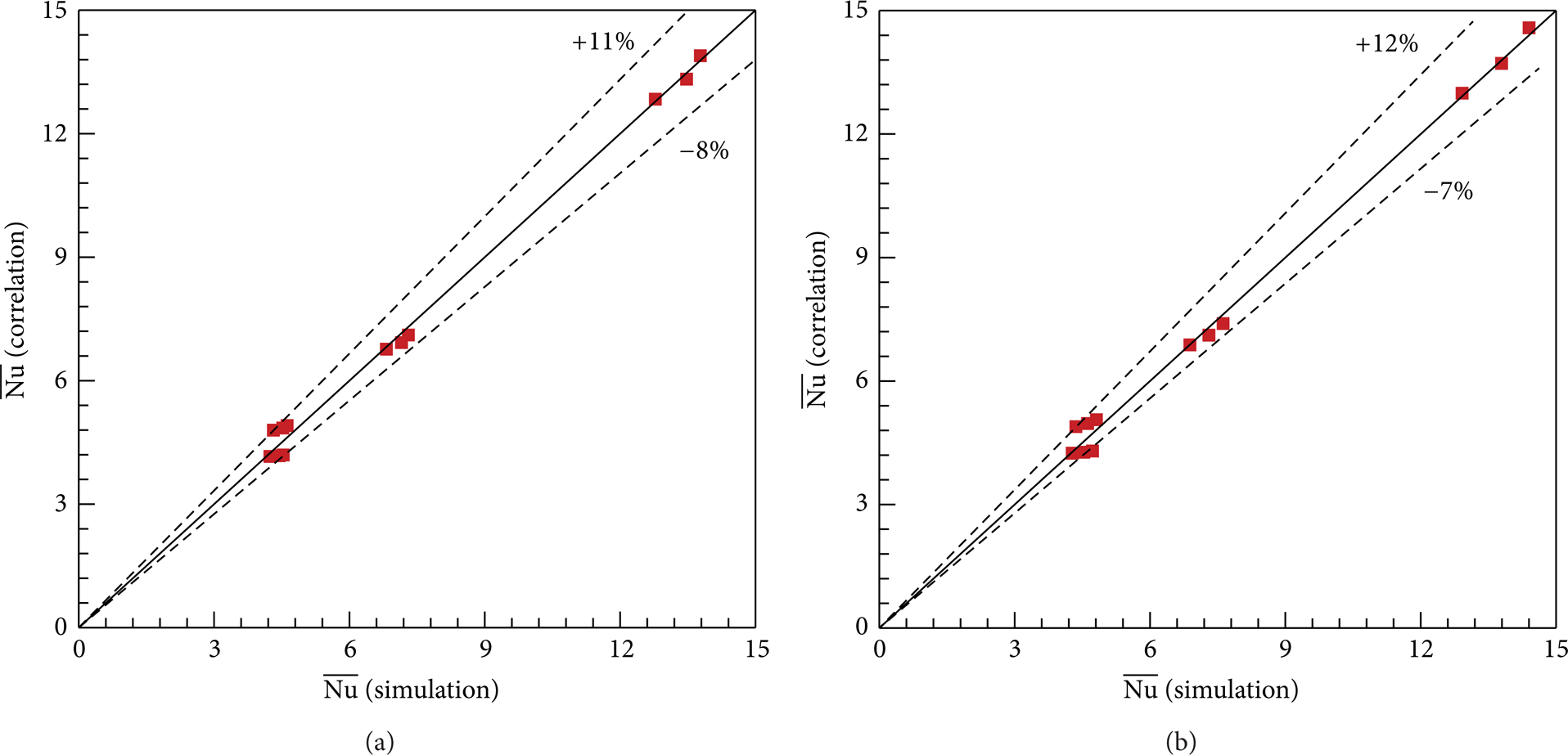
Parity plot comparing the prediction data and simulation results, for (a) nanofluid, (b) hybrid nanofluid.
5. Conclusions
The effect of Rayleigh number and the inclusion of Al2O3 and Al2O3-Cu nanoparticles in the base fluid, for a laminar natural convection in a sinusoidal corrugated enclosure with a discrete heat source on the bottom wall, on heat transfer and flow characteristics have been numerically investigated in this study.
Some of important conclusions drawn from the present analysis are as follows.
Classical models for specifying nanofluids thermophysical properties significantly underestimate the hybrid nanofluid viscosity and thermal conductivity, particularly in the higher volume concentrations. This result has been also observed by Suresh et al. [5].
The average Nusselt number increases by Rayleigh number. Moreover, nanofluid clearly enhances the heat transfer rate, thanks to the presence of nanoparticles. More importantly, hybrid nanofluid improves the average Nusselt number more than that of nanofluid. In the present study, the highest value of the average Nusselt number
The increase of Rayleigh number strengthens the natural convection flows which results in increasing the local Nusselt number of the heated section and reduction of the corresponding temperature. The increase of volume concentration of nanoparticles causes the maximum surface temperature (i.e., located in point in maximum Nusselt number) to decrease, particularly at low Rayleigh numbers, because conduction regime prevails.
The velocity distribution along the vertical midline in sinusoidal corrugated enclosure is clearly nonsymmetric due to the geometry and boundary conditions. The velocity increases by Rayleigh number, as expected.
To predict the average Nusselt number of nanofluid and hybrid nanofluid, two correlations have been developed. These equations are based on the modeling results and calculated by employing the classical least square method.
Footnotes
Nomenclature
Conflict of Interests
The authors declare that there is no conflict of interests regarding the publication of this paper.
Acknowledgments
The authors would like to thank the Delta Offshore Technology Co. for financial support and the R&D department of this company for allocating computing facilities.