




Abstract
The unsteady free convection boundary layer flow of a thermomicropolar fluid along a vertical plate with effect of micropolar heat conduction has been investigated. The governing equations are transformed into a new form using a method of transformed coordinates. We then use an explicit finite difference scheme to solve the transformed equations. Here, the governing equations have been reduced to the forms that are valid for entire, small, and large time regimes, by using stream-function formulation. The results obtained for the above mentioned three time regimes are compared and found to be in excellent agreement. Moreover, the effects of the physical parameters such as the viscosity parameter, K, and the heat conduction parameter, α*, are presented in terms of the transient shear stress, couple stress, and surface heat transfer coefficient as well as transient velocity profiles, angular velocity profiles, and temperature profiles.
1. Introduction
The concept of a micropolar fluid to model fluids with microstructures which cannot be adequately is described by the classical Stokesian theory introduced by Eringen [1, 2]. According to him, examples of such fluids are animal blood, liquid crystals, and certain polymeric fluids. In such fluids the microelements possess both translational and rotational motions. The interaction of the macrovelocity field and microrotation field can be described through new material constants in addition to those for a classical Newtonian fluid.
The concept of boundary layer in micropolar fluids was first introduced by Willson [3] to study the steady, incompressible laminar flow over 2-dimensional bodies. Subsequently, the steady boundary layer flow of micropolar fluids at the stagnation point of a 2-dimensional body has been considered by Peddieson and McNitt [4]. In addition to these, Ahmadi [5] considered the steady boundary layer flow of micropolar fluids over a semi-infinite flat plate and obtained a self-similar solution. The thermal boundary layer in micropolar fluids at the stagnation point of a 2-dimensional body was considered recently by Ramachandran et al. [6] and Gorla [7]. Hossain et al. [8, 9] investigated two-dimensional mixed convection and natural convection flow of a viscous incompressible thermomicropolar fluid with uniform spin-gradient over a flat plate.
Later, Jena and Mathur [10–12] studied the similarity solutions for the steady laminar free convection boundary layer flow of a thermomicropolar fluid past a nonisothermal vertical flat plate. Recently, a model on natural convection flow of a thermomicropolar fluid along a porous vertical surface has been studied by Hossain et al. [13]. But all the above studies pertain to steady flows.
But all the above studies pertain to steady flows. However, Gorla and Takhar [14] examined the effect of buoyancy force on an unsteady incompressible micropolar fluid in the vicinity of the lower stagnation point of a circular cylinder. More or less recent studies on transient boundary layer flow of micropolar fluid without or with buoyancy effect have been done by Kumari and Nath [15], Lok et al. [16], and Xu et al. [17]. Unsteady mixed convection flow of thermomicropolar fluid along a vertical thin cylinder and along a vertical wavy surface have been investigated in [18–20]. Very recently, Hossain et al. [21] have studied the fluctuating free convection boundary layer flow of a thermomicropolar fluid of micropolar thermal conductivity along a vertical plate considering the small amplitude temperature oscillations about a variable surface temperature.
Here, we propose to study the unsteady free convection boundary layer flow of a thermo-micropolar fluid along a heated vertical plate with the presence of micropolar heat conduction. The reduced governing equations that are valid for entire time regimes is solved using explicit finite difference method. Asymptotic solutions for small and large time are also obtained. The results thus obtained are compared and found to be in excellent agreement. We further have examined the effect of the physical parameters, such as the vortex viscosity parameter, K, and the heat conduction parameter, α*, in terms of the transient shear stress, couple stress, and surface heat transfer coefficients as well as transient velocity profiles, angular velocity profiles, and temperature profiles.
2. Mathematical Formalisms
A two-dimensional unsteady laminar boundary layer flow of a thermomicropolar natural convection incompressible fluid along a permeable vertical flat plate is considered. The flow configuration and the coordinate system are shown in Figure 1. The dimensionless equations of continuity, momentum, angular velocity, and energy that govern the flow are given as [10, 13, 21]


The set of equations (1)–(4) are dimensionless which are based on the following dimensionless dependent and independent variables

Here,

In the above equation, θ w (x) is the prescribed surface temperature. Here, we have considered that θ w (x) = x.

Flow configuration and coordinate system.
In the meantime, Jena and Mathur [11, 12] studied the same model for steady laminar free convection flow of a thermomicropolar fluid past a nonisothermal vertical flat plate as well as for nonuniformly heated porous vertical flat plate.
The values of the physical quantities, namely, the shear stress, τω, the couple-stress, mω, and the rate of heat transfer, qω, at the surface of the plate, which are important from the experimental point of view are readily obtained

3. Methods of Solution
Here, we are investigating the present problem in three time regimes, namely, (i) entire, (ii) small, and (iii) large time regimes. The method of solutions discussed in the following section has been adopted by Hossain et al. [22] and Mahfooz et al. [23] while analyzing the problems on unsteady mixed convection boundary layer flow of viscous incompressible fluid along a symmetric wedge with variable surface temperature as well as on the radiation effects on transient magnetohydrodynamic natural convection flow with heat generation.
3.1. Solutions for Entire Time Regime (All τ)
To get the solutions for entire time regime here we introduce the following group of transformations [22, 23]:

In (1), η is the similarity variable and ψ is the stream function defined by

That satisfies the equation of continuity (1).
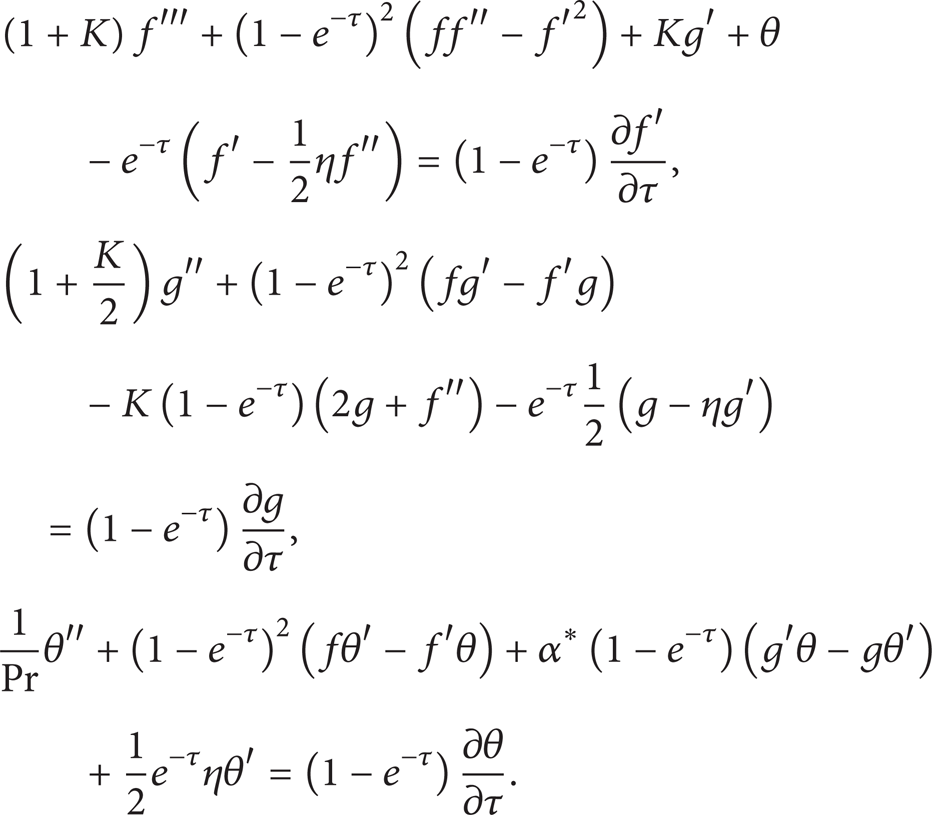
Now, (1)–(4) together with the boundary conditions (6) and the transformations (8) are reduced to
The corresponding boundary conditions are

where primes denote the differentiation with respect to η.
The starting point to obtain the solutions of (10) is the set of the finite-difference equations obtained by spatial discretization of the transformed equations (10). The first-order central difference approximation is used for the first-order derivative with respect to η, and the second-order central difference approximation is used for the second-order derivative with respect to η. The forward differences are used for the time derivative. This discretization results in the following tridiagonal algebraic system of equations:

In the above equations, the subscripts k (= 1, 2, and 3) represent the functions U, θ, and φ, respectively. i (= 1, 2,…, M) and j (= 1, 2,…, N) correspond to the grid points in η and τ directions, respectively. The coefficients A k , B k , C k , and D k may be obtained easily. These block tridiagonal systems for k = 1, 2, and 3 are solved by a block matrix version of the well-known Thomas algorithm. Once the function U = f′(η) is known, the function f may be found explicitly from the following relation:

The computation is started at τ = 0.0 and then marches forward until it reaches a steady state. The convergence criteria for detecting the steady state solutions are set in such a way that the difference between the values of the function f(η, τ) obtained in two consecutive time steps is less than 10−4. The computational domain is discretized in the (τ, η) space by using the step sizes of Δτ and Δη. After some experimentation, the final mesh sizes are chosen to be Δη = 0.005 and Δτ = 0.02.
Solutions obtained are thus used to get the values of nondimensional shear stress, the couple stress, and the rate of heat transfer from (5) and are then transformed to

Numerical values of the coefficients of shear stress, the couple stress, and the rate of heat transfer are presented in tabular form as well as graphically in the following sections.
In the next subsections, we will discuss the asymptotic solutions for small and large time τ.
3.2. Asymptotic Solutions for Small Time (τ ≪ 1) Regime
For small time regime, we consider τ ≪ 1. Consequently, the value of e−τ ≈ 1 and 1 − e−τ ≈ τ. Thus, (15) must now be written in the following form, which is more convenient for analysis at small times:

The boundary conditions (11) become

By knowing the functions f, g, and θ and their derivatives, we can readily get the values of the shear stress, the couple stress, and the rate of heat transfer, q, from the following relations.
At small values of τ (τ ≪ 1), it can easily be verified that the solutions of (15) take the following form:
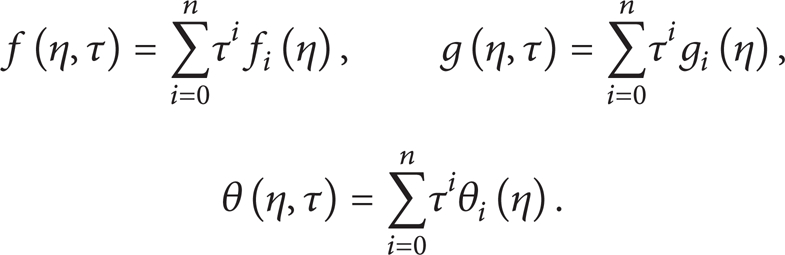
Now, by substituting the series expressions given in (17) into (15) and picking up the terms up to the O(τ2), we get the following sets of boundary value problems:


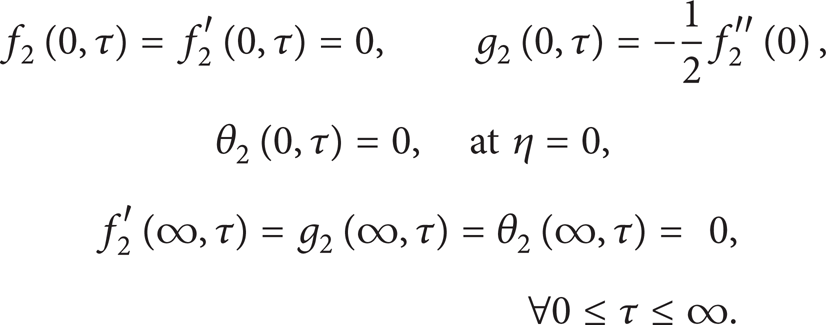
The set of equations (18)–(20), (22)–(24), and (26)–(28) are linear by nature which, although are solvable analytically, are solved numerically employing the linear shooting method (or the method of superposition). Results thus obtained for f i ″(0), g i ′(0), and θ i ′(0), i = 0, 2, are used in obtaining the values of the shear stress, the couple stress, and the rate of heat transfer, from

For example, we have obtained the solutions of the above sets of equations for K = 1 while Pr = 9.0 and α* = 0.25, for which we have the following expressions for shear stress, τω/x, couple stress, mω/x, and surface heat transfer, qω/x:

Numerical values obtained from the above expressions for shear stress, couple stress, and surface heat transfer entered in Table 2 for comparison with other solutions obtained by the method discussed in forgoing section.
3.3. Asymptotic Solutions for Large Time (τ ≫ 1) Regime
Now for large time regime, (10) can be reduced to following form:

Corresponding boundary conditions are obtained as follows:

Expanding the functions involves the set of equations (32)–(33) in powers of τ−1 as given below

Now, by using the functions given in (34) into (32)–(33) and taking the terms up to the O(τ−1) we get





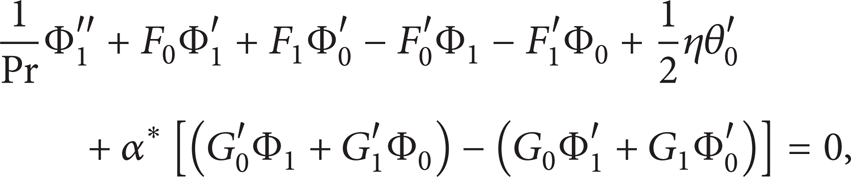

Equations (35) to (37) are the leading order equations and represent the steady state flow at large τ. The same set of equations were obtained by Hossain et al. [21] as the steady mean part of the fluctuating flow of the thermomicropolar fluid past a flat surface that was maintained at small amplitude oscillating temperature about a nonuniform steady mean temperature. We should further mention that Jena and Mathur [10] in studying the laminar free convective flow of a thermomicropolar fluid past a nonisothermal vertical flat plate obtained the same set of that given above. It should be noted that the set of equations (35) to (37) are nonlinear. Hence, solutions of these equations are obtained numerically by employing the nonlinear shooting method. Typical values of F″(0), G′(0), and Φ′(0) obtained are thus compared with that of Jena and Mathur [10] in Table 1.
Numerical values of the coefficients of shear stress, surface heat transfer, and couple stress for K = 0.1 and 0.25, while Pr = 9.0 and α* = 1.0 in a comparison.

Numerical values of shear stress, τω/x, couple stress, mω/x, and surface heat transfer, qω/x, while K = 1.0 and α* = 0.25 against τ.

s stands for small time and l stands for large time.
Here, we have obtained the solutions of equations up to the O(τ−1) using the nonlinear shooting method. Once we know the values of F i ″(0), G i ′(0), and Φ i ′(0) for i = 0, 1, we may obtain the numerical values of the coefficients of shear stress, couple stress, and surface heat transfer from the expressions that are given below

For example, taking K = 1.0, Pr = 9.0, and α* = 0.25, we get the following expressions for shear stress, τω/x, couple stress, mω/x, and surface heat transfer, qω/x:

Numerical values thus obtained for shear stress, τω/x, couple stress, mω/x, and surface heat transfer, qω/x, are entered in Table 2 for values of τ while K = 1.0 and α* = 0.25. This table also contained the asymptotic values of the above physical quantities for comparison. The comparison shows excellent agreement with the perturbation solutions for smaller value of τ up to 1.48 and for large value of τ from 40.0 that are obtained for all τ.
4. Results and Discussion
In the above sections, we have analyzed the problem of unsteady natural convection laminar boundary layer flow of thermomicropolar viscous incompressible fluid along a nonuniformly heated vertical surface. The governing dimensionless boundary layer equations are transformed into suitable forms appropriate for entire, small, and large time regimes. Solutions of the resulting equations are then obtained numerically and the results are depicted in terms of the transient shear stress, τω/x, couple stress, mω/x, and surface heat transfer, qω/x. Here, we have discussed the effects of the physical parameters, such as the micropolar heat conduction parameter, α*, the vortex viscosity parameter, K, and τω/x, mω/x, and qω/x against the time variable τ. The present analysis of the problem has been carried out considering the fluid for which Pr = 9.0 [10]. Further results have been presented and discussed in terms of axial velocity, angular velocity, and the temperature profiles with effect of the aforementioned physical parameters.
4.1. Effect of Micropolar Heat Conduction Parameter, α*, on Transient Shear Stress, Couple Stress Coefficients, and Surface Heat Transfer
The effects of the micropolar heat conduction parameter, α*, on the transient shear stress, τω/x, the couple stress, mω/x, and the surface heat transfer coefficient, qω/x, are presented, respectively, in Figures 2(a) to 2(c) taking value of the vortex viscosity parameter, K, equal to 1.0. It is seen from these figures that as the micropolar heat conduction, α*, leads to decrease of the value of the shear stress as well as the heat transfer, there is increase in the couple stress. These happen due to the fact that increase in the value of micropolar thermal conductivity enhances the fluid's thermal conductivity. These figures also contain the representative values of τω/x, mω/x, and qω/x obtained from the asymptotic solution for different values of α*. One can claim that the asymptotic values in the smaller and larger time regimes agree excellently with all time solutions. This claims that the results presented here for all-time regime are accurate and hence may be useful for the experimentalists.

Numerical values of (a) shear stress, (b) couple stress, and (c) surface heat transfer coefficient for different values of α* against values of τ while Pr = 9.0 and K = 1.0.
4.2. Effect of Vortex Viscosity Parameter, K, on Transient Shear Stress, Couple Stress Coefficients, and Surface Heat Transfer
Now, we show the effect of the vortex viscosity parameter, K, on the transient shear stress, τω/x, couple stress, mω/x, and surface heat transfer coefficient, qω/x. Figures 3(a)–3(c) depict the values of τω/x, mω/x, and qω/x for K = 1.0, 3.0, and 5.0 while α* = 1 against τ. From these figures, one can see that an increase in the value of the vortex-viscosity leads to increase in shear stress but decrease in the couple stress and the surface heat transfer. This is expected because increasing value of the vortex viscosity will increase the total viscosity of the fluid.
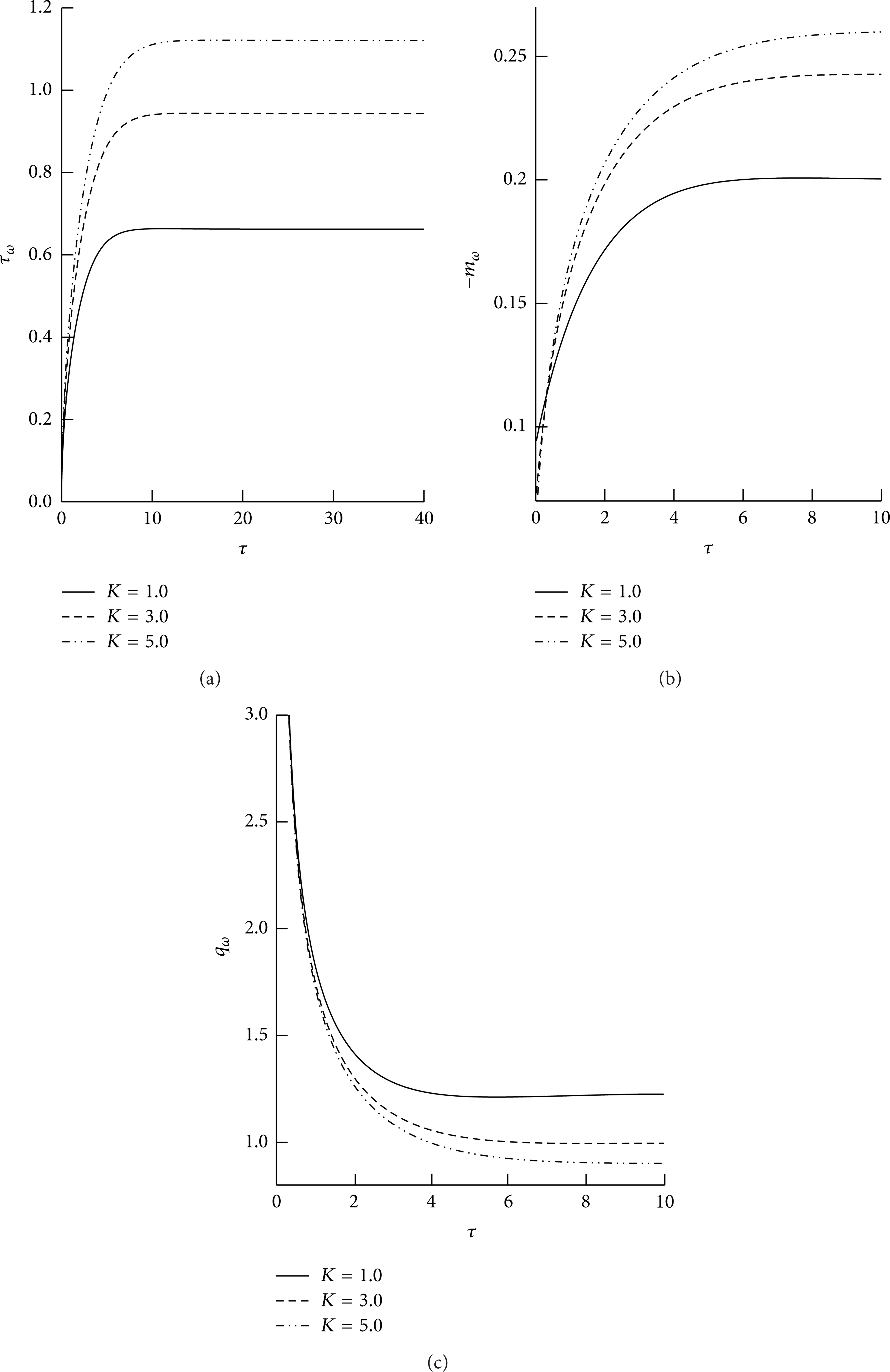
Numerical values of (a) shear stress, (b) couple stress, and (c) surface heat transfer coefficient for different values of K against values of τ while α* = 1.0.
4.3. Transient Axial Velocity, Angular Velocity, and Temperature Profiles for Different Time (τ)
The transient axial velocity, angular velocity, and temperature profiles are shown in Figures 4(a)–4(c) against η for values of τ in [0, 8] while vortex-viscosity parameter K = 1 and micropolar thermal conductivity parameter α* = 5.0. It is seen from Figures 4(a) and 4(c) that the axial velocity and the temperature profiles increase with the increase of time which leads to increase in both the momentum boundary thicknesses. On the other hand, one can also see that in the vicinity of the surface, that is, in the region η ≤ 2 (approximately), the angular velocity profile decreases, whereas these profiles increase with the increase of time in the region η > 2. Further, we notice that all the profiles reach to the asymptotic profile or the steady state profile at larger value to time parameter τ. In this case, we found the maximum value of τ to be 8 to reach the profiles at steady state.

Numerical values of (a) velocity profiles, (b) angular velocity profiles, and (c) temperature profiles for different values of τ against η when Pr = 9.0 and K = 1.0.
4.4. Effect of Micropolar Heat Conduction Parameter, α*, on Axial and Angular Velocity and Temperature Profiles
Here, we show the effect of micropolar thermal conductivity, α*, on the transient axial velocity, angular velocity, and the temperature profiles at τ = 2.0 while K = 1.0 through Figures 5(a) to 5(c), respectively. In this case α* = 0.0, 0.5, 1.0, 1.5, and 2.0. It is clear from these figures that the axial velocity, angular velocity, and temperature profiles increase due to increase in micropolar thermal conductivity, α*. But, owning to increase in the heat conduction parameter, no significant effect on the angular velocity profile is observed.

(a) Axial velocity profiles, (b) angular velocity profiles, and (c) temperature profiles for different values of α* against η at τ = 2 when Pr = 9.0 and K = 1.0.
4.5. Effect of Vortex Viscosity Parameter, K, on Axial Velocity, Angular Velocity, and Temperature Profiles
The effect of increasing values of the vortex viscosity parameter, K, on the transient axial velocity, angular velocity, and temperature profiles are depicted in Figures 6(a)–6(c) at τ = 2.0 and α* = 0.25. From Figure 6(a), it can be seen that, within the region η < 1.8, the velocity profile increases due to increase in the value of the vortex-viscosity of the fluid, whereas, this leads to decrease in the velocity profile in the region η > 1.8. This implies that increase in the vortex viscosity leads to decrease in the momentum boundary layer thickness. We further observe that the angular velocity profile decreases owing to increase in the value of K which leads to reduction in the angular momentum boundary layer thickness. Finally, one can see that there is no significant contribution to the temperature profile due to increase in the vortex viscosity parameter K.

Numerical values of (a) velocity profiles, (b) angular velocity profiles, and (c) temperature profiles for different values of K against η at τ = 2 when Pr = 9.0 and α* = 0.25.
5. Conclusions
In this paper, we have investigated an unsteady free convection boundary layer flow of a thermomicropolar fluid along a heated vertical plate, considering the presence of micropolar heat conduction. The reduced governing equations that are valid for entire time regimes are solved using explicit finite difference method. Asymptotic solutions for small and large time are also obtained. The results obtained are thus compared and found to be in excellent agreement. From the present investigation, we may conclude the following.
The micropolar heat conduction, α*, leads to decrease in the shear stress as well as the heat transfer, whereas this leads to increase in the couple stress.
There are decrease in the value of shear stress and the couple stress and increase in the surface heat transfer owing to increase in the value of the vortex viscosity.
Both the axial velocity and angular velocity along with temperature profile increase due to increase in the micropolar thermal conductivity, α*.
Increase in the vortex viscosity leads to decrease in the momentum boundary layer thickness but leads to reduction of the angular momentum boundary layer thickness.
Footnotes
Nomenclature
Conflict of Interests
The authors declare that there is no conflict of interests regarding the publication of this paper.
Acknowledgment
The authors would like to thank the respected reviewers for their valuable suggestions for improving the quality of the paper.