




Abstract
A sensor comprising a pair of stainless steel planar electrodes and a capacitance meter is proposed for the real-time monitoring of the moisture content in soil. As rain falls on the ground, the moisture content of the soil between the two electrodes increases. The resulting change in the dielectric constant of the sensing material (soil) produces a corresponding change in the capacitance signal, from which the moisture content can then be inversely derived. The measurement performance of the proposed sensor is enhanced by means of an ion trap mechanism comprising two graphite mesh electrodes positioned orthogonally to the measurement electrodes. A DC voltage is applied to the two electrodes such that the anions and cations in the water are trapped by the positive and negative electrodes, respectively, thereby minimizing their effects on the sensing operation. The experimental results show that the proposed sensor achieves a high degree of sensitivity (i.e., 1.27 μF/%) for gravimetric water contents ranging from 21 to 28%. Moreover, it is shown that the sensor has a repeatability of ±0.71% and ±0.55% for low and high gravimetric water contents, respectively.
1. Introduction
On August 8, 2009, hundreds of residents of Xiaolin village in south Taiwan were buried alive in a landslide caused by Typhoon Morakot. Although many systems have been developed for monitoring landslides and debris flows, they generally fail to provide adequate warning of an imminent landslide event, and thus the lives of the residents living above or below the affected slopes continue to be at risk.
Soil moisture plays a critical role in almost all types of slope failure since the water reduces the soil strength and increases the shear stress between the soil layers in accordance with the Mohr-Coulomb failure criterion [1]. Thus, the problem of obtaining in situ moisture profiles of the soil layers on a regional or even global scale has attracted increasing attention in recent decades. Birchak et al. [2] presented two microwave sensors based on a low-loss dielectric slab waveguide and a tapered dielectric slab, respectively, for monitoring the long-term moisture content in highway subgrades and similar applications. The experimental results showed that the two sensors provided a good measurement resolution for moisture contents ranging from 10 to 50% and 0 to 10%, respectively. Alharthi and Lange [3] proposed a mathematical model for determining the fractional water content of soil (θ) from the measured value of the dielectric constant (
Many time-domain reflectometry (TDR) devices have been developed for measuring the volumetric water content of soil for agricultural purposes. In a typical TDR device, the moisture content is monitored by a sensor consisting of two or more parallel rods attached to a coaxial cable with the same impedance as the output connection of the TDR. The rods, which serve as waveguides, are inserted into the ground, and the soil then acts as a dielectric medium between them. The travel time of the pulse between the two waveguides depends on the dielectric constant of the separating medium. The relative dielectric constant of pure water is approximately 80, whilst that of the solid phase in soils ranges between 3 and 5. As a result, the dielectric constant of soil is highly sensitive to the volumetric water content [4]. Therefore, by measuring the travel time of the pulse and determining the corresponding dielectric constant, the moisture content of the soil can be inversely derived. TDR enables the water content to be determined using a single probe with a minimal disturbance of the soil. However, TDR systems have several practical limitations [5]. For example, Topp et al. [6] showed that the travel time of the TDR signal can only be used to determine the dielectric constant of the soil if the intensity of the reflected signal is of a sufficient strength. Similarly, Mojid et al. [7] showed that the absorption of water cations on the soil particles results in a large bulk electrical conductivity, which subsequently reduces the energy of the TDR pulse. Nonetheless, Regalado et al. [8] showed that TDR methods provide a viable means of evaluating the dielectric response (i.e., moisture content) of volcanic soils given the use of a suitable linear calibration curve. Kizito et al. [9] presented a low-cost capacitance-based sensor for evaluating the moisture content, bulk conductivity, and temperature of various mineral soils. It was shown that, for a measurement frequency of 70 MHz, a single calibration curve could be successfully determined for a range of different soils, irrespective of the soil salinity.
Liu et al. [10] proposed a polymer-based microsensor for soil moisture measurement, in which the water content was evaluated by measuring the change in the device output resistance in the presence of water. It was shown that the output resistance varied from 2.5 to 4.0 MΩ given a change of 15 to 35% in the gravimetric water content. Stacheder et al. [11] and Skierucha and Wilczek [12] proposed two frequency domain reflectometry (FDR) sensors for measuring the moisture content of soil. However, in both cases, the measurement performance was highly sensitive to the salinity of the soil sample.
The current study develops a real-time soil moisture sensor incorporating two stainless steel planar electrodes to measure the change in capacitance of the soil in the presence of water and an electrokinetic ion trap mechanism to attract the ions in the water, thereby reducing the effect of salinity on the sensor output by the proposed ion trap mechanism.
2. Materials and Methods
Figure 1 presents a schematic illustration of the proposed soil moisture sensor (inner diameter: 33 mm and height: 37.5 mm) [13]. As shown, the sensor comprises two planar electrodes (20 × 10 mm2; fabricated of 316 stainless steel), a capacitance meter, two ion trap electrodes (20 × 10 mm2; made of a graphite mesh), and a DC power supply. As rain falls on the ground, it increases the water content of the sensing material which is coarse sand (according to the soil size classification) within the sensor (particle size 0.5~1.0 mm; see Figure 2) [13] and therefore changes the dielectric constant. As a result, a measurable change in the capacitance occurs from which the moisture content of the soil can then be inversely derived. To minimize the effect of the soil salinity on the capacitance signal, a DC voltage is applied to the graphite electrodes, causing the anions and cations in the water to be trapped by the positive and negative electrodes, respectively.

Schematic illustration of proposed soil moisture sensor with electrokinetic ion trap mechanism [13].

Photograph of proposed soil moisture sensor [13].
3. Results and Discussion
The performance of the proposed soil moisture sensor was evaluated experimentally. In performing the experiments, the ion trap electrodes were powered by a DC power supply capable of providing a stable DC power in the range of 0~15 V. Moreover, the change in capacitance given the presence of moisture in the soil was measured using an LCR meter (4263B, Agilent Technologies) with a working frequency ranging from 100 Hz to 100 kHz at a constant temperature of 25°C. In the study, the working frequency was set to be 1 kHz.
To evaluate the measurement performance of the sensor, the capacitance was measured as the gravimetric water content of the soil was increased from 0 to 28% given the use of saline solutions with NaCl concentrations of 0.000 M, 0.125 M, and 0.250 M (Electrical Conductivity, EC: 17.3 dS/m). The corresponding results are presented in Figures 3–5 [13]. In Figures 3–5, when the applied voltage is 0 V DC, the measured capacitance of the sensor is higher as the NaCl concentration is higher due to the ion effect caused by the rich solutions. It is seen in Figure 3, corresponding to a gravimetric water content of 18%, that, for an ion concentration of 0.250 M, a significant reduction in the measured capacitance occurs as the electric voltage applied to the ion trap electrodes is increased from 0 to 15 V DC. In addition, it is observed that the capacitance response of the sensor is very similar for ion concentrations of 0.000 M (deionized (DI) water) and 0.125 M, respectively. In both cases, the capacitance reduces sharply as the DC voltage is increased beyond 6 V DC because the ions in the water can be trapped by the electrodes with enough voltage. In the case of the pure DI water sample, the reduction in the capacitance arises as a result of the electrolysis of the water molecules at the graphite mesh electrodes. Meanwhile, for the sample with a NaCl concentration of 0.125 M, the capacitance reduction is a result of the ion trap effect. In Figures 4 and 5 [13], corresponding to gravimetric water contents of 24% and 28%, respectively, the measured capacitance of the three soil samples has a similar value given an ion trap voltage of 6 V DC. In other words, a voltage of 6 V DC improves the robustness of the proposed sensor toward the effects of soil salinity and therefore represents the optimal value of the ion trap voltage.
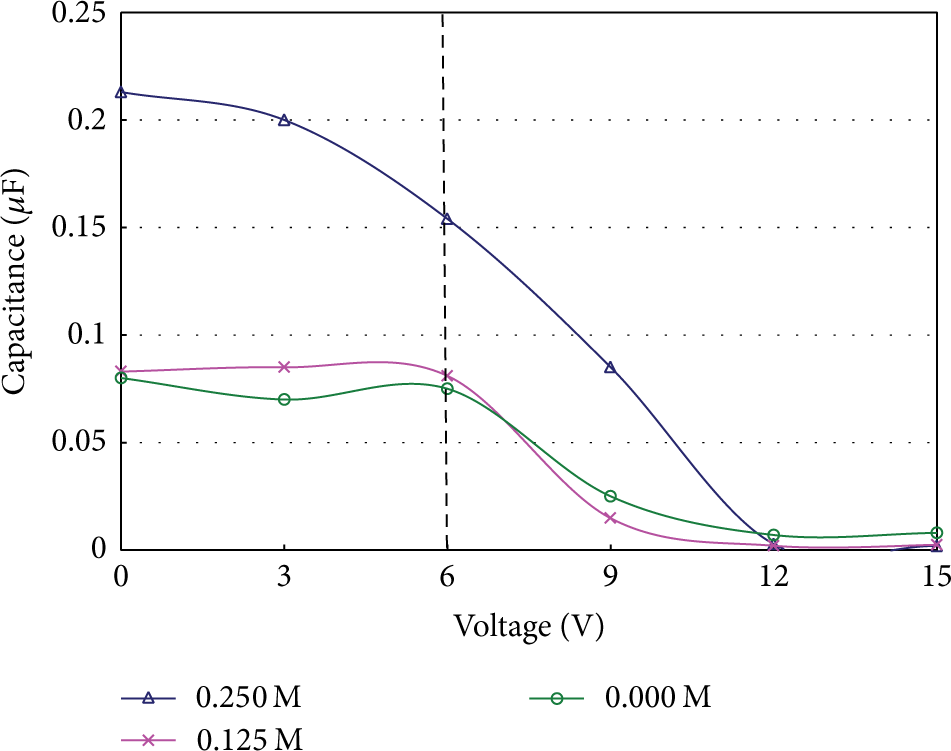
Variation of capacitance with DC voltage as function of NaCl concentration given soil moisture content of 18% [13].

Variation of capacitance with DC voltage as function of NaCl concentration given soil moisture content of 24% [13].

Variation of capacitance with DC voltage as function of NaCl concentration given soil moisture content of 28% [13].
Figure 6 shows the variation of the capacitance with the gravimetric water content as a function of the NaCl concentration [13]. It is seen that the proposed sensor has a linear response for gravimetric water contents ranging from 21 to 28%. (Note that a moisture content of 28% corresponds to a saturation ratio of 100%). Applying a regression analysis technique to the experimental data for the three water samples, the capacitance (y) is found to be related to the gravimetric water content (x) via the relationship

Variation of capacitance with gravimetric water content as function of NaCl concentration. Note that the ion trap voltage is 6 V DC [13].
The performance of the proposed sensor was further verified by means of a field test conducted using the experimental arrangement shown in Figures 7 and 8. As shown, three sensors were placed in a circular tank containing loamy sand (EC = 1.66 dS/m). The sensors were separated by a vertical distance of 14 cm and were arranged such that the first sensor was located at a distance of 7 cm from the upper sand surface, while the third sensor was positioned at a height of 7 cm above the lower sand surface. The ion trap electrodes of the three sensors were connected in series to a single power source with an output voltage of 6 V DC. Meanwhile, the measurement electrodes of the three sensors were connected to three different capacitance meters. As shown in Figure 7, the DC power line and sensor signal lines were sheathed in a PVC pipe in order to protect them against moisture. For comparison purposes, the soil moisture content was also measured using a TDR device (804-8019-000B, AQUA-TEL-TDR, AUTOMATA, CA, USA). The TDR probe was positioned within the tank such that the buried length was equal to 48 cm and the lower tip of the probe was located at a height of 6 cm above the lower sand surface. In performing the test, water was sprinkled onto the upper sand surface at a rate of 60 mm/hr (corresponding to torrential rain) by an array of nozzles which was evenly distributed at a height of 50 cm above the upper sand surface.

Schematic illustration of experimental setup.

Photographs of (a) bottom, (b) middle, and (c) upper sensors placed in soil tank. Note that TDR device is also placed in tank for comparison purposes.
Figure 9 shows the variation of the capacitance signals of the three sensors given a pure DI water sample and a saline solution with a NaCl concentration of 0.025 M as the gravimetric water content is increased from 0 to 31.5% calculated on the basis of the rainfall rate. The corresponding change in the voltage signal of the TDR device is also shown for comparison purposes. It is seen that, for both water samples, the TDR voltage signal increases approximately linearly as the gravimetric water content increases beyond 4.8%. From inspection, the voltage signal obtained for the saline water sample is found to be approximately 6% higher than that of the pure DI water sample given a constant value of the gravimetric water content. In other words, when using the TDR device to evaluate the soil moisture content, some form of calibration technique must be applied in order to compensate for the salinity effect. Moreover, the TDR device provides only an indication of the average water moisture content over the buried length of the probe. In other words, the probe does not enable the distribution of the moisture content over the soil depth to be determined. For each of the three sensors, the capacitance signal obtained when using the saline solution is very similar to that obtained when using the pure DI water. From inspection, the average deviation between the two capacitance curves for each sensor is found to be less than 2%. Thus, the effectiveness of the ion trap electrode mechanism in compensating for the salinity effect is confirmed. The capacitance signal of the upper sensor increases sharply at a gravimetric water content of approximately 4.6~4.8%. It then increases slowly and approximately linearly toward a final value of 4.0 μF at a gravimetric water content of ~8.0%. For the central sensor, the capacitance increases rapidly at a gravimetric water content of 16% and then converges slowly to a final value of around 4.0 μF. Similarly, the capacitance signal of the lower sensor increases sharply at a gravimetric water content of 19.4% and then approaches a final value of 4.0 μF at a gravimetric water content of 28%. Overall, the results show that, compared to the TDR device, the proposed sensors enable the distribution of the moisture content at different depths of the soil to be reliably obtained.
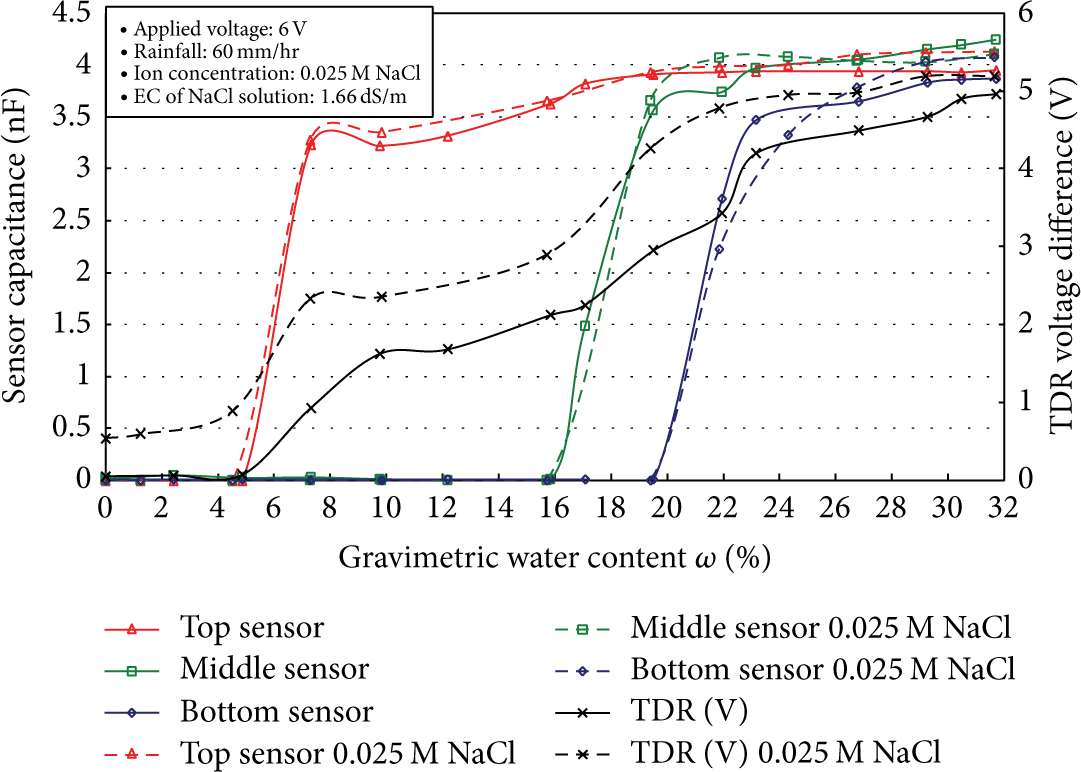
Variation of capacitance change with gravimetric water content as evaluated by upper, middle, and lower sensors given use of DI water and saline solution with 0.025 M NaCl, respectively. Note that results obtained using TDR device are also shown for comparison purposes.
Figure 10 shows the variation of the capacitance signal when the sensor was exposed alternately and repeatedly to soil samples with gravimetric water contents of 24.2% and 27.8%, respectively. (Note that the results were obtained using a saline solution with a NaCl concentration of 0.025 M.) From inspection, the sensor is found to have a repeatability of ±0.71% and ±0.55% under low (24.2%) and high (27.8%) gravimetric water content conditions, respectively. It is noted that the repeatability reduces as the moisture content decreases. Nevertheless, the repeatability is sufficient to detect the moisture content with adequate precision in practical applications.
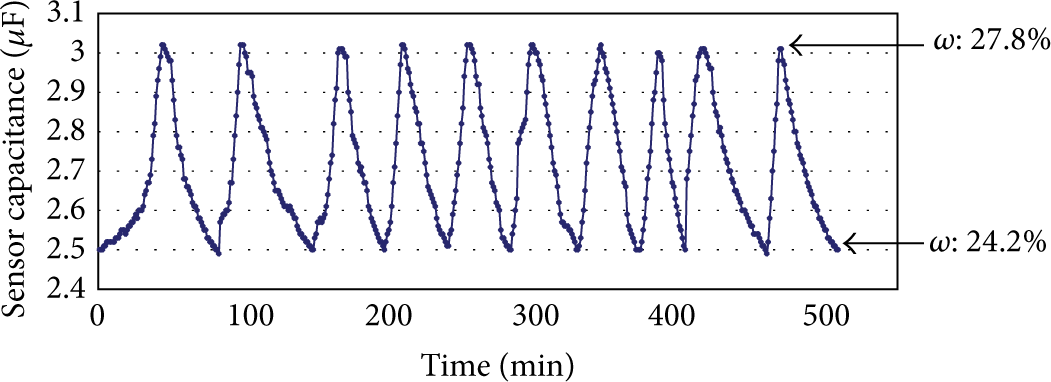
Experimental results for repeatability of proposed sensor given gravimetric water contents of 24.2% and 27.8%, respectively. Note that saline solution has NaCl concentration of 0.025 M.
Figure 11 shows the temperature effect of the proposed sensor given gravimetric water contents from 0% to 25% at 10°C, 20°C, 30°C, 40°C, and 50°C, respectively. It can be found that the variability of the sensor is ±0.4% of gravimetric water content.
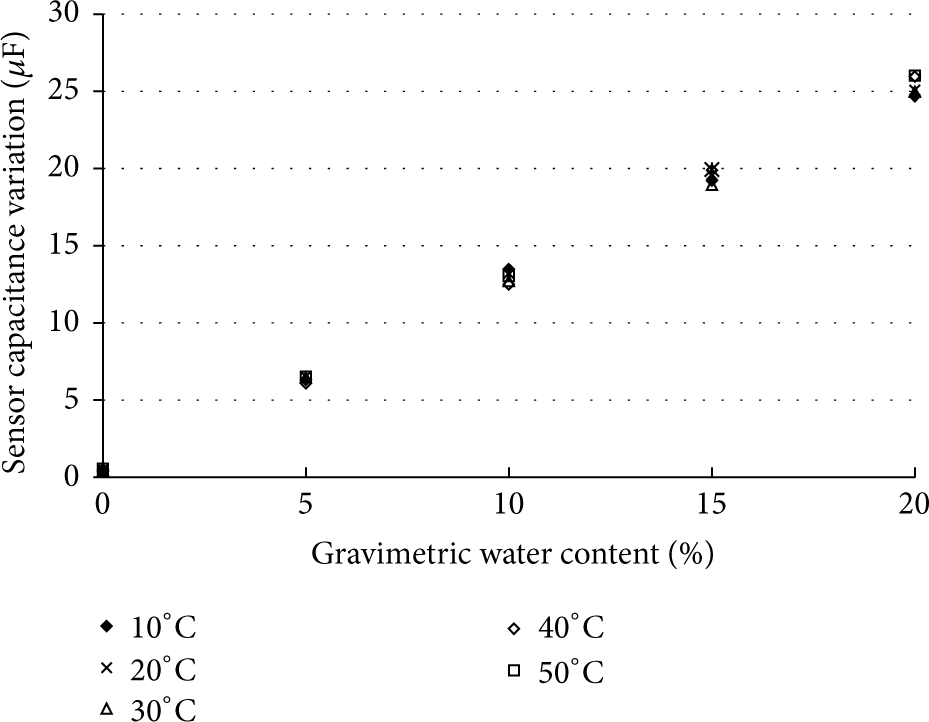
Experimental results for thermal effect of proposed sensor given gravimetric water contents from 0% to 25% with a step of 5% at 10°C, 20°C, 30°C, 40°C, and 50°C, respectively.
4. Conclusions
This study has presented a soil moisture sensor comprising two planar stainless steel electrodes, a capacitance meter, a pair of graphite mesh electrodes, and a DC power supply. As rain falls on the ground, the dielectric constant of the soil increases. As a result, a change in the measured capacitance occurs from which the water content can then be inversely derived. During the sensing operation, a DC voltage is applied to the graphite electrodes. The electric field causes the anions and cations in the water to be trapped by the positive and negative electrodes, respectively, and therefore minimizes the effect of salinity on the measured capacitance value. The experimental results have shown that the proposed sensor has a high sensitivity (1.27 μF/%) over a measurement range of 21~28% (gravimetric water content) and a repeatability of ±0.71% and ±0.55% under low (24.2%) and high (27.8%) gravimetric water content conditions given a NaCl concentration of 0.025 M, respectively.
Overall, the sensor proposed in this study provides a feasible solution for the realization of a landslide monitoring and warning system. Specifically, having performed the slope stability analysis of a specific slope in order to determine the soil moisture content at which slip may occur, the moisture content in the slope can be measured using an array of sensors and monitored remotely by a central computer programmed to issue a warning when the moisture content approaches the critical value.
Footnotes
Conflict of Interests
The authors of the paper confirm that there is no conflict of interests with any third party regarding the publication of this paper.
Acknowledgments
The authors would like to thank the contributions of Professor Shih-Hao Jien and Professor Cheh-Shyh Ting in National Pingtung University of Science and Technology and Mr. Jason Yang in EUJASON Engineering Products Company and financial supports provided by the National Science Council (NSC 101-2221-E-020-039 and NSC 102-2221-E-020-032) and the Ministry of Economic Affairs in Taiwan.