




Abstract
The dynamical behaviors of single-walled carbon nanotube (SWCNT) with the internal and external wettability are studied based on a multiple flexible shell model in the paper. The SWCNT-water system comprises five constituent parts, that is, the SWCNT, the absorbed inner and outer layers of water molecules, the water in the center of the SWCNT, and the water surrounding the absorbed outer water layer. Here we consider the absorbed water layers as infinitesimally thin shells, which interact with the nanotube via a continuum Lennard-Jones potential, and the water in the center of the SWCNT and the counterpart surrounding the absorbed outer water layer as the potential flow. It is found that the interactions of SWCNT and the water layer are responsible for an upshift in the frequency of the SWCNT and the total upshift is approximately the sum of the two corresponding upshifts. The vdW interactions also cause the increase of the frequency of internal and external water shells. We hope that the paper can offer a new modeling approach to determine whether carbon nanotubes have adsorbed fluids inside their pores and could be used for detecting changes in their filling state.
1. Introduction
Carbon nanotubes (CNTs) have drawn much attention in recent years not only for their superior mechanical, electronic, and chemical properties, but also in the patulous area of nanofluidics [1]. For example, CNTs can swim in the human body to deliver drugs [2], and CNTs can usually be used as biological sensors to operate in aqueous environments [3]. As we all know, the dynamical behaviors of CNTs are highly sensitive to the environment [4, 5]. So, a thorough understanding of the interactions between nanotubes and fluids is essential for the development of the CNT-based nanodevices. The existing experimental observations [6–8] report an upshift in the radial breathing mode (RBM); furthermore, molecular dynamics (MD) simulations show that wetting of the outer surface leads to upshifts in RBM of single-walled carbon nanotube (SWCNT) with the order of 4–10 wave numbers [9], while adsorption on the inner surface (in the case of filled nanotubes) leads to an additional upshift of 2–6 wave numbers [10]. However, because of the difficulty of the experiments and the complex and time consuming MD simulations, continuum theory has been widely used to study the domain. Specifically, the elastic shell model was efficiently used for the mechanical behaviour of CNTs system [11–13]. In addition, experiments have demonstrated that fluid properties become drastically altered when the separation between solid surfaces approaches the atomic scale [14, 15]. In the case of water, the so-called drying transitions occur on this scale as a result of strong hydrogen bonding between water molecules, which can cause the liquid to recede from nonpolar surfaces and form distinct layers separating the bulk phase from the surface [16]. Up till now, Longhurst and Quirke [9, 10, 17], Wang et al. [18], and Yan et al. [19] have used the infinitesimally thin shell model to simulate the water layer absorbed surrounding the CNTs and found that the model is not only effective but can also greatly reduce the time required to simulate absorbed fluids on CNTs.
Motivated by these studies, we develop a multiple flexible shell model to study the SWCNT-water system with the presence of water on inner and outer surfaces of SWCNT. Here the SWCNT and inner and the outer absorbed layers of water are modelled as three-layer thin shells coupled via the interlayer vdW interaction. The water in the center of the SWCNT and the counterpart surrounding the absorbed outer water layer are considered as the potential flow. As will be shown below, based on the model, discussions in detail on the vibration of SWCNT with water are performed.
2. The Multiple Shell Model
The SWCNT-water system comprises five constituent parts, that is, the SWCNT, the absorbed inner and outer layers of water molecules, the water in the center of the SWCNT, and the water around the absorbed outer water layer. The SWCNT and the absorbed layer of water are modelled as three-layer thin shells coupled via the interlayer vdW interaction, and the rest of water is considered as the potential flow. By using Donnell's cylindrical shell model, the governing equations of motion are stated as
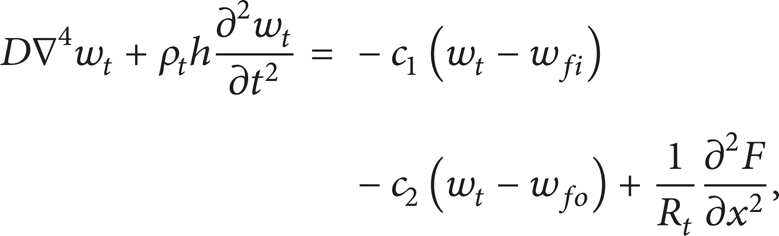




where x and θ are the axial and circumferential (angular) coordinates, respectively, t is the time, ∇4 = [(∂2/∂x2) + (1/R t 2)(∂2/∂θ2)]2 a differential operator, I n and K n are the modified Bessel function of the first and second kind, respectively, and prime (·′) is the derivative with respect to the spatial variable. For SWCNT, R t is the radius, w t is the radial displacement, E is Young's modulus, h is the tube thickness, D is the flexural rigidity, ρ t is the mass density per unit bulk, and L is the length; for the inner water shell, ρ fi is the mass density per unit area, R fi is the radius, w fi is the radial displacement, and p i is the radial pressure executed on the inner water shell due to the water in the center of the inner tube; for the outer water shell, ρ fo is the mass density per unit area, R fo is the radius, w fo is the radial displacement, and p o is the radial pressure executed on the outer water shell due the potential flow surrounding it. γ is the CNT-water interfacial tension, ρwater is the mass density per unit bulk of the potential flow, c1 is the vdW interaction coefficient between SWCNT and the inner water shell, and c2 is the vdW interaction coefficient between SWCNT and the outer water shell. They can be obtained via a continuum Lennard-Jones potential [20]

where |0.6K k | is the well depth, s k is the interlayer mean separation between the SWCNT and the water shell (for inner water shell, k = 1; for outer water shell, k = 2), and c k is the second derivative of (7) at equilibrium distance s k that is expressed as

For simply supported SWCNT of length L, the solution of (1)–(3) can be determined by


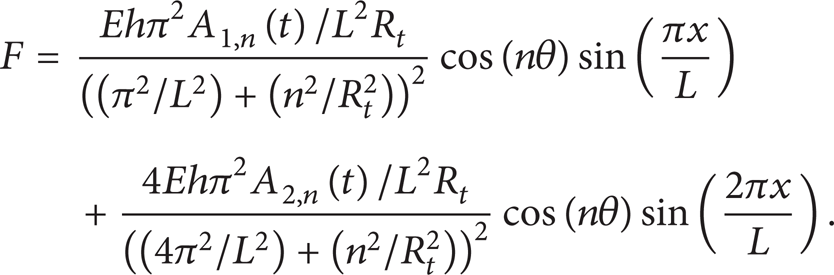
where A m, n (t) is the unknown function of time, m is the axial half wave number, and n is the circumferential wave number. Substituting (9) into the right-hand side of (4), the differential equation for the stress function F is yielded as
In fact, on the Galerkin projection principle, a more general orthogonal relationship is written as

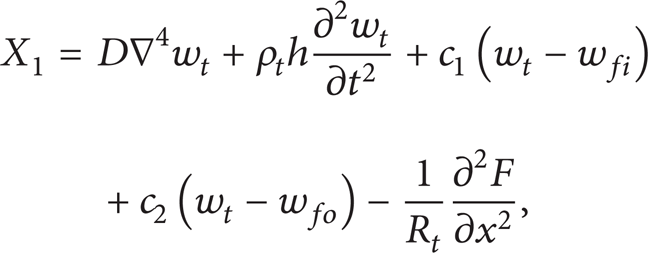
From (1)–(3), letting X i and Z a be


Thus, a set of the linear ordinary differential equations for the unknown functions A m, n (t) are obtained as

where

The expression of angular frequencies ω1, ω2, and ω3 of SWCNT and inner and outer water shells with wave numbers is, respectively, deduced from (18) by using polynomial eigenvalue method, and Δω1 represents the upshift in frequency of SWCNT.
3. Results and Discussions
The dynamical behaviors of the (22, 0) zigzag SWCNT with the presence of water on both surfaces at 300 K are studied in the paper. The radius of carbon nanotubes is determined by
Firstly, the dynamic characteristics of the SWCNT are examined. The frequency serves as an index to represent quantitatively the effects of the external environment on SWCNT. The frequencies of SWCNT with various wave numbers n are calculated and listed in Table 1. It is observed that the frequencies with an absorbed layer of water on inner, outer, or both surfaces of SWCNT are larger than those without water existing, which indicates that the interactions of SWCNT-water are responsible for an upshift in the frequency of SWCNT. In particular, the upshift of outer wetting is slightly larger than the case of the internally adsorbed layer. This is because the overall mass in the outer adsorbed layer is much greater than that in the inner layer, resulting in more coupling with the externally adsorbed layer (i.e., c2 > c1) and a subsequent upshift of frequency. The detailed comparisons in upshift are shown in Figure 1. Obviously, wetting on both internal and external surfaces results in an upshift in frequency which is very nearly the sum of the two individual upshifts taken separately for n ≥ 5 because of the reasonable application of Donnell's cylindrical shell model. From Table 1, we can also get that the upshift of the frequency at n = 0, that is, the axisymmetric mode, is 8.95 cm−1. The conclusion is in good agreement with the case in [9] in which the upshift of 4–10 cm−1 is obtained.
Natural frequencies (×1014) of the SWCNT.


Upshift in frequency of SWCNT for presence of water on inner, outer, and both surfaces.
Next, the dynamic characteristics of the water shell in SWCNT are investigated. From Figures 2(a) and 2(b), we can see that the radial vibration of the inner water shell with c1 ≠ 0 (c2 = 0 or c2 ≠ 0) exhibits the frequency higher than its counterpart with c1 = 0. The higher frequency of water shell is owing to the interlayer vdW interaction. Obviously, this character is different from the macroscopic solid-fluid coupling system. Furthermore, we can get that the radial vibration of the inner water shell with c1 ≠ 0 and c2 ≠ 0 exhibits the frequency higher than its counterpart with c1 ≠ 0 and c2 = 0 for 0 < n < 6, and for n ≥ 6, the value of c2 can hardly cause the corresponding variation of frequencies in the inner water shell. The results indicate that the difference at the low frequency stage is mainly ascribed to the influence of vdW forces. With the increasing frequency, modes gradually play an important role in the vibrating behaviors and the influence of vdW forces on the vibration gets smaller, which causes the frequency curves of SWCNT to gradually approximate to that without vdW forces, that is, the case c2 = 0.

The frequency of internal water shell ω2 with different wave number n.
At last, the frequencies of the outer water shell are researched. The comparison made in Figures 3(a) and 3(b) demonstrates that the outer water shell with c2 ≠ 0 (c1 = 0 or c1 ≠ 0) exhibits the frequency higher than its counterpart with c2 = 0. As shown before, the higher frequency of water shell is owing to the interaction of SWCNT and outer water shell. Furthermore, we can get that the inner water of the SWCNT has little effect on the outer water shell. The reason is that the SWCNT has more coupling with the externally adsorbed layer than the inner water shell (i.e., c2 > c1) and the effect of c2 is quite significant for the vibrating behaviors from beginning to end.
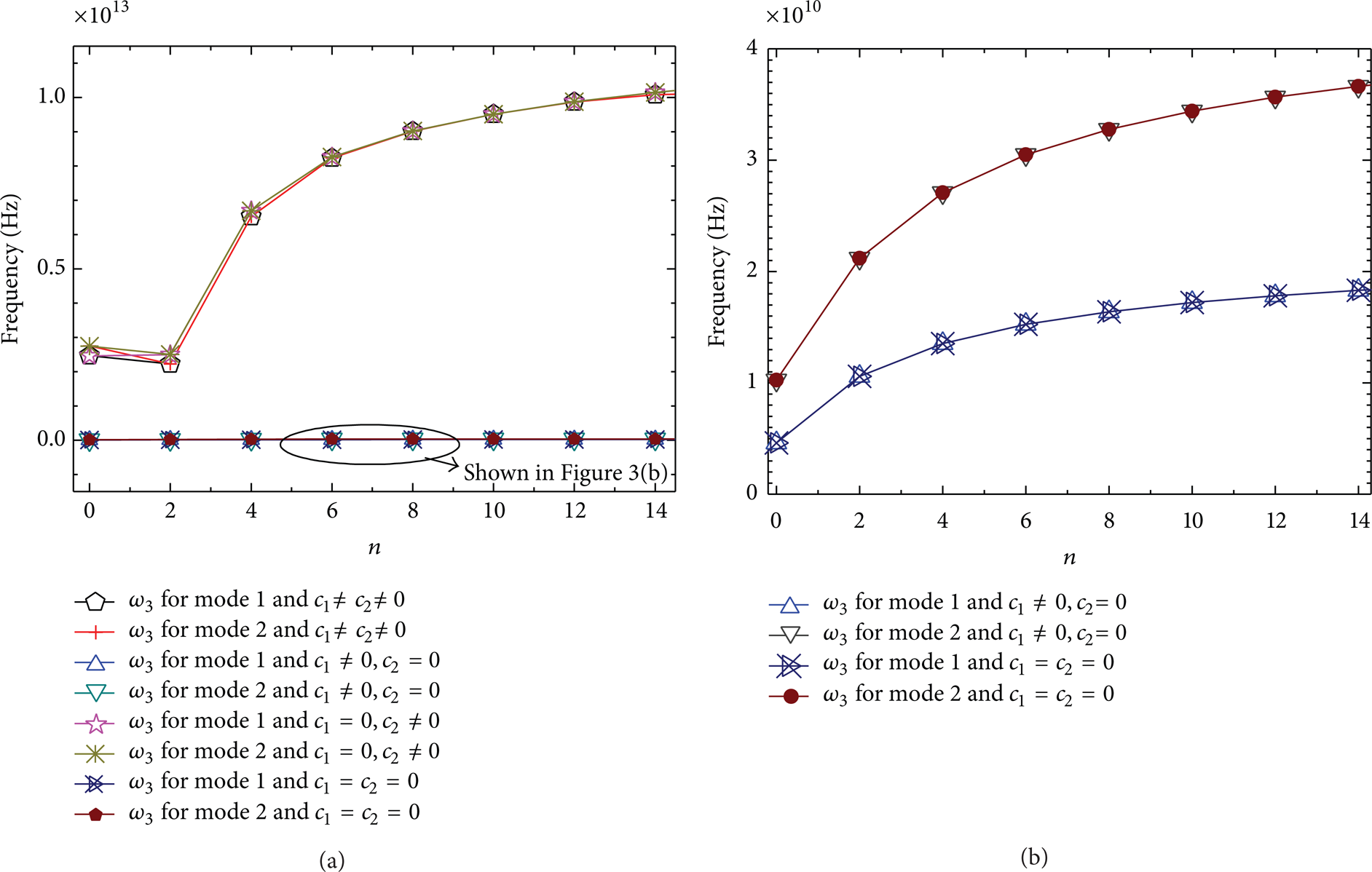
The frequency of external water shell ω3 with different wave number n.
4. Conclusions
The dynamical behaviors of SWCNT with the presence of water on both surfaces are studied by a multiple flexible shell model in the paper. Results reveal that the internally and externally adsorbed water shells lead to an upshift in frequencies of SWCNT, and the total upshift is approximately the sum of the two corresponding upshifts. Furthermore, the upshift of inner wetting is slightly smaller than the case of the externally adsorbed layer. The vdW interactions among the SWCNT and the water shell are also responsible for the increase of the frequency of the water shells. The study not only greatly reduces simulation time but also can provide a new model to explain the experimental observation and MD simulations available in particular cases.
Conflict of Interests
The authors declare that there is no conflict of interests regarding the publication of this paper.
Footnotes
Acknowledgments
The work described in this paper is funded by the research grant of the Natural Science Foundation of China (Grant nos. 11172115 and U1302271). The authors are grateful for their financial support.