




Abstract
In wireless cognitive sensor networks, natural antagonism arises among unlicensed users when nodes opportunistically compete for unused frequency bands and the operations are seriously hampered by acute scarcity of resources. The transmitted power, which is inherently pertinent to the signal-to-interference-plus-noise ratio (SINR), cognition methodology, and lack of central management, must be preserved for longer network lifetime. In the midst of this struggle to acquire desired frequency band, where the performance of the entire network is dependent upon the behavior and etiquette exhibited by individual nodes, it is pivotal to introduce an effective cooperation mechanism in order to improve the vital network parameters. In this paper, we employ the concepts of game theory to develop an efficient and sustainable cooperation mechanism for efficient cognition and improved spectrum utilization. The nodes exhibit autochthonous pattern in opting for spectrum choices, which results in acceptable level of cooperation and consequently improvement in spectrum utilization. In order to achieve this global benefit, the users are motivated to carefully analyze the impact of their own choice in selecting a channel for transmission and its peers.
1. Introduction
The cognitive radios (CRs) in a wireless ad hoc network must adopt a mechanism to efficiently utilize the bandwidth that is unused by licensed owners. The efficiency of spectrum utilization significantly depends upon this sharing mechanism, as the entities in wireless sensor networks are prone to selfish behavior. We discuss a cognitive radio sensor network, where the nodes opportunistically try to utilize unused spectrum, irrespective of the type of cognition mechanism (underlay or overlay) and the presence of cooperation at some level is critical. Typically, the numbers of available channels are limited, which results in a competitive environment and the users make every effort to optimize their own performance [1–5]. This competition can be proficiently modeled as a game. In a game theoretic framework, the most rational behavior of selfishness leads to conflicts among sensors due to the restricted choices and diminishing benefits for the players. A cooperative game environment can effectively resolve conflicts among different players and keep the system stable while leading to improved performance [6, 7].
Several researchers have explored the cognition phenomenon from game theoretic perspective. These include both noncooperative and cooperative games [1–5, 8–15]. Some form of cooperation involves the use of secondary users (SUs) as relays by the primary user (PU) and setting a price for channel use [8, 9]. Other cooperative forms involve payments by CRs to their licensed owners [11], which set a price for channel access. These works discuss the problems of spectrum allocation and power and system stability or convergence. The noncooperative games lack stability and the ability to efficiently allocate resources [14]. On the other hand, the cooperative games provide system convergence as well as optimum resources [15–17]. An effective method to achieve stability and increase throughput for cognitive radios is the application of potential game models. These games are comprehensive with homogenous players, which do not focus on individual benefits, rather the whole network performance. They also assist in determining the convergence or Nash equilibrium behavior of the system.
The first critical work on cognitive potential games is conducted by Neel et al. [15] which discerns convergence for power control games. In [13], a Nash equilibrium solution for two-player Cournot and Bertrand games is presented. Some of the noncompetitive two- and three-player games, thoroughly discussed in the literature, are given in [12, 15]. In [1], an incomplete information Bayesian game providing cooperation through relaying is presented. Another form of game, suitable for cognitive modeling, is the Stackelberg game [11], which explores channel and power allocation strategies.
The core issue faced by the CR users is the need to address the interference caused to the PU and to each other. Cognitive transmissions can cause more interference, increase the bit error rate (BER), and degrade the channel performance. If the users behave in a noncooperative manner, they choose their strategies selfishly and do not consider the impact of their actions on their opponents or the overall network. This behavior may prove initially beneficial but deteriorates network performance in the long run. In this paper, we employ cooperative game theory that encourages the users to carefully utilize resources for mutual benefits. The users cooperate with each other by taking into account the influence their actions create for all the opponents. This automatically promotes sharing of resources and leads to a controlled use of available bandwidth.
In this work, we model the competition as a cooperative game, where SUs cooperate to avoid conflicts and accomplish task of the most suitable channel acquisition. We discuss two different potential game models for cognitive radio systems. In the first part of this paper, we formulate a potential function based solely on interference and BER and no pricing scheme is adopted. The second part of this paper involves a cost based potential game, which takes into account the channel cost as well as interference. The convergence of the network is analyzed and the improvement in performance is also discussed.
The rest of this paper is organized as follows. In Section 2, we describe the system model. Section 3 elaborates the problem formulation. Section 4 explains the utility function and its formulations. The application of potential function without adopting any pricing scheme is explained in Section 5. Section 6 includes a description of power optimization in cost based potential game. Finally, Sections 7 and 8 present the numerical results and conclusion.
2. System Model
The sensor nodes in the network are uniformly distributed in a two-dimensional region of arbitrary dimensions
Due to the ad hoc nature of the cognitive sensor network, there is no mechanism to centrally aid the cognition phenomenon. Instead, the users must monitor the available channels for the amount of interference and decide their strategies based on the potential function, which is formulated subsequently. Inherently, all SUs immediately prefer to capture vacant channels. The players choose their preferences based on the SINR observed on the channel and decisions are made accordingly. The SINR, which is defined as a function of transmitted power

This value of SINR deteriorates when more than one user decide to transmit over the same channel. This discourages users to opt for channels that are overcrowded or have already been chosen by a large number of opponents (SUs). The benefit that each player achieves as a result of their corresponding choices varies for every player.
3. Problem Formulation
In this section, we elaborate our problem for two paradigms; one excludes the PU (overlay), while the other includes it during simultaneous secondary transmissions (underlay). The later system can avail more spectrum opportunities as long as the parameters set by PU are satisfied. The overlay problem addresses the issue of channel access among SUs that are involved in playing the game to achieve better payoff for improved potential function. The underlay problem discusses the channel acquisition by SUs coexisting with the PU by taking into account PU's tolerance limit, which is incorporated in the potential game formulation.
This paper considers two different games for the above-mentioned scenarios. The first game lacks any pricing mechanism and only interference is responsible for a suitable solution. The second part of this paper considers a pricing game, which includes a cost function to trigger cooperation. The utility function for each of these cases is discussed below.
3.1. Utility for Underlay Sensor Networks
The mode of cognition in this case is slightly complex due to the involvement of the licensed user. The SUs must not hinder the transmission of PU and keep their interference lower than the tolerable amount regulated by the PU.
Every SU decides its strategy according to the utility achieved based on the transmission success. This can be determined using the ratio of number of bit errors to the total bits transmitted. Every channel operates for a target BER; otherwise, the communication is compromised due to unacceptable signal conditions. The higher the interference is observed over a particular channel, the higher is the number of errors detected in transmissions and the BER is greater. Each PU, being a priority user, benefits from a BER suitable for successful transmissions. The SUs accessing this channel must consider this criterion to avoid disrupting PU's transmission. A channel with a better BER attracts more cognitive users. However, if more users start transmitting over the same channel, the BER is increased causing more noise for the PUs. The PU's main concern is their target BER; if satisfied, PU allows their transmission to remain unaffected by these CR users. This provides an efficient utilization of bandwidth.
We define the utility function of jth SU when it uses channel i, as

where

where
3.2. Utility for Overlay Sensor Networks
In this case, the cognitive users search for vacant spectrum bands. This scheme is only applicable when PU is not transmitting. The competing players involve only the unlicensed users. As predicted, the main objective of these players is to choose channels that offer minimum interference. The interference level of the network is continuously monitored and it changes with the adopted strategies of players. This mode of implementing cognition is considered simpler due to the absence of the crucial licensed player.
As the number of CRs accessing a channel is increased, their utility is reduced due to increased BER and interference. These SUs search for vacant channels and compete to gain access to them. The users, when playing in a cooperative mode, encourage resource sharing by providing incentives to their competitors by lowering their created interference. Due to the absence of PU in this game, the utility for SUs can simply be written as

4. Utility Function without Pricing
We develop a utility function for a cooperative scenario such that the nodes contemplate the payoffs of their opponents besides maximizing their own utilities. No pricing scheme is adopted in this game. The users consider the amount of interference caused to others and keep it lower in order to earn more payoffs. This kind of behavior in strategy building improves the performance of other players and also increases the individual payoff. In this way, the user causing higher interference to their opponents is discouraged via lower payoff.
Given the target SINR

where
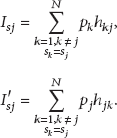
All selfish users are considered only with the term
For overlay, we must take into account the probability of error α in detecting PU, which affects the performance of the SUs by unknowingly adding to the interference in addition to other sources such as jammers [18]. Moreover, the payoff depends on the amount of interference observed and created. Based on these observations, the utility function can be modified as

where
In case of spectrum underlay scheme, the presence of PU must also be incorporated with highest priority and cognitive users adjust accordingly. This scheme requires two payoffs to be optimized, one of licensed user and the other of CR. The PU's utility for transmitted power

where
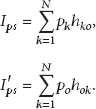
Equation (8) provides utility for PU in terms of interference due to secondary transmissions. The SU's utility for the underlay case is expressed as

where the primed terms represent the interference created by users and unprimed terms are interference suffered by the node.
5. Potential Game
The potential game is a generic and global formulation of a game, which is completely expressed through a single potential function. This function combines the individual payoffs in a way that associates with the network performance. The objectives of all players are common and depicted in the potential function. Incorporating cooperation is more effective and comprehensive in a potential game. In order to improve network performance, this single function needs to be optimized instead of individual payoffs. The corresponding strategies for optimum performance can be determined based on the optimized potential function.
In the subsequent discussion, we develop the potential function suitable for the underlay and overlay access scenarios for cognitive wireless sensor networks.
5.1. Overlay Case
The potential function in this case is based on the accumulated payoffs of individual players over a channel. There is no PU involved in creating interference or governing the rules of the game. The challenges a CR must face are created by their fellow SUs. In order to ensure a suitable environment for all stake holders, the players attempt to keep their transmission power low, serving the dual purpose of reducing interference for others and conserving their resources. For the jth CR over channel i, the utility function is given by
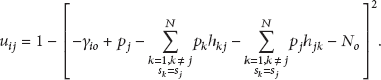
The potential games are a combination of dummy games, symmetric games, and unilateral games [15]. The dummy game is the component of potential game, which does not depend on the action of a player j, but only on the actions of other players
In the bilateral symmetric game (BSI), the payoff of a strategy is independent of the player and depends only on the other strategies. In such games, the objective function or utility is a sum of bilateral symmetric terms, which can be written as

It can be seen from the above expression that the change in identities of the players does not affect the payoffs. The unilateral game involves the actions taken by only one party, player, or a set of players. This potential game is represented as a combination of a dummy game, unilateral game, and BSI games. The expression of these component games is formulated as

The potential function for overlay game can be written as

where

We maximize this potential function by differentiating it with respect to

This power level maximizes the potential function under the condition

5.2. Underlay Case
The underlay access case must incorporate the primary user as a priority player in their utility and potential function formulations. The utility of CR is influenced by the presence of PU transmission and the interference created by the competitors as well as the interference a CR creates for their opponents and PU. The utility function for the PU over ith channel, in this case, can be written as

where the interference suffered by PU is represented as the sum.
The unilateral and BSI games that provide the payoff for the PU is given by

The SU's payoff depends on the interference created by the opponents and the interference due to the presence of PU. This utility must also incorporate the interference the SU creates for their opponents and the corresponding PU. The utility function for SUs in this case is given by

The payoff for SUs in spectrum underlay case is given by

The underlay potential function can be written as
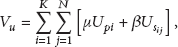
where μ and β are the weights assigned to the payoff factors of primary and secondary users, respectively, with the constraint

6. Cost Based Potential Game
In order to achieve a stable solution for the competition faced by the introduction of cognition, players are encouraged to cooperate. For this, nodes must take into account the amount of interference they are causing for their opponents. A parameter providing this interference measurement is given by a function

Here, α is the probability of incorrect PU detection (false alarm). This leads to the involvement of PU interference according to the transmitted power level
The previous formulation of potential function involves only the level of interference for the player and their opponents. Next we develop a potential game, where players are charged for their channel choices. The cost function is developed to discourage high interference creating users. This allows revenue generation for the license holder and promotes a more robust cooperative scenario. In this game, the utility function depends on the interference levels and the cost of selected channel. This accommodates the transmitted power of CRs. We can write the utility function for this case as

where
This kind of game presents a player with two different approaches for selecting a strategy. One of these approaches allows the channel selection based on lowest cost, which leads to an obvious increase in the utility. The other approach provides strategies according to the transmitted power levels, which improves the utilities.
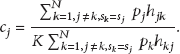
The cost function must be carefully devised to accommodate the requirements of a CR network. The users, which create higher level of interference, must be discouraged by charging a higher price, while the users providing lower interference are enticed by offering a lower price. This results in an increase in competition among channels for low interference users. Hence, the cost reduces with the number of available channels and the interference level on the channel and increases with the amount of interference an entering user creates over the channel. Mathematically, we define our cost function as
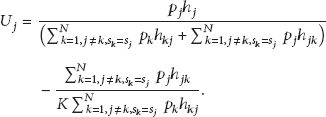
Based on this cost function and assuming the probability of false alarm to be zero, the utility function for the CR users becomes
The corresponding potential function for the game can be written as
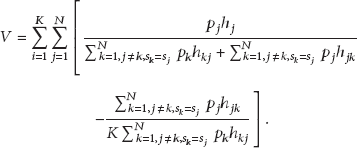
This potential function is responsible for evaluating the network performance. The objective in selecting strategies allows access to the most suitable channel with maximum utilities. For the cooperative benefit, the potential function is optimized by equating its first derivative to zero, which yields the optimized transmitted power for jth player

For underlay systems, the potential function can be defined as
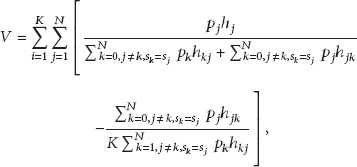
which provides the power levels as

7. Numerical Simulations and Results
The proposed simulation model comprises of two-dimensional uniformly distributed network of dimension 200 m2. The number of licensed users with their dedicated channel is
Figure 1 shows a plot of average transmitted power for nonpriced game. The game is played for overlay and underlay spectrum access scenarios and the corresponding power levels for the two schemes are observed. It is seen that the underlay scheme, besides providing more spectrum opportunities, also requires lower transmission power. On the other hand, the transmitted power levels for the overlay access are much higher.
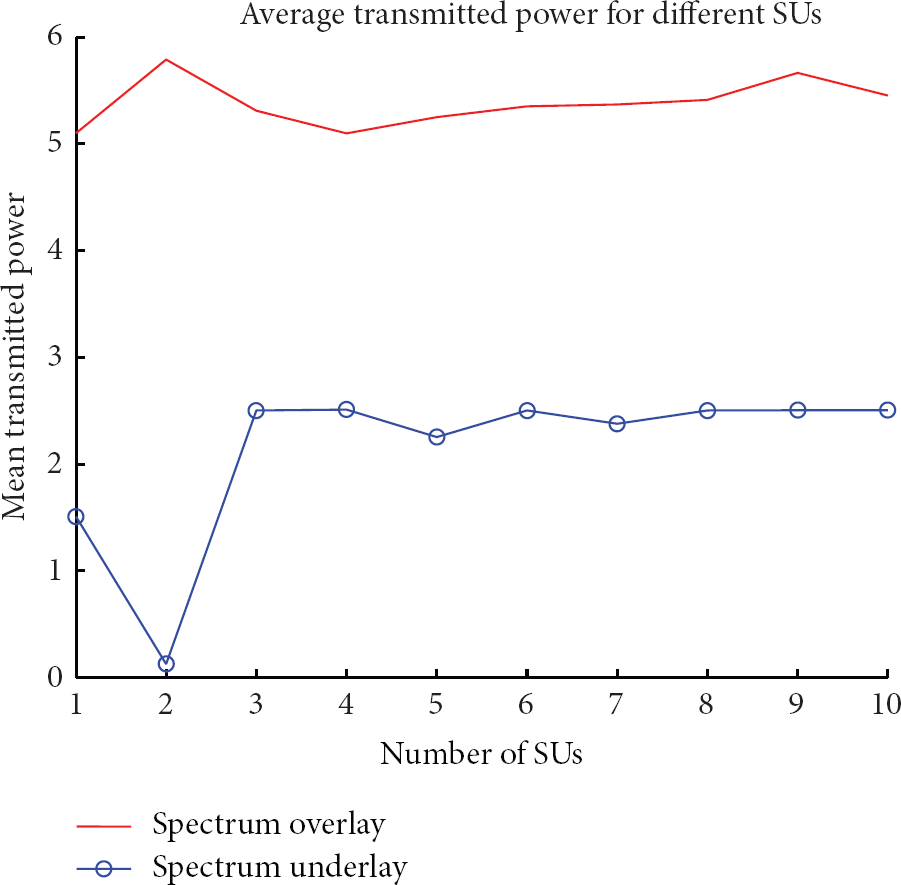
Plot of the average transmitted power for overlay and underlay cases without pricing.
For the potential game based on pricing, the convergence of strategies is established in Figures 2 and 3. Figure 2 provides convergence for minimum cost potential game, where potential function is improved by lowering the cost of channel. This provides better utility with the benefit of low cost channels. However, this leads to suboptimal channel choices in terms of power consumption. Due to low cost, the players may choose high interference channels, which require more transmitted power. This can also lead to an increased packet loss. The power levels for this case are depicted in Figure 4.

Plot of convergence of minimum cost strategies.
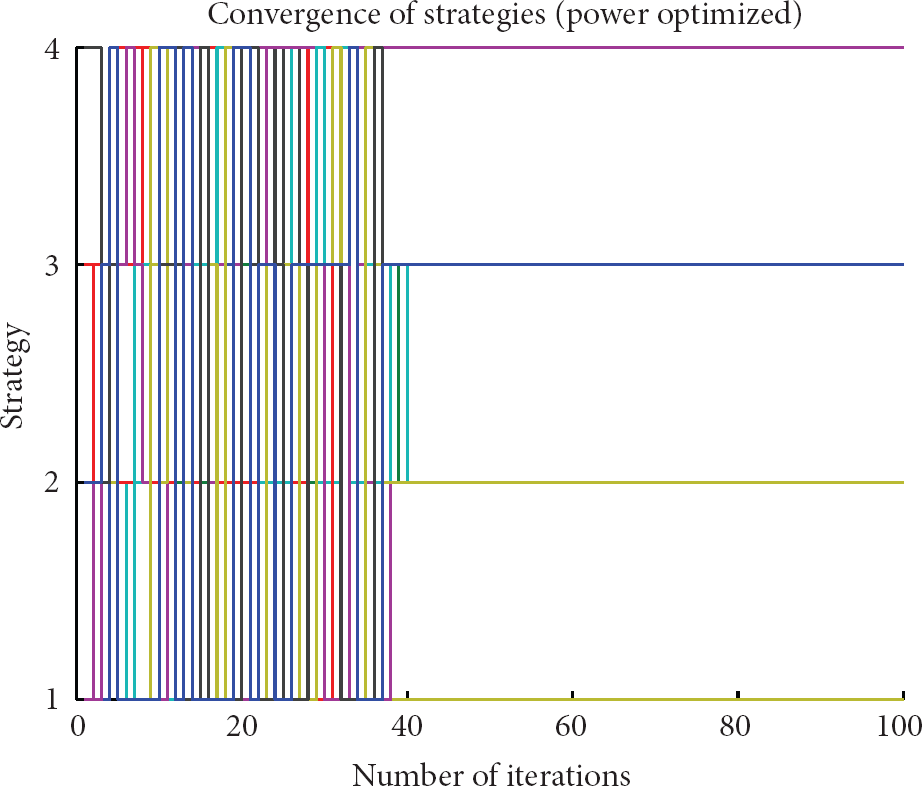
Plot of convergence of optimum power strategies.

Plot of the transmitted power for minimum cost game.
Figure 3 shows the convergence of strategies for a power optimum cost based potential game. In this game, the players choose strategies, which allow conservation of resources by employing power efficient choices. The chosen channels may not be economical in terms of cost, but the main advantage is offered in terms of optimum transmitted power. Figure 5 shows the power level achieved at convergence. The average number of iterations after which the convergence is achieved is approximately equal to the number of users competing in the game.

Plot of the transmitted power for optimum transmitted power game.
Figure 6 is an interesting comparison of the average throughput for all three games: nonpricing, minimum cost, and power control games. From the figure, we can see that power control game provides better performance as compared to the minimum cost and nonpricing potential games. The games lacking any cost mechanism have the lowest performance.
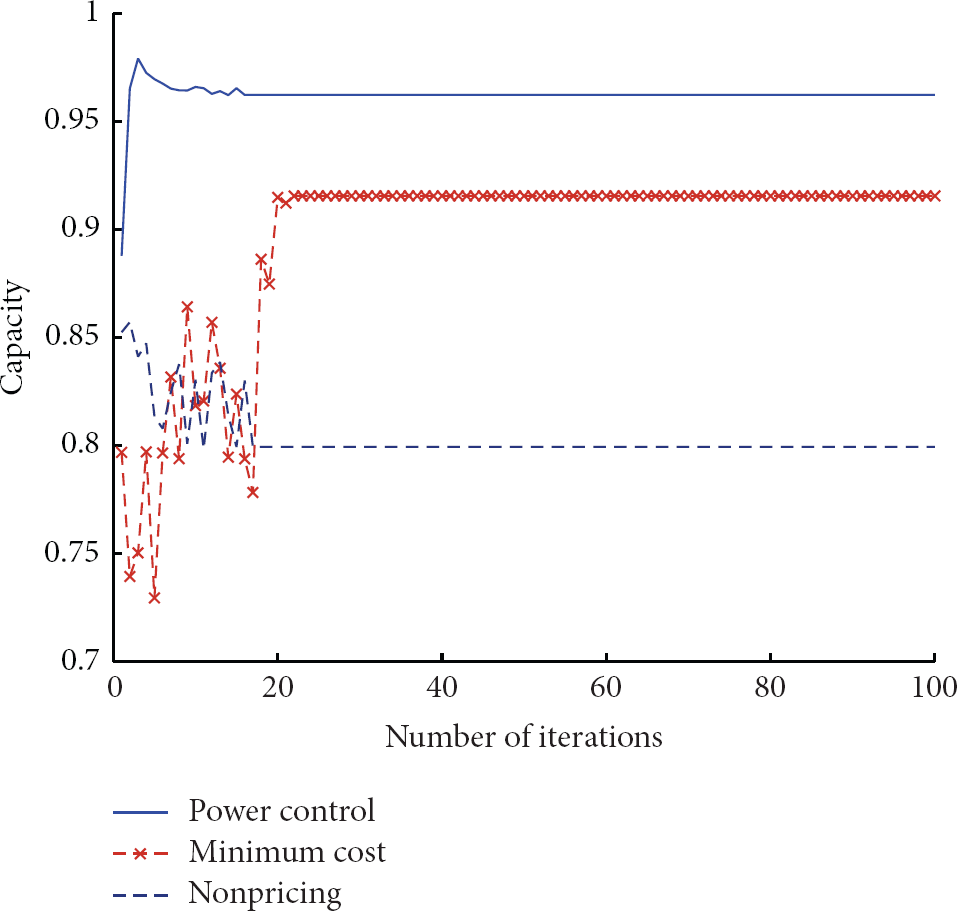
Plot of average network capacity for power control, minimum cost, and nonpricing game strategies.
8. Conclusion
In this paper, we discuss different potential games for ad hoc cognitive sensor networks and formulate the potential functions for these games. The underlay and overlay access schemes are considered for optimal network performance in a cooperative environment through the potential function as the decision making parameter. In this way the players, in a pursuit to opt for the most suitable strategy, result in optimum network performance, benefiting all players. The formulation of the potential function changes for the overlay and underlay schemes. The main advantage offered by underlay systems is the additional opportunities that can be availed even in the presence of PU, and the level of transmitted power must be kept so as to minimize the interference for PU.
We observe the performance of network for two different pricing games. In the first game, we use price as the parameter for channel choice. The unlicensed users opt for a cheaper channel in order to maximize their profit (in this case successful channel access). This game converges for a higher transmission power and some channels become more congested than others. The second game involves users, which improve their payoff not by price but by optimizing their power. The opted strategy may cost slightly higher, but it is more resource optimized. In this game, the users converge to channels, which are not overcrowded, making more efficient utilization of all bandwidth. The optimum power levels ensure the most appropriate possible interference levels.
Footnotes
Conflict of Interests
The authors declare that they have no conflict of interests regarding the publication of this paper.
Acknowledgments
The research of the 2nd author is supported in part by the Natural Sciences and Engineering Research Council of Canada (NSERC). The research of the 1st and 3rd author is supported in part by HEC Grant no. 1-308/ILPUFU/HEC/2009-609. We are grateful to the anonymous referees for their helpful and constructive comments.