




Abstract
While deploying sensor nodes for sensitive services, we need to focus on both the coverage and connectivity. The sensor relocation scheme had been proposed earlier, where the sensors themselves move towards the required position to make proper coverage and connection. From our experimental results, we noted that this work achieves good coverage. However, this approach fails to focus on connectivity issue due to node migration and secured communication too, which may compromise our collecting data. To address these serious issues, we proposed an efficient sensor relocation technique based lightweight integrated protocol (LIP). We have implemented and studied thoroughly our proposed work. From our experimental results, our proposed work LIP outperforms the existing sensor relocation scheme in terms of network connectivity, coverage, throughput, packet delivery fairness, energy consumption, energy loss, network resiliency, and secured communication. It is also noted that our proposed model maximizes the lifetime of wireless sensor networks.
1. Introduction
Recent advances in wireless network technologies have made the development of small, inexpensive, low power distributed devices, which are capable of local processing and wireless communication, and those devices are called sensor nodes. Sensors are generally equipped with limited data processing and communication capabilities and are usually deployed in an ad hoc manner in an area of interest to monitor events and gather data about the environment. Among various challenges faced while designing wireless sensor networks, maintaining network connectivity and coverage and maximizing the network lifetime stand out as critical consideration. The connectivity and coverage issues are generally met by deploying a sufficient number of sensor nodes or using specialized nodes with long-range capabilities to maintain a connected graph [1–3]. The network lifetime can be increased through energy conservation methods by using energy efficient protocols and algorithms. Due to various factors, such as the inaccessibility of the terrain and scale of the network, optimal deterministic deployment of the sensor network is often infeasible. A common scenario envisioned for deployment is that of randomly scattering sensor devices over the field of interest [4–6]. Thus, it makes the task of guaranteeing coverage much harder. As an alternative, mobile sensor nodes can be used to heal coverage holes in the network so that the randomness in sensor deployment can be compensated. Mobile platforms are already available in many deployment scenarios, such as soldiers in battlefield surveillance application, animals in habitat monitoring applications, and buses in traffic monitoring applications. In other scenarios, mobile devices can be incorporated into the design of the WSN architecture [1]. Failures in sensor networks [2, 7–9] are common and can be cured by using the redundant nodes in the network, that is, moving mobile redundant nodes to overcome the failure of sensor nodes or activate any sleeping redundant node in the group. Sensor nodes failure may cause connectivity loss and, in some cases, network partitioning.
However, such situation can be corrected by injecting a few mobile nodes in the network which can move to desired locations and repair broken network or using redundant nodes in the network to heal the network failures. Utilization of redundant mobile nodes plays an important role in prolonging network lifetime. However, reallocating mobile sensor nodes has many challenges and special requirements. First, movement in sensor networks involved communication and can be very expensive in terms of energy. Mobility in WSN would also require network reconfiguration. When a node moves in the network, its relation to the environment and neighboring nodes will change and, thus, cause the network to reconfigure. As a result, mobility will add additional overhead to the network in terms of communication messages and reconfiguration.
Therefore, an energy efficient strategy is required to adopt mobile nodes in the network. Second, the reallocation of redundant mobile sensor nodes should have minimum effect on network sensing topology. Third, reallocation should be localized to achieve quick response time. For example, failure of sensor nodes monitoring a patient should be replaced immediately. To address the above discussed challenges, Asim et al. proposed distributed cellular architecture that partitioned the whole network into a virtual grid of cells. The initial design of the cellular architecture [10] was proposed by Asim et al., where a cell manager is chosen in each cell to perform management tasks. These cells combine to form various groups and each group chooses one of their cell managers to be a group manager. This model was used in [11]. However, from our research work, we have realized that the modified cellular architecture [11] consumes more energy, which minimizes the lifetime of sensor networks. And also it is identified that this approach fails to focus on secured communication, which may compromise our collecting data. To address these serious issues, this research work has proposed an efficient sensor relocation technique based on lightweight integrated protocol (LIP).
2. Related Work
Mobility and its effects on the sensor network operation have been extensively studied and emerged as an important requirement for wireless sensor networks. Wang et al. [12] presented a proxy-based sensor relocation algorithm for the sensor networks composed of both static nodes and mobiles. Mobile from nearby locations moves to fill the coverage hole. This results in the emergence of new holes. Thus, more and more sensors are involved in relocation. This approach relies on flooding for replacement and uses a direct relocation method that can produce inconsistent relocation delay. Wang et al. [13] presented a grid-quorum-based relocation protocol for mobile sensor networks. In this protocol, the network field is geographically partitioned into grids. In each grid, a node as grid head runs the quorum-based location service to fund the redundant sensor nodes in the network. Then the discovered replacement is relocated along a carefully selected path in a cascaded way, that is, in the shifted way. Asim et al. [11] have proposed sensor relocation scheme which consists of two main phases, namely, (i) identifying redundant nodes and (ii) sensor relocation. In this model, the cell manager is responsible for collecting information of its cell members and determines the existence of redundant sensors based on their location. For redundant sensors located on the boundary of the cells, the cell managers coordinate to make decisions. The cell manager can also monitor its cell members and initiate a relocation process in case of new event or sensor failure.
Redundant nodes may be sent to a sleep mode to save or conserve energy. In other words, in some cell areas, there may be more sensor nodes than others and, hence, they need to maintain nodes intensity. That is, some nodes can be sent to a sleep mode to adjust the cell size. Cell size is affected by factors such as the transmission range of the transmitter or the transmission power and the sensing range of the sensor nodes. Varying the cell size in the network affects the lifetime of the network.
In this cellular architecture [6, 9, 11], the cell size is a user defined parameter, which can be adjusted to meet the required cell-head density. Also, to keep the hierarchical structure efficient, load for each cluster head should be equivalent. Thus, the cluster size is a key parameter to achieve balanced load among clusters.
Cell-head density will be defined according to application requirements. Appropriate cell-head density plays an important role in maximizing the performance of the network. However, for most sensor networks applications, it is important to support fast delivery of important and urgent data. Also, maximizing cell-head density may put extra burden on cell manager for certain operations, that is, data aggregation. Therefore, it is extremely important for the performance of sensor network to carefully define cell size and cell-head density.
The average number of static sensors needed to cover a cell is represented by p and is maintained by the cell manager [11]. However, some cells may contain fewer sensors than p due to the randomness in deployment or node failures. If cell I contains static nodes (Ni) < p, mobiles nodes need to move into the cell to fill in the vacancies. The cell managers within the same group represent a virtual grid structure towards their group manager. Instead of flooding subscribe/publish messages across the network and polling information from hundreds of thousands of nodes, the cell manager contacts its group manager in the virtual grid structure to track the redundant mobile nodes. This design minimizes the number of communication messages and thus conserves node energy. Our proposed framework is based on finding redundant sensor nodes in a localized fashion. We believe that adopting localization to a certain degree reduces network traffic whenever possible. Additionally, such an approach also has a quick response to events that occurred in the network. Each group manager [11] maintains information about the publisher cells within its group and shares this information with the closest neighboring group managers only. This supports the short distance movement of mobile sensor nodes. If the mobile sensor node travels a long distance to replace a faulty node or fill the coverage, it may run out of power and create a new coverage hole. When a cell has redundant sensor nodes, the cell manager propagates this information to its group manager. When a cell wants more sensors, the cell manager only needs to contact its group manager. Group manager will first look for redundant sensor nodes within a group and if there are no redundant nodes within its group, it then searches which nearest group has redundant sensor nodes.
For example, as shown in Figure 1, suppose Cell 3 and Cell 9 have redundant sensors, while Cell 4 needs information for its group manager. The cell manager of Cell 4 puts forward its demand for more sensors to its group manager. The group manager finds the distance between the subscriber cell and all possible publishing cells. The publishing cell with the shortest distance to the subscribing cell will get the priority. The group manager will notify the selected publisher cell to move its redundant sensor nodes to the subscriber cell. The idea and the finding of the redundant nodes [11] are shown in Figure 1.

Finding redundant nodes.
From our literature survey, we concluded that the sensor relocation scheme proposed by Asim et al. [11] is the best model, which defined the problem of sensor relocation that can be used to deal with sensor coverage holes or sensor failures [14]. This cellular hierarchical architecture located redundant mobile sensor nodes with minimum message complexity. Information about the redundant sensor nodes is only available at some intermediate nodes. This helps to reduce message complexity through message filtration and avoid message flooding, and it reduces the energy consumption also.
3. Identified Problem
Though this sensor relocation scheme reduces the message complexity through message filtration and avoiding message flooding and it reduces the energy consumption, this model could not address the important sensors networks’ challenges such as connectivity and network security. That is, this model could not achieve fair connectivity as the sensor nodes are involving migration from one cell to another cell for achieving coverage. The mobility pattern is also to be considered to provide assured connectivity. This is one of the major issues to be addressed. And for the second one, as the nodes are moving from one cell to another cell, this model might be compromised and vulnerable to system security. To address these issues, this research work proposed an efficient lightweight integrated protocol (LIP) which is integrated with the existing sensor relocation scheme, that is, focusing both connectivity and security as well. This proposed sensor relocation technique based lightweight integrated protocol (LIP) addresses secured coverage, connectivity, communication, and path security.
4. Proposed Sensor Relocation Technique Based Lightweight Integrated Protocol (LIP)
As discussed in the previous section, we have understood that the sensor relocation scheme could not support ensuring connectivity and security.
Thus, this research work has proposed an efficient lightweight integrated protocol (LIP) which is integrated with the sensor relocation technique. This section briefly describes the principle and the procedure of our proposed technique.
4.1. Principle of Sensor Relocation Technique Based Lightweight Integrated Protocol (LIP)
A wireless sensor may consist of hundreds to thousands of sensor nodes and is usually deployed randomly, and, hence, this may result in some areas having more sensor nodes than others. Hence, the proposed sensor relocation scheme identifies the redundant nodes.
After locating the redundant sensor nodes, the sensor relocation scheme moves the sensor to the new destination, where the density of sensor nodes is less. The nodes are moving to destination as follows.
Direct movement, where nodes are moving between two direct neighboring cells, which heals the coverage. But connectivity is the issue.
Cascaded movement, where nodes are moving from one cell to another remote cell through neighbor cell.
While moving nodes, the above described procedure does not focus on location awareness and connectivity awareness as well. Thus, the proposed lightweight integrated protocol is working along with the sensor relocation scheme as follows.
The first phase of the proposed work is registering the IDs of all created nodes with a WSN-security server. During the migration of nodes between cells, group manager and cell manager will permit the nodes to enter into any cell if that node's ID is registered with WSN-security server.
It divides the sensor networks into virtual rings of optimal width
Then to provide guaranteed connectivity coverage, the distance between nodes is maintained as min
It also divides the communication range into two different threshold levels, namely, Threshold Th1 and Threshold Th2. The Th1 is at 40% and Th2 is at 80% of
The sensor relocation scheme through LIP will move the redundant sensors only when the previous step conditions are satisfied, that is, within Virtual Ring 1 or Virtual Ring 2. Otherwise, this scheme does not move the sensor nodes.
Instead of moving sensor nodes, this proposed scheme will change the state of nodes as follows. Sensing only: nodes in this state can sense their environment but cannot transmit or receive data as their transceivers are switched off. A very low energy is used by the nodes in this state.
Sleeping: nodes in this state can neither sense their environment nor transmit and receive data. Sleeping nodes consume extremely low amount of energy.
4.2. Procedure of Sensor Relocation Technique Based Lightweight Integrated Protocol (LIP)
After the network boots up, all nodes in the network run the WSN-security server to register their IDs for getting authentication while migrating to another cell in future for communication.
While migrating, group manager/cell manager will get authentication from WSN-security server for permitting node to enter into any cell.
Then, these nodes run the sensor relocation scheme as follows.
Call the Publication Phase
Collect the availability of redundant sensor nodes through publication phase called subscription phase.
Find the sensing hole [15].
Request the redundant nodes.
Move towards hole with the help of group and cell managers if condition cdn satisfied Cdn.
Divide the sensor nodes into virtual rings with width =
Set Node to Fully Active
If communication range level is less than
If communication range level is greater than
Otherwise restrict the move.
Change the node state to sensing or sleeping state.
If redundant nodes broadcast message within the group and its communication range is
If sensing nodes receive the same broadcast message (sense) more than one time, then change state into sleeping for period T.
Move towards hole with the help of group and cell managers if condition cdn is satisfied.
The sensor relocation technique based lightweight integrated protocol (LIP) is executing nodes as shown in the above procedure.
5. Experimental Setup and Performance Evaluation
As shown in Figure 2, the sensor network is divided into rings and groups/clusters as proposed by the lightweight integrated protocol (LIP). Each cell is managed by cell manager and each group/cluster is managed by group manager. This model is implemented with QualNet 5.0 Simulator and is studied thoroughly. We have considered simulation parameters in Table 1 for our simulation.


Simulation setup for framework.
From Figure 3, it is observed that the throughput of the proposed work is better and almost fair compared with the existing sensor relocation technique based cellular model. The proposed technique achieves higher fair throughput because this system does not face any connectivity issues while moving from one cell to another. That is, before moving the sensor, our proposed model examines the transmission, coverage, and sensing range between two nodes based on their distances. The proposed work retains the coverage range of the existing network, which is shown in Figure 4.
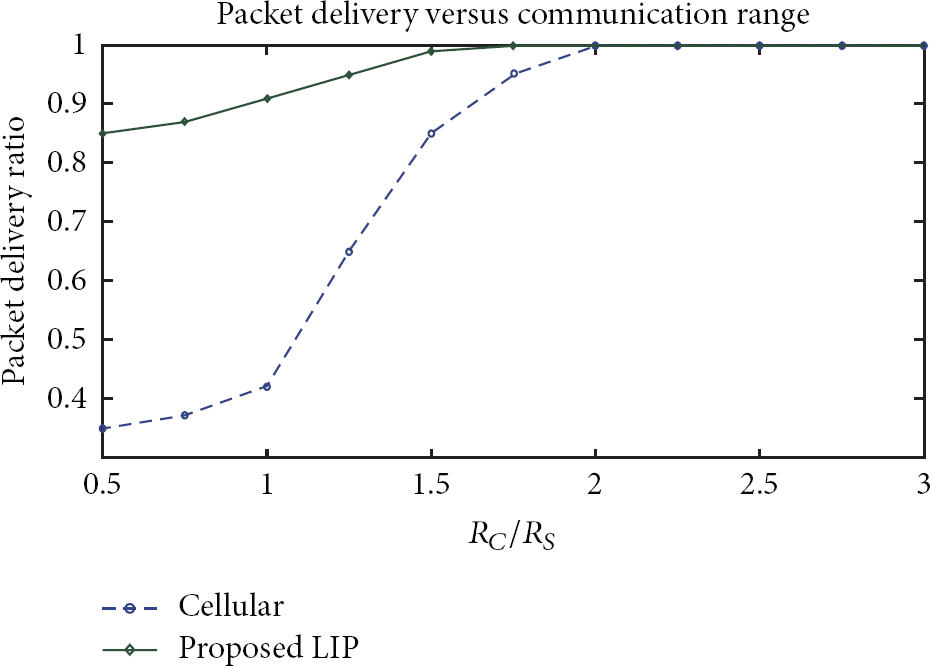
Throughput (packet delivery).

Coverage range.
Our proposed model saves considerable energy by restricting sensor movements between cells. The proposed model permits the redundant node to migrate from one cell to another cell to ensure coverage provided that the system ensures connectivity and hence the spending energy for migration will not be wasted. The energy consumption too is limited as the migrations of nodes are restricted as shown in Figure 6. Thus, the proposed model has maximized the lifetime of sensors and sensor networks, which is shown in Figure 5.

Energy loss.

Energy consumption.
6. Conclusion
This research work has studied sensor relocation scheme thoroughly and is implemented through QualNet 5.0 Simulator. The experimental results established that this sensor relocation scheme performs better in terms of coverage. It is found that this scheme is consuming more energy for node migration, it faces connectivity issue too, and it leads to minimizing of the lifetime of sensor networks. With respect to this issue, our research work has proposed and implemented an efficient sensor relocation technique based lightweight integrated protocol (LIP). From our study, it is observed that our proposed work LIP performs better than the existing sensor relocation scheme in terms of network connectivity, coverage, throughput, packet delivery fairness, energy consumption, energy loss, network resiliency, and secured communication. It is also noted that our proposed model maximizes the lifetime of wireless sensor networks.
Footnotes
Conflict of Interests
The authors declare that there is no conflict of interests regarding the publication of this paper.