




Abstract
Vehicular ad hoc networks (VANETs) are a new communication scenario in which vehicles take an active part. Real-time reporting of misbehaving vehicles by surrounding ones is enabled by in-vehicle sensors and VANETs. Thus, sensors allow detecting the misbehavior whereas VANETs allow sending the report to the authority. Nevertheless, these reports should pass unnoticed by the reported driver to avoid his/her potential reprisals. Information hiding techniques could be used to allow vehicles to transmit information covertly. In this work, two mechanisms for vehicle reporting are proposed based on two information hiding techniques—subliminal channels and steganography. The approach is to embed information into beacon messages either in the signature process (subliminal channel) or altering the least significant bits of selected sensorial fields (steganography). Results show that the proposal is computationally feasible for current vehicular devices and that it is possible to configure the system to operate in highways, secondary roads, and urban maps.
1. Introduction
Vehicular ad hoc networks (VANETs) are a new communication context in which vehicles can exchange information. They form a successful internet-of-things scenario that will be applied in the short term. VANETs are one of the enabling technologies of intelligent transportation systems (ITSs).
An interesting ITS application is the automatic reporting of misbehaving drivers by other drivers (or their vehicles). To be part of the VANET, vehicles need a communication and processing device called on-board unit (OBU). This device exchanges data with nearby vehicles mainly for traffic safety purposes. These data are mostly obtained from current vehicle-mounted sensors. Therefore, these technologies enable vehicles to automatically perceive the behavior of near ones. In fact, they have already been applied to use nearby vehicles as witnesses to defend against unfair punishments [1].
The capacity to monitor surrounding vehicles' behavior, along with the immediacy of VANETs, could significantly shorten the reporting process [2]. However, the reporting message could be observed by the misbehaving driver. This is because of the shared nature of VANETs. If the report is known by the offender, he/she could take reprisals against the reporting vehicle. Thus, its content must be concealed.
Encrypting the report would make it unreadable for the reported driver, since it would be encrypted using a key only known by the reporter and the authority. However, it must be noted that most VANET messages are related to traffic safety and thus they are sent in the clear. Therefore, an encrypted message being sent short after the illegal action would raise reasonable suspicions on the misbehaving vehicle. Even if it will never be sure on the actual message content (i.e., he/she will not know if it is actually a report or if it is referred to him/her), these suspicions would potentially be enough to take reprisals against the reporting vehicle. Given the terrible consequences that such an action may have, it would be useful to have a mechanism that could conceal the message existence (and not only its contents) from the reported vehicle.
Information hiding techniques allow sending data promoting that it passes unnoticed to undesired receivers. Particularly, subliminal channels and steganography are two representative mechanisms [3]. A subliminal channel hides messages in the way an algorithm is applied over the normal-looking communication. On the other hand, steganography hides the secret by modifying some parts of the transmitted message. It must be noted that, thanks to information hiding techniques, it is not necessary to introduce a new message to convey data; it is sent embedded in regular messages and only when it is needed (e.g., a misbehaving action has been detected).
Sensor data is of outmost relevance in VANETs. They enable having real-time information on the traffic status. The use of information hiding techniques has been previously explored over sensorial data. It has been applied for proving ownership or integrity of sensor generated data [4–6]. However, to the best of our knowledge, the use of these information hiding techniques in VANETs has not been explored yet.
The goal of this work is to introduce information hiding techniques, particularly subliminal channels and steganography, to enable vehicles to send reports about misbehaving ones. Particularly, the beacon message will be taken as the carrier. This is a well-known VANET-related message that contains the sender current status in terms of position, speed, heading, and so forth. According to current standards, they are signed and sent every 100 ms to 1-hop VANET entities [7].
The approach of this work is to hide the complaint in the way the signature is calculated (subliminal channel) or within the beacon's sensorial data fields (steganography).
Subliminal channels can be used in this context since ECDSA the signature algorithm in IEEE 1609.2 standard for security in VANETs is not subliminal-free [8]. Steganography may be used in these fields because sensorial measurements are subject to some inaccuracy—there are some unrepresentative bits that may be used to embed data.
Different pros and cons may be found for both techniques. Subliminal channels are interesting because they do not alter beacon information. However, high-capacity subliminal channels in ECDSA require the sender and receiver to share an authentication key [9]. This issue must not be suitable for privacy-careful drivers which do not fully trust the Authority (i.e., the report receiver). Concerning steganography, the situation is exactly inverse. Whereas such a key sharing is not necessary, it involves modifying some bits within a beacon. Furthermore, future potential enhancements over sensors may decrease their inaccuracy, thus limiting the steganographic capacity.
Taking into account these issues, both mechanisms are adopted as alternatives in the proposed approach. This promotes the validity of the proposal even if any of the aforementioned limitations affects one mechanism. The capacity, robustness, and feasibility of the proposed approaches are evaluated. Results show that they are feasible for current vehicular devices and that at least one configuration setting exists in which they are operational for common scenarios (highways, secondary roads, and urban environments).
Paper Organization. Section 2 provides a brief background on information hiding techniques. Section 3 describes the considered model. Section 4 describes the proposed technique based on the subliminal channel, whereas Section 5 introduces the one which relies on steganography. Section 6 focuses on how these mechanisms may be applied in a real-world setting. Section 7 evaluates the security and feasibility of both techniques. Finally, Section 8 concludes the paper.
2. Information Hiding Techniques
In this section, the main information hiding techniques are described. A systematic revision of these techniques was performed by Petitcolas et al. [10]. In their paper, they identify four main families of techniques: steganography, subliminal channels, anonymity, and copyright marking. Neither anonymity nor copyright marking are interesting for our paper since their application is rather different from our goal. Therefore, only steganography and subliminal channels are relevant techniques.
Section 2.1 focuses on subliminal channels. Afterwards, a particular type of subliminal channel is studied due to its relationship in the proposal. Particularly, subliminal channels for the ECDSA algorithm (which is the digital signature mechanism for vehicular environments, according to the related security standard IEEE 1609.2 [11]) are presented in Section 2.2. Finally, Section 2.3 briefly presents the foundations of steganography.
2.1. Subliminal Channels
A subliminal channel can be defined as any communication link that hides messages in elements that were not originally intended for communication. Under this general definition, Zander et al. identified two main techniques to build these channels [12].
Timing Channel. The time in which an action is performed has an intrinsic meaning. For example, if a message is sent in an odd second (e.g. 27th second within a minute), it would represent a bit value (say “0”); whereas if it is sent in an even one (e.g., 12th second) it would represent the opposite value (say “1”). Storage Channel. The use/absence of an element represents a value. For example, if a message content is bigger than a predefined threshold, it would represent “1” and “0” otherwise.
Apart from the previous categories, the way in which an algorithm or protocol is applied may also be used to build a subliminal channel [9]. For example, selecting a given value for an algorithm parameter may be interpreted in a particular way by the receiver. Therefore, it may be employed to communicate between both parties. For the purpose of this work, a particular kind of this category is further explained in Section 2.2.
2.2. ECDSA and Its Subliminal Channels
In this section, a short description of ECDSA is first presented. Afterwards, the concept of subliminal channel and the ones applying to the aforementioned algorithm are introduced.
2.2.1. ECDSA
ECDSA is a public key signature algorithm that is based on a finite field
In this algorithm, the private key is a random
Using the private key, the signature over a certain message m is a pair

2.2.2. Subliminal Channels
Subliminal channels enable sending a secret by the way an algorithm is used. Generally speaking, the secret is inserted within one of these algorithm parameters or results [9].
There are two types of subliminal channels, namely, broadband and narrowband channels. The difference between both types is the amount of data that can be embedded—it is maximum in the broadband channel, whereas it is reduced in the narrowband one [14].
For the specific case of ECDSA, one broadband and three narrowband channels have been identified [9]. Even if the cited work is focused on DSA, at least the broadband subliminal channel is also valid for ECDSA [15]. In all of them, it is necessary to share some information between sender and receiver. For the broadband channel, the shared secret is the sender's private key. In the narrowband ones, only a prime number, a binary sequence, or a particular value for a given parameter is required.
One important issue in broadband channels is that if the warden knows exactly the content of the subliminal message transmitted, he can retrieve the private key of the sender. Thus, in order to prevent this issue, it is necessary to send the subliminal message encrypted.
2.3. Steganography
Steganography is the science that focuses on how to hide the existence of messages [16]. Steganography shall not be confused with cryptography whose main aim is to conceal the content of the message so only allowed parties are able to read it. On the contrary, steganography aims to hide the message itself. The first informal description of steganography was given by Simmons as the prisoners problem [3]. Simmons described two prisoners (Alice and Bob) who want to plot an escape plan. They must communicate through a warden (Willie) who will analyse any communication between them. If Willie ever suspects that Alice and Bob are exchanging secret information he will isolate them.
In order to achieve their goal, they should hide their messages into innocuous-looking ones (called covers), so Willie will not be aware of the real meaning of those messages. As a difference with subliminal channels, the use of steganography involves modifying the cover.
The main goal of steganography is to build embedding functions that enable inserting practical amounts of data into covers while being undetectable for an attacker [17]. To achieve this goal, there should not be statistical differences between the set of all possible covers and the set of covers that hide the secret (stego-objects). Thus, it should not be possible to detect whether an object has embedded information or not without the knowledge of the key.
According to Petitcolas et al., two types of steganography are identified, namely, linguistic steganography and technical one [10].
Linguistic steganography involves transforming the message to conceal into a textual (i.e., natural language) representation. For example, given a secret bit stream, this procedure builds a (potentially random) text with some semantical meaning. The receiver performs the reverse operation on the text to retrieve the secret bit stream. Technical steganography may be based on two underlying procedures. First, a grammar may be used to generate a well-formed (potentially random) carrier message that internally contains the secret. The undetectability of this mechanism relies on the degree of realism of the created carriers. Second, parts of a carrier message may be altered to hide the secret. To promote undetectability, performed changes must not alter the original message meaning. Therefore, any source of redundant data is preferred for this purpose.
3. System Model
In this section, the model considered in this work is presented. First, the participant entities are introduced in Section 3.1. Section 3.2 introduces the system requirements. The threat model is described in Section 3.3. In Section 3.4, the selected message to hide the misbehavior report is described. Afterwards, the secret message structure is presented in Section 3.5, and the working assumptions are described in Section 3.6.
3.1. Participant Entities
In the proposed model, there are seven entities at stake (see Figure 1). The reporting vehicle (through its on-board unit, OBU) is the entity that sends the report related to a purported offending vehicle. This report is sent to in-range road-side units (RSUs). To enable the communication between OBUs and RSUs, a vehicular ad hoc network (VANET) is established. RSUs are common VANET-related static entities placed aside the roads that connect OBUs to service providers and the authority. For this particular context, RSUs send the received reports to the decision support system (DSS), which is managed by the Authority. DSS reveals the embedded data and sends it to the inspector who evaluates the relevance of the report and, if necessary, sends it to the report manager to proceed with the enforcement process.

Model entities.
In order for DSS to perform its operations, it interacts with the certification Authority (CA). CA manages the lifecycle of vehicular pseudonym-based short-lived certificates.
Vehicles are equipped with sensors that measure the vehicle's status (position, speed, heading, etc.). Sensorial data are assumed to be firstly sent to the event data recorder (EDR) device [18].
3.2. System Requirements
The envisioned system has to fulfil the following four main requirements:
Undetectability. Secret information must remain undetectable for unauthorized parties. Reduced Computational Workload for RSUs. Road-side units have to minimize their computational workload. Particularly, they cannot perform the message decryption or retrieval, and they must be able to determine, autonomously, whether a received message may contain secret information or not. Reduced Computational Workload for DSS. DSS must only process messages in which it is plausible for them to contain a secret. Robustness. The proposed approaches must contain countermeasures against the incidental data loss produced within the vehicular network.
3.3. Threat Model
Four entities are fully trusted, namely, report manager, CA, inspector, and DSS. All of them are related to the Authority or government in force, so they are under its physical and logical control. Furthermore, their interconnecting networks are also assumed to be fully reliable—no chance to access or manipulate the exchanged information.
Concerning RSU, it may be compromised by a malicious attacker to eavesdrop all exchanged messages to and from DSS. Even if the attacker could deactivate this device, this threat is left out of the scope as it requires physical countermeasures to be fully addressed.
With respect to the vehicular entities, the offending vehicle (i.e., the warden) cannot block the message sent, but, only eavesdrop it. The communication network may also be eavesdropped, and it is subject to incidental message losses. Denial-of-service attacks are assumed to have been countermeasured.
3.4. Message Structure to Hide the Report
The selected message to hide the secret (i.e., the misbehavior report) is the beacon message. According to standard SAE J2735, it contains several sensorial data fields (e.g., position, speed, heading, etc.) describing the sender's current status. It is sent every 100 ms. to nearby nodes (1 km away at most), and it is not routed [7].
There are two main reasons to perform this selection. On one hand, it is periodically sent by all vehicles, which enables an almost continuous communication channel to hide information. On the other hand, sensorial information is subject to errors caused by the limited accuracy of sensors. These errors lead to a set of unrepresentative bits that may be altered without causing a relevant threat to the data reliability. This is a beneficial situation for steganographic mechanisms.
One interesting issue is that according to SAE J2735, beacons are sequentially numbered [7]. This fact helps in relating different fragments of a given secret.
3.5. Secret Message
The misbehavior report to be secretly transmitted contains the following three fields (Figure 2).
Misbehaving action (4 bits): it will identify the type of the reported misbehaving action. Message payload (32 bits): it will be filled with the misbehaving vehicle identifier. Although this is a temporal pseudonym, it is the only publicly known identifier available to the reporting vehicle. Random section (2 bits): it contains meaningless data. It is only included in the subliminal-based approach to promote that the secret may be sent using this technique.
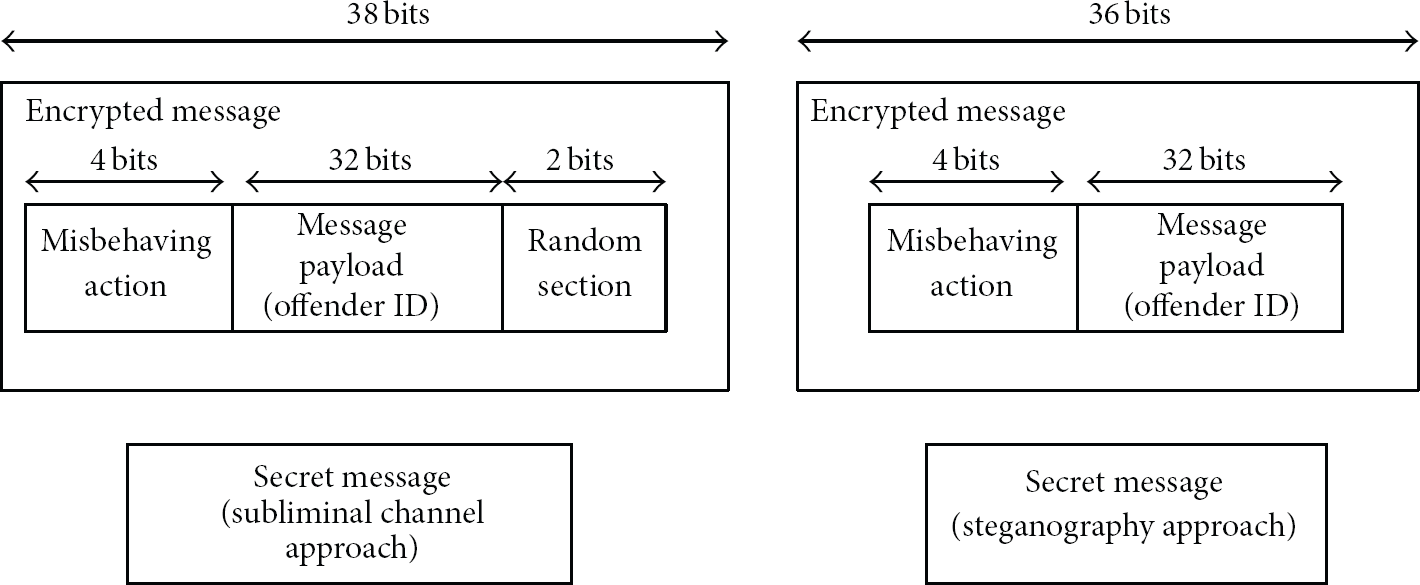
Structure of the reporting message to hide into beacons under both approaches.
The size of the random section is motivated by the probability for a message not to be transferable through a subliminal channel. According to Simmons, the total amount of messages that cannot be sent is
3.6. Working Assumptions
The proposed mechanisms are intended to work under the following five assumptions. First, vehicles' sensors are compliant with IEEE 1616 [18] and SAE J2735 [7] resolution and accuracy, and their inaccuracies (or errors) are random.
Second, each beacon is signed by the sending vehicle and the corresponding public key certificate is sent along with the beacon. This assumption is in line with recent mandates on vehicular security as stated in IEEE 1609.2 [11]. Related to this point, the third assumption is that vehicles will be using the same pseudonym while a single secret is sent.
Fourthly, concerning the subliminal-based approach, the vehicular cryptomaterial (i.e., public/private keypairs) is generated by the certification authority. This is one of the certificate request models identified in IEEE 1609.2 [11].
Finally, each vehicle is equipped with a set of (at least) 14 passwords. Each password is the result of encrypting for CA (using CA's public key) one permutation of the vehicle identification number (VIN). Each password may be used in a predefined set of seconds within each minute. According to ISO 3780, VIN has 17 alphanumeric elements [19]. For the sake of simplicity, we will assume that all elements are transliterated and represented by 4 bits. Thus, the whole VIN (and thus, each password) is 68 bits long.
It is also assumed that the sender will perform each sending operation for a single report using a different password. The selected amount of passwords is based on the quantity of repetitions required to promote that the message arrives taking into account data losses in VANETs. This issue is analysed in Section 7.1.
4. Subliminal Channel Architecture
In this section, the approach based on subliminal channels is described. At first, all subliminal channel techniques introduced in Section 2.1 are available. However, in the approach taken in this paper, the beacon message is selected as the carrier for the secret (see Section 3.4). Based on this decision, neither timing nor storage channels could be practical. Mandated by standards, beacons are regularly sent at periodic intervals, so the sender cannot choose when to send it. On the other hand, their structure is also well-known, so it is not possible to alter it at will. Even if they have one optional part (part II, as defined in standard SAE J2735 [7]), it is not intended to be frequent. Therefore, its mere existence could contribute to reveal the existence of the subliminal channel.
Considering these issues, only ECDSA-related subliminal channels (see Section 2.2) are available. Taking into account that broadband channels offer the maximum capacity, they are selected herein to maximize the efficiency. As explained in Section 2.2, it is possible because the vehicular cryptomaterial is known by the certification Authority, so the vehicle (sender) private key is already known by this entity.
Channel capacity is introduced in Section 4.1, whereas the embedding and revealing functions are presented in Sections 4.2 and 4.3, respectively.
4.1. Channel Capacity
According to Simmons, the channel capacity for a broadband channel is given by
4.2. Embedding Function
In order for the vehicle to subliminally send the secret, it is taken as the value k of the ECDSA algorithm (Figure 3). Given that the warden may know the exact content of the secret, he could recover the reporting vehicle signing key (recall Section 2.2). Thus, the secret is encrypted before being used as the subliminal message. For this purpose, Simmons' method (which relies on Vernam encryption) is applied [14]. The key to be used in this step is the VIN-based password suitable for the time mark of the beacon at stake. As this password is 68 bits long (recall Section 3.6), which is greater than the message to encrypt, it may be used as the key for the process. It must be noted that using the VIN as key would also be possible, but having it encrypted limits the attacker's probability of success.
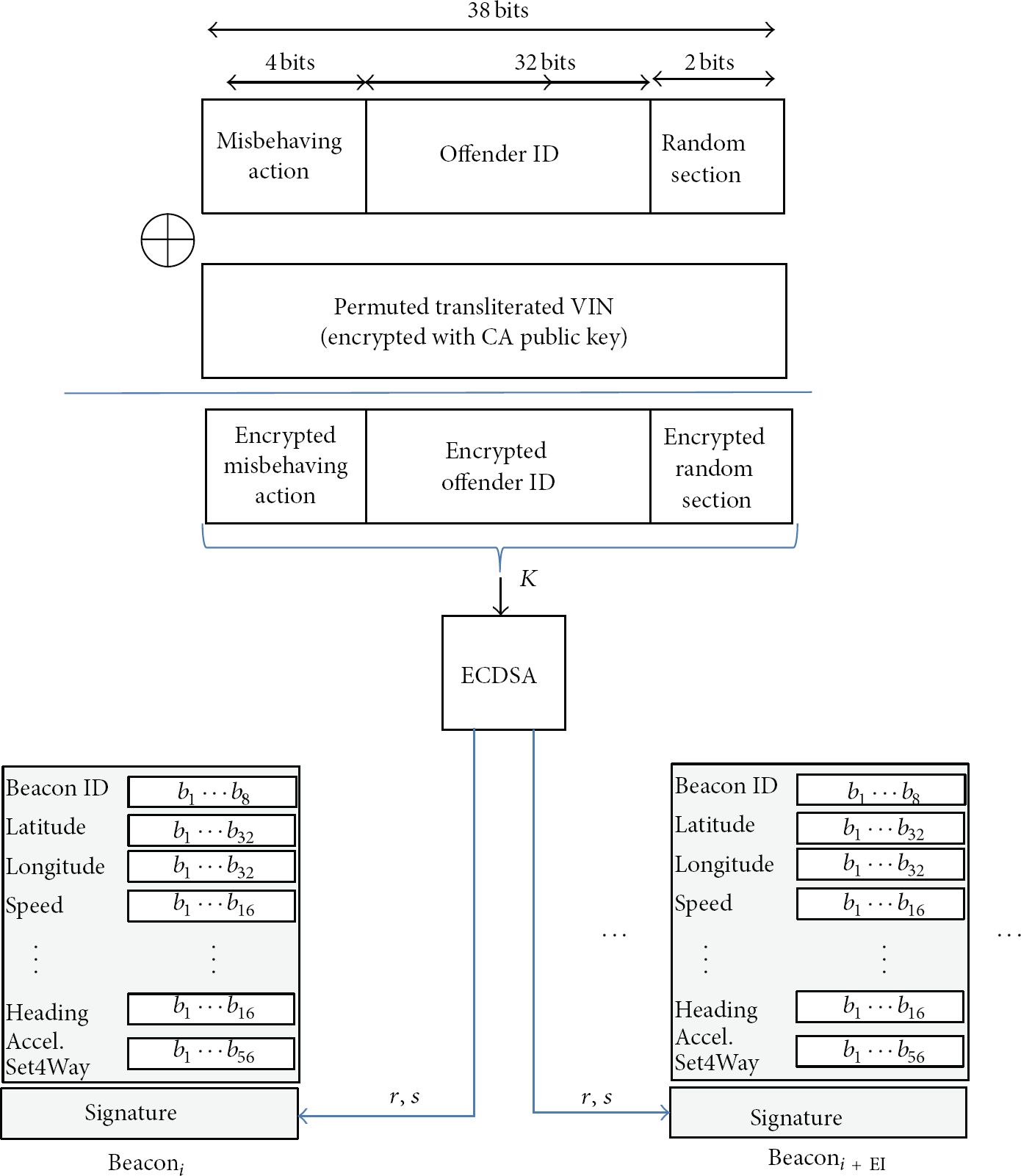
Embedding function for the approach based on subliminal channels.
The signature process over the beacon

As the beacon is sent from the vehicle using the vehicular communication channel, the message may get lost. Thus, to promote that the message is received by DSS, it is re-sent several times. The amount of repetitions to be made for a report is given by the system parameter R. The analysis on the effect of this parameter in the global robustness of the system is discussed in Section 7.1.
It may happen that even if the beacon ID is a multiple of
4.2.1. Preventing False Positives
One critical issue to ensure the success of this approach is to prevent false positives, that is, beacons that contain a well-formed hidden message that was not intentionally inserted by the sender. To address this issue, the sender must avoid using misleading values of k when no hidden data is inserted. These values are those that lead to a valid secret message structure.
4.3. Revealing Function
The revealing function is applied periodically to the stream of received beacons (see Figure 4). This forces DSS to temporarily store these beacons (Section 7.3 analyses the amount of storage required). The process starts by the latest received ones, provided that their signature is successfully verified. Thus, for every received beacon


Subliminal approach. Revealing function workflow.
In order to decrypt
Once
5. Steganography Based Architecture
In this section, the approach based on steganography is described. The first issue to address is to choose a particular type of steganography (see Section 2.3). Recalling that the beacon message is selected as the carrier for the secret, building a linguistic-based steganographic mechanism is not feasible since it is not a natural language element. Similarly, the first technical steganography procedure cannot be used herein. In such a procedure, the secret would be transformed into a beacon. The reverse transformation would enable retrieving the secret. However, it must be noted that beacons contain sensorial information which is far from random. Sensor measurements must be realistic to be credible. For example, current position or time values must be as close to their actual values as possible.
Considering these facts, modifying parts of the beacon is the best technical steganography procedure available for our purposes. The rest of this section describes the core of this technique. The capacity of each beacon is analysed in Section 5.1. Afterwards, the embedding and revealing functions are described in Sections 5.2 and 5.3, respectively.
5.1. Cover Message Capacity Analysis
In this work, it is considered to be acceptable to alter the sensorial value
The capacity of one data element

The sensorial data is obtained first by the motor vehicle event data recorder (subject to IEEE 1616 [18]), and then the beacon message is constructed according to the SAE J2735 standard [7]. To calculate the capacity of each sensorial data element, the accuracy and resolution defined in the aforementioned standards have been analysed. While the EDR standard establishes the required resolution and accuracy, J2735 only describes the resolution of each field. Thus, in the calculations, the accuracy described in the IEEE 1616 standard has been used.
Table 1 specifies the maximum capacity of each beacon sensor field and the whole capacity of the message, 13 bits, considering the minimum capacity provided by both standards. Using this lower value is the most conservative approach, as it enables embedding the data at any point in the process, that is, before or after the sensorial data has been recorded in the EDR or prepared to be transmitted within a beacon.
Capacity of each beacon sensorial data field, maximum introduced error and overall capacity of beacon messages.

5.2. Embedding Function
The proposed embedding technique consists in replacing the least significant bits of the sensorial data elements with those of the secret message (Figure 5).
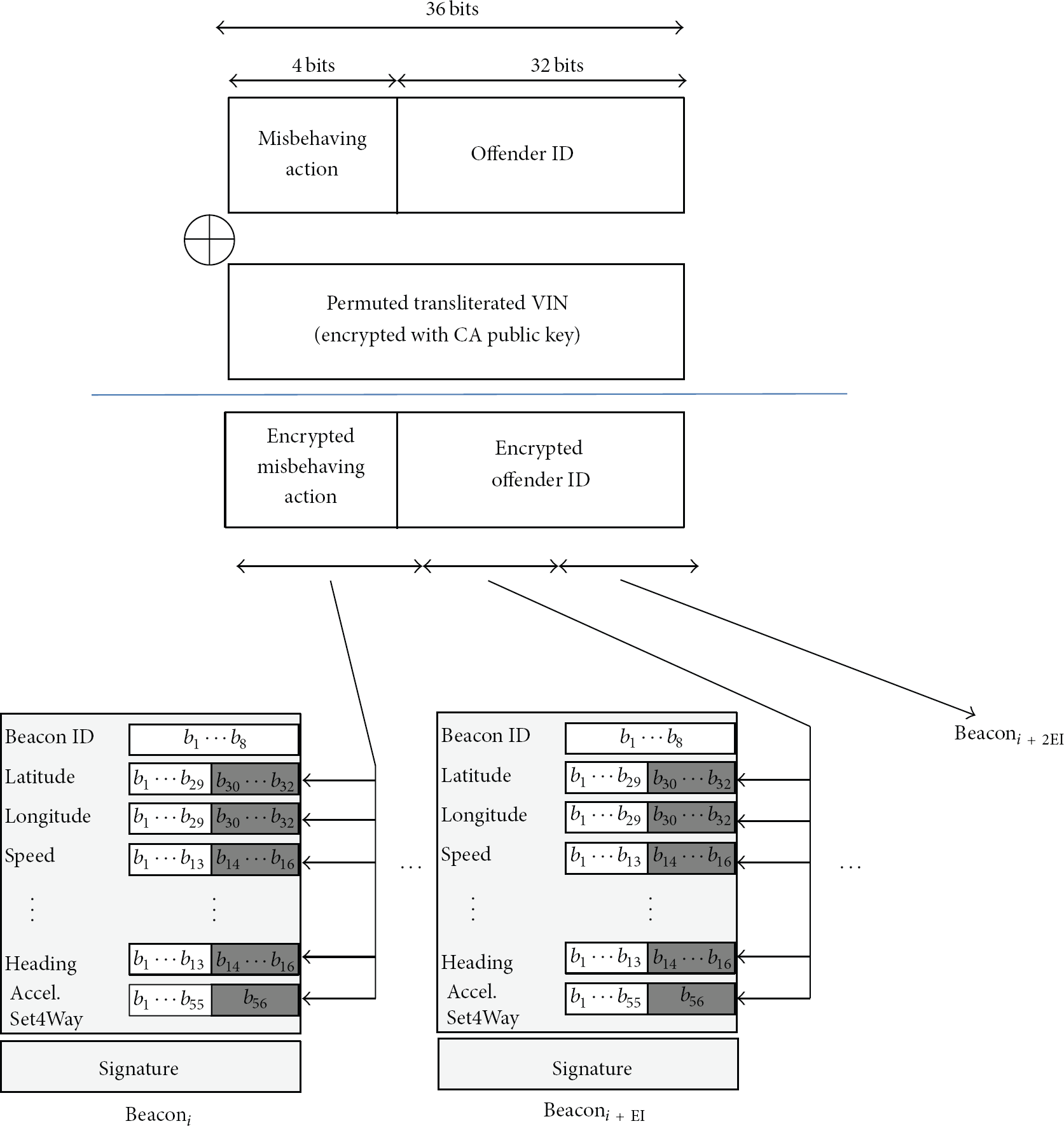
Embedding function for the steganographic approach.
As the vehicular communication channel is subject to data losses, a simple repetition scheme is selected. In this way, as it happened in the subliminal channel technique, every report will be repeated a number R of times. Nevertheless, if the same secret were identified by the attacker it would raise suspicions. For this purpose, it is necessary to prepare the message in such a way that every repetition leads to a different embedded message.
The proposed preparation is analogous to the one applied for the subliminal approach. Essentially, the secret (in this case, without the random section) is encrypted with a password using a Vernam cipher. The password is again a particular permutation of the VIN encrypted for the CA. The choice of the permutation to apply depends on the time mark of the beacon.
Once the message is prepared, it is inserted into the selected sensorial fields of the beacon. As the length of the secret (36 bits, recall Section 3.5) is higher than the capacity of each beacon (13 bits, recall Section 5.1), it is necessary to fragment the secret. The total amount of fragments (and thus, required beacons) is referred to as 
The last step is to send the R instances of the secret to the receiver. As it happened in the subliminal based approach, an embedding interval
5.2.1. Preventing False Positives
As it happened in the subliminal channel, it is critical to avoid a well-formed hidden message when it is not inserted by the sender on purpose. To prevent these false positives, the sender must keep an eye on the bits affected by this embedding function for all beacons whose identifier is multiple of
5.3. Revealing Function
To obtain back the secret message, the revealing function reverts the embedding operations, performing in reverse order the process shown in Figure 5. The receiver does not know in advance if a reporting message is embedded in a beacon. Thus, it must proceed as if every beacon, among those eligible (i.e., considering the
6. Practical Settings
The subliminal channel technique (Section 4) and the steganography-based one (Section 5) are two different alternatives to convey the secret message.
In order to select which technique to apply, this section describes the two different practical settings that are envisioned.
Preestablished Selection. In this setting, the Authority and the vehicle owner establish in advance which technique to apply. Two different choices are available.
Always Subliminal. This setting is suitable for drivers who share their private key with the Authority. They will benefit from the fact that improvements on sensor technologies will not affect their ability to send reports. Always Steganography. This is the preferred setting for drivers that do not share their private key with the Authority. They will be able to send reports even if future revisions of IEEE 1609.2 standard determine a subliminal-free version of the ECDSA algorithm. On-the-Fly Selection. The technique to apply is chosen by the sending vehicle on the fly. This enables full flexibility at the sender's side, as it will have both mechanisms available. In this setting, the receiver will first evaluate whether the subliminal channel has been used and, if it is not the case, it will assess the use of steganography. This decision is motivated by the fact that the receiver is not aware of the type of information hiding technique that is in use. Therefore, it is necessary to execute both revealing procedures one after the other before determining that a given beacon does not contain hidden data. The resulting revealing workflow is shown in Figure 6. It is a slight modification of Figure 4.
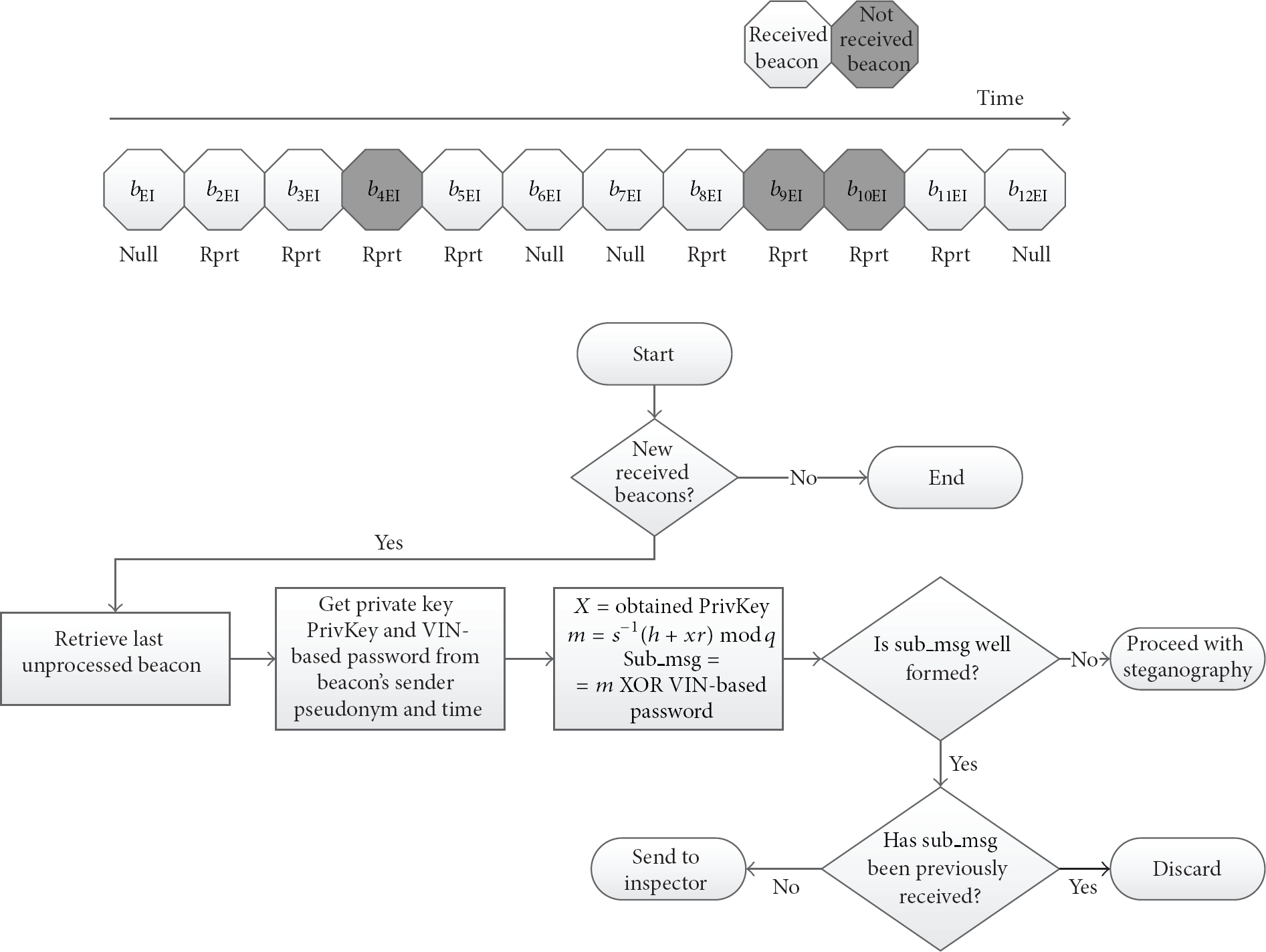
Subliminal approach. Revealing function workflow for on-the-fly selection setting.
7. Evaluation
In this section, the proposed system is evaluated. First, the system robustness given certain configuration is assessed in Section 7.1. The configuration is given by the system parameters
7.1. Robustness
The communication reliability of DSRC affects the robustness of the proposed system, as there is a nonnegligible probability of losing a sent packet. In this section, the minimum number of repetitions
Let 


Analysis of the minimum repetition rate
7.2. Computational Feasibility
In this section, it is analysed if all participants are computationally capable of sending and receiving hidden messages. For the sake of clarity, the sender feasibility and the receiver one will be analysed separately.
In order to simplify the reasoning, it is assumed that both OBUs and RSUs operate in continuous access mode to the wave control channel (CCH) [22]. This channel is employed to transmit beacon messages. Thanks to this type of access, no channel switching overhead has to be considered and no synchronization is required for this task.
7.2.1. Sender
In both approaches, the first action is to prepare the secret message (
Once the message is prepared, it is necessary to take it as an input for the signing process. For this purpose, it is encrypted using a Vernam cipher. Determining which key (i.e., which encrypted permutation of the VIN) has to be applied takes a time 
In order to estimate the sender cost, it is assumed that the most computationally significant operations are the cryptographic ones, as the remaining operations are simple manipulations of messages. The multiplication in Galois field (
Even if the previous figures indicate that there is enough time to perform these operations, it must be noted that all beacons sent are signed. For this reason, the temporal overhead introduced by signature generation over sent beacons, 

7.2.2. Receiver
With respect to the receiver, there are two entities at stake—RSU and DSS. The RSU's task is to decide whether the beacon identifier is multiple of the parameter 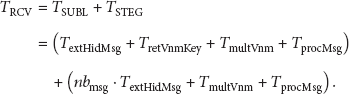
It is important to note that in the subliminal approach the secret is not fragmented (and therefore, only one extraction is applied) and that the key is the same for both approaches in a given beacon (so there is no need to retrieve it in the steganographic process).
Among all the described operations, there are three remarkable ones. First, solving the ECDSA-based equation in the subliminal approach (
In order to ensure that DSS can cope with all beacons, it must be able to timely process all of them. Thus, for a given second (12) must hold, where 
7.3. Operational Feasibility
In the proposed approaches, it is assumed that the reporting vehicle sends the required amount of beacons while being in the range of a set of RSUs. Nevertheless, the amount of required RSUs connected to a single DSS has not been characterized. It mainly depends on the vehicle's speed. This section analyses the system feasibility regarding this issue. The suitability of different system configurations (parameters
7.3.1. Amount of Required RSUs: Suitability to Different Driving Scenarios
Assuming that a specific system setting is selected by choosing certain values of
To guarantee the system's operational feasibility, M must necessarily be greater than N. By design, 
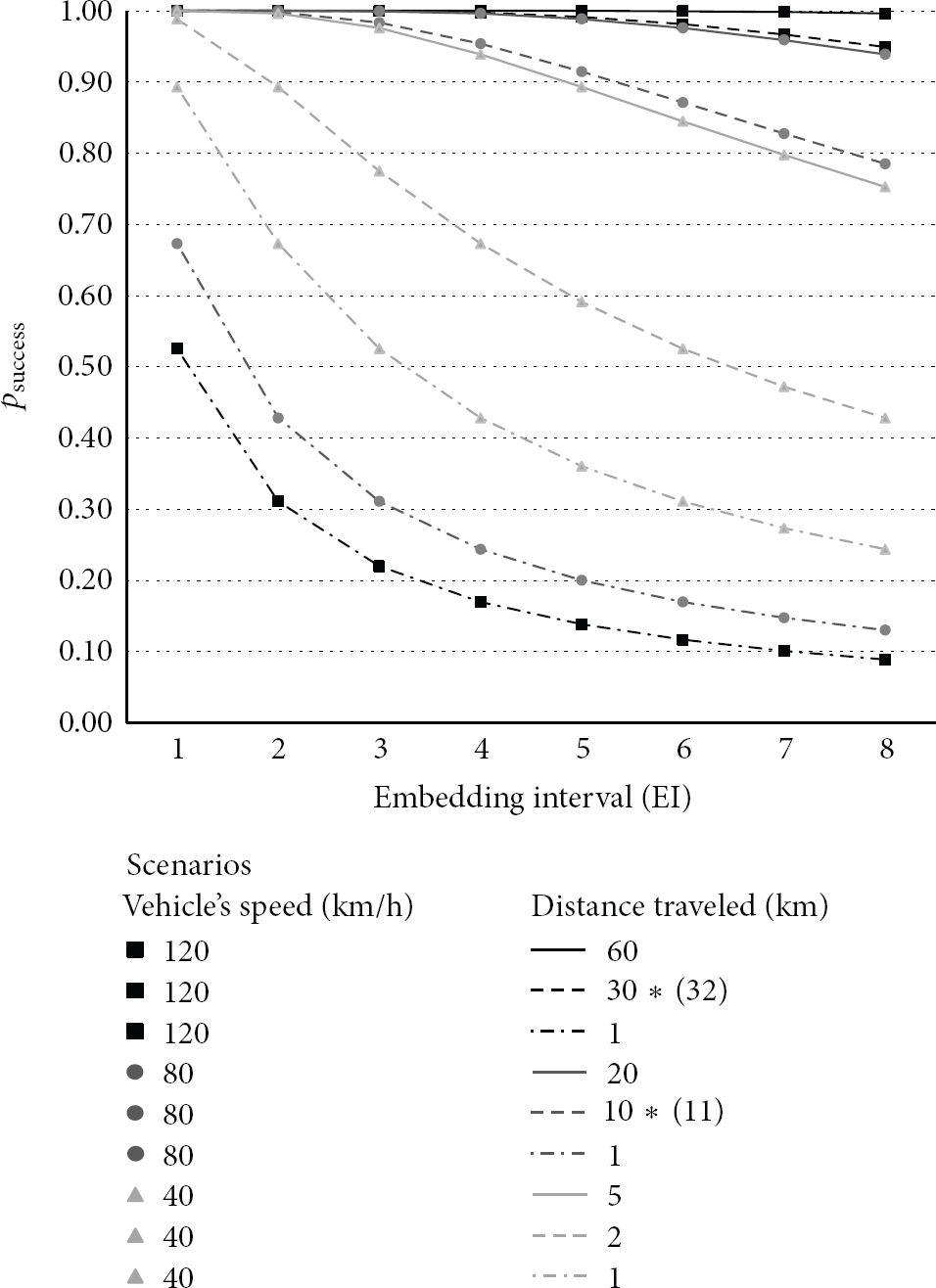
We analyse the system's operational feasibility in nine scenarios specified by the vehicle's speed and the distance travelled (Figure 8). Considered speeds are those common in highways (
Success probability in the considered scenarios.
Figure 8 shows the probability of success
From our point of view, the system is considered to be feasible if
7.3.2. Storage Needs for DSS
The amount of beacons at stake must be stored by DSS. As the described revealing procedures are applied periodically to the set of received beacons, it is necessary to temporarily store them.
Speaking generally, the amount of beacons to store depends on six variables, 
From the storage point of view, the worst situation is when the amount of RSUs is higher and the embedding interval is minimum. Thus, in order to give a worst-case value on this issue, it will be assumed that
Based on the previous values, the amount of storage required by DSS is
7.4. Requirements Analysis
In a nutshell, both approaches have fulfilled the imposed requirements. A detailed explanation for each one is given below.
Undetectability. The subliminal approach fulfills this property as the key used to encrypt the secret is unknown to the warden, so it cannot determine the mere existence of the secret. On the other hand, the steganographic approach keeps the modified value within the accuracy boundaries, thus avoiding to perform a noticeable change over the beacon data. Furthermore, this technique does not introduce statistical differences under the working assumptions. It must be noted that even if the identity of the reporting vehicle is known to the misbehaving one, there is no risk of reprisals. The reported vehicle cannot detect that it is being reported. The report itself is hidden from that vehicle, thanks to the said properties of the selected information hiding techniques. Reduced Computational Workload for RSUs. The workload on RSUs is reduced in both mechanisms to determine whether the received beacon's identifier is multiple of the parameter Reduced Computational Workload for DSS. Related to the previous point, the parameter Robustness. Both techniques follow a repetition strategy, thus decreasing the probability of secret data loss.
8. Conclusions and Future Work
In this work, two information hiding approaches (subliminal channels and steganography) have been proposed to enable vehicles sending hidden reports about other misbehaving ones. For this purpose, the report is embedded in the signature process of VANET beacon messages (subliminal channel) or within the least significant bits of selected sensorial data fields within these messages (steganography). For both approaches, the secret message structure, the cover capacity, and the procedures to protect, embed, and extract the secret data have been presented. The proposal has been evaluated in terms of the degree of robustness against communication errors, the required computational effort, and its feasibility in representative scenarios. It has been shown that it is suitable to current vehicular computational devices and that it may be used (under different settings) for common values of vehicle's speed and distance travelled.
Considering the previous facts, the proposed system has four main advantages. Particularly, (1) it enables sending sensitive data (a traffic misbehaving report) over public, shared communication media (the VANET), unnoticed to all entities except for the intended receiver; (2) as reports are embedded in beacon messages, they can be sent immediately after the misbehaving action is detected; (3) the system is robust against incidental data losses typical of VANETs; and (4) it is computationally feasible for the vehicular environment, taking into account current state-of-the-art devices and realistic driving scenarios.
The approach taken in this paper serves as a starting point for the application of covert channels in vehicular networks. Given that several malicious uses could be given to this technique (e.g., driver-to-driver radar/police control warning), we believe that this will encourage the research community to invest efforts in this direction.
Future work on this area will have three main directions. First, we will evaluate other encryption techniques for the steganographic approach to improve its performance. An open issue is to increase the efficiency for both the sender (avoid the overload caused by repetitions) and the receiver (avoid processing beacons without a secret). Second, a practical evaluation with real sensors will be performed to contrast the degree of randomness of their errors. Third, the adoption of other information hiding mechanisms (e.g., timing subliminal channels) will be studied. For this purpose, other messages structures to hide the message must be taken into consideration.
Footnotes
Conflict of Interests
The authors declare that there is no conflict of interests regarding the publication of this paper.
Acknowledgments
This work is partially founded by Ministerio de Ciencia e Innovacion of Spain under Grant TIN2009-13461 (project E-SAVE). Authors want to thank Dr. M. I. González-Vasco and Dr. Julio C. Hernandez-Castro for their helpful suggestions. Furthermore, authors would like to thank the anonymous reviewers for their valuable comments.