




Abstract
Security is an inherent and challenging task in Wireless Sensor Networks (WSNs) characterized by multihop routing and stringent resource constraints such as limited processing capability, storage capacity, communication bandwidth, and energy. Most of the existing trust-based routing schemes require the support of promiscuous mode of operation and gather a large number of recommendations from the neighbors for trust derivation. These result in higher energy consumption, higher communication overhead, and larger memory requirements in a resource constrained sensor network. In this paper, we propose a new two-way acknowledgment-based trust (2-ACKT) framework with individual (2-ACKT-I) and group (2-ACKT-G) acknowledgment to minimize the communication overhead and memory requirement for trust establishment in WSNs. The 2-ACKT protocol calculates the direct trust using a link layer acknowledgment and a two-hop acknowledgment from a downstream neighbor. The simulation and theoretical results indicate that 2-ACKT scheme significantly outperforms the conventional multihop and trust-based routing schemes in terms of packet delivery ratio, network lifetime, communication overhead, and memory requirements.
1. Introduction
Wireless Sensor Networks (WSNs) consist of densely deployed tiny sensor nodes to monitor the real world environment by sensing, processing, and communicating about the sensor field [1]. In WSNs, the environment being monitored does not require any installed infrastructure for energy and communication thereby simplifying the system design and operation [2]. Sensor nodes (SNs) in WSNs suffer from resource constraints such as low computational capability, limited storage capacity, limited communication bandwidth, and the use of insecure communication channel [3]. WSNs are prone to varied types of attacks [3–8] such as black hole attack, sink hole attack, and sniffing attack, which require a security solution. The memory and power constrained sensors make the employment of cryptographic solutions such as centralized keying and pair wise key sharing techniques, less attractive security solutions for WSNs. Moreover, cryptographic solutions can successfully defend against outsider attack but can fail under insider malicious attacks [9]. This vulnerability along with the cooperative nature of sensor networks requires the need for assessing the trust relationships among the nodes in the network [10]. Trust is the level of confidence in an entity and classified as direct and indirect trust [11]. The direct trust is the trust derived based on the node A's experience with its neighbor B while the indirect trust is the trust derived by the node A based on the experience of its neighbors with node B. Several trust-based routing protocols proposed in the literature use direct or indirect trust or both to thwart malicious attacks. But for accurate derivation of direct trust, the participating sensors need to support the promiscuous mode of operation. The promiscuous mode of operation demands the sensor to be in the idle listening state till the next hop neighbor forwards the packet, and, hence, consumes more energy. Moreover, the promiscuous mode of operation does not always provide sufficient evidence on the behavior of a monitored node. A monitored node may not be able to relay the packet due to the low quality of the wireless link. Alternatively, the indirect trust is derived based on the recommendations gathered from the neighbors. The large number of recommendations gathered from the neighbors increases the overhead and energy consumption in the network.
In order to minimize the overhead and energy consumption, we propose a two-way acknowledgment-based trust (2-ACKT) framework for WSN. The 2-ACKT model does not require the sensors to support the promiscuous mode of operation. It uses the link layer acknowledgments and also exploits the dense nature of the network to derive the trust on the neighbors. The main aim of the proposed 2-ACKT model is to meet the following design objectives:
to minimize the number of recommendations gathered from the neighbors for trust evaluation thereby minimizing the control overhead, to avoid the promiscuous mode of operation of sensors thereby allowing the sensors to be in sleep mode as directed by medium access control layer thereby reducing the energy consumption, and to reduce the memory requirement by representing the trust with lower number of bits.
This paper is organized as follows: Section 2 describes the related work. Section 3 presents the proposed 2-ACKT protocol. Section 4 discusses performance analysis. Section 5 offers conclusions and future scope of the work.
2. Related Work
Many trust-based routing schemes proposed for WSNs use either direct observation or recommendations or a combination of both to derive trust on their neighbors. Trust-based routing protocol TRANS [12] was proposed to thwart black hole attack [3]. It used a light-weight broadcast management scheme μTESLA [13] to authenticate all requests. The drawback of this protocol was that it required Message Authentication Code (MAC) along with shared encryption key to ensure integrity and confidentiality of request in routing. k-parent Flooding Trust Model (k-FTM) [14, 15] was robust against black hole attack on broadcast messages. It was a novel trust-aware framework designed specifically for performing secure broadcast communication in WSNs. The drawback of this approach was that it required a secure key-management protocol to establish pair-wise keys between each node and the base station. Ganeriwal and Srivastava proposed Reputation-based Framework for Sensor Network (RFSN) [16] scheme was a distributed reputation management approach. It employed a watchdog mechanism to build reputation and Beta reputation system to represent the reputation as well as to update the reputation continuously based on recommendations received from the neighbors. RFSN encountered bad mouthing attack [17] but at the cost of system efficiency as nodes could not share their bad experiences with others. Moreover, it also used past behavior of a node to predict its future behavior. This could be utilized by adversaries that planned attacks considering the weaknesses in different building blocks of the framework. The intelligent adversary could use a highly reputed node to abuse the system by potentially compromising it. Some work available in the literature [18, 19] used weight factor while integrating the direct and indirect trust value to avoid the bad mouthing attacks.
A distributed trust model Parameterized and Localized trUst management Scheme (PLUS) [20] was proposed to calculate trust by direct and indirect observations. It was a protocol specific trust mechanism and worked on the top of Parameterized Localized trUst management based Secure Routing (PLUS-R). In this scheme, the important control packets generated by the base station (BS) were appended with a hashed sequence number (HSN) to check the identity of the BS. Inclusion of this HSN increased the overhead of communication and computation. Trust values were updated for node i by the judge node on receiving a packet from node i. On reception, judge node would check the integrity of the packet. Integrity was checked by attaching MAC to thwart modification attack. If the integrity check failed, then the trust value of node i would decrease even though the modification was not performed intentionally thereby increasing the probability of false alarm. The judge node identified the black hole by setting its transceiver in promiscuous mode after routing some packets through the suspect and checked whether the suspect forwarded the packets. Trust value was represented in the range of 0 and 1. Using mobile agents, Agent-based Trust and Reputation Management (ATRM) [21] scheme maintained trust of each node in clustered WSNs. The trust was evaluated based on the service provided, that is, data forwarding behavior of the neighbor. The trust of the neighbor was updated by each node to its mobile agent. It assumed the existence of a trusted authority to generate and launch mobile agents and so it was vulnerable to a single point of failure. Also, it assumed that mobile agents were resilient against malicious attacks which were not realistic in many applications.
Agent-based Trust management model for WSNs (ATSN) [22] was a distributed agent-based trust mechanism that used promiscuous mode to overhear the behavior of its neighboring nodes and computed the trust. After computing the trust, the trust values were encrypted by the agent nodes and were broadcast to its neighbors. Li et al. proposed a novel scheme [23] that avoids bad recommendations by performing a deviation test by the monitoring nodes before accepting the indirect recommendation. The drawback of this scheme was that the monitoring nodes were assumed to be always trusted which was infeasible in real circumstances. Efficient Monitoring Procedure In a REputation system (EMPIRE) [24] was designed to reduce power consumption, memory usage, and communication overhead in WSNs. The main task of EMPIRE was to reduce the nodal monitoring activity and to maintain the system performance at a satisfactory level. It evaluated reputation based on direct and indirect observation. The reputation was computed by monitoring the packet forwarding behavior of a node and it thwarted black hole attacks. Reliable Adaptive serviCe-driven Efficient Routing (μRACER) [25] was proposed for sensor actuator network. It was based on three protocols namely, trust-aware routing protocol (TARP), context-aware routing protocol (CARP), and service-aware routing protocol (SARP). TARP was used to avoid routing through non-cooperative nodes and to monitor the behavior of nodes. It considered both direct and indirect reputation. The scheme addressed the grey hole attack [3] by eliminating distrusted nodes from the routing path. To evaluate direct reputation, the scheme overheard the packet forwarding behavior of the neighbor.
Most of the trust management schemes did not address the various resource constraint requirements of WSNs. Therefore, Group-based Trust Management Scheme (GTMS) [26] overcame some of these constraints. Each node calculated trust based on direct or indirect observations. It adopted distributed trust management approach in intra group level and centralized trust management approach in inter group level. In intra group level, each node calculated trust by getting recommendations from all its group members, whereas in inter group level, each cluster head (CH) obtained recommendation about other CHs only from the BS. Trust value was represented in the range of 0 and 100, that is, as an unsigned integer that saved memory space and it addressed black hole attacks. The drawback of GTMS was the use of promiscuous mode of operation to monitor the neighbor. It demanded high energy and more memory space for CHs. Moreover, it also assumed a trusted BS which is immune to security threats.
Trust Management Architecture (TMA) [27] used super node-based trust management approach to overcome black hole attacks. It calculated trust based on direct and indirect observation. The direct observation was performed by monitoring the neighbor in promiscuous mode. The trust value representation and the assumptions made were similar to that of GTMS. Trust-based Cross Layer Model (TCLM) [28] scheme calculated trust by a cross-layer concept, that is, by using acknowledgments from data link layer and transport layer. The trust value was defined by Bayesian statistics and Beta distribution. The trust value was represented in the range of 0 and 1 as real numbers which required more memory. The aforementioned trusted routing schemes used promiscuous mode of operation to observe the packet forwarding behavior of a neighboring node. They have the following drawbacks:
need for omni-directional transceivers; compulsory support from sensors for full duplex transmission mode; excessive energy consumption.
3. 2-ACKT Protocol
Our proposed 2-ACKT protocol calculated the direct trust based on the link layer acknowledgment (LLACK) and a two hop acknowledgment from the downstream neighbor.
The LLACK, which was derived from IEEE 802.15.4 MAC protocol, was a low rate wireless personal access network with low power consumption, low data rate and low cost requirement. The trust was computed by the SN based on the data forwarding behavior of a neighbor. The trust value was calculated from the number of successful and failed transactions. Here, transaction meant the cooperation of two nodes in forwarding the data packets. The sender would consider a transaction as successful if the sender confirmed that the packet was successfully received by the neighbor node and that node had forwarded the packet toward the destination honestly following the routing protocol. The 2-ACKT protocol consisted of four components such as neighbor monitoring, trust computation, trust representation and 2-ACK routing protocol as shown in Figure 1.

Block diagram of 2-ACKT routing protocol.
3.1. Assumptions
Trust is a relationship associated between two nodes for specific action, that is, data forwarding. Basically, each node trusts other nodes to perform data forwarding action. In this paper, the following terms are used to define the entities:
subject (S) is the SN that calculates the trust on its downstream neighbor in the discovered path to the BS, target (T) is the downstream neighbor of the subject in the discovered path to the BS, sponsor (R) is the downstream neighbor of the target in the discovered path to the BS, third party (P) is a neighbor common to both the subject and sponsor.
The 2-ACKT protocol was designed with the following assumptions:
all nodes behaved legitimately during route discovery stage, each SN in the peer-to-peer network must have unique identity, all nodes were static and homogenous with regard to storage capacity, processing speed, and energy, collaborative attackers were not present, and a secure communication channel which can be established with the help of any key management schemes [13, 29–31], provided protection for acknowledgments and data packets from traffic analysis or fabrication during transfer from one node to another.
3.2. Neighbor Monitoring
The neighbor monitoring component in a trust-based routing scheme must ensure that the neighbor has successfully received the packet and it has forwarded the packet honestly to its neighbor by following the underlying routing protocol. Consider the topology shown in the Figure 2. In 2-ACKT scheme, each node derives trust based on the packet forwarding behavior of its neighbor. Let us assume that the subject (S) unicasts a data packet to its neighbor target (T). Being a legitimate node, target will forward the packet to its next hop sponsor (R) by following the underlying routing protocol. Any packet forwarding misbehavior of the target reduces its trustworthiness in the network. For accurate derivation of trust, the subject must ensure the occurrence of the following two events:
target has successfully received the packet sent by it, and target has forwarded the packet to its downstream neighbor R faithfully following the protocol.
In 2-ACKT scheme, the occurrence of event (1) was ensured by using the link layer acknowledgment (LLACK) generated from the IEEE 802.15.4 MAC protocol. In this standard, subject (sender) kept packets in its cache until it received an LLACK from the target (receiver). When the target successfully receives the packet, it would send back an LLACK to the subject. If the subject did not receive a LLACK within a predefined threshold time, then it would retransmit that packet. Thus, after receiving the packet successfully, the target forwarded the packet to the sponsor.

Neighbor monitoring.
The occurrence of event (2) was ensured by unicasting a two-hop ACK to the subject through the alternate path R-P-S as shown in Figure 2. On receiving the packet, the sponsor sent a LLACK to target as mentioned above and also a two-hop ACK to the subject through the alternate path that contained the third party (P). The alternate path was determined during the route discovery stage by exploiting the dense nature of the sensor network as discussed in Section 3.5. The subject on receiving a LLACK from the target and subsequently an acknowledgment from sponsor through the alternate path would consider that transaction as successful, else it was considered to be a failure. The number of successful and failed transactions was stored in the transaction table as described in Section 3.3.
Based on the frequency of acknowledgments sent by the sponsor, the 2-ACKT protocol could be classified as 2-ACKT with individual acknowledgment (2-ACKT-I) and 2-ACKT with group acknowledgment (2-ACKT-G). In the proposed 2-ACKT-I scheme, the sponsor sent individual acknowledgment to the subject for every data packet it received from the target through the alternate path and hence it incurred more control overhead. In order to reduce the control overhead, we also proposed a 2-ACKT-G scheme in which the individual acknowledgment was sent for first “p” packets and thereafter an acknowledgment was sent for a group of “G” data packets (group acknowledgment), where
3.3. Trust Computation
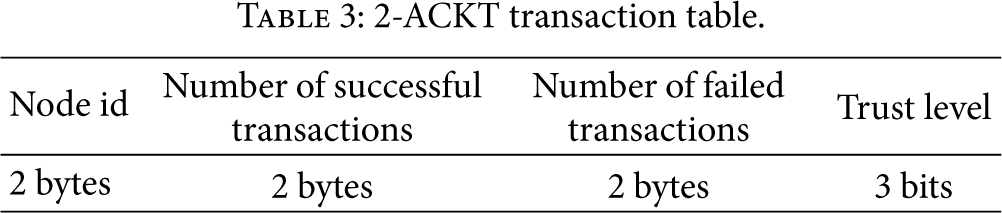
In order to store the details gained during neighbor monitoring, we introduced a transaction table in the routing protocol. The observed successful and failed transactions were stored in the transaction table. The fields in the transaction table of the subject were as follows:
〈
node id, number of successful transactions, number of failed transactions, trust level
〉
where node id is the address of the neighbor, namely, target, number of successful transactions is incremented by 1 or G when individual or group acknowledgment is received, respectively, number of failed transactions is incremented by 1 when it has not received the ACK in a given timeout, and trust level can take an integer value from 0 to 7 as discussed in Section 3.4.
The transaction table is updated when (i) the subject receives an ACK from the sponsor through the alternate path and (ii) the subject does not receive an ACK in a given timeout period.
3.4. Trust Representation
The trust is computed based on the observed number of successful and failed transaction entries in the transaction table. The initial trust value (





Trust representation.

Probability of false alarm versus threshold trust level.
3.5. 2-ACK Routing Protocol
When an SN (node A) desires to report an event to the BS for which a valid route is not found, it initiates a route discovery process by broadcasting a route request (RREQ) to its neighbors (node B and C) as shown in Figure 5(a). The RREQ contains the following fields:
〈source_address, source_seq_#, broadcast_id, destination_seq_#, hop_cnt, upstream_neighbor_address〉.
The pair 〈
source_address, broadcast_id
〉 uniquely identifies an RREQ. broadcast_id is incremented whenever the source issues a new RREQ. source_seq_# and destination_seq_# is used to maintain the freshness of the route. upstream_neighbor_address is the address of the neighbor from which the RREQ is received. As node A initiates the RREQ, upstream_neighbor_address is undefined.

2-ACK routing protocol.
The algorithm for processing an RREQ packet is shown in Algorithm 1. Node B rebroadcasts the RREQ to its neighbors (node A and D) after incrementing the hop_cnt by one and updating the upstream_neighbor_address as node A as shown in Figure 5(b). In WSNs, destination address corresponds to the BS address. Each node maintains a route table that contains the following information:
〈destination address, next hop, number of hops, destination sequence number, active neighbors for this route, third party neighbors for this route, expiration time for the route table entry〉.
Associated with each route entry is a route timer which will cause the deletion of the entry if it is not used within a specified lifetime. In each route table entry, the address of active neighbors and third party neighbors are maintained. A neighbor is considered active for that destination if it originates or relays at least one packet for that destination within the most recent active_timeout period. As node B received only one copy of the RREQ packet, the third party neighbor field is undefined. Each SN maintains a route table entry for each destination of interest. Similarly node C also rebroadcasts the RREQ packet to its neighbors A and D as shown in Figure 5(c). As a result, node D receives another copy of the RREQ from A through node C with an identical source_address, broadcast_id and upstream_neighbor_address. Now node D updates the third party neighbor in the route table for the destination A as node C.
drop the RREQ packet
stores the destination address, source address, broadcast_id, expiration time for reverse path route entry, source sequence number and upstream neighbor address in routing table destination)) send RREP packet to source rebroadcast RREQ after setting hop_cnt = hop_cnt + 1 upstream_neighbor_address as the address of the upstream neighbor node check the route table drop RREQ update third_party_neighbor as the address of the upstream node and then drop the packet
Once the RREQ reaches the BS or an intermediate SN with a fresh enough route, the BS or an intermediate SN responds by unicasting an RREP packet back to the neighbor from which it first received the RREQ. As the RREP is routed back along the reverse path, SNs along this path verify whether the RREP is received from a trusted SN and set up forward route entries in their route tables which point to the SN from which the RREP came.
On receiving the RREP packet from node B, node A will forward the data packet to node B. The algorithm for processing the data packet is shown in Algorithm 2. Node B will forward the data packet to node D as shown in Figure 5(d). On successfully receiving the data packet from node B, node C will send an acknowledgment to the node A through the alternate path D-C-A.
send a two-hop acknowledgment to the third party neighbor forward data packet to next hop send a two hop acknowledgment to subject through the alternate path
drop data packet
4. Performance Analysis
The performances of 2-ACKT-I and 2-ACKT-G routing protocols were evaluated using ns-2 simulator. The simulation parameters are listed in Table 1. We took a simulation area of 300 m × 300 m, with six hundred nodes placed in random. The transmission range was 45 m. The IEEE 802.15.4 was the MAC layer protocol used to evaluate the performance of the proposed trust model under attack conditions.
Simulation parameters.

4.1. Metrics
The performance of 2-ACKT trust model was evaluated using the following metrics.
Packet Loss. The total number of data packets lost legitimately or through malicious action without any notification.
Packet Delivery Ratio (PDR). The ratio of total number of data packets received to the total number of data packets transmitted.
Control Overhead. The ratio of the total number of control packets generated to the total number of data packets received.
Energy Consumption. The average energy consumed by each node during the given simulation time and expressed in Joules (J).
Network Lifetime. Time taken for the energy of the first node to fall from 0.5 J to zero and expressed in seconds.
End-to-End Delay. The delay experienced by the data packet during transmission from source to BS, including processing, queuing and propagation delay.
Communication Overhead. The total number of packets generated for trust establishment in the network.
Memory Requirement. The total memory space exclusively used for trust derivation and representation, expressed in bits.
4.2. Simulation Results and Discussion
The performance of 2-ACKT-I and 2-ACKT-G protocols is compared with AODV [32] protocol under varying number of malicious nodes as shown in Figure 6. The malicious nodes manifest black hole attack [3] where the node drops all the received data packets instead of forwarding. We have also implemented the promiscuous mode-based trust AODV routing protocol (PMT-AODV). In PMT-AODV, node A sends a packet to node B and sets its transceiver in promiscuous mode. The transaction is considered as successful when node A receives an LLACK and a passive acknowledgment (by overhearing) from node B. If the acknowledgment is not received within a time period, the transaction is considered as failed. The numbers of successful and failed transactions are updated in the transaction table represented in Section 3.3. The trust computation and trust representation are performed as mentioned in Section 3.4. The 2-ACKT-I, 2-ACKT-G, PMT-AODV, and AODV protocols are tested against exactly the same scenario and connection pattern. The packet loss of 2-ACKT-I, 2-ACKT-G, PMT-AODV, and AODV protocols are plotted against varying percentage of malicious attacks as shown in Figure 6(a). In AODV, the discovered route to the BS may consist of malicious nodes. As a result, the packet loss in 2-ACKT-I is 61.9 percent lower than AODV protocol. The malicious nodes are effectively identified and eliminated in the discovered route, resulting in lower packet loss in 2-ACKT-I, 2-ACKT-G, and PMT-AODV protocols. This has a positive effect on the PDR of the 2-ACKT-I, 2-ACKT-G, and PMT-AODV protocols as shown in Figure 6(b). 2-ACKT-I routing protocol augments the PDR of the AODV routing protocol by 40.12 percent. In 2-ACKT-I routing protocol, the sponsor sends ACK to the subject through the third party for every data packet received from the target. As a result, the control overhead of 2-ACKT-I is 45.44 percent higher than AODV protocol. In PMT-AODV, each SN overhears every packet forwarded by its neighbors and, as a result, the control overhead of PMT-AODV is 19.9 percent higher than 2-ACKT-I scheme. In 2-ACKT-G protocol, the sponsor sends an ACK for every group of “G” data packets received from the target. Consequently, the control overhead of 2-ACKT-G protocol is 13.81 percent lower than 2-ACKT-I protocol and 28.12 percent lower than PMT-AODV protocol as shown in Figure 6(c). The lower control overhead in 2-ACKT-G reduces energy consumption by 12.61 percent and 26.2 percent when compared to 2-ACKT-I and PMT-AODV, respectively, as shown in Figure 6(d). The simulation is performed with an initial energy of 0.5 J to calculate the network lifetime. The higher energy consumption of 2-ACKT-I, 2-ACKT-G and PMT-AODV protocols result in lower network lifetime of 5.9 percent, 2.53 percent and 12.6 percent, respectively, over AODV routing protocol as shown in Figure 6(e). The lower energy consumption of 2-ACKT-G improves the network lifetime by 3.59 percent and 11.53 percent when compared to 2-ACKT-I and PMT-AODV protocols, respectively. Even though the control overhead of AODV is lower than 2-ACKT-I, 2-ACKT-G and PMT-AODV, the presence of malicious nodes results in higher end-to-end delay in AODV as most of the packets do not reach the destination as shown in Figure 6(f).

Performance comparison of 2-ACKT-I, 2-ACKT-G, PMT-AODV, and AODV routing protocols under varying percentage of malicious attacks.
The impact of ε on the PDR of the network was studied under 0 and 30 percent malicious attacks as shown in Table 2. When ε is low and in the absence of malicious nodes, the trust value of the legitimate neighbor falls from the trusted region
ε versus PDR.

4.3. Theoretical Analysis
Let us assume that “N” be the total number of SNs in the network and let “h” denote the average number of hops between an SN and the BS. We have assumed that all nodes in the network want to communicate with the BS using “h” hops and do not have any prior trust relationship with their neighbors. It can be understood that when the number of interactions is less than “p”, there is no difference in the operation of 2-ACKT-I and 2-ACKT-G protocols and hence they are represented simply as 2-ACKT protocol in the following analysis and discussion. In this section, the performance of 2-ACKT protocol is compared with the GTMS [26], RFSN [16], PLUS [20] and ATRM [21] protocols in terms of communication overhead and memory requirement.
4.3.1. Communication Overhead
In 2-ACKT, when a node wants to communicate with the BS in the discovered path, then the total number of acknowledgments generated for trust computation is 
GTMS. In GTMS [26], when a node from ith group wants to communicate with the BS through its CH, it sends a maximum of 


RFSN. In RFSN [16], when a node from ith group wants to communicate with the BS, it sends a maximum of 



PLUS. In PLUS [20], a node broadcasts a request packet and in turn receives 



ATRM. In ATRM [21], a node transmits four packets to communicate with the CH and hence the communication overhead is





Performance comparison of 2-ACKT, GTMS, RFSN, ATRM, and PLUS protocols.
It can be understood that when the number of interactions increases, the communication overhead increases in 2-ACKT-I by the factor 2 per interaction and thus making it suitable for low traffic sensor network. However, the group acknowledgment used in 2-ACKT-G does not increase the communication overhead linearly with the interactions and thus making it suitable for low as well as high data traffic sensor networks.
4.3.2. Memory Consumption
In 2-ACKT, SN maintains a transaction table to monitor and store the trust level of their neighbors. The fields in the transaction table and its memory size are shown in the Table 3. The node id, number of successful transactions and number of failed transactions occupies 2 bytes each, and trust level requires 3 bits. Therefore, the memory required to store a record in the transaction table that represents the trust relationship with a neighbor is 6.375 bytes. The total size of the transaction table that represents the trust relationship between an SN and all its neighbors is

2-ACKT transaction table.
Therefore, the total memory requirement for the entire network which consists of N number of sensors is

GTMS. In GTMS [26], each SN maintains a trust table to store the intra group trust relationship with its neighbors. In addition to this, each CH maintains a group trust table to store the trust relationship with the other CHs in the network. The memory size of the each record in the trust and group trust table is largely determined by the size of the time window 
GTMS trust table.

Assuming the minimum possible value for 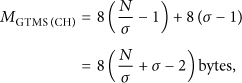
GTMS group trust table.

The total memory required for a network that consists of N number of nodes and 

RFSN. In RFSN [16], each SN and CH maintains two tables, that is, Reputation Module Matrix (RMM) of 27 bytes and RFSN monitor of 6 bytes. The memory size for the fields used in the RFSN tables is shown in Tables 6 and 7. The memory requirement of each record maintained in the RMM table and monitor is 33 bytes. Therefore, the size of the trust tables to store the trust relationship with the neighbors is

RFSN reputation module matrix.

RFSN monitor.

The memory size required to store the trust tables in a CH is

The total memory required for a network that consists of N number of nodes and 

ATRM. In ATRM [21], each SN and CH maintains two tables, that is, trust evaluation table of 14 bytes and t_Instrument table of 16 bytes for each record. The SN and CH also maintain r_certificate and the memory size of r_certificate are largely determined by the number of available context and the hash function used. Each context requires 8 bytes and the other fields such as node id (2 bytes), time stamp (4 bytes). Assume that the hash function used is MD5 (16 bytes). Therefore, the r_certificate requires 

ATRM trust evaluation table.

ATRM t_Instrument table.

The memory size required to store the trust tables in a CH is
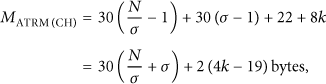
The total memory required for a network that consists of N number of nodes and 

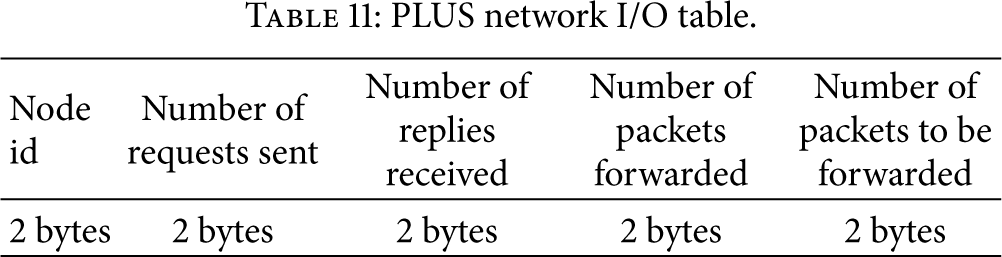
PLUS. In PLUS [20], each SN and CH maintains trust estimator table of 22.375 bytes and network I/O table of 10 bytes for each record. It also maintains seven context parameters and requires 4 bytes for each parameter. The memory size required for the fields used in the PLUS tables is shown in Tables 10 and 11. The size of the two tables and context parameters in SN to store the trust relationship with the neighbors is

PLUS trust estimator table.

PLUS network I/O table.
The memory size required to store the trust tables in a CH is

The total memory required for a network that consists of N number of nodes and 

5. Conclusions
Security is an important problem that can significantly degrade the performance of resource constrained WSNs. In this research work, we have proposed a new 2-ACKT framework to thwart malicious attacks in WSNs. It relies on a two-hop acknowledgment from the sponsor to derive the trust on neighboring nodes. This scheme exploits the dense nature of the sensor networks to establish trust in the network. The simulation and theoretical results show that the proposed 2-ACKT protocol has better performance than the conventional multihop and trust-based routing protocols in terms of packet delivery ratio, network lifetime, end-to-end delay, communication overhead, and memory consumption making it suitable for homogeneous WSNs. In this research work, the malicious attacks are manifested by individual sensor nodes. However, there exists a much wider spectrum of security threats involving collaborative attackers. Hence, we plan to design a comprehensive trust-based security solution that thwarts collaborative attackers in a resource constrained WSNs.