




Abstract
In order to improve the sensing accuracy of the Cognitive Radio Sensor Networks and reduce the interference to the primary user, this paper proposes an improved optimal linear weighted cooperative spectrum sensing scheme on the assumption that the report channel is not ideal. Through mathematical modeling, the spectrum sensing problem is ultimately converted into a constrained nonconvex optimization problem, and the chaotic harmony search (CHS) algorithm is to be used to find the optimal weighting vector value. The simulation results show that the proposed linear cooperative spectrum detection scheme based on the CHS algorithm has better performance than HS, SFLA, EGC, MRC, and MDC algorithm. In addition, the influence of local noise power, report channel noise power, and report channel gain on the performance of the algorithm is analyzed by simulation. The results show that local noise power has greater impact on the sensing performance.
1. Introduction
Currently, the wireless sensor networks (WSNs) use the Industrial, scientific, and medical (ISM) band, for example, the 2.4 GHz band. However, other applications, such as Wi-Fi, Bluetooth, and cordless phones, also work in this band. So the ISM band is becoming more and more engaged. The interference level among these applications has increased and even caused the unavailability of the ISM band in certain regions [1]. And for the large-scale WSNs, when a large number of nodes try to send data simultaneously, the collision probability and packet loss rate increase [2]. One solution of the abovementioned problem is to adopt the cognitive radio (CR) technology by WSN. The CR technology [3] can provide dynamic spectrum access and improve the efficiency of spectrum utilization. The WSNs using the cognitive radio technology is referred to as cognitive radio sensor networks (CRSNs) [4].
Spectrum sensing is one of the significantly important functions of the CRSN [4]. Its goal is to detect the spectrum holes that the CRSN nodes (secondary users) can use. There are three main spectrum-sensing methods: matched filter detection, energy detection, and cyclostationary feature detection [5]. They are noncooperative spectrum sensing schemes. However, there are the shadows, multipath, fading, and other unfavorable factors in the wireless environments, which can significantly degrade the detection performance of the single CRSN node. To improve the accuracy of spectrum sensing, multinode cooperative sensing can be used.
At present, a lot of cooperative spectrum sensing techniques have been proposed. In [6], the “OR”, “AND” rules were used to fuse the SU sensing results for the final judgment. The performances of hard decision based on the likelihood ratio test (LRT) and soft decision based on the “AND” rule are compared in [7], and the results show that the soft decision method has better performance. In [8], D-S evidence theory is applied to soft information fusion in cooperative spectrum sensing and can achieve the suboptimal fusion performance. This method outperforms the traditional “AND” and “OR” rules, but it requires the prior information.
The data fusion method based on the Bayesian was proposed in [9], but its disadvantage is that the prior probability of the PU signal, such as the false alarm probability and the detection probability of the SU, needs to be known beforehand. This prior information is difficult to be obtained in the actual communications system. In order to save the nodes' energy, a censor-based cooperative spectrum sensing scheme for CRSN has been proposed in [10]. And in [2], the authors proposed a Takagi and Sugeno's (T-S) fuzzy logic based spectrum sensing scheme for CRSNs. In [11], a simplified linear cooperative spectrum sensing model based on energy detection has been proposed. The performance of this method is close to the optimal LRT's and is simpler. However, the method based on the modified deflection coefficient (MDC) for solving the weight vector is only a suboptimal method and cannot guarantee that the optimal solution in theory can be obtained.
In this paper, the linear weighted cooperative spectrum sensing model [11] is improved and the nonideal report channel conditions are considered. To improve the robustness and the convergence speed of basic harmony search (HS) algorithm [12], an improved chaos harmony search (CHS) algorithm is proposed. And the CHS algorithm is used to solve the optimal weight vector value in the cooperative linear spectrum sensing. Simulation results show that the proposed method has high detection accuracy.
The rest of this paper is organized as follows. In Section 2, we introduce the improved optimal linear weighted cooperative spectrum sensing structure and mathematical model. In Section 3, we give the CHS algorithm and use it to calculate the optimal weight vector. Section 4 gives the simulation results and analysis. Section 5 concludes this paper.
2. System Model of the Improved Optimal Linear Weighted Cooperative Spectrum Sensing Algorithm
2.1. Framework of Linear Weighted Cooperative Spectrum Sensing
The information fusion framework of the optimal linear weighted cooperative spectrum sensing can be divided into three phases, as shown in Figure 1.
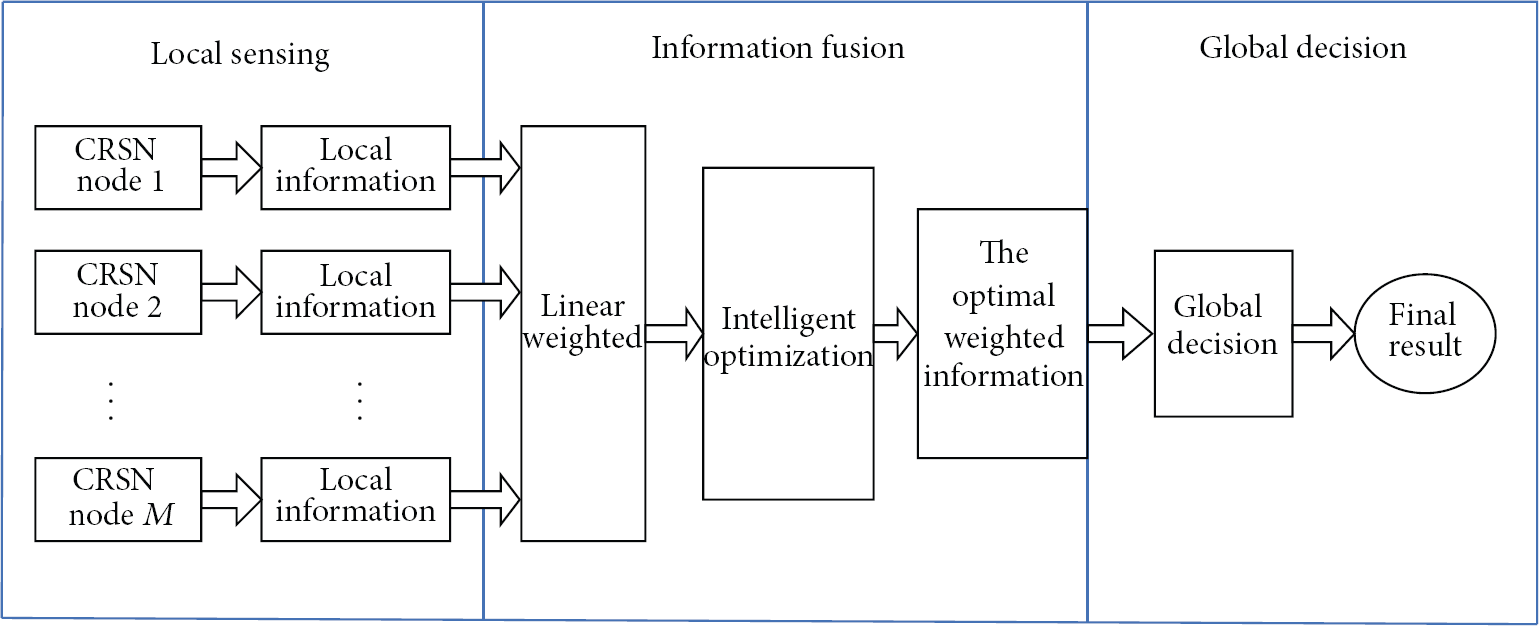
The information fusion framework of optimal linear weighted cooperative spectrum sensing.
The first phase is the local sensing. The CRSN nodes in cooperative sensing use the energy detection method to detect the PU signal and do the local processing on the sensing signal, thus making the local sensing function complete. The second phase is the information fusion. The FC (fusion center) weights the local sensing information of SU linearly and, through the intelligent optimization, gets the optimal weighted complete information. Thus, the information fusion is completed. The third phase is the global decision. The FC processed information will be compared with the threshold, and a final decision about the existence of the PU signal will be made.
2.2. Mathematical Model of Linear Weighted Cooperative Spectrum Sensing
In [11], the author proposed a simplified linear cooperative spectrum sensing model, but in this model the report channel is assumed to be ideal. However, in practical cases, the report channel is not ideal. Therefore, the linear weighted cooperative spectrum sensing model is improved in this paper and the nonideal report channel conditions are considered.
The system model is shown in Figure 2. We consider that the CRSN is comprised of M cognitive sensors and an FC. The binary hypotheses test model whether the primary user is present (


System model of linear weighted cooperative spectrum sensing.
2.2.1. Local Sensing
Suppose the node of CRSN using the energy detection and the summary statistic of ith node

Assuming each node is independent of each other, let

According to the central limit theory, when the sampling number N is large enough (e.g.,

Let the

Then, the local false alarm probability

2.2.2. Global Decision
The summary statistics

From the above, we can see that the

After the FC receives
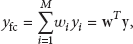
Weight
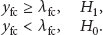
Similarly, the FC global decision statistic

Let the FC fusion center decision threshold be
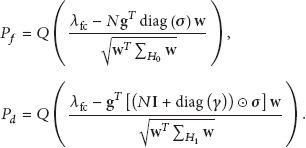
At last, the global false alarm probability
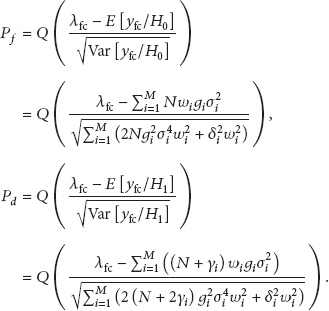
Let the control (report) channel gain vector be
2.2.3. The Optimal Detection under the Conditions of Constant False Alarm Probability
The missed detection probability
According to the given

Combined with formulae (14) and (13), the

Formula (15) shows that, for a given
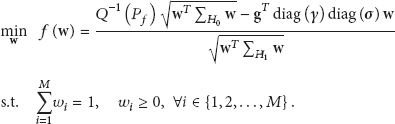
Through mathematical modeling, the spectrum sensing problem is ultimately converted into a constrained nonconvex optimization problem in formula (16), and the optimal
3. Chaotic Harmony Search Algorithm
The basic harmony search (HS) algorithm can be found in [6]. The proposed chaotic harmony search (CHS) algorithm for calculating the optimal weight vector
Step 1.
The Parameter Initialization.
Determine the harmony memory size (HMS) of harmony memory (HM), the feasible solution space dimension D, the range of feasible solution
Step 2.
Initialize the Harmony Memory by Chaos.
Randomly generate a D-dimensional vector Each component of chaotic sequence The N feasible solutions
Step 3.
Harmony Search and Chaotic Disturbance.
Divide the HM into S subharmonic memory and each subharmonic memory contains G harmony. Assign the HMS feasible solutions into the S subharmonic memory according to the quality. Determine the worst solution If


Randomly generate a vector
Step 4.
Update the Harmony Memory.
Merge the S subharmonic memories into an HM. Sort all solutions according to
Step 5.
Terminate Algorithm.
Terminate the algorithm. Output the global optimal solution in the HM, which corresponds to the wanted optimal weight vector
4. Simulation Results and Analysis
To evaluate the performance of the proposed CHS algorithm which is to solve the linear cooperative spectrum sensing problem in the CRSN, the simulations are implemented in MATLAB7.1. The sensing performance of the proposed scheme is compared with the scheme that is based on the OR, AND, MDC, ISFLA [14], EGC, and MRC [6]. In the simulation, the signal to be sensed is assumed to be the BPSK modulation signal, and the sampling value
In order to make the simulation results comparable, after a lot of experiments, the parameters of HS and CHS algorithm in the simulation are set as follows: the harmony memory size HMS
Experiment 1.
The Optimize Performance of HS, CHS, and ISFLA.
Let the global probability of false alarm
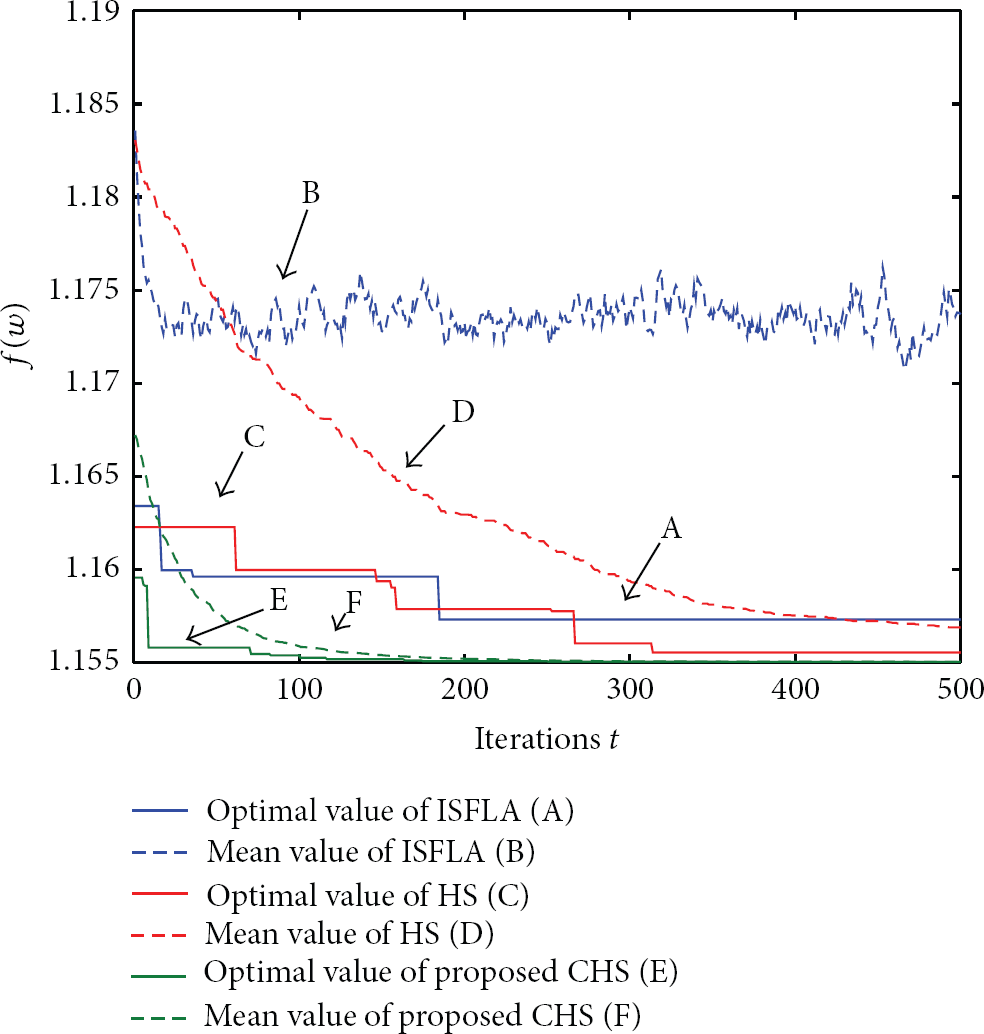
Average convergence curves of three algorithms based on the fitness function
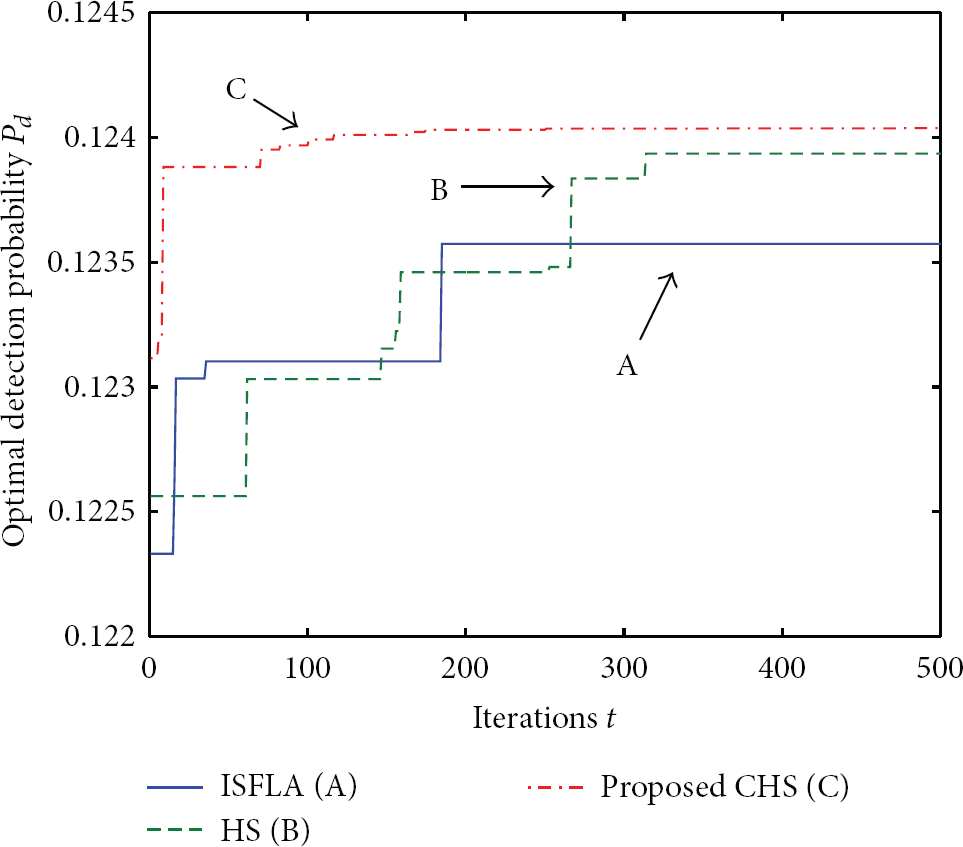
Average convergence curves of three algorithms based on optimal detection probability
Experiment 2.
The effect of the system parameters change on the performance of CHS algorithm.
The Monte Carlo simulation runs with 10,000 samples under the following conditions:

The impact of sample points N and user number M and the average SNR on CHS.
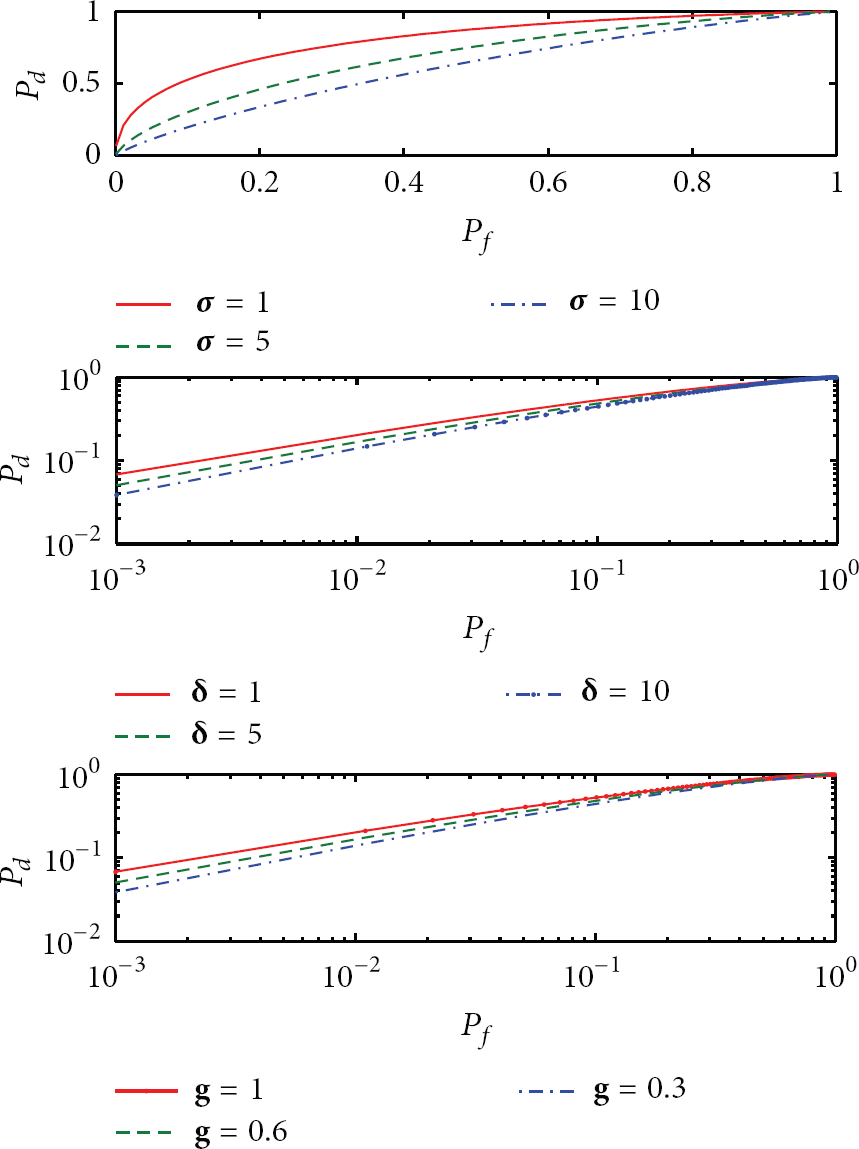
The impact of local noise and report channel noise and channel gains on CHS.
Simulation Results Analysis. From Figures 5 and 6, we can see that when we increase the sampling points N, the CRSN node number M and the local average SNR, the detection performance of CHS algorithm is significantly improved. When we increase the local noise and reporting channel noise intensity, the performance of CHS will decrease, and the local noise has relatively large impact on the CHS. Further, when the channel attenuation occurs in the report channel, the spectrum detection performance will decrease.
Assuming that the CRSN node number
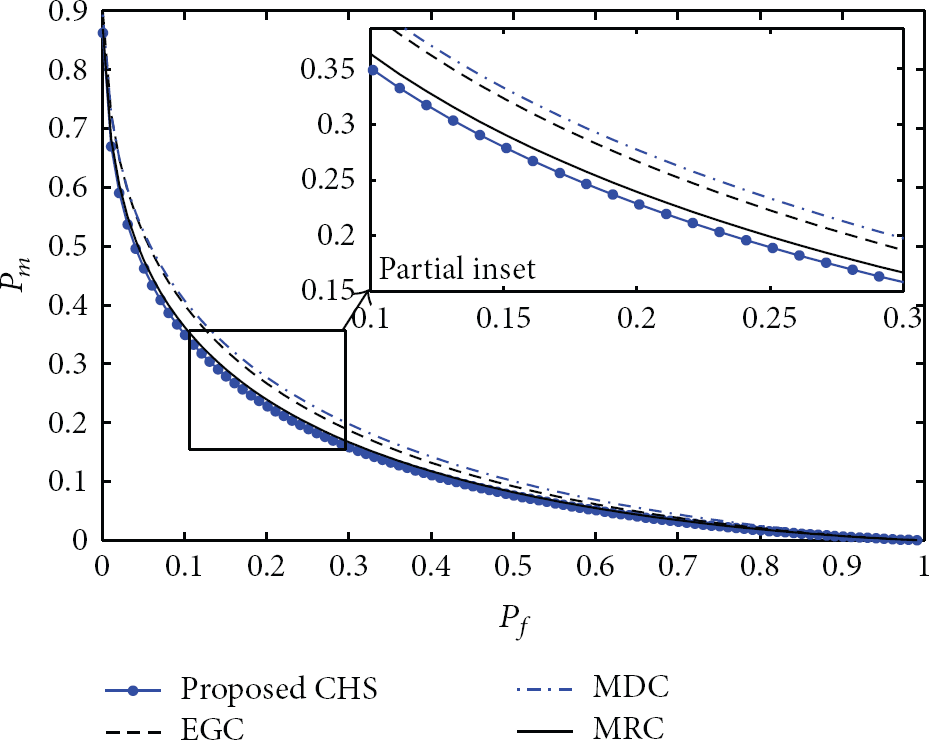
The ROC of different algorithms when local noise

The ROC of different algorithms when local noise
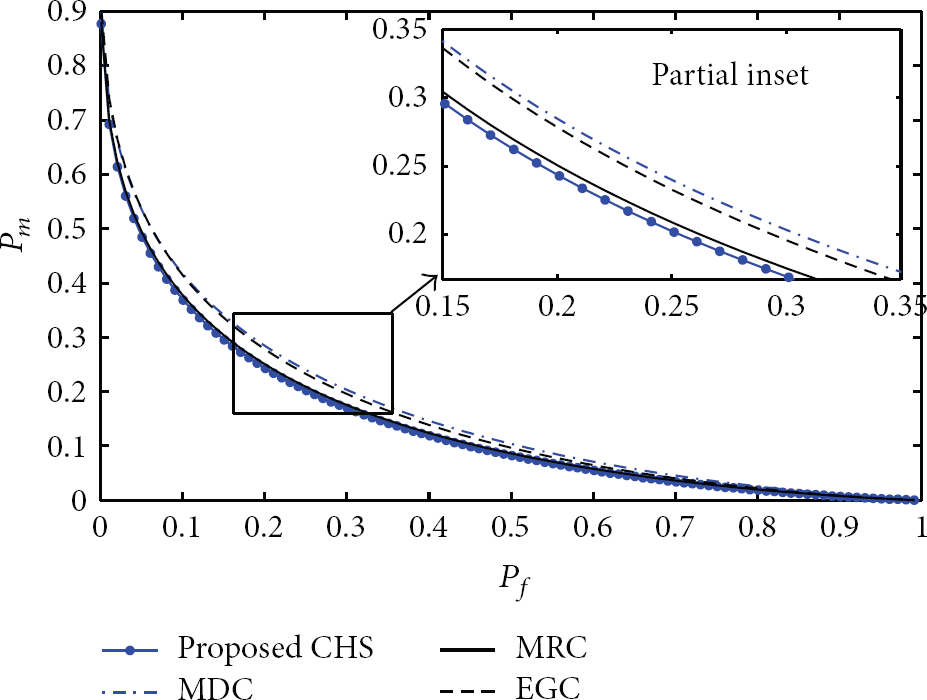
The ROC of different algorithms when local noise
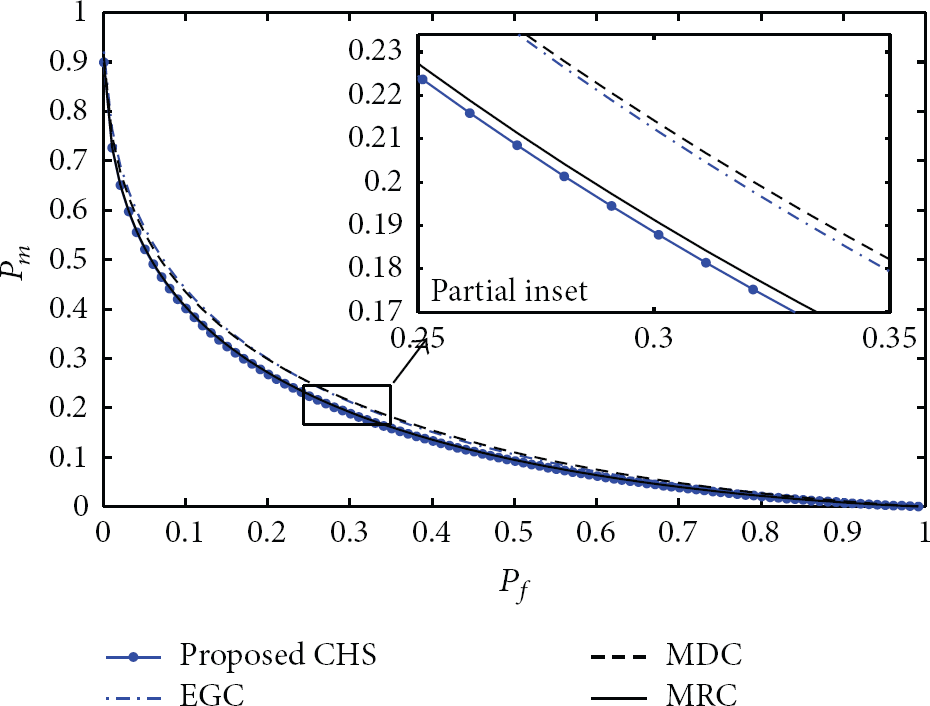
The ROC of different algorithms when report channel gain of
Figure 11 shows the CHS performance on condition that the local noise variance

Performance of CHS algorithm in different wireless environments.
Table 1 shows the probability of missed detection (
The probability of missed detection (

Simulation Results Analysis. From Figures 5–11 and Table 1 we can see that the four algorithms are subject to noise and channel gain influence. The missed detection will increase when the local noise and report channel noise are increasing and the report channel is not ideal, and then the detection performance of these four algorithms is reduced. And the influence of the channel attenuation, report channel noise, and the local noise to the detection performance of four algorithms are enhanced. In addition, it can be seen that the influence of these factors on the CHS is smaller than the other three methods. Because the cooperative spectrum sensing based on the CHS takes comprehensive consideration about the noise, SNR, channel gain, and other factors and builds the cooperative detection linear optimization mathematical model that can transform it into the minimum optimization problem and use CHS powerful global search capability to solve this NP problem, MDC is a suboptimal solution method, and its optimality is based on the user's local SNR
5. Conclusions
This paper proposed an improved optimal linear weighted cooperative spectrum sensing scheme. By using chaotic harmony search (CHS) algorithm for solving the optimal weighted coefficiency, the overall perception of system performance can be improved. And the validity of the algorithm is verified through simulation. The simulation results show that, compared with MDC, EGC, and MRC and other methods, CHS achieves better detection performance. When the wireless environment becomes more severe, if local noise increases, the report channel noise increases or the report channel in nonideal case, the detection performance of the system will be reduced, and the effect of local noise strength on the final sensing performance of the system is the biggest. Therefore, while choosing the cooperative secondary users, the influence of the local noise power of secondary users on the final performance of the detection system needs to be given more consideration.
Footnotes
Conflict of Interests
The authors declare that there is no conflict of interests regarding the publication of this paper.
Acknowledgments
This research was supported by The National Natural Science Foundation of China (nos. 61273219 and 61102034), the Guangdong Natural Science Foundation (no. S2013010015768), the Shenzhen New Industry Development Fund under Grant (no. CXB201005250021A), the Developing Fund for Innovative Research Team of Guangdong University of Technology (no. GDUT2011-10), and the Ph.D. Programs Foundation of Guangdong University of Technology (no. 103042).