




Abstract
A numerical study of the flow and heat transfer on a rotating cylindrical cavity solving the mass, momentum, and energy equations is presented in this work. The study describes the influence of the Prandtl number on flow in critical state on a cavity which contains a cooling fluid. Problem studied includes Prandtl numbers 0.001 < Pr > 15, aspect ratios 0.25 < A > 1, and Reynolds numbers 0.001 < Re > 600. Differential equations have been discretised using the finite differences method. The results show a tendency followed by heat transfer as the Reynolds number increases from 300 to 600; in addition, emphasis on the critical values of the Rayleigh number for small Prandtl numbers shows that thermal instability in mixed convection depends on the Prandtl number.
1. Introduction
Flows in mixed convection heat transfer frequently happen in engineering systems and natural phenomena. An important issue is the understanding of this phenomenon on cavities, which have applications in the growth of crystals, glass production, flows in nuclear reactors, and atmospheric prediction among others. For the development of new technologies in gas turbines design, which operate at high temperatures, studies of the cooling systems, generators, and rotors are necessary. Optimal design of these cooling systems will be able to improve heat transfer in the region of the rotor. Due to the centrifugal acceleration and temperature difference in the walls on cavity, a flow induced by the action of the centrifugal and body forces will occur, becoming an unstable and oscillating characteristic for the critical regime.
The study of Laje et al. [1] shows the effect of the Prandtl number and the Rayleigh number on the convection of Bénard and concludes that the critical Rayleigh number Rac is increased substantially as the Prandtl number decreases to small values. Verhoeven [2] and Soberman [3] investigated the values of the Rac for Pr = 0.025 (liquid metals like mercury and sodium), and Bertin and Hiroyuki [4], on the other hand, studied the influence of the Prandtl number, in the rank of 0,001–1000 on the critical Rayleigh number. Chao et al. [5] developed a study of the influence of the Prandtl number on the convection of Bénard, reaching the same conclusion of the study of Laje et al. [1].
A numerical study presented/displayed by Gelfgat et al. [6] shows the transition of stable convective flow oscillating for small Prandtl numbers (Pr = 0,0 to 0,015) in rectangular cavities laterally warmed up in the 0.1 < A > 1 interval. They showed that the oscillating instabilities were a product of a supercritical bifurcation caused by small infinitesimal disturbances, which means that the heat transfer has a strong effect of the instability of small values of Prandtl numbers. Also, they showed that the critical frequencies of oscillation as well as the number of critical Grashof are responsible for the change for the aspect ratio.
In other studies, Zhang and Nguyen and Durand et al. [7, 8] have investigated the forced convection heat transfer between two short concentric cylinders. The inner-rotating cylinder drives the forced flow, while the end plates and the outer cylinder are stationary. The annulus is filled with a heat-generating fluid where the internal heat source may be due to viscous dissipation or to exothermic reactions. The normal modes (with an inlet flow along the end plates) were studied in terms of the Reynolds and Prandtl numbers for a radius ratio R = 2 and an aspect ratio H = 3.8. Was found that as flows develops on 2-cell, 4-cell and 2-cell regimes; as Re increases from zero. These results are consistent with the general description given in the papers of Benjamin [9, 10] on the bifurcation phenomena in viscous flows between short cylinders.
Existing studies have thus confirmed the importance and complex interrelation between the centrifugal force due to rotation and the viscous force at the end plate. As a consequence, the flows have been developed in a very different way compared to the case of pure Taylor vortices, and the concepts of primary flow, secondary flow, normal and anomalous modes have been theoretically developed and experimentally realized in an attempt to construct a unified picture of the complex bifurcation phenomena in finite-dimensional systems.
In spite of the works previously developed, very few of them have focused on the behavior of the flow in cylindrical cavities in rotation. In order to obtain a better understanding of the flow and heat transfer, the behavior of the flow within cylindrical cavities in rotation with emphasis on the effect of the Prandtl number appears in the instability of flow in mixed convection.
2. Description of the Problem
The physical problem studied is schematically shown in Figure 1. The system consists of two vertical concentric cylinders of radii R i and R0 and a finite length H. The cylinders are closed by two end plates. The outer cylinder and the end plates are fixed, while the inner cylinder rotates with a constant angular velocity Ω.

Geometry of the system.
The annulus is filled with an incompressible Newtonian fluid with density ρ, viscosity ν, diffusivity α, and thermal expansion coefficient β. All thermophysical properties of the fluid may be considered constant, except the variation of density in the buoyancy force according to the Boussinesq approximation. The two cylinders (rotating walls) are maintained at a same uniform temperature and the end plates (static walls) are perfectly insulated.
For axisymmetric flows, the system may be described by a stream function Ψ, vorticity ω, swirl velocity U = ruθ, and a temperature field T.
By using the scales R i 2/ν for time, R i for length, ν/R i for velocity, and SR i 2/k for temperature, the nondimensional governing equations may be written as follows:

where
The boundary conditions for the problems under consideration are
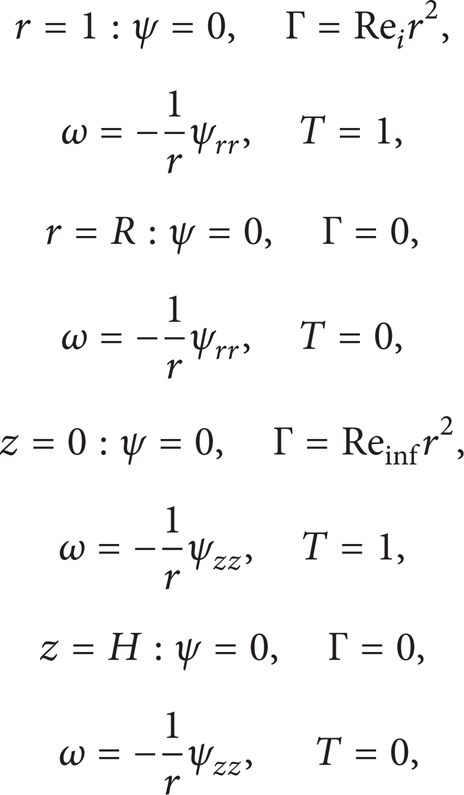
where Re = R i 2Ω/ν is the Reynolds number.
The previous systems of equations were solved by a finite difference method based on a control-volume formulation [7, 8]. The discretised equations for the flow field were derived using central differences for spatial derivatives and forward difference for the time derivative. The control volume formulation in conjunction with the power-law interpolation scheme was used for high Prandtl, Reynolds, and/or Rayleigh numbers.
The numerical approach used in this study has been validated by comparison with the results obtained by Ball and Farouk [11] and Fasel and Booz [12]. The agreement was satisfactory within the graphical precision.
A 41 × 49 mesh was selected, because with it the maximum stream function value of the 2-cell mode at Re = 200 only changed by 0.2% [8].
This condition was applied to all quantities at all mesh points as a convergence criterion for the following steady solution:

3. Results and Discussion
The effect of the Prandtl number on the instability of flow has attracted a great scientific interest after experimental investigations showed that the oscillations caused by the thermal-dynamic instability produce a change in the structure of the flow of numerous processes in growth of crystals in liquid phase (Hurle et al., 1974 [13]). Nevertheless, for very small Prandtl numbers, the dependency of the transition from the stable state to oscillating on the change in the aspect ratio widely has not been studied until 1997 by Gelfgat et al. [6].
3.1. Effects of the Prandtl Number on the Heat Transfer
This problem was studied for a range of the Prandtl number 0.001 < Pr > 1, with aspect ratios A = 1, finding the critical Rayleigh numbers for the interval of the Reynolds number to be 100 < Re > 600, making emphasis on the critical values of the Rayleigh number for small Prandtl numbers, and demonstrating that thermal instability in mixed convection depends on the Prandtl number. If in the system heating did not exist (Gr = 0), flow only becomes unstable due to dynamic effects by increasing the Reynolds number. For this, the dynamic instability is strongly stabilized by an increase in the potential of temperatures and the flow returns to destabilize itself when the body forces are increased to their critical value, showing 2 types of instabilities of thermal origin.
At first, as shown in Figures 2(a), 2(b), 3(a), and 3(b), for small values of Prandtl number (Pr < 0.1), there is a weak influence of body forces on the centrifugal forces, streamlines are predominant in opposite to clockwise, and heat transfer has a conductive nature. Second, Figures 2(c), 2(d), 3(c), and 3(d) for high Prandtl numbers (Pr ≫ 0.1) the flow becomes unstable by the increase of the body effects that distort the velocity profiles; for this, the flow becomes unstable by the increase of the body effects that distort the velocity profiles; in this case, the fluid is not a good heat conductor, the disturbance of temperatures is located more in a region, and the strong action of the body forces initiates the instability.
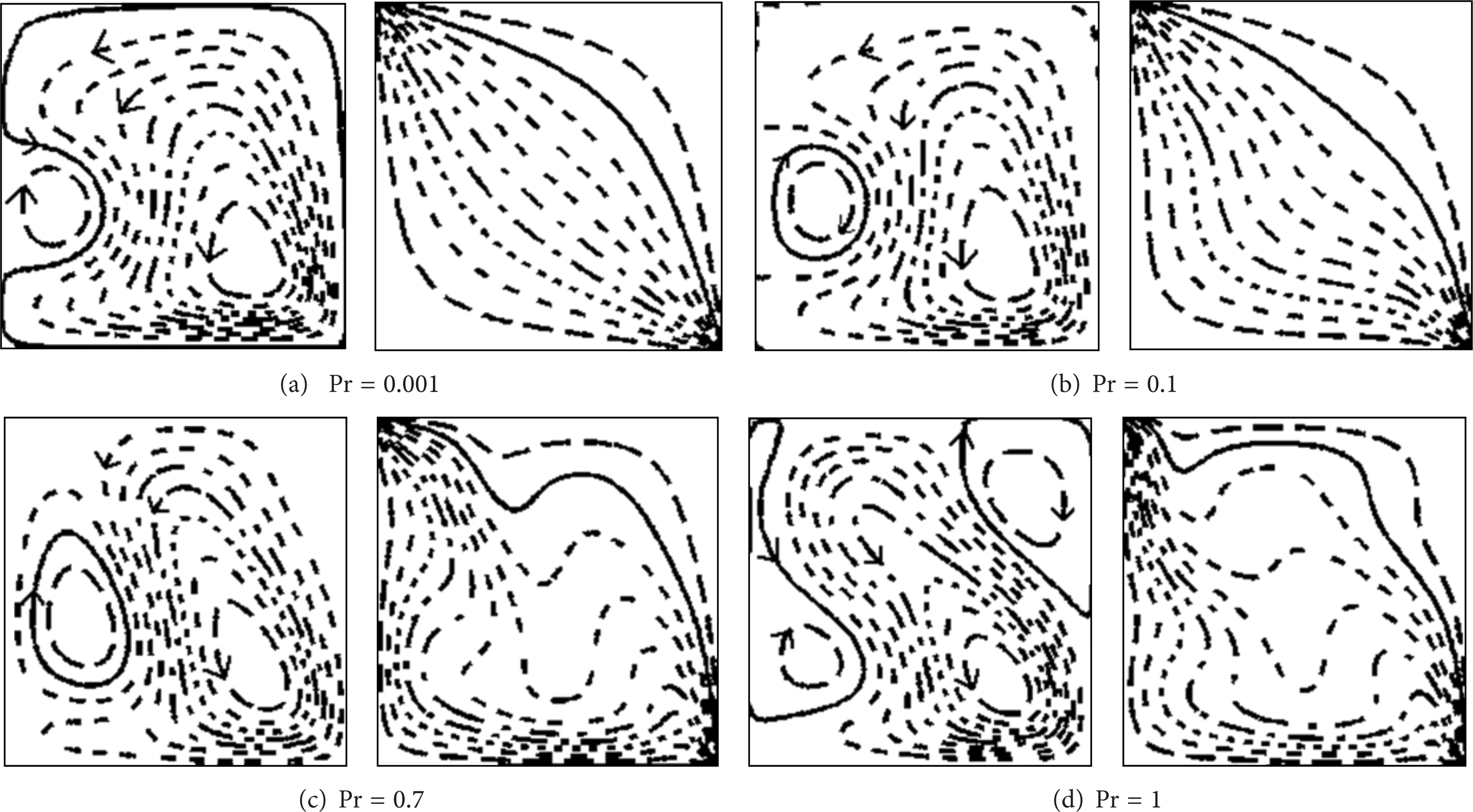
Streamlines and isotherms for A = 1, Re = 300, and Rac = (a) 40, (b) 4 × 10³, (c) 4 × 10⁴, and (d) 7 × 10⁴ and 51 × 51 mesh.

Streamlines and isotherms for A = 1, Re = 400, and Rac = (a) 50, (b) 5 × 10³, (c) 6 × 10⁴, and (d) 1.2 × 10⁵ and 51 × 51 mesh.
For small values of the Prandtl number, thermal effects do not have influence on the flow instability; the temperature difference is small, so that the centrifugal forces come to be the main influence on flow. This is shown in Figure 4; the critical Rayleigh number is seen to be strongly increased in agreement with the viscous fluid.
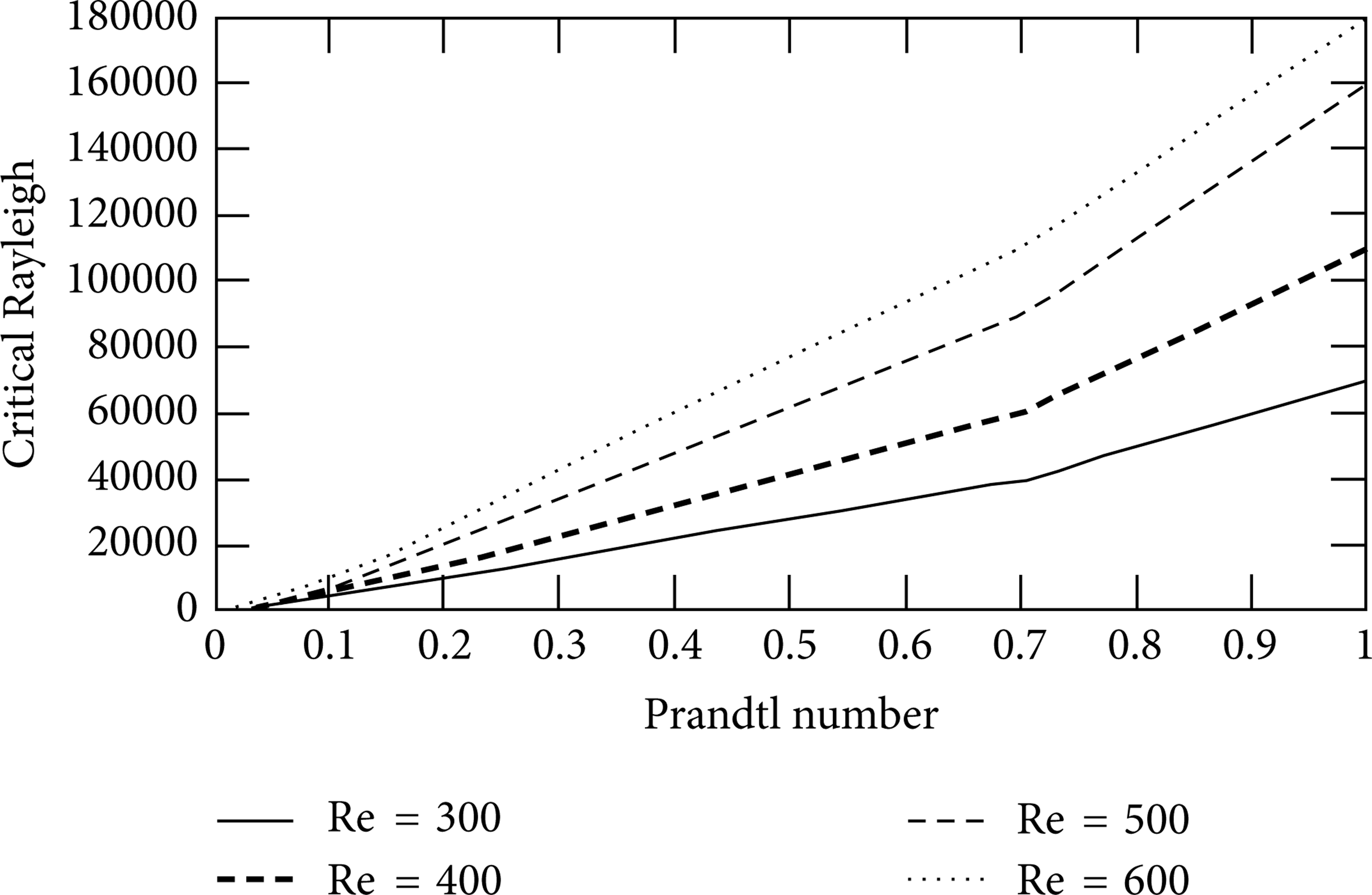
Critical Rayleigh versus Prandtl number for A = 1,300 ≤ Re ≤ 600 and 51 × 51 mesh.
3.2. Effects of the Prandtl Number on the Reynolds Number
While the Reynolds number is smaller, the body forces will affect the centrifugal forces from small Prandtl numbers. This is shown by means of the comparison of Figure 6(a) with Figure 7(a) and the streamlines of Figure 2(a) with Figure 3(a). In Figure 2(a), for Re = 300, it is possible to observe that the cell formed in the hot wall of the internal cylinder shows a growth as the Prandtl number grows; this cell is the one that determines the magnitude of the body forces and has a clockwise direction of rotation.
The previous examples explain why the critical Rayleigh number decreases from fluid with high Prandtl numbers to low Prandtl numbers, for moderate Reynolds numbers 300 < Re > 600. In order to exemplify the previous observation, Figure 5 shows clearly this tendency. For an increase in the Reynolds number, the critical Rayleigh and Nusselt numbers are increased and the body forces are cushioned by the centrifugal forces. On the other hand, an increase in the Prandtl number causes a strong increase in the heat transfer in the hot walls, the isotherms are highly distorted, and the convective terms come to be predominant. Figures 6, 7, 8, and 9 visualize the mentioned behaviors.

Critical Rayleigh versus Reynolds number for A = 1,0.001 ≤ Pr ≤ 1.0 and 51 × 51 mesh.
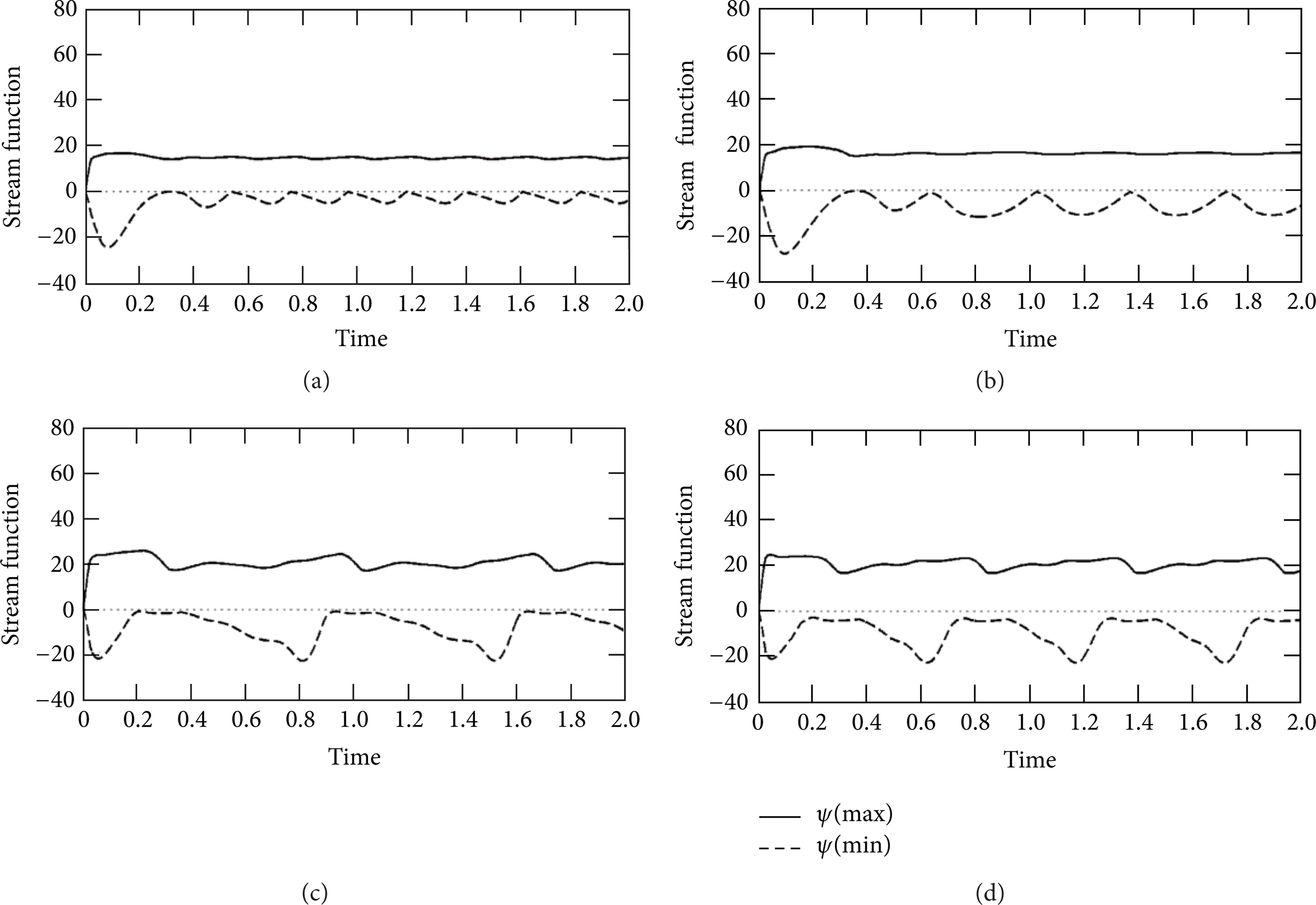
Streamline versus time for A = 1, Re = 300, (a) Pr = 0.001, (b) Pr = 0.1, (c) Pr = 0.7, (d) Pr = 1, and Rac = 40, 4 × 10³, 4 × 10⁴, and 7 × 10⁴ and 51 × 51 mesh.
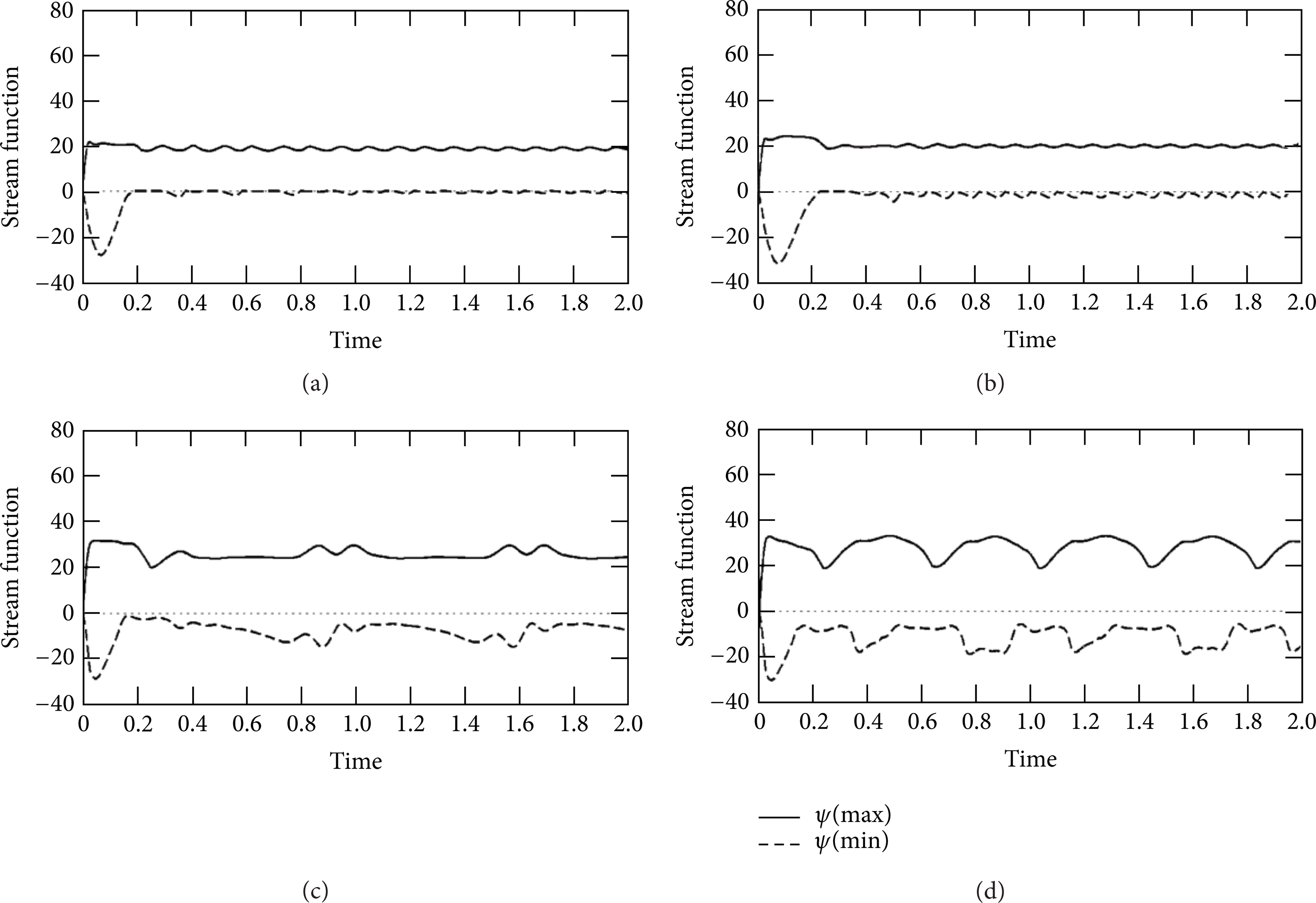
Streamline versus time for A = 1, Re = 400, (a) Pr = 0.001, (b) Pr = 0.1, (c) Pr = 0.7, (d) Pr = 1, and Rac = 50, 5 × 10³, 6 × 10⁴, and 1.2 × 10⁵ and 51 × 51 mesh.
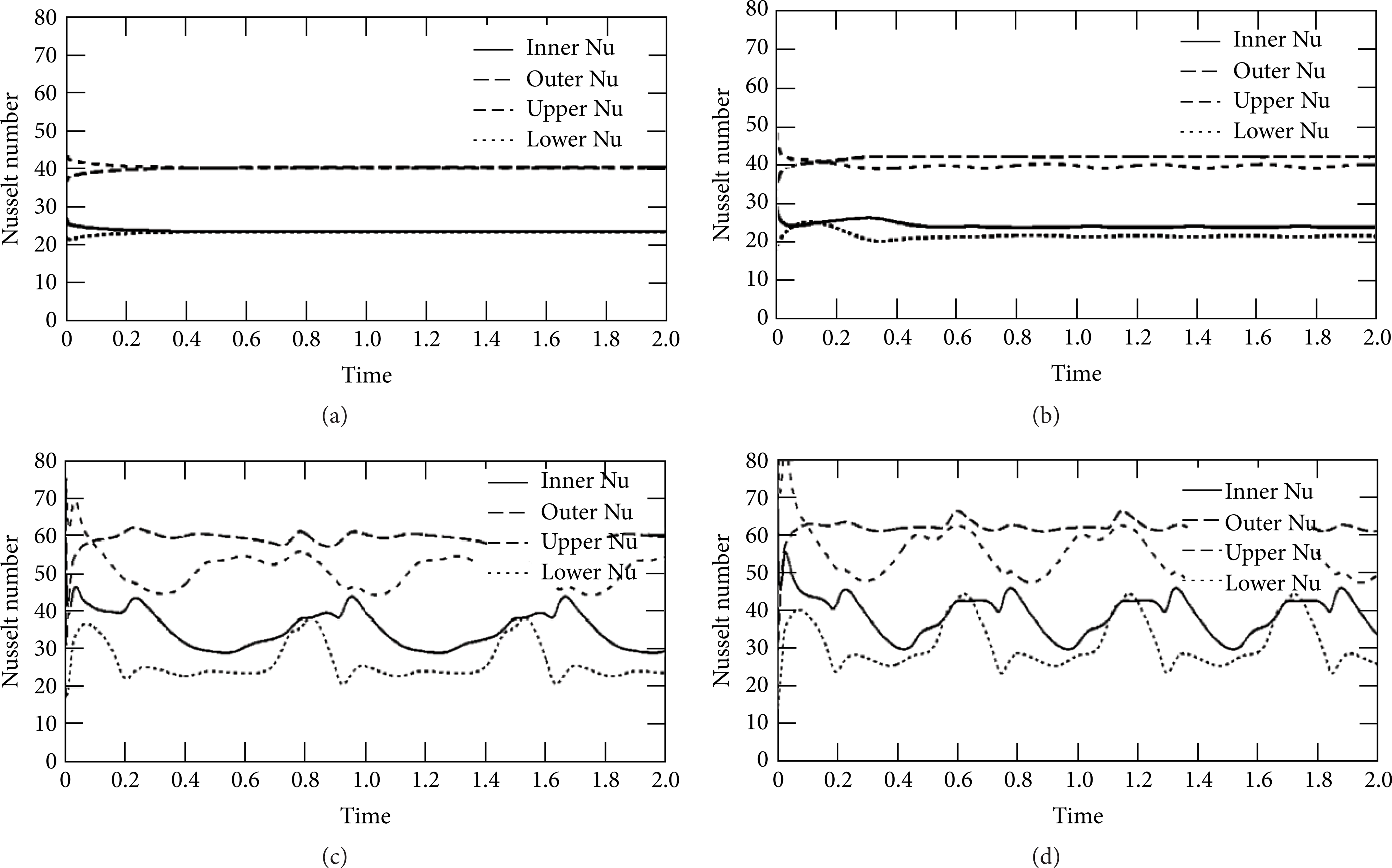
Nusselt number versus time for A = 1, Re = 300, (a) Pr = 0.001, (b) Pr = 0.1, (c) Pr = 0.7, (d) Pr = 1, and Rac = 40, 4 × 10³, 4 × 10⁴, and 7 × 10⁴ on a 51 × 51 mesh.
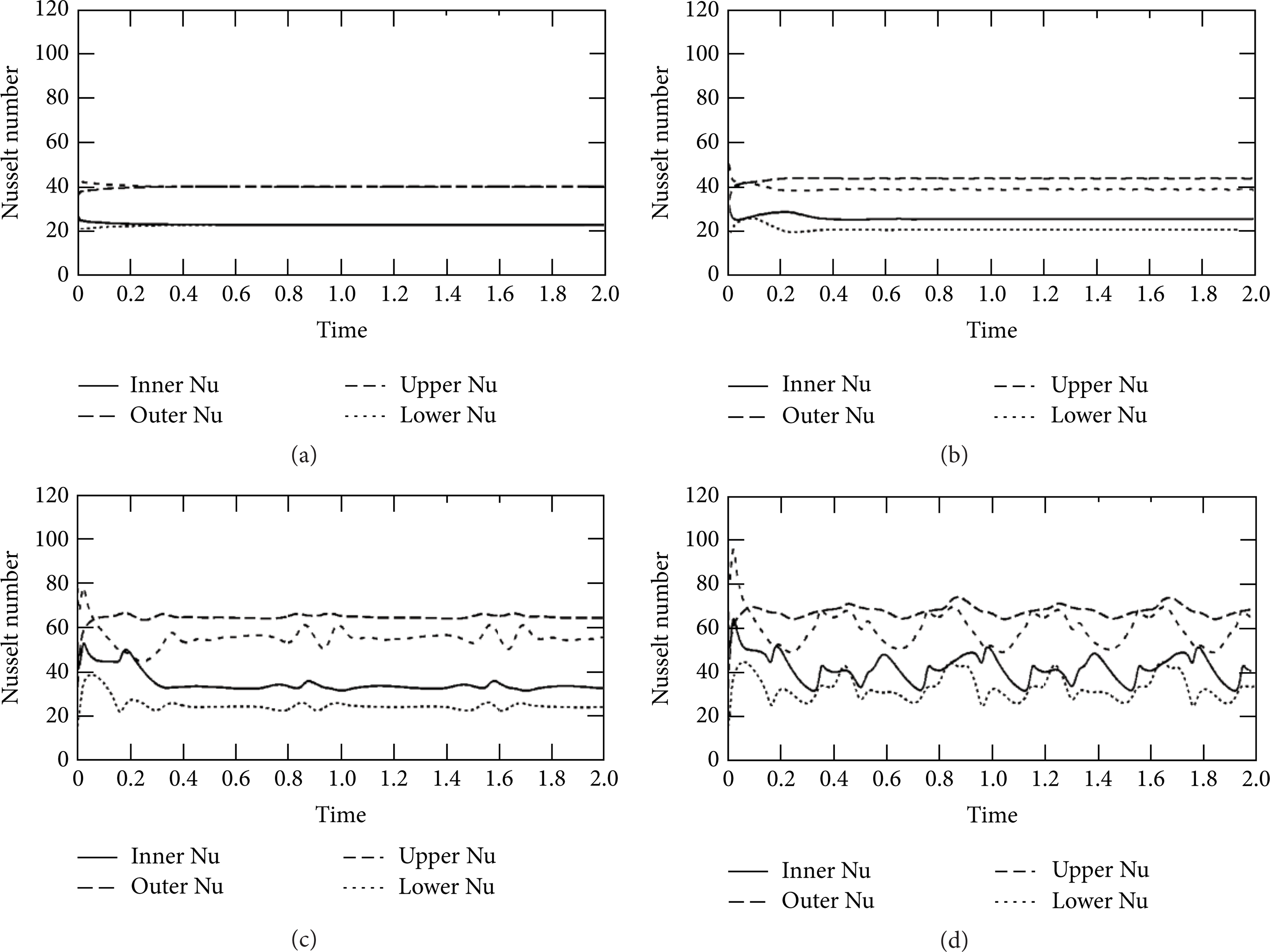
Nusselt number versus time for A = 1, Re = 400, (a) Pr = 0.001, (b) Pr = 0.1, (c) Pr = 0.7, (d) Pr = 1, and Rac = 50, 5 × 10³, 6 × 10⁴, and 1.2 × 10⁵ and mesh = 51 × 51.
For detailed analysis, a study of the effect of the Prandtl number 0.001 < Pr > 15 on the number of Nusselt in the walls of the cavity for numbers of Re = 0–600 and aspect ratios A = 1, 0.5, and 0.25 was carried out, where the number of Grashof was taken like 1000. This analysis did not reach a regime of critical flow, showing that the tendency of heat transfer for a flow below the critical Grashof number, for different ratios, is similar to the ones produced in a regime of flow for critical Grashof numbers and superior to these.
Figures 10, 11, and 12 show the effect of Prandtl and Reynolds numbers on the Nusselt on the inferior surface of the cavity, which is warmed up, as well as the surface of the internal cylinder. The continuous lines represent the natural convection within the cavity (Re = 0) and show an ascending heat transfer from Pr > 1. This should happen only because body forces have action over the flow, and there is a cell with clockwise turn. To increase Reynolds number, a strong action of the centrifugal forces on those of body will increase the percentage of transfer of heat in the walls.

Nusselt number versus Prandtl number for A = 1,300 ≤ Re ≤ 600, and Gr = 1 × 10³ and 71 × 71.

Nusselt number versus Prandtl number for A = 0.5, 300 ≤ Re ≤ 600, and Gr = 1 × 10³ and 81 × 41.
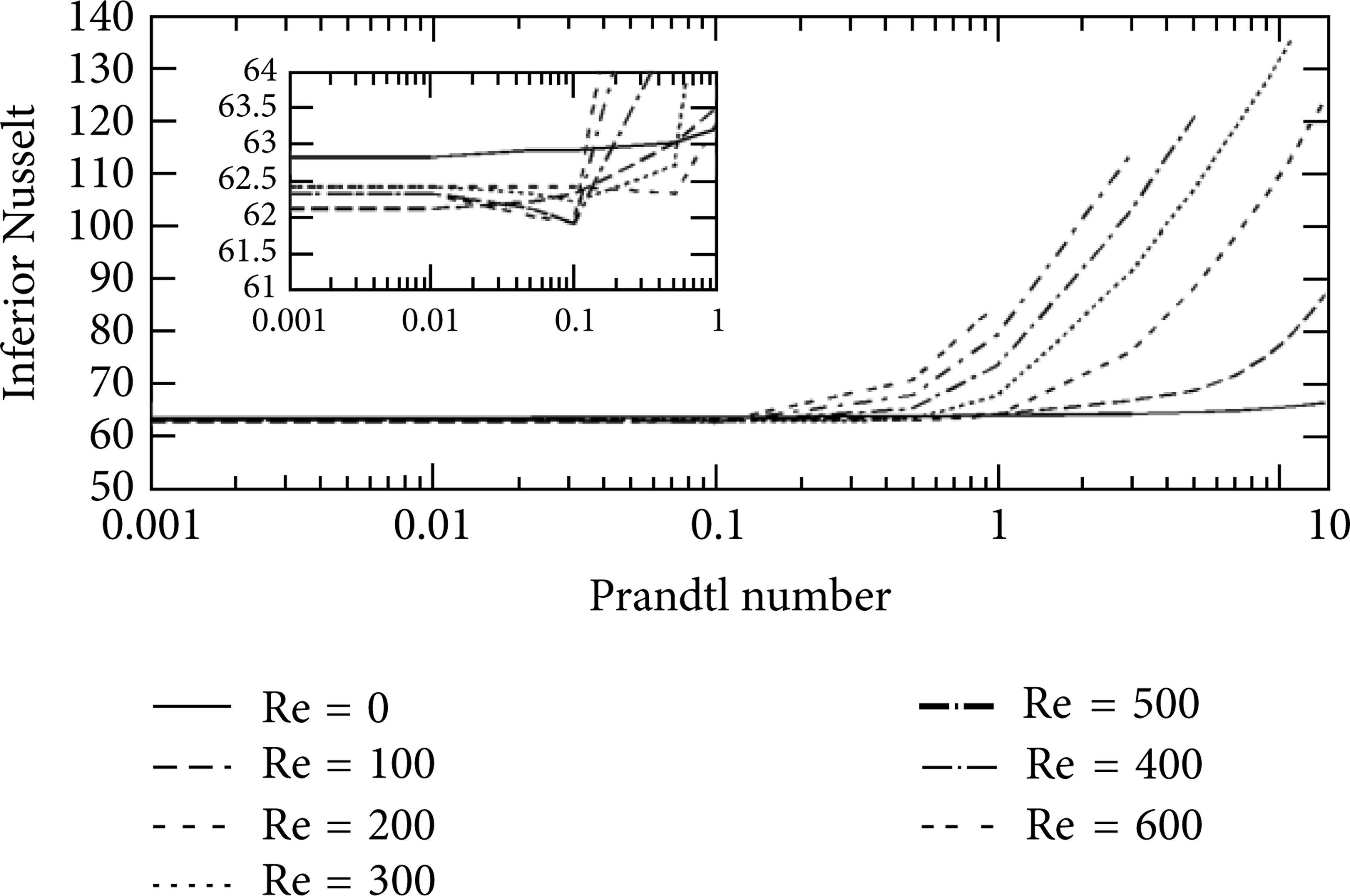
Nusselt number versus Prandtl number for A = 0.25, 300 ≤ Re ≤ 600, and Gr = 1 × 10³ and 81 × 21.
This effect begins in the interval of 0.1 < Pr > 0.5; the flow undergoes drastic changes in the dynamic patterns, where it stops values of the inferior Prandtl number to 0.1 is dominated by the forces of body and values superior to 0.5 that by the centrifugal forces. Making comparisons between Figures 10, 11, and 12, makes it possible to observe the change in the flow patterns that happens between 0.1 < Pr < 0.3 and has a smaller effect for smaller aspect ratios. On the other hand, the heat transfer in the inferior wall is increased in agreement with the aspect ratio decreases.
From the results of Figures 10, 11, and 12, some correlations to determine the number of Nusselt of the inferior wall can be deduced. For all the cases, the number of Grashof is 1000, that is why the flow is in laminar regime.
The correlation for natural convection (Re = 0) is expressed in (4), all the values for this variables are mentioned in Tables 1, 2, and 3:

Values for constant C and m.
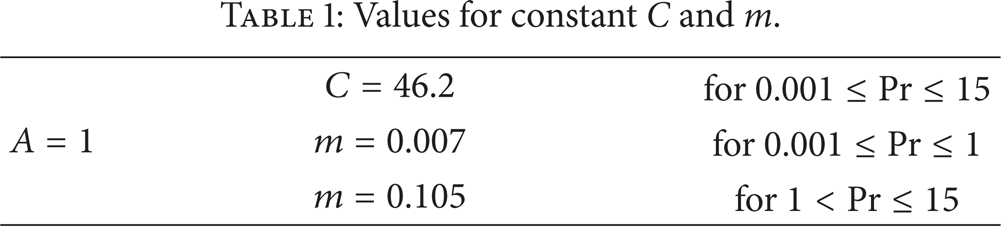
Values for constant C and m.

Values for constant C and m.

The correlation for mixed convection is expressed in (5); all the values for this variable are in Tables 4, 5, and 6:

Values for constant C and m.

Values for constant C and m.

Values for constant C and m.

The values of constant m used in the correlation for mixed convection (5) are shown in Table 2.
4. Conclusions
Present work demonstrates that for values of Pr ≪ 0.01, the convective terms of heat transfer are negligible. This means that body forces are constant and only hydrodynamic effects cause instability. In spite of the weak influence of the forces of body on the flow for small Prandtl numbers, the study demonstrated that the thermal instability in mixed convection depends strongly on the Prandtl number.
The dynamic instability is strongly stabilized by an increase in the potential of temperatures, and the flow returns to destabilize itself when the body forces are increased to their critical values. Two instabilities of thermal origin first happened for very small values of the Prandtl number, where the heat transfer has a conductive character. Second, for high Prandtl numbers, it is shown that the body effects that distort the velocity profiles cause heat transfer to have a convective character.
For small Reynolds numbers the body forces affect with greater magnitude the centrifugal forces from very small Prandtl numbers. Then, the critical Rayleigh number, for moderate Reynolds numbers (300 < Re < 600), diminishes from convective fluids with high Prandtl numbers to conductive fluids with very low Prandtl numbers.
The tendency of the heat transfer from a flow below the number of critical Grashof to different aspect ratios is very similar to the one produced in a regime of flow for numbers of Grashof that are critical and superior to these. On the other hand, the heat transfer in the inferior wall increases as the Prandtl number increases and aspect ratio decreases.