




Abstract
In recent years the piston effect in subways has become a topic of interest for researchers and engineers. Many publications have appeared on this topic, but reliable information is scattered and poorly organized. This review paper covers the latest publications on the piston effect in subways. We compile information about the mechanism of the piston effect, evaluate its influence, and describe how it can be effectively utilized.
1. Introduction
In today's society, the subway is a well-developed and highly promoted mode of transportation because of its comfort, high speed, environmental friendliness, and large transport capacity. Since the first urban underground subway opened in London in 1863, more than 60 countries and nearly 200 cities have developed subway systems [1]. The total length of subways in the whole world is more than 6000 km. Thus, the subway has emerged as the lifeline of urban development. In China, the subway has been rapidly developed in recent years. The total length of light rail and subway is predicted to be 2000 km in China by the end of 2050. This urban rail transit system will be able to accommodate approximately 50%~80% of the total urban passenger traffic [2].
With the development of subway construction technology, the running speed of subway trains has increased. When a subway train travels through a relatively narrow tunnel, the positive pressure formed at the head pushes the foul air out, while the negative pressure formed at the tail sucks fresh air in. This generates a piston wind. The piston wind ventilates the subway station, but it also brings in heat from the tunnel, which may result in high temperature in the station and poor air quality. The piston wind is one of the most important factors in the environment of the subway and greatly influences energy consumption; therefore, research that evaluates the use of the piston effect has aroused great interest.
Many papers have been published on the piston effect, but the information is scattered and poorly organized. In this review paper, we cover the latest publications on the piston effect in subways and compile the most relevant information about the mechanism of the piston effect. We also evaluate its influence and describe how it can be effectively utilized.
2. The Piston Effect Mechanism
Any study on the piston wind must begin by describing the piston effect mechanism, including the formation of the piston wind and the piston wind speed calculation.
2.1. Formation Mechanism of the Piston Effect
The formation mechanism of the piston effect is based on the formation of the piston wind and the vertical airflow distribution when the train passes through the tunnel. When a train runs above ground, the air in front of the train is pushed to the sides and the top of the train, before it flows around the back of the train. When a train passes through a tunnel, as shown in Figure 1, the tunnel wall forms a space constraint. The air pushed by the train cannot completely flow to the rear of the train. Therefore, some of the air will flow to the front of the train, where it is discharged as the train exits the tunnel. The rear end of the train forms a negative pressure vortex region. As a result, some fresh air is sucked into the tunnel through the opening, forming the piston wind [3, 4].

The formation mechanism of the piston wind.
From the perspective of energy transformation, as shown in Figure 2, there is an interaction between the train and the surrounding fluid (i.e., air) through complex motion and force, which causes energy exchange between the train and the air. This process is expressed as a pressurization effect on the train (i.e., the piston wind pressure). It is composed of three parts: the driving force of the pressure head, the annulus homogeneous section shear force booster, and the rear traction force booster. Under the piston wind pressure, air will flow longitudinally in the tunnel (i.e., there will be a piston wind) [5]. To facilitate better understanding of this process, Xu simulated the tunnel using a large cylinder, where the effect of the piston wind was created by fans blowing and exhausting. The direction of blowing and exhausting was the same, similar to a train passing through a tunnel [6].

Tunnel airflow when the train passes through the tunnel with total pressure distribution [5].
2.2. Calculation of Piston Wind Velocity
Piston velocity is calculated on the basis of air volume and air pressure. It is very important to perform this calculation correctly.
Most formulas for the calculation of the piston wind are derived from theoretical analyses and numerical simulations. For a theoretical derivation, the following assumptions are often used: only one train is present in the calculation interval; only two piston shafts, one in the front and the other in the rear, are considered; and air flow is treated as one-dimensional steady flow. The Bernoulli equation for annular space (the tunnel section of the air flow relative to the train and the piston wind relative to the duct) and the tunnel flow and continuity equation are then compiled to simultaneously solve for the piston wind velocity [7]. In the process of solving the problem, the piston effect coefficient, which is related to the resistance coefficient and the length of the train, is introduced. Although this method has been widely used, its use is limited because it relies on an empirical parameter (i.e., the resistance coefficient). In addition, it requires specialized skills and long periods of time to perform, further limiting its use in engineering applications [8]. However, by using one-dimensional calculation software, such as SES, Kang simplified the process for calculating the ventilation pipeline flow of the piston wind by using a V0 velocity driving force as the power source in the ventilation pipe and deducing the simplified calculation in one dimension [9]. When Li deduced the formula for the piston wind using a fundamental calculation similar to the traditional method, the solution of the piston wind pressure equation produced a piston wind pressure that was divided into three parts: the driving force of the pressure head, the annulus homogeneous section shear force booster, and the rear traction force booster. This method represents a more accurate analysis of the flow characteristics of air [10].
2.2.1. The Calculation Model and Formulas for the Piston Speed
Assuming the cross-sectional area of the train is A0 and the speed is v0, as shown in Figure 3, during the time dt, the air volume pushed to the front of the train will be A0v0dt with the air volume divided into two parts. One part flows to the front of the train and ultimately forms the piston wind. The other part flows to the rear of the train through the annular gap that forms between the train and the tunnel wall. Assuming the cross-sectional area of the tunnel is A, the speed is v, and the air speed of the annular gap is w, the air volume that flows to the front of the train will be Avdt. Meanwhile, the air volume that flows to the rear of the train will be (A – A0)wdt. The piston wind pressure will be (p3 – p4). According to the continuity equation A0v0dt = Avdt + (A – A0)wdt and the fundamentals of fluid mechanics, one can derive the piston velocity calculation formula.
Bernoulli's equation for the relative motion between the airflow and the train is
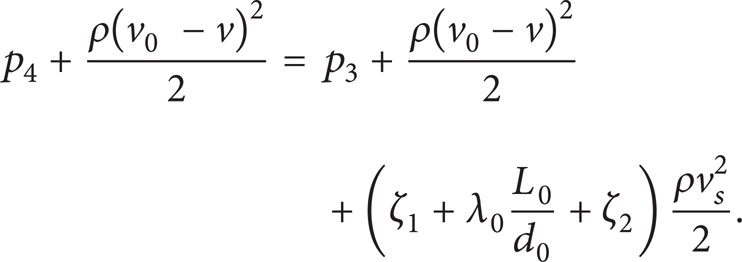
Bernoulli's equation for the relative motion between the airflow and the duct/tunnel is

The continuity equation is

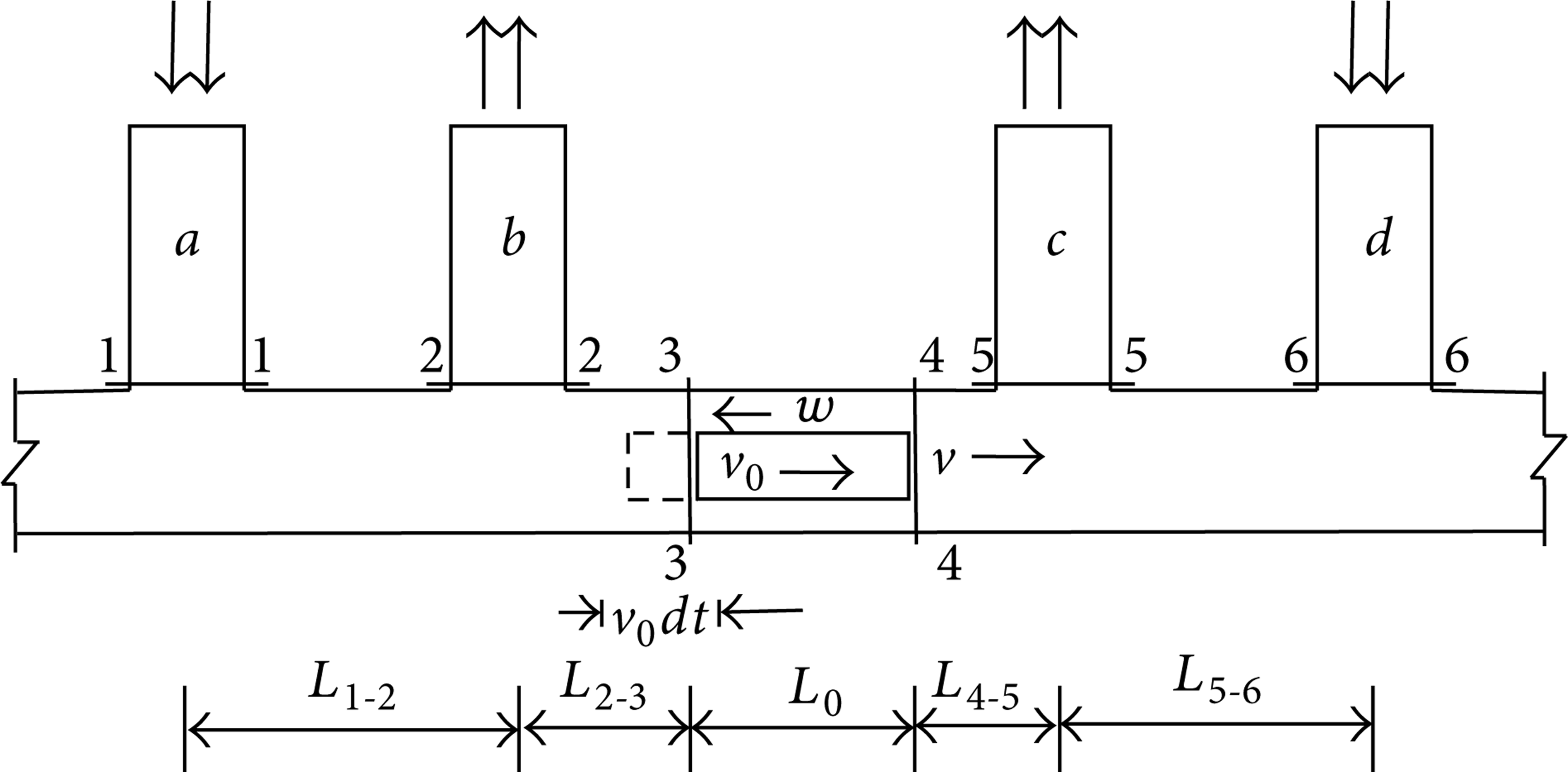
Calculation model for the piston wind velocity [7].
Solving the above equation gives the piston speed:

In this formula, ζ is the integrated drag coefficient for the computed network system and K is the train piston wind action coefficient:

2.2.2. The Numerical Simulation Tools
Numerical simulation always uses software such as CFDesign [11], PHOENICS [12], and CFX [13]. These programs use the Reynolds averaging method for simulation and the control equation, which consists of the continuity equation, the momentum equation, the energy equation, and the turbulent kinetic energy equation, to analyze the flow characteristics of the air station. Compared to other commonly used software such as CFX and FLUENT, the best feature of CFDesign is the introduction of the solid motion module (the CFDesign Motion Module), which can be used to analyze the interaction between solid and fluid motion using a method known as moving mesh technology of masking to solve the flow problem with solid movement. Therefore, it is more suitable for 3D simulations of subway train movements. Yang used CFDesign to simulate flow field distribution using a three-dimensional numerical simulation and an analysis of the impact of waiting passenger comfort under typical flow rates for island platform without opening the mechanical ventilation system as a single train moved into and out of the station [11]. In addition, subway environment simulation software (SES) is widely recognized and used internationally as relatively mature subway simulation software. This software allows the user to simulate different environmental control systems, set the air flow of the underground tunnels and stations, and adjust various stable and unstable heat sources. Wang [4] used SES to analyze the effects on the temperature and velocity fields in the tunnel and station from the piston wind during different seasons, times, and train conditions.
There are many studies on the piston effect mechanism. Most studies use analytical calculations, model tests, and simulation software methods to determine the change law of the piston wind velocity, the pressure, and the air volume of the tunnel and the station. For piston wind calculation, quantitative methods are conducted based on model simplifications and theories. These methods are not for the engineering application. And air models are based on one-dimensional steady-state assumptions because three-dimensional unsteady flow analysis is inadequate.
3. Evaluation of the Piston Effect
To use the piston effect to improve passenger comfort, it is necessary to evaluate the piston effect, which should entail an evaluation of the piston effect itself, an evaluation of the effect of the piston wind on ventilation and the thermal environment in the subway station, an evaluation of the effect of the piston wind on passenger comfort, and an evaluation of the effect of the piston wind on energy consumption of the ventilation and air conditioning systems. In addition, it is necessary to evaluate the effect of the piston wind on the air quality in the subway station.
3.1. Evaluation of the Piston Effect Itself
Research on the piston effect itself has focused on its role in natural ventilation. The piston wind not only carries the heat produced by the trains running in the tunnel, discharging it to the outside through the passageways but also produces indoor air pressure fluctuations. When the train leaves the station, fresh air is sucked through the station passageways, into the station. When the train goes into the station, foul air is pushed to the outside, improving the air quality in the station and providing natural ventilation. This brings in fresh air for subway station without the need for draught relief shaft or additional power consumption. Using natural energy can reduce the shaft area, the air conditioning equipment capacity, and the air conditioning energy consumption compared with conventional air conditioning systems. The piston wind produced as trains repeatedly enter and leave the station achieves natural ventilation without using additional power [14]. Jia et al. used CFD to produce a transient simulation of the train pulling in and out of the station. They analyzed the ventilation environment caused by the piston wind in the station and studied the intake and exhaust status of each piston effect. This revealed the role of the piston wind in natural ventilation [15].
3.2. Evaluation of the Piston Effect on the Ventilation and Thermal Environment in the Subway Station
Theoretical analyses, numerical simulations, model experiments, field measurements, and other methods are commonly used to study the piston wind in tunnels and stations, including aspects such as the velocity field and the temperature field. However, most studies only focus on single-track tunnels, a single train, or a single driving condition. Furthermore, they usually only analyze the piston wind caused by a train passing at a certain speed over a short period of time in either a qualitative or a quantitative manner. Some studies, however, have provided more significant analyses by investigating different angles. Important considerations include the use of a single train or a double train, the action of pulling in or out of the station, one-way tunnels versus double-track tunnels, different boundary conditions for the models, normal stations versus transfer stations, the presence of a trackless bottom exhaust, different operating conditions, operating speed, weather, times, and air distribution. Bao used CFD to simulate the speed and pressure distribution for different speeds, different tunnel lengths, different train lengths, and single versus double trains [16]. Jia et al. performed a transient simulation for the airflow velocity distribution in the station hall, the platform, the inlet, and the outlet based on a train under closed operation and under open operation, taking into consideration the action of a single train pulling in and out of the station at different times. He then analyzed variation rules for open operation and train stations for each piston shaft of air volume over time [15]. These studies were all carried out for a piston effect in a one-way tunnel. To improve the effect of the piston wind, Jia et al. studied the air flow characteristics of a two-way tunnel train sports team. In the CFD simulation, the subway tunnel was simplified as a circular tube, the train was simplified as a cuboid, and the air flow tunnel was simplified as a three-dimensional unsteady incompressible turbulent flow. Each of the two trains, which were running at the same speed, passed at different points, and the flow velocity distribution in the cross-section of the tunnel was simulated. This simulation showed that the tunnel and the flow field distribution were influenced by the combined effects of the two trains [17]. Wang analyzed different boundary conditions and compared the theoretical and actual situations for the boundary conditions. The simulations were performed for trains with different initial speeds in a uniform stop process, different temperature fields, and different speeds in the subway tunnel [18]. To simulate a transfer station, Pflitsch et al. measured the air flow speed and the temperature on a British transfer station and used a series of rules for air flow in the station [19]. Ke et al. studied the distribution of a trolley bottom exhaust tube for different speeds, different shaft broken areas, and different lengths for velocity and pressure in the tunnel. This study also analyzed the influence of pressure and velocity on the tunnel shield for a train with travelling at less than 55 km/h through the screen door [12]. Huang studied the air distribution driven by the piston wind inside tunnel and performed transient simulations for five types of typical driving conditions at the same time for different loop control systems (i.e., a single train, a single outbound train, one train moving in and another train moving out synchronously, two trains moving in synchronously, and two trains moving out synchronously). Thus, detailed flow field distributions have been obtained for different working conditions [20]. J. Y. Kim and K. Y. Kim set up a 1: 20 scale model of a train and a tunnel to study the air pressure caused by the piston wind. They used the wind speed change rule under various conditions for acceleration, uniform speed and deceleration in tunnels while the train was running [13]. Yin from Tianjin University provided qualitative and quantitative analyses about the patterns of variation of the temperature field and the velocity field during different seasons and time periods on subway platforms. He also assessed the applicability of the platform screen door system at a side type platform, providing theoretical support and technical references for the effective use of the piston wind according to the season [21]. Wang and Li performed numerical simulations for the temperature and velocity fields in tunnels and stations. Thus, the temperature and air velocity distributions for different conditions can be obtained [22].
3.3. The Role of the Piston Effect in Passenger Comfort
To analyze the role of the piston effect in passenger comfort, Yang simulated the flow field distribution of a typical island platform for close running trains pulling in and out the station. According to the actual criterion for design of the metro, “the instantaneous wind speed of platform and underground hall should not be greater than 5 m/s,” one can simply analyze the effect of wind speed change on passenger comfort [11]. Wang et al. adopted comfort indexes, such as the Relative Warmth Index (RWI) and the Heat Deficit Rate (HDR), and performed field measurements of the velocity and temperature of the coupling airflow between the air-conditioning air supply and the piston wind at different measurement points below the typical jet in the closed environment control system on the platform and the station hall to determine the effect on passenger comfort [23]. Gerhardt and Krüger not only analyzed the air flow in a station but also put forward some control measures for air flow movement and prevention of excessive gas flow into the platform, which provides powerful guidance for improving passenger satisfaction [24].
3.4. Piston Effects on Subway Air Conditioning Energy Consumption
There are a large number of experimental measurements and numerical simulations that prove that the piston wind affects the subway air-conditioning system, suggesting that the full use of the piston wind can lead to load reduction. For instance, Dong summarized the influence of the piston wind on the air conditioning load and confirmed that the effective use of the piston wind can save energy and reduce the subway ventilation and air conditioning system energy consumption [3]. By comprehensively considering factors such as traffic, grid density, and personnel area, Krasyuk put forward a method for calculating the tunnel fan capacity to confirm that the subway piston wind can be used as a part of the air-conditioning and ventilation air volume. The experimental data and calculated results suggested that the piston wind can actually reduce the air conditioning load [25]. To calculate the degree of influence of the air conditioning energy consumption of the piston wind, Deng et al. proposed a practical simulation method that used the underground mixing coefficient to evaluate how the piston affected the thermal environment. The correlation between the platform space design and the coefficient provided an effective way to reduce air conditioning load [26]. Shen et al. provided a solution for using the piston wind to reduce the air conditioning energy consumption. Based on piston wind measurements for the Shi Men Yi Lu station of Shanghai subway line 2, they suggested that the piston wind can be fully utilized to introduce fresh air during transition seasons and to reduce air conditioning energy consumption [27]. Subway safety door systems are widely used. While the doors provide security, they also affect the cooling load on the platform. Zhao provided an evaluation of the subway ventilated air conditioning energy consumption with the interference of the safety doors. Theoretically, the subway thermal environment changes when the height of the gate changes within an allowed range (1.1 m~2.5 m). As the height increases, the ventilated air conditioning energy consumption decreases [28].
3.5. Evaluation of the Piston Effect on Subway Station Air Quality
Studies of the piston effect on subway station air quality are not detailed enough. The existing research mainly concerns pollutants and pollution levels in the subway station. Some interior air quality evaluation indexes have been proposed; however, particles that impact the air quality should be considered when designing the air-conditioning and ventilation systems in the subway. After summarizing the existing research, Nieuwenhuijsen et al. noted that Fe and Mn are the major particles present in subways. These particles are potentially poisonous to passengers; therefore, their levels should be reduced by using appropriate air conditioning and ventilation systems [29]. Juraeva et al. used an air curtain to reduce particulate concentrations. They confirmed using the theory of fluid mechanics and CFX calculation software that reasonable installation position for the air curtain can be calculated. This cannot only reduce the spread of bacteria and radioactive particles but also provide benefits to the subway environment and control system [30]. Ding et al. used the relevant standards for air parameters in railway air conditioned trains as a reference. They combined interior air operation parameters and subway characteristic to analyze qualities such as the thermal comfort index, the air quality index, and the air distribution index. They concluded that particulate matter should be carefully considered to improve air quality in trains [31]. However, research about particle distribution in subway station is in its infancy. Using CFD numerical simulations, Domingo and other researchers used five underground subway constructions in Spain as models. They applied five different ventilated air conditioning operation strategies to determine the best design to limit the pollutant concentration and lower the temperature to standard values, providing a reference for how fresh air volume affects particulate concentration [32]. The quantification of particulate matter can thus be used to inform designs and operational parameters for subway air-conditioning systems to create optimal subway environments.
Although this research has been influential, the majority of studies about subway station environments only focus on what should be performed or whether what was performed previously was right or wrong. Very few evidentiary studies give definitive conclusions established based on sufficient reliable data. In particular, data on the volume of piston wind that passes through the entrance and arrives at the platform hall is lacking, limiting potential energy saving.
4. The Efficient Use of the Piston Effect
The piston wind generated during subway train operation will introduce fresh air and discharge foul air, achieving subway ventilation and influencing the subway station thermal environment. Because the piston effect is bound to exist, the question is how to make efficient use of the piston.
4.1. Factors Influencing the Piston Effect
Based on the unsteady flow piston wind theory, He et al. developed a simplified mathematical model of the piston wind to analyze how the train speed, the train length, the tunnel blockage ratio, and the tunnel length affect the piston wind [33]. Wang et al. tried to resolve the problem by introducing the shunt to suction ratio. They concluded that the shaft area, the length, the one-way resistance coefficient, the local resistance coefficient, and various other factors influence the piston wind speed. Thus, changing the shaft area or other factors can effectively optimize the piston wind effect on the velocity field of each unit, such as tunnels and platforms [34]. Han et al. simulated the effect of different forms of piston vents on tunnel ventilation. They noted that a direct air shaft was superior to an inclined air shaft [35].
4.2. Control Measures for the Piston Effect
The piston effect has a great effect on the temperature, wind speed, and air quality in subway stations. Therefore, to improve passenger comfort, it is necessary to take measures to control the piston wind.
4.2.1. Changing the Geometric Parameters of the Station or the Air Velocity in the Tunnel
Tao used the Dongdan station of the Beijing Metro Line 1 to study the effect of piston wind on the temperature and velocity fields. To achieve better subway environments, he changed the station area, the stairwell area, and the other corridor areas to control the air velocity in the station. He also limited the train speed and changed the size of tunnel and exhaust system [36].
4.2.2. Using a Platform Screen Door with an Air Vent
Dong developed an innovative system to equip the platform screen door with a controllable air vent. In summer, the air vent was shut off to separate the heat of the moving train from the piston wind. During transitional seasons and winter, the vent served to introduce warm piston wind and reduce energy consumption. In case of a fire, it can also be used to exhaust smoke so that passengers can be evacuated in time. Such system combines the advantages of the platform screen door system and the security door system to provide a safer, more comfortable, and more energy efficient platform screen door system for northern cities. This technique also reduces the ventilating and air conditioning system energy consumption [3]. Meanwhile, Cao et al. noted that by using this platform screen door, ventilation energy consumption can be reduced by 50% during transitional seasons and in winter, while providing 30% reductions in annual energy consumption [37].
4.2.3. Reducing the Height of the Vertical Jet Cooling Damp Wind Nozzle
From the benchmark of 0.5 m and 1.7 m, Zhang and Li used fluid dynamics simulations to determine the effect of different installation heights (5.4 m and 4.9 m) of the vertical jet cooling damp wind nozzle. The velocity curve for the cross-section and the temperature distribution for the two conditions were analyzed. They found that the total cooling load was reduced and the piston wind control was improved by reducing the height of the cooling damp wind nozzle [38].
4.2.4. Using the Draught Relief Shaft
After simulating and calculating the air volume induced by the piston effect, Gao noted that the draught relief shaft can be used to improve the efficiency of the piston wind. A single draught relief shaft was better on the side of the outbound station than on the side of the inbound station [39]. Ren et al. suggested that setting the draught relief shaft can not only discharge the waste heat but also introduce cooling air to reduce energy consumption. The wind pressure formed in the front of the train that is a discomfort to passengers can thus be released [40]. Therefore, how can one take advantage of the draught relief shaft to achieve effective use of the piston wind? Ke et al. suggested that changing the cross-sectional area and the length of the draught relief shaft can improve the use of the piston wind. The air volume can be changed when the shaft length is changed from 40 to 100 m, reducing the air volume of the piston wind by 15% to 25%. When the shaft cross-sectional area increases from 15 m2 to 30 m2, the air volume of the piston wind increases by 40% [12]. J.-Y. Kim and K.-Y. Kim analyzed the ventilation effects generated by four different positions of the draught relief shaft to determine the optimal position for the draught relief shaft [41].
Most studies on piston wind utilization and control measures start from a local unit. They are not comprehensive enough. Moreover, the use of control measures is not specific enough. The effective use of the piston effect can also save energy. This is a factor that should be given more attention.
5. Conclusions
Piston wind influences the environment and energy consumption of subway systems. Studies on subway piston winds generally focus on variation laws and the main factors involved with the piston wind. Using model experiments, numerical simulations, and other methods, the overall variation laws for ventilation and the thermal environment can be determined for every section of a station. These methods can also provide the air speeds, temperatures, and other environmental parameters and distribution characteristics under various driving conditions for different types of platforms. Based on studies that analyze the piston effects on air-conditioning energy consumption, it is possible to propose control measures for the piston effect. Nevertheless, further research is required on this subject.
Most studies use only one method, such as theoretical derivation or numerical simulation. A one-dimensional steady-state assumption is made when constructing simulation models, while a three-dimensional flow dynamic analysis is less commonly used. Most studies on the subway environmental ignore the piston effects or simplify it, in many cases providing only qualitative analysis. Quantitative analysis of the fresh air volume introduced to the station by the piston effect is seldom conducted. Furthermore, we found no discussions on carbon dioxide and particle distribution resulting from the piston effect.
Conflict of Interests
The authors declare that there is no conflict of interests regarding the publication of this paper.
Footnotes
Acknowledgments
The work was financially supported by the “Ri Xin Ren Cai Project” of the Beijing University of Technology; the “Theory and Investigation Research Project 2013” of the Beijing Returned Overseas Chinese Federation; the Beijing Key Lab of Heating, Gas Supply, Ventilating and Air Conditioning Engineering (no. NR2012K03); and Fundamental Research Funds for the Central Universities (no. 3142013095). The authors are grateful for the support from these sponsors.