




Abstract
Multicopy forwarding schemes have been employed in delay tolerant network (DTN) to improve the delivery delay and delivery rate. Much effort has been focused on reducing the routing cost while retaining high performance. This paper aims to provide an optimal joint expected delay forwarding (OJEDF) protocol which minimizes the expected delay while satisfying a certain constant on the number of forwardings per message. We propose a comprehensive forwarding metric called joint expected delay (JED) which is a function of remaining hop-count (or ticket) and residual lifetime. We use backward induction to calculate JED by modeling forwarding as an optimal stopping rule problem. We also present an extension to allow OJEDF to run in delay constrained scenarios. We implement OJEDF as well as several other protocols and perform trace-driven simulations. Simulation results confirm that OJEDF shows superiority in delay and cost with acceptable decrease of delivery rate.
1. Introduction
A delay tolerant network (DTN) [1] is a sparse mobile multihop network where a complete path from the source to the destination may not exit most of the time. A DTN can be viewed as a collection of time-varying and separate node clusters. Under this condition, conventional mobile ad hoc network (MANET) or wireless sensor network (WSN) routing will become impractical because of frequent disruption and high packet loss. The Delay-Tolerant Networking Research Group (DTNRG) [2] is concerned with architecture and relevant protocols in order to provide interoperable communications with and among extreme and performance-challenged environments. In DTNs, the messages can be forwarded asynchronously using the store-carry-forward routing mechanism which relies on the contact opportunities between nodes [3].
Routing in DTN has been an active research area in recent years. Epidemic [4] exchanges the copies whenever contact occurred within pair of nodes. Epidemic can guarantee the maximized delivery rate and the minimized end-to-end delay under ideal conditions. However, unrestrained flooding is impractical because of huge consumption of energy, buffer and bandwidth. Much literature has been focused on reducing the number of copies of each message while retaining a high routing performance. Previous works proposed a variety of metrics, including movement trend [5], delivery probability [6], encounter frequency [7], the distance to destination [8], end-to-end delay [9], energy [10], signal to noise ratio (SNR) [11], and comprehensive utility [12]. These metrics are used to make decision for forwarding in order to optimize certain performance such as expected delay and delivery rate.
In this paper, we propose optimal joint expected delay forwarding whose main idea is similar to that of optimal probabilistic forwarding (OPF) [13]. This means that optimal stopping rule [14] is used again. Different from maximizing the delivery rate in OPF, we concentrate on optimizing the expected delay of each message with the constraint on the maximum of copies per message. The problem is how to forward the copies of each message in each discrete time slot in order to minimize the expected delay when the number of copies is given. To solve this problem, we firstly employ the comprehensive dynamic forwarding metric called joint expected delay (JED) which is a function of two important states of a message copy: remaining hop-count and residual lifetime. Then, we propose the forwarding rules to decide whether to forward the copies. Based on the hop-count constraint forwarding scheme, we propose a general ticket constraint OJEDF which can be viewed as a development of Spray and Wait [15] with special spray metric. We also extend OJEDF in delay constrained scenarios.
We performed simulations using St. Andrews encounter trace [16] and Illinois encounter trace [17] to evaluate the routing performance of OJEDF against several DTN routing protocols, including Spray and Wait, ProphetV2 [7], and Epidemic, in terms of average delay, delivery rate, and the number of forwardings for each message. Simulation results confirmed that OJEDF improves the average delay and cost with acceptable decrease of delivery rate.
This paper is organized as follows. Section 2 summarizes the related works. Section 3 introduces preliminaries on optimal joint expected delay forwarding and presents the motivation and assumption of OJEDF. Section 4 proposes the calculation algorithms of our delivery metric JED and optimal forwarding rule in hop-count constraint OJEDF and ticket constraint OJEDF, respectively. Section 5 proposes an extension of OJEDF which makes it work in delay constrained scenarios. Section 6 presents our simulation methods and results. Finally, the paper is concluded in Section 7.
2. Related Works
The single-copy routing protocols such as MobiSpace [18] and CAR [19] are energy efficient but always have large delay. Due to uncertainty in nodal mobility and network partition, DTN routing algorithms usually spawn and keep multiple copies for the same message in different nodes. Epidemic is the first distribution routing protocol for DTN, and it gains good delivery delay. However, Epidemic wastes a lot of energy and suffers from severe contention.
Much literature has aimed to balance the delay and energy. Some restricted flooding or spray mechanisms disseminate a small number of message copies to potential relay nodes, and then each copy finds routing to the destination independently. These mechanisms can obtain better delay performance without a lot of resource consumption.
Spray and Wait is a multicopy routing without any routing knowledge. Spray and Wait combines the speed of Epidemic routing with the simplicity and thriftiness of direct transmission. This mechanism “sprays” a number of copies into the network and then “waits” till one of these nodes meets the destination. Spray and Focus [20] replaced the direct transmission in wait phase with utility-based single-copy strategy and proposed the utility transfer mechanism to disseminate the history contact information. Thrasyvoulos was absorbed in utility-based spraying [21] and proposed three potential utility functions: last-seen-first spraying, most-mobile-first spraying, and most-social-first spraying. Jindal proposed distance utility-based spray strategy [22] which utilized dynamic programming to calculate the optimal relay node. An adaptive distributed spray mechanism (AMR) was performed in [23] which determined the depth of spray tree by relay nodes. But AMR is just efficient in random waypoint model and sometimes can produce at most
Different from Spray and Wait, delegation forwarding [26] forwards the messages based on different delivery probability metrics. Delegation forwarding maintains a forwarding threshold τ when contact of node pairs occurred. Forwarding threshold indicates the quality of node such as cost, delivery rate, and average delay. RAPID [27] treats DTN routing as a resource allocation problem that translates the routing metric into per-packet utilities such as minimizing average delay, minimizing missed deadlines, and minimizing maximum delay.
Some routing protocols aimed to achieve the desired performance with different levels of prior knowledge about the network. OPF [28] was proposed to maximize the delivery rate of each message when mean inter-meeting times between all pairs of nodes were known. Cyclic MobiSpace [29] assumes that each node has full contact information to other nodes, and it optimizes minimum expected delay.
3. Preliminaries
3.1. Hop-Count Constrained Forwarding and Ticket Constrained Forwarding
We consider two constraint patterns related to the number of message copies: hop-count constrained forwarding and ticket constrained forwarding.
In hop-count pattern, a maximal remaining hop-count K was defined in source node. The remaining hop-count decreased progressively when forwarding occurred. The calculation of the remaining hop-count for the copies of each message is independent. Figure 1 depicts the forwarding process with

An illustration of hop-count constrained forwarding with

An illustration of ticket constrained forwarding with
3.2. Motivation
Many routing protocols in DTNs forward the messages based on the specific routing metrics by means of comparing the direct forwarding qualities of node pairs. However, such forwarding strategy ignores the time dimensionality which is an important character in DTNs. In fact, the forwarding decision only relied on the direct forwarding qualities of node pairs and cannot stand for the optimal choice in whole time dimensionality of delivery.
In this paper, we optimize the expected delay of each message based on the comprehensive forwarding metric We propose a comprehensive forwarding metric JED which is related to the time dimensionality and the number of copies for each message. We propose the backward induction algorithms to calculate JEDs with hop-count constraint and ticket constraint, respectively. We solve the delay restraint optimal cost forwarding by the extension of OJEDF.
3.3. Assumption
To model our optimal forwarding problem as an optimal stopping rule problem, we have the following assumptions.
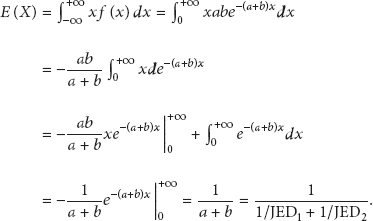
Like other probabilistic forwarding protocols, nodal mobility exhibits long-term regularities and each node knows the matrix Time dimensionality in whole forwarding process is discrete. OJEDF employs a discrete residual time-to-live Tr with time slot size U for each message copy. So we can state the next time-slot as JEDs are exponentially distributed. Therefore, the JED of two copies with

Proof.
Let

4. Optimal Joint Expected Delay Forwarding (OJEDF)
4.1. OJEDF with Hop-Count Constraint
Without loss of generality, we consider a copy in node i with destination d, remaining hop-count

We only consider unicast forwarding. When a node contacts with several nodes at the same time slot, the copy is forwarded to the node j which has the minimum
The forwarding metric
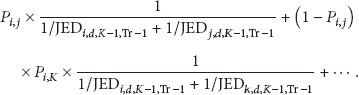
Specially, the copy only can be delivered to the destination when the remaining hop-count
In our OJEDF, Tr is only used to define the finite upper bound on the number of stages which is essential for modeling OJEDF as optimal stopping rule problem. So it is feasible to calculate the JEDs of the previous stage using the backward induction method even when
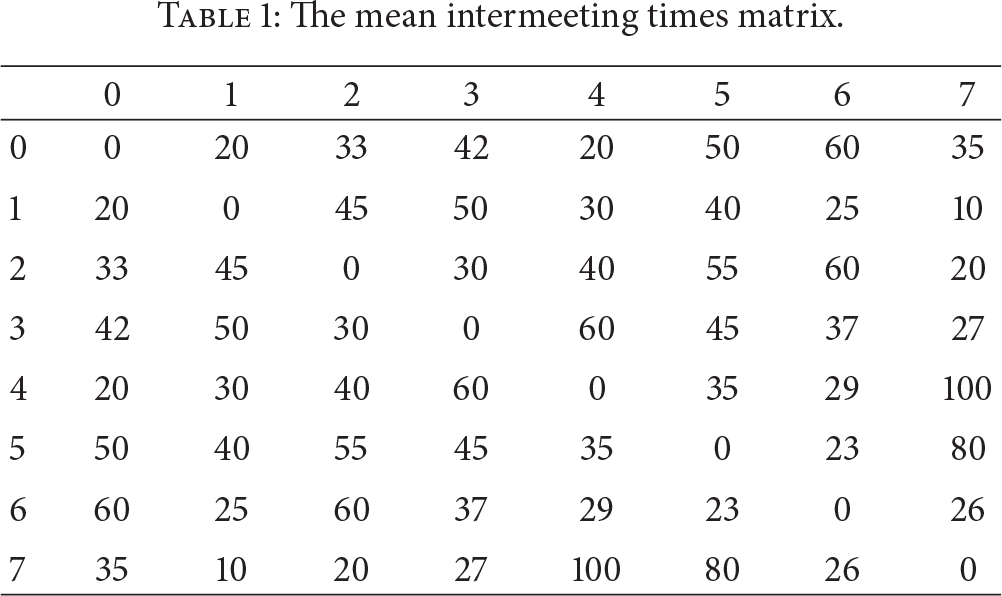
As an example, a matrix
The mean intermeeting times matrix.
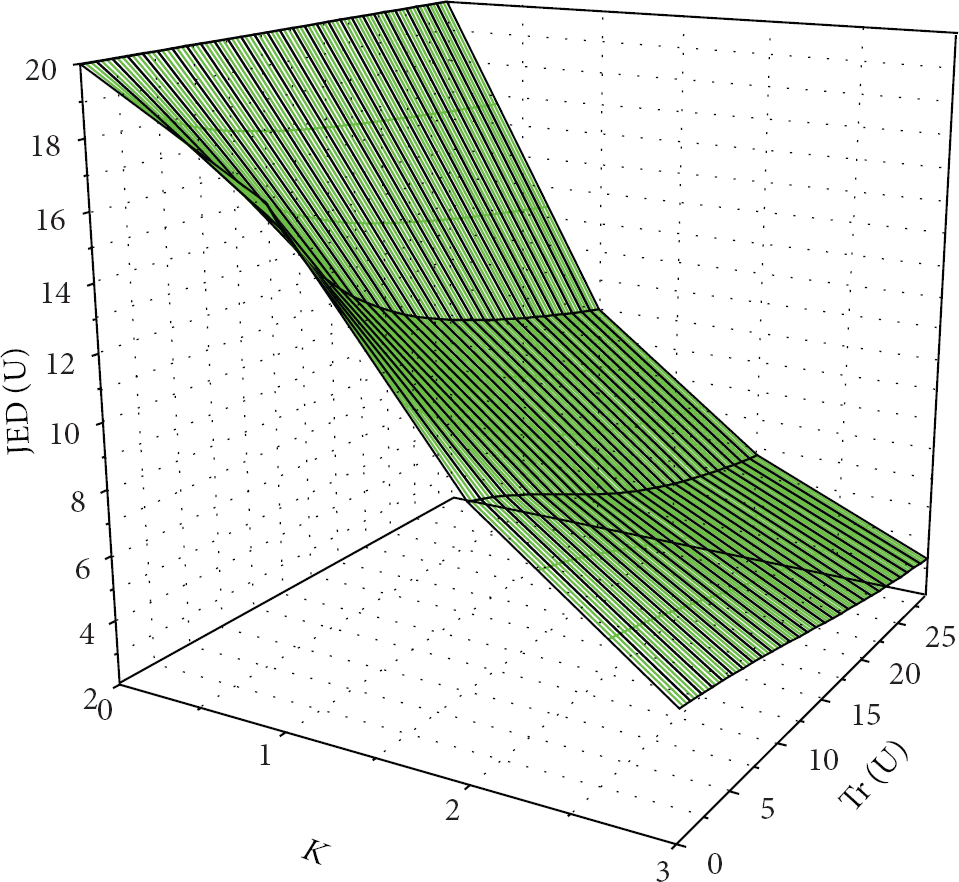
The JEDs calculated by OJEDF in hop-count based forwarding.

(a) Forwarding options based on OJEDF in hop-count based forwarding with
4.2. OJEDF with Ticket Constraint
Another copy constraint pattern is ticket constraint which is more precise than hop-count constraint since it replaces the remaining hop-count K with the number of tickets L. Without loss of generality, we consider a copy in node i with destination d, the number of tickets
Algorithm 2 shows the backward induction algorithm to calculate
We use the same matrix defined in Table 1. The JEDs calculated by OJEDF in ticket based forwarding were shown in Figure 5 with

The JEDs calculated by OJEDF in ticket based forwarding.

(a) Forwarding options based on OJEDF in ticket based forwarding with
5. An Extension of OJEDF for Delay Constrained Scenarios
We have solved the optimal joint expected delay problem with the constraint of remaining hop-count or ticket of messages. As a further consideration, we extend OJEDF to run in delay constrained DTN applications. For example, electronic notice in campus networks [30] and village networks [31] and short-term weather information in large national parks [32] must be forwarded with constrained delay. On the other hand, as the access networks, configuration and forecast for QoS are also necessary in order to provide acceptable service (such as e-mail) in DTNs.
Since JED is a function of remaining hop-count (or the number of tickets) and residual lifetime, the OJEDF can also be used to estimate the minimum hop-count K or the minimum tickets L to meet the constrained delay. We give a simple hop-count estimation algorithm with constrained delay based on JED in Algorithm 3. We define the K_MAX as the maximum of hop-count which equals
We can get the minimum of hop-count with different constrained delay for each destination node using Algorithm 3. Assuming that the message was generated in node 0 and the mean inter-meeting times matrix was in Table 1, Figure 7 showed the minimum of hop-count with

The minimum of hop-count with

The minimum of tickets with
6. Simulation
We evaluated OJEDF with hop-count constraint (OJEDF-H) and OJEDF with ticket constraint (OJEDF-T) against Spray and Wait (SNW), ProphetV2 (PRO2), and Epidemic (EP) using St. Andrews encounter trace and Illinois encounter trace. We implemented the above protocols in The ONE [33] which was developed by the Helsinki University of Technology. We obtained the performance indicators including average delay (only of the copies delivered successfully), the delivery rate, and the average number of copies for each message (no acknowledgment mechanism) from The ONE. The simulation parameters were shown in Table 2 (only the default values without any special instruction).
Settings for simulation.

6.1. Simulation Using St. Andrews Encounter Trace
St. Andrews encounter trace set up a mobile sensor network comprising mobile IEEE 802.15.4 sensors (T-mote invent devices) carried by human users and Linux-based basestations that bridge the 802.15.4 sensors to the wired network. St. Andrews encounter trace deployed 27 T-mote invent devices among 22 undergraduate students, 3 postgraduate students, and 2 members of the staff of the University of St. Andrews from the participants' Facebook friend lists. Participants were asked to carry the devices whenever possible.
Due to the limit of buffer and the queue of external events, we only employ the encounter data from time 0 to 5369. We optimize the original data in order to remove the reduplicative records and invalid users. The reduplicative records are the same encounter records in the same time, and the invalid users mean the users who never appeared before time 5369. As a result, we get 25 valid users and 591 external encounter events. The final encounter data must be formatted into standard external event queue data which can be read by The ONE.
We get the performance with different message overload. The intervals of message generator varied from 10 s to 50 s.
Figure 9(a) showed the average delay with different intervals of message generator. The average delay increased with the increasing intervals. When the message overload was high, the multihop forwardings were difficult due to the constrained buffer size. As a result, the average delay was low. The average delay increased with the decreased message overload since the multihop forwardings became common. There was no copy control in EP and PRO2, so the average delay of them was high compared with that of SNW and OJEDF due to the constrained buffer size set in simulation. We can see from Figure 9(a) that the average delay of PRO2 was lower than that of SNW and OJEDF when the interval of message generator was long enough. This is because the buffer size becomes sufficient in low message overload, and the average delay is low when there is no copy control in PRO2. OJEDF which optimizes the joint expected delay can be viewed as an improvement of SNW. The average delay rates of OJEDF-H and OJEDF-T were 8.89% and 14.05% lower than that of SNW, respectively.

(a) Average delay with different interval for message generator using St. Andrews encounter trace. (b) Delivery rate with different interval for message generator using St. Andrews encounter trace. (c) Number of forwardings with different interval for message generator using St. Andrews encounter trace.
Figure 9(b) showed the delivery rate with different intervals of message generator. The delivery rate increased when the overload decreased. All of the delivery rates are lower than 50%. This is because only 244 contacts occurred between 25 users in the first 5369 s. This is a very low contact probability. OJEDF did not forward the copies to the node first encountered but forwarded based on the expected delay. So the delivery rates of OJEDF-H and OJEDF-T were 14.20% and 13.61% lower than that of SNW in average, respectively. Most of the time, the delivery rate of OJEDF is higher than that of EP and PRO2.
We also got the number of forwardings with different intervals of message generator. We can see form Figure 9(c) that the numbers of forwardings of OJEDF-H and OJEDF-T were much lower than those of EP, PRO2, and SNW. OJEDF only forwarded the messages to the optimal node, and the numbers of forwardings of OJEDF-H and OJEDF-T were 34.86% and 36.00% lower than that of SNW, respectively.
We also compared the performance with different TTLs (from 10 minutes to 90 minutes).
Figure 10(a) showed the average delay. The average delay means the delivery delay of messages which were delivered successfully, so the average delay was low when TTL was low. The average delay rates of EP and PRO2 were higher than those of SNW and OJEDF. OJEDF outperformed other protocols in terms of the average delay with all TTLs. Specially, the average delay rates of OJEDF-H and OJEDF-T were 9.24% and 18% lower than that of SNW, respectively.
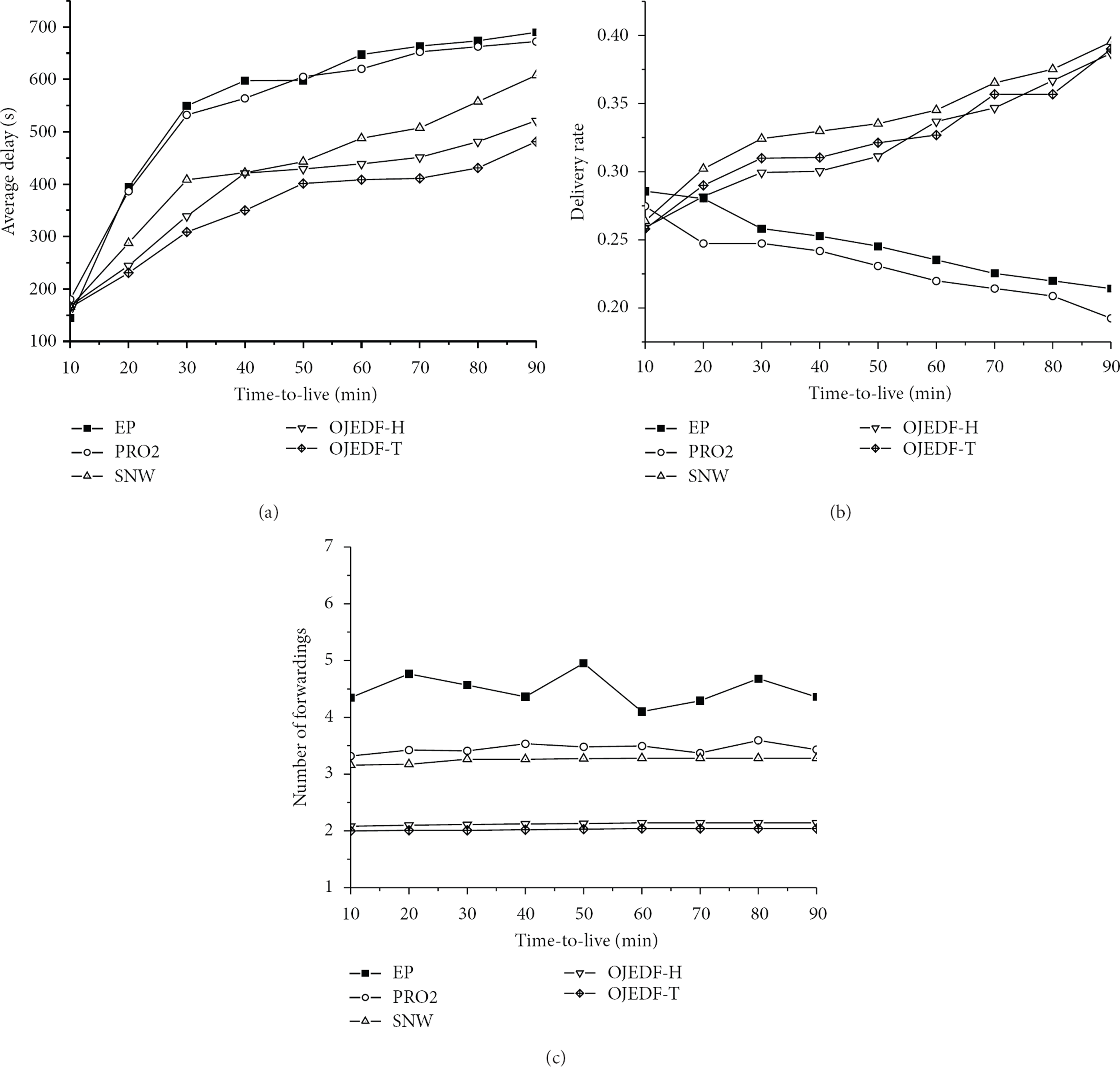
(a) Average delay with different TTLs using St. Andrews encounter trace. (b) Delivery rate with different TTLs using St. Andrews encounter trace. (c) Number of forwardings with different TTLs using St. Andrews encounter trace.
Figure 10(b) showed the delivery rate with different TTLs. With increasing TTL, more messages were unable to be forwarded due to the restraint of buffer size. As a result, the delivery rate of EP and PRO2 trended to decrease. On the contrary, the delivery rate of SNW and OJEDF increased with increasing TTL. The delivery rates of OJEDF-H and OJEDF-T were 4.9% and 3.8% lower than that of SNW, respectively.
Figure 10(c) showed the number of forwardings with different TTLs. OJEDF outperformed all protocols in terms of the number of forwardings with all TTLs. Specially, the numbers of forwardings of OJEDF-H and OJEDF-T were 34.69% and 37.66% lower than that of SNW, respectively.
6.2. Simulation Using Illinois Encounter Trace
Illinois encounter trace is the dataset of MACs of Bluetooth and Wi-Fi access points collected by the University of Illinois Movement (UIM) framework using Google Android phones. The set of Bluetooth and WiFi traces were collected by 28 users for 3 weeks in 2010. These people are staff, faculties, graduates, and undergraduates at the University of Illinois. Each UIM experiment phone encompasses a Bluetooth scanner and a Wi-Fi scanner capturing both Bluetooth MAC addresses and Wi-Fi access point MAC addresses in proximity to the phone.
To unify the network interface in simulator, we only used the Bluetooth trace. Considering the constraint of buffer and external event queue, only 7017 external encounter events from February 26, 2010 07:00:42 to February 26, 2010 22:59:57 were employed. We found seven different MAC addresses in this period.
We tested the performance with different message overload. The intervals of message generator were varied from 100 s to 500 s. Figures 11(a), 11(b), and 11(c) showed the simulation results using Illinois encounter trace. Like the results in St. Andrews encounter trace, EP and PRO2 still have higher average delay than other copy constrained algorithms. The average delay rates of OJEDF-H and OJEDF-T were 6.09% and 12.14% lower than that of SNW, respectively. The delivery rate increased when the overload decreased. All of the delivery rates are lower than 21%. This is because about 38.08% of the total 7017 contacts occurred between user 3 and user 4 or between user 4 and user 6. These unevenly distributed contacts led to low delivery rate when we only employed the encounter trace in one day. Different from Saint Andrews encounter trace, we set a big buffer relative to message size, so the delivery rates of EP and PRO2 were higher than those of OJEDF-H and OJEDF-T. The delivery rates of OJEDF-H and OJEDF-T were 15.55% and 9.66% lower than that of SNW in average, respectively. OJEDF still had the least forwardings for each message. The numbers of forwardings of OJEDF-H and OJEDF-T were 10.90% and 11.86% lower than that of SNW, respectively.
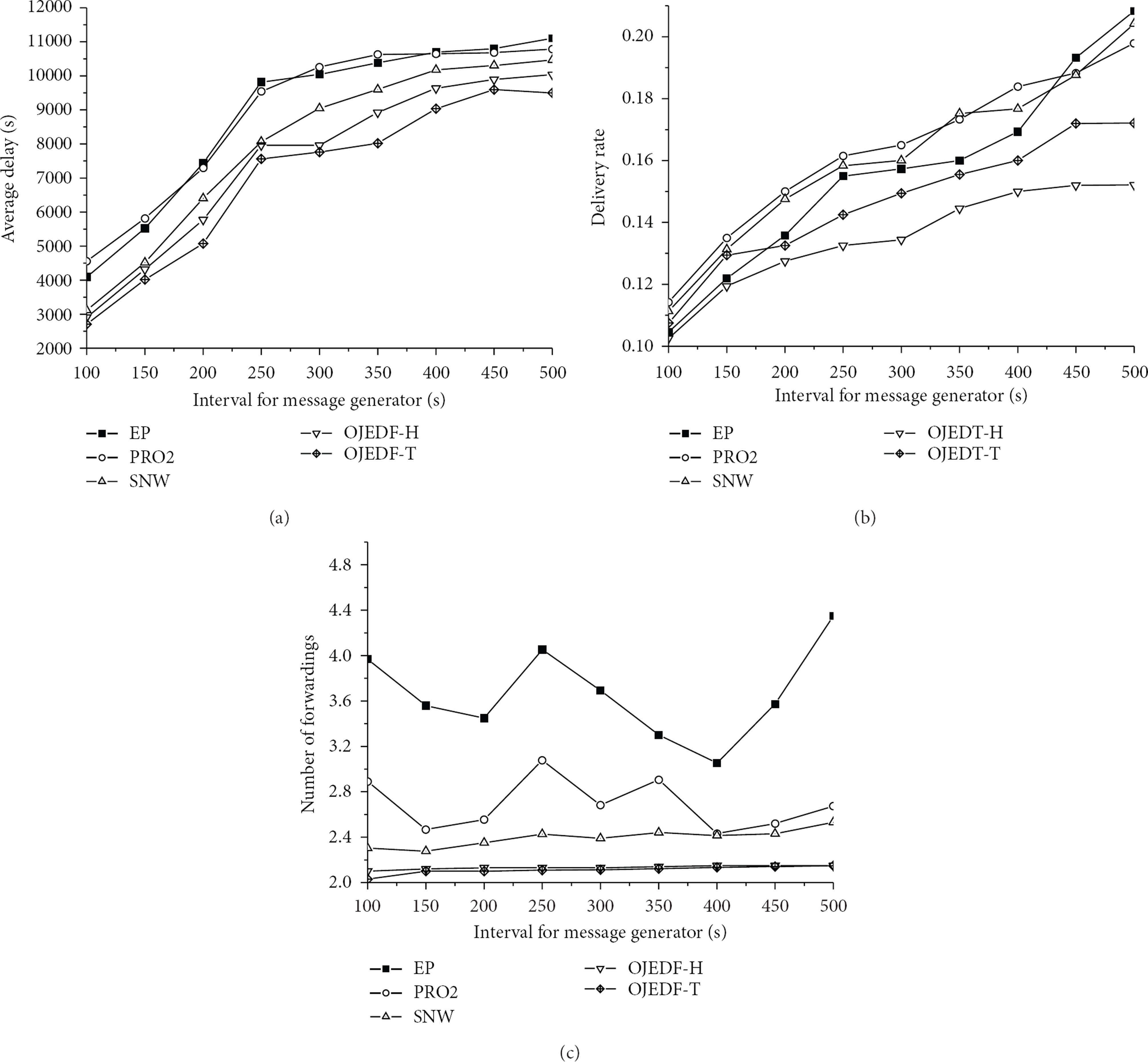
(a) Average delay with different interval for message generator using Illinois encounter trace. (b) Delivery rate with different interval for message generator using Illinois encounter trace. (c) Number of forwardings with different interval for message generator using Illinois encounter trace.
We compared the performance with different TTLs. Large TTLs (from 100 minutes to 500 minutes) were used in our simulations. Firstly, the valid encounters lasted for 230301 seconds at 02-26-2010 in Illinois encounter trace. Secondly, the encounters were unevenly distributed between seven persons. As a result, many copies need more time to find useful encounters during all simulation time and to meet the destinations ultimately.
Figures 12(a), 12(b), and 12(c) showed the performance of different algorithms with different TTLs using Illinois encounter trace. The average delay rates of EP and PRO2 were lower than that of SNW. This profited from flooding based diffusion and sufficient buffer. OJEDF outperformed all protocols in terms of the average delay with all TTLs. The average delay rates of OJEDF-H and OJEDF-T were 47.93% and 52.76% lower than that of SNW, respectively. The delivery rates of all protocols increased with increasing TTLs in Illinois encounter trace scenario. The delivery rates of OJEDF-H and OJEDF-T were 28.61% and 21.91% lower than that of SNW, respectively. But the numbers of forwardings of OJEDF-H and OJEDF-T were 11.65% and 12.37% lower than that of SNW, respectively.
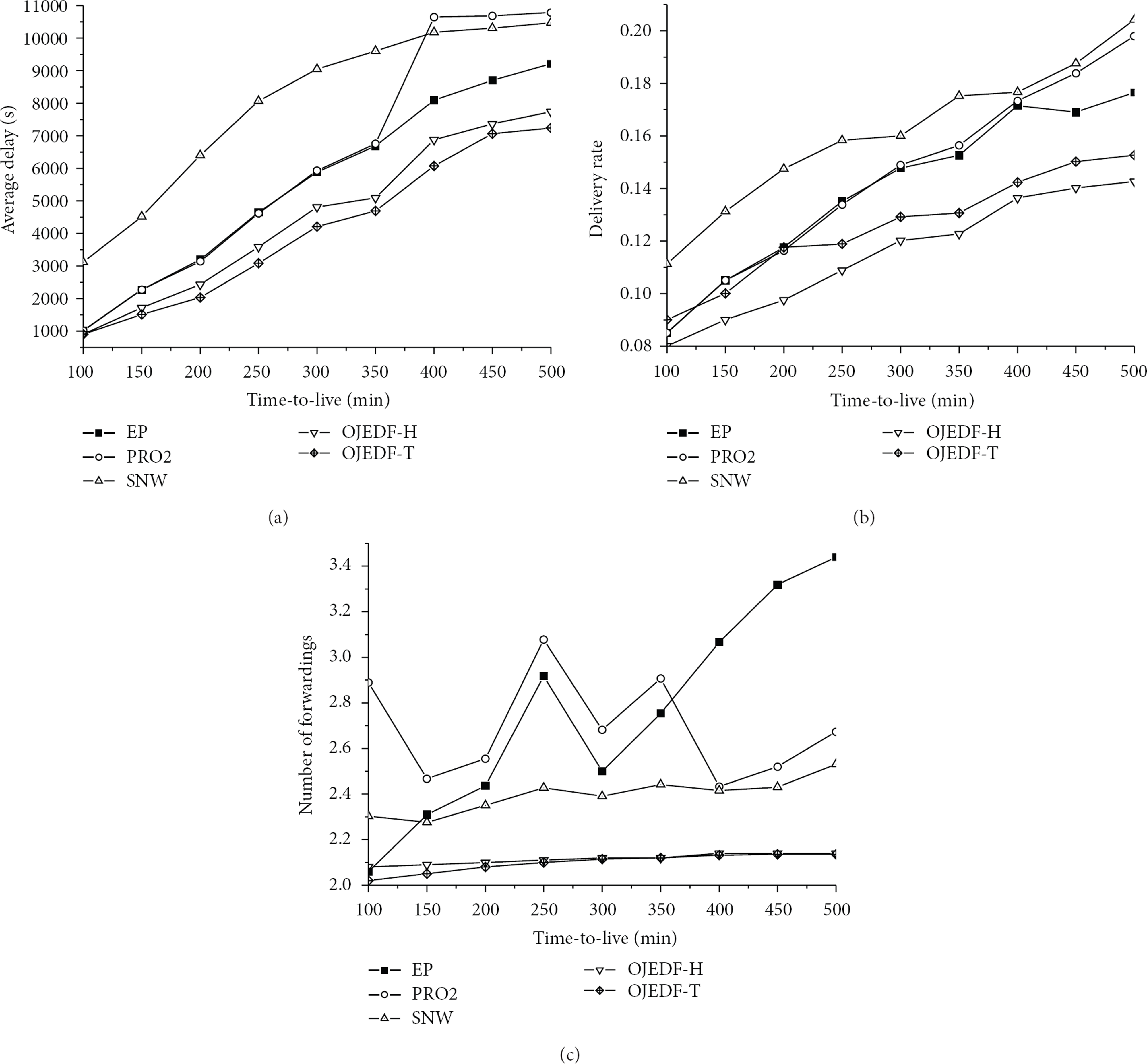
(a) Average delay with different TTLs using Illinois encounter trace. (b) Delivery rate with different TTLs using Illinois encounter trace. (c) Number of forwardings with different TTLs using Illinois encounter trace.
6.3. Summary of Simulation
Simulation results confirm that OJEDF outperforms all protocols in terms of average delivery delay and forwarding cost using both St. Andrews encounter trace and Illinois encounter trace. The delivery delay and the number of forwardings of OJEDF-H are 18% and 23% lower than those of SNW while decreasing only 15% delivery rate. OJEDF-T is more accurate than OJEDF-H in terms of copy control. The delivery delay and the number of forwardings of OJEDF-T are 24% and 25% lower than those of SNW while decreasing only 12% delivery rate.
7. Conclusion
In this paper, we provide an optimal forwarding protocol which minimizes the expected delay while satisfying the constant on the number of forwardings per message. We propose the optimal joint expected delay forwarding which makes optimal forwarding decisions by modeling forwarding as an optimal stopping rule problem. We firstly employ the comprehensive dynamic forwarding metric called joint expected delay (JED) which is a function of two important states of a message copy: remaining hop-count and residual lifetime. Then we propose the forwarding rules to decide whether to forward the copies. Based on the hop-count constraint forwarding scheme, we propose a general ticket constraint OJEDF which can be viewed as a development of Spray and Wait with special spray metric. We also present an extension to allow OJEDF to run in delay constrained scenarios. We implemented OJEDF as well as several other protocols and performed trace-driven simulations. Simulation results verified the efficiency of OJEDF.
In the future, we will perform simulations on the extended version of OJEDF, that is, estimating the minimum hop-count or tickets to meet the constrained delay. We will also do research on the expansibility and adaptability of OJEDF when only partial routing information is known.
Footnotes
Acknowledgments
This research was supported in part by the National Natural Science Foundation of China (61100199), the Scientific and Technological Support Project (social development) of Jiangsu Province (BE2013666), the Natural Science Key Fund for Colleges and Universities in Jiangsu Province (12KJA520002), the Special Fund of postdoctor (2013T60553), the Jiangsu Provincial Natural Science Foundation of China (BK2011692), the Postdoctoral Foundation (20110491453), the Jiangsu Planned Projects for Postdoctoral Research Funds (1101126c), the talents project of Nanjing University of Posts and Telecommunications (NY210077), and the Project Funded by the Priority Academic Program Development of Jiangsu Higher Education Institutions (yx002001).