




Abstract
Affective computing draws more and more attention to the human-computer interaction. Based on physiological signals acquired by body sensor network, within the affection recognition process, the problem that training samples have larger class distance and smaller intraclass distance must be considered. For the class divisibility and intraclass compactness problem, researching method of samples validity was proposed based on metric multidimensional scaling. With dissimilarity matrix, scalar product matrix was calculated. Subsequently, individual attribute reconstructing matrix could be got using principal components factor analysis to display samples difference in low dimension. By means of experiment results, training and testing samples for sentiment classifier will be selected instructionally.
1. Introduction
To realize natural human-computer interaction, more personalized services are required during the interactive process. Therefore, it is an effective way to bring in a user's affection with body sensor network to the service. The artificial psychological and affective computing are becoming new research directions in the field of artificial intelligence [1]. Generally, researches focus on simulating affective recognition, modeling, and expression mainly. The affective recognition consists of two types. One is recognizing user's affection which is user centered, and the other is recognizing affection in content, such as light effect, context, and characters in film, music, and art painting, which is content centered [2].
For the first type, researches can use multitypes of sensors to measure user's affection. Kim et al. surveyed the amount of sweat, pulse, body temperature, and blood pressure. Based on this physiological information, they determined the user's affective state after data fusion and fuzzy inference [3]. Nguyen used fewer sensors, only with pulse and body temperature, to acquire affection [4]. Arapakis proposed a method with facial expression [5]. In addition, the measuring method also includes the questionnaire or its extended form. It is an indirect way. González et al. used emotion quotient (EQ) test table [6]. Ai Thanh Ho provided a group of different colors to select for user and determined the user's affection based on his selection. The features of these affection acquiring methods are compared in Table 1.
Comparison among the methods of affection accessing.

The method based on the user's physiological information to judge the affective state is better than others in portability, signal continuity, sensibility, and comfort as shown in Table 1. Therefore, researches on physiological divisibility of affection attract the interest of researchers in the field of human-computer interactionMany psychologists got different conclusions on autonomic nervous system (ANS). On the one hand, paper [7], regarded that the “detest” affection has specific ANS proposed. But on the other hand, the opposite researching view was also studied in [8]. However, the existence of specific affection ANS has got more and more support from recent studies [7–16]. In the research of affection recognition based on physiological signals, some affective physiological data sample libraries were established as shown in Table 2. However, these libraries provide a foundation for comparison and analysis of affective physiological feature selection and sentiment classification, whether they are valid, that is, whether or not having a larger class distance and a smaller intraclass distance, as training data is worthy of study. For the affective physiological database proposed in [17], this paper analyzes the divisibility and compactness of 20 groups of samples with 8 kinds of affections.
Library of affective physiological samples.

2. Affective Physiological Samples
Affective database DataSet I, which is established by Picard, recorded physiological data of 20 days. The samples include 4 types: myoelectricity E, pulse B, skin conductance S, and respiratory R. And the affective states have 8 classes. They are calmness (N), anger (A), hate (H), grief (G), platonic love (P), romantic love (L), joy (J), and reverence (R). These signals were sampled in 100 seconds. The length of the time series is

Data organization of affection database DataSet I.
3. Analysis of Divisibility and Compactness
In the affective state discriminating process with physiological signals, for feature-based classification methods, the training samples and selected feature impact on the classifier directly. Due to the different deployment of sensors in body sensor network and the participant's daily life, training samples have more noise. So samples, which have a larger class distance and a smaller intraclass distance, should be selected to train the classifier. In addition, for different feature sets, dispersion between classes or within one class should be discussed. Therefore, after selecting a certain feature set, validity analysis for affective physiological sample is one of the key factors in training the affective state classifier. Based on the multidimensional scaling theory, this paper illustrates a general validity analysis method by using the dataset proposed in [17]. From the view of similarity or dissimilarity of affective physiological signals, we represent the samples in the low-dimensional space to reveal the underlying structure of the sample.
The literature in psychophysiology and related disciplines described features about affective state recognition based on facial muscle movement, heart rate changes, and so on [10]. Picard et al. proposed 6 static characteristics. They are mean value 

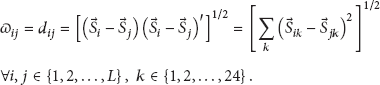


At the same time, it is easy to obtain eigenvalues 
4. Experiment
4.1. Class Divisibility
Take 8 classes of affective state feature vector on the day D to form a matrix

Restructuring graph of affective eigenvectors on the Dth day.
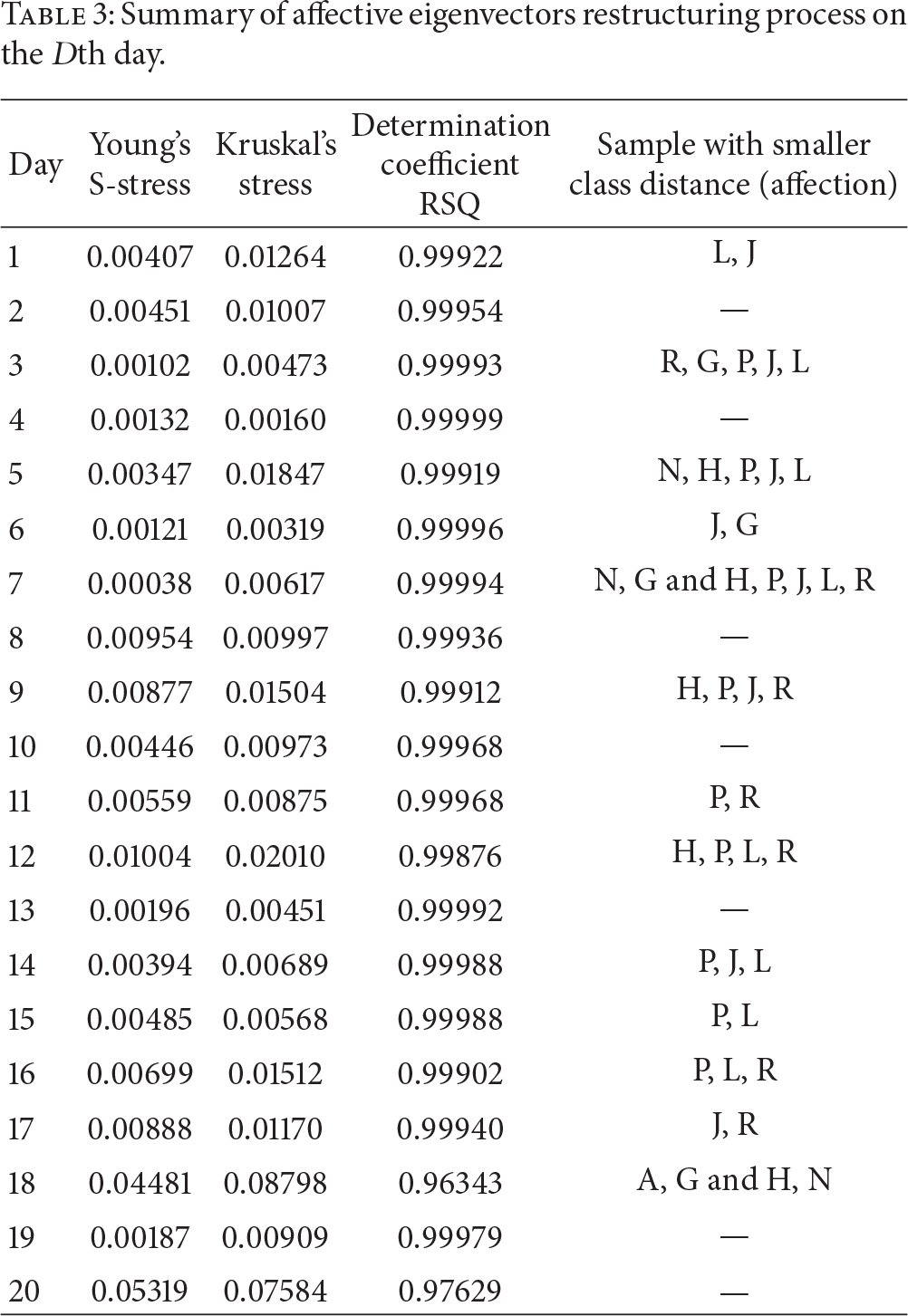
In Figure 2, N, A, H, G, P, L, J, and R represent 8 classes of affective states, respectively. The axes of the left figures mean relative distance between reconstructive points. Take Figure 2(a) as an example; points L and J are closer, which demonstrates that the two types of affection, romantic love L and happiness J, only have few differences for the first day samples while affective physiological data are described with 6 static features above. Their class divisibility is too poor to train an effective classifier. Points R, P, H, and G have few differences in dimension II but some differences in dimension I. However, there are large differences for points A and N no matter in dimension I or II.
The right part of Figure 2(a) shows the linear fit scatter plot of reconstruction process. The x-axis means the samples disparity, and the y-axis reflects the fitting distance. Fitting coefficient
Summary of affective eigenvectors restructuring process on the Dth day.
4.2. Intraclass Compactness
Affective state feature matrix

Restructuring graph of 8 types of affective eigenvectors.
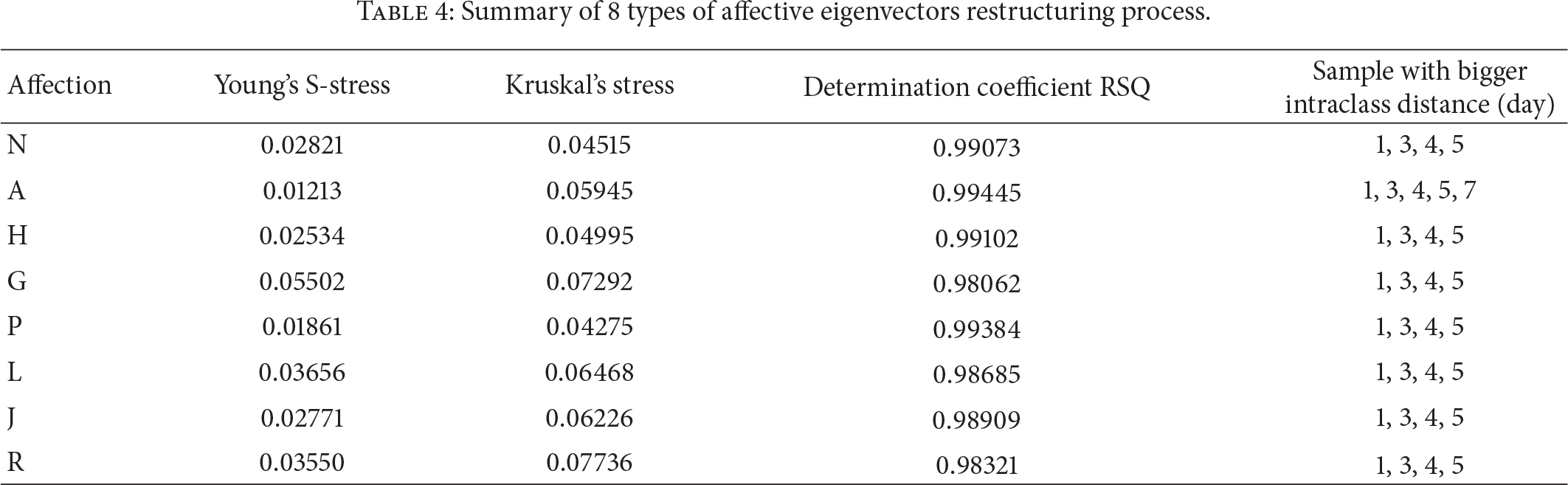
In Figure 3, points Day 1–Day 20 denote the eigenvectors of 20 days for the same kind of affective state. From the left part of Figure 3, the axes also mean relative distance between reconstructive points. Points Day 1, Day 3, Day 4, and Day 5 are far away from the rest of the reconstructive points. That is to say intraclass distances of the same type of affective physiological data for the first day and the 3th–5th days are larger. Their intraclass compactness is poor. In addition, the 7th day samples also have a larger intraclass distance for anger affective state.
The right part of Figure 3 shows the linear fit scatter plot of reconstruction process. The x-axis means the samples disparity, and the y-axis reflects the fitting distance. Fitting coefficient
Summary of 8 types of affective eigenvectors restructuring process.
5. Conclusions
As training samples of a classifier, the validness of affective physiological feature vectors is worthy of study. Larger classes distance and smaller intraclass distance are needed. An analysis method is proposed for body sensor network, which collects affective physiological data. Particularly, in this paper, we take the affective physiological database DataSet I as an example, and analyze divisibility and compactness of 20 groups of samples belonging to 8 types of affections.
Based on the 6 static features described by formulas (1)–(2), with the samples in DataSet I, class divisibility is poor for the 4 types of affection P, L, J, and R in one day. And for the same affective type, intraclass compactness is poor for the 1st, 3rd, 4th, and 5th days.
Footnotes
Acknowledgment
This work was supported by the Foundation for Young Scholars of Hebei Educational Committee (QN20131152, Q2012070).