




Abstract
The vibration band gaps in the phononic crystal (PC) Euler beam on two-parameter foundation are investigated theoretically by the combination of the transfer matrix (TM) method and Bloch theorem. Compared with the Winkler foundation with only the foundation reaction modulus k, the shear modulus
1. Introduction
Elastic beam structures anchored on a foundation, normally regarded as a basement or supporting part of a system, are widely used in civil engineering [1]. They are always suffered by dynamic loading that may lead to fatigue damage, parametric resonance, and so forth. Evaluating, controlling, and eliminating their dynamic response is a permanent topic for the scientists. In the recent years, the concept of phononic crystals (PCs) is introduced to the beam-foundation system and relevant research shows that PC beam-foundation system can cause considerable attention in a certain frequencies range to decrease the influence of vibrations. In order to evaluate the dynamic response of these structures effectively, Winkler foundation model is commonly used. The concept of Winkler foundation model is that the parameter k represents the stiffness of the foundation. This model is easy to be understood and calibrated by the computing method [2–4].
In 1993, Kushwaha first put forward the concept of phononic crystals (PCs) [5]. These kinds of artificial periodic composite materials have caused much attention because of the existence of the band gaps. The elastic wave in the frequencies range of the band gaps cannot be propagated so that the PCs have wide potential applications such as noise control, improvements in the design of transducers, wireless communications, new acoustic devices, and vibration absorption [6–9]. The introduction of PCs to beam and then to beam-foundation system is available to be applied in engineering. Jensen verified firstly that vibration band gaps exist in one-dimensional PC bars by experimental study [10]. In the work of Wen et al., the concept of PC was introduced to the periodic beam and a series of laboratory experiments and numerical calibration have been performed to verify the results [11, 12]. Ma studied vibration isolation properties of periodic copper reinforced concrete Timoshenko beams on Winkler foundation. When the length is significantly larger enough than the cross section size of beam, it can ignore the effects of the shear deformation and rotary inertia. Thus, Timoshenko beam can be simplified to the Euler-Bernoulli beam (Euler beam). Meanwhile, several theoretical methods have been developed for calculating the band structure of PCs, such as the TM method [8, 13–17], the plane wave expansion (PWE) method [18, 19], the finite difference time domain (FDTD) method [20–22], the multiple scattering theory (MST) [23, 24], and the lumped-mass (LM) method [25].
As a matter of fact, the relevant research about the PC beam-foundation system is based on the Winkler foundation model and the continuity of deformation of the foundation has not been taken into account [26–28]. To overcome the disadvantage of this “one-parameter” Winkler foundation model, in this paper, two-parameter foundation model is to be introduced to PC beam-foundation system and this improvement can apply more precise analysis according to continuity of deformation of foundation [29]. First, we present the detailed derivation of the TM method for the calculation of band structures in the PC Euler beams on two-parameter foundation. Then, we use a lead-copper PC Euler beam to illustrate the propagation characteristics of transverse vibration in the system. Finally, we analyze the impact of the parameters of foundation and geometric parameters on the band gaps.
2. Theory
2.1. General Vibration Equation
Winkler foundation model was proposed by Czech Engineer Winkler in 1867; the model assumes that the subsidence at a point in the contact is affected to different degrees by the pressure [30]. Thus, the contact surfaces can be regarded as a set of independent springs. The shear stress between them is neglected, so the contact pressure at a point is only dependent on the actual deformation at that point. When the foundation generates the vertical deformation, there is no friction between the foundation and the foundation, and only the normal stress rather than shear stress. In fact, the foundation has shear stress and produces stress diffusion at the same time. Two-parameter foundation introduces two independent parameters, which are the foundation reaction modulus k and the shear modulus G p , to represent the characteristics of the foundation. Considering the interaction of the foundation, the pressure could produce diffusion in the foundation. Therefore, the two-parameter foundation is more suitable for the frictional material such as soil and rock than Winkler foundation.
Considering the homogeneous Euler beam support in accordance with the assumed elastic foundation, as shown in Figure 1, the governing equation of the flexural-free vibration becomes

where y(x, t) is the lateral displacement; E and I, respectively, are the elastic modulus and the area moment of inertia with respect to the axis perpendicular to the beam axis; ρ is the density; A is the cross-sectional area. For the rectangular beam, A = bh, in which b and h, respectively, are the width and the height of beam.

Flexural-free vibration of homogeneous Euler beam on a two-parameter foundation.
When F(x, t) = cy(x, t), where c = kb, in which k is the foundation reaction modulus, it is Winkler foundation; when
2.2. General Vibration Solution
For a harmonic solution y(x, t) = y(x)T(t), y(x) is the amplitude, and its particular solution form is y(x) = Ae sx . Substituting it into (1), we can obtain the characteristic equation
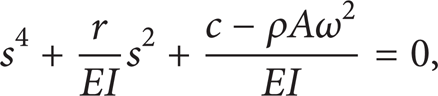
where ω is the vibration circular frequency. Let
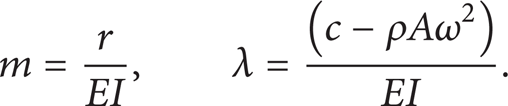
When m2 – 4λ > 0, λ ≥ 0, the general solution of (2) can be written as

where A, B, C, and D are the state parameters,
In Euler beam, the amplitudes of the rotation angle, bending moment, and shearing force are given by θ(x) = y′(x), M(x) = – EIy′′(x), and Q(x) = – EIy′′′(x), where y′(x), y′′(x), and y′′′(x) are the first, second, and third derivatives of y(x) with respect to x. According to (4), the matrix form of the y(x), θ(x), M(x), and Q(x) can be written as

where


When m2 – 4λ > 0, λ < 0, the general solution can be written as

where

C2j, C3j, C4j can be expressed as the form of (7).
When m2 – 4λ ≤ 0, the general solution can be written as

where

C2j, C3j, C4j, can be expressed as the form of (7).
2.3. The TM Method for Flexural Vibration PC Euler Beam on a Two-Parameter Foundation
Figure 2 illustrates a straight PC Euler beam on a two-parameter foundation. The beam consists of an infinite repetition of alternating segment j (j = 1,2, …, n) with material j and length l
j
arrayed along the x direction. The lattice constant is

The PC Euler beam on a two-parameter foundation composed of n kinds of materials, and ((b)–(d)) the cross-sectional sizes of different segments.
Using the idea of the TM method and using (4), (8), and (10), the vibration amplitude of segment j in the mth primitive cell is given as

where x L is the local coordinate corresponding to the internal coordinate x of segment j, and thus x L ∈ [0, l j ]. The continuities of the displacement, rotation angle, bending moment, and shearing force at the interface of segment j and j + 1 in the mth primitive cell give

or can be written as follows:

where
Deduced by analogy we can got

Then the continuity conditions between the mth primitive cell and the m + 1th primitive cells give

Substituting (15) into (16) can give
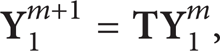
where
Due to the periodicity of the infinite structure along the x direction, using Bloch theorem [14], we can obtain

where
Substituting (18) into (17) can obtain an eigenvalue problem that contains the dispersion relation of the flexural vibration PC Euler beams on a two-parameter foundation as

where
For a given circular frequency ω, (19) can calculate the wave vector q, then we can obtain the band structure of PC Euler beam on a two-parameter foundation.
3. Results and Discussion
3.1. Validation
To validate the proposed method for calculating the band structures, the PC Euler beam composed of a lead (material A) and a copper (material B) on a foundation is studied. Material properties are given in Table 1. The geometrical parameters are chosen as l A = l B = 0.5 m, and the lattice constant a = 1.0 m; b A = b B = 0.05 m; h A = h B = 0.05 m. The analysis of frequency responses, performed by Abaqus software with finite element method (FEM), provides an approach to verify the above theoretical deduction. Due to the limit of Abaqus, the shear modulus is neglected and the foundation reaction modulus is chosen as k = 30.0 × 10⁶ Nm−3. Figure 3 shows the transverse vibration band structure in the range of 0–400 Hz. There are 3 band gaps which are the blank areas separated from the horizontal axis and curves. The ranges are 0–38.5 Hz, 59.4–85.3 Hz, and 226.6–274.1 Hz. We also calculate the frequency responses of the vibration for the 8-cell corresponding PC Euler beam. We apply the harmonic displacement impulse that sweeps over the range of 0–400 Hz to one end of the finite periodic structure, and then get the frequency response at the other end. The frequency ranges with distinct attenuation correspond to the band gaps. The attenuation properties in the BGs are shown in Figure 4. Three band gaps exist in the range of 0–400 Hz and they are 0–38.9 Hz, 67.9–93.0 Hz, and 215.9–265.0 Hz. The comparison of the BGs ranges are shown in Table 2. It is evident that the band gaps obtained by the TM method and analysis of the frequency response have a good agreement.
Material parameters.

Comparison of ranges of BGs (Hz).


Band structures for the lead/copper PC Euler beam resting on a Winkler foundation.

Frequency of responses of the 8-cell PC Euler beam on a Winkler foundation.
3.2. Influence of the Two Parameters of Foundation
The influence of the shear modulus G p is first discussed. Examples with the same geometrical parameters and material properties mentioned above are calculated. The foundation reaction modulus k is fixed as 30.0 × 10⁶ Nm−3 while the shear modulus G p is changed in the range of 0−12 × 106 Nm−1. As mentioned above, the two-parameter foundation, with G p = 0 × 106 Nm−1, is simplified to one-parameter Winkler foundation such as a spring foundation. Figure 5 shows the influence of the shear modulus. With the increasing of the shear modulus, the end frequency of the first band gap is unchangeable while the start frequency and the end frequency of the 2nd band gap increase almost linearly. The range of the second band gap becomes narrower. Compared with the Winkler foundation, the existence of the shear modulus demonstrates the apparent effect. With the increase of the shear modulus, it has no impact on the distribution of the first band gap while the second band gap trends to higher frequency. With the increasing of the frequency and the shear modulus, Winkler foundation may cause unacceptable calculation errors and it is not suitable to solve the vibration problems any more. For example, a soil foundation and a spring foundation with the same k as 30.0 × 10⁶ Nm−3 and different G p as 10 × 106 Nm−1, 0 × 106 Nm−1, respectively, have the obvious different band characters by two-parameter foundation. In contrast, they have no distinction by Winkler foundation that is not logical. It is concluded that the introduction of the shear modulus G p can provide a more precise answer about the distribution of band gaps due to the continuity of deformation of the foundation.
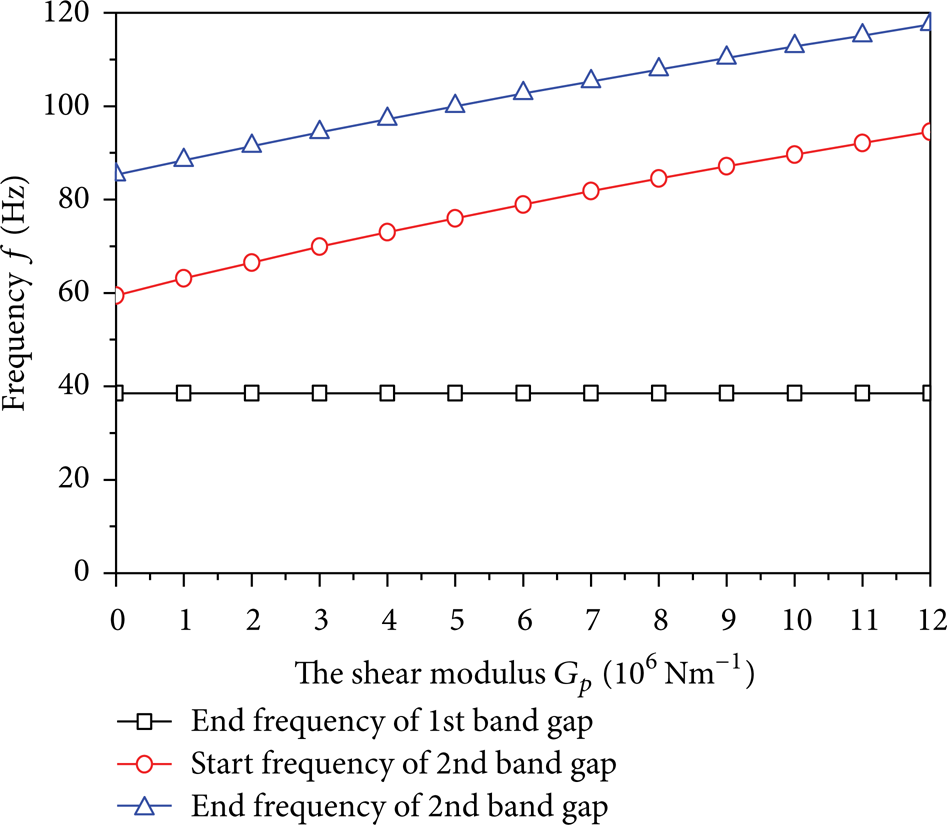
The influence of the shear modulus on flexural vibration band gaps.
Then we study the influence of the foundation reaction modulus k. We construct the examples with the same materials. The shear modulus G p is constant as 10.0 × 10⁶ Nm−1 while the foundation reaction modulus k ranges from 5 × 10⁶ Nm−3 to 60 × 106 Nm−3. The influence on the band gaps is shown in Figure 6. Along with the increase of the foundation reaction modulus, the end frequency of the first band gap increases, the start frequency and the end frequency of the secnd band gap increase nearly linearly, and the range of the second band gap becomes narrower. The existence of foundation reaction modulus effects not only the distribution of the first band gap but also the other band gaps. With the increase of the foundation reaction modulus, the band gaps of PC Euler beam on two-parameter foundation trend to higher frequency and the first band gap which starts at 0 Hz becomes wider.

The influence of the foundation reaction modulus on flexural vibration band gaps.
3.3. Influence of Length Ratio of the Segments
The length ratio of the segments is defined as

The influence of the length ratio on flexural vibration band gaps.
Assuming an extreme condition that l
B
is equal to 0, the structure of PC Euler beam on two-parameter foundation is simplified to the general homogeneous Euler beam on two-parameter foundation. We calculate the case with
Comparison of ranges of band gaps (Hz).

In a word, for the purpose of getting available band gaps in different applications, a series of measurement can be applied such as selecting a suitable foundation material, adjusting the length ratio of the segment.
4. Conclusions
We derive the TM method to calculate the flexural vibration band structure of PC beam on the two-parameter foundation. Compared with the general Winkler foundation, the introduction of the shear modulus G p has a clear advantage for the foundation composed with frictional materials. The effect of the continuity of deformation is taken into account and this improvement can apply more precise analysis. The propagation of flexural vibration is studied by both the TM method and the frequency response analysis. To obtain different band gaps, the influence of the two parameters of foundation and the length ratio of the segment is analyzed systemically. Analysis shows that PC Euler beam on two-parameter foundation has better vibration isolation characteristics, compared with the homogeneous Euler beam. This study helps to obtain flexural vibration band gaps on the beam-foundation system, especially in the case of frictional foundation.
Footnotes
Acknowledgments
This work was supported by the National Natural Science Foundation of China (Grant nos. 50978085 and 51278167) and the Fundamental Research Funds for the Central Universities of China (Grant no. 2013/B13020166).