




Abstract
In wireless sensor networks, coverage holes are caused by energy depletion at some nodes, and the aim of this paper is to study how to utilize the redundant nodes with remaining energy. Particularly, this paper proposes a vector algebra based algorithm by exploring redundant nodes as an extra dimension for coverage compensation. This algorithm consists of two parts. One is to find the locations of potential redundant nodes for coverage compensation; and the other is to opportunistically select the best redundant nodes by jointly considering the hole boundaries and the remaining energy of nodes. Simulation results are provided to demonstrate that the proposed algorithm minimizes the energy consumption when repairing the holes for full coverage. Furthermore, compared with other algorithms, the proposed one exhibits better performance in terms of moving distance and energy consumption.
1. Introduction
Wireless sensor networks (WSNs) are composed of numerous small-size sensors that have various features, such as low cost, light weight, high mobility, and capabilities for sensing, computing, and communications. The sensor has the same capabilities as the machine does. In fact, WSNs are one of typical application of machine to machine communications. The “smart home” is just an example. It is not only a good application based on WSN but also an instance of machine to machine communications. With these features, WSNs have been widely used in many fields, including intelligent transportation, military applications, infrastructure monitoring, antiterrorism disaster relief, environmental monitoring, wireless healthcare, and target tracking [1–3].
Coverage is an important metric of the quality of service (QoS) in WSNs [4, 5] and is a fundamental issue since each sensor is energy constrained. The reason why some areas are not covered is due to random deployment of sensors, node energy depletion, or environmental damages. Consequently, coverage holes appear in various parts of WSNs [6, 7], significantly reducing the QoS and the lifetime of the network. An important observation is that a number of inactive redundant nodes also exist in the network, which results in the simultaneous coexistence of two types of sensors, one with extra energy and the other with drained batteries. In hybrid WSNs, such a difficulty can be overcome by moving mobile redundant sensors to the locations at which coverage holes occur.
Many recent studies on patching holes by exploring mobile nodes are based on geometry. Reference [8] proposed the Coverage Hole Patching Algorithm (CHPA), which selects the patching point along the perpendicular bisector between any two adjacent hole boundary nodes. The distances between the selected point and the corresponding two boundary nodes are equal to the communication radius. This algorithm can be easily implemented due to its low complexity but suffers low resource efficiency. To overcome this shortcoming, the two-point vertical determination method was modified to a three-point approach in the Patching Algorithm Triangle by Triangle based on mobile node (PATT) [9]. Compared with CHPA, PATT can achieve better stability and higher coverage but does not consider the use of the existing redundant sensors. Reference [10] proposed the use of a vector algebra distributed method to achieve effective deployment of redundant nodes. This algorithm effectively uses the existing redundant resources while maintaining a sufficient level of coverage. However, [10] did not consider the energy consumption caused by long-distance moving.
In order to use such redundant node resources, this paper proposes a novel mobile node scheduling algorithm, namely, a Dispatching Algorithm based on vector algebra at mobile node (DAVM), for patching holes in hybrid WSNs. Localization algorithms are independently carried out at both static and mobile nodes. Particularly, the first step of the proposed algorithm is to find where patching position is. Then the mobile sensors adjacent to boundaries calculate their moving distance and direction towards the patching position. Static nodes will select their best patching redundant nodes individually. The criterion for node selection is based on the largest remaining energy which is determined by moving distance and initial energy of redundant node. At last, the selected nodes will be activated and asked to move towards the patching positions. Those nodes are not utilized before they are activated. DAVM provides an effective method to utilize redundant nodes. It is worthy pointing out that redundant nodes calculate their corresponding patching positions by using the local and one-hop positioning information. And the proposed node scheduling method can not only avoid patching conflict caused by more than one redundant node nearby the boundaries but also minimize the energy consumption caused by node moving by inviting the nodes close to the boundaries. Simulation results are provided to demonstrate the superior performance of the proposed scheduling algorithm by comparing it with some existing schemes.
2. Preliminaries
2.1. Network Model
Consider a hybrid wireless sensor network which consists of randomly deployed n sensor nodes. These sensors comprise a set C, including both static nodes and mobile redundant nodes. Static nodes do not have energy harvesting ability, whereas mobile redundant nodes cannot move and sense until they are activated. Mobile redundant nodes have the same capacities as static nodes in terms of communication, sensing, and data processing. Moreover, mobile redundant nodes can have theapriori information about their own initial energy. The binary perception model is adopted at all of the nodes [11]. According to [12–14], the communication radius (
We assume that the coverage holes are closed and inside the monitoring region. We can obtain all the information about the boundary nodes of the coverage hole by using hole detection algorithm [17]. In [17], the maximum simple complex is built according to network topology. When a node is adjacent to the edges of the maximum simple complex network, this node is a hole boundary node but not vice versa.
2.2. Relative Definitions
Definition 1 (coverage hole).
If a continuous area is not covered by any sensor node in WSNs, this area is defined as a coverage hole [19]. As shown in Figure 1, the shadow area is a coverage hole. Given a set of boundary nodes
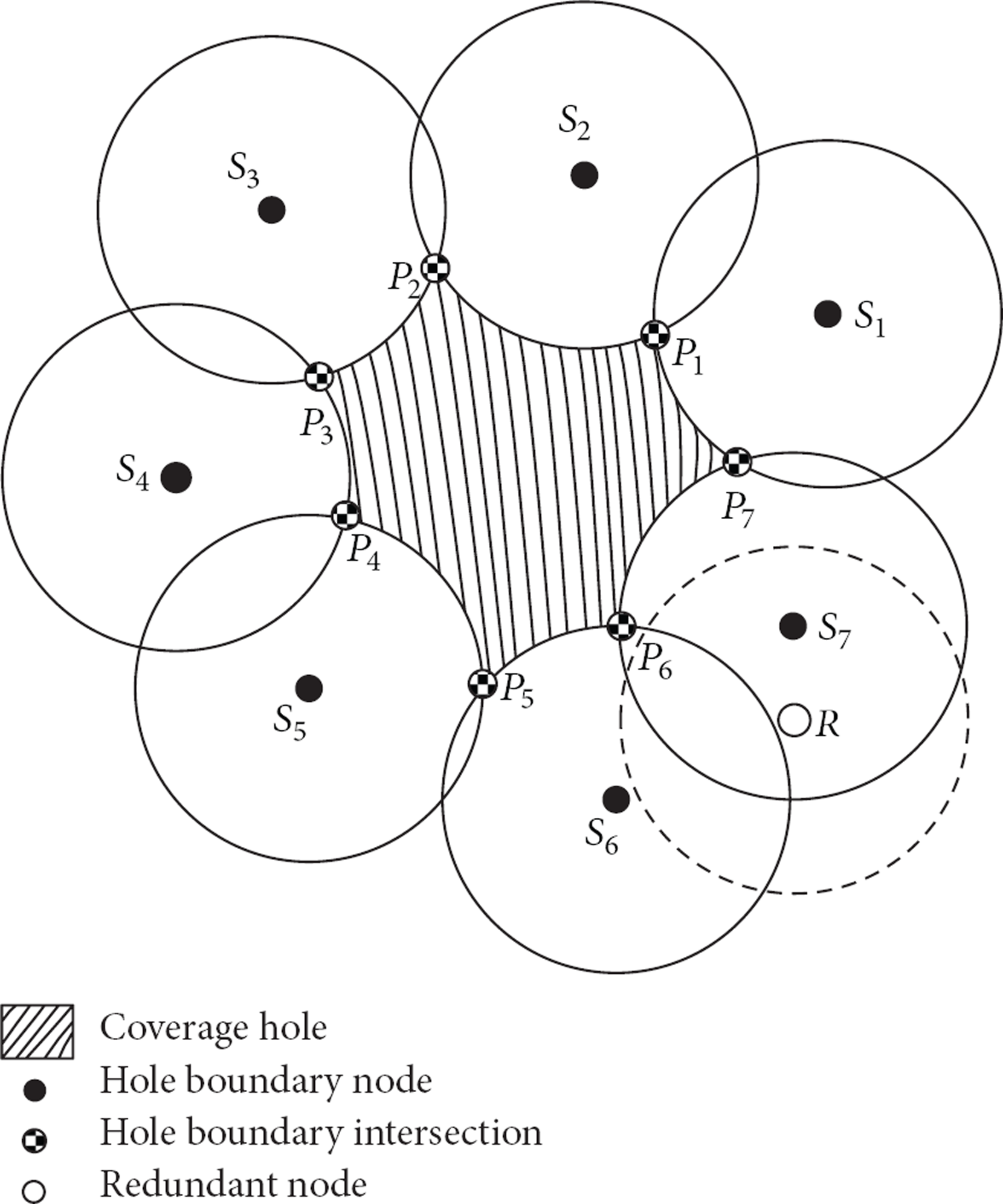
Coverage holes.
Definition 2 (hole boundary neighbor).
The two nodes
Definition 3 (hole boundary intersection).
If two hole boundary nodes intersect at one point within a hole that is beyond the scope of the third node's sensing range, then this intersection point is called a hole boundary intersection.
3. Vector Algebra Principles
The fundamental function of DAVM is to calculate the potential patching locations. In consideration of the existing coverage hole, vector algebra can be used to move the redundant nodes. Without any constraints, more than one redundant node can patch the hole. Therefore, choosing the best node is another challenging problem considered in DAVM. To be considered effective, DAVM needs to guarantee that the patching node covers the hole without splitting the hole; that is, the patching node does not generate new holes [20, 21].
Thus, DAVM consists of two parts:
3.1. Displacement of Redundant Node
(i) Moving Direction. Consider a part of hole boundary that includes


Mobility azimuth of R.
Case 1.
When
Case 2.
When
Case 3.
When
Case 4.
When
(ii) Moving Distance. The moving distance of R,

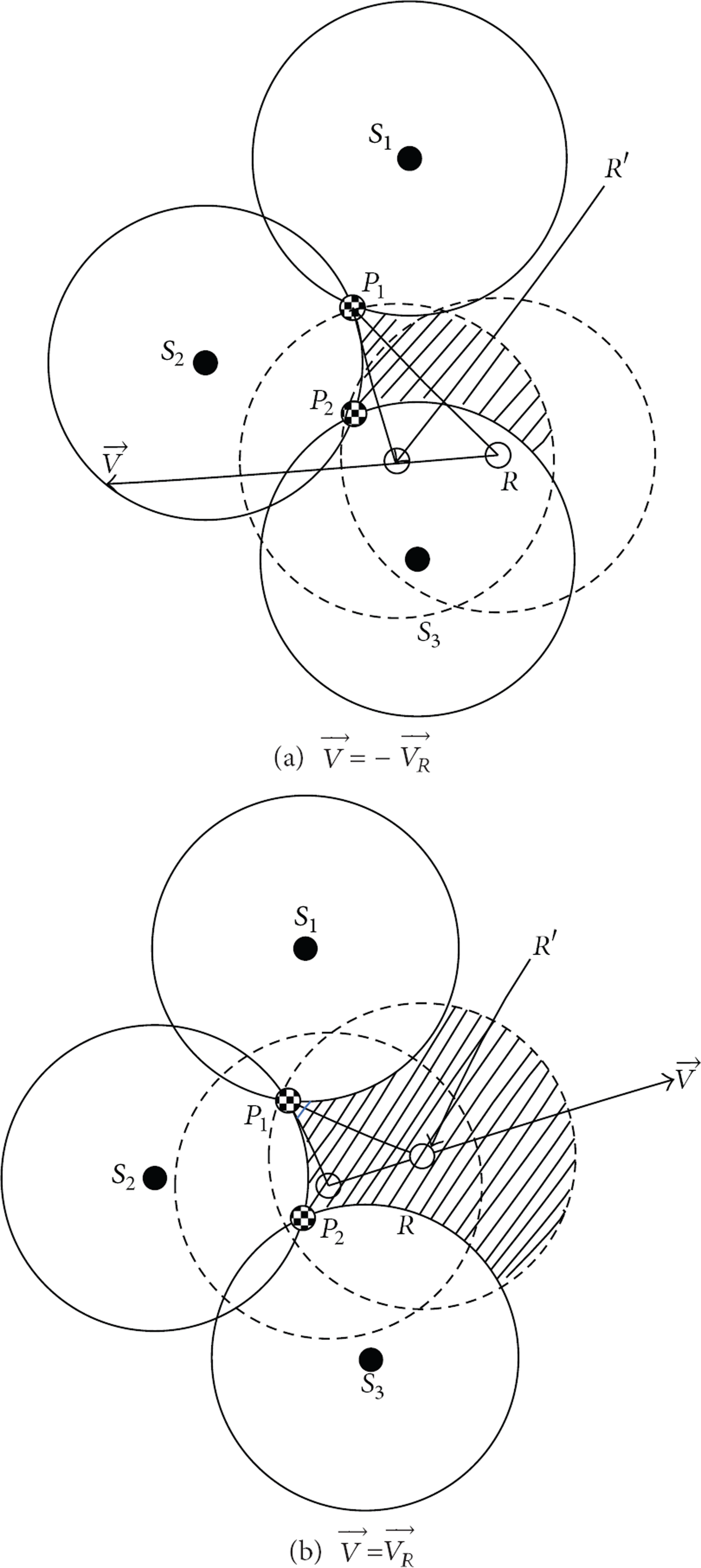
Moving distance based on the new position
The new position
3.2. Best Redundant Node
More than one node may try to participate into patching because of the high mobility of redundant nodes. To avoid patching collision, the best redundant node should be selected in terms of energy and moving distance. Thus, the evaluated remaining energy

Let
4. DAVM
In DAVM, the hole boundary node
4.1. Displacement Algorithm
When a redundant node
Step 1.
Calculate
Step 2.
Reply
Step 3.
Start the timer T.
Step 4.
If T is out of time, proceed to Step 6.
Step 5.
If
Step 6.
Enter a dormancy state.
4.2. Best Redundant Node Schedule
The hole boundary node
Step 1.
Calculate the value of
Step 2.
Step 3.
Wait for the feedback messages from the redundant nodes and update
Step 4.
Based on
Step 5.
Send activated command to
Step 6.
Update the set S.
4.3. DAVM for Multiple Holes
In applications, it is a fact that there is more than one hole in WSN because of random deployment. If these holes are separated and satisfy the network model in Section 2.1, DAVM can still work effectively through patching them one by one. It is not overlooked that the patching order of holes might affect the results of DAVM. That is, the set of nodes used for holes patching may not be the same if the holes are patched in different orders. But the local optimality can be obtained when patching multiple holes in sequence, because DAVM can select the best redundant node from the remaining redundant node.
5. Simulation
5.1. Simulation Environment
The simulations are implemented by using Matlab. DAVM is evaluated and compared with the coverage optimization algorithm (COA) mentioned in [10]. Note that COA is also based on vector algebra. In consideration of the randomness in WSNs, the simulation is performed 20 times with the same topology for each algorithm in each scenario according to Monte Carlo theory. The simulation focuses on a normal N-polygon hole, and the N vertices are the N hole boundary nodes. The length of the edge is constant; thus, more N corresponds to a larger hole. For the multiple holes, DAVM can be usedpatchingthese holes one by one.
Furthermore, the initial energies and positions of the redundant nodes are random in the coverage hole. The simulation parameters and calculations are given in Table 1.
Simulation parameters and calculations.

5.2. Simulation Analysis
5.2.1. Coverage Evaluation
The coverage ratio is the ratio of the covered area to the area of hole. Figure 4 shows the relationship between the coverage ratio and the number of mobile nodes Sum in different N-polygon holes, where

Number of mobile nodes versus coverage ratio.
5.2.2. Evaluation of the Total Number of Mobile Nodes
As shown in Figure 5, the number of activated redundant mobile nodes is simulated for various hole sizes. The number of redundant mobile nodes activated Sum increases with an enlarging hole in both algorithms. Compared with DAVM, COA requires smaller mobile nodes for a larger hole (
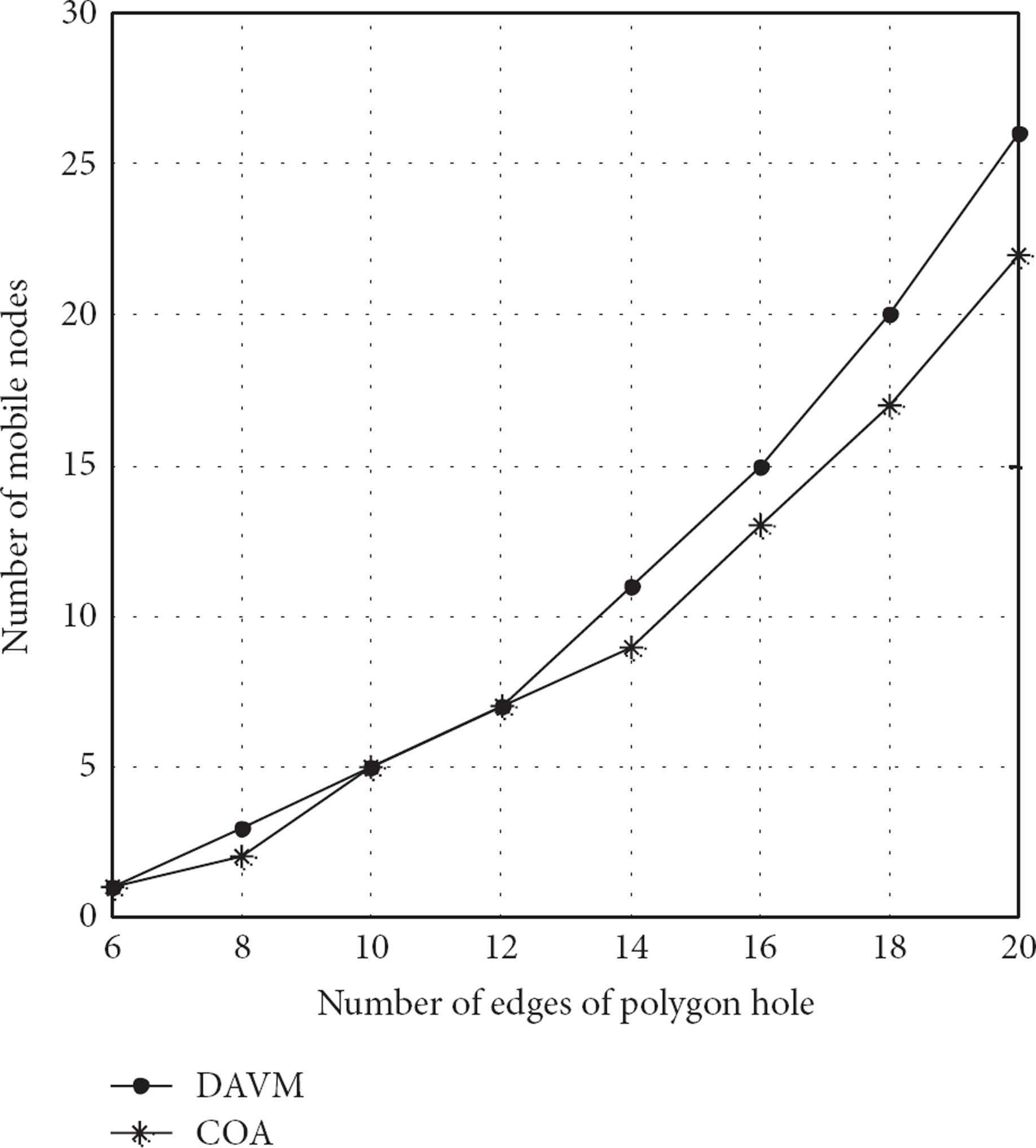
Evaluation on number of mobile nodes.
5.2.3. Evaluation of Average Moving Distance
The moving distance of the mobile node directly affects the energy consumption. To analyze the average moving distance, several algorithms are simulated to evaluate the energy consumption in different holes. The average moving distance L is defined as follows:
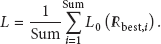
As shown in Figure 6, the average moving distance L shows an obvious pulsation when the area of the hole increases (i.e., N↑) because COA does not consider the remaining energy of nodes. In DAVM, L stably ranges from 5 to 6, which is smaller than the range from 6 to 8 in COA. This finding verifies that the best redundant node schedule balances the energy.
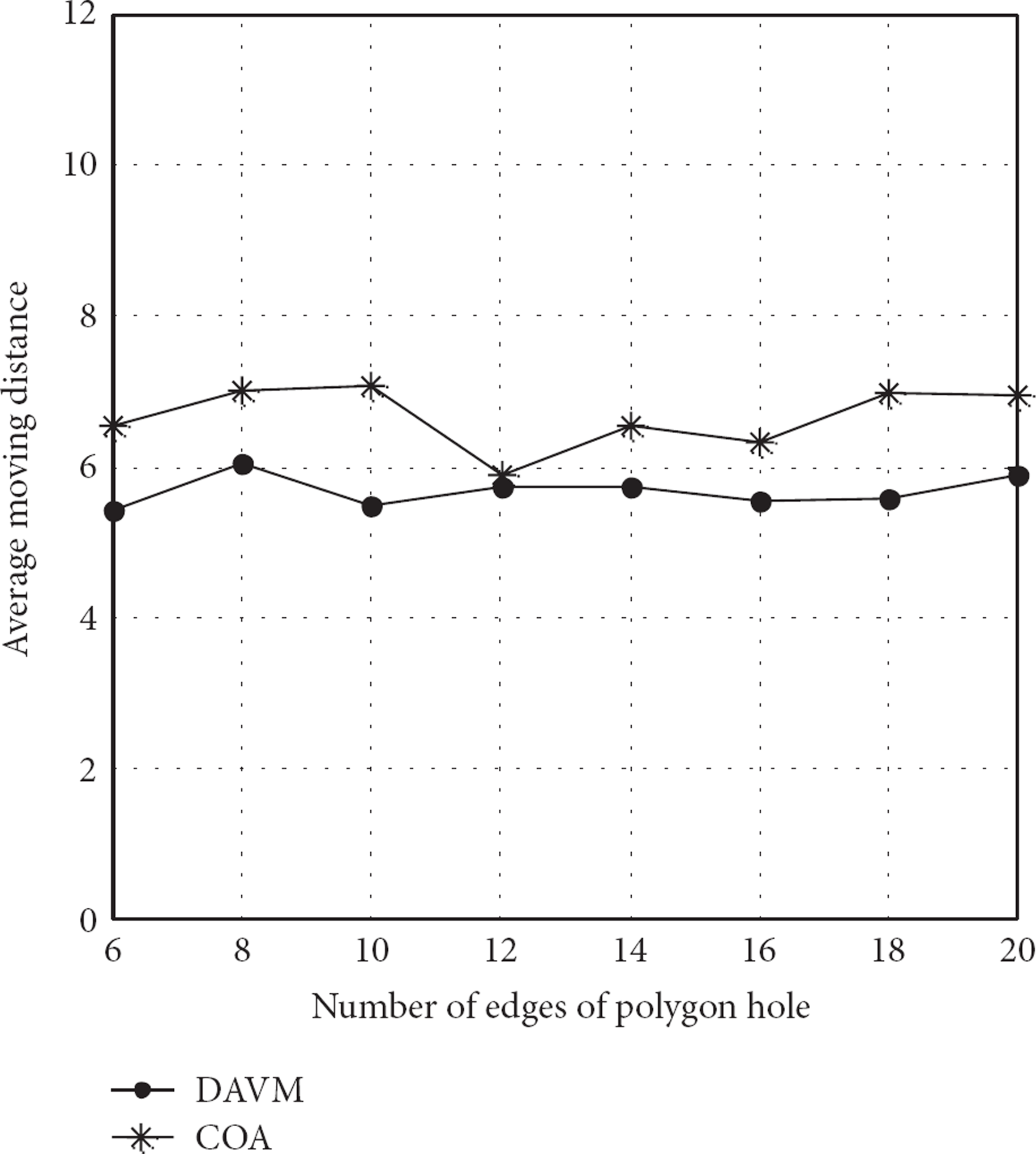
Evaluation on average moving distance L.
5.2.4. Evaluation of Average Remaining Energy
Figure 7 shows the average remaining energy with the hole size N and β. The average remaining energy E is defined as follows:


Evaluation of average remaining energy E, where coordinates
DAVM takes the remaining energy of nodes into the consideration when designing the scheduler, which is important to effectively prevent larger moving distances of nodes and hence avoid consuming excess energy. As shown in Figure 7, the average remaining energies of both algorithms fluctuate minimally with various N and β. Compared with COA, DAVM has smoother and higher energy surface, and the fluctuation range is maintained within 1%. As result, the decrease of the network lifetime brought by using DAVM would be less than the use of COA. With an increase in β, E decreases, especially in COA. Therefore, DAVM is less sensitive to β.
5.2.5. Evaluation of Average Computation Time
The comparison of average computation time of nodes under several conditions is shown in Table 2, and Figure 8 presents the corresponding box plots. As shown in Figure 8, the computation time ranges from 0.304 s to 0.399 s for different N-polygon holes. Given a certain β, DAVM has consistently shorter computation time than COA. The performance of DAVM is more effective than COA.
Average computation time of each node.


Box plots of simulation results for average computation time of each node.
6. Conclusions
This paper has proposed a novel algorithm to combat coverage holes by using redundant nodes in a wireless sensor network. The proposed algorithm achieves a balanced tradeoff between the initial energy and the moving energy consumption and chooses the best redundant node to patch the hole. Simulation results have been provided to show that DAVM is superior to COA for several aspects. However, DVAM may not be effective to the scenarios with sparse redundant nodes. A promising future direction is to focus on coverage holes with sparse redundant nodes.
Footnotes
Acknowledgments
All authors thank the effort from Dr. Yang Le. This research was financially supported by the Project Funded by the Priority Academic Program Development of Jiangsu Higher Education Institutions (no. JUSRP11129), the Doctoral Fund of Ministry of Education of China (no. 20100093120007), and the National Natural Science Fund of China (no. 61304214).