




Abstract
Residual Distributed Video Coding (RDVC) is a branch of the Distributed Video Coding (DVC). By reducing the coding rate, the RDVC scheme gets a better rate-distortion performance. The overall performance of the traditional pixel-based RDVC scheme is better than the traditional transform-based domain DVC scheme. But the traditional RDVC scheme also has some application limitations; for example, the performance of RDVC is bad when it is applied to intense motion regions. And the pixel-based RDVC scheme cannot fully exploit the spatial correlations of the original information. In this paper, we propose a new approach of residual coding combined IMB (intense motion block) extraction algorithm with Low Density Parity Check (LDPC) and Baum-Welch iterative decoding algorithm. Experimental results show that the proposed scheme achieves better rate-distortion performance compared to traditional DVC and RDVC scheme.
1. Introduction
With the development of wireless multimedia communication technology, the new video processing and transmission demand began to appear: such as hand-held digital camera, low-power video sensor networks, PAD, and other video equipments. Typically, this new device has the features of small battery capacity and limited computing power, so it requires a low complexity coding scheme. In conventional video coding standards, such as the ISO/IEC MPEG-x and ITU-T H.26x, the encoding complexity is 5 to 10 times [1] the decoding. Obviously, traditional coding schemes are not suit for the new video applications. So a special video coding framework which is called Distributed Video Coding (DVC) [2, 3] gets more attention from scholars.
The DVC scheme is different from the traditional video coding scheme. DVC scheme takes the intraframe coding and interframe decoding techniques and discovers the correlation of the video signal at the decoder; thus, the DVC scheme transfers the complexity from the encoding side to the decoding side. The DVC scheme has the characteristics of low complexity encoding and good robustness which can meet the new demand for video applications.
The Residual Distributed Video Coding (RDVC) [4] system is another research direction of DVC. In RDVC scheme, some of the similarities of the frame with respect to the known reference are utilized at the encoder, and the conditional decoding with respect to a better side information frame is still benefited at the decoder. Compared to the traditional Wyner-Ziv coding scheme, the residual scheme can reduce the information entropy of the encoding end and obtain a higher coding efficiency. But the scheme also has some limitations. First, the RDVC scheme shows poor performance when it is used to the regions of a frame with intense motion [5]. In addition, compared to the scheme based on DCT domain, the RDVC scheme which is based on pixel domain lacks attention on the exploration of spatial information, and the overall performance of RDVC based on pixel domain is not better than the DCT-DVC scheme [4]. For the above two points, we propose a new RDVC coding scheme based on pixel domain. At the encoding end, we use the intense motion block (IMB) algorithm to distinguish the intense motion blocks (IMBs) and non-IMBs, and at decoding end, we use the method of LDPC-Baum-Welch iterative decoding algorithm [6] which can explore the spatial correlation of the original information.
The remainder of this paper is organized as follows. Section 2 gives the traditional Distributed Video Coding system and its principle. Section 3 gives some details of DVC schemes and focuses on RDVC scheme. Section 4 details the proposed new scheme of the Residual Distributed Video Coding. At last, the paper presents the results of experiment and does an analysis.
2. Theoretical Basis of Distributed Video Coding
The theoretical basis of Distributed Video Coding is the Slepian-Wolf theorem [8] and Wyner-Ziv theorem [9]. The Slepian-Wolf theorem can be simply described: source


Figure 1 is the diagram of Slepian-Wolf theorem and Wyner-Ziv theorem, it shows the regions that meet the requirement of (1) and (2).
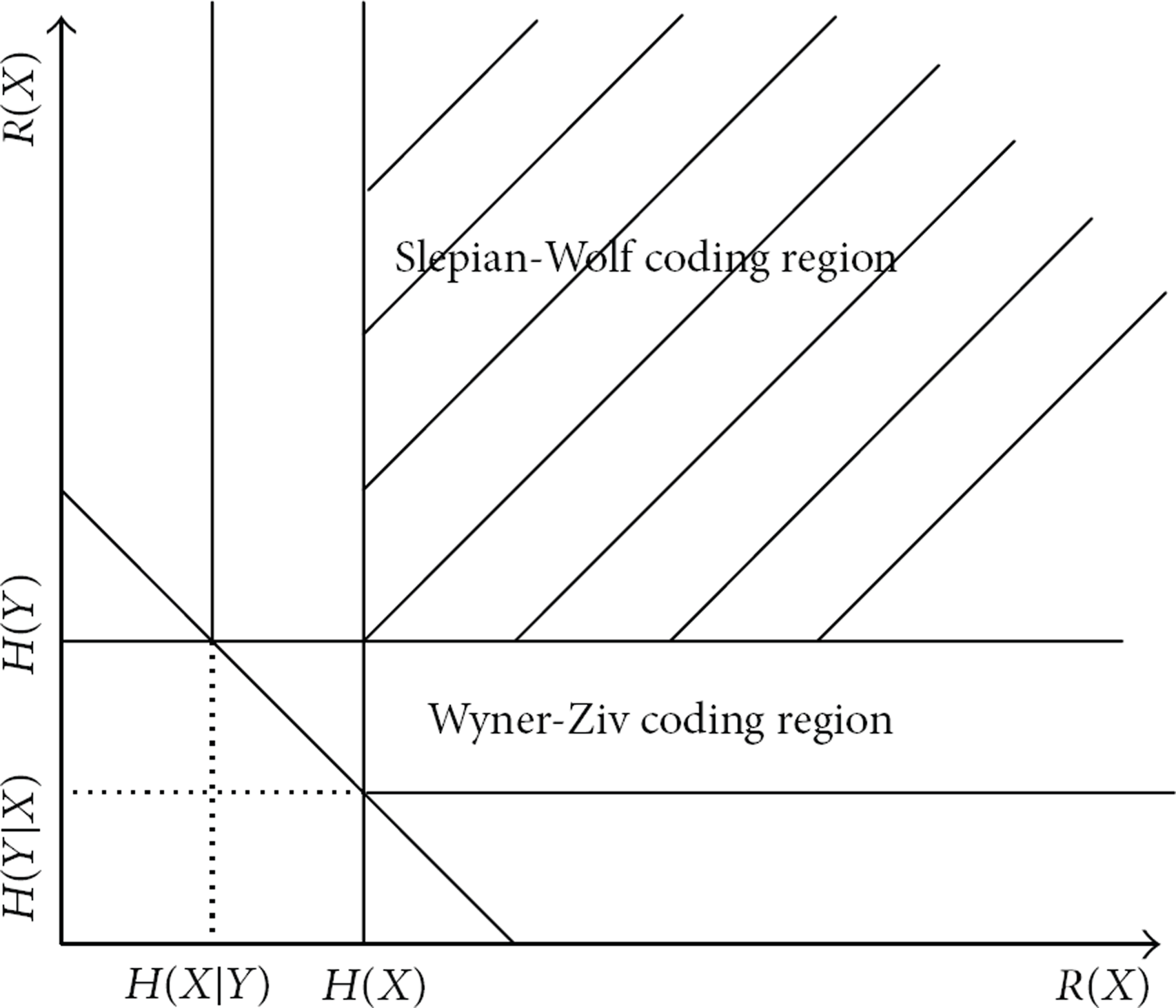
Diagram of Slepian-Wolf and Wyner-Ziv theorem.
Slepian-Wolf theorem and Wyner-Ziv theorem proved that the method which uses independent coding and joint decoding can get the same performance with the traditional joint coding and decoding method. Figures 2 and 3 are the schematic diagram of traditional video coding system and Distributed Video Coding system.

Traditional video coding scheme.

Distributed compression of two statistically dependent random processes, X and Y, the decoder jointly decodes X and Y and thus may exploit their mutual dependence.
3. Typical Distributed Video Coding
3.1. Distributed Video Coding Scheme Based on DCT Domain
The traditional DVC based on pixel domain ignores the exploration of spatial correlations between the original video information. In order to achieve higher compression efficiency, Girod et al. proposed a new DVC system based on Discrete Cosine Transform (DCT) domain [3]. By using the method of DCT, the program fully explored the spatial correlation of the source information. Figure 4 is the system diagram of DCT-based DVC scheme.

Traditional DCT-based DVC scheme [7].
By exploring the spatial correlation of original information, the DCT scheme based on DCT domain obtain a good performance of compression efficiency. But the encoder of the DCT-based DVC scheme is complicated than the traditional pixel-based DVC scheme and demands more storage and higher computing power.
3.2. Residual Distributed Video Coding Scheme Based on Pixel Domain
Compared with traditional video coding system, the overall performance of the Distributed Video Coding system is to be further improved. According to information theory, if only the decoding side can get the side information, the coding efficiency of the system is low; that is, if the encoding side can obtain the part of the relevant information, the overall system performance of the Distributed Video Coding can be better. In order to further reduce the entropy of the input source, improve the compression of the video sequence, and ultimately obtain the improvements of the system rate-distortion performance, Aaron et al. proposed the Residual Distributed Video Coding system [4], as shown in Figure 5.

Pixel-based RDVC scheme [4].
The implementation steps of the RDVC scheme are as follows. In order to reduce the input information entropy and reduce the bit rate of the encoding end, the RDVC scheme makes the Wyner-Ziv frame subtract the reference frame in pixel domain. And then, quantifying and encoding the residual frame are done. The decoder makes the fusion of the residual frame and the reference frame to reconstruct the original frame. Compared to the original Wyner-Ziv frame, the information of the residual frame is smaller, and the overall performance is better than the traditional Distributed Video Coding based on pixel domain.
But the residual scheme has an application limitation: applying the RDVC method to the intense motion blocks of an image frame may cause excessive distortion of the decoded image. In order to overcome the defect, some scholars have proposed some methods [5]. For us, to solve the problem, we proposed a method using the IMB extraction algorithm at the encoder. To avoid the limitations of the residual coding, different blocks are encoded with different coding method in our RDVC scheme. In addition, considering that the traditional RDVC scheme failed to fully exploit the spatial correlation of the original information and the performance is not better than the traditional DCT-based DVC scheme, we applied the LDPC-Baum-Welch iteration decoding algorithm into our Residual Distributed Video Coding scheme. The new proposed RDVC scheme of this paper effectively played the advantages of the RDVC, avoided the application limitations, minimized the complexity of the encoder, and improved the system performance.
4. Proposed RDVC Scheme Based on Pixel-IMB Algorithm
4.1. Framework of Proposed RDVC Scheme
As discussed in Section 3, we proposed a new RDVC scheme which uses IMB extraction algorithm at the encoding end and uses the LDPC-Baum-Welch algorithm at the decoding end. Figure 6 shows the general framework for the proposed RDVC scheme.
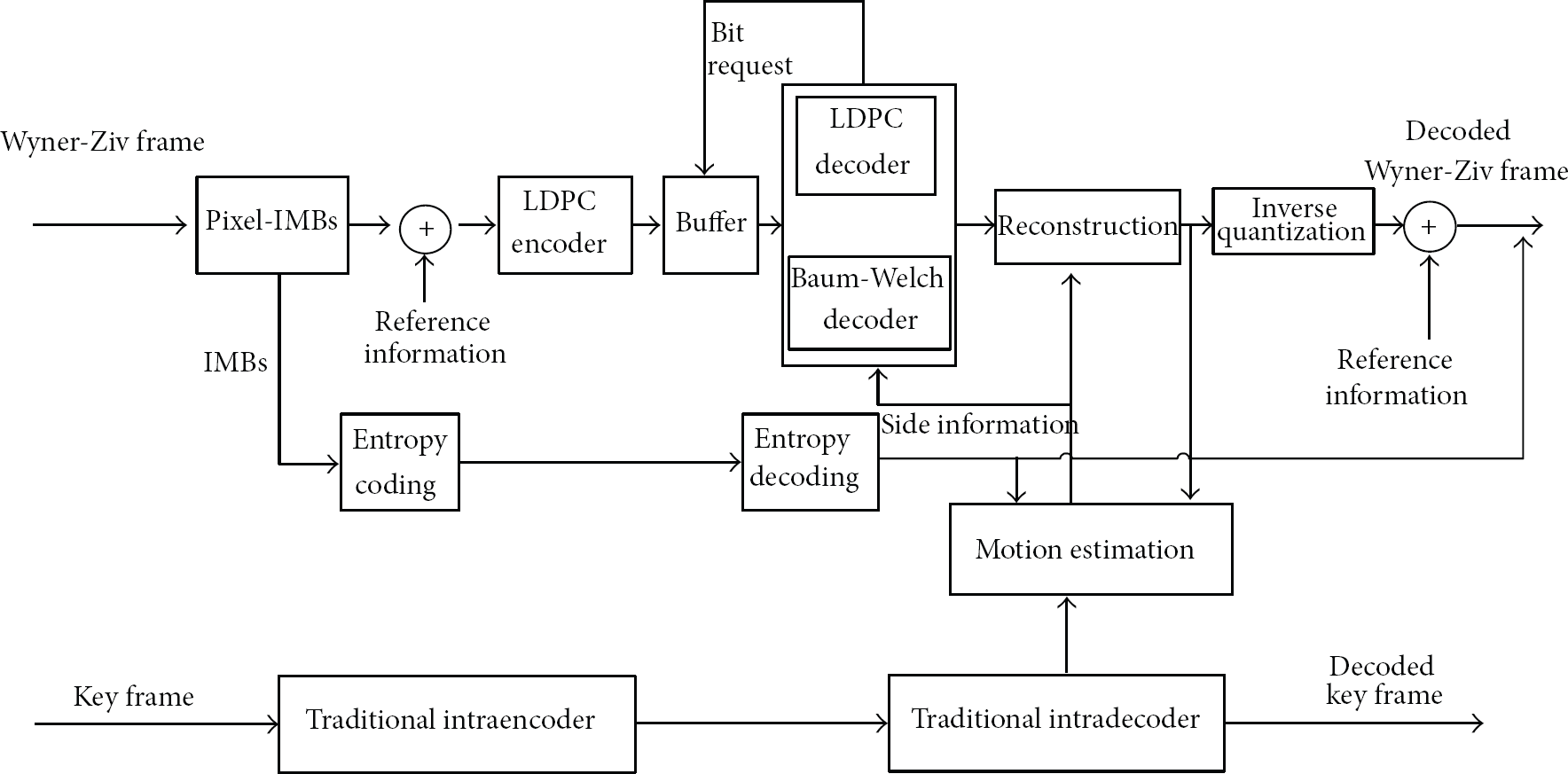
Proposed RDVC scheme based on Pixel-IMB algorithm.
4.2. Encoder Design of the Proposed RDVC Scheme
As shown in Figure 6, at the encoder end, a subset of frames, regularly spaced in the sequence, serve as key frames, K, which are encoded and decoded using a conventional intraframe 8 × 8 Discrete Cosine Transform (DCT) codec, such as JPEG codec.
The frames between the key frames are “Wyner-Ziv frames” and encoded according to the IMB discrimination algorithm.
According to (3), we calculate the value of

The intense motion blocks are encoded with residual distributed coding method, while the non-IMBs are encoded with entropy coding method. The residual information is from the difference of the intense motion block and the reference block.
4.3. Decoder Design of the Proposed RDVC Scheme
At the decoder, we take the LDPC-Baum-Welch (LDPC and Baum-Welch) iterative decoding scheme. The Baum-Welch decoding algorithm is based on the theory of Markov model. We look at the video image as the relevant source and use the Baum-Welch algorithm to estimate the transition probabilities of the Markov model. Thus, we can explore the spatial correlation among the source and achieve the compression.
The detailed process is as follows.
Provided the source X is a Markov model. The Baum-Welch decoder accepted the coded residual information

The LDPC decoder accepted the information from Baum-Welch decoder and the residual information. The two decoders mutually exchange information and iteratively decode the original information.
Usually, the image sequence is two-dimensional Markov model, and the state of source X is huge, so the transfer equation which is used to estimate the probability is simplified, showing as (5), where w represents the width of the frame.

5. Experiment Results
The experiment of the proposed scheme chose the standard video sequences “carphone” and “salesman.” The image format is QCIF (177 × 144), and the coding frequency is 30fps. The rule of Wyner-Ziv frames (W) and key frames (K) is “K-W-K-W”. The key frames use the JPEG coding method [10], while the Wyner-Ziv frames use the IMB algorithm to distinguish the IMB and non-IMB. To the non-IMB, we use the RDVC coding and decoding method and LDPC-Baum-Welch algorithm. The reference frame is the previous frame. The check matrix of LDPC codes is generated by the PEG method [11–13]; rate is 7/8. According to the experiment results, we chose the threshold T of IMB algorithm as 64. We compared the rate-PSNR performance of these schemes as below. The encoder of H.263+ is TMN8 [14]. The results of the experiment are shown in Figure 7.
H.263+interframe (I-P-I-P) coding—H.263+P. H.263+intraframe (I-I-I-I) coding—H.263+I. Conventional JPEG codec—JPEG. Pixel-IMB-based Residual Distributed Video Coding—Proposed scheme. DCT-ROI-based Wyner-Ziv residual video coding—DCT-ROI-residual scheme [15]. Conventional DCT-based Wyner-Ziv coding—Wyner-Ziv.

The simulation results of the proposed scheme.
From Figure 7, we can draw a conclusion that the proposed scheme of this paper has 1 dB improvement compared to the DCT Wyner-Ziv scheme, and approximately 0.2 dB improvement to the DCT-ROI-residual scheme. Though there is still a performance gap between our proposed scheme and the H.263 interframe scheme, our scheme is easier at coding end which is fit for Wireless Multimedia Sensor Networks.
Figures 8 and 9 show the decoded 6th frame of sequences “carphone” and “salesman” using the proposed scheme and traditional RDVC scheme which is based on pixel domain. The scheme we proposed has an improvement on the quality of the decoded image. On the whole, our scheme is effective. Compared to the DCT-based DVC scheme and the traditional H.263 interframe scheme, the proposed scheme is easier at coding. By using the IMB algorithm, the proposed scheme reduced the input entropy and reduced the energy consumption. From the experiment results, we draw that our proposed scheme has an overall improvement. Because of the using of IMB algorithm, the proposed scheme avoided the application limitation of RDVC. And because of the using of LDPC-Baum-Welch algorithm, the scheme explored the spatial correlation of the original information which is more advanced than the traditional pixel-based RDVC scheme and the traditional DCT-based DVC scheme, which is more complex at encoder.

Decoded “carphone” sequence of proposed scheme and traditional RDVC scheme.

Decoded “salesman” sequence of proposed scheme and traditional RDVC scheme.
6. Conclusion
The paper proposed a new RDVC scheme based on traditional pixel-based RDVC scheme. The proposed scheme used the LDPC-Baum-Welch algorithm which can explore the spatial correlation of original information. Thus, the proposed RDVC scheme can achieve better performance at pixel domain compared to traditional DCT-based scheme. The proposed scheme used IMB algorithm which can avoid the shortcoming of traditional RDVC scheme. The experiment proved that the proposed scheme reduced the complexity of the RDVC encoder and made the best use of RDVC. The proposed scheme is more suitable to the WMSNs.
Footnotes
Acknowledgments
This work is supported in part by the National Natural Science Foundation of China under Grant nos. 61171053, 61300239, and 61373137 and the Doctoral Fund of Ministry of Education of China under Grant no. 20113223110002.