




Abstract
Because of the special nature of wireless sensor networks, data fusion process is vulnerable to attacks by the destroyer, which is useful for reducing the network communication overhead and improving the data transmission efficiency. Therefore, it is very essential to provide transmission with high security and low energy consumption for sensitive data fusion in wireless sensor network. In this paper, a data fusion algorithm of privacy protection based on Query of Server (Qos) and hierarchical multilayers was put forward, which divided the required privacy protection levels according to different safety requirements, and set up hierarchical network models. In data fusion process, delay constraint was added to guarantee service quality of Qos, and this would reduce energy consumption overhead. Meanwhile, it would guarantee the accuracy of the data and reduce the probability of the whole network information exposed.
1. Introduction
Wireless sensor network (WSN) data fusion technique has broad application prospects, which is one of the key technologies in the internet of things. Data fusion technology is the process of processing multiple copies of data and it gets more effective data to users. But wireless sensor network is vulnerable to various attacks for its open and self-organizing features. The fusion data attacks may cause bad results, which not only makes the wireless sensor network lose the original construction objective but also may cause much more damage. Therefore, it is very necessary to provide transmission of security and low energy consumption for sensitive data fusion in wireless sensor network.
Currently, data fusion safe programs can be divided into two kinds. One is the program based on data integrity, and the other is data confidentiality [1]. In traditional ways, Hop-by-hop encryption is the main way to protect the confidentiality [2]. The confidentiality of end-to-end and authentication of data fusion technology are the two main goals of safety data fusion protocol [3]. Data security in sensor networks fusion scheme was proposed in the paper in [4], and secure data fusion in wireless sensor network was proposed based on the homomorphic MAC in [5] by Wei et al. The security of data fusion was studied by both of them in wireless sensor network [4, 5].
However, security will increase the resource cost and reduce the efficiency improved by data fusion mechanism. Therefore, when the effective security of data fusion, calculation, and transmission was set up, resource consumption should be reduced as little as possible, and network life cycle should be prolonged as long as possible [6]. In this paper, a data fusion model of privacy protection based on Qos and hierarchal multilayers was put forward. The core problem of privacy protection in data fusion process is how to achieve data fusion of the privacy accurate and efficient ratio. To solve this problem, researchers have proposed some privacy protection algorithms [7–10]. The earliest is the PDA algorithm by He et al. to data fusion of privacy [11], and it includes two kinds of privacy protection data fusion algorithms. One is fusion algorithm of CPDA of privacy protection data based on clustering, and the other is fusion algorithm of SMART of privacy protection data based on distributed way.
Based on the problems above, a data fusion algorithm of privacy protection based on Qos and hierarchical multilayers was put forward, which divided the required privacy protection levels according to different safety requirements and set up hierarchical network models. In data fusion process, delay constraint was added to guarantee service quality of Qos, and this would reduce energy consumption overhead. Meanwhile, it would guarantee the accuracy of the data and reduce the probability of the whole network information exposed.The main structure of this paper is as follows: the first part gives the current situation at home and abroad; the second part puts forward the system structure of data fusion in wireless sensor networks; the third part puts forward the multilayers hierarchically data fusion approach to privacy protection; the fourth part gives the using method of the Qos applied in multilayers hierarchically data to the privacy protection; the fifth part is the experiment of a modern vegetable planting base to validate the effectiveness of the method.
2. System Structure of WSN in Data Fusion
Data fusion is a subset of information fusion, which can be used for processing multiple copies of data or information. More effective and useful data to user can be combined [1]. For WSN, the data fusion technology can greatly reduce the amount of data transmission to WSN and reduce the data conflict. It can reduce the network congestion and save energy costs effectively, too, which will prolong the lifetime of network.
Sensor nodes are divided into ordinary nodes, fusion nodes, and sink nodes, by WSN in data fusion process. Effect of data fusion technique was studied through two kinds of methods with theoretical analysis and simulation test. The results show that the minimum energy consumption ratio of using data fusion technology and not using data fusion technology is as follows:

In this equation,
3. Data Fusion of Privacy Protection Method Based on Multilayers Hierarchically
3.1. Layered Data Fusion
Wireless sensor network consists of a large number of sensor nodes, which are deployed in the monitoring region. Sensor nodes are divided into three categories. It includes base station, cluster head, and the common sensor nodes. The base station has enough energy and rich resources, and cluster head has less of them. However, energy and resources of ordinary sensor node are the least [11].
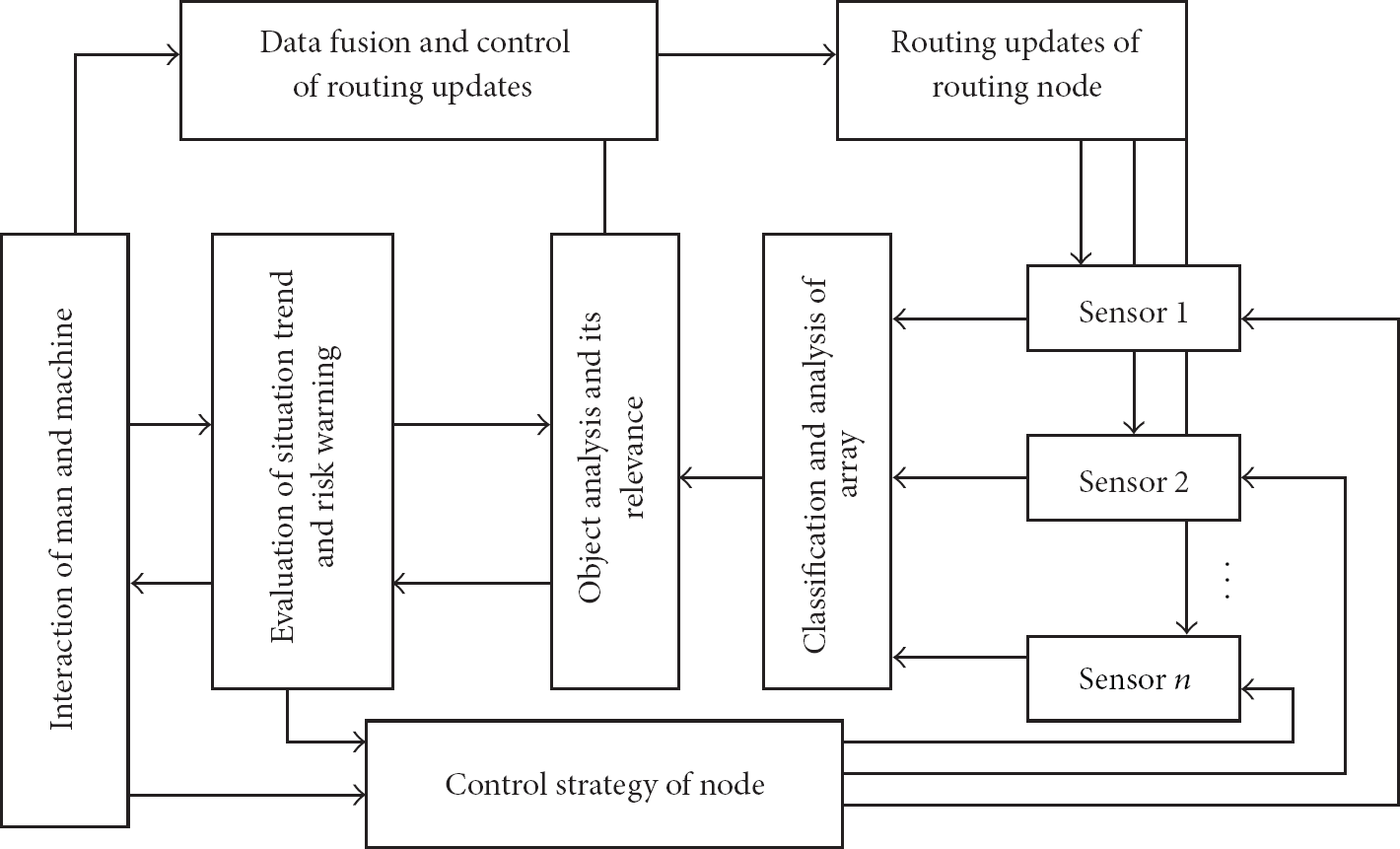
In the model of wireless sensor network, a node can establish a communication link with any other node in same clusters through different sharing keys. Each cluster of wireless sensor network has n nodes, one of which is a cluster head, and the others are ordinary sensor nodes [12]. This paper proposes a sequence flow diagram of the calculation procedure of data fusion, which is shown in Figure 1.
The calculation procedure of data fusion.
3.2. Data Fusion of Classification Privacy Protection
In data fusion of classification privacy protection, in order to reduce the communication, according to the barrel principle of information security, privacy level packet contains a minimum of three node groups. Secondly, next packet contains four nodes, and so on. If all nodes in cluster are divided into a group, this situation is defined as the highest level of privacy.
For a cluster containing sensor node number of m, if it can be divided into two privacy levels, its highest level of privacy is the same as the aggregation scheme of private data based on cluster. At the lowest level of privacy, m sensor nodes are divided into two pretreatment groups. One contains three sensor nodes, and they are A, B, and C. Their private data are respectively a, b, and c. The other contains four nodes, which are E, F, G, and H, and their private data are e, f, g, and h, respectively.
For the three members of the group, the pretreatment process is similar to the private data based on cluster aggregation scheme. Pretreatment values can be obtained by nodes A, B, and C as follows:

In the above expression,
For the four members of the group, E, F, G, and H, respectively, we use common nonzero digits

In the above expression,
After receiving

In the above expression,

Pretreatment values of nodes F, G, and H are calculated in the same way.
Then nodes A, B, C, D, E, F, G, and H send
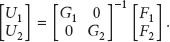
In the above expression,

The first element of
4. Application of Qos in Data Fusion of Privacy Protection Based on Multilayers
4.1. The Service Quality of Qos in WSN
Three basic design goals of mechanism research of Qos in wireless sensor network are real time, reliability, and validity of resource utilization. Metrics definition, transmission mode of non-end-to-end data, and node resources are the main study problems of Qos wireless sensor networks [13].
4.2. Multitiered Privacy Protection Data Fusion Protocal Based on Qos
In WSN, Multitiered privacy protection data fusion protocal based on Qos (MPPDF-Qos) includes three kinds of nodes, which are Qos node, fusion node, and leaf node. In the traditional technology of data fusion, Qos node is the root of data fusion structure tree to get the final result of data fusion. The merging data of fusion node receives from its child nodes and collected data by itself and sends to the parent node. Leaf node is responsible for collecting data and sending it to the parent node.
In this algorithm, we assume that Qos is a Time Delay

In the above expression,
4.2.1. The Algorithm Steps
The First Step: preparatory work. Each node
The Second Step: nodes collusion. The size of MinDeg is used to determine how much the allocation of time slice, and
Firstly, the network node is assigned within the ComD and time slice of
4.2.2. Collusion Method
Nodes firstly verify their values of When the node i receives the encryption seeds, it uses the sharing key to decrypt with neighbor nodes and obtain

The Third Step: fusion process. In the FusD time, fusion steps of TAG algorithm are used to do fusion process from the bottom node to the top node based on the data fusion tree set up in the first step, and data fusion result will be obtained at QoS at last. At this time, the node cycle number will be plus one. If loop is smaller than Loop, step two will be executed. Otherwise, the algorithm will end.
5. Verification of Case
Wireless sensor networks have been widely applied in the field of intelligent agriculture, and experiments were conducted in a modern vegetable planting base in city. Whether the irrigation of vegetables was needed is mainly determined by the detection of air humidity. For the comprehensive analysis of the data fusion scheme, it was necessary to analyze the data accuracy, security, and data transmission overhead.
5.1. The Experimental Platform
According to the characteristics of data fusion in wireless sensor network, Matlab simulation platform was used to analyze the data. In the region of 50 m * 100 m for vegetable greenhouse, thirty sensor nodes were deployed, and the transmission radius of each node was 15 m. Ten vegetable bases like this were selected and tested.
5.2. System Model
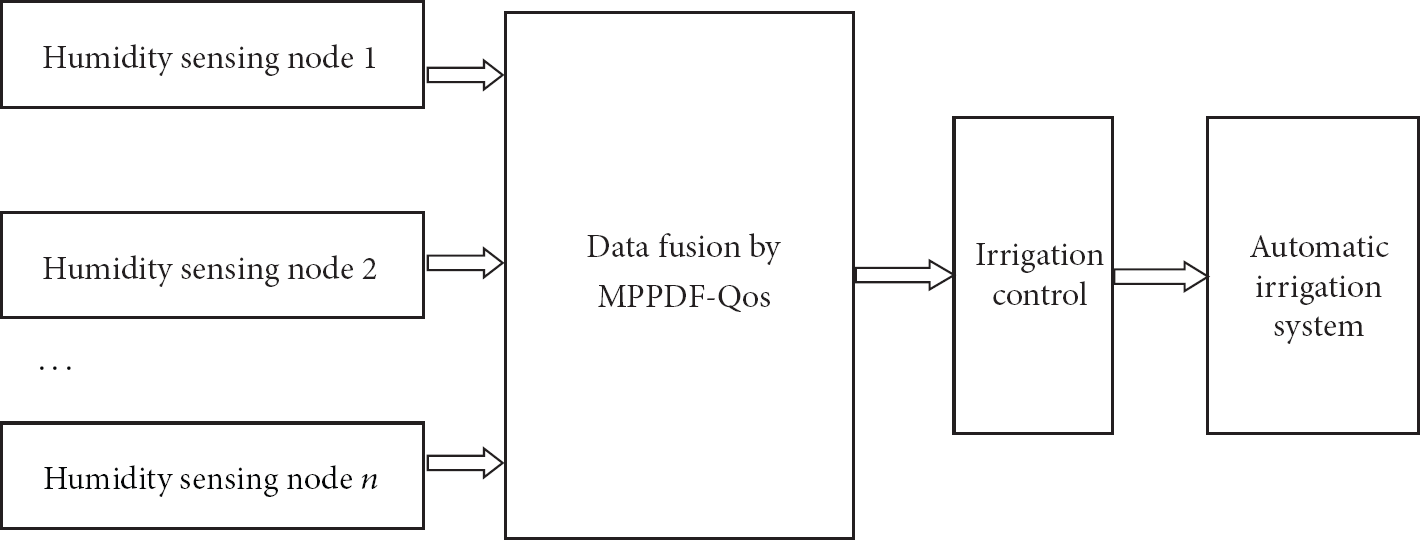
Network experiment model was as shown in Figure 2, and humidity sensor was AM1001, for sensing the humidity in the greenhouse. The fusion node first did security data fusion to the received information, and then it transmitted the information to the base station. The traditional methods of data fusion and MPPDF-Qos data fusion methods were used to do data fusion of perceived humidity data and the final results of the analysis were as a basis whether to irrigate vegetable.
Network model.
5.3. Experimental Results and Analysis
In the MPPDF-Qos scheme, each node could establish links with other nodes through different shared keys. Probability on violation of privacy by eavesdropping was zero; therefore, only the coordinated attack situation should be considered. In order to prevent the attack, each group needed to have at least three sensor nodes. Therefore, the definition of privacy level for minimum packet was the packet with three sensor nodes. So, we set
(1) The Energy Consumption. In the MPPDF-Qos scheme, nodes communicated only within the same group, in addition to transmitting preprocessing data to the cluster head. However, in the other scheme, all nodes in the cluster could have communication. Therefore, the MPPDF-Qos scheme saved data overhead. Figure 3 was comparison of data traffic of the CPDA scheme, SMART scheme, and MPPDF-Qos scheme.

Comparison of energy consumption.
(2) Security. In Figure 4, privacy protection performances of the MPPDF-Qos scheme and CPDA scheme were compared when there were 30 nodes in a cluster. From the figure, it can seem that it would increase with the increasing rate of node capture in three schemes, and the probability of exposure of data information had been improved. However, it could provide privacy protection based on different privacy levels required in MPPDF-Qos scheme. Even if it was intercepted for the same data as CPDA, the probability is that the whole information exposed was much lower than in the CPDA.

Comparison of privacy protection.
(3) Accuracy. In order to reduce the probability of data privacy exposed, a random number would be generated in the course calculating of cluster by nodes. Disturbance data would be added in the transmitted data. Data perturbation could reduce the probability of data exposed, but it often affected the accuracy of the results.
SMART needed to send more count data to its neighbor node; thus, it would cause more collision to reduce the accuracy. Data collision chance was avoided in MPPDF-Qos scheme, so its data accuracy was ideal. There are 10 simulations in each numerical value for each EpochD and the means of these simulation results are as our result. Accuracy analysis was shown in Figure 5.

Comparison of accuracy.
6. Discussion and Conclusion
A data fusion algorithm of privacy protection based on Qos and multilayers hierarchically was put forward, which divided the required privacy protection levels according to the different safety requirements, and hierarchical network models were set up, too. In data fusion process, delay constraint was added to guarantee service quality of Qos. This scheme has great advantages in energy consumption and safety. In the next period of time, data accuracy will be the key point to study.
Wireless sensor network data fusion technology is an important part of the internet of things, and it has wide application prospect in real life. How to provide security transmission to sensitive data fusion in wireless sensor network and how to protect its privacy are important technical support issues for the practical application.
However, security is often based on the overhead of the additional overhead, and too much overhead will reduce the efficiency of data fusion mechanism. Therefore, building an effective guaranteed security of data fusion, calculation, and transmission is important. Meanwhile, reducing resource consumption and prolonging the network life are necessary, too. It can meet the accuracy and privacy requirements of data fusion through MPPDF-Qos scheme and has lower energy consumption, too.
Footnotes
Conflict of Interests
The authors declare that there is no conflict of interests regarding the publication of this paper.
Acknowledgments
This work has been supported by the National Natural Science Foundation of China (no. 61301232) and the Science Technologies Foundation of Henan, China (no. 13A520148).