




Abstract
In order to study the polymer effect on the behavior of nonlinearities in decaying homogeneous isotropic turbulence (DHIT), direct numerical simulations were carried out for DHIT with and without polymers. We investigate the nonlinear processes, such as enstrophy production, strain production, polymer effect, the curvature of vortex line, and many others. The analysis results show that the nonlinear processes like enstrophy production (and many others) are strongly depressed in regions dominated by enstrophy as compared to those dominated by strain either in the Newtonian fluid case or in polymer solution case. Polymers only decrease the values of these parameters in the strongest enstrophy and strain regions. In addition, polymer additive has a negative effect on enstrophy and strain production, that is, depression of nonlinearity in DHIT with polymers.
1. Introduction
Kraichnan and Panda [1] suggested comparing the key nonlinear terms in real turbulent flows with their Gaussian counterparts, which are involved in the description of nonlinear dynamics in physical space, and firstly introduced the notion of depression of nonlinearity. In decaying homogeneous isotropic turbulence (DHIT), they found that
However, as compared with velocity, the field of velocity gradient is much more sensitive to the non-Gaussian nature of turbulence or more generally to its structure and hence reflects more of its physics [6]. It is also a Galilean invariance containing significant fluid mechanics information independent of the reference of a moving observer. Moreover, its dynamical behavior governs the mechanism of vortex stretching which in turn contributes to the energy cascade process in turbulent flows (as pointed in [6] “The turbulent kinetic cascade in Fourier space must be replaced with the generation of velocity gradients (i.e., both vorticity and strain) in physical space.”). Therefore, its evolution is of primary importance in the understanding of the kinematics and dynamics of turbulence. The velocity gradient includes two parts: vorticity and strain. Therefore, it is very important to investigate the nonlinearity process from vorticity and strain transport equations. Tsinober [7] defined all four regions in real turbulent flow: (i) regions of concentrated vorticity; (ii) regions of “structureless” background; (iii) regions of strong vorticity/strain (self) interaction and strong enstrophy generation; (iv) regions with negative enstrophy production. The results of turbulent grid experiment [8] and DHIT [7] demonstrated that all four regions are strongly non-Gaussian, dynamically significant, and possess structures, and it is also argued that due to the strong nonlocality of turbulence in physical space all the four regions are in continuous interaction and are strongly correlated. Tsinober [7] also highly stressed the role of regions of strong vorticity/strain (self) interaction and argued that important regions of concentrated vorticity are not as important as is commonly believed. Then he [9, 10] investigated the behavior of key nonlinearities related to velocity gradients in flow regions dominated by enstrophy and strain, such as the magnitude of the vortex stretching vector
In the present paper, the purpose is to investigate the polymer effect on the behavior of nonlinearity in DHIT and study which region (as Tsinober defined in [7]) is influenced by polymers. We use the dataset from direct numerical simulation in the periodic cubic domain of size ℝ = 2π computed with a pseudo-spectral code for Navier-Stokes equations and finite difference code for FENE-P (finitely extensible nonlinear elastic Peterlin) constitutive model with resolution 963 using the Adams-Bashforth scheme [11]. The Taylor-scale Reynolds number Reλ and the Weissenberg number Wi are defined as
2. Enstrophy and Strain Transport Equations
In one of our previous studies [12], we have paid our attention to velocity gradient, especially for vorticity and strain field. These two quantities must be considered in parallel, as they are weakly correlated in isotropic turbulence and they are tied by a strongly nonlocal relation. So we firstly give the fundamental evolution equations for the enstrophy
The enstrophy transport equation of DHIT with polymers is as follows:

where ς
nji
is the permutation symbol; Ω = ω
i
ω
i
/2 the enstrophy, here
The strain transport equation of DHIT with polymers is as follows:
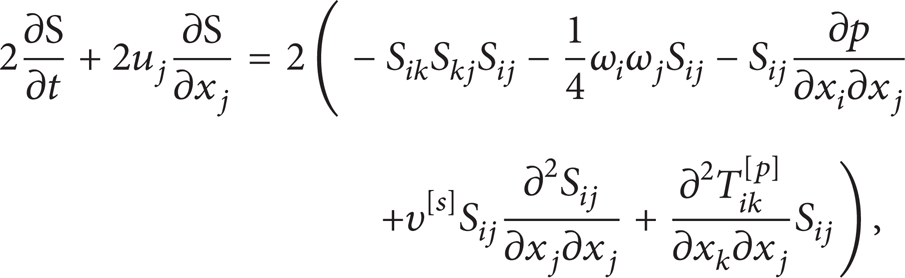
where S = S
ij
S
ij
/2 is the total strain; Sstr = – S
ik
S
kj
S
ij
the strain production from strain self-amplification; Wstr = ω
i
ω
j
S
ij
/4 the enstrophy production effect on the total strain; Rstr = S
ij
(∂ 2p/ ∂ x
i
∂ x
j
) the interaction of strain with pressure Hessian; Vstr = υ[s]S
ij
∇ 2S
ij
the strain viscous dissipation;
It is found that ω
i
ω
j
S
ij
term appears in (1) and (2). When ω
i
ω
j
S
ij
is positive, the production of total strain is decreased and the production of total enstrophy is increased; when ω
i
ω
j
S
ij
is negative, the results are contrary. However,

Schematic view of the velocity-gradient self-amplification process in isotropic turbulence.
3. Results and Discussion
We take dissipation rate, enstrophy production, strain production, and vortex stretching herein as the measurement of nonlinearity in DHIT. Conditional averages of all quantities here are conditioned on

Conditional averages of (a) dissipation rate and (b) polymer elastic energy in slots of
One of the aspects of the problem in question concerns the enstrophy production Sens = ω
i
ω
j
S
ij
, enstrophy viscous dissipation

Conditional averages of (a) enstrophy production; (b) enstrophy viscous dissipation; (c) the polymer effect; (d) vortex stretching in slots of
It is equally important to investigate the nonlinear behavior of strain production (Sstr = – S
ik
S
kj
S
ij
and 2 (Sstr – Wstr) = 2(-S
ik
S
kj
S
ij
– ω
i
ω
j
S
ij
/4)), strain viscous dissipation (Vstr = υ[s]S
ij
∇ 2S
ij
), and the polymer effect on strain (Pstr = B
ij
[p]S
ij
), and the conditional averages of which are shown in Figure 4. It follows that the mean rate of strain production
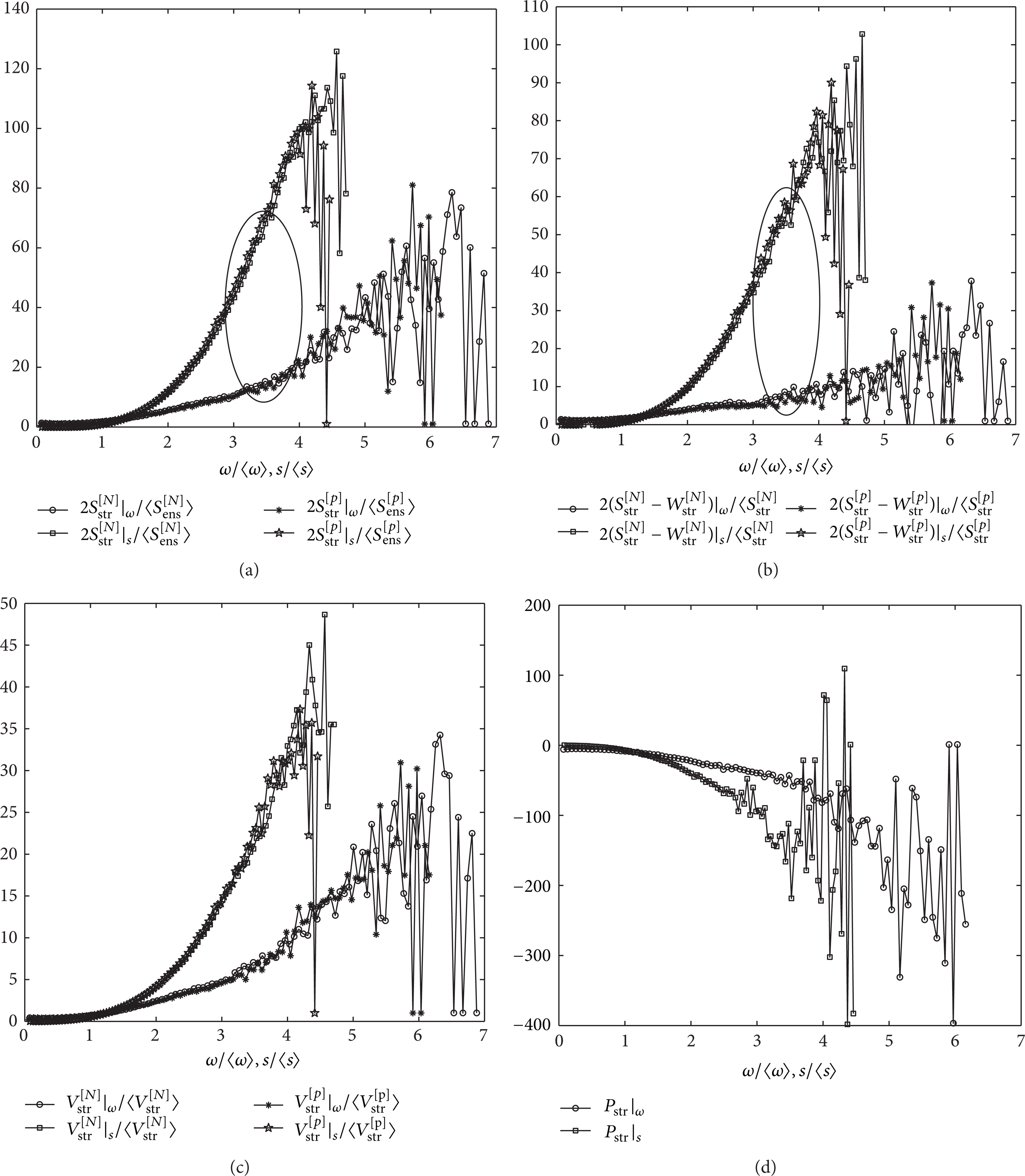
Conditional averages of (a) strain production; (b) strain production and enstrophy production effect on the total strain; (c) strain viscous dissipation; (d) the polymer effect in slots of
Another manifestation of the depression of nonlinearity is the decrease of curvature of vortex lines in the enstrophy dominated regions. As is known, it is easy to obtain three-dimensional vorticity

Conditional average of curvature in slots of
Also we consider that the conditional averages of enstrophy, strain, and dissipation rate conditioned on

Conditional averages of (a) enstrophy and strain; (b) dissipation rate in slot of
In order to expatiate the distribution of enstrophy production, enstrophy viscous dissipation, and the polymer effect in the polymer elastic energy region, the conditional averages of these parameters are carried out, as shown in Figure 7. It is clearly shown that the enstrophy production and enstrophy viscous dissipation are firstly increasing with

Conditional averages of (a) enstrophy production and enstrophy viscous dissipation; (b) the polymer effect in slot of
Also, we show the conditional averages of strain production, strain viscous dissipation, and the polymer effect in the polymer elastic energy regions, as shown in Figure 8. Compared with the results in Figure 7 (a), it can be seen that the values of 2 (Sstr – Wstr) and Vstr are much larger than the values of Sens and Vens. This indicates again the well correlation between strain and polymer elastic energy, which is consistent with the conclusion of polymers mainly stretching in strain dominated regions in our previous study [11]. The polymer additive always has a negative effect on strain, suggesting the inhibition of strain production by polymer additives. The value of conditional averages of Pstr is much larger than that of Pens, indicating that the polymer effect on strain field is stronger than that on enstrophy field. Overall, polymers have an important and negative effect on enstrophy and strain fields. From this viewpoint, the nonlinear processes in DHIT of polymer solution are depressed due to the existence of polymer additives.

Conditional averages of (a) strain production and enstrophy production effect on the total strain and strain viscous dissipation; (b) the polymer effect in slot of
4. Conclusions
DNS of DHIT with and without polymers have been carried out based on Navier-Stokes equation coupled with FENE-P constitutive model. We investigated the polymer effect on the nonlinear processes based on the important parameters in the enstrophy/strain transport equations and the curvature of vortex line. Some important conclusions have been drawn as follows.
The existence of polymers in DHIT only decreases the values of the important parameters in the strongest regions of enstrophy and strain. And also, polymers have a negative effect on enstrophy production and strain production, suggesting the depression of nonlinearity in DHIT with polymers.
The curvature of vortex line in the enstrophy dominated regions is smaller than that in the strain dominated regions. This suggests that vortex structures are distorted tempestuously in the strong vorticity/strain regions.
The strongest contribution of the polymer effect exists in regions where
Footnotes
Acknowledgments
The authors thank Professor B. Yu of China University of Petroleum (Beijing) and Dr. Y. Yamamoto of Kyoto University, for their discussion on DNS. This study was supported by National Natural Science Foundation of China (Grant no. 51206033), the Fundamental Research Funds for the Central Universities (Grant no. HIT.NSRIF.2012070), the China Postdoctoral Science Foundation (Grant no. 2011M500652), and the Heilongjiang Postdoctoral Science Foundation (Grant no. 2011LBH-Z11139). The authors are also very grateful for the enthusiastic help of all members of Complex Flow and Heat Transfer Laboratory of Harbin Institute of Technology.