




Abstract
A joint access control and subchannel allocation (JACSA) scheme is proposed in this paper for femtocell-based machine-to-machine (M2M) network to provide better communication services. As short-range and cost-beneficial eNodeBs, femtocells can improve indoor coverage and data transmission, and can further be used for M2M communication. There are two challenges for femtocell network, access control and truth-telling. Femtocell machine-type communication devices (FMD) select femtocell access points (FAPs) according to the reported channel capacities, while the true values are private information of each femtocell. Therefore, selfish FAPs have incentive to report larger capacities to win greater opportunity to be selected. To solve the aforementioned two problems, a JACSA scheme based on the Arrow-d'Aspremont-Gerard-Varet (AGV) is proposed both in open access and hybrid access scenarios, and formula derivations are given. We prove that, compared with the optimal subchannel allocation (OSA) scheme, JACSA scheme has the feature of achieving near optimal performances with much lower computational complexity. Furthermore, we compare the allocation results for open access and hybrid access in the proposed JACSA scheme. Finally, simulations are performed, and the results verify the availability of our proposed scheme.
1. Introduction
Machine-to-machine (M2M) or machine-type communication (MTC) is an emerging technology that allows devices to communicate with MTC server or each other in absence of human intervention or interaction [1]. In the M2M networks, which have the characteristics of large device number and small data transmission, machine-type devices communicate with each other through wired or wireless connections. As smart home and smart grid become popular, such as home security sensing, lighting control, and the sensors of actuators, M2M communications have a widespread and promising coverage [2, 3].
Due to their commercial prospects and properties, M2M networks have been widely studied [4–7]. In [4], the authors briefly review the features of M2M services in the third generation (3G) long-term evolution (LTE) and the advanced (LTE-advanced) networks, and a variety of radio resource allocation schemes are proposed. In [5], focusing on the problem of heavy random access (RA) load caused by accommodating the huge population of M2M or MTC customers/devices in LTE networks, two methods are proposed to solve the RA congestion. Different from [4, 5], where the M2M communications exist in LTE networks, the work in [6] promotes the new paradigm of cognitive machine-to-machine (CM2M) communication, by exploiting cognitive radio technology in M2M communications, and proposes a coordination-based energy-efficient spectrum discovery scheme that can be used in smart grid neighborhood area networks, which is shown to significantly save energy consumption. For the M2M communications of smart meters, cognitive radio (CR) functions based on different multiobjective genetic algorithms are proposed to find out the tradeoff between power efficiency and spectrum efficiency in different operating environments [7].
Recently, there are a few emerging research interests focusing on the femtocell-based M2M networks [8, 9]. Femtocells are small, inexpensive, low-power base stations (BSs) for better indoor voice coverage and data reception. They connect to their own wired backhaul connections, and thus can efficiently offload data traffic from macrocell networks, which appeals to operators [10, 11]. Due to the short transmission distance, femtocells require very low transmission power and thus extend battery life of machines. In addition, femtocells can ease the RA congestion problem if M2M traffic is shared among the femtocell base stations [8]. In [8], the authors propose the group-based time control mechanism to improve the network overload and delay performance in the femtocell-based MTC networks. In [9], the potential added values are analyzed, as well as challenges, in augmenting personal telehealth systems with MTC personal health devices with integrated 3GPP interfaces (GPRS, HSPA, LTE, etc.) and operating in a femtocell network environment.
Femtocells have many benefits both for users (e.g., M2M devices) and operators. However, these benefits are not easy to accomplish simultaneously due to many challenges. One of the major challenges in the femtocell network is the access control problem because the choice of access control mechanism directly influences the interference and performance of the network.
Since femtocells provide better coverage and higher data rates for indoor machines, owners of femtocells prefer the closed access mechanism in order to fully use the femtocell resources, while operators are more interested in the open access mechanism, because open access femtocells can help operators offload the data traffic from the macrocell network and thus assist in providing higher network throughput and outdoor capacity. Nevertheless, hybrid access, a tradeoff of the open access and closed access, is the most promising access mechanism which is likely to benefit both users and operators [12, 13].
Besides, there are some studies on resource allocation using game theory [14–16] and auction theory [17, 18]. Both theories are important mathematical tools that can effectively solve the complex interactions and cheating problems among rational players and guarantee fairness and truth-telling characters. They are widely used in wireless communication [19] and show great advantages in resource allocation problems [20, 21] and access control problems [22–24].
In [22], the paper considers the selfishness of femtocell owners and proposes a utility-aware refunding framework to motivate femtocell owners to adopt hybrid access through refunding. The framework is formulated and analyzed as a Stackelberg game, and the authors prove that maximum utility can be achieved at the unique Nash Equilibrium. In [23], the authors considered the scenario that femtocell owners rent spectrum from the macrocell and proposed a spectrum leasing framework based on game theory. They model the process as a three-stage Stackelberg game and obtain the optimal spectrum leasing price, spectrum leasing ratio, and open access ratio from the Nash equilibrium. The authors in [24] propose a reverse auction in access control problem, and they use Vickery-Clarke-Grove (VCG) mechanism [17] to motivate femtocell owners participate in the auction process and maximize social welfare. Nevertheless, the VCG mechanism cannot implement the budget balance of the network, which means extra cost needs to be paid by the players in the game, and thus, the total welfare is impaired. Compared with the VCG mechanism, the AGV mechanism [17, 25] is an incentive efficient mechanism that can maximize the expected total payment of all the players in the game and achieve budget balance.
In this paper, we consider a femtocell based on M2M network with OFDMA techniques and assume all the subchannels are orthogonal and using the same spectrum. FAPs need to report their channel capacity to MTC devices (FMDs), and these devices select FAPs according to the reported information and pay for the femtocell resource they use. The channel capacity is private information, so femtocells do not know others' channel information. Since FAP cannot get payment from FMDs unless it is selected, each FAP has an incentive to report exaggerated channel capacity to get more chance to be selected, which may lead to cheating and vicious competition in the access control process and thus decrease the throughput of the network. Under these conditions, we propose a JACSA scheme to solve the problems. By adding a transfer payment to the total payment of each FAP, we prove that there is no incentive for FAPs to report exaggerated channel information. Each femtocell can get its maximum expected total payment when it reports the true information and any cheating behavior leads to a decrease in its expected total payment. Moreover, the subchannel allocation solution based on the truthful mechanism contains two steps. Firstly, FMDs select FAPs according to their reported information. Then all FAPs allocate their subchannels to the linked FMDs aiming at maximizing their own payment. The truth-telling mechanism results in that each FAP reports its real subchannel capacity, which ensures one feature that near optimal performance can be achieved. The subchannel allocation method, with which each FAP (FUE) only chooses FUEs (FAPs) with the largest capacities, decides another feature of low computational complexity of this scheme. Further analysis proves effectiveness of the truthful mechanism and shows the near optimal performance of the subchannel allocation solution with low computational complexity.
This paper is organized as follows. In Section 2, the system model of open access and hybrid access femtocell-based M2M network is described. Then the access control and resource allocation problem are formulated. In Section 3, we propose the JACSA scheme and prove the verity of AGV mechanism in both open and hybrid access scenarios. The simulation results of open access scenario in JACSA scheme versus OSA scheme, hybrid access scenario in JACSA scheme versus OSA scheme, and open access scenario versus hybrid scenario in JACSA scheme are shown in Section 4. Finally, conclusions are drawn in Section 5.
2. System Model
Access control mechanisms in femtocell networks could be classed into three categories [12, 26]. (1) Closed access: in this scenario, only registered user equipments (UEs), which are defined as closed subscriber group (CSG) in the third generation partnership project (3GPP), are able to connect to femtocells. (2) Open access: in this scenario, all public access to femtocells is allowed. (3) Hybrid access: in this scenario, there is a mixing of open access and closed access modes. In this paper, we consider a two-tier femtocell-based M2M network with the open access and hybrid access mechanism and compare these two situations.
Open access: the system consists of one macrocell base station (MBS), Hybrid access: besides the FAPs and FMDs described in the open access scenario (which we call OFAP and OFMD for short), there are
For hybrid access scenario, there exist three cases:
OO case: OFAPs OC case: OFAPs CC case: Each CFAP
The open access scenario can be regarded as a special case of the hybrid access scenario with
The interference analysis model is shown in Figure 1. M2M communications have the characteristics of dealing with a huge number of devices. A large amount of MTC device will increase congestion in the network. As a result, only part of MTC devices can access the network. Here we only discusses the truth-telling problem of MTC devices which are able to access the network. The interference exists when the MBS and all FAPs share the same K subchannels with equal bandwidth of W. Here we consider the worst condition that interference exists in all the subchannels. The transmission power of MBS and FAP (e.g.,


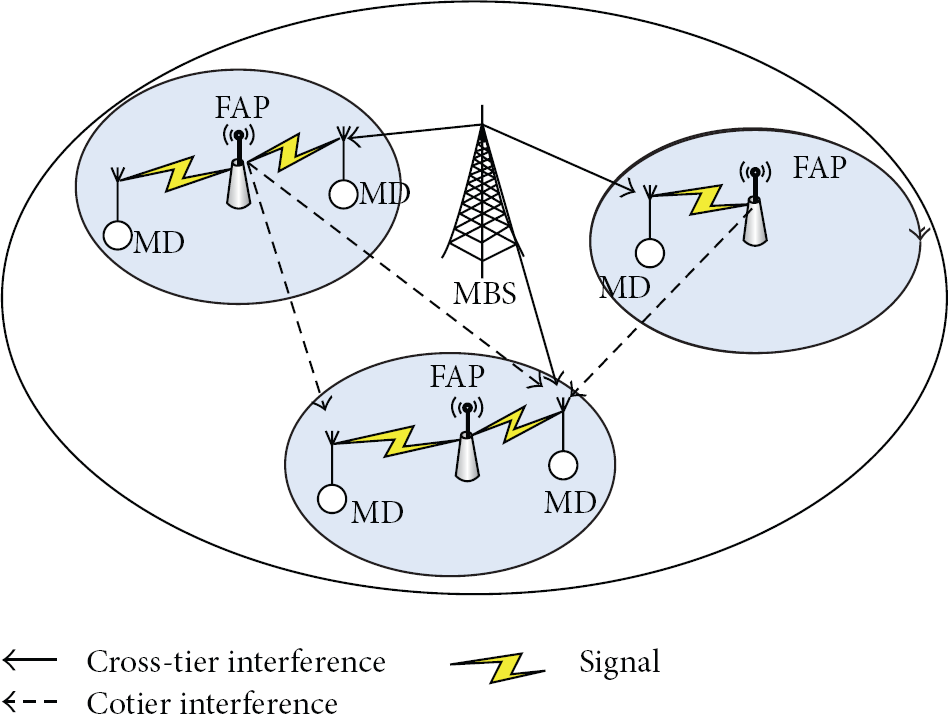
System model of the OFDMA femtocell network.
During the access control and subchannel allocation processes, the FAPs first report to FMDs their channel state information (CSI), which may be false information. According to the quality of CSIs, FMDs select FAPs by comparing the capacities they report, where we assume that each FMD can only access one of the FAPs to enjoy the service. Based on the true subchannel information, FAPs allocate the capacities of all subchannels to one or more applying FMD(s) to maximum their profits, and each FMD pays for the sum of the subchannel capacities provided by the FAP. Therefore, the sum of the subchannel capacities of


In order to solve the access control and subchannel allocation problem, we need to construct a mathematical model to describe it. During the accessing process of femtocell network, each FAP aims at increasing its own revenues by providing larger capacities, while the FMDs prefer better communication quality by selecting FAPs with larger capacities. However, the information shared by FMDs and FAPs is unbalanced, and the FMDs have incomplete information: they do not know either the real channel capacity of the each FAP or the real capacity of each subchannel. They have no other choice but to trust the FAPs of their reported information, and can only select the FAPs according to their reported capacities. For the FMDs, to select the FAPs with largest reported average capacities is always a good idea. After all, FAPs with larger average capacities are more probably to provide subchannels with larger capacities. Furthermore, the FMD can guarantee that it has larger opportunity to attain a subchannel when it select to attach the FAP with largest capacity rather than a smaller one, since the FAP always grants its subchannels to those FMDs with largest capacities. In a simple scheme, the FAPs are paid by FMDs only when they are selected. If no FMD selects the FAP, it will get nothing. This result may drive the FAPs to report better channel information to FMDs in order to win greater opportunity to be selected, causing unfairness in subchannel allocation and reduction of the throughput of the network

When FMDs select FAPs according to their reported information, the truth-telling problem needs to be solved effectively to maximize the throughput of the network.
3. Joint Access Control and Subchannel Allocation Scheme
To formulate the problem above, we denote the real and the reported subchannel capacities of


Here we consider For
Based on the PDF of capacities,


In order to solve the above problem, a truthful mechanism AGV in JACSA scheme can be employed to prevent FAPs reporting false information, when each FAP gets its maximum expected total revenue when it reports the real capacities. We will introduce the AGV mechanism in the next chapter.
Here we assume that all FAPs would report their real capacities to FMDs, and the next problem to be solved is how the FAPs allocate their subchannels among linked FMDs to maximize the throughput. Global optimum can not be reached, since each FMD only knows its own choices of FAPs, and it can not learn other FMDs' choices, and those FMDs who select the same FAP may compete for subchannel resources. For the optimal subchannel allocation (OSA) scheme which maximizing the throughput of the whole network, all subchannel information (which, of course, should be the true values) and allocation probabilities should be concerned, and the complexity of the algorithm is Based on the truth-telling mechanism, all FAPs report real average capacities to FMDs. OFAP According to the reported information, FMDs select one FAP with the largest average capacity to access. OFMD can only access According to the accessing information, FAPs allocate their subchannel resources among FMDs who select them. For each subchannel, FAP will allocate it to the FMD with the most capacity to maximize its throughput. OFAPs will allocate their subchannels among all FMDs, while CFAPs only allocate among CFMDs in their CSGs. Subchannel allocation finished. FMDs will access the FAPs who have allocated resources to them.
4. AGV Mechanism
Truth-telling is achieved by adding a transfer payment to the expected revenue For OO case, the transfer payment is where the externality represents the sum of other FAPs' expected payment from For OC case, the transfer payment is where the externality is For CC case, the transfer payment is where the externality is the same as OC case.


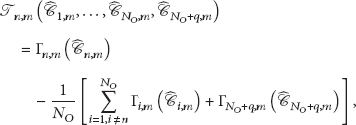


The expected total payment or the expected utility of

The existence of transfer payment can effectively prevent the FAPs from reporting false information. The FAPs who report larger capacities than their real values can be punished, and the loss of any FAP's revenue caused by exaggeratedly reported capacities of other FAPs can be compensated. If
Proposition 1.
Each FAP maximizes its expected utility from FMDs only when it reports its real information

Proof.
Without loss of generality, we consider the expected utility of

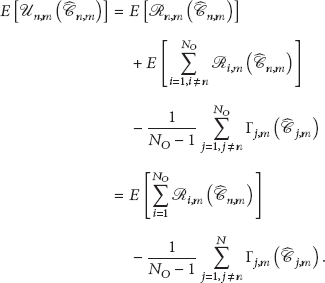


The terms on the right side of (18), (20), and (22) represent the expected revenue of all FAPs paid by
Proposition 2.
The network pays no extra costs for the truthful mechanism.
Proof.
From the transfer function equations (10), (12), and (5) we can obtain the sum of the transfer payment of all FAPs with
(1) for open FMDs (OO case)
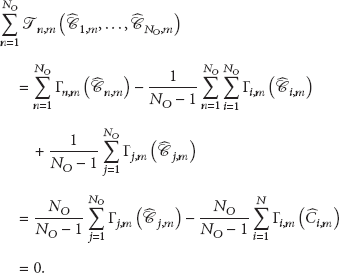
(2) For closed FMDs (OC and CC case)

The total transfer payment of all FAPs with
5. Simulation Results
Based on the analysis in previous sections, simulation results are given to evaluate the performance of the proposed JACSA scheme. Generally, the reported subchannel capacity of each FAP is assumed to obey the exponential distribution described by PDF
Firstly, we will focus on verification of truth-telling mechanism. For the open scenario, we investigate the performance of the truth-telling mechanism and consider a femtocell network with the settings of


Without loss of generality, we consider
In Figure 2, we demonstrate the variation of
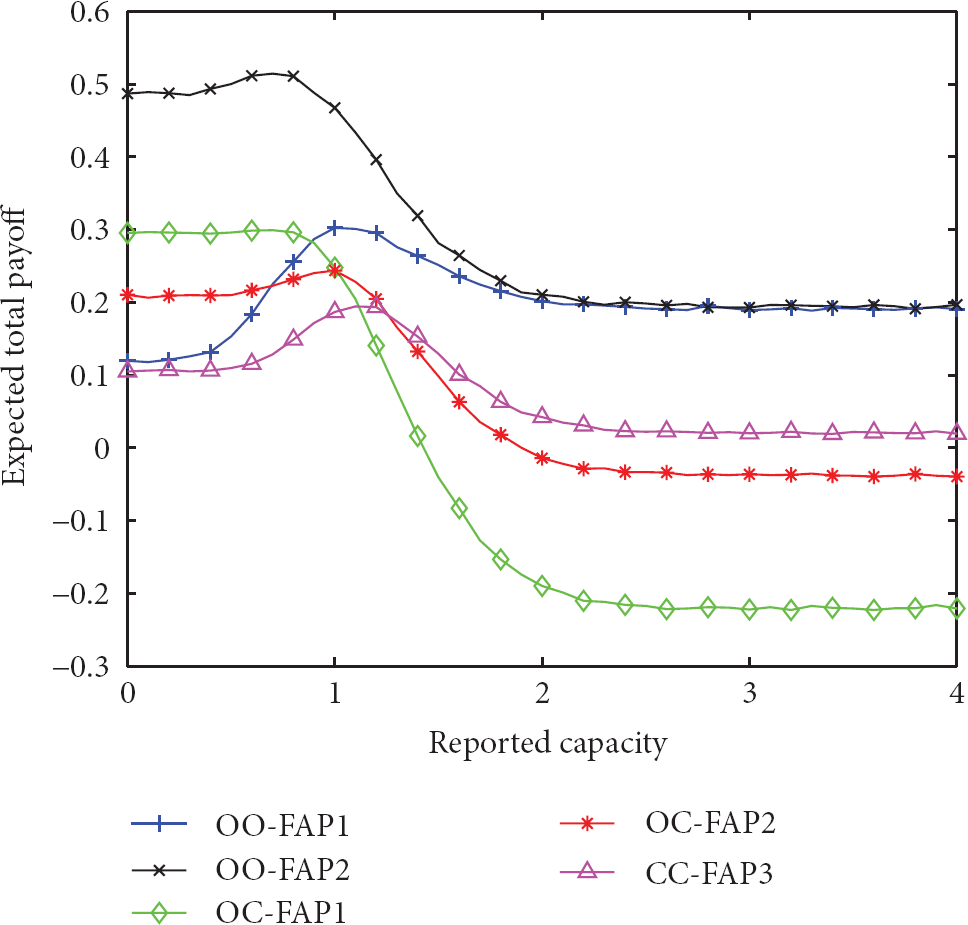
Expected total payment when different average subchannel capacities are reported to
In Figure 2, in the hybrid access scenario, the open FAP
Figure 3 shows the expected transfer payment of

Expected transfer payment when different average subchannel capacities are reported to
When all FAPs report true information, the transfer payments of all FAPs
Second, we consider the performance of the JACSA scheme and OSA scheme for an open access scenario. We primarily focus on the allocation result and throughput of the network at different K and

Throughput comparison at different K.
Then we set
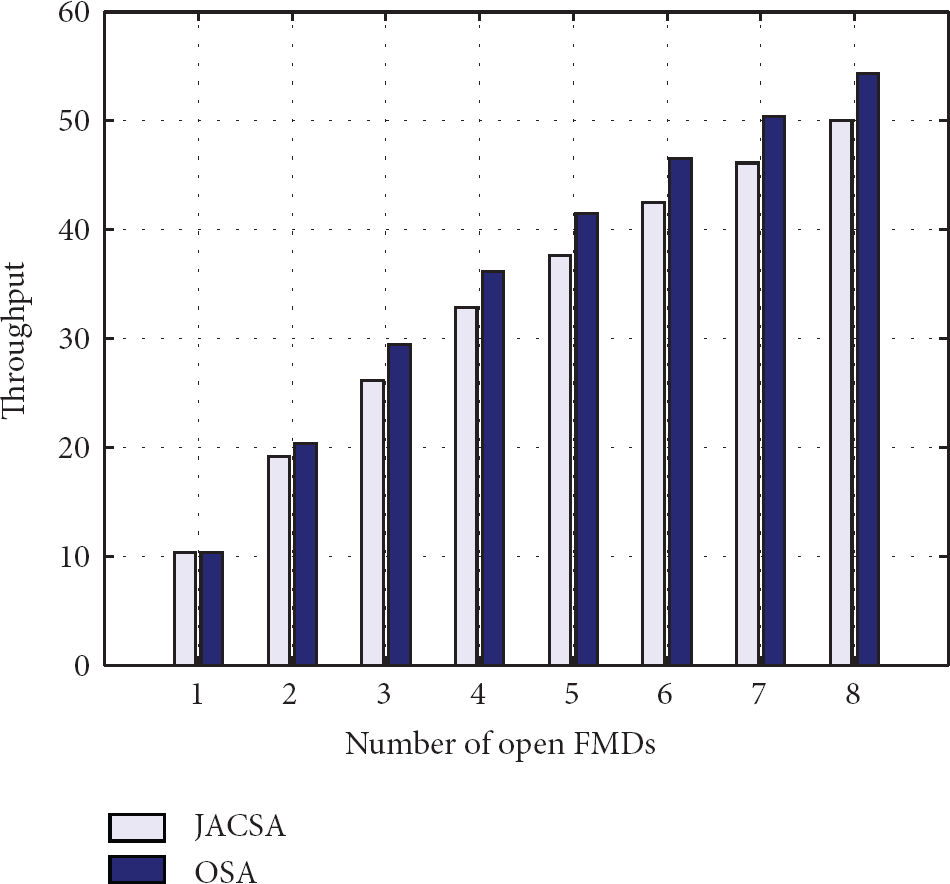
Throughput comparison at different
Third, comparing the JACSA scheme with the OSA scheme for the hybrid access scenario. We set
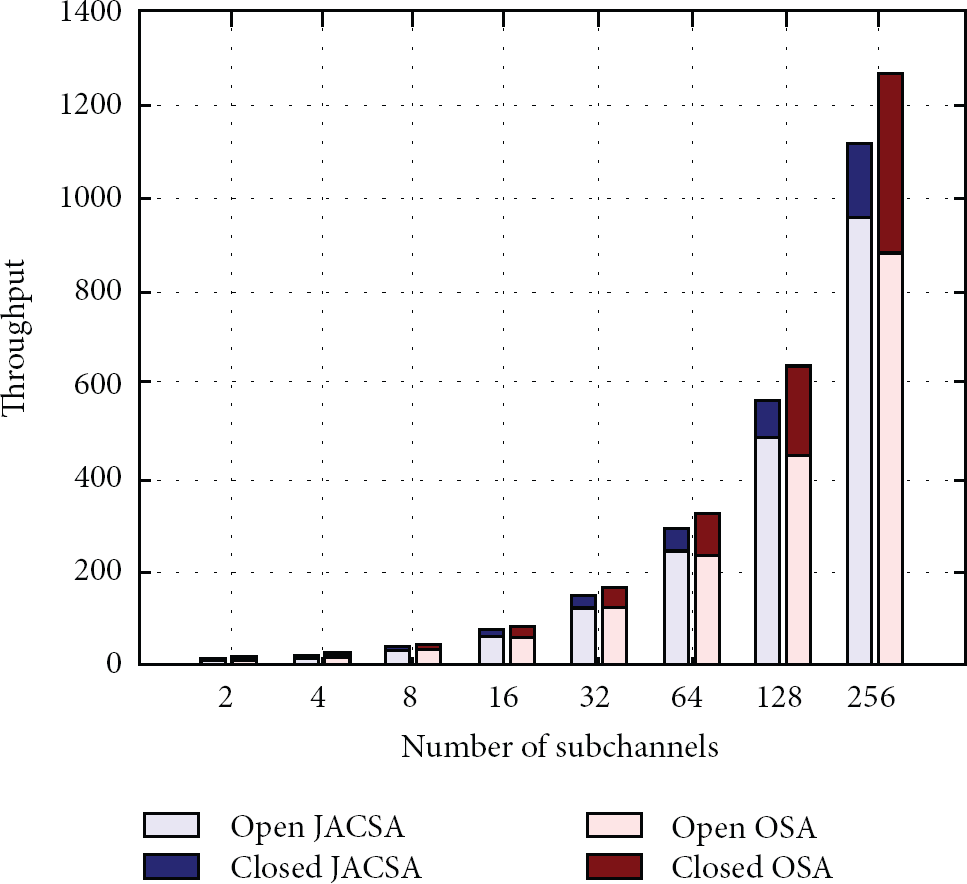
Throughput comparison at different K.
Similarly, we consider the influence of the number of closed FMDs in the hybrid access scenario. Figure 7 shows the throughput of all open and closed FAPs in the JACSA and OSA schemes. Increasing of the number of closed FMDs means that both subchannels of the open and closed FAPs are used sufficiently and the throughput of both kinds of FAPs increases.

Throughput comparison at different
Finally, in the hybrid access scenario, due to the existence of the closed FAP, which is exclusive to closed FMDs, these closed FMDs have more access choices, and thus they probably have larger per user capacity. Compared with the situation where this FAP is open, however, there is less chance for access, thus total throughput decreases. First, we look from the perspective of the FAPs and calculate the total throughput of the system. Figure 8 shows the throughput of open and closed FAPs with

Throughput comparison with different combinations of FAPs and FMDs. The figure shows the number of open FAPs and open FMDs, and the total number of FAPs and FMDs satisfies
From the perspective of FMDs, the average capacity is enjoyed by each FMD, as shown in Figure 9. When there is no closed FMD, as there are less open FAPs, the average capacity for open FMDs is smaller. If one FMD decides to join the CSG, the average capacity to be obtained is larger than that of an open FMD, and is also larger than that received by other open FMDs. As the closed FMDs probably access the closed FAP, the open FMDs have less competition and enjoy larger average capacity. As more FMDs join the CSG, as there are more competitions for the closed FAP, the average capacity decreases for each closed FMD but is still larger than that received by open FMDs and received with an open FMD. If all FMDs become closed, the situation is the same as in the open access scenario, and the capacity of each closed FMD is minimum. This indicates that, when closed FAPs exist, by becoming a closed FMD, the average capacity each FMD enjoys grows.

Average capacity per FMD enjoys with different combinations of FAPs and FMDs. The figure shows the number of open FAPs and open FMDs, and the total number of FAPs and FMDs satisfies
6. Conclusion
In this paper, we focus on the OFDMA femtocell-based M2M network with several femtocells and MTC devices distributed randomly in open access scenario and hybrid access scenario. In order to solve the truth-telling and subchannel allocation problems under these two scenarios, we propose a joint access control and subchannel allocation scheme based on the AGV mechanism. We use the transfer payment to balance the total payment and prove that there is only one equilibrium to be reached at the point when all FAPs reported their true capacities. By comparing the JACSA scheme with the OSA scheme in the two scenarios, we show that the JACSA scheme can obtain near optimal results with lower complexity. Finally, we compare the open access scenario with hybrid access scenario in the JACSA scheme, and the simulation results show that from the view of FAPs, an open access scenario is better to get more payments, but from the view of FMDs, when there are closed FAPs, it is better to join the CSG for better services.
Footnotes
Acknowledgments
This research was partly supported by the National Science Foundation of China (Grant no. NFSC #61071083, no. NFSC #61371073) and the National High Technology Research and Development Program of China (863 program, no. 2012AA01A506).