




Abstract
The demand of the wireless communications service is increasing in recent years, and the demand of the wireless communication rate is increasing too. However, the static spectrum allocation mechanism results in lots of free spectrum resources in space, and the spectrum is wasted. The cognitive radio technology with intelligent searching and efficient utilization of the idle spectrum resources just provides the opportunity to use the free spectrum resources. Thus, the spectrum allocation technology of the cognitive radio has also been more and more broadly concerned. In order to avoid the interference, a mathematical model of spectrum allocation for cognitive radio spectrum allocation algorithm is established through a graph theory. The spectrum allocation algorithms with different allocation objectives based on graph theory are studied according to the different network structures. After the basic ideas and allocation processes of these algorithms are described, a centralized network spectrum allocation algorithm based on the allocation sequence is proposed. Simulation results show that the improved algorithm can significantly reduce the time overhead and can have better fairness compared with other existing Collaborative-Max-Sum-Reward (CSUM), Collaborative-Max-Min-Reward (CMIN), and Collaborative-Max-Proportional-Fair (CFAIR) algorithms under the same design criterion.
1. Introduction
Wireless technology is playing a more and bigger fundamental role in the Internet than it has nowadays. The radio frequency spectrum has been chronically regulated with static spectrum allocation policies since the early 20th century. With the fast growing services and devices based on the spectrum, the remaining available spectrum for future wireless services is being exhausted, known as the spectrum scarcity problem [1, 2]. The current fixed spectrum allocation scheme leads to significant spectrum white spaces, where many allocated spectrum blocks are used only in certain geographical areas. Recognizing that the traditional spectrum management process can stifle innovation, and it is difficult to provide a certain quality of service (QoS) for systems operated in unlicensed spectrum [3–6], Federal Communications Commission (FCC) has proposed new spectrum management models and the use of a measure of interference temperature. Current spectrum management methods include command and control, exclusive usage based on license, commons, interference temperature, and fast command and control [7–9].
Existing cognitive radio network architecture model mainly has distributed list coloring spectrum allocation and centralized coloring spectrum allocation [10–12]. Dr. Joseph Mitola and Jondral Professor are the founder of cognitive radio; they proposed the centralized spectrum pooling system [13–15], and Bell Laboratories and Stevens Institute proposed DIMSUMnet (Dynamic Intelligent Management of Spectrum for Ubiquitous Mobile-access network) system [16]. IEEE 802.22 Working Group studied WRAN (Wireless Regional Area Network). Microsoft Asia Research Institute and University of California-Santa Barbara cooperates distributed spectrum sharing Nautilus project that is designed to emphasize distributed coordination enabled spectrum sharing,without relying on centralized control [17]. The United States Army's DARPA XG program aims to implement the policy based intelligent radios known as cognitive radios [18]. Professor Brodersen proposed CORVUS (cognitive radio approach for usage of virtual unlicensed spectrum) system [19]. The European OverDRiVE (Spectrum Efficient Uni- and Multicast Services Over Dynamic Radio Networks in Vehicular Environments) project aims at UMTS enhancements and coordination of existing radio networks into a hybrid network to ensure spectrum efficient provision of mobile multimedia services [20].
Among the graph theory methods of spectrum allocation, sequence-based spectrum allocation algorithm is proposed to solve the problem of spending too much time overhead to maximize the minimum income criteria by the spectrum allocation algorithm based on graph theory centralized network algorithm. Firstly, establish the mathematical model of graph theory methods to solve the problem of spectrum allocation. Secondly, analyze the basic idea of the different network structures under the existing graph theory algorithms and summarize their advantages and disadvantages. Finally, CSGC algorithm maximizing the minimum income criteria is not well adapted to the needs of the centralized network, and it must improve the time overhead, so this paper proposed an allocation sequence based on the spectrum allocation algorithm.
2. Graph Theory Modeling of Spectrum Allocation
The cognitive radio network uses the spectrum sensing function to find an available idle spectrum, and then the idle spectrum resources are divided into many channels allocated to the cognitive users of the network, and the cognitive users can communicate. Therefore, the key issue of affecting spectrum allocation algorithm design is how to know the spectrum sensing function detected for the communication services of the cognitive users. Currently, there are two main models to determine each cognitive users' rights:
2.1.
Model
The available form of the spectrum resource is just the start of the real communication business to obtain the results of the cognitive users' first screening channel, and thereafter also to consider the interference between other cognitive users, and the second screening process is done. After two rounds of screening, cognitive users really learn using the communication channel resources. In addition, in the process of the communication service, if the authorized users have the communication needs, the cognitive users need to immediately stop the use of the band, and the band is marked as “0” by the cognitive users, which are no longer available. After the authorized users have finished using the band, the cognitive users' some detection cycle is marked as “1,” which is the available frequency bands.
The model is applied to the actual operation, and the authorized users' power received by the measured cognitive users' spectrum detecting function is less than the power threshold, and the spectrum used by the authorized users is the idle spectrum resources of the cognitive users. In the spectrum allocation algorithm design, the distance of the cognitive users and authorized users is greater than the distance threshold, and the band used by the authorized users can be used as the available band. A specific example can refer to three cells of the authorized network and multiple cognitive users' scene shown in Figure 1. The authorized users (PU1, PU2, and PU3) are three base stations, respectively, using the channels CH1, CH2, and CH3, and four cognitive users' (CR1, CR2, CR3, and CR4) optional spectrum list is also illustrated in Figure 1.

2.2. Interference Temperature Model
The interference temperature concept is proposed by the United States Federal Communications Commission (FCC), whose aims are to measure the size of the interference and to effectively manage interference [21]. The interference here refers to the interference of PU, and the interference is the interference of the reception power. Interference temperature model is to ensure that the interference of PU to cognitive user (SU) cannot exceed the interference temperature limit. SUs based on the measured current interference situation do real-time adjustment of the transmitter parameters such as operating frequency and transmit power in order to meet this requirement. There is a noise temperature, and its definition is equivalent to the interference temperature, and they are the powers measuring the interference. The corresponding units are Kevin, which is defined as in (1):

Another term related to the interference temperature is interference temperature threshold
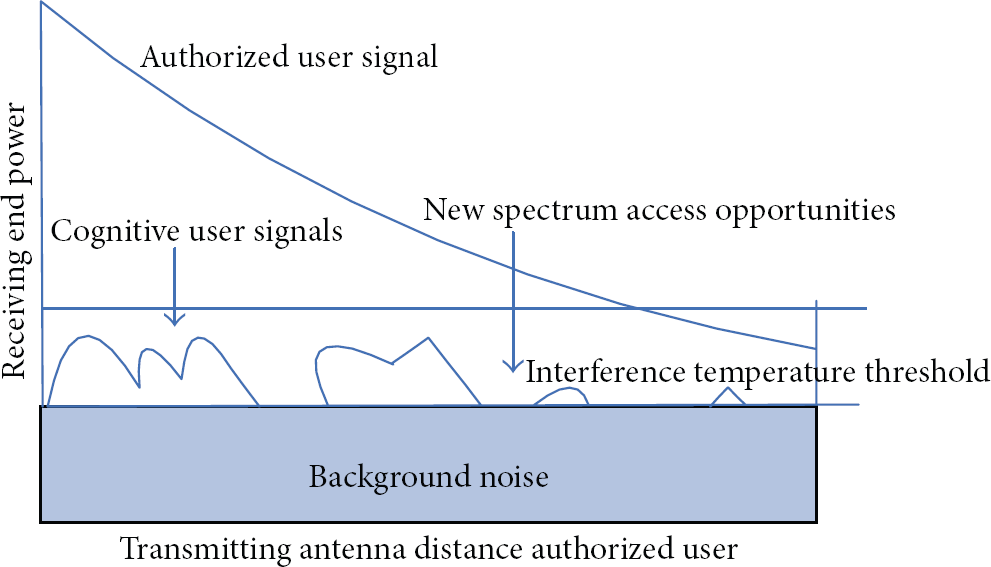
Interference temperature model.
The literature [11] defined the ideal model and the generic model of the interference temperature and has a detailed analysis and comparison of two models, and the signal and the interference as well as the relationship of bandwidth and center frequency are explicitly discussed.
(1) Ideal Model. When considering the background noise and interference signals from cognitive users, the cognitive restrictions and requirements of the users' receiver parameters are defined in the authorized users' bandwidth. Assume that the average power of cognitive users is P, and the center frequency is
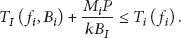

(2) Common Model. Consider the background noise, authorized users, and other cognitive users; the restriction of the cognitive users' transmitter parameters is defined in the cognitive user bandwidth:

The main difference between the two models is that the latter cannot distinguish between the signal of authorized users and interference, and the interference temperature model is for the entire frequency band. And the monitoring point of the former is in the authorized user, so the authorized signals are easily distinguished from the interference and noise, and interference temperature model is for the specific authorized users.
However, the interference temperature is still a vague concept to the cognitive equipment manufacturer. So the literature [12] proposed the prediction and assessment model with the small interference to the authorized users, and the model has guiding significance for using broadcast television band for the unauthorized users. But this model is impacted by the cognitive users' signal modulation parameters, antenna parameters, and power control and detects authorized user channel capacity and many other factors.
Interference temperature model for cognitive radio spectrum allocation algorithm usually considers cognitive users using the same spectrum of the authorized users, and the interference from cognitive users to authorized users is limited by the interference temperature. The literature [20] pointed out that this model can be efficiently used for dynamic spectrum access. Due to the problem of spectrum allocation for cognitive radio networks, the literature [18] designed cognitive wireless mesh network channel selection algorithm based on the interference temperature model.
Finally, the cognitive radio network may run on the licensed band and the nonauthorized band depending on the type of free spectrum resources, and it can also be run in a mixed manner. When the cognitive users' idle spectrum is unlicensed spectrum such as ISM (Industrial Scientific and Medical) band, it is referred to as “horizontal sharing” spectrum; when the cognitive users' idle spectrum is unlicensed spectrum using the licensed spectrum, it is referred to as “vertical sharing” spectrum.
Assume that in the cognitive radio network area there are a P-authorized user (PU) and N cognitive users (SU), and the system available spectrum is divided into M same bandwidth and completely orthogonal sub channels. In order to share the channel available information of the respective nodes and the central node as well as the delivery channel allocation message, the system also requires the specialized transmission control channel.
In the coloring theory, the available channel is determined according to the distance of the cognitive users and the authorized users, and whether there is interference according to the distance between the cognitive users and other cognitive users. As shown in Figure 3, assume that each user uses the omnidirectional antenna in the system, and the transmission range of the authorized users is the circular area for the radius
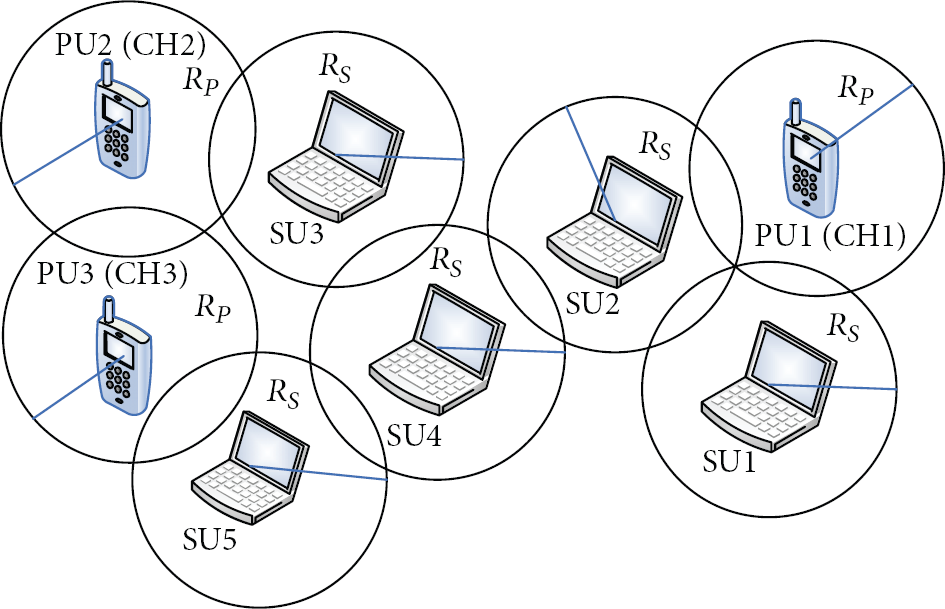
Cognitive radio spectrum allocation scene.

Graph topology of cognitive radio network.
It should be noted that the network topology of Figure 4 represents just the mutual interferences of one moment cognitive user between the cognitive radio networks. Because the authorized users' spectrum usage status is constant conversion between idle and busy in reality, the available channel has the time-varying characteristics. In addition, authorized users and cognitive users must consider the impact of mobility on the interference between them. The spectrum allocation algorithm of the graph theory model is generally assumed that cognitive users' position is unchanged and the cognitive users' available spectrum resources are unchanged in the process of implementation of the allocation algorithm; namely, the graph topology of the cognitive radio network is unchanged.
The graph theory topology of Figure 4 can be further described by mathematical method, and the undirected graph of Figure 4 is recorded as
(1) Vertex Vector. V is the vertex of the graph, which represents N cognitive users.
(2) Interference Matrix.
(3) Channel Availability Matrix.
(4) Conflict-Free Channel Assignment Matrix.
Obviously, if

3. Existing Algorithms
3.1. Distributed List Coloring Spectrum Allocation
Three cognitive radio spectrum allocation algorithms were proposed in the case of distributed network [13]: Distributed Greedy Algorithm (DGA), Distributed Fairness Algorithm (DFA), and Randomized Distributed Algorithm (RDA). And the spectrum allocation using mathematical methods is described by formula (6) as follows:

(1) Distributed Greedy Algorithm. DGA's goal is to achieve the maximizing spectrum utilization of formula (7) in the case of satisfying formula (6) in the three constraints; that is, the results of the spectrum allocation are to let the maximum of the number of subchannels shared by all the cognitive users:


The idea of distributed greedy algorithm is to deal with all the colors one by one, and the goal of the greedy algorithm is to maximize the use of the color for each color k. The specific approach is when color k is assigned, color k is given priority to the smallest vertex degree

Distributed greedy algorithm.
Distributed greedy algorithm considers the constraint conditions between the cognitive users based on the vertex degrees of all vertices to maximize the spectrum utilization. But the cognitive user minimally disturbed by the other users with small vertex degree always has the highest priority of the subchannel allocation to always get the spectrum. The users with large vertex degree always are allocated less spectrum or even are not allocated the spectrum, so it is less fairness.
(2) Distributed Fairness Algorithm. Distributed fairness algorithm goal is to satisfy three constraints of formula (6) to achieve the fairness of spectrum allocation. The spectrum allocation of the distributed greedy algorithm would lead to spectrum allocation unfairness, so distributed fairness algorithm makes more equitable distribution of the spectrum through the establishment of a directed graph approach.
In the distributed fairness algorithm, the spectrum degree

Distributed fairness algorithm is divided into the following three steps (Figure 6).

Distributed fairness algorithm.
First, the undirected graph G is modified to the directed graph G based on the concept of vertex degree and spectrum degree. This requires the undirected graph G edge at one end add to an arrow from a vertex point to another vertex. Increasing the rules of the arrow is if the spectrum degree
The interference matrix E can reflect the point to the edge of the graph G, and E matrix is modified as follows: if
Second, the places vertices have the highest priority of the spectrum allocation at the cycle of the algorithm, and only the places vertex does the spectrum allocation to gradually allocate spectrum to the source vertex. Multiple places vertices at the same time select a subchannel, and the subchannels are the least number of channels for all available channels of the places vertices of all neighbors. The places vertex selects the available channel, and issues set-color flag to notify all its neighbors vertices which cannot use the channel. When a nonplaces vertex receives set-color flag issued by all neighbors of the vertex, all output sides of the nonplaces vertices are deleted to become a new places vertex, and in the next cycle participate in spectrum allocation. In addition, the vertex that have not available spectrum should quit spectrum allocation.
Finally, if all vertices are no longer available subchannels, the algorithm ends; otherwise, enter the first step to start a new spectrum allocation from the places vertex to the source vertex. First, the source vertex issues reset flag to all its downstream neighbor vertices, only when a vertex received reset flag from the upstream neighbor vertex, the vertex delivered the reset flag to all of its downstream neighbor vertices. When all nonsource vertices receive the reset flag, the system is restarted. Then, enter the first step of the algorithms. Start from the places vertex to check whether there is available spectrum; if available spectrum exists, the spectrum is allocated in accordance with the second step of the method; if there is no available spectrum, exit the operation. Finally, if there is no vertex available spectrum, the spectrum allocation algorithm ends.
Distributed fairness algorithm not only considers the vertex degree, but also considers the spectrum degrees relative to the best fairness spectrum allocation in the other two algorithms. It realized the fairness spectrum allocation, but consumed more communication overhead in the same time. This is mainly due to the need to sort vertex degree and spectrum degrees.
(3) Random Distributed Algorithm. Random distributed algorithm goal is to meet three constraint conditions of formula (1), and to reduce communication overhead. When the number of vertices and color is very big, distributed greedy algorithm and distributed fairness algorithm need large number of iterations, and therefore random distributed algorithm was proposed to reduce communication latency and overhead.
If a vertex in the loop of the algorithm and the competition channel of the neighbor vertices fail in random distributed algorithm, they will increase their contention window. The next contention channel will have bigger winning probability so that we can reduce the probability of the vertex competitive resource conflict.
The basic idea of the random distributed algorithm is that each vertex i of the undirected graph G sets its own contention window

Random distributed algorithm.
Random distributed algorithm achieves cognitive radio spectrum allocation by the way of comparing the cognitive users and the random numbers generated by the neighbor cognitive users. In addition, the fairness of the cognitive user spectrum allocation is realized by adjusting the size of the contention window. This algorithm significantly reduces the complexity of the spectrum allocation, while reducing the overhead of the communication.
3.2. Centralized Coloring Spectrum Allocation
The coloring spectrum allocation algorithm described in the previous section reflects that the interference matrix E is a two-dimensional matrix between the users. That is, in the different subchannels, the mutual interferences between the characteristics of the users are the same. If two cognitive users interference cannot be ignored in a subchannel, then another subchannel must be mutual interference. The number of any subchannel interference neighbors is the same in the undirected graph G and the directed graph G.
In fact, because the interference of the cognitive users and authorized users is the same, the cognitive users' available subchannels also have differences. So taking into account the difference of the different channels, the edges between two vertices in the undirected graph G cannot simply think that all subchannels all exist the edges, but they exist with the subchannels. That is to say on a different subchannel, in which the number of interfere neighbors is different, which is the problems of interference spectrum difference.
Therefore, the literature [14] proposed Color-Sensitive Graph Coloring (CSGC) spectrum allocation algorithm against the interference spectrum differences and spectral quality differences. Figure 3 needs to be amended as the undirected graph with repeated edges shown in Figure 8.

Spectrum allocation undirected graph with interference difference.
After undirected graph is modified as the undirected graph with repeated edges, in order to reflect the interference differences, interference matrix E is also required to have the spectrum characteristics to become three-dimensional interference matrix
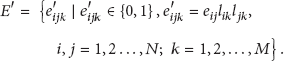
Then, the channel gain matrix B is defined as a set of all cognitive users on each subchannel gain. The gains generally refer to the maximum bandwidth or throughput, and so on.

The main goal of color sensitive graph theory coloring spectrum allocation algorithm is to achieve a variety of spectrum allocations to maximize the revenue function based on the interference conditions according to the different requirements of cognitive radio network plan, and the revenue function mainly includes the following three forms.
(1) Max Sum Reward (MSR). When the cognitive radio networks do not consider the fairness of the cognitive user spectrum allocation, max sum reward makes the spectrum utilization maximum. The revenue function of the cognitive radio network can be expressed by the following formula:

(2) Max Min Reward (MMR). Min is the cognitive users that allocated the least spectrum at the end of the spectrum allocation algorithm. The revenue function of Min can be expressed by the following formula:

(3) Max Proportional Fairness (MPF). The revenue function design goal of the max proportional fairness is to find fairness distribution results. Any other form of distribution with respect to the allocation of revenue in the form of proportional change is negative in the allocation result. The revenue function of the max proportional fairness can be expressed by the following formula:


The basic idea of CSGC spectrum allocation algorithm is to design the appropriate vertex labeling rule in order to achieve the above revenue function needs. The size of the tag reflects the contribution of the vertex to the revenue function. Each label corresponds to a lot of color values. Each selection of CSGC algorithm has the largest contribution to the vertex of the revenue function and chooses the biggest color of the color values. When a vertex is colored, all other adjacent vertices are necessary to remove the color from their available channels, and the channel availability matrix is updated with heavy edge, and the undirected graph G has also been updated. If the graph G is not empty, then continue to the next algorithm cycles until all vertices are no longer available colors, and the algorithm ends. CSGC spectrum allocation algorithm flow is shown in Figure 9.
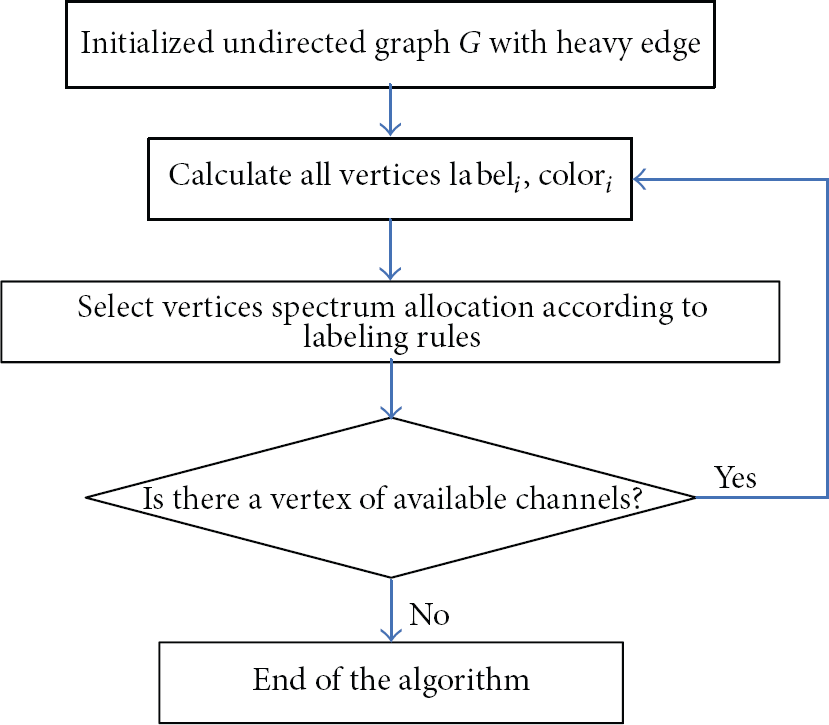
CSGC spectrum allocation algorithm.
CSGC algorithm is divided into collaborative and noncollaborative according to the vertex whether to consider the impact on the neighbors. Collaborative CSGC spectrum allocation algorithm is necessary to consider the system spectrum utilization level, but it also considers the impact on the neighbors of each color choices, so the labeling rules of CSGC algorithm can be divided into the following six forms.
(1) Collaborative-Max-Sum-Reward (CSUM). The number of conflicts is an important concept in the collaborative CSGC spectrum allocation algorithm, which is defined as a subchannel k, and the number of the neighbors of cognitive user i can be calculated by the following formula:


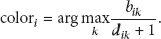
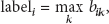
(2) Noncollaborative-Max-Sum-Reward (NSUM). NSUM does not consider the impact on the neighbor color selection, while the size of the tags for each vertex and the corresponding size of each color are calculated by the following method:

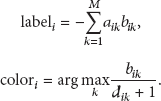
(3) Collaborative-Max-Min-Reward (CMIN). CMIN is different from CSUM and NSUM rules, and its label features are related to the previous spectrum allocation revenue. The vertex of the smallest gains on spectrum allocation stage has the spectrum priority at this stage. Each spectrum allocation phase labeling rule is as follows:
(4) Noncollaborative-Max-Min-Reward (NMIN). NMIN does not consider the interference problem of the vertices, which still has priority access to the spectrum at this stage. The vertex of the smallest gains has the spectrum priority. Each spectrum allocation phase labeling rule is as follows:
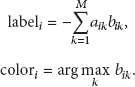
(5) Collaborative-Max-Proportional-Fairness (CFAIR). CFAIR is to achieve the fairness of the spectrum allocation described by formula (14). The size of the label is not only influenced by the number of conflicts, but it is also related to the spectrum allocation in the last phase. The labeling rules of each stage are as follows:

(6) Noncollaborative-Max-Proportional-Fairness (NFAIR). NFAIR is the noncooperation of CFAIR, and it is no longer considering the impact on the size of the label. The labeling rules of each spectrum allocation phase are as follows:

4. Improved Spectrum Allocation Algorithm Based on Allocation Sequence
4.1. Overhead of CSGC Spectrum Allocation Algorithm
The list coloring spectrum allocation algorithm and CSGC spectrum allocation algorithm are the spectrum allocation for the static cognitive radio network topology, that is in the process of the spectrum allocation algorithm execution; either undirected or directed cognitive radio network topology graphs always remain the same. After the execution of the spectrum allocation algorithm, if there is a new cognitive radio nodes join the network, the system must re-construct graphical topology including all of the network nodes, the global optimization algorithm increase the algorithm's time overhead. CSGC algorithm overhead is formula (25), which increases with the increase of the number of users and the number of available channels:

In order to reduce the allocation overhead, the literature [15] proposed a distributed local bargaining spectrum allocation algorithm, and it started from the reduction in the number of users involved in spectrum allocation point of view and took full advantage of the previous allocation result, which only does spectrum allocation for the local network topology graph of the newly added network nodes at bargaining, thus reducing the time overhead of the spectrum allocation algorithm. The literature [16] proposed parallel spectrum allocation algorithm from the point of view of the amount of spectrum to further reduce the time overhead of CSGC spectrum allocation algorithm. The overhead of the parallel spectrum allocation algorithm is formula (26):

However, the parallel spectrum allocation algorithm currently only improves CSGC spectrum allocation algorithm based on MSR and MPF guidelines. In order to meet the requirements of the MMR guidelines, new spectrum allocation algorithm must be designed to further reduce the time overhead of the CSGC algorithm.
4.2. Improved CSGC Algorithm Based on MMR Criterion
MMR criterion is represented by formula (13) in CSGC algorithm to maximize the cognitive users' bandwidth with the least number of the allocation spectrums. To ensure that the network spectrum resources are not wasted, the spectrum allocation worst user is always able to get more spectrum gains priority with the spectrum allocation fairness. However, the time overhead is the key factors that affect the actual application in CSGC algorithm.
MMR criterion requires that the goal of the spectrum allocation is to maximize
Equations (17)~(20) explain that CSGC algorithm has the following main features in both forms of cooperation or noncooperation.
Start point of the spectrum allocation is random. In CSGC algorithm of MMR guidelines, the first cycle of the algorithm randomly allocates spectrum to a user. Because any user does not get the spectrum at the first time, the calculation result of The number of channel allocation opportunities is equal; in the form of cooperation and noncooperation of CSGC algorithm, the more the amount of spectrum allocations is, the smaller the opportunity of cognitive users again shared the spectrum is; the less the amount of spectrum allocations is, the greater the opportunity of cognitive users again shared the spectrum is. The opportunity of the channel gains is equal. Channel allocation sequence always begins from the channel giving cognitive user maximum channel gain. However, from the results of the final allocation, the shared channel may be more than one. Both can make it to get the maximum channel gain channel, but also make it to obtain the minimum revenue channel. Visible is to make the channel gains close to the average allocation among the cognitive users so that bottlenecks user has more bandwidth. The number of conflicts is the main reason affecting the income of bottlenecks user bandwidth.
Based on the above four points, it is necessary to improve the fairness of the distribution for bottleneck users, and to reduce the execution time of CSGC algorithm in a centralized network. In this paper, spectrum allocation algorithm based on the allocation sequence is proposed in the MMR criterion. Design the tag rules shown in formula (27) and formula (28) considering the separation of the time overhead and cognitive users' historical allocation information:


Specifically, in each channel, all the users'
Process of spectrum allocation algorithm based on the allocation sequence is as follows:
Undirected graph G with repeated edges generates M undirected graphs Compare N cognitive users' Find out all users interfering with cognitive user To determine whether there is an available channel for cognitive users. If the result is “1,” the algorithm returns to (2); if the result is not “1,” the whole spectrum allocation algorithm ends.
A more intuitive process of spectrum allocation algorithm based on allocation sequence is shown in Figure 10.

Spectrum allocation algorithm based on allocation sequence.
5. Simulation and Analysis
5.1. Parameter Settings
This section mainly studies the performance of the spectrum allocation algorithm based on the allocation sequence through MATLAB simulation, and the simulation parameters are shown in Table 1.
Parameter list.

5.2. Simulation Results
In the form of cooperation spectrum allocation through MATLAB simulation, the spectrum allocation algorithm based on the allocation sequence proposed in this paper does the comparison with the CSGC spectrum allocation algorithm meeting MSR, MMR, and MPF (called as CSUM, CMIN, and CFAIR algorithms, resp.). In this paper, we consider the measure of spectrum allocation algorithm performance indicators including cognitive users' minimum income, cognitive users' average income, fairness of algorithm allocation, and time overhead of the algorithm.
(1) Cognitive Users' Minimum Income. First of all, the MMR guidelines using formula (14) analyze the performance in the cognitive user minimum income to verify whether the algorithm is in line with the MMR guidelines. The relationship of the cognitive user minimum income and of the number of cognitive users cognitive users is shown in Figure 11 in a fixed amount of spectrum and

Comparison of cognitive users' minimum income.
As can be seen from Figure 11, CMIN algorithm can get more bandwidth income characteristics of best protected cognitive users with the minimum income. When the cognitive users are enough, the algorithm proposed in this paper will be very close to CMIN algorithm. CSUM algorithm and CMIN algorithm do not consider the minimum bandwidth gains as much cognitive users bandwidth gains. And with the increase of cognitive users, CSUM algorithm and CFAIR algorithm are increasingly unable to meet the bandwidth minimum income that cognitive users' channel needs.
(2) Cognitive Users' Average Income. Secondly, cognitive users' average income can also evaluate the performance of the proposed algorithm. The average of the total income of formula (13) based on the MSR criteria can get the average income in the form of formula (28) as the standard of the average income of the evaluation of cognitive users. The relationship between cognitive users' average income and the number of cognitive users in a fixed amount of spectrum and 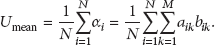
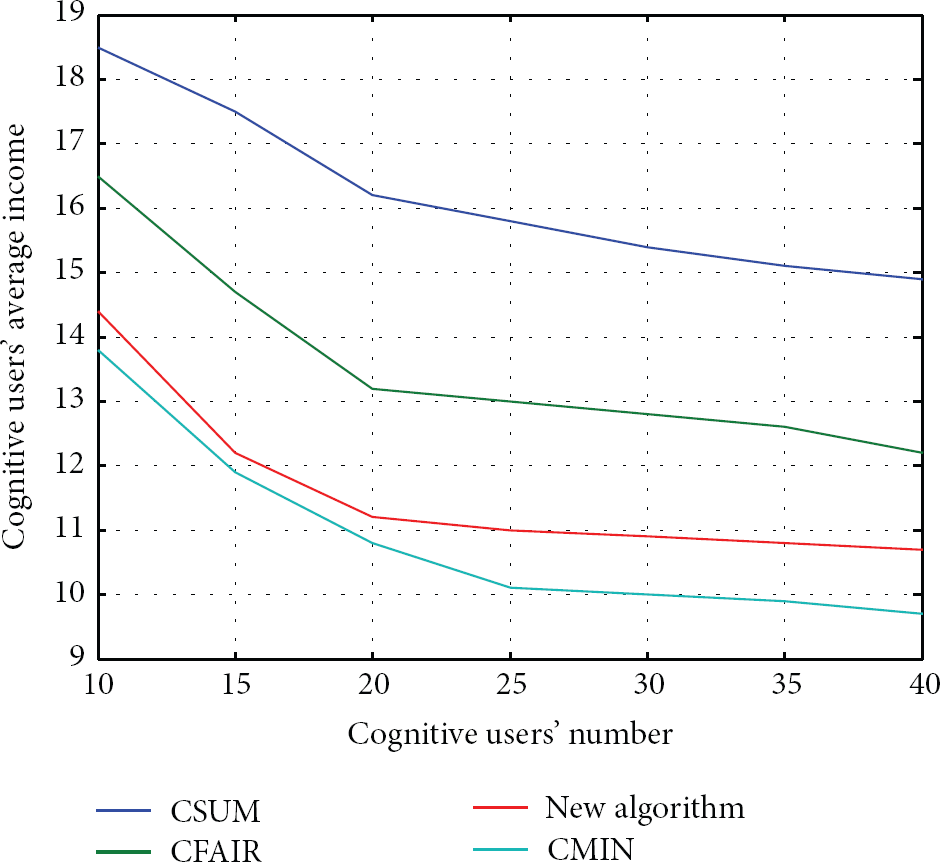
Comparison of cognitive users' average income.
(3) Fairness of Algorithm Allocation. The fair evaluation criteria of the algorithm use formula (14) of MPF guidelines. The relationship between the fairness of algorithm allocation and the number of cognitive users in a fixed amount of spectrum and
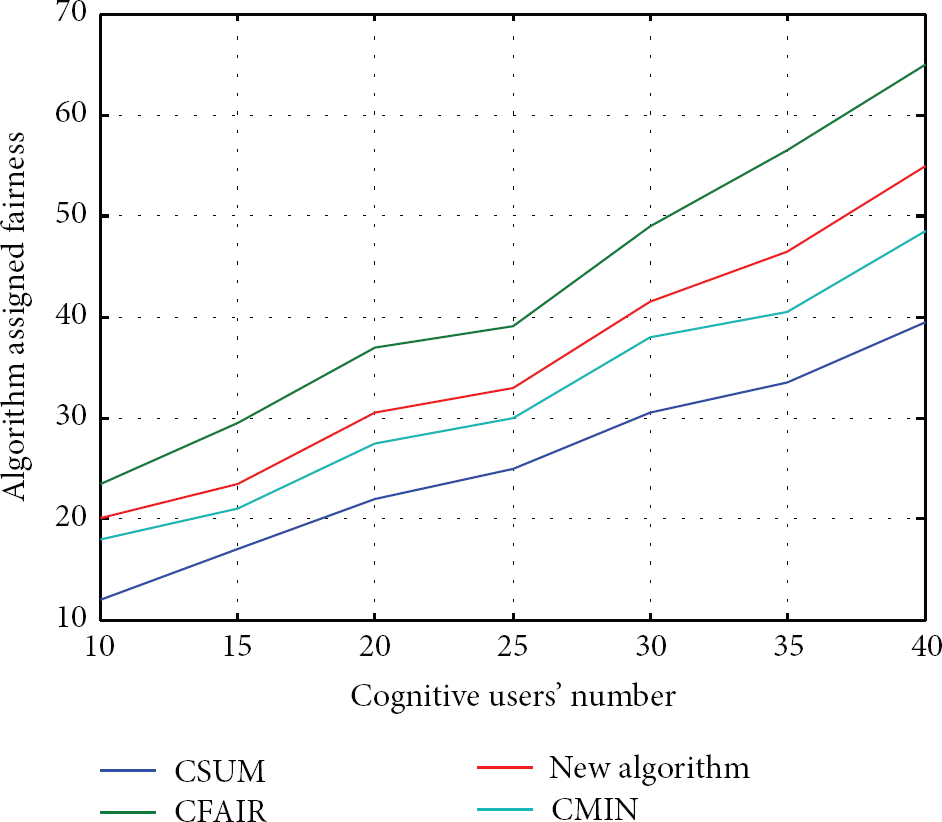
Comparison of the fairness of algorithm allocation.
The comparison of the fairness of algorithm allocation in Figure 13 illustrates that the fairness of spectrum allocation is better than CMIN algorithm under the same MMR guidelines, but the performance is still below the CFAIR algorithm meeting the fair MPF guidelines. In addition, with the increase of the cognitive user network, the proposed algorithm and CMIN algorithm simultaneously increase in fairness, while the fairness of CSUM algorithm will increase slowly.
(4) Time Overhead of the Algorithm. Finally, in order to evaluate the time overhead proposed by this paper, MATLAB program run time is directly used to measure with other algorithms, and the time overhead of existing algorithm and CSGC algorithm is compared to each other. The curve of the time overhead of the spectrum allocation algorithm with the changes of the number of cognitive users is shown in Figure 14 in a fixed amount of spectrum and
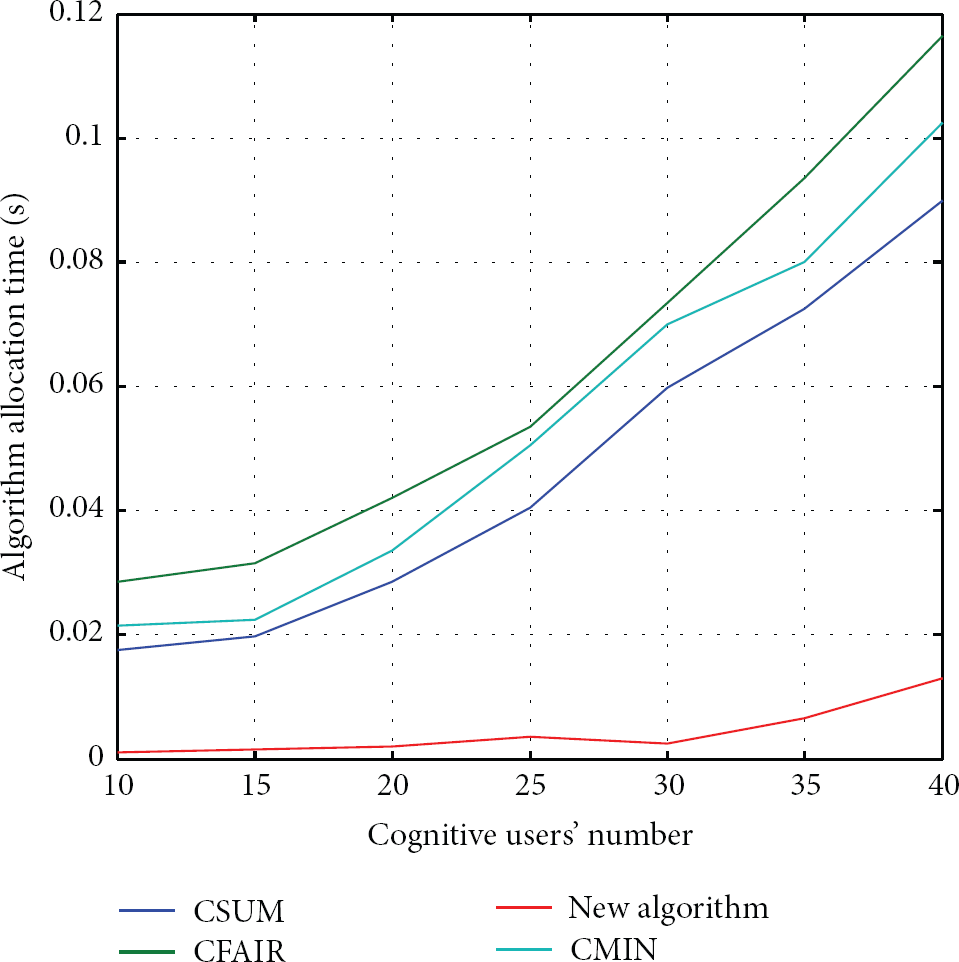
Time overhead and cognitive users' number.

Time overhead and number of frequencies.
As seen from Figure 14, the time overhead of the algorithm proposed in this paper is significantly lower than existing CSUM algorithm, CMIN algorithm, and CFAIR algorithm in the same amount of spectrum. With the increase in the number of cognitive users, the time overhead of the algorithm proposed in this paper will increase, but it is not obvious, and the time overhead is still very small. It is very important to the centralized cognitive radio networks, because the rapid convergence of the algorithm is able to increase the flexibility and applicability of cognitive radio network.
Figure 15 illustrates the relationship between the time overhead of the algorithm and the amount of spectrum in the same number of cognitive users. As can be seen, with the increase in the number of the spectrum, the execution time of the algorithm in this paper does not increase, but fluctuates in a range, and the time complexity of the algorithm depends only on the allocation for the longest time undirected graph.
In short, the simulation results show that the spectrum allocation algorithm proposed in this paper based on the allocation sequence is not only able to meet the design requirements of cognitive radio networks based on MMR guidelines but also able to reduce the spectrum allocation algorithm execution time in centralized cognitive radio network. And the time is only related to the number of users, is not related to the amount of spectrum. In addition, the spectrum allocation is closer to CFAIR algorithm that is done the best in fairness compared with other algorithms.
6. Conclusion
This paper establishes the mathematical model for the cognitive radio spectrum allocation based on the graph theory and the existing spectrum allocation algorithms based on the distributed cognitive radio networks and the centralized cognitive radio networks, which include the basic idea of the algorithms and the specific process of the algorithms. The improved algorithm based on the central cognitive radio network spectrum allocation algorithm is proposed. The simulation results show that the improved algorithm can significantly reduce the allocation time of the algorithm compared to the existing graph theory algorithms.