




Abstract
A theoretical model based on the integral formalism approach for laminar external natural convection in the vicinity of a vertical wall is used to be extended to nanofluids. Two kinds of thermal boundary conditions including uniform wall temperature (UWT) and uniform heat flux (UHF) are used for this modeling. Two different nanofluids are tested, namely, Cu/water and CuO/water nanofluids for which both viscosity and thermal conductivity were determined using Brownian motion-based models. A close attention is focused on the influence due to increasing the volume fraction of nanoparticles on both the heat transfer and dynamic parameters. Results are presented only for particle volume fractions up to 4% to ensure a Newtonian behavior of the mixture. It has been found that natural convection heat transfer increases with the volume fraction for a fixed Grashof number, whatever the nanofluid is. Nevertheless, the enhancement of heat transfer is more pronounced in the case of Cu/water than for the CuO/water nanofluid. Moreover, this trend is also confirmed regarding the dynamical parameters such as the maximum velocity value within the dynamical boundary layer and the corresponding boundary layer thickness.
1. Introduction
The application of additives to base liquids in the sole aim to increase the heat transfer coefficient is considered as an interesting mean for thermal systems. Until now, it was known that, in forced convection [1, 2] as well as in mixed convection, using nanofluids could produce a considerable enhancement of the heat transfer coefficient that increased with increasing the nanoparticle volume fraction. One of the major reasons was that nanoparticles enhance heat transfer rate by increasing the thermal conductivity of the resulting nanofluid and incurring thermal dispersion in the flow [3, 4]. Consequently, many researches have focused on the way to increase the thermal conductivity parameter by modifying the particle volume fraction, the particle size/shape, or the base fluid [5–7]. However, it is worth mentioning that a recent work [8] in forced convection indicates that the assessment of the heat transfer enhancement potential of nanofluid is difficult and closely dependent on the way the nanofluid thermophysical properties are modeled. Unlike forced convection, there is a striking lack of theoretical and experimental data in natural convection. Furthermore, the conclusions from the few published results in the literature also seem to be controversial. For example, for a buoyancy driven flow in a two-dimensional enclosure, Khanafer et al. [9] have numerically found that the nanofluid heat transfer rate increases with the increase in nanoparticle volume fraction. On the other hand, the experimental study by Putra et al. [10] for a natural convection case of copper and alumina-water nanofluids inside a horizontal differentially heated cylinder has shown an apparently paradoxical behaviour of significant heat transfer deterioration. Wen and Ding [11], using titanium dioxide nanoparticles, have also observed experimentally such deterioration in the natural convective heat transfer.
Because knowledge of nanofluids is still at their early stages, it seems very difficult to have a precise idea on the way the use of nanoparticles acts in natural convection heat transfer, and complementary works are needed. Thus, to remedy this lack of data and to document the natural convection heat transfer, a theoretical model is used for nanofluid applications in external boundary-layer flows. Nanoparticles, because of their very fine structure, make a stable and homogeneous state when solving in the base fluid. Thus, the nanofluids are usually considered similar to the base fluids as monophase ones, and the present investigation shall be restricted to Newtonian nanofluids.
Two kinds of thermal boundary conditions including uniform wall temperature (UWT) and uniform heat flux (UHF) are used for this modeling. Two different nanofluids are tested, namely, Cu/water and CuO/water nanofluids for which both viscosity and thermal conductivity were determined using Brownian motion-based models. A close attention is focused on the influence due to increasing the volume fraction of nanoparticles on both the heat transfer and dynamical parameters. Results are presented only for particle volume fractions up to 4% to ensure a Newtonian behavior of the mixture.
2. Nanofluid Properties
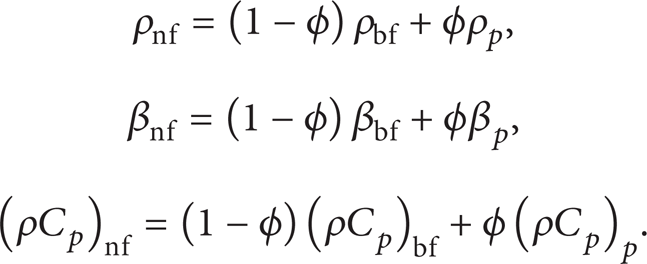
The thermophysical properties of the nanofluids, namely, the density, volume expansion coefficient and heat capacity, have been computed using classical relations developed for a two-phase mixture [3, 11, 12]:
It is worth noting that for a given nanofluid, simultaneous measurements of conductivity and viscosity are missing. The development of accurate theoretical models taking into account all influencing parameters is still an active research area. Several possible mechanisms, such as Brownian motion or particle clustering [13] to name a few, have been proposed to explain the observed strong increase in the thermal conductivity and viscosity.
In the present study, the average particle diameter is about 40 nm, and the conductivity is obtained with a semiempirical model aiming at taking into account possible effects of the Brownian motion on the resulting effective thermal conductivity. The corresponding correlation is

where the Reynolds number is based on the Brownian velocity (VBr) of the nanoparticles, which is defined in [14]:

where l is the mean free path and kB is the Boltzman constant.
Also, the dynamic viscosity is obtained from the relationship proposed by Davalos-Orozco and del Castillo [15] which takes into account semidiluted and Brownian motion effect with a second order-correction:

Nanofluid thermophysical properties are presented in the following tables where the Prandtl number is calculated as follows:

3. Mathematical Modeling
Consider laminar natural convection along a vertical plate initially located in a quiescent fluid. Two kinds of boundary conditions including uniform wall temperature (UWT) and uniform heat flux (UHF) are used for this modeling. Denote U and V, respectively, the velocity components in the streamwise x and crosswise y directions. Assuming constant fluid properties and negligible viscous dissipation (Boussinesq's approximations) the continuity, boundary-layer momentum and energy equations are as follows.
Continuity equation:

Momentum equation:

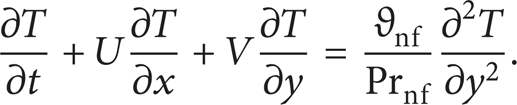
Energy equation:
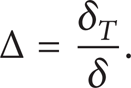
Using the Karman-Pohlhausen integral method [16, 17], physically polynomial profiles of fourth order are assumed for flow velocity and temperature across the corresponding hydrodynamic and thermal boundary layers (see Figure 1). The major advantage in using such a method is that the resulting equations are solved analytically. It has been shown that the ratio Δ between the temperature δ T and the velocity δ layers depends only upon the Prandtl number [18]:

Boundary layer flows in natural convection.
With the correlation (9), the integral forms of the boundary-layer momentum and energy conservation equations become

where Θ = T – T∞.
Solving analytically (10) with physically correct fourth-order polynomial profiles for flow velocity and temperature across their respective hydrodynamic and thermal boundary layers [18, 19] leads to a seventh-order polynomial in terms ofΔ(Pr):

where
In order to assess the influence of the particle volume concentration on a reference heat transfer, let us build the average Nusselt number along the wall in terms of the base-fluid Grashof number:

Thus, the average Nusselt number calculation yields

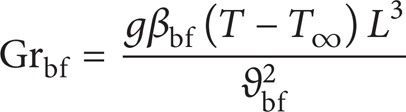
where Grashof number (Grbf) is
for the (UWT) surface condition and

where modified Grashof number (Grbf*) is

for the (UHF) surface condition.
4. Results and Discussions
To ensure Newtonian mixture conditions, the nanoparticle volume fraction is considered in the range 0% (based-fluid only)–4%. Moreover, to ensure laminar flow conditions, this study is made in the range 104 < Gr, Gr* < 108 for UWT and UHF thermal boundary conditions. Figures 2, 3, 4, and 5 present the evolution of the average Nusselt number versus the nanoparticle volume fraction for the two nanofluids and for two thermal boundary conditions. Similar trends are observed, namely, a drastic increase in the Nusselt number when increasing the nanoparticle volume fraction. Moreover, whatever the different cases, increasing the nanoparticle volume fraction leads to an increase in the Nusselt number. Nerveless, this augmentation is strongly dependent on both the nanofluid used and the thermal boundary conditions.

Nusselt number for the UWT surface condition with Cu/water nanofluid.

Nusselt number for the UHF surface condition with Cu/water nanofluid.

Nusselt number for the UWT surface condition with CuO/water nanofluid.

Nusselt number for the UHF surface condition with CuO/water nanofluid.
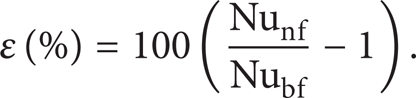
To quantitatively illustrate the way the heat transfer enhancement can occur using the two nanofluids used, let us introduce the convective heat transfer performance parameter which is called ε and defined as
From (17), one may define the parameter

Average heat transfer performance versus the particle volume fraction.
It is worth noting that, in the Newtonian fluid range, the Cu/water nanofluid (Table 1) seems to give the best enhancement whatever the thermal case is. For example, this enhancement reaches about 35% for the UWT case and for ϕ = 4%, while the UHF leads to a 25% enhancement at a same particle volume fraction. On the other hand, a less pronounced enhancement is also observed for the CuO/water nanofluid (Table 2). This enhancement is about 3.5–4.5%, whatever the thermal condition is. Comparing the boundary thermal cases indicates that the UWT case is the best way to enhance heat transfer for the tested nanofluids.
Thermophysical properties of Cu/water nanofluid.

Thermophysical properties of CuO/water nanofluid.

Because in natural convection both heat transfer and mass transfer are inseparable, to get more details on the effect of using nanofluids, dynamical parameters have been analyzed varying the particle volume fraction (ϕ). Not to overload the analysis, only the UHF case is presented here. For this purpose, one may consider nanofluids flowing laminarily over a semi-infinite plate suddenly heated (φ w = 100 W/m2) at x = 0.1 m.
For example, we present in Figures 7, 8, and 9 the velocity profiles (18) and the deduced maximum velocity value and boundary layer thickness (19) in the range 0 ≤ ϕ ≤ 4% as follows:


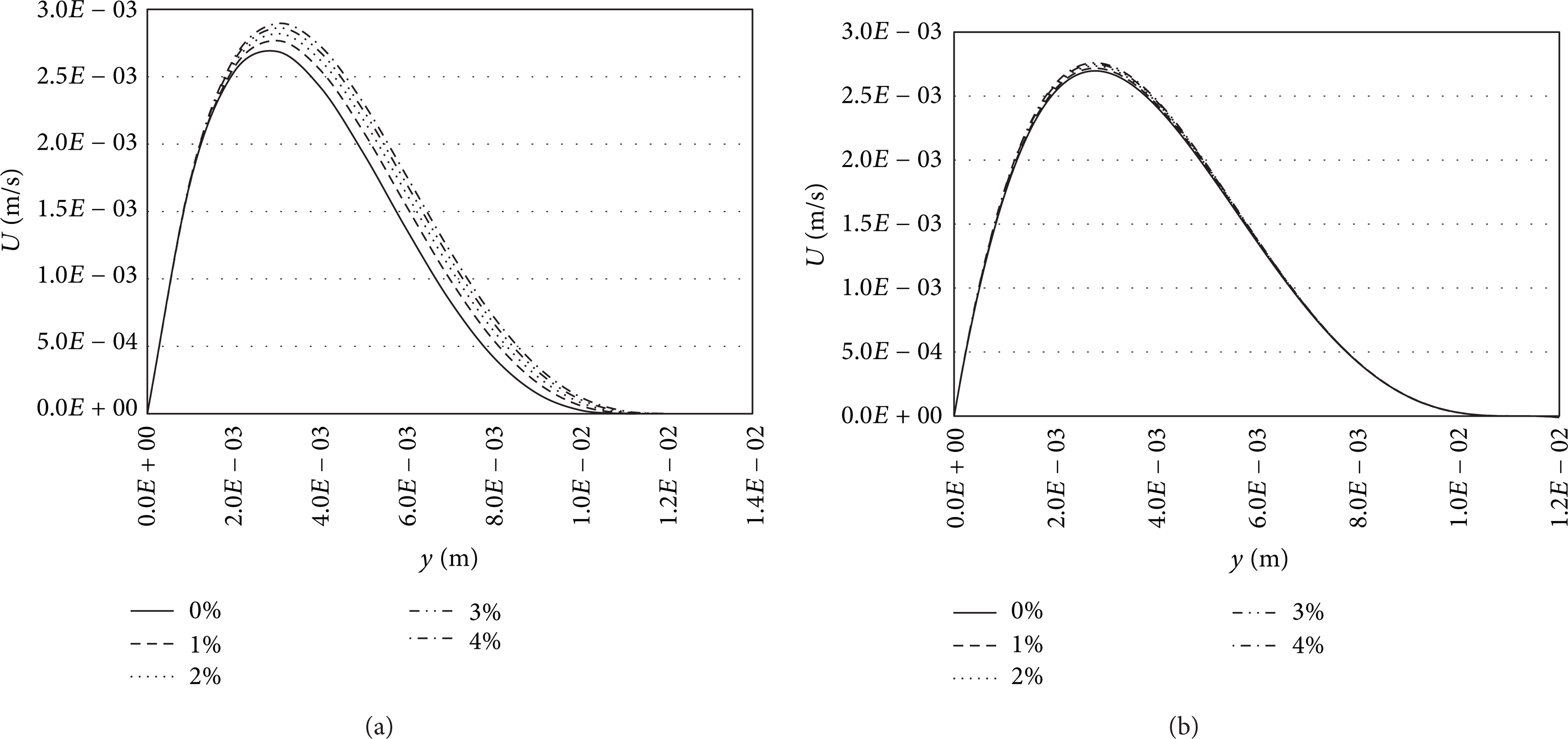
(a) Velocity profiles for the UHF surface condition with Cu/water nanofluid for φ w = 100 W/m2 and x = 0.1 m. (b) Velocity profiles for the UHF surface condition with CuO/water nanofluid for φ w = 100 W/m2 and x = 0.1 m.
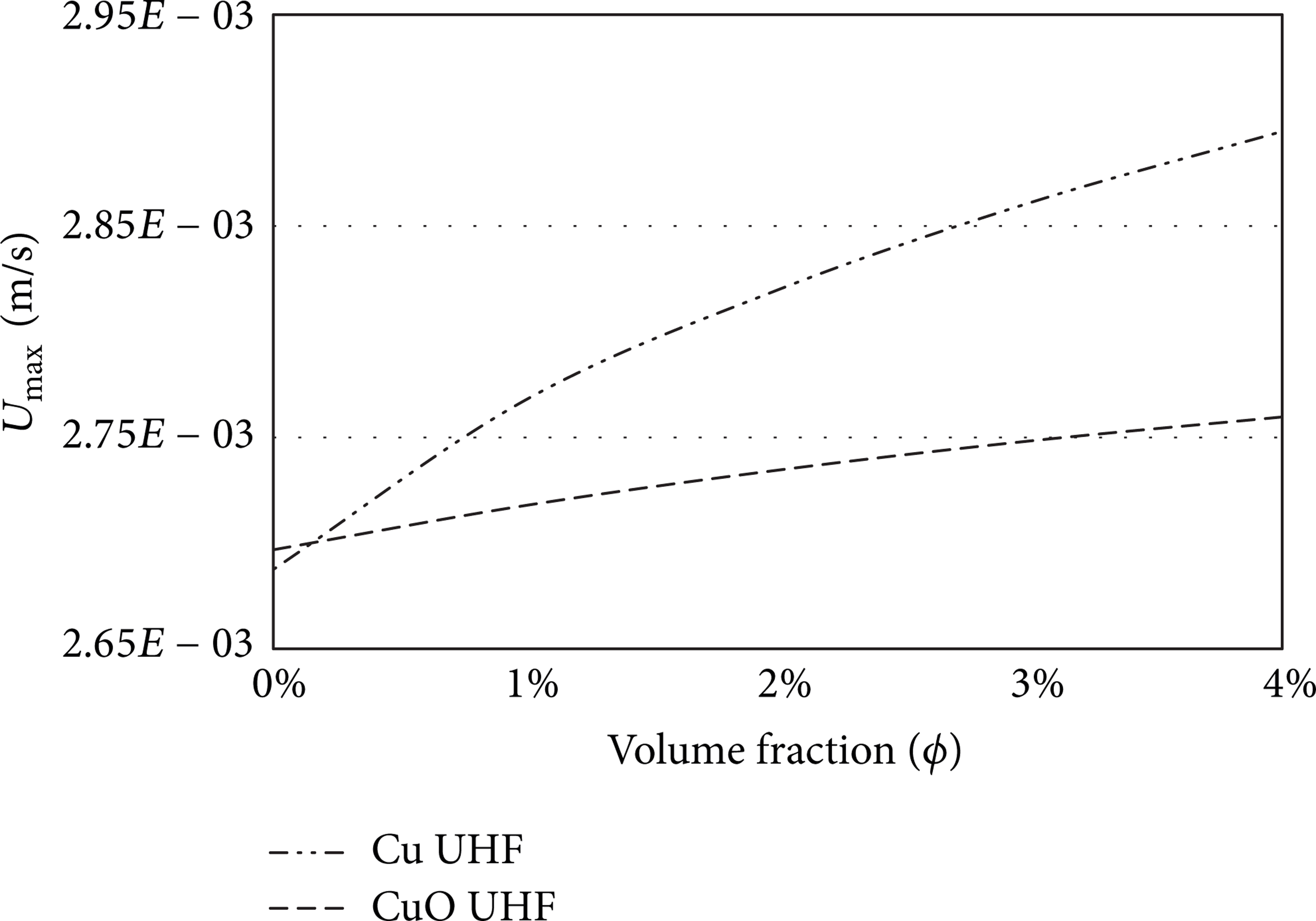
Maximum velocity versus the particle volume fraction for φ w = 100 W/m2 and x = 0.1 m.

Boundary layer thickness versus the particle volume fraction for φ w = 100 W/m2 and x = 0.1 m.
One can observe in Figures 7(a) and 7(b) that strong differences exist between the velocity profiles versus the volume fraction for the two studied nanofluids. Indeed, it seems that the particle volume fraction is not a key parameter in the velocity profile distribution for the CuO/water nanofluid case.
Regarding the maximum velocity values (Figure 8) leads to the conclusion that this maximum increases, increasing the particle volume fraction, whatever the nanofluid is. Nevertheless, excepted for base-fluid (φ = 0%), the maximum velocity for Cu/water nanofluid is always upper than the CuO/water one, to reach a 5% increase.
For the boundary layer thickness presented in Figure 9, the results are more contrasted for the two nanofluids. For example, the δ boundary layer thickness increases for Cu/water nanofluid increasing the particle volume fraction. A contrario, the adverse phenomenon, is noted when the CuO/water nanofluid is considered. Indeed, in such a case, the δ boundary layer thickness decreases increasing the particle volume fraction.
5. Conclusion
The aim of this paper was to investigate the heat transfer enhancement in external laminar natural convection flow using Cu/water and CuO/water nanofluids taking into account nanoparticle Brownian motions. At the contrary of previous studies where viscosity and conductivity models were correlated by usual formulas, it is shown that enhancement of heat transfer is observed, whatever the nanofluids is and whatever initial thermal condition are (UHF or UWT). In particular enhancement reaches about 35% for the UWT case and for ϕ = 4%, while the UHF leads to a 25% enhancement at a same particle volume fraction for the Cu/water nanofluid. On the other hand, a less pronounced enhancement is also observed for the CuO/water nanofluid. This enhancement is about 3.5–4.5%, whatever the thermal condition is. Moreover, comparing the boundary thermal cases indicates that the UWT case is the best way to enhance heat transfer for the tested nanofluids. Details regarding velocity profiles and deduced dynamical parameters such as the maximum velocity value within the dynamical boundary layer and the corresponding boundary layer thickness lead to the conclusion that these parameters are more influenced using the Cu/water nanofluid.