




Abstract
Spectrum sensing in wideband cognitive radio (CR) networks faces several significant practical challenges, such as extremely high sampling rates required for wideband processing, impact of frequency-selective wireless fading and shadowing, and limitation in power and computing resources of single cognitive radio. In this paper, a distributed compressed spectrum sensing scheme is proposed to overcome these challenges. To alleviate the sampling bottleneck, compressed sensing mechanism is used at each CR by utilizing the inherent sparsity of the monitored wideband spectrum. Specifically, partially known support (PKS) of the sparse spectrum is incorporated into local reconstruction procedure, which can further reduce the required sampling rate to achieve a given recovery quality or improve the quality given the same sampling rate. To mitigate the impact of fading and shadowing, multiple CRs exploit spatial diversity by exchanging local support information among them. The fused support information is used to guide local reconstruction at individual CRs. In consideration of limited power per CR, local support information percolates over the network via only one-hop local information exchange. Simulation results testify the effectiveness of the proposed scheme by comparing with several existing schemes in terms of detection performance, communication load, and computational complexity. Moreover, the impact of system parameters is also investigated through simulations.
1. Introduction
Spectrum sensing, whose objectives are detecting signal of licensed users (LUs) and identifying the spectrum holes for dynamic spectrum access (DSA) [1], is an important enabling technology for cognitive radio, a leading choice for efficient utilization of spectrum resource [2–4]. In wideband cognitive radio networks, cognitive radio could attain more spectrum access opportunities in wideband regime. On the other hand, the task of wideband spectrum sensing entails several major challenges, such as very high signal acquisition cost in wideband scenario, uncertain channel fading and random shadowing, and limitation in power and computational capability per CR.
To alleviate the heavy pressure on the conventional analog to digital converter (ADC) technology, compressed sensing (CS) theory [5–7] has been introduced into the application of wideband spectrum sensing by utilizing the low percentage of spectrum occupancy, a fact that motivates dynamic spectrum access [8–10]. CS theory states that sparse signal can be reconstructed from much fewer samples than suggested by the Shannon-Nyquist sampling theorem. However, a single CR may fail to detect hidden terminals or LUs due to shadowing or deep fading. In order to alleviate this problem, cooperative spectrum sensing (CSS) [3, 4] that exploits the built-in spatial diversity among multiple CRs has been proposed for CR networks. In addition, cooperation is especially useful for CS-based approaches since compressed reconstruction is quite susceptible to noise and the performance degrades severely when the signal to noise ratio (SNR) is low. Based on how cooperative CRs share their sensing data in the network, CSS can be classified into two categories: centralized CSS and distributed CSS. In centralized CSS scheme, a fusion center (FC) is required to collect measurements from all CRs and make centralized sensing decisions. Centralized CSS schemes using CS theory are presented in [11, 12]. The performance achieves global optimization; however, the incurred power cost and communication load in transmitting local information to the FC and conveying centralized sensing decisions back to CRs are significantly high. Besides, the network is sensitive to node failure. Unlike centralized CSS, distributed CSS does not rely on a FC for making global decision. In this case, CRs communicate among themselves and converge to a unified decision on the spectrum occupancy by iterations. Distributed scheme reduces the communication workload significantly and is robust to the failure of node and reporting channel. CS-based distributed CSS schemes have been studied in [13, 14]. In [13], each CR makes local decision on spectrum occupancy based on the local reconstruction, and then the global decision, which is the average value of local decisions, is computed in a distributed manner using the consensus averaging technique [15]. This scheme is simple to implement but does not take full advantage of the joint sparsity structure [16, 17] that local spectrum of different CRs shares the same sparsity pattern. In [14], the CR networks iteratively solve the centralized formulation using distributed implementation. Upon convergence, each CR achieves near-optimal performance. However, due to the strict consensus-enforcing constraint, this scheme converges slowly, which makes the communication load and computational complexity very high.
In this paper, a new distributed compressed spectrum sensing scheme, called support fusion-based distributed compressed spectrum sensing (SF-DCSS), is proposed. This approach alternates between local compressed reconstruction at each CR and adaptive learning of support knowledge in distributed manner among all CRs. During each iteration, each CR reconstructs local sparse spectrum through truncated
The remaining part of this paper is organized as follows. The signal model and the spectrum sensing problem of interest are introduced in Section 2. Section 3 presents the details of the proposed scheme of distributed compressed spectrum sensing. Numerical experiments are given to demonstrate the performance of the proposed approach in Section 4 and some conclusions are drawn in Section 5.
2. Signal Modeling and Problem Statement
Consider a licensed communication system operating over a wideband spectrum that is divided into N nonoverlapping narrowband subbands (also known as slots [13, 14]). Suppose that I spatially distributed CRs collaboratively sense the wideband spectrum and the division scheme of the monitored wideband spectrum is known to all CRs, which are ideally synchronized. However, the power spectral density (PSD) of each subband is dynamically varying due to its occupancy status caused by the LUs. Without loss of generality, we assume that the licensed system uses frequency division multiple access (FDMA) technology such that there is at most one active LU on each slot.
Suppose that the Nyquist-rate discrete form of received signal at ith CR is denoted by an

It is shown by many investigations that the radio spectrum is in a very low utilization ratio [1–3]. Therefore, it is reasonable, by using sparse structure, to model the received spectrum of individual CR in a particular time and geographical area, which suggests that
In addition to sparsity at individual CR user, it is worth noting that different CRs share the same nonzero support (known as joint sparsity structure [16, 17]), provided that the channel does not experience deep fades [13], even though the nonzero values may be different at individual CRs. This is due to the fact that all CRs are affected by the same LUs as stated in (1).
Aiming at breaking the sampling bottleneck, CS theory has been introduced into the application of spectrum sensing. The first step in CS-based spectrum sensing is to collect time-domain compressed measurements at individual CR. The mathematical representation of compressed measurements at ith CR can be expressed as follows:

It has been demonstrated theoretically that the problem of recovering sparse
According to the hierarchical access model [1], overlay spectrum sharing protocol is adopted in which CR avoids transmitting at any occupied subbands. In this case, the goal of CS-based CSS scheme is to make a global decision
In consideration of the limitation power per CR, we aim to design a distributed compressed spectrum sensing scheme without using FC in the following section.
3. Distributed Compressed Spectrum Sensing
In CS recovery, the existence of noise or insufficient measurements will result in inexact reconstruction. However, the above-mentioned characteristic of large dynamic range makes it possible to identify the locations of large entries (i.e., incomplete support information) from inexact reconstruction and it may be achieved even without recovering the locations of small entries. In this section, we first study how to exploit this support information of the sparse spectrum to improve the sensing performance. Following the guideline of iterative support detection algorithm [22], we then develop a distributed approach to adaptively obtain reliable support knowledge. Finally, a distributed scheme to wideband spectrum sensing is presented based on these studies.
3.1. Compressed Spectrum Reconstruction with Partially Known Support
In traditional CS, the solution of local reconstruction from local compressed measurements is the one with minimum number of nonzeros among infinite data-consistency candidates [6, 7]. For notational simplicity, we drop the index i in this subsection. The corresponding procedure can be formulated as follows:
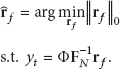
Recently, theoretical analysis and numerical study have demonstrated that incorporating partially known support into the CS reconstruction can effectively reduce the number of measurements required by traditional CS to achieve a given reconstruction quality or improve the quality given the same number of measurements.
Assume that partial support (denoted by S) is known; the candidates for the sparse

In order to decrease computational complexity and improve the robustness, an approximate solution of (4) can be obtained by solving

This problem is referred to as the truncated minimization since the objective function is related to a truncated version of the signal, instead of the entire signal. This formulation encourages a solution with more zeros outside S, and thus it may recover the signal more accurately than traditional CS does for signals whose support includes S. Based on sufficient condition [19, 22, 23] for CS-PKS, the number of measurements required for CS-PKS is less than that required for traditional CS, and the more the support is known, the fewer the measurements needed are. The robustness of truncated minimization in noisy case has been discussed in [20–22].
In practice, the PKS S may not exactly belong to the true support. There may be some false nonzeros (assumed nonzero but actually zero) in S. In this case, we separate PKS S into two parts, true nonzeros
In the application of wideband spectrum sensing, the received signal is inevitably polluted by noise. In this case, a conic constraint is required and (5) should be modified to

3.2. Adaptive Learning of Support Knowledge in a Distributed Manner
Now, let us turn to each of the CR

However, the existence of ambient noise results in sharp increase in the number of false nonzeros in local support information. Too many false nonzeros can severely degrade the recovery performance of truncated minimization. Recognizing the joint sparsity structure that different CRs share the same sparsity pattern, it is an effective approach to obtain reliable support information via cooperative support fusion among multiple CRs. Network-wide, the optimal fused result is the average value
In consideration of limited power per CR, we aim to compute


Using weights stated in (9), (8) can guarantee that

Note that each CR does not have to converge to the average value

Thus, through several local one-hop communications, each CR obtains more reliable support information S. Subsequently, each CR can update its local reconstruction through truncated
3.3. Support Fusion-Based Distributed Compressed Spectrum Sensing
Based on the above studies, we propose a SF-DCSS scheme that adaptively and iteratively learns and uses the support information in CS such that the sensing performance of the CR network can be improved.
During iterations of the proposed SF-DCSS scheme, it is obvious that fused support information S needs to change from one iteration to the next. Otherwise, two iterations will result in identical local reconstructions for all CRs and thus the stagnation of proposed scheme. Therefore, we terminate the iterations when iteration posts no change in the set S or the iterations reach predefined maximum iteration times
When iteration terminates, local decision on spectrum occupancy status

Globally at the network level, the sufficient statistic for optimal decision fusion is the average value

Based on fusion decision
To recap, the complete SF-DCSS scheme is summarized in Algorithm 1.
number ( ( (2a) Each CR obtains local support information (2b) Each CR broadcasts weights in (9), and finally obtains fusion support information ( broadcasts finally makes global decision
3.4. Choice of Thresholds
In the proposed SF-DCSS scheme, there are four thresholds in (7), (11), (12), and (13), respectively. Those thresholds significantly affect the performance of SF-DCSS scheme. In this subsection, we elaborate the choice of thresholds.
Choice of Threshold in (7). Equation (7) is used to obtain local support information at each CR. For each CR i, small
Different strategies on choice of

Choice of Threshold in (11). Thresholds in (11) are used to reduce the false detection caused by ambient noise and obtain reliable fusion support information at each CR. If γ is set to be zero, false detections at different CRs will be accumulated in S. Obviously, larger γ will result in more reliable S, but the cardinality of PKS
Choice of Threshold in (12). Equation (12) is used to make local decision on spectrum occupancy status at individual CR. Large
Choice of Threshold in (13). Equation (13) is used to obtain unified fusion decision at each CR. The choice of
4. Simulations
In this section, simulation results are provided to illustrate performance of the proposed SF-DCSS scheme. First, the simulation setup and relevant performance metrics are described. Then we compare the detection performance of several CS-based cooperative spectrum sensing schemes and investigate their computational complexity and communication workload. Lastly, the impact of system parameters such as SNR, the number of cooperating CRs, and the compression ratio is studied.
4.1. Simulation Step and Performance Metrics
Consider a monitored wideband which is equally partitioned into

Connectivity of CR network with 5 nodes (both ends of each line segment are neighbors and local communications are allowed between them).
The signal to noise ratio (SNR) is defined as the ratio of the average received signal to noise power over the entire wideband spectrum. Suppose that the received signal at each CR is corrupted by additive white Gaussian noise (AWGN) and all CRs have the same received SNR. The compression ratio
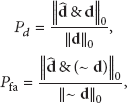
4.2. Performance Comparison among Several CS-CSS Schemes
The proposed SF-DCSS scheme in Algorithm 1 is compared with three benchmark schemes, a centralized fusion scheme, a distributed scheme for decision fusion in [13], and a distributed fusion consensus scheme in [14]. Particularly, the centralized scheme requires a FC to collect local measurements

4.2.1. Detection Performance versus SNR
Figure 2 depicts the detection performance of the four schemes, for desired probability of false alarm

Detection probability versus SNR for
As shown in Figure 2, there is a small gap between detection performance curve of proposed SF-DCSS scheme and that of distributed scheme in [14]. This suggests that proposed scheme can achieve comparable detection performance with the distributed scheme in [14] which has near-optimal performance. This gap is relatively large at low SNR (e.g., −3, 0, 3, and 5 dB), since the ambient noise severely worsens the reliability of fusion support information and consequently degrades recovery performance. As SNR increases, the detection performance improves dramatically. At high SNR, this gap becomes trivial. When
4.2.2. Computational Complexity and Communication Workload
The exploitation of spatial diversity in cooperative sensing results in a significant improvement in detection performance. However, cooperation among CRs may also incur a variety of overheads. This overhead refers to any performance degradation caused by cooperative sensing, such as computational complexity and communication workload. To evaluate communication workload, we introduce the metric of communication step. When all CRs transmit a vector of size
Among the four aforementioned schemes, the centralized scheme apparently has the highest overhead and the distributed scheme in [13] has the lowest. In this subsection, we compare the cooperative overhead (i.e., computational complexity and communication workload) of proposed SF-DCSS scheme with that of the distributed scheme in [14]. Both of them consist of an iterative loop. At each iteration of distributed scheme in [14], one communication step occurs and each CR needs to solve an optimization problem which incurs comparable complexity with traditional compressed reconstruction.
According to the proposed SF-DCSS scheme depicted in Algorithm 1, computational complexity mainly depends on step 1 in recovering local reconstructions at individual CR. Other steps are based on basic arithmetic and logical operations which are omitted here for simplicity. Each CR needs to solve a truncated
Under the same parameter configuration with the above subsection, iterations of SF-DCSS scheme and distributed scheme in [14] for various SNRs are given in Table 1. Each value in the table is obtained by averaging over 400 Monte Carlo trials.
Iterations of proposed scheme and distributed scheme in [14].

Take
When the number of CRs in CR network increases or the degrees of CRs in the network reduce, iterations of the distributed scheme in [14] increase dramatically. In this case, those reductions will become more considerable.
4.3. Performance of Proposed SF-DCSS Scheme
Parameters of CR networks, such as the number of cooperating CRs, the compression ratio, and SNR, significantly affect the performance of SF-DCSS scheme. In this subsection, we investigate the impact of those system parameters.
4.3.1. Performance versus Number of CRs
Cooperation among multiple spatially distributed CRs offers cooperative gain. It is an attractive and effective approach to combat multipath fading and shadowing and mitigate the receiver uncertainty problem. Figure 3 depicts the ROC curves for various number of collaborating CRs I, under the parameter setting:

ROC performance of the proposed SF-DCSS scheme for different numbers of collaborating CRs (SNR = 3 dB,
4.3.2. Performance versus Compression Ratio
In the proposed SF-DCSS scheme, CS is introduced to break the bottleneck of ADC technology in wideband regime, such as sampling rate, fidelity, and power consumption. However, it also incurs performance degradation, especially in the noisy case. Figure 4 depicts the ROC performance for various compression ratios, under the parameter setting:
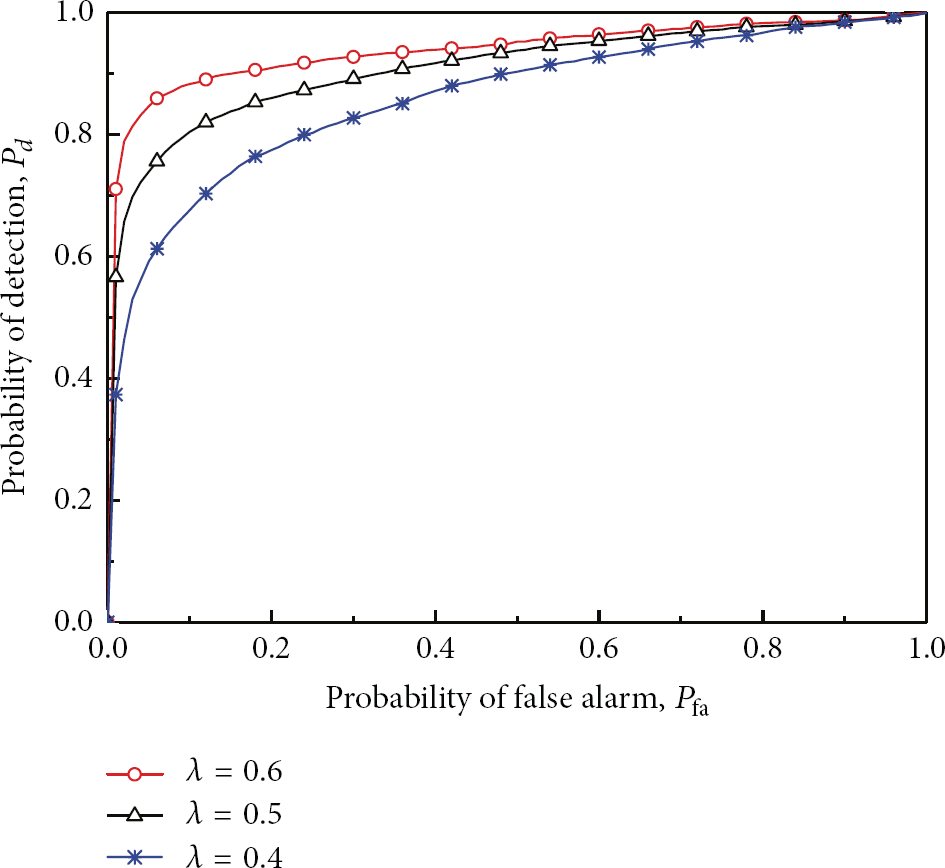
ROC performance of the proposed SF-DCSS scheme for different compression ratios (
4.3.3. Performance versus SNR
As stated above, ambient noise can significantly worsen the reliability of fusion support information and consequently degrade the detection performance. Figure 5 depicts the ROC performance for various SNRs, under the parameter setting:

ROC performance of the proposed SF-DCSS scheme for different SNRs (
5. Conclusions
Recognizing the joint sparsity structure and large dynamic range of sparse spectrum at each CR, this paper has developed a distributed compressed spectrum sensing scheme via cooperative support fusion. The use of compressed sensing effectively reduces the signal acquisition cost and then makes it possible to simultaneously monitor a very wideband spectrum. Using fusion support information to guide local reconstructions is a valid way in exploiting spatial diversity among all CRs, and it can effectively mitigate the impact of fading and shadowing. It also expedites the convergence and lowers the computation and communication load. During spectrum sensing, only one-hop communications are used which significantly reduce the consumed transmission power per CR. Compared with those schemes with optimal or near-optimal detection performance, this proposed scheme significantly reduces the cooperative overhead such as computational complexity and communication workload, at the expense of slight degradation in detection performance. This proposed scheme is suitable for the case of large number of CRs and small degrees of nodes in CR network. In those cases, the cooperative overheads incurred by optimal or near-optimal schemes become extremely high.
Footnotes
Acknowledgment
This work was supported by the National Major Scientific and Technological Special Project (no. 2012ZX03006003-004).